义 务 教 育 教 科 书
英语
(精通)
(三年级起点)
六年级
上册
(中 国)人民教育出版社 课程教材研究所
英语课程教材研究开发中心 编著
(新加坡)泛太平洋教育出版有限公司
·北 京·Copyright © 2013 by People’s Education Press Ltd. and Pan Pacific Educational Press Ltd.
No part of this publication may be reproduced or transmitted in any form or by any means,
without permission in writing from the publisher.
版权共有,未经出版社书面同意,任何人不得以任何形式或方式复制或转换本作品的任何部分。
主 编:郝建平 Chailee Dodds
副主编:李静纯 陈 力
主要编写人员: 郝建平 李静纯 Heather Jones
Chailee Dodds 陈 力
责任编辑:马晓蕾
版式设计:新加坡泛太平洋教育出版有限公司
北京人教聚珍图文技术有限公司
插 图:何安冉(封面) 金葆工作室 Matthew Cole 严 峥
义务教育教科书 英语(三年级起点) 六年级 上册
(义中务 教国育)教人科民书教 育英出语版(社三 年课级程起教点材) 研六究年所级 上册
(中 国)人英民语教课育程出版教社材 研课究程教开材发研中究所心 编著
( 新 加 坡 )英泛太语平课洋程教教育材出研版究有开限发公中司心 编著
(新加坡)泛太平洋教育出版有限公司
出 版
出 版 (北京市海淀区中关 村南大街17号院1号楼 邮编:100081)
网 址 (ht北tp京://w市w海w.p淀ep区.c中om关.cn村南大街17号院1号楼 邮编:100081)
网重 址印 h×tt×p:/×/ww出w版.pe社p.com.cn
发 行 ×××新华书店
印 刷 ×××印刷厂
版 次 2014年3月第1版
印 次 2012年6月第1次印刷
开 本 787毫米×1092毫米 1/16
印 张 6
字 数 120千字
印 数 册
书 号 ISBN 978-7-107-27996-6
定 价 元
审 图 号 GS(2012)2082号
审 图 号 GS(2012)2082号
版权所有·未经许可不得采用任何方式擅自复制或使用本产品任何部分·违者必究
如版发权现所内有容·质未量经问许题可,不请得登采录用中任小何学方教式材擅意自见复反制馈或平使台用:本j产cyj品fk.任pe何p.c部om分.c·n 违者必究
如如发发现现印内、容装质质量量问问题题,,请影登响录阅中读小,学请教与材本意社见联反系馈。平电台话:j:cy4jf0k0.p-e8p1.0c-om57.c8n8
如发现印、装质量问题,影响阅读,请与本社联系。电话:400-810-5788致同学
亲爱的同学们:
你们好!这个学期你们就进入小学的最后一年啦!
新学年,朋友们又见面了,大家都很开心!Li Yan 还结识了新笔友
Lucy!同学们将在更加丰富真实的语言情景中运用已学知识,学习新知
识,在快乐有趣的活动中,学会用英语做更多的事情。
本书六个单元将给大家介绍学校活动、兴趣爱好、生日聚会,月
份、节日和四季等话题。为适应你们不断提升的英语水平,我们准备了
更多的学习材料。每个单元的趣味百科(Fun Facts)知识面更宽、更广
了。歌谣(Let’s chant)部分增加了更多字母组合的说唱内容,帮助同学
们感受英语的声音与节奏。趣味小故事(Fun story)一直陪伴着你们,
Mimi 和 Micky 等着和你们一起开展新活动呢!在每个单元的最后,我们
依然安排了语言知识要点(Language Focus),大家可以用它来检查自己
的学习成果。
本书仍有两个快乐时光(Fun Time),这两个复习单元是温故而
知新的好机会,你们将从中获得合作学习的新体验。在趣味阅读(Fun
Reading)中,你们将会经历获取信息的真实过程。文化桥(Cultural
link)栏目为大家介绍了不同国家午餐饮食的特点和南北半球的圣诞节等
知识。
经过几年的学习,你们一定喜欢上英语了吧!做一个好学、勤学、
善学、乐学的英语学习者并不难,只要你们认真学习,勤于运用,按计
划、循序渐进地学习英语,你们就能够借助英语去了解外面更为广阔的
世界。
为帮助同学们更好地学习,我们还准备了活动手册、录音带、单词
卡片、光盘等辅助学习材料,你们可以根据自己的情况选择使用。
祝同学们在新学期的英语学习中取得更大的进步!
编 者
2013年5月Contents
I go to school at 8:00. 2
Unit 1
Unit 2
What’s your hobby? 14
Would you like to come to my
Unit 3
birthday party? 26
38
Fun Time 1
January is the first month. 44
Unit 4
July is the seventh month. 56
Unit 5
There are four seasons in a year. 68
Unit 6
80
Fun Time 2
86
Words in each unit
89
VocabularyI go to school at 8:00.
Unit 1
Lesson 1
Just read and talk
FFrroomm:: Lucy@mail.com
SSSeeennnddd tttooo::: Liyan@mail.com.cn
SSSuuubbbjjjeeecccttt::: Hello!
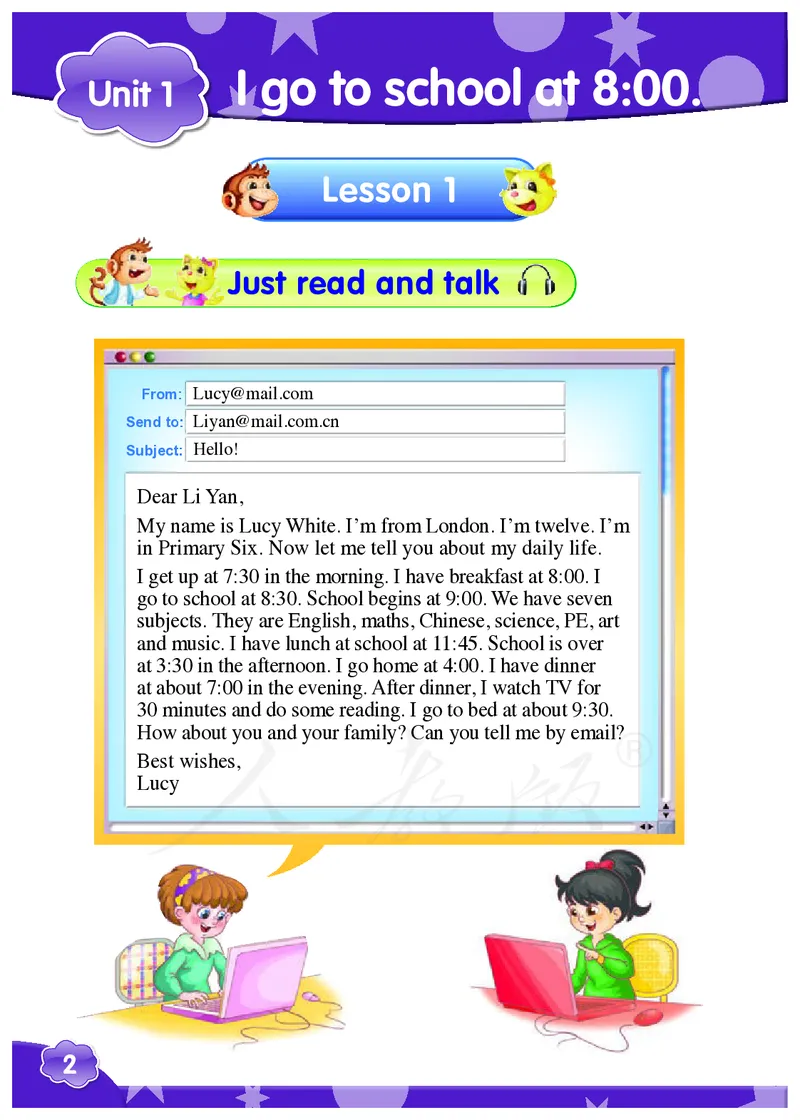
Dear Li Yan,
My name is Lucy White. I’m from London. I’m twelve. I’m
in Primary Six. Now let me tell you about my daily life.
I get up at 7:30 in the morning. I have breakfast at 8:00. I
go to school at 8:30. School begins at 9:00. We have seven
subjects. They are English, maths, Chinese, science, PE, art
and music. I have lunch at school at 11:45. School is over
at 3:30 in the afternoon. I go home at 4:00. I have dinner
at about 7:00 in the evening. After dinner, I watch TV for
30 minutes and do some reading. I go to bed at about 9:30.
How about you and your family? Can you tell me by email?
Best wishes,
Lucy
2Lesson 2
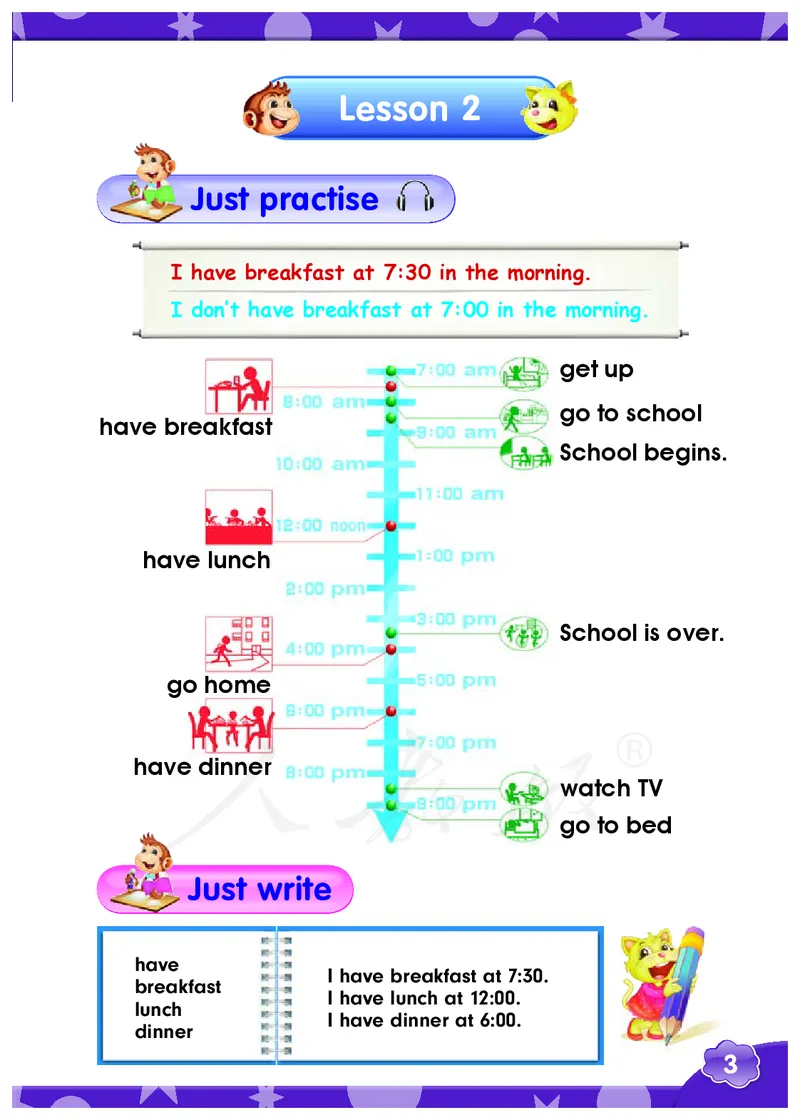
Just practise
I have breakfast at 7:30 in the morning.
I don’t have breakfast at 7:00 in the morning.
get up
go to school
have breakfast
School begins.
have lunch
School is over.
go home
have dinner
watch TV
go to bed
Just write
have
I have breakfast at 7:30.
breakfast
I have lunch at 12:00.
lunch
I have dinner at 6:00.
dinner
3Let’s do a survey
I get up at 7:00 am. I go to school at 8:00 am.
Names
Li Yan
Activities
get up 7:00
have breakfast
go to school
have lunch
go home
do homework
have dinner
watch TV
go to bed
I have dinner at 6:30 pm. I go to bed at 9:30 pm.
Let’s chant
TThhee tteeaacchheerr tteeaacchheess lliisstteenniinngg..
But Jean likes speaking.
The teacher teaches reading.
4 But Jean likes writing.Lesson 3
Just read and talk
FFrroomm:: Liyan@mail.com.cn
SSSeeennnddd tttooo::: Lucy@mail.com
SSSuuubbbjjjeeecccttt::: Thanks for your email!
Dear Lucy,
I’m very happy to get your email. I’m from Beijing, China.
I’m in Grade Six. My mother is an English teacher. Every
morning, she gets up at 6:00. Then she cooks breakfast.
She goes to school at 7:00. She has four lessons a day.
Her students often learn English by singing, chanting and
playing games. They like her lessons very much. She goes
home at about 5:30 in the afternoon, and then she cooks
dinner. After dinner she often takes a walk with my father.
She reads English stories to me. I love my mother and father
very much! Please tell me about your parents, Lucy.
Best wishes,
Li Yan
5Lesson 4
Just practise
She gets up at 6:00 in the morning.
She doesn’t get up at 6:30 in the morning.
cook breakfast
teach English
take a walk
read stories
Just write
walk every morning
afternoon evening
6Let’s talk
Bring a few photos of your family or your friends.
Talk about them in groups.
My brother gets up
at 7:30 am.
Let’s chant
Ted has a headache.
What’s for his breakfast?
Some bread is for Ted.
He wants a cake instead.
7Lesson 5
Just read and talk
Kate: Hi, Peter! Tomorrow is
Saturday. What do you do on
Saturdays?
Peter: I often go and see a film
with my parents. How
about you?
Kate: I usually have piano
lessons.
Peter: Is it diffi cult to play the piano?
Kate: Yes. But Zhou Pei always
helps me.
Peter: Does she play the piano on Saturdays?
Kate: Yes, she practises it at home. But
sometimes she helps her mum to do
the housework.
Peter: Really?
Kate: Sure. We should learn from her!
8Lesson 6
Just practise
What do you do on Saturdays?
I often go and see a fi lm.
What does Kate do on Saturdays?
She usually plays the piano.
ssseeeeee aaa fififi lllmmm ppplllaaayyy ttthhheee pppiiiaaannnooo
c c c clllleeeeaaaannnn tttthhhheeee wwwwiiiinnnnddddoooowwww cccclllleeeeaaaannnn tttthhhheeee ddddoooooooorrrr cccclllleeeeaaaannnn tttthhhheeee flflflfl oooooooorrrr
Just write
often
see a fi lm
clean the window What do you do on Saturdays?
door/fl oor I often go and see a fi lm.
easy
diffi cult
9Let’s act
What do you do
on Sundays?
I often read
stories.
Do you read
stories on
Sundays?
No, I don’t. I often
play the piano.
Let’s chant
I see a sheep,
Sitting on a jeep.
I know the sheep,
Is going to sleep.
10Revision
Fun story
Read and act.
1
Hello, Mimi. I’m 2
Dancing Cat. Hi, Dancing Cat.
Nice to meet you.
Dancing Cat is from London. Every Mimi eats a big lunch at 11:45. Dancing
morning, she starts to dance at 7:30. Cat doesn’t eat lunch.
3
Where is your
new friend?
4
Dancing Cat is still
practising at school.
Mimi takes a walk in the evening. At 6:30, Micky comes to Mimi’s house.
Dancing Cat is still dancing. They watch TV.
7
5 6
No, it isn’t.
Is it diffi cult Yes, it is.
to dance?
9
8
How
Look! Dancing Cat is
beautiful !
dancing very well.
10
Practice makes perfect.
They always see Dancing Cat at the Dancing Cat and Micky dance at the
school. She dances day and night. party. Who is a good dancer? 11Let’s listen and number
A
B
Language Focus
I don’t have breakfast at 7:00 in the morning. I have breakfast at 7:30.
She gets up at 6:00 in the morning. I have lunch at 12:00.
She doesn’t get up at 6:30 in the morning. I have dinner at 6:00.
What does Kate do on Saturdays? What do you do on Saturdays?
She usually plays the piano. I often go and see a film.
get up go to school have breakfast lunch
School begins. School is over. dinner walk every
go home go to bed cook breakfast morning afternoon
teach English take a walk evening
read stories play the piano often see a film
clean the window/door/floor
easy difficult
12 SkillS: listen Speak Read WriteFun Facts
Reading
for
knowledge
Do you usually have lunch in school?
Children in New Zealand bring their own lunch to school. Th ey have small lunch
boxes. Ben is in a primary school in New Zealand. Let’s look inside his lunch box. It is
quite interesting. Th ere is no hot
food.
a cereal bar
Children in China have their
a sandwich
lunch in school or at home. Th ey
usually have rice, vegetables, some
pork or chicken in their school
popcorn
lunch.
Children in England also have
lunch in school. But some English
children bring their own lunch
a cup of an apple
boxes, too. Children in Australia
yogurt
usually bring lunch boxes to
Would you like this food for lunch?
school. Th ey often eat their lunch
outside the classroom.
Thinking tasks
Look
Them Up
➊ •
usually
What do children in New Zealand
•
inside
I don’t have breakfast at 7:00 in the morning. I have breakfast at 7:30.
She gets up at 6:00 in the morning. I have lunch at 12:00.
➋ often have for lunch?
•
outside
What do children in China usually
She doesn’t get up at 6:30 in the morning. I have dinner at 6:00.
...
➌ have for their school lunch?
What does Kate do on Saturdays? What do you do on Saturdays?
What do you usually have for lunch?
She usually plays the piano. I often go and see a fi lm.
➍ Where do you have it?
get up go to school have breakfast lunch Look at the pictures below. Th ese children are having their lunch. Where do they
School begins. School is over. dinner walk every come from? Australia, China or England?
go home watch TV morning afternoon
go to bed cook breakfast evening
teach English take a walk often see a fi lm
read stories play the piano clean the window/door/fl oor
easy diffi cult
1) 2) 3)
SKILLS: Listen Speak Read Write 13What’s your hobby?
Unit 2
Lesson 7
Just read and talk
Bob: Hi, Peter. I have a new toy car.
Peter: Can I have a look, please?
Bob: Sure! Open the box and see.
Peter: Wow! What a super car! Do you like toy cars?
Bob: Yes. I like collecting them. What’s your hobby, Peter?
Peter: My hobby is collecting stamps.
Bob: How about you, Kate and Li Yan?
Kate: My hobby is collecting maps.
Li Yan: I like collecting picture cards. Look!
Bob & Peter: Oh! They’re so colourful and beautiful!
14Lesson 8
Just practise
What’s your hobby?
My hobby is collecting maps.
collect toy cars collect stamps
collect maps collect picture cards
Just write
open
hobby
collect What’s your hobby?
map My hobby is collecting maps.
box
colour
15Let’s talk
What’s your hobby?
My hobby is collecting stamps.
What’s your hobby?
My hobby is reading.
Let’s chant
TTTThhhheeeerrrreeee’’’’ssss aaaa sssswwwwiiiimmmmmmmmiiiinnnngggg ppppoooooooollll,,,,
In my primary school.
I like swimming in the pool.
I think swimming is cool.
16Lesson 9
Just read and talk
Jim: Hi, Gao Wei! Do you want to look at my family photos?
Gao Wei: Sure! Wow! What’s he doing?
Jim: My grandpa is fishing.
Gao Wei: Is that his hobby?
Jim: Yes. What’s your
grandpa’s hobby?
Gao Wei: His hobby is planting
fl owers.
Jim: Look here at my grandma.
Her hobby is drinking
Chinese tea.
Gao Wei: That’s great! What’s your
dad’s hobby?
Jim: Look at this photo! His
hobby is cooking.
Gao Wei: That’s interesting!
And what’s your
mum’s hobby?
Jim: Her hobby is singing.
In this photo, she’s
singing at her
birthday party.
Gao Wei: That’s wonderful!
17Lesson 10
Just practise
What’s your dad’s hobby?
His hobby is planting fl owers.
What’s your grandpa’s hobby?
His hobby is fi shing.
go fi shing
plant fl owers cook meals
Just write
dad
mum What’s your dad’s hobby?
plant fl ower His hobby is planting fl owers.
drink tea
18Let’s do a survey
Name Date
His hobby
People Hobbies
is reading.
grandpa
grandma
father
My father’s
mother hobby is
cooking.
uncle
aunt
What’s your
father’s brother
My father’s
hobby?
hobby is
sister
fi shing.
teacher
friend
you
Let’s chant
CCCCooooooookkkk sssshhhhoooowwwwssss mmmmeeee aaaa ggggoooooooodddd bbbbooooooookkkk....
The book is about a good cook.
His hobby is collecting books.
Look! Look! Have a look.
19Lesson 11
Just read and talk
Yang Ming: What are you doing, Zhou Pei?
Zhou Pei: I’m making a doll. I’m
interested in making dolls.
How about you?
Yang Ming: I’m interested in playing
computer games. What are
you interested in, Lisa?
Lisa: I’m interested in
taking photos.
Yang Ming: Really?
Lisa: Yes. I have two photos
here. Look at this one!
Yang Ming: How cute! The kid is
feeding the baby.
Lisa: Yes, the baby is hungry.
He’s crying.
Lisa: And now look at this
photo. The baby is
smiling.
Yang Ming: What a super kid! She
takes good care of the
baby.
20Lesson 12
Just practise
What are you interested in?
I’m interested in taking photos.
play computer games make dolls take photos
Just write
take photo
kid baby
hungry cry
21Let’s interview
1. What’s your hobby? 4. How about your father?
2. Are you interested 5. What’s your mother’s
in taking photos? hobby?
3. Are you interested in 6. Is she/he interested in
cooking? singing/dancing …?
Name Date
Are you
interested in
People Hobbies/Interests
What’s your
making dolls? father’s hobby?
No, I’m interested in playing
computer games. His hobby is
taking photos.
Let’s chant
IIII sssseeeeeeee aaaa ssssmmmmaaaallllllll ggggooooaaaatttt,,,,
On a fl oating boat.
I see Old Noah,
Wearing a thick coat.
22Revision
Fun story
Read and act.
The animals are talking about their Mimi says, “My hobby is fishing.” But
hobbies. Micky says, “I don’t like fishing.”
The elephant says, “My hobby is The bird says, “My hobby is singing.”
playing basketball.” But Micky says, But Micky says, “
“ .” .”
The rabbit says, “My hobby is cooking.” The animals ask Micky, “
But Micky says, “ ?”
.” 23Let’s listen and number
LLLaaannnggguuuaaagggeee FFFooocccuuusss
What’s your grandpa’s hobby? What’s your hobby?
His hobby is fi shing. My hobby is collecting maps.
What are you interested in? What’s your dad’s hobby?
I’m interested in taking photos. His hobby is planting fl owers.
collect toy cars collect stamps open hobby collect map
collect picture cards go fi shing box colour dad
cook meals mum plant fl ower
play computer games make dolls drink tea take photo kid
baby hungry cry
SSSKKKIIILLLLLLSSS::: LLLiiisssttteeennn SSSpppeeeaaakkk RRReeeaaaddd WWWrrriiittteee
24Fun Facts
Reading
for
knowledge
Mr Kent is a science teacher. His hobby is bird-watching.
Mr Kent wants people to care more about birds.
In a science lesson, Mr Kent takes his class to a big field.
Birds are looking for food.
He asks his students, “What will birds eat in winter? Can
birds find food to eat?”
Many birds fl y to another place in winter. Chinese cranes
will fl y from
Heilongjiang to
JJiiaannggssuu eevveerryy wwiinntteerr..
Th ey fl y together in
small groups. Th ey often fl y at night.
Mr Kent’s students are very interested in birds.
In winter, his students give birds seeds to eat.
Th ey like bird-watching.
Look
Them Up
• care
•
crane
Thinking tasks
•
another
...
What’s your grandpa’s hobby? What’s your hobby?
His hobby is fi shing. My hobby is collecting maps.
What are you interested in? What’s your dad’s hobby?
I’m interested in taking photos. His hobby is planting fl owers.
collect toy cars collect stamps open hobby collect map
collect picture cards go fi shing box colour dad
Th ere are only a few red- We do not often see this We can see this bird in
cook meals mum plant fl ower
crowned cranes left in the beautiful bird. many parks.
play computer games make dolls drink tea take photo kid
world.
baby hungry cry
➊
What is Mr Kent’s hobby?
SKILLS: Listen Speak Read Write ➋
What does Mr Kent want to do?
➌
Look at the birds above. Are they all Chinese birds?
25Would you like to come to
Unit 3 my birthday party?
Lesson 13
Just read and talk
Lisa: Hi, Kate, Gao Wei and Peter.
Tomorrow is my birthday.
Would you like to come to my
birthday party?
Peter: Sure. I’d love to.
Lisa: What about you, Gao Wei?
Gao Wei: What time does your party
begin?
Lisa: It begins at about 5:30 after
school.
Gao Wei: That’s good! I can come then.
Kate: Me, too. We can all celebrate
your birthday!
Lisa: Thanks! Here are my
invitation cards for all of you.
Peter, Kate
Thanks! Goodbye! See you tomorrow!
& Gao Wei:
Lisa: Bye-bye!
26Lesson 14
Just practise
Would you like to come to my birthday party?
Sure. I’d love to.
invite your friends celebrate your birthday give a birthday card
to your party with your friends to your friend
Just write
time
Would you like to come to my
after
birthday party?
then
Sure. I’d love to.
me
Goodbye!/Bye-bye!/Bye!
bye
27Let’s make and act
Make an invitation card. Then give it to a friend. Don’t forget
to write your friend’s name, and sign your name, too.
11
222
Please come to my party.
333
Here’s a card for you!
Thank you!
Let’s chant
I like bows, you know.
I have a bow to show.
I hold the bow high and low.
To shoot a yellow arrow.
28Lesson 15
Just read and talk
Mum: What kind of cake would you
like, Lisa?
Lisa: I’d like a chocolate cake.
Mum: What shape would you like?
How about this star-shaped
cake?
Lisa: Well, Mum. I really like that
heart-shaped cake.
Mum: That’s wonderful! It can show
our love for you.
Lisa: Thank you, Mum! It can also
show my love for you and Dad.
Mum: Good girl!
Lisa: Mum, can I have some
ice cream and some
jelly, please?
Mum: Sure. And I’ll get
some candy and
fruit pies for
you, too.
Lisa: Thanks, Mum!
I’ll have a great
birthday party.
29Lesson 16
Just practise
What kind of cake would you like?
I’d like a heart-shaped cake.
Can I have some ice cream?
Sure.
star-shaped cake heart-shaped cake
jelly fruit pie
Just write
kind
Can I have some ice cream?
ice cream
Sure.
candy
30Let‛s act
What kind of
cake would
I’d like a heart-
you like?
shaped cake.
Can I help you?
Yes, we’d like
some ice cream
and apple pies.
Let‛s chant
How is Howe?
Howe is powerful.
How are Howe’s cows?
The cows are wonderful.
31Lesson 17
Just read and talk
Kate, Gao Wei
& Peter: Happy birthday, Lisa!
Lisa: Thank you! Welcome
to my birthday party.
Kate: Here’s a teddy bear for
you!
Gao Wei: I have a new storybook
for you!
Peter: Look! Here are some
chocolates for you!
Lisa: Thank you very much!
Mum: Shall we begin the party?
All: Yeah!
Mum: Let’s light the candles and sing
the birthday song.
All: OK!
All: Make a wish and blow
out the candles, Lisa.
Lisa: All right. Let me make
a wish!
All: And now cut the cake,
Lisa!
Lisa: OK. Have a piece of
cake, please!
32 All: Thank you!Lesson 18
Just practise
Here’s a birthday cake for you.
How do they celebrate the birthday?
First, they light the candles and then ...
light the candles sing the birthday song make a wish
blow out the candles cut the cake eat the cake
Just write
light Here is a birthday cake for you.
33Let’s act and sing
I want to have
Let’s light the candles. a computer.
Let me blow out the candles. Here you are.
Thanks.
HHHHHHHHHHHHHHHHHHHHHHHHHHHHHHHHHHHHHHHHHHHHHHHHHHHHHHHHHHHHHHHHHHHHHHHHHHHHHHHHHHHHHHHHHHHHHHHHHHHHHHHHHHHHHHHHHHHHHHHHHHHHHHHHHHHHHHHHHHHHHHHHHHHHHHHHHHHHHHHHHHHHHHHHHHHHHHHHHHHHHHHHHHaaaaaaaaaaaaaaaaaaaaaaaaaaaaaaaaaaaaaaaaaaaaaaaaaaaaaaaaaaaaaaaaaaaaaaaaaaaaaaaaaaaaaaaaaaaaaaaaaaaaaaaaaaaaaaaaaaaaaaaaaaaaaaaaaaaaaaaaaaaaaaaaaaaaaaaaaaaaaaaaaaaaaaaaaaaaaaaaaaaaaaaaaappppppppppppppppppppppppppppppppppppppppppppppppppppppppppppppppppppppppppppppppppppppppppppppppppppppppppppppppppppppppppppppppppppppppppppppppppppppppppppppppppppppppppppppppppppppppppppppppppppppppppppppppppppppppppppppppppppppppppppppppppppppppppppppppppppppppppppppppppppppppppppppppppppppppppppppppppppppppppppppppppppppppppppppppppppppppppppppppppppppppppppppppppppyyyyyyyyyyyyyyyyyyyyyyyyyyyyyyyyyyyyyyyyyyyyyyyyyyyyyyyyyyyyyyyyyyyyyyyyyyyyyyyyyyyyyyyyyyyyyyyyyyyyyyyyyyyyyyyyyyyyyyyyyyyyyyyyyyyyyyyyyyyyyyyyyyyyyyyyyyyyyyyyyyyyyyyyyyyyyyyyyyyyyyyyyy bbbbbbbbbbbbbbbbbbbbbbbbbbbbbbbbbbbbbbbbbbbbbbbbbbbbbbbbbbbbbbbbbbbbbbbbbbbbbbbbbbbbbbbbbbbbbbbbbbbbbbbbbbbbbbbbbbbbbbbbbbbbbbbbbbbbbbbbbbbbbbbbbbbbbbbbbbbbbbbbbbbbbbbbbbbbbbbbbbbbbbbbbbiiiiiiiiiiiiiiiiiiiiiiiiiiiiiiiiiiiiiiiiiiiiiiiiiiiiiiiiiiiiiiiiiiiiiiiiiiiiiiiiiiiiiiiiiiiiiiiiiiiiiiiiiiiiiiiiiiiiiiiiiiiiiiiiiiiiiiiiiiiiiiiiiiiiiiiiiiiiiiiiiiiiiiiiiiiiiiiiiiiiiiiiiirrrrrrrrrrrrrrrrrrrrrrrrrrrrrrrrrrrrrrrrrrrrrrrrrrrrrrrrrrrrrrrrrrrrrrrrrrrrrrrrrrrrrrrrrrrrrrrrrrrrrrrrrrrrrrrrrrrrrrrrrrrrrrrrrrrrrrrrrrrrrrrrrrrrrrrrrrrrrrrrrrrrrrrrrrrrrrrrrrrrrrrrrrtttttttttttttttttttttttttttttttttttttttttttttttttttttttttttttttttttttttttttttttttttttttttttttttttttttttttttttttttttttttttttttttttttttttttttttttttttttttttttttttttttttttttttttttttttttttttthhhhhhhhhhhhhhhhhhhhhhhhhhhhhhhhhhhhhhhhhhhhhhhhhhhhhhhhhhhhhhhhhhhhhhhhhhhhhhhhhhhhhhhhhhhhhhhhhhhhhhhhhhhhhhhhhhhhhhhhhhhhhhhhhhhhhhhhhhhhhhhhhhhhhhhhhhhhhhhhhhhhhhhhhhhhhhhhhhhhhhhhhhddddddddddddddddddddddddddddddddddddddddddddddddddddddddddddddddddddddddddddddddddddddddddddddddddddddddddddddddddddddddddddddddddddddddddddddddddddddddddddddddddddddddddddddddddddddddddaaaaaaaaaaaaaaaaaaaaaaaaaaaaaaaaaaaaaaaaaaaaaaaaaaaaaaaaaaaaaaaaaaaaaaaaaaaaaaaaaaaaaaaaaaaaaaaaaaaaaaaaaaaaaaaaaaaaaaaaaaaaaaaaaaaaaaaaaaaaaaaaaaaaaaaaaaaaaaaaaaaaaaaaaaaaaaaaaaaaaaaaaayyyyyyyyyyyyyyyyyyyyyyyyyyyyyyyyyyyyyyyyyyyyyyyyyyyyyyyyyyyyyyyyyyyyyyyyyyyyyyyyyyyyyyyyyyyyyyyyyyyyyyyyyyyyyyyyyyyyyyyyyyyyyyyyyyyyyyyyyyyyyyyyyyyyyyyyyyyyyyyyyyyyyyyyyyyyyyyyyyyyyyyyyy ttttttttttttttttttttttttttttttttttttttttttttttttttttttttttttttttttttttttttttttttttttttttttttttttttttttttttttttttttttttttttttttttttttttttttttttttttttttttttttttttttttttttttttttttttttttttttoooooooooooooooooooooooooooooooooooooooooooooooooooooooooooooooooooooooooooooooooooooooooooooooooooooooooooooooooooooooooooooooooooooooooooooooooooooooooooooooooooooooooooooooooooooooooo yyyyyyyyyyyyyyyyyyyyyyyyyyyyyyyyyyyyyyyyyyyyyyyyyyyyyyyyyyyyyyyyyyyyyyyyyyyyyyyyyyyyyyyyyyyyyyyyyyyyyyyyyyyyyyyyyyyyyyyyyyyyyyyyyyyyyyyyyyyyyyyyyyyyyyyyyyyyyyyyyyyyyyyyyyyyyyyyyyyyyyyyyyoooooooooooooooooooooooooooooooooooooooooooooooooooooooooooooooooooooooooooooooooooooooooooooooooooooooooooooooooooooooooooooooooooooooooooooooooooooooooooooooooooooooooooooooooooooooooouuuuuuuuuuuuuuuuuuuuuuuuuuuuuuuuuuuuuuuuuuuuuuuuuuuuuuuuuuuuuuuuuuuuuuuuuuuuuuuuuuuuuuuuuuuuuuuuuuuuuuuuuuuuuuuuuuuuuuuuuuuuuuuuuuuuuuuuuuuuuuuuuuuuuuuuuuuuuuuuuuuuuuuuuuuuuuuuuuuuuuuuuu..........................................................................................................................................................................................
HHHHHHHHHHHHHHHHHHHHHHHHHHHHHHHHHHHHHHHHHHHHHHHHHHHHHHHHHHHHHHHHHHHHHHHHHHHHHHHHHHHHHHHHHHHHHHHHHHHHHHHHHHHHHHHHHHHHHHHHHHHHHHHHHHHHHHHHHHHHHHHHHHHHHHHHHHHHHHHHHHHHHHHHHHHHHHHHHHHHHHHHHHHHHHHHHHHaaaaaaaaaaaaaaaaaaaaaaaaaaaaaaaaaaaaaaaaaaaaaaaaaaaaaaaaaaaaaaaaaaaaaaaaaaaaaaaaaaaaaaaaaaaaaaaaaaaaaaaaaaaaaaaaaaaaaaaaaaaaaaaaaaaaaaaaaaaaaaaaaaaaaaaaaaaaaaaaaaaaaaaaaaaaaaaaaaaaaaaaaaaaaaaaaaappppppppppppppppppppppppppppppppppppppppppppppppppppppppppppppppppppppppppppppppppppppppppppppppppppppppppppppppppppppppppppppppppppppppppppppppppppppppppppppppppppppppppppppppppppppppppppppppppppppppppppppppppppppppppppppppppppppppppppppppppppppppppppppppppppppppppppppppppppppppppppppppppppppppppppppppppppppppppppppppppppppppppppppppppppppppppppppppppppppppppppppppppppppppppppppppppppppyyyyyyyyyyyyyyyyyyyyyyyyyyyyyyyyyyyyyyyyyyyyyyyyyyyyyyyyyyyyyyyyyyyyyyyyyyyyyyyyyyyyyyyyyyyyyyyyyyyyyyyyyyyyyyyyyyyyyyyyyyyyyyyyyyyyyyyyyyyyyyyyyyyyyyyyyyyyyyyyyyyyyyyyyyyyyyyyyyyyyyyyyyyyyyyyyyy bbbbbbbbbbbbbbbbbbbbbbbbbbbbbbbbbbbbbbbbbbbbbbbbbbbbbbbbbbbbbbbbbbbbbbbbbbbbbbbbbbbbbbbbbbbbbbbbbbbbbbbbbbbbbbbbbbbbbbbbbbbbbbbbbbbbbbbbbbbbbbbbbbbbbbbbbbbbbbbbbbbbbbbbbbbbbbbbbbbbbbbbbbbbbbbbbbbiiiiiiiiiiiiiiiiiiiiiiiiiiiiiiiiiiiiiiiiiiiiiiiiiiiiiiiiiiiiiiiiiiiiiiiiiiiiiiiiiiiiiiiiiiiiiiiiiiiiiiiiiiiiiiiiiiiiiiiiiiiiiiiiiiiiiiiiiiiiiiiiiiiiiiiiiiiiiiiiiiiiiiiiiiiiiiiiiiiiiiiiiiiiiiiiiiirrrrrrrrrrrrrrrrrrrrrrrrrrrrrrrrrrrrrrrrrrrrrrrrrrrrrrrrrrrrrrrrrrrrrrrrrrrrrrrrrrrrrrrrrrrrrrrrrrrrrrrrrrrrrrrrrrrrrrrrrrrrrrrrrrrrrrrrrrrrrrrrrrrrrrrrrrrrrrrrrrrrrrrrrrrrrrrrrrrrrrrrrrrrrrrrrrrttttttttttttttttttttttttttttttttttttttttttttttttttttttttttttttttttttttttttttttttttttttttttttttttttttttttttttttttttttttttttttttttttttttttttttttttttttttttttttttttttttttttttttttttttttttttttttttttttthhhhhhhhhhhhhhhhhhhhhhhhhhhhhhhhhhhhhhhhhhhhhhhhhhhhhhhhhhhhhhhhhhhhhhhhhhhhhhhhhhhhhhhhhhhhhhhhhhhhhhhhhhhhhhhhhhhhhhhhhhhhhhhhhhhhhhhhhhhhhhhhhhhhhhhhhhhhhhhhhhhhhhhhhhhhhhhhhhhhhhhhhhhhhhhhhhhdddddddddddddddddddddddddddddddddddddddddddddddddddddddddddddddddddddddddddddddddddddddddddddddddddddddddddddddddddddddddddddddddddddddddddddddddddddddddddddddddddddddddddddddddddddddddddddddddddaaaaaaaaaaaaaaaaaaaaaaaaaaaaaaaaaaaaaaaaaaaaaaaaaaaaaaaaaaaaaaaaaaaaaaaaaaaaaaaaaaaaaaaaaaaaaaaaaaaaaaaaaaaaaaaaaaaaaaaaaaaaaaaaaaaaaaaaaaaaaaaaaaaaaaaaaaaaaaaaaaaaaaaaaaaaaaaaaaaaaaaaaaaaaaaaaaayyyyyyyyyyyyyyyyyyyyyyyyyyyyyyyyyyyyyyyyyyyyyyyyyyyyyyyyyyyyyyyyyyyyyyyyyyyyyyyyyyyyyyyyyyyyyyyyyyyyyyyyyyyyyyyyyyyyyyyyyyyyyyyyyyyyyyyyyyyyyyyyyyyyyyyyyyyyyyyyyyyyyyyyyyyyyyyyyyyyyyyyyyyyyyyyyyy tttttttttttttttttttttttttttttttttttttttttttttttttttttttttttttttttttttttttttttttttttttttttttttttttttttttttttttttttttttttttttttttttttttttttttttttttttttttttttttttttttttttttttttttttttttttttttttttttttooooooooooooooooooooooooooooooooooooooooooooooooooooooooooooooooooooooooooooooooooooooooooooooooooooooooooooooooooooooooooooooooooooooooooooooooooooooooooooooooooooooooooooooooooooooooooooooooooo yyyyyyyyyyyyyyyyyyyyyyyyyyyyyyyyyyyyyyyyyyyyyyyyyyyyyyyyyyyyyyyyyyyyyyyyyyyyyyyyyyyyyyyyyyyyyyyyyyyyyyyyyyyyyyyyyyyyyyyyyyyyyyyyyyyyyyyyyyyyyyyyyyyyyyyyyyyyyyyyyyyyyyyyyyyyyyyyyyyyyyyyyyyyyyyyyyyooooooooooooooooooooooooooooooooooooooooooooooooooooooooooooooooooooooooooooooooooooooooooooooooooooooooooooooooooooooooooooooooooooooooooooooooooooooooooooooooooooooooooooooooooooooooooooooooooouuuuuuuuuuuuuuuuuuuuuuuuuuuuuuuuuuuuuuuuuuuuuuuuuuuuuuuuuuuuuuuuuuuuuuuuuuuuuuuuuuuuuuuuuuuuuuuuuuuuuuuuuuuuuuuuuuuuuuuuuuuuuuuuuuuuuuuuuuuuuuuuuuuuuuuuuuuuuuuuuuuuuuuuuuuuuuuuuuuuuuuuuuuuuuuuuuu...................................................................................................................................................................................................
HHHHHHHHHHHHHHHHHHHHHHHHHHHHHHHHHHHHHHHHHHHHHHHHHHHHHHHHHHHHHHHHHHHHHHHHHHHHHHHHHHHHHHHHHHHHHHHHHHHHHHHHHHHHHHHHHHHHHHHHHHHHHHHHHHHHHHHHHHHHHHHHHHHHHHHHHHHHHHHHHHHHHHHHHHHHHHHHHHHHHHHHHHHHHHHHHHHHHHHHHHHHHHHHHHHHHHHHHHHHHHHHHHHHHHHHHHHHHHHHHHHHHHHHHaaaaaaaaaaaaaaaaaaaaaaaaaaaaaaaaaaaaaaaaaaaaaaaaaaaaaaaaaaaaaaaaaaaaaaaaaaaaaaaaaaaaaaaaaaaaaaaaaaaaaaaaaaaaaaaaaaaaaaaaaaaaaaaaaaaaaaaaaaaaaaaaaaaaaaaaaaaaaaaaaaaaaaaaaaaaaaaaaaaaaaaaaaaaaaaaaaaaaaaaaaaaaaaaaaaaaaaaaaaaaaaaaaaaaaaaaaaaaaaaaaaaaaaaappppppppppppppppppppppppppppppppppppppppppppppppppppppppppppppppppppppppppppppppppppppppppppppppppppppppppppppppppppppppppppppppppppppppppppppppppppppppppppppppppppppppppppppppppppppppppppppppppppppppppppppppppppppppppppppppppppppppppppppppppppppppppppppppppppppppppppppppppppppppppppppppppppppppppppppppppppppppppppppppppppppppppppppppppppppppppppppppppppppppppppppppppppppppppppppppppppppppppppppppppppppppppppppppppppppppppppppppppppppppppppppppppppppppppppppppppppppppppppppppppppppppppppppppppyyyyyyyyyyyyyyyyyyyyyyyyyyyyyyyyyyyyyyyyyyyyyyyyyyyyyyyyyyyyyyyyyyyyyyyyyyyyyyyyyyyyyyyyyyyyyyyyyyyyyyyyyyyyyyyyyyyyyyyyyyyyyyyyyyyyyyyyyyyyyyyyyyyyyyyyyyyyyyyyyyyyyyyyyyyyyyyyyyyyyyyyyyyyyyyyyyyyyyyyyyyyyyyyyyyyyyyyyyyyyyyyyyyyyyyyyyyyyyyyyyyyyyyyy bbbbbbbbbbbbbbbbbbbbbbbbbbbbbbbbbbbbbbbbbbbbbbbbbbbbbbbbbbbbbbbbbbbbbbbbbbbbbbbbbbbbbbbbbbbbbbbbbbbbbbbbbbbbbbbbbbbbbbbbbbbbbbbbbbbbbbbbbbbbbbbbbbbbbbbbbbbbbbbbbbbbbbbbbbbbbbbbbbbbbbbbbbbbbbbbbbbbbbbbbbbbbbbbbbbbbbbbbbbbbbbbbbbbbbbbbbbbbbbbbbbbbbbbbiiiiiiiiiiiiiiiiiiiiiiiiiiiiiiiiiiiiiiiiiiiiiiiiiiiiiiiiiiiiiiiiiiiiiiiiiiiiiiiiiiiiiiiiiiiiiiiiiiiiiiiiiiiiiiiiiiiiiiiiiiiiiiiiiiiiiiiiiiiiiiiiiiiiiiiiiiiiiiiiiiiiiiiiiiiiiiiiiiiiiiiiiiiiiiiiiiiiiiiiiiiiiiiiiiiiiiiiiiiiiiiiiiiiiiiiiiiiiiiiiiiiiiiiirrrrrrrrrrrrrrrrrrrrrrrrrrrrrrrrrrrrrrrrrrrrrrrrrrrrrrrrrrrrrrrrrrrrrrrrrrrrrrrrrrrrrrrrrrrrrrrrrrrrrrrrrrrrrrrrrrrrrrrrrrrrrrrrrrrrrrrrrrrrrrrrrrrrrrrrrrrrrrrrrrrrrrrrrrrrrrrrrrrrrrrrrrrrrrrrrrrrrrrrrrrrrrrrrrrrrrrrrrrrrrrrrrrrrrrrrrrrrrrrrrrrrrrrrttttttttttttttttttttttttttttttttttttttttttttttttttttttttttttttttttttttttttttttttttttttttttttttttttttttttttttttttttttttttttttttttttttttttttttttttttttttttttttttttttttttttttttttttttttttttttttttttttttttttttttttttttttttttttttttttttttttttttttttttttttttttthhhhhhhhhhhhhhhhhhhhhhhhhhhhhhhhhhhhhhhhhhhhhhhhhhhhhhhhhhhhhhhhhhhhhhhhhhhhhhhhhhhhhhhhhhhhhhhhhhhhhhhhhhhhhhhhhhhhhhhhhhhhhhhhhhhhhhhhhhhhhhhhhhhhhhhhhhhhhhhhhhhhhhhhhhhhhhhhhhhhhhhhhhhhhhhhhhhhhhhhhhhhhhhhhhhhhhhhhhhhhhhhhhhhhhhhhhhhhhhhhhhhhhhhhdddddddddddddddddddddddddddddddddddddddddddddddddddddddddddddddddddddddddddddddddddddddddddddddddddddddddddddddddddddddddddddddddddddddddddddddddddddddddddddddddddddddddddddddddddddddddddddddddddddddddddddddddddddddddddddddddddddddddddddddddddddddddaaaaaaaaaaaaaaaaaaaaaaaaaaaaaaaaaaaaaaaaaaaaaaaaaaaaaaaaaaaaaaaaaaaaaaaaaaaaaaaaaaaaaaaaaaaaaaaaaaaaaaaaaaaaaaaaaaaaaaaaaaaaaaaaaaaaaaaaaaaaaaaaaaaaaaaaaaaaaaaaaaaaaaaaaaaaaaaaaaaaaaaaaaaaaaaaaaaaaaaaaaaaaaaaaaaaaaaaaaaaaaaaaaaaaaaaaaaaaaaaaaaaaaaaayyyyyyyyyyyyyyyyyyyyyyyyyyyyyyyyyyyyyyyyyyyyyyyyyyyyyyyyyyyyyyyyyyyyyyyyyyyyyyyyyyyyyyyyyyyyyyyyyyyyyyyyyyyyyyyyyyyyyyyyyyyyyyyyyyyyyyyyyyyyyyyyyyyyyyyyyyyyyyyyyyyyyyyyyyyyyyyyyyyyyyyyyyyyyyyyyyyyyyyyyyyyyyyyyyyyyyyyyyyyyyyyyyyyyyyyyyyyyyyyyyyyyyyyy,,,,,,,,,,,,,,,,,,,,,,,,,,,,,,,,,,,,,,,,,,,,,,,,,,,,,,,,,,,,,,,,,,,,,,,,,,,,,,,,,,,,,,,,,,,,,,,,,,,,,,,,,,,,,,,,,,,,,,,,,,,,,,,,,,,,,,,,,,,,,,,,,,,,,,,,,,,,,,,,,,,,,,,,,,,,,,,,,,,,,,,,,,,,,,,,,,,,,,,,,,,,,,,,,,,,,,,,,,,,,,,,,,,,,,,,,,,,,,,,,,,,,,,,, dddddddddddddddddddddddddddddddddddddddddddddddddddddddddddddddddddddddddddddddddddddddddddddddddddddddddddddddddddddddddddddddddddddddddddddddddddddddddddddddddddddddddddddddddddddddddddddddddddddddddddddddddddddddddddddddddddddddddddddddddddddddddeeeeeeeeeeeeeeeeeeeeeeeeeeeeeeeeeeeeeeeeeeeeeeeeeeeeeeeeeeeeeeeeeeeeeeeeeeeeeeeeeeeeeeeeeeeeeeeeeeeeeeeeeeeeeeeeeeeeeeeeeeeeeeeeeeeeeeeeeeeeeeeeeeeeeeeeeeeeeeeeeeeeeeeeeeeeeeeeeeeeeeeeeeeeeeeeeeeeeeeeeeeeeeeeeeeeeeeeeeeeeeeeeeeeeeeeeeeeeeeeeeeeeeeeeaaaaaaaaaaaaaaaaaaaaaaaaaaaaaaaaaaaaaaaaaaaaaaaaaaaaaaaaaaaaaaaaaaaaaaaaaaaaaaaaaaaaaaaaaaaaaaaaaaaaaaaaaaaaaaaaaaaaaaaaaaaaaaaaaaaaaaaaaaaaaaaaaaaaaaaaaaaaaaaaaaaaaaaaaaaaaaaaaaaaaaaaaaaaaaaaaaaaaaaaaaaaaaaaaaaaaaaaaaaaaaaaaaaaaaaaaaaaaaaaaaaaaaaaarrrrrrrrrrrrrrrrrrrrrrrrrrrrrrrrrrrrrrrrrrrrrrrrrrrrrrrrrrrrrrrrrrrrrrrrrrrrrrrrrrrrrrrrrrrrrrrrrrrrrrrrrrrrrrrrrrrrrrrrrrrrrrrrrrrrrrrrrrrrrrrrrrrrrrrrrrrrrrrrrrrrrrrrrrrrrrrrrrrrrrrrrrrrrrrrrrrrrrrrrrrrrrrrrrrrrrrrrrrrrrrrrrrrrrrrrrrrrrrrrrrrrrrrr AAAAAAAAAAAAAAAAAAAAAAAAAAAAAAAAAAAAAAAAAAAAAAAAAAAAAAAAAAAAAAAAAAAAAAAAAAAAAAAAAAAAAAAAAAAAAAAAAAAAAAAAAAAAAAAAAAAAAAAAAAAAAAAAAAAAAAAAAAAAAAAAAAAAAAAAAAAAAAAAAAAAAAAAAAAAAAAAAAAAAAAAAAAAAAAAAAAAAAAAAAAAAAAAAAAAAAAAAAAAAAAAAAAAAAAAAAAAAAAAAAAAAAAAArrrrrrrrrrrrrrrrrrrrrrrrrrrrrrrrrrrrrrrrrrrrrrrrrrrrrrrrrrrrrrrrrrrrrrrrrrrrrrrrrrrrrrrrrrrrrrrrrrrrrrrrrrrrrrrrrrrrrrrrrrrrrrrrrrrrrrrrrrrrrrrrrrrrrrrrrrrrrrrrrrrrrrrrrrrrrrrrrrrrrrrrrrrrrrrrrrrrrrrrrrrrrrrrrrrrrrrrrrrrrrrrrrrrrrrrrrrrrrrrrrrrrrrrrnnnnnnnnnnnnnnnnnnnnnnnnnnnnnnnnnnnnnnnnnnnnnnnnnnnnnnnnnnnnnnnnnnnnnnnnnnnnnnnnnnnnnnnnnnnnnnnnnnnnnnnnnnnnnnnnnnnnnnnnnnnnnnnnnnnnnnnnnnnnnnnnnnnnnnnnnnnnnnnnnnnnnnnnnnnnnnnnnnnnnnnnnnnnnnnnnnnnnnnnnnnnnnnnnnnnnnnnnnnnnnnnnnnnnnnnnnnnnnnnnnnnnnnnnooooooooooooooooooooooooooooooooooooooooooooooooooooooooooooooooooooooooooooooooooooooooooooooooooooooooooooooooooooooooooooooooooooooooooooooooooooooooooooooooooooooooooooooooooooooooooooooooooooooooooooooooooooooooooooooooooooooooooooooooooooooooolllllllllllllllllllllllllllllllllllllllllllllllllllllllllllllllllllllllllllllllllllllllllllllllllllllllllllllllllllllllllllllllllllllllllllllllllllllllllllllllllllllllllllllllllllllllllllllllllllllllllllllllllllllllllllllllllllllllllllllllllllllllllddddddddddddddddddddddddddddddddddddddddddddddddddddddddddddddddddddddddddddddddddddddddddddddddddddddddddddddddddddddddddddddddddddddddddddddddddddddddddddddddddddddddddddddddddddddddddddddddddddddddddddddddddddddddddddddddddddddddddddddddddddddddd.........................................................................................................................................................................................................................................................
HHHHHHHHHHHHHHHHHHHHHHHHHHHHHHHHHHHHHHHHHHHHHHHHHHHHHHHHHHHHHHHHHHHHHHHHHHHHHHHHHHHHHHHHHHHHHHHHHHHHHHHHHHHHHHHHHHHHHHHHHHHHHHHHHHHHHHHHHHHHHHHHHHHHHHHHHHHHHHHHHHHHHHHHHHHHHHHHHHHHHHHHHHaaaaaaaaaaaaaaaaaaaaaaaaaaaaaaaaaaaaaaaaaaaaaaaaaaaaaaaaaaaaaaaaaaaaaaaaaaaaaaaaaaaaaaaaaaaaaaaaaaaaaaaaaaaaaaaaaaaaaaaaaaaaaaaaaaaaaaaaaaaaaaaaaaaaaaaaaaaaaaaaaaaaaaaaaaaaaaaaaaaaaaaaaappppppppppppppppppppppppppppppppppppppppppppppppppppppppppppppppppppppppppppppppppppppppppppppppppppppppppppppppppppppppppppppppppppppppppppppppppppppppppppppppppppppppppppppppppppppppppppppppppppppppppppppppppppppppppppppppppppppppppppppppppppppppppppppppppppppppppppppppppppppppppppppppppppppppppppppppppppppppppppppppppppppppppppppppppppppppppppppppppppppppppppppppppppyyyyyyyyyyyyyyyyyyyyyyyyyyyyyyyyyyyyyyyyyyyyyyyyyyyyyyyyyyyyyyyyyyyyyyyyyyyyyyyyyyyyyyyyyyyyyyyyyyyyyyyyyyyyyyyyyyyyyyyyyyyyyyyyyyyyyyyyyyyyyyyyyyyyyyyyyyyyyyyyyyyyyyyyyyyyyyyyyyyyyyyyyy bbbbbbbbbbbbbbbbbbbbbbbbbbbbbbbbbbbbbbbbbbbbbbbbbbbbbbbbbbbbbbbbbbbbbbbbbbbbbbbbbbbbbbbbbbbbbbbbbbbbbbbbbbbbbbbbbbbbbbbbbbbbbbbbbbbbbbbbbbbbbbbbbbbbbbbbbbbbbbbbbbbbbbbbbbbbbbbbbbbbbbbbbbiiiiiiiiiiiiiiiiiiiiiiiiiiiiiiiiiiiiiiiiiiiiiiiiiiiiiiiiiiiiiiiiiiiiiiiiiiiiiiiiiiiiiiiiiiiiiiiiiiiiiiiiiiiiiiiiiiiiiiiiiiiiiiiiiiiiiiiiiiiiiiiiiiiiiiiiiiiiiiiiiiiiiiiiiiiiiiiiiiiiiiiiiirrrrrrrrrrrrrrrrrrrrrrrrrrrrrrrrrrrrrrrrrrrrrrrrrrrrrrrrrrrrrrrrrrrrrrrrrrrrrrrrrrrrrrrrrrrrrrrrrrrrrrrrrrrrrrrrrrrrrrrrrrrrrrrrrrrrrrrrrrrrrrrrrrrrrrrrrrrrrrrrrrrrrrrrrrrrrrrrrrrrrrrrrrtttttttttttttttttttttttttttttttttttttttttttttttttttttttttttttttttttttttttttttttttttttttttttttttttttttttttttttttttttttttttttttttttttttttttttttttttttttttttttttttttttttttttttttttttttttttttthhhhhhhhhhhhhhhhhhhhhhhhhhhhhhhhhhhhhhhhhhhhhhhhhhhhhhhhhhhhhhhhhhhhhhhhhhhhhhhhhhhhhhhhhhhhhhhhhhhhhhhhhhhhhhhhhhhhhhhhhhhhhhhhhhhhhhhhhhhhhhhhhhhhhhhhhhhhhhhhhhhhhhhhhhhhhhhhhhhhhhhhhhddddddddddddddddddddddddddddddddddddddddddddddddddddddddddddddddddddddddddddddddddddddddddddddddddddddddddddddddddddddddddddddddddddddddddddddddddddddddddddddddddddddddddddddddddddddddddaaaaaaaaaaaaaaaaaaaaaaaaaaaaaaaaaaaaaaaaaaaaaaaaaaaaaaaaaaaaaaaaaaaaaaaaaaaaaaaaaaaaaaaaaaaaaaaaaaaaaaaaaaaaaaaaaaaaaaaaaaaaaaaaaaaaaaaaaaaaaaaaaaaaaaaaaaaaaaaaaaaaaaaaaaaaaaaaaaaaaaaaaayyyyyyyyyyyyyyyyyyyyyyyyyyyyyyyyyyyyyyyyyyyyyyyyyyyyyyyyyyyyyyyyyyyyyyyyyyyyyyyyyyyyyyyyyyyyyyyyyyyyyyyyyyyyyyyyyyyyyyyyyyyyyyyyyyyyyyyyyyyyyyyyyyyyyyyyyyyyyyyyyyyyyyyyyyyyyyyyyyyyyyyyyy ttttttttttttttttttttttttttttttttttttttttttttttttttttttttttttttttttttttttttttttttttttttttttttttttttttttttttttttttttttttttttttttttttttttttttttttttttttttttttttttttttttttttttttttttttttttttttoooooooooooooooooooooooooooooooooooooooooooooooooooooooooooooooooooooooooooooooooooooooooooooooooooooooooooooooooooooooooooooooooooooooooooooooooooooooooooooooooooooooooooooooooooooooooo yyyyyyyyyyyyyyyyyyyyyyyyyyyyyyyyyyyyyyyyyyyyyyyyyyyyyyyyyyyyyyyyyyyyyyyyyyyyyyyyyyyyyyyyyyyyyyyyyyyyyyyyyyyyyyyyyyyyyyyyyyyyyyyyyyyyyyyyyyyyyyyyyyyyyyyyyyyyyyyyyyyyyyyyyyyyyyyyyyyyyyyyyyoooooooooooooooooooooooooooooooooooooooooooooooooooooooooooooooooooooooooooooooooooooooooooooooooooooooooooooooooooooooooooooooooooooooooooooooooooooooooooooooooooooooooooooooooooooooooouuuuuuuuuuuuuuuuuuuuuuuuuuuuuuuuuuuuuuuuuuuuuuuuuuuuuuuuuuuuuuuuuuuuuuuuuuuuuuuuuuuuuuuuuuuuuuuuuuuuuuuuuuuuuuuuuuuuuuuuuuuuuuuuuuuuuuuuuuuuuuuuuuuuuuuuuuuuuuuuuuuuuuuuuuuuuuuuuuuuuuuuuu..........................................................................................................................................................................................
Let’s chant
Roy is a little boy.
Troy gives him a little toy.
Roy looks at the toy with joy.
34 He has many games to enjoy.Revision
Fun story
Read and act.
my
Plea
B
o
s
n
I
e
R
S
c
a
o
P T
t
m
u
a
H e
r
r
d
D t
t
a
o A
y
y
Y
at 5:00
Micky’s birthday is on Saturday. He is Mimi reads the invitation card. She
writing invitation cards for his friends. likes cake, jelly and ice cream at the
party.
I’ll come.
Me, too.
Micky asks the panda and the rabbit, Micky asks the elephant, “
“Will you come to my birthday party?” ?”
The elephant says, “This Saturday is So they have a big birthday party. How
my birthday party, too. Let’s celebrate old are they? Do you know?
it together.” 35Let’s listen and number
LLLaaannnggguuuaaagggeee FFFooocccuuusss
What kind of cake would you like? Would you like to come to my
I’d like a heart-shaped cake. birthday party?
How do they celebrate the birthday? Sure. I’d love to.
First, they light the candles and then ... Good bye! /Bye-bye! /Bye!
Can I have some ice cream?
Sure.
invite your friends to your party Here’s a birthday cake for you.
celebrate your birthday with your friends
time after then me bye
give a birthday card to your friend
kind ice cream candy
star-shaped cake
light
heart-shaped cake jelly
fruit pie light the candles
sing the birthday song
make a wish blow out the candles
cut the cake eat the cake
333666 SSSKKKIIILLLLLLSSS::: LLLiiisssttteeennn SSSpppeeeaaakkk RRReeeaaaddd WWWrrriiittteeeFun Facts
Reading
for
knowledge
David is celebrating his birthday today. His
mother brings a birthday cake to his class.
David is going to share the cake with his
friends.
First, the teacher helps David to light the
candles. Why do we put candles on a birthday
cake?
Candles make our day bright and happy. Th e
candles also show our
age. David’s cake has
eleven small candles, because he is eleven years old. For old
people, one big candle shows ten years. Eight big candles will
show that a person is eighty years old.
Th e children play games. Th en, everyone sings the birthday
song. David makes a wish. He blows out the candles.
Everyone claps. He cuts the cake and gives each of his friends
a piece of cake. Everyone is happy.
What kind of cake would you like? Would you like to come to my
I’d like a heart-shaped cake. birthday party? Look
Them Up
How do they celebrate the birthday? Sure. I’d love to.
•
share
First, they light the candles and then ... Good bye! /Bye-bye! /Bye! Thinking tasks
Can I have some ice cream? •
blow
Sure. ➊ • clap
invite your friends to your party Here’s a birthday cake for you. Why do people put candles on a
...
celebrate your birthday with your friends ➋ birthday cake?
time after then me bye What does a big candle on a birthday
give a birthday card to your friend
kind ice cream candy ➌ cake show?
star-shaped cake
here for light then We celebrate a birthday to show time. Count the time and write it down.
heart-shaped cake jelly
Let’s count time! Write your answers here.
fruit pie light the candles
sing the birthday song 1. How old are you? Count the years.
make a wish blow out the candles 2. How old are you? Count the months.
cut the cake eat the cake
3. How old are you? Count the days.
4. How old are you? Count the hours.
SKILLS: Listen Speak Read Write 333777Fun Time 1
Recycle 1
Let’s check
A. Listen to the story. Then listen again to number the
pictures.
S
E
I
B
B
O
H
S
L’
BIL
B. Read the sentences below. Listen to the story again
and number the sentences.
He likes to plant vegetables, too.
He also enjoys playing hockey.
Bill has many hobbies.
He has many tomato and cucumber plants.
Bill is good at football.
He collects invitation cards.
He has stamps from China, America and Australia.
38Let’s listen and draw
A. Listen and draw the time in the clocks.
B. Read the sentences below. Listen to the story again
and number the sentences.
Jim often plays basketball at 6:30 in the evening.
On weekends, he gets up a little later, at 8:00.
Then he walks to school at 7:45.
He has English lessons on Tuesday at 9:40.
Every morning, Jim gets up at 6:15.
He usually has breakfast at 7:00.
39Recycle 2
Let’s talk
Are you interested
in …?
What’s
your
hobby?
2. planting fl owers
1. collecting stamps
4. playing computer games
3. fi shing
6. making dolls
5. taking photos
Let’s draw and talk
Draw on these cards.
My Birthday
is on
When is your
birthday?
40Let’s play
Oh, no!
Are you interested in collecting
stamps? Oh, I get 5 points.
sometimes always
go fi shing play
play basketball
computer
open have
games
window lunch
door dinner
blow out cook
candles breakfast
cake dinner
7:30 often
10:00 watch
9 o’clock TV
usually toy cars
go to school picture cards
go home stamps
celebrate see a fi lm
birthday take a walk
party play the piano
All players start at one o’clock.
Say a sentence or ask a question with one of the
words or phrases there.
Score 5 points.
Lose a turn if you can’t say a sentence or ask a question.
Throw one dice to move up to six o’clock.
Throw two dices to move after six o’clock.
The winner is the player to reach 12 o’clock with the highest
score.
41Fun Reading
Let’s read and act a story
Shan Shan loves to read good books. She is interested in famous people.
She tells these stories to her friend, Winnie. Today, she tells Winnie about
the American president, Lincoln.
I’m going to tell you
So his family
about a poor boy. His
is not rich.
name is Lincoln.
Every morning, Lincoln got up at five o’clock. He washed his face with
cold water. He helped his father to cut some wood. Then he helped his
mother to cook the breakfast.
What did Lincoln have for
breakfast? Can you guess?
● egg ● cake
● milk ● rice
● bread ● chicken
● noodles ● fruit
● tea ● coffee
42Every afternoon, Lincoln studied under a tree. He didn’t go to school.
There was no school near his home. He didn’t have a teacher.
Lincoln didn’t
have a watch. Can
you write the time in
his daily timetable?
In the evening, he went for a walk. He
Time
usually took a walk at four o’clock. Then he
Get up:
went home for dinner.
Breakfast:
Study:
Lunch:
Take a walk:
Dinner:
Cultural link
Take-away Lunches Around the World
1. a school lunch box 2. a sandwich 3. a sushi lunch box
in China in the USA in Japan and a tiffin
carrier in India
43January is the first month.
Unit 4
Lesson 19
Just read and talk
There are twelve months
in a year. January is the
first month. The first day,
January 1st, is called New
Year’s Day. People have a
holiday and they celebrate
New Year’s Day!
February is the second month of the
year. In China, Spring Festival is
usually in January or February. Now
people call it Chinese New Year. For
Chinese New Year, all people in China
have a holiday. They go back home
to celebrate the festival with their
families.
On the eve of the festival, people
usually have dumplings. People in
the south of China have rice cakes.
They all enjoy the festival at home.
444444Lesson 20
Just practise
January is the fi rst month of the year.
February is the second month of the year.
Months
1. January
2. February
the fi rst month 3.
4.
of the year
5.
6.
7.
8.
9.
10.
11.
12.
the second month
of the year
NNeeww YYeeaarr’’ss DDaayy Spring Festival
Just write
January February back their
45Let‛s talk
Look at this
picture. It’s It’s January.
January. The The children
children are are making a
skating. snowman.
It’s February. It’s February.
People are They are
shopping celebrating
in the Spring
supermarket. Festival.
Let‛s chant
Today is a sunny day.
We can play all the way.
Let’s play by the bay.
46 We’re happy all the day.Lesson 21
Just read and talk
March is the third month
of the year. People can
see green trees and
green grass everywhere.
In China, Tree Planting
Day is on March 12th.
People plant trees on that
day. They want to stop
the sand on windy days
and make the air clean.
They want to make the
country greener.
April is the fourth month
of the year. Easter is
in March or April. It is
always on a Sunday. For
school children in America,
the Easter holidays are a
week long. During Easter,
children get colourful
Easter eggs.
47Lesson 22
Just practise
March is the third month of the year.
April is the fourth month of the year.
Months
1. January
2. February
the third month 3. March
4. April
of the year
5.
6.
7.
8.
9.
10.
11.
12.
the fourth month
of the year
grass Tree Planting Day Easter
Just write
March April tree
grass stop egg
48Let‛s talk
It’s March.
Look, the
They are
students
taking a
are planting
photo.
trees.
It’s a sunny
day in April.
It’s April.
We are
Children get
going on a
colourful
trip.
Easter eggs.
Let‛s chant
GGaallll iiss vveerryy vveerryy ttaallll..
He’s walking out of the hall.
He’s holding a basketball,
But he can’t play it at all! 49Lesson 23
Just read and talk
May is the fifth month of the
year. Labour Day, or May
Day, is on May 1st. People
sing and dance to celebrate
May Day. Mother’s Day is
also in May. We give gifts
to our mothers to show our
love.
June is the sixth month of the
year. The first day of June is
Children’s Day in China. Many
children perform to celebrate.
Father’s Day is in June, too. We
also give gifts to our fathers to
show our love.
50Lesson 24
Just practise
May is the fi fth month of the year.
June is the sixth month of the year.
Months
1. January
2. February
3. March
the fi fth month 4. April
of the year 5. May
6. June
7.
8.
9.
10.
11.
12.
the sixth month
of the year
MMootthheerr’’ss DDaayy Labour Day Children’s Day Father’s Day
Just write
May June Mother’s Day
Father’s Day Children’s Day
51Let‛s talk
It’s February
Look at this now. Look! The
picture. It’s children are
January. She’s celebrating
skating. Spring Festival.
In March,
It’s April. Easter
the children
is usually in April.
are planting
trees.
The fi rst day of June
It’s May Day.
is Children’s Day.
They’re celebrating
Look! They’re singing
Labour Day.
and dancing.
Let‛s chant
WWWWeeee’’’’rrrreeee llllooooooookkkkiiiinnnngggg aaaatttt tttthhhheeee ttttrrrraaaaiiiinnnn....
We’re waiting for the train.
The train’s running on the plain.
52 The train’s running in the rain.Revision
Fun story
Read and act.
I like it, but it is not
I like festivals. What is
my favourite one.
your favourite festival?
Micky and Mimi are talking about the Micky asks Mimi, “Do you like New
festivals in the year. Year’s Day? It’s in January.”
I like to eat
I like to plant trees with my
during Spring
friends, but .
Festival. But it’s not
my favourite festival.
Do you like Spring Festival? It is often in Do you like Tree Planting Day? It’s on
February. Sometimes it is in January. March 12th.
I like to eat Easter eggs,
This is my favourite festival.
but .
Do you like Easter? It’s in March or April. Micky doesn’t know Mimi’s favourite
festival. Can you guess?
53Let‛s listen and number
LLLaaannnggguuuaaagggeee FFFooocccuuusss
January is the fi rst month of the year. January February
February is the second month of the year. back their
March is the third month of the year. March April
April is the fourth month of the year. tree grass
May is the fi fth month of the year. stop egg
June is the sixth month of the year. May June
Mother’s Day Father’s Day
New Year’s Day Spring Festival Children’s Day
Tree Planting Day Easter
Labour Day
SSSKKKIIILLLLLLSSS::: LLLiiisssttteeennn SSSpppeeeaaakkk RRReeeaaaddd WWWrrriiittteee
54Fun Facts
Reading
for
knowledge
Children’s Day in China is on June 1st. On this day all children have a holiday.
There are many interesting activities for them. Children put on beautiful clothes.
They sing and dance in shows. Their parents and teachers enjoy the shows. Some
parents take their children to the cinema. Some go to the park. Children’s Day is a
happy holiday for all children.
Do you know there was no Children’s Day in America?
One day, a little boy wrote a letter to the president of the USA. The boy was only
six years old. He asked the president to give a special holiday to all the children of
America. The president was very happy to read this letter. He decided that Children’s
Day in America would be on October 8th for that year. Many Americans still say
Children’s Day is every day of the year, not just one special day.
To:
The President of the USA
The White House
1600 Pennsylvania Avenue NW
Washington, DC 20500
Dear Mr President,
I wish we could have a Children’s
Day in America ...
Look
Them Up
Thinking tasks
•
special
➊ • decide
When is Children’s Day in China?
• wish
➋
...
Why did the American boy write a
➌ letter to the president?
Let’s compare some holidays in China
and America.
Festivals in China Festivals in America
1. 1.
2. 2.
3. 3.
55July is the seventh month.
Unit 5
Lesson 25
Just read and talk
July is the seventh
month of the year. July
1st is the birthday of
the Communist Party
of China (CPC). Party
members celebrate
the day when it was
founded.
August is the eighth
month of the year. The
People’s Liberation Army
(PLA) Day is on August
1st. In August, school is
out. Students have their
summer holidays.
56Lesson 26
Just practise
July is the seventh month of the year.
August is the eighth month of the year.
Months
1. January
2. February
the seventh month 3. March
of the year 4. April
5. May
6. June
7. July
8. August
9.
10.
11.
the eighth month 12.
of the year
AArrmmyy DDaayy
tthhee PPaarrttyy’’ss bbiirrtthhddaayy
Just write
July August month year
57Let‛s make and talk
It’s August. What
JAN
festival is in August?
Army Day is
in August.
AUG
MAY
1. Draw your own picture.
2. Write the name of a month.
3. Ask each other questions.
FEB
4. See who can do best.
APR
JUN
JUL
It’s March. What
festival is in March?
MAR
Tree Planting Day
is in March.
Let‛s chant
TThheerree’’rree ttaallll ttrreeeess aarroouunndd..
They stand on the ground.
Nobody else can be found.
58 Let’s listen to the sound.Lesson 27
Just read and talk
September is the ninth
month of the year. Students
go back to school. They
celebrate Teachers’ Day on
September 10th. Look, the
students are giving their
teachers flowers to show
their love.
October is the tenth
month of the year.
China’s National Day
is on October 1st.
Look, the children are
celebrating National
Day.
59Lesson 28
Just practise
September is the ninth month of the year.
October is the tenth month of the year.
Months
1. January
2. February
3. March
the ninth month
4. April
of the year 5. May
6. June
7. July
8. August
9. September
10. October
11.
12.
the tenth month
of the year
Teachers’ Day National Day
Just write
September October Teachers’ Day
60Let’s chant and sing
September, September,
Is the ninth month.
Teachers’ Day, Teachers’ Day,
Is on September 10th!
October, October,
Is the tenth month.
National Day, National Day,
Is on October 1st!
Let’s chant
The boy was told,
The cat was old.
The cat was cold.
I kept it in my hold.
61Lesson 29
Just read and talk
NNoovveemmbbeerr iiss tthhee
eelleevveenntthh mmoonntthh ooff
tthhee yyeeaarr.. IInn AAmmeerriiccaa,,
TThhaannkkssggiivviinngg DDaayy iiss
oonn tthhee 44tthh TThhuurrssddaayy
ooff NNoovveemmbbeerr.. IInn
tthhiiss ppiiccttuurree,, tthhee
ffaammiillyy iiss cceelleebbrraattiinngg
TThhaannkkssggiivviinngg..
December is the
twelfth and last
month of the
year. Christmas
is on December
25th. Look! The
children have
presents from
Santa Claus.
62Lesson 30
Just practise
November is the eleventh month of the year.
December is the twelfth and last month of the year.
Months
1. January
2. February
3. March
the eleventh
4. April
month of the year 5. May
6. June
7. July
8. August
9. September
10. October
11. November
12. December
the twelfth
month of the year
Thanksgiving Christmas
Just write
November December is the
December last month of the year.
63Let‛s interview
How many months are there in a
year? What are they?
What are some of the festivals in
the twelve months?
Names Months Holidays
Let‛s chant
At a bright moonlight night,
I had a wonderful sight.
I saw two birds fl ying high.
One turned left, one turned right.
64Revision
Fun story
Read and act.
Let’s give a present
OK.
to our teacher.
My favourite
holiday is .
Mimi’s favourite holiday is on June 1st. In September, the animals go back to
She and her friends watch the children school. They are happy. They have a
dancing and singing. lovely teacher.
Let’s learn English Hi, Micky. Get
together. up. Please open
the door.
It’s 10
o’clock!
It is cool in October and November. The One day in December, the rabbit and
animals have lessons at school. Mimi go to Micky’s house.
We have presents
for everybody.
Let’s have Do you know
a party. what day it is
Thanks, Santa.
today?
Micky doesn’t know what day it is. The Look at Mimi’s house. What can you see
rabbit and Mimi want Micky to celebrate there? Do you know what day it is?
65
it with them.Let’s listen and number
Language Focus
July is the seventh month of the year. July
August is the eighth month of the year. August
September is the ninth month of the year. month
October is the tenth month of the year. year
November is the eleventh month of the year. September
December is the twelfth and last month of the year. October
Teachers’ Day
the Party’s birthday Army Day November
National Day December
Thanksgiving Christmas December is the last
month of the year.
SkillS: listen Speak Read Write
66Fun Facts
Reading
for
knowledge
People eat turkey on Thanksgiving Day in America.
Do you know why?
Thanksgiving is a day to remember some American people in
history. They sailed from Britain to reach America. They called
it the New World. It was a long time ago.
Americans worked hard to make a new life in the New
World, but it was difficult. Many of them died in the
winter. But they were successful. In the
next autumn, they had a celebration on
Thanksgiving Day to celebrate the harvest
and other blessings of the past year.
They went to the forest to hunt and they got some turkeys. Then
they roasted the turkeys for dinner.
Today, people in America still enjoy eating turkeys during
Thanksgiving.
Look
Them Up
•
successful
•
forest
Thinking tasks • roast
...
➊
What do people eat on Thanksgiving Day
➋ in America?
Why do people celebrate Thanksgiving in America?
➌
Do a survey in your class about Chinese festivals. What is the favourite festival in
your class?
Festivals Favourite Festival
1 Spring Festival
2 Mid-Autumn Festival
3 Children’s Day
…
67There are four seasons in a year.
Unit 6
Lesson 31
Just read and talk
There are four seasons in a year.
Spring is the first season. In
China, springtime begins around
March. It is still a little cold, but
it gets warmer and warmer, and
the days get longer and longer.
What is spring like? Spring
is the green season. The trees
have new green leaves. There
are a lot of flowers on apple
trees, pear trees and peach
trees. Some animals wake up
from their long sleep. Birds
sing to welcome the spring.
What do people do in
spring? Farmers are
busy. They farm the
land. People go on
outings. Children fly
kites. Everyone enjoys
the spring.
6688Lesson 32
Just practise
Spring is the fi rst season.
What‛s spring like?
What do people do in spring?
Trees have There are a lot Birds sing
new green of fl owers on the to welcome
leaves. peach trees. the spring.
farm the land go on spring outings fl y kites
Just write
season spring
little green Spring is the fi rst season.
bird fl y
69Let‛s sing
Two little spring birds, Spring comes, Come here, Peter.
Singing in the sky. And birds come. Come here, Guy.
One named Peter, Spring comes, Have some pie.
One named Guy. And birds come. Have some pie.
Let‛s chant
A few new places.
A few new faces.
A few new friends.
A few new lessons.
70Lesson 33
Just read and talk
Summer is the second and the
hottest season of the year. In
China, summer begins around
June. The weather is very hot
and there’s often a lot of rain.
Sometimes there is heavy rain.
In summer, schools close and
students have their holidays.
Some of them go on trips with
their parents, some go camping
with their teachers, and some
have summer classes. They all
enjoy the summer holidays.
71Lesson 34
Just practise
Summer is the second season of the year.
What do students do on summer holidays?
go on a trip go to a have summer
summer camp holidays
Just write
begin close
Summer is the
summer weather
second season.
heavy rain
72Let‛s talk
It‛s very hot. People
What‛s summer like? often go swimming. And
there‛s a lot of rain.
Some of us go to a
What do you do on
summer camp. And
summer holidays?
some go on trips.
Let‛s chant
My grandma grows grass.
She grows green grass.
The grass makes the ground green.
The grass makes the world green. 73Lesson 35
Just read and talk
AAuuttuummnn iiss tthhee tthhiirrdd sseeaassoonn
ooff tthhee yyeeaarr.. IItt bbeeggiinnss aarroouunndd
SSeepptteemmbbeerr.. TThhee wweeaatthheerr ggeettss
ccoollddeerr aanndd ccoollddeerr.. TThhee ddaayyss ggeett
sshhoorrtteerr aanndd sshhoorrtteerr..
Autumn is the golden season.
The leaves on the trees are yellow
and brown. The farmers are busy
harvesting. Look! This farmer is
picking apples.
WWiinntteerr iiss tthhee ffoouurrtthh aanndd tthhee llaasstt
season of the year. It begins
around December. The weather
is cold and it often snows.
WWiinntteerr iiss tthhee wwhhiittee sseeaassoonn..
When it snows, everything
is white. It looks beautiful!
Children make snowmen.
What beautiful snow!
74Lesson 36
Just practise
Autumn is the third season.
Winter is the fourth season.
What do people do in autumn and winter?
pick apples cut rice
make a snowman sweep the snow
Just write
autumn yellow
Autumn is the third season.
brown white
Winter is the fourth season.
winter snowman
75Let‛s talk
Hello, boys and girls!
Let’s talk about the
four seasons.
What’s What do you do
spring like? in the summer
holidays?
Winter is cold
Autumn is the
and it often
third season.
snows.
Let’s talk
Summer is
about
the second
summer.
season.
It’s very
hot.
We have summer
holidays. Some of us
go on trips. Some ...
Let‛s chant
PPlleeaassee ccoommee ttoo tthhee ppllaaccee..
The place is warmer.
Please play a game,
With great pleasure.
76Revision
Fun story
Read and act. You aren’t reading the
book. When do you
want to read it?
I will read it
tomorrow.
It is January 1st. Spring is coming. There It is March 1st. It is spring. Micky is
is still snow on the windows. Mimi gives climbing a tree. He is having fun.
Micky a nice book as a New Year’s gift.
Mimi is reading.
But I will read it
tomorrow.
It is June. It is already summer. The peach It is October. Autumn is here. The
tree has a lot of fruit. Micky is picking leaves are red, yellow and brown.
peaches. He isn’t reading the book. Micky is looking for a bird. He isn’t
reading the book.
What is the
book about?
You didn’t do any
reading the whole year! It’s about you.
It is December 31st. It is the last day of What is the book about? What is Micky
the last month of the year. It is snowing. thinking of? Tell your friend.
77
It is winter time. Micky is still playing.Let‛s listen and number
LLLaaannnggguuuaaagggeee FFFooocccuuusss
What’s spring like? Spring is the fi rst season.
What do people do in spring? Summer is the second season.
Trees have new green leaves. Autumn is the third season.
There are a lot of fl owers on the peach trees. Winter is the fourth season.
Birds sing to welcome the spring.
What do students do on summer holidays?
What do people do in autumn and winter?
farm the land go on spring outings fl y kites season spring little
go on a trip go to a summer camp green bird fl y
have summer holidays begin close summer
pick apples cut rice weather heavy rain
make a snowman autumn yellow brown
sweep the snow white winter snowman
SSSKKKIIILLLLLLSSS::: LLLiiisssttteeennn SSSpppeeeaaakkk RRReeeaaaddd WWWrrriiittteee
7788Fun Facts
Reading
for
knowledge
Do you know what children do at Easter?
Easter is a festival in Western countries. Children often play a game called the Easter
egg-hunt. It is an old English game. Th e children take little baskets to a field. Th ey
look for Easter eggs in the grass. Th ey try to fill their baskets with eggs. Most English
and American children like to play this game. Th ey all love to eat the real eggs and the
chocolate eggs.
Easter is in spring. It celebrates the start of new life. An egg is the best way to show
this.
Paul is a little boy in England. Paul’s mother makes Easter eggs for an egg-hunt.
It is the day before Easter. She cooks some eggs. Th en she colours them. Th ere are
red, green, yellow and blue eggs. Paul’s mother also buys some chocolate eggs in the
supermarket. Th ey are colourful. Paul loves the chocolate eggs.
Thinking tasks
Look
Them Up
What’s spring like? Spring is the fi rst season.
• fill
What do people do in spring? Summer is the second season. ➊
Trees have new green leaves. Autumn is the third season. In what season is Easter?
•
basket
There are a lot of fl owers on the peach trees. Winter is the fourth season. ➋
Birds sing to welcome the spring. What game do American children play at ...
What do students do on summer holidays? ➌ Easter?
What do people do in autumn and winter? How do people make Easter eggs?
➍
farm the land go on spring outings fl y kites season spring little What do you do in spring? Tick your springtime activities.
go on a trip go to a summer camp green bird fl y
have summer holidays begin close summer a Celebrate Spring Festival. □
pick apples cut rice weather heavy rain
b Look at beautiful fl owers. □
make a snowman autumn yellow brown
c Play in the park. □
sweep the snow white winter snowman
d Fly kites. □
e Go to the zoo. □
SKILLS: Listen Speak Read Write
79Fun Time 2
Recycle 1
Let‛s do a survey
A. Listen and tick (√) in the table.
Names of What season do they like?
Students spring summer autumn winter
Peter
Lisa
Kate
Yang Ming
Li Yan
Gao Wei
Wu Jing
The season the students like best is .
B. Ask the students in your class.
Who has a birthday in this month? Write the short forms.
Months Short forms Boys Girls Total
1 January Jan.
2 February
3 March
4 April
5 May
6 June
7 July
8 August
9 September
10 October
11 November
12 December
Most students have their birthdays in .
80Let‛s check
Listen to the tape and circle the correct words or pictures.
It is 1 January/June/October again! Lucy is
very happy. It’s 2 his/her/your birthday! Lucy’s
mother says she can have a 3 party/visit/field
trip on her birthday.
Today is January 4 19th/21st/30th. Lucy has a
big / / birthday cake.
5
There are twelve s / s / s on it. All
6
her friends 7 ask/dance/sing Lucy the birthday
song. Lucy makes a 8 cake/wish/toy and blows
out the candles.
81Recycle 2
Let’s do
Each group writes five
questions about holidays
and festivals. Then ask
the other group.
1. What holiday
is on May
1st?
Let’s talk
I have some
greeting cards. Let’s
talk about them.
What date is it?
What month is it?
What season is it?
82Let‛s play
The fi rst group that
fi nds the 9th answer
will get fi ve s.
Find the 9th
answer!
I know the
9th I know the
second answer!
fi rst answer!
You must fi nd all
the answers fi rst!
Find the answers. Write them in the puzzle.
What’s the weather like in summer?
What’s this shape?
My grandpa has his 70th birthday party.
How old is he?
What is the 12th month of the year?
What is the hottest season of the year?
What is the short form for the 2nd month of the year?
Which country is New York in?
What is the fi rst season of the year?
83Let‛s listen and read a story
Mimi’s birthday is on July 5th. Mimi wants to have a nice birthday party.
5th
July
is
my birthday.
Mimi’s party is going to be fun. Where is her party?
Mimi gives the elephant an invitation card.
Micky is watching TV. Mimi gives a card to him.
8888844444
3
m
tI
0 :
a el P
e m o c
a p y
t a si
m p 0
e s
o t
y t r
.
!
Fun Reading
What will Mimi
have at her party?
·cake ·hamburger
·candies ·Coke
·jelly ·French fries
·fruit pie ·ice cream
Where is Mimi’s birthday party?
Can you guess?
·in the park
·at the swimming pool
·in the playground
·at the cinemaDid you guess right? Mimi’s party is at the swimming pool. Her friends light
the candles and sing the birthday song to Mimi.
Cultural link
Seasons around the world
Seasons in the world are not the same in the northern and
the southern hemispheres. Many Western countries like Britain,
France, Germany, Russia, USA and Canada often have a
“White Christmas” because it often snows in December.
In the southern hemisphere, December 25th is in the
summertime. Countries like Australia, New Zealand and South
Africa celebrate Christmas in warm, sunny weather.
It’s a sunny Christmas Britain often
in Australia, so Santa has a white
is on the beach. Christmas.
Christmas is in
summer in New Canada often
Zealand, so Santa has a snowy
has a barbeque. Christmas.
85WWWWoooorrrrddddssss iiiinnnn eeeeaaaacccchhhh uuuunnnniiiitttt
单元词汇表
(注:黑体单词要求学生能听、说、读、写;白体单词只作听、说、认读要求)
Unit 1 Unit 2
get up 起床 collect toy cars 收集玩具汽车
have breakfast 吃早餐 collect stamps 收集邮票
go to school 去上学 collect maps 收集地图
School begins. 开始上课。 collect picture cards 收集图片
have lunch 吃午饭 open 开;打开
School is over. 放学。 hobby 爱好
go home 回家 collect 收集
have dinner 吃晚饭 map 地图
go to bed 睡觉 box 盒子
breakfast 早餐 colour 颜色
lunch 午餐 go fi shing 去钓鱼
dinner 晚餐 plant fl owers 种花
cook breakfast 做早餐 cook meals 做饭
teach English 教英语 dad 爸爸
take a walk 散步 mum 妈妈
read stories 读故事 plant 植物;种植
walk 走;步行 fl ower 花
every 每一个 drink 喝
morning 早晨 tea 茶
afternoon 下午 play computer games 玩电脑游戏
evening 晚上;傍晚 make dolls 做布娃娃
see a fi lm 看电影 take photos 照相
play the piano 弹钢琴 photo 照片
clean the window 擦窗户 kid 小孩
clean the door 擦门 baby 婴儿
clean the fl oor 擦地板 hungry 饿的
often 时常;常常 cry 哭
easy 容易
diffi cult 困难
86 86Words in each unit
January 一月
Unit 3
单元词汇表
February 二月
invite your friends to your party back 回原处;后面
(注:黑体单词要求学生能听、说、读、写;白体单词只作听、说、认读要求)
邀请朋友参加聚会 their 他(她、它)们的
celebrate your birthday with your the third month of the year
friends 与朋友庆祝生日 一年里的第三个月
give a birthday card to your friend the fourth month of the year
向朋友赠送生日贺卡 一年里的第四个月
time 时间 Tree Planting Day 植树节
after 在⋯⋯后 Easter 复活节
then 那时 March 三月
me 我 (I的宾格) April 四月
bye 再见 tree 树;树木
star-shaped cake 星形蛋糕 grass 草;草地
heart-shaped cake 心形蛋糕 stop (使)停止
jelly 果冻 egg 蛋;卵
fruit pie 水果派;水果馅饼 the fi fth month of the year
kind 种类 一年里的第五个月
ice cream 冰激凌 the sixth month of the year
candy 糖果 一年里的第六个月
sure 当然 Labour Day 劳动节
light the candles 点蜡烛 May 五月
sing the birthday song 唱生日歌 June 六月
make a wish 许愿 Mother’s Day 母亲节
blow out the candles 吹蜡烛 Children’s Day 儿童节
cut the cake 切蛋糕 Father’s Day 父亲节
eat the cake 吃蛋糕
light 点燃
Unit 5
the seventh month of the year
Unit 4
一年里的第七个月
the fi rst month of the year the eighth month of the year
一年里的第一个月 一年里的第八个月
the second month of the year the Party’s birthday 党的生日
一年里的第二个月 Army Day 建军节
New Year’s Day 元旦 July 七月
Spring Festival 春节 August 八月
87 87month 月 season 季节
year 年 spring 春天
the ninth month of the year little 一点
一年里的第九个月 green 绿色(的)
the tenth month of the year bird 鸟
一年里的第十个月 fl y 飞
National Day 国庆节 go on a trip 去旅游
September 九月 go to a summer camp 去夏令营
October 十月 have summer holidays 过暑假
Teachers’ Day 教师节 begin 开始
the eleventh month of the year close 关;关闭
一年里的第十一个月 summer 夏天
the twelfth month of the year weather 天气
一年里的第十二个月 heavy 重的
Thanksgiving 感恩节 rain 雨;下雨
Christmas 圣诞节 pick apples 摘苹果
November 十一月 cut rice 割稻子
December 十二月 make a snowman 堆雪人
sweep the snow 扫雪
autumn 秋天
Unit 6 yellow 黄色(的)
brown 棕色(的)
farm the land 种地;种田 white 白色(的)
go on spring outings 去春游 winter 冬天
fl y kites 放风筝 snowman 雪人
88 88VVVooocccaaabbbuuulllaaarrryyy
词汇表
(注:黑体单词要求学生能听、说、读、写;白体单词只作听、说、认读要求)
A collect picture cards G
收集图片
after 在⋯⋯后 collect stamps 收集邮票 get up 起床
afternoon collect toy cars 收集玩具 give a birthday card to
下午 your friend 向朋友赠
汽车
April 四月 colour 颜色 送生日贺卡
Army Day 建军节 cook breakfast 做早餐 go fi shing 去钓鱼
August 八月 cook meals 做饭 go home 回家
autumn 秋天 cry 哭 go on a trip 去旅游
go on spring outings
cut rice 割稻子
B
cut the cake 切蛋糕 去春游
go to a summer camp
baby 婴儿
D 去夏令营
back 回原处;
go to bed 睡觉
后面 dad 爸爸
go to school 去上学
begin 开始 December
grass 草;草地
bird 鸟 十二月
green 绿色(的)
blow out the candles
diffi cult 困难
吹蜡烛 dinner 晚餐 H
box 盒子 drink 喝
breakfast have breakfast 吃早餐
早餐 E have dinner 吃晚饭
brown have lunch 吃午饭
Easter 复活节
棕色(的) have summer holidays
easy 容易
bye 再见 过暑假
eat the cake 吃蛋糕
heart-shaped cake
C egg 蛋;卵
心形蛋糕
evening
heavy 重的
candy 糖果 晚上;傍晚
hobby 爱好
celebrate your birthday
every 每一个
hungry 饿的
with your friends 与朋
友庆祝生日 F I
Children’s Day 儿童节
farm the land
Christmas ice cream 冰激凌
种地; 种田
圣诞节 invite your friends to your
Father’s Day 父亲节
clean the door 擦门 party 邀请朋友参加
February 二月
clean the fl oor 擦地板 聚会
fl ower 花
clean the window
fl y 飞 J
擦窗户
fl y kites 放风筝
close 关;关闭
fruit pie January 一月
collect 收集
水果派;水果馅饼 jelly 果冻
collect maps 收集地图
89 89July 七月 plant the eighth month of the year
June 六月 植物;种植 一年里的第八个月
plant fl owers 种花 the eleventh month of the
K
play computer games year 一年里的第十一
玩电脑游戏 个月
kid 小孩
play the piano 弹钢琴 the fi fth month of the year
kind 种类
一年里的第五个月
R
L the fi rst month of the year
一年里的第一个月
rain 雨;下雨
Labour Day 劳动节 the fourth month of the year
read stories 读故事
light 点燃 一年里的第四个月
light the candles S the ninth month of the year
点蜡烛 一年里的第九个月
little 一点 School begins. the second month of the year
lunch 午餐 开始上课。 一年里的第二个月
School is over. 放学。 the seventh month of the year
M
season 季节 一年里的第七个月
make a snowman 堆雪人 see a fi lm 看电影 the sixth month of the year
September
make a wish 许愿 一年里的第六个月
make dolls 做布娃娃 九月 the tenth month of the year
sing the birthday song
map 地图 一年里的第十个月
March 三月 唱生日歌 the third month of the year
snowman
May 五月 一年里的第三个月
me 我 (I的宾格) 雪人 the twelfth month of the
month 月 spring // 春天 year 一年里的第十二
morning 早晨 Spring Festival 春节 个月
Mother’s Day 母亲节 star-shaped cake their
mum 妈妈 星形蛋糕 他(她、它)们的
stop ( 使)停止 then 那时
N summer 夏天 time 时间
sure 当然 tree 树;树木
National Day 国庆节 sweep the snow 扫雪 Tree Planting Day 植树节
New Year’s Day 元旦
November T W
十一月
take a walk 散步 walk 走;步行
O take photos 照相 weather 天气
tea 茶 white // 白色(的)
October 十月 teach English 教英语 winter 冬天
often 时常;常常 Teachers’ Day
open 开;打开 教师节 Y
Thanksgiving
P year 年
感恩
yellow 黄色(的)
photo 照片 节
pick apples 摘苹果 the Party’s birthday
党的生日
90 90后 记
本册教科书是由人民教育出版社课程教材研究所英语课程教材研究开
发中心依据教育部《义务教育英语课程标准》(2011年版)与新加坡泛太
平洋教育出版有限公司合作编写的,经国家基础教育课程教材专家工作委
员会2013年审查通过。
本册教科书集中反映了基础教育教科书研究与实验的成果,凝聚了参
与课改实验的教育专家、学科专家、教研人员以及一线教师的集体智慧。
我们感谢所有对教科书的编写、出版提供过帮助与支持的同仁和社会各界
朋友。
本册教科书出版之前,我们通过多种渠道与教科书选用作品(包括照
片、画作)的作者进行了联系,得到了他们的大力支持。对此,我们表示
衷心的感谢!但仍有部分作者未能取得联系,恳请入选作品的作者与我们
联系,以便支付稿酬。
我们真诚地希望广大教师、学生及家长在使用本册教科书的过程中提
出宝贵意见,并将这些意见和建议及时反馈给我们。让我们携起手来,共
同完成义务教育教材建设工作!
联系方式
电 话:010-58758275
电子邮箱:jcfk@pep.com.cn
人民教育出版社 课程教材研究所
英语课程教材研究开发中心
2013年5月