ffi
2019 £1:- 12 iJ Im�-- ( 3 • )
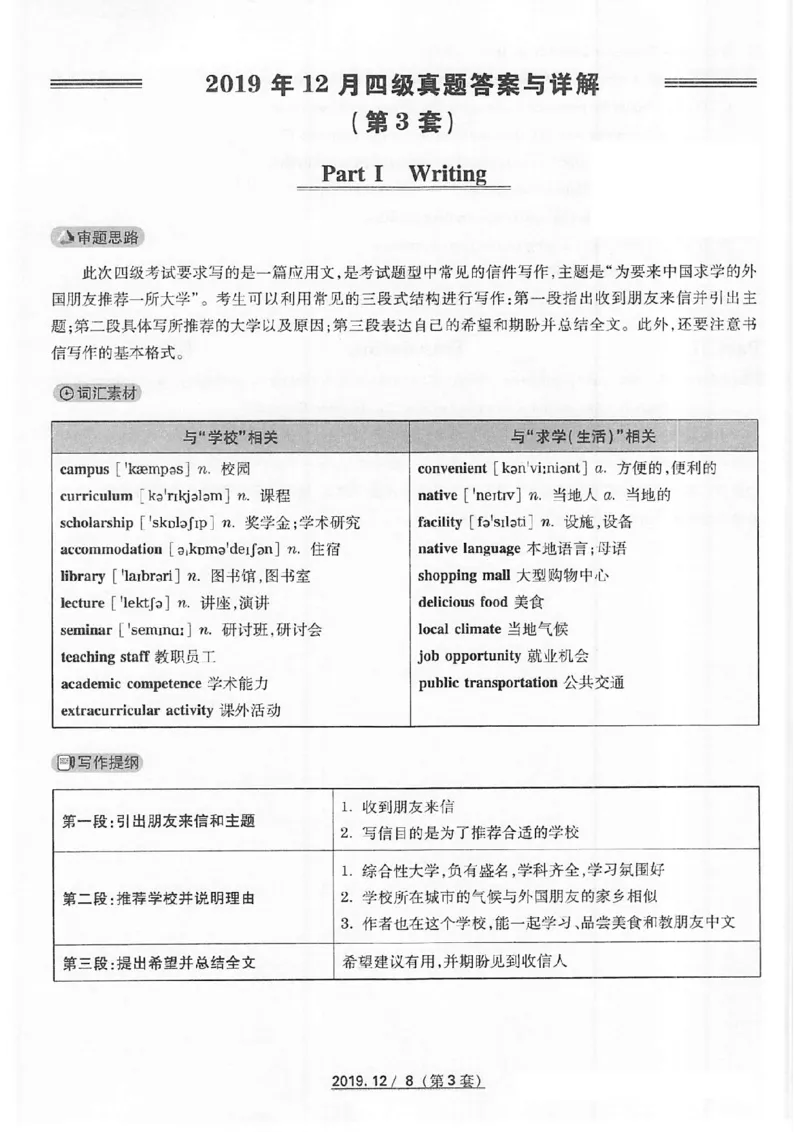
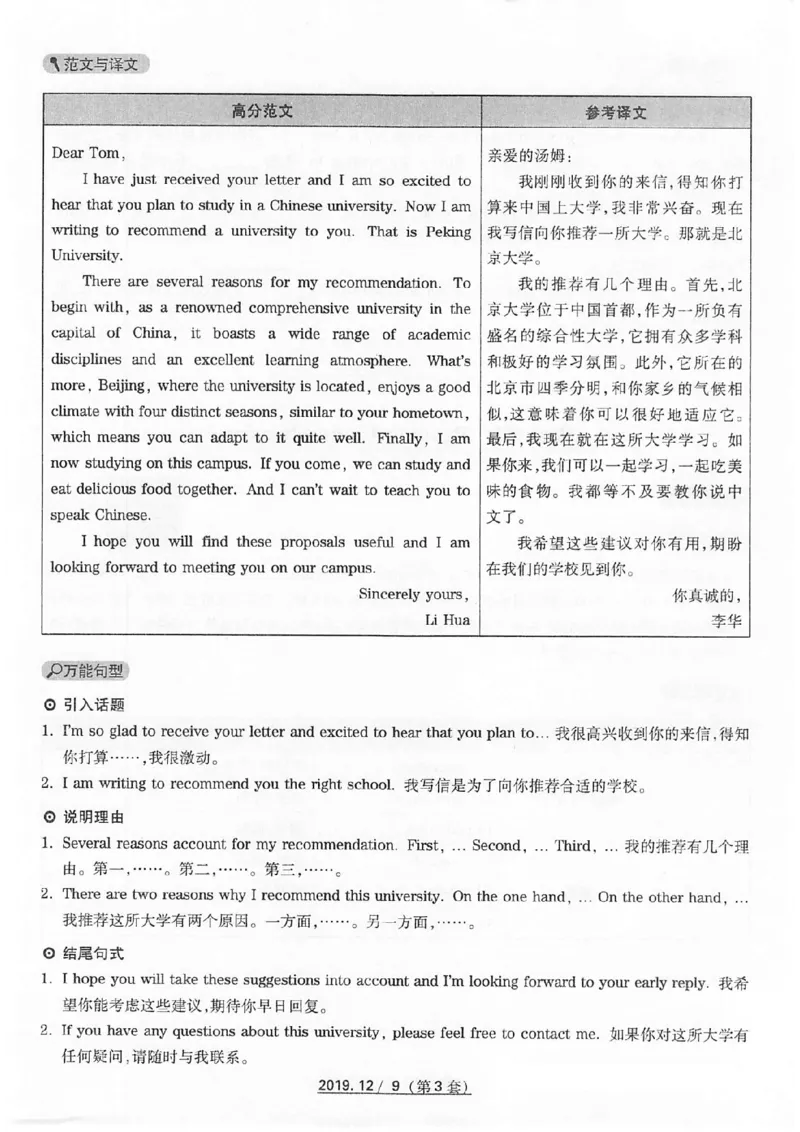
Part I Writing ( 30 minutes)
Directions: For this part, you are aJlowed 30 minutes to write a letter to a foreign friend who
wants to study in China. Please recommend a university to him. You slwuul write
at least 120 words but no more than 180 words.
Part II Listening Comprehension ( 25 minutes)
.R�nm
mM = m T 2019 $ 12 1.11m&�iit��3t�7 2 ff PJrn ,21t•a1111Jr1J-'=ifrr 2 •t*.1!11��-*¥,
ff�-*¥, ffl Jlt1£21tintli � �:pj:IUUl:l lJ\!o
m
Part Reading Comprehension ( 40 minutes)
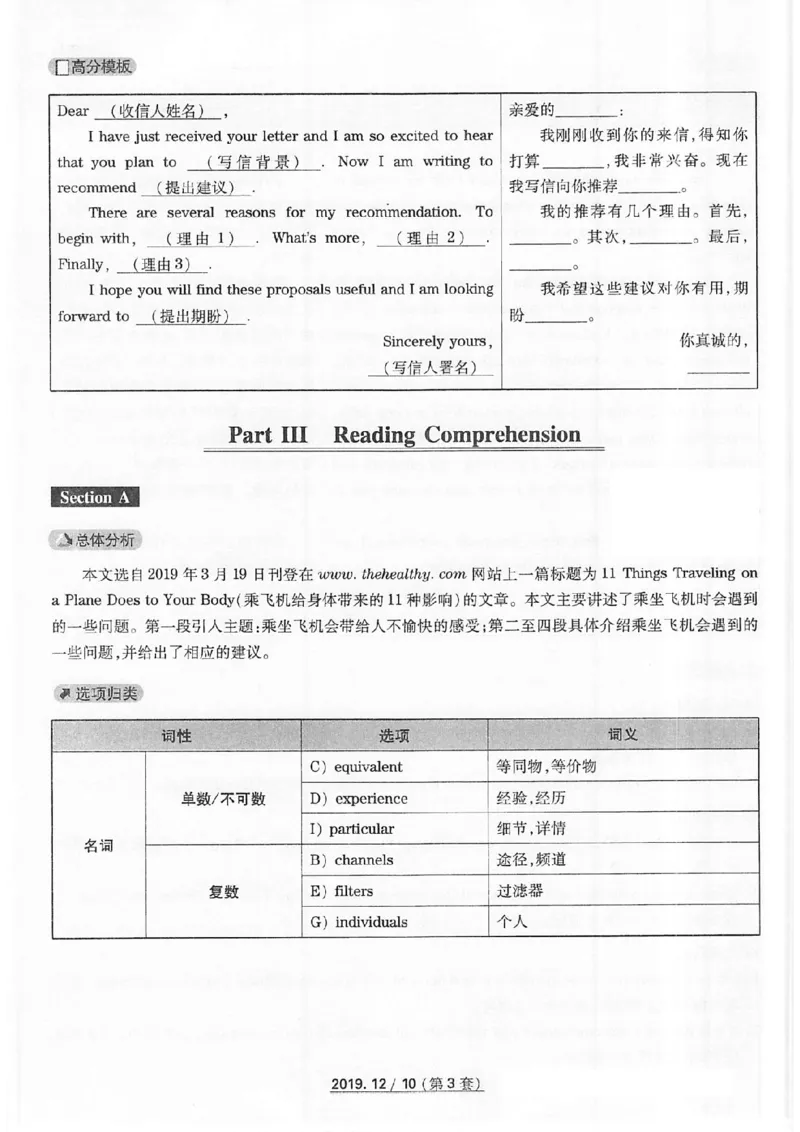
Section A
Directions: In this section, there is a passage with ten blanks. You are required to select one word for
each blank from a list of clwices given in a word bank following the passage. Read the
passage through carefully before making your clwices. Each clwice in the bank is
identified by a letter. Please mark the corresponding letter for each item on Answer
Sheet 2 with a single line through the centre. You may not use any of the words in the
bank more than once.
Millions of people travel by plane evecy single day. If you're planning on being one of them soon,
you might not be looking forward to the � feeling air travel often leaves you with.
Besides the airport crowds and stress, traveling at a high altitude has real effects on the body.
Although the pressure of the cabin is _JJ__ to prevent altitude sickness, you could still �
sleepiness or a headache. The lower oxygen pressure found in an aircraft cabin is � to that at
6,000 -8,000 feet of altitude. A drop in oxygen pressure can cause headaches in certain �. To
help prevent headaches, drink plenty of water, and avoid alcohol and coffee.
Airplane food might not really be as tasteless as you � thought. The air you breathe in a plane
dries out your mouth and nose, which can affect your sense of taste. Perception of sweet and salty
foods dropped by almost 30 percent in a simulation of air travel. However, you can make your taste
buds active again by drinking water. A dcy mouth may � taste sensitivity, .but taste is restored by
drinking fluids.
Although in-flight infections � in dcy environments like airplanes, your risk of getting sick
from an airplane is actually low because of the air 34 used. Unless you're sitting next to someone
2019. 12 / 1 (ffi 3,#)who is coughing or sneezing, you shouldn't worry too much about getting sick. However, bacteria have
been shown to live on cabin surfaces, so wash your hands 35 .
A) adjusted I) particular
B) channels J) primarily
C) equivalent K) ·reduce
D) experience L) renovated
E) filters M) smooth
F) . frequently N) thrive
G) individuals 0) unpleasant
H) originally
Section B
Directions: In this section, you are going to read a passage with ten st,a,tements attached to it. Each
st,a,tement cont,a,ins information given in one of the paragraphs. Identify the paragraph
from which the information is derived. You may choose a paragraph more than once.
Each paragraph is marked with a l,ett,er. Answer the questions by marking the
corresponding l,etter on Answer Sheet 2.
A South Korean city designed for the future takes on a life of its own
A) Getting around a city is one thing-and then there's the matter of getting from one city to another.
One vision of the perfect city of the future is a place that offers easy access to air travel. In 2011, a
University of North Carolina business professor named John Kasarda published a book called
Aerotropolis : The Way We'll Live Next. Kasarda says future cities should be built intentionally
around or near airports. The idea, as he has put it, is to offer businesses "rapid, long-distance
connectivity on a massive scale. "
B) "The 18th century really was a waterborne ( 71<� B9 ) century, the 19th century a rail century, the
20th century a highway, car, truck century-and the 21st century will increasingly be an aviation
century, as the globe becomes increasingly connected by air, " Kasarda says. Songdo, a city built
from scratch in South Korea, is one of Kasarda's prime examples. It has existed for just a few years.
"From the outset, it was designed on the basis of connectivity and competitiveness, " says Kasarda.
"The government built the bridge directly from the airport to the ·songdo International Business
District. And the surface infrastructure was built at the same time as the new airport. "
C) Songdo is a stone's throw from South Korea's lncheon Airport, its main international hub ( ;f!Kffl).
But it takes a lot more than a nearby airport to be a city of the future. Just building a place as an
"international busin.ess district" does�'t mean it will become one. Park Yeon Soo conceived (�10
this city of the future back in 1986. He considers Songdo his baby. Park sees himself as a visionary.
Thirty years after he imagined the city, Park's baby is close to 70 percent built, with 36, 000 people
living in the business district and 90, 000 residents in greater Songdo. It's about an hour outside
201s. 12 / 2 (ffi3 lUSeoul, built on former tidal flats along the Yellow Sea. There's a Coast Guard building and a tall
trade tower, as well as a park, golf course and university.
D) Chances are you've actually seen this place. Songdo appears in the most famous music video ever to
come out of South Korea. "Gangnam Style" refers to the fashionable Gangnam district in Seoul. But
some of the video was filmed in Songdo. "I don't know if you remember, there was a scene in a
subway station. That was not Gangnam. That was actually Songdo," says Jung Won Son, a
professor of urban development at London's Bartlett School of Planning. "Part of the reason to shoot
there is that it's new and nice. "
E) The city was supposed to be a hub for global companies, with employees from all over the world_.
But that's not how it has turned out. Songdo's reputation is as a futuristic ghost town. But the reality
is more complicated. A bridge with big, light-blue loops leads into the business district. In the
center of the main road, there's a long line of flags of the world. On the corner, there's a Starbucks
and a 7-Eleven-all of the international brands that you see all over the world nowadays.
F) The city is not empty. There are mothers pushing baby carriages, old women with walkers-even in
.
the middle of the day, when it's 90 degrees out. Byun Young-Jin chairs the Songdo real estate
.
association and started selling property here when the first phase of the city opened in 2005. He says
demand has boomed in the past couple of years. Most of his clients are Korean. In fact, the
developer says, 99 percent of the homes here are sold to Koreans. Young families move here
because the schools are great. And that's the problem: Songdo has become a popular Korean city
more popular as a residential area than a business one. It's not yet the futuristic international
business hub that planners imagined. "It's a great place to live. And it's becoming a great place to
work," says Scott Summers, vice-president of Gale International, the developer of the city. The
floor-to-ceiling windows of his company's offices overlook Songdo Central Park, with a canal full of
small boats and people fishing. Shimmering ( IA]� a(]) glass towers line the canal's edge.
:•
G) "What's happened is that our focus on creating that quality of life first has enabled the residents to
live here, " Summers says. _But there needs to be strong economic incentives for companies to locate
here. The city is still unfinished, and it feels a bit like a theme park. It doesn't feel all that
futuristic. There's a high-tech underground trash disposal system. Buildings are environmentally
friendly. Everybody's television set is connected to a system that streams personalized language or
exercise classes.
H) But this is not Star Trek. And to some of the residents, Songdo feels hollow. "I'm, like, in prison
for weekdays. That's what we call it in the workplace," says a woman in her 20s. She doesn't want
to use her name for fear of being fired from her job. She goes back to Seoul every weekend. "I say
I'm prison-breaking on Friday nights. " But she has to make the prison break in her own car. There's
no high-speed train connecting Songdo to Seoul, just over 20 miles away.
I) Park Yeon Soo, the man who first imagined Songdo, feels frustrated, too. He says he built South
Korea a luxury vehicle, "like Mercedes or BMW. It's a good car now. But we're waiting for a good
driver to accelerate. " But there are lots of other good cars out there, too. The world is dotted with
2019. 12 / 3 (1ll 3 1f)futuristic, high-tech cities trying to attract the biggest international companies.
J) Songdo's backers contend that it's still early, and business space is filling up-about 70 percent of
finished offices are now occupied. Brent Ryan, who teaches urban design at MIT, says Songdo
proves a universal principle. "There have been a lot of utopian ( �ttt-lSB9) cities in history. And
the reason we don't know about a lot of them is that they have vanished entirely. " In other words,
when it comes to cities-or anything else-it is hard to predict the future.
36. Songdo's popularity lies more in it.s quality of life than it.s business attraction.
37. The man who conceived Songdo feels disappointed because it has fallen short of his expectations.
38. A scene in a popular South Korean music video was shot in Songdo.
39. Songdo still lacks the financial stimulus for businesses to set up shop there.
40. Airplanes will increasingly become the chief means of transportation, according to a professor.
41. Songdo has ended up different from the city it was supposed to be.
42. Some of the people who work in Songdo complain about boredom in the workplace.
43. A business professor says that a future city should have easy access to international transportation.
44. According to an urban design professor, it is difficult for city designers to foresee what will happen
in the future.
45. Park Yeon Soo, who envisioned Songdo, feels a parental connection with the city.
Section C
Directions: There are 2 passages in this section. Each passage is followed by some questions or
unfinished statements. For each of them there are four choices marked A) , B) , C) and
D). You should decide on the best choice and mark the corresponding ktter on Answer
Sheet 2 with a singl,e line through the centre.
Passage One
Questions 46 to 50 are based on the following passage.
The fifth largest city in the US passed a significant soda tax proposal that will letry ( ffl:&) 1. 5 cents
per liquid ounce on distributors.
Philadelphia's new measure was approved by a 13 to 4 city council vote. It sets a new bar for
similar initiatives across the country. It is proof that taxes on sugary drinks can win substantial support
outside super-liberal areas. Until now, the only city to successfully pass and implement a soda tax was
Berkeley, California, in 2014.
The tax will apply to regular and diet sodas, as well as other drinks with added sugar, such as
Gatorade and iced teas. It's expected to raise $ 410 million over the next five years , most of which will
go toward funding a universal pre-kindergarten program for the city.
While the city council vote was met with applause inside the council room, opponents to the
measure, including soda lobbyists, made sharp criticisms and a promise to challenge the tax in court.
"The tax passed today unfairly singles out beverages-including low- and no-calorie choices, " said
Cffi lD
2019.121 4 3Lauren Kane, spokeswoman for the American Beverage Association. " But most importantly, it is
against the law. So we will side with the majority of the people of Philadelphia who oppose this tax and
take legal action to stop it. "
An industry-backed anti-tax campaign has spent at least $ 4 million on advertisements. The ads
criticized the measure , characterizing it as a "grocery tax. "
Public health groups applauded the approved tax as a step toward fixing certain lasting health issues
that plague Americans. "The move to recapture a small part of the profits from an industry that pushes
a product that contributes to diabetes, obesity and heart disease in poorer communities in order to
reinvest in those communities will sure be inspirational to many other places, " said Jim Krieger,
executive director of Healthy Food America. "Indeed, we are already hearing from some of them. It's
not 'just Berkeley' anymore. "
Similar measures in California's Albany, Oakland, San Francisco and Colorado's Boulder are
becoming hot-button issues. Health advocacy groups have hinted that even more might be coming.
46. What does the passage say about the newly-approved soda tax in Philadelphia?
A) It will change the lifestyle of many consumers.
B) It may encourage other US cities to follow suit.
C) It will cut soda consumption among low-income communities.
D) It may influence the marketing strategies of the soda business.
4 7. What will the opponents probably do to respond to the soda tax proposal?
A) Bargain with the city council.
B) Refuse to pay additional tax.
C) Take legal action against it.
D) Try to win public support.
48. What did the industry-backed anti-tax campaign do about the soda tax proposal?
A) It tried to arouse hostile feelings among consumers.
B) It tried to win grocers' support against the measure.
C) It kept sending letters of protest to the media.
D) It criticized the measure through advertising.
49. What did public health groups think the soda tax would do?
A) Alert people to the risk of sugar-induced diseases.
B) Help people to fix certain long-time health issues.
C) Add to the fund for their research on diseases.
D) Benefit low-income people across the country.
50. What do we learn about similar measures concerning the soda tax in some other cities?
A) They are becoming rather sensitive issues.
B) They are spreading panic in the soda industry.
C) They are reducing the incidence of sugar-induced diseases.
D) They are taking away a lot of profit from the soda industry.
2019. 12 / s O[P 1VPassage Two
Questions 51 to 55 are based on the following passage.
Popping food into the microwave for a couple of minutes may seem utterly harmless, but Europe's
stock of these quick-cooking ovens emit as much carbon as nearly 7 million cars , a new study has
fom1d. And the problem is growing. With costs falling and kitchen appliances becoming "status" items,
owners are throwing away microwaves after an average of eight years. This is pushing sales of new
microwaves which are expected to reach 135 million annually in the EU by the end of the decade.
A study by the University of Manchester calculated the emissions of Co -the main greenhouse gas
2
responsible for climate change-at every stage of microwaves, from manufacture to waste disposal. "It
is electricity consumption by microwaves that has the biggest impact on the environment, 0 say the
authors. The authors also calculate that the emissions from using 19 microwaves over a year are the
same as those from using a car. According to the same study, efforts to reduce consumption should
focus on improving consumer awareness and behaviour. For example, consumers could use appliances
in a more efficient way by adjusting the time of cooking to the type of food.
However, David Reay, professor of carbon management, argues that, although microwaves use a
great deal of energy, their emissions are minor compared to those from cars. In the UK alone, there are
around 30 million cars. These cars emit more than all the microwaves in the EU. Backing this up,
recent data show that passenger cars in the UK emitted 69 million tons of CO in 2015. This is 10 times
2
the amount this new microwave oven study estimates for annual emissions for all the microwave ovens
in the EU. Further, the energy used by microwaves is lower than any other form of cooking. Among
common kitchen appliances used for cooking, microwaves are the most energy efficient, followed by a
stove and finally a standard oven. Thus, rising microwave sales could be seen as a positive thing.
51. What is the finding of the new study?
A) Quick-cooking microwave ovens have become more popular.
B) The frequent use of microwaves may do hmm to our health.
C) CO emissions constitute a major threat to the environment.
2
D) The use of microwaves emits more CO than people think.
2
52. Why are the sales of microwaves expected to rise?
A) They are becoming more affordable.
B) They have a shorter life cycle than other appliances.
C) They are getting much easier to operate.
D) They take less time to cook than other appliances.
53. What recommendation does the study by the University of Manchester make?
A) Cooking food of different varieties.
J;3) Improving microwave users' habits.
C) Eating less to cut energy consumption.
D) Using microwave ovens less frequently.
cffi �u
201s.12I s 354. What does Professor David Reay try to argue?
A) There are far more emissions from cars than from microwaves.
B) People should be persuaded into using passenger cars less often.
C) The UK produces less CO than many other countries in the EU.
2
D) More data are needed to show whether microwaves are harmful.
55. What does Professor David Reay think of the use of microwaves?
A) It will become less popular in the coming decades.
B) It makes everyday cooking much more convenient.
C) It plays a positive role in environmental protection.
D) It consumes more power than conventional cooking.
Part IV Translation ( 30 minutes)
Directions: For this part, you are allowed 30 minutes to translate a passage from Chinese into
English. You should write your answer on Answer Sheet 2.
-=fa�*'
i:p �&�)dl9½« mtt"1«ffl.•o i:rxtt« ff9�.��' !t't-��t£1fir' « Bit£1tlff O Jttt-
Im-BJ:*tt* ��
1ittt1tffl � o �mi, tn1-, a-=r Jh!, o -1&,IHJi, « 1=f -1'-Y.Jc;w.i 1'-&* ,ii# *�Jt-BJ: xt • r
A9Smo�MrA9«*�W*�lliJt-BJ:#ma-=r•�tt�#A9A,••Mm•m�tt��A9�ffioJt-BJ:
��-ntmtitfiM-rllti, ��«•tttt�f*IDfH�-=f-�o
2019. 12 / 7 (ffi 3 If)