A
r
r
a
n
g
e
2011 潜在答案训d练
b
y
Good morning, everyone. Today we'll look at culture, or rather (1)__________________.
J
Usually when we deal with different people, we deal with them as if we waere all members of
the same culture. However, it’s possible that people from different cultures hadve different
e
assumptions about the world, regarding such important and basic ideas as time,
(2)__________________.And this is the view of Edward Hall. And Edward Hall is aTn
a
anthropologist who spent a large part of his life studying (3)__________________, their
u
culture, their language. But he was different from a lot of other anthropologists who just
r
study one culture. He was interested in the relations between cultures, how cultures interact. u
s
What Hall believes is that cultures can be classified by placing them on a continuum ranging
from what he called (4)__________________ to (5)__________________.OK, what is a
high-context culture? A high-context culture is a culture in which the context of the
(6)____________, or the action, or an event, carries a large part of its meaning and
significance. What this means is that in a high-context culture more attention is paid to what’s
happening in and around the message than to the message itself. Now, let me give you
examples. First, in terms of personal space, generally speaking, in a high context culture,
because there’s greater dependency on (7)__________________, people lean towards heavier
sensory involvement or closeness to people. And they have less respect for
(8)__________________, for personal space. If you go into that culture, people might stand
closer when they are talking to you. They might touch more and if they are jostled in a crowd.
they won't feel violated. And also people from a high-context culture pay attention
to(9)__________________ because, remember what I said, the definition of a high-context
culture is that more attention is paid to the context of the message than to the message itself.
And part of the context is body language. Second in terms of time, people in high-context
cultures are considered to have what is called a (10)__________________ attitude toward
time. Here “poly” means multiple and “chronic” means time. What this means is that they
believe people, things, events have their own time. And there can’t be a standard system of
time for everything. What this leads them to believe is that you can’t emphasize
(11)__________________. Things happen when they are supposed to happen. So
there’s a different attitude toward time. There’s no set standard of time. You can’t control
time. Everything has its own (12)__________________. So it’s a culture that pays little
attention to time, to clock time. Now, let’s move on to low-context culture. A low-context
culture is just the opposite. A low-context culture is one in which the message, the event, or
the action, is a separate entity having meaning onto itself regardless of the surroundings orA
r
r
a
n
g
e
the context, that the message, the event, the action
d
has (13)__________________. So what this means in a low-con text culture is that people pay
b
more attention to the event itself. rather than to the context which suyrrounds the event or the
message. For example, in terms of personal space again, there’s more e mphasis on
J
a
(14)__________________. So the concept of privacy is very, very important. Whereas
d
before, as I said, in a high-context culture, they might not even be concerned with privacy or
e
personal space. But in a low-context culture, there’s a feeling that we each have our own
T
personal space. If you get too close, if you don’t knock on doors before entering, that’s an
a
invasion of u
r
privacy ;people feel (15)__________________. There’s a respect and a desire for privacy. u
And you’ll also see that people might pay less attention to body language, because as I said, s
the message is “the message is everything. ” They are not going to worry about all the details
around it. What you say is the important thing, or what you do is the important thing. Another
example of a low-context culture is people’s (16)__________________. In terms of time, I
said before there was a poly-chronic sense of time in a high-context culture. What do you
think there would be in a low context culture? Mono-chronic. Right. A
(17)__________________ sense of time and by that we mean that there's one time. And that
concept means that people in a low context culture believe that there’s one
(18)__________________ and that should be for everything and so I’m not willing to
hear“Oh, the traffic was heavy. That’s why I’m late.” or “Oh, I slept late.” People in a low-
context culture would be much more upset with (19)__________________ because they feel
that everyone should follow the same time. There shouldn’t be all this flexibility with time
and they expect punctuality. And they look at time as almost a commodity that they use
expressions like“use time”, “to waste time”, “to spend time”or“Time is money.”All of these
expressions reinforce the concept that time is actually something you can hold onto. So,what
this is all about is that Hall stresses that people need to be aware of these different
assumptions or concepts about reality. And he thinks that this has all kinds of relevance, no
matter what you are doing. If you are in business, negotiations, (20)__________________, if
you are dealing with people from different cultures in any way, it’s going to affect every part
of your life. In any multicultural situation, these assumptions need to be taken into account
for successful interactions.
OK. Today, we’ve taken a brief look at Edward Hall’s view of culture, mainly his
classification of high or low-context culture with some examples. Next week, we’ll look at
some more examples of cultures on the continuum between high-context and low-context
cultures.A
r
r
a
n
g
e
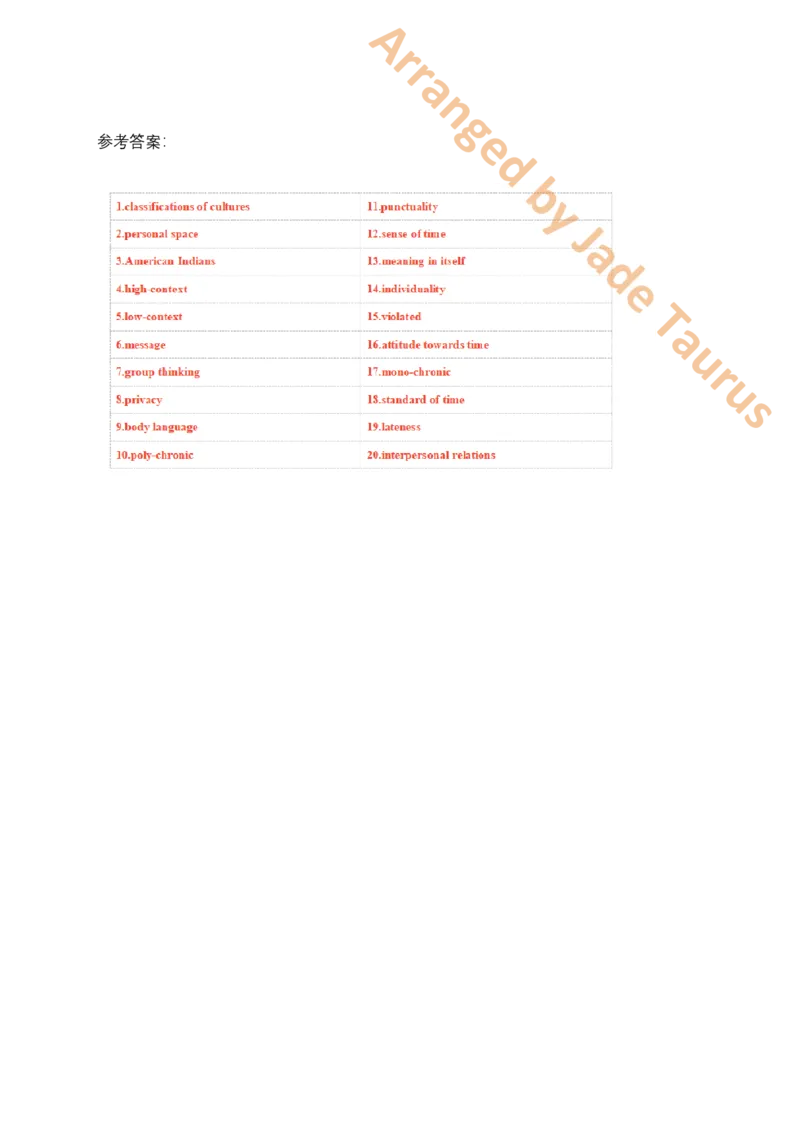
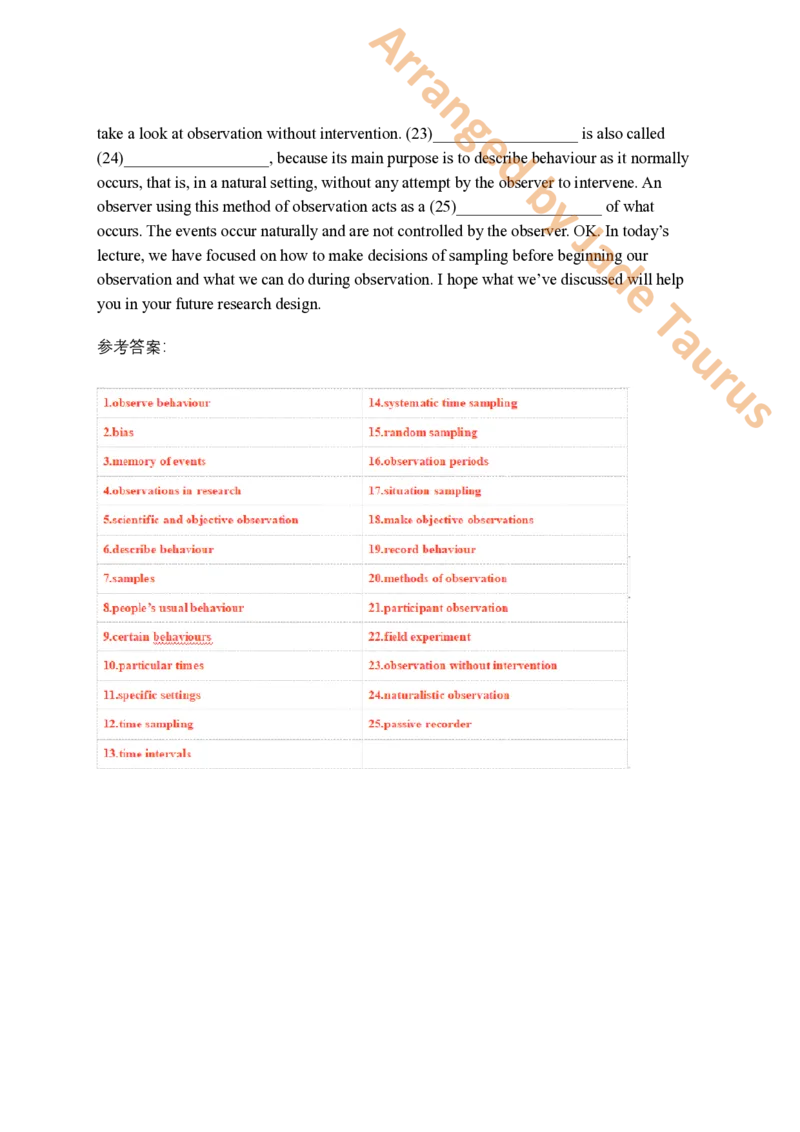
参考答案:
d
b
y
J
a
d
e
T
a
u
r
u
sA
r
r
a
n
g
e
2012 潜在答案训d练
b
y
Good morning, everyone. Today, we’ll look at how to (1)__________________ in research.
J
Perhaps you would say it’s easy and there’s nothing extraordinary. Yes, yoau may be right. All
of us observe behaviour every day. For example, when traveling in another coduntry, we can
e
avoid embarrassment by observing how people behave in that culture. And, failing to be
observant while walking or driving can be life-threatening. We learn by observing peTople’s
a
behaviour. Researchers, too, rely on their observations to learn about behaviour, but there are
u
differences. For instance, when we observe casually, we may not be aware of factors that
r
(2)__________ our observations. And, when we rarely keep formal records of our u
s
observations, instead, we rely on our memory of (3)_____________.
(4)__________________, on the other hand, are made under precisely defined conditions,
that is, in a systematic and objective manner
and with careful record keeping. Then, how are we going to conduct observations in our
research studies? And what do we need to do in order to make a
(5)_____________________? Now, as you remember, the primary goal
of observation is to (6)__________________. But it is, in reality, impossible to observe and
describe all of a person’s behaviour. So we have to rely on observing
(7)__________________ of people’s behaviour. In doing so, we must decide whether the
samples represent (8)__________________. Thus, we’ll first take a brief look at how
researchers select samples of behaviour. Before conducting an observational study,
researchers must make a number of
important decisions. That’s about when and where observations will be made. That’s about
when and where observations will be made. As I’ve said before, the researcher cannot
observe all behaviour. Only (9)__________________ occurring at
(10)__________________, in (11)__________________ can be observed. In other words,
behaviour must be sampled. In this lecture, I’ll briefly introduce two kinds of sampling, that
is, time sampling and situation sampling. Now, first, time sampling.
(12)__________________ means that researchers choose various (13)__________________
for their observation. Intervals may be selected systematically or randomly. Suppose we want
to observe students’ classroom behaviour. Then, in (14)__________________, our
observations might be made during five twenty-minute periods beginning every hour. The
first observation period could begin at 9 a. m., the second at 10 a. m., and so forth. However,
in (15)__________________, these five twenty-minute periods may beA
r
r
a
n
g
e
distributed randomly over the course of the day. That is to say, intervals between
d
(16)__________________ could vary, some longer, others shor ter. One point I’d like to make
b
is systematic and random time sampling are not always used in isolaytion. They are often
combined in studies. For example, while observation intervals are sche duled systematically,
J
a
observations within an interval are made at random times. That means the researcher might
d
decide to observe only during fifteen-second intervals that are randomly distributed within
e
each twenty-minute
T
period. Now, let’s come to situation sampling. Then, what is (17)__________________a? It
u
involves studying behaviour in different locations and under different circumstances and
r
conditions. By sampling as many different situations as possible, researchers can reduce the u
chance that their observation results will be peculiar to a certain set of circumstances and s
conditions. Why? Because people, or for that manner, animals, do not behave in exactly the
same way across all situations. For example, children do not always behave the same way
with one parent as they do with the other parent. And animals do not behave the same way in
zoos as they do in the wild. So, by sampling different situations, a researcher can
(18)______more____________ than he would in only a specific situation.
Having discussed ways to sample behaviour in research, we are now moving on to another
issue, that is, what researchers should do to (19)__________________ as it occurs. That
is,whether researchers are active or passive in recording behaviour. This refers to the
(20)__________________. Observational methods can be classified as “observation with
intervention” or “observation without intervention”. Observation with intervention can be
made in at least two ways—(21)__________________ and (22)__________________. In
participant observation, observers, that is, researchers, play a dual role. They observe
people’s behaviour and they participate actively in the situation they are observing. If
individuals who are being observed know that the observer is present to collect information
about their behaviour, this is
undisguised participant observation. But in disguised participant observation, those who are
being observed do not know that they are being observed. Another method of observation
with intervention is field experiment. What is a field experiment? When an observer controls
one or more conditions in a natural setting in order to determine the effect on behaviour, this
procedure is called field experiment. The field experiment represents the most extreme form
of intervention in observational methods. The essential difference between field experiments
and other
observational methods is that researchers have more control in field experiments. Now, let’sA
r
r
a
n
g
e
take a look at observation without intervention. (23)__________________ is also called
d
(24)__________________, because its main purpose is to describe behaviour as it normally
b
occurs, that is, in a natural setting, without any attempt by the observer to intervene. An
y
observer using this method of observation acts as a (25)__________________ of what
J
occurs. The events occur naturally and are not controlled by the observer. OK. In today’s
a
lecture, we have focused on how to make decisions of sampling before begindning our
e
observation and what we can do during observation. I hope what we’ve discussed will help
you in your future research design. T
a
u
参考答案:
r
u
sA
r
r
a
n
g
e
2013 潜在答案训d练
b
y
Good morning. Today I’ll discuss what is active learning and, uh...what do active learners do.
J
In rder to define active learning, I will look at the differences between a
(1)__________________and (2)__________________ by examining six chadracteristics of
e
active learners and contrasting them with those of passive learners.
T
OK, let’s start. With the first characteristic, active learners tend to read with the purpose of
a
(3)__________________. I bet that no one deliberately sits down to read with the purposeu of
not understanding the text. However, I’m sure that some of you have been in a situation, r
u
probably more than once, where you read, quote and unquote “an (4)__________________”,
s
closed the text and thought “what the world was that about?” When you interact with a text in
this manner, you are reading passively. Active readers, on the other hand,
(5)__________________ before they read and check their understanding as they read. When
they finish, they can explain the
(6)__________________ and know that they have understood what they have read.
Now, the second characteristic of active learners is to (7)__________________ and
(8)__________________. Being reflective is an important part of active learning because it
means that you are thinking about the information. In other words, you are
(9)__________________. For instance, you may (10)__________________ between the new
information and what you already know, (11)__________________ that you may not
understand very well, or (12)__________________ of what you are reading. An active
learner reflects constantly in this way. In contrast, passive learners may read the text and
listen to lectures and even understand most of what is read and heard, but they do not
(13)______ that ______ next______ of actually thinking about it.
Let’s move on to the third one. The third characteristic is to listen actively by
(14)__________________ in an organized way, like what you should be doing now. We
lecturers are always amazed at the number of students who engage in activities other than
listening and note-taking in their lecture classes. We’ve seen students reading newspapers,
doing an assignment for another class or chatting with the classmates. Perhaps the all-time
winner for passive learning, however, was a student who regularly came to my class with a
pillow and fell asleep. Unlike these students, active learners are (15)__________________.
They listen actively to the professor for the entire class period, and they write down as muchA
r
r
a
n
g
e
information as possible.
d
To be an active note-taker, you must be more than simply prese nt. You have to think about the
b
information before you write. y
J
The fourth characteristic is to (16)__________________ when they are experiencing
a
problems. Because active learners are constantly (17)__________________, dthey know when
their comprehension breaks down and they ask for help before they become loste. In addition,
active T
a
learners often predict the courses or even particular concepts within courses that may give
u
them trouble. They have a plan in mind for getting assistance should they need it. Active r
u
learners may (18)__________________ their professors or peers. Although passive learners
s
may seek help at some point, it is often too little, too late. In addition, because passive
learners do not reflect and think critically, they often don't even realize that they need help.
The next characteristic is to (19)__________________. This means that active learners raise
questions on information that they read and hear, while passive learners accept both the
(20)__________________ and the words of their professors as truth. Of course, active
learners don’t question everything, but they do evaluate what they read and hear. When new
information fails to fit in with what they already know, they may differ in the conclusions
they draw or in the
inferences they make. The last characteristic, which I think is the most fundamental one, is to
accept much of the (21)__________________. Active learners understand that the
responsibility for learning must come from within, while passive learners often want to blame
others for their (22)__________________, poor performance, (23)__________________ and
other difficulties that they might experience. When active learners don’t perform as well as
they’d hoped, they evaluate why they didn’t do well and change those studying behaviours
the next time. Passive learners, on the other hand, often approach every course in the same
manner and then get angry
with professors when their performance is poor. It is only when students accept the
responsibility for their own learning that they can truly be called active
So, from what I’ve said so far, you can see that being an active learner involves both
(24)__________________. By skill, I mean the tools to handle the studying and learning
demands placed on you, like how to (25)__________________, when and where to get
assistance if you are having difficulty. By will, I mean the desire and motivation to follow
through. Here Yd like to emphasize that skill is nothing without will. For example, you mayA
r
r
a
n
g
e
have a friend who is knowledgeable but not motivated in the classroom. Even though he
d
reads widely and can intelligently discuss a variety of issues, he does little school work and
b
rarely studies. In other words,students,such as these,may have the skills to do well, but
y
for some reason, they simply do not have the will. And because skill andJ will go hand in
a
hand, unmotivated students, those who do not have the will, may experience difficulty in
d
college. OK. Today we discussed the differences between an active learner and ae passive one,
and some useful study strategies that may eventually help you become an active lea rner.
T
a
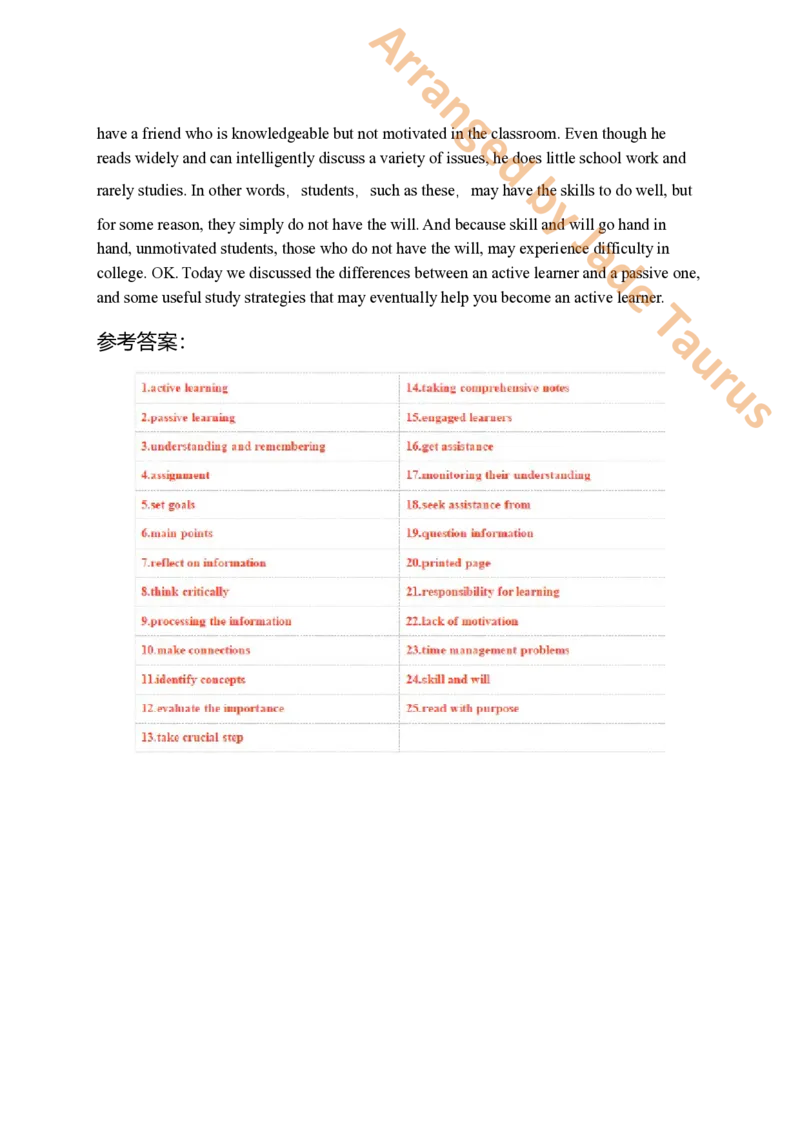
参考答案: u
r
u
sA
r
r
a
n
g
e
2014 潜在答案训d练
b
y
Good morning! Today we’ll look at how to (1)__________________. As you all know, life
J
always has stressors, ur, things which are causing us stress and living withaout stress is
virtually impossible. So, if we have to live with stress, we may as well find odut more about
e
what it is, how we can deal with it and so on. What is stress, then? The term was originally
used in physics to describe the force exerted between two touching bodies. I restrict Tit a term
a
describing a (2)__________________.Then in
u
the 1930s,a doctor named Hans Selye, S-e-l-y-e, first used this term to describe a human’s r
u
reaction to a demand placed on it, pleasant or not. And he included in this response things
s
like accelerated breathing, accelerated (3)__________________, increased(4)____________,
(5)_______________ and so on. Now, please notice that I said that stress can be pleasant or
not. This response can also be pleasant or not. And stress can be both negative and positive.
Let’s take a look at positive stress. (6)__________________ occurs in a life situation towards
which one feels positively. Things like Christmas or (7)__________________ are usually
positive
events, but still stressful, nonetheless. Another example is the pressure in a job can give some
people incentive to work and excitement, but it still is stress. (8)__________________ is
what most of us think of when we think of stress. And negative stress occurs logically enough
in situations towards which one feels negatively. And those examples could be
(9)__________________, a friend’s death and so on. But here a thing to remember is that
stress in itself is not hazardous. Rather, the danger is in the individual’s reaction to the stress.
So
psychologists have found that if we develop appropriate ways to cope with stressful
situations, individuals can reduce the (10)__________________ which is caused by stress, or
which can be caused by stress. And that’s what I want to talk a bit about today—what are
these appropriate ways to deal with stress; how to minimize any negative reactions. The first
thing that most psychologists suggest is to learn to recognize your own
(11)__________________. We all have different types of stress signals, but individuals
should monitor themselves for stress signals, so that they can focus on minimizing or
acknowledging the stress before it (12)__________________. And common early signs for
many people include irritability, (13)__________________, (14)__________________ or
even weight gain, smoking, drinking, increases in small errors, all kinds of things that people
get which could be an early signal of stress. You can consider ways to protect yourself whenA
r
r
a
n
g
e
you start seeing these signs coming on. So you might decide to withdraw from a stressful
d
situation or reward yourself with equal amounts of low-stress activity time. That’s really the
b
first important way to deal with stress appropriately. The second important way to deal with
y
stress is to pay attention to your (15)__________________. Most psychologists are finding
J
that a good exercise program, (16)__________________, decreases the amount of stress, or
a
the (17)__________________ on the body or in the mind. And this seems qudite apparent
e
because exercise can provide a stress free
T
environment away from your usual stressors and it keeps your body busy and preoccupied
a
with non-stressful things. OK, the third thing to reduce stress is to (18)________________u__
when appropriate. What is suggested is that rather than wasting energy on worrying, an r
u
individual can direct his or her energy to plan the steps and act. And often, just the planning
s
of the action helps to reduce the stress, because it reduces the worrying. And also the results
of the plans or action may serve to remove or weaken the (19)__________________ of the
stress. Please notice that I just now said“when appropriate.”And this next suggestion has to
do with that
idea of “when (20)__________________.”The third suggestion was to make plans and act
when appropriate rather than just sit around and worry. But the fourth plan, or fourth idea
says to learn to (21)__________________ which are out of your control. These two then go
hand in hand. You can make plans and act when it’s appropriate, but when it’s not
appropriate, or when it’s impossible, the only way is to learn to accept that some things are
unchangeable and (22)__________________. So, for example, if you are in traffic, lateness
caused by traffic is out of your hands. There’s no sense in getting really crazy about that. If
you do so, it only increases
your stress to waste energy trying to resist what’s inevitable or what can’t be avoided.
The last item that psychologists suggest is to pace your activities. (23)__________________
I mean giving yourself some (24)__________________ to do at a reasonable speed. That is,
you go at a speed that you can handle, break your task into manageable parts, rather than try
to deal with the whole task all at once. So, as an example in your lives as students, a whole
term paper might feel overwhelming. But if you say to yourself“ today I’m going to the
library and gather resources;tomorrow I’m going to read three articles,”and so on, you’ll
have broken this one
large task, that’s writing a term paper, down into many smaller and more manageable tasks.
This will certainly reduce your stress. OK. Having said all these, I want you to remember thatA
r
r
a
n
g
e
the problem is not in the stressful experiences themselves. We all experience stress and
d
(25)_____________. The problem is in our reactions to these experiences. And each of us has
b
our own limits for stress and our own ways of coping with stress. So long as we have our
y
own appropriate ways, stress or stressful
J
a
situations can certainly be dealt with.
d
OK. That’s all for today’s lecture. See you next week. e
T
参考答案: a
u
r
u
sA
r
r
a
n
g
e
2015 潜在答案训d练
b
y
Good morning, everybody. Now, at the university, you, as students, are often called on to
J
perform any types of listening tasks: listening in a group discussion, listenaing to a teacher on
a one-tone basis, and listening to academic lectures. So, what I'm going to taldk about today is
e
what a listener needs to be able to do in order to comprehend an (1)__________________
efficiently. OK. What do you need to do in order to understand the lecture? Now, theTre are
a
four things that I'm going to talk about. The first thing is that you need to be aware of all of
u
the parts of the language that (2)__________________.You all know that words carry
r
meaning. So, you' ve got to u
s
be aware of the vocabulary of the language, but there are some other
(3)__________________.For one thing, you need to be aware of
(4)__________________.Let me give you an example: “I went to the bar.”“I went to the
bar.”It makes a difference. In the second example, I'm stressing the fact that it was me and not
someone else so that this means stress has some meaning. Now the next thing you might want
to listen for is intonation. For example, if I say “He came.” “He came?” There are two
different meanings: one is a (5)__________________, the other one is a
(6)__________________.And another thing you need to listen for is
(7)__________________.For instance, “Can you see, Mary?”versus “Can
you see Mary?”da da DA da da...da da da DA da. Those two mean something different: in the
first one, they' re talking directly to Mary, while the second one means “Can you see
Mary...over there?” Now, the next thing you must do when you listen is that you need to
(8)__________________ that the lecturer expects you to add. All lecturers assume that they
share some information with their audience and that their audience does not need them to
explain every word. And listeners have an ability to add this information due to two sources
of information, that is, one, their
knowledge of a (9)__________________ and, two, their knowledge or
(10)__________________.So remember: listening is not a matter of just absorbing the
speaker's words; the listener has to do more than that. The listener is not a tape recorder,
absorbing the speaker's words and putting them into his or her brain. Rather, listening
involves hearing the speaker's words and (11)__________________ them, adding
information if necessary. So the meaning is not in the word alone. Rather, it is in the person
who uses it or responds to it. So that's the second thing that a listener must do...add
information that the lecturer assumes that they share. OK. The third thing that a listener needsA
r
r
a
n
g
e
to do, and this is to me the most important thing of all, and that's to
d
(12)__________________ as you listen. Now, let me give you two reasons why you have to
b
predict. For one thing, if you predict, it helps you (13)__________________.What do I mean
y
by noise? Maybe there's noise outside and you can't hear me; maybe you' re in the back of the
J
room and you can't hear all that well; maybe the microphone doesn't work; maybe there's
a
noise inside your head. By that I mean maybe you' re thinking of something edlse, and then all
e
of a sudden, you' ll remember “Oh!...I've got to listen!”By being able to predict during the
lecture, you can just keep listening to the lecture and not lose the idea of what's goingT on. So,
a
predicting is important to help you overcome outside noise and inside noise. And another
u
reason that predicting is important is because it (14)__________________.Now when you
r
listen, you need time to think about the information, relate it to u
s
(15)__________________,(16)__________________, and if you're only keeping up with
what I'm saying or what the lecturer's saying, you have no time to do that. And I' ll bet a lot of
you are having that problem right now because it's so hard just to follow everything I'm
saying, that you don't have time to note down ideas. So, predicting saves you time. If you can
guess what I'm going to say, you' re
able to take notes, you' re able to think, you have more time. OK? And there are two types of
predictions that you can make: (17)__________________ and (18)__________________.Let
me give you an example, in terms of content, if you hear the words “because he loved to
cook, his favorite room was...”, what would you expect?“Kitchen.”You can guess this
because you know people cook in the kitchen. OK? And you can also predict organization. So
if I was going to tell you a story, you'd expect me to tell you why the story is important, give
you a setting for the story. So
you have (19)__________________ of what the speaker is going to talk about, and how the
speaker will organize his or her words. Now, let's come to the last thing a listener must do:
the listener must (20)__________________, as he or she is listening, decide what's important,
what's not; decide how something relates to something else. OK? There are, again, two
reasons for this. The first one is evaluating helps you
to decide what to take notes about: What's important to (21)__________________? What's
not important to write down? And the second reason is that evaluating helps you
to(22)__________________.Studies have shown that we (23)__________________ more
information, if ideas are connected to one another rather than just individually remembered.
So for example, if I give you five ideas that are not related to one another, that's much more
difficult to remember than five ideas that are related. So, you can see, evaluating helps you to
remember information better because it connects ideas to one another. OK, from what I'veA
r
r
a
n
g
e
said so far, you can see there's a lot involved in listening to lectures —
d
(24)__________________, adding information, making predictions and
b
(25)__________________.I hope these will be useful to you in lecture comprehension.
y
参考答案: J
a
d
e
T
a
u
r
u
sA
r
r
a
n
g
e
2016 潜在答案训d练
b
y
Good morning, everyone. My name is David and I am good at arguing. So welcome to our
J
introductory lecture on argumentation. Why do we want to argue? Why doa we try to convince
other people to believe things that they don't want to believe? Is that even a ndice thing to do?
e
Is that a nice way to treat other human being, try and make them think something they don't
want to think? Well, my answer is going to make reference to three (1)___________T_____.
a
The first mode1—let's call this the (2)________________—is that we think of
u
(3)________________. And you know what that's like—there's a lot of
r
(4)________________and (5)________________. And that's not really a very helpful model u
s
for arguing, but it's a pretty common and fixed one. I guess you must have seen that type of
arguing many times, in the street, on the bus, or in the subway. Let's move on to the second
model. The second model for arguing regards (6)________________. Think of a
mathematician s argument. Here's my argument. Does it work? Is it any good? Are the
premises warranted? Are the inferences valid? Does the conclusion follow the premises? No
opposition, no adversariality—not necessarily any arguing in the adversarial sense. And
there's a third model to keep in mind that I think is going to be very helpful, and that is
(7)________________, arguments as being in front of an audience. We can think of a
politician trying to present a position, trying to convince the audience of something. But
there's another twist on this model that I really think is important, namely, that
when we argue before an audience, sometimes the audience has a more participatory role in
the argument. That is, you present your arguments in front of an audience who are like juries
that make a judgment and decide the case. Let's call this model the (8)________________,
where you have to tailor your argument to the (9)________________ at hand. Of those three,
the argument as war is the (10)________________ one. It dominates how we talk about
arguments; it dominates how we think about arguments. And because of that, it shapes how
we argue, our actual conduct in arguments. We want strong arguments, arguments that
have a lot of punch, arguments that are right on target. We want to have our
(11)________________ up and our (12)________________ all (13)________________. We
want killer arguments. That's the kind of argument we want. It is the dominant way of
thinking about arguments. When I'm talking about arguments, that's probably what you
thought of, the (14)________________. But the war metaphor, the war paradigm or model
for thinking about arguments, has, I think, negative effects on how we argue. First, it elevates
(15)________________ over substance. You can take a class in logic argumentation. YouA
r
r
a
n
g
e
learn all about the strategies that people use to try and win arguments, and that makes arguing
d
adversarial; it's polarizing. And the only foreseeable outcomes are triumph—glorious
b
triumph—or disgraceful defeat. I think those are very (16)________________, and worst of
y
all, it seems to (17)____________ things like negotiation and collaboration. Um, I think the
J
argument-as-war metaphor inhibits those other kinds of resolutions to argumentation. And
a
finally—this is really the worst thing—arguments don't seem to get us anywhdere; they're
e
(18)________________. We don't get anywhere. Oh, and one more thing. That is, if argument
is war, then there's also an (19)________________aspect of meaning— T
a
(20)________________. And let me explain what I mean. Suppose you and I have an
u
argument. You believe a proposition, and I don't. And I say, “Well,why do you believe r
u
s
that?” And you give me your reasons. And I object and say, “ Well,what about ...?”And you
answer my objection. And I have a question: “ Well,what do you mean? How does it apply
over here?” And you answer my question. Now, suppose at the end of the day, I've objected,
I've questioned, I've raised all sorts of questions from an opposite perspective, and in every
case you've responded to my satisfaction. And so at the end of the day, I say,“You know
what? I guess you're right. ”Maybe finally I lost my argument, but isn't it also a process of
learning? So you see arguments may also have (21)________________. So how can we find
new ways to achieve those positive effects? We need to think of new kinds of arguments.
Here, I have some suggestions: If we want to think of new kinds of arguments, what we need
to do is think of new kinds of arguers—people who argue. So try this: Think of all the roles
that people play in arguments. There's the proponent and the opponent in an adversarial,
dialectical argument. There's the audience in rhetorical arguments. There' s the reasoner in
arguments as proofs. All these different roles. Now, can you imagine an argument in which
you are the arguer, but you're also in the audience, watching yourself argue? Can you imagine
yourself watching yourself argue? That means you need to be supported by yourself. Even
when you lose the argument, still, at the end of the argument, you could say, “Wow, that was
a good argument!” Can you do that? I think you can. In this way, you've been supported by
yourself. Up till now, I've lost a lot of arguments. It really takes practice to become a good
arguer in the sense of being able to benefit from losing, but fortunately, I've had many, many
colleagues who have been willing to step up and provide that practice for me. OK. To sum
up, in today's lecture, I've introduced three models of arguments. The first model is called the
dialectical model, the second one is the model of arguments as proofs, and the last one is
called the rhetorical model, the model of arguments as performances. I have also emphasized
that though the adversarial type of arguments is quite common, we can still make argumentsA
r
r
a
n
g
e
produce some positive effects. Next time,I will continue our discussion on the process of
d
arguing. b
y
参考答案:
J
a
d
e
T
a
u
r
u
sA
r
r
a
n
g
e
2017 潜在答案训d练
b
y
Good morning,everyone. In our last lecture, I was talking about langu age as part of our
J
a
semiotic system. And today, I'm going to move on to another topic. That is, the
d
(1)___________________. As you may know, messages are transmitted in humaen language
most frequently through two primary modes: (2)_________ and (3)__________. W ell, you
T
know there is also a third mode which is not that frequently used as speech and writing.a The
u
third mode is called (4)___________, which is used by (5)___________________. But in
r
today's lecture, we will just focus on speech u
s
and writing and the specific features of these two modes. In(6)___________________, it is
commonly noted that speech is (7)___________ and writing secondary. Linguists take this
position because all languages are spoken except those dead languages such as Latin, which
is only existed in written form. All children will naturally acquire the spoken version of a
language if they are exposed to it. They acquire the spoken form of their
(8)___________________ during the formative period of language acquisition. However, to
become (9)____________, a child will need some kind of formal schooling in reading and
writing. In many respects, we might call speech “primary” and writing “secondary”. It
implies that writing has a second-class status when compared with speech. In fact, it is more
accurate to view the two modes as having different but (10)___________________. For
instance, in most legal systems, while an (11)___________________ is legally binding, a
written contract is preferred. The reason is simple. Unlike speech, writing provides a
(12)___________________ of the contract. Thus, if the terms of the contract are disputed, the
written record of the contract can be (13)___________ and (14)_____________. Disputes
over an oral contract will involve one person's recollection of the contract versus another
person's. While writing may be the preferred mode for a contract, in many other
(15)___________________, speech will be more appropriate. Because the most common
type of speech—face-to-face conversations—is (16)___________________,this mode is
well suited to many social contexts, such as casual conversations over lunch, business
transactions in a
grocery store, discussions between students and teachers in a classroom. And in these
contexts, (17)___________________ have many advantages over writing. For instance,
individuals engaged in conversation can ask for immediate clarification if there is a question
about something said: in a letter to a friend, in contrast, such immediacy is lacking. WhenA
r
r
a
n
g
e
speaking to one another speakers are face to face and can therefore see how individuals react
d
to what is said; on the other hand, writing creates distance between writer and reader,
b
preventing the writer from getting any immediate reaction from the reader. Speech is oral,
y
thus making it possible to use intonation to emphasize words or phrases and express emotion.
J
Of course, one might say that
a
d
writing has (18)___________________. Well, it can express only a small proportion of the
e
features that (19)___________________ has. Because speech is created “on-line”, it is
T
produced quickly and easily. This may result in many “ungrammatical” constructions, but
a
rarely do these rough sentences cause miscommunications. You know, if there is a u
misunderstanding, it can be easily corrected. On the contrary, writing is much more r
u
(20)___________________. It requires planning, editing, and thus taking much more time to
s
produce on the part of the writer. Because of all these characteristics of writing, if an
individual desires a casual, intimate encounter with a friend, he or she is more likely to meet
personally than write a letter. In this case, writing a letter to a friend might turn out to be too
formal. Of course, in today's world, the highly-developed technology has made such
(21)___________________ possible with “instant messaging” over a computer or smart
phone. And if someone wishes to have such an encounter with a friend living many miles
away, then this kind of on-line written “chat” can mimic a face-to-face conversation. But
because such conversations are a hybrid of speech and writing,they still lack the
(22)___________________ and (23)___________________ of a face-to-face conversation.
While speech and writing are often viewed as discrete modes, it is important for us to note
that
there is a continuum between speech and writing. While speech is in general more interactive
than writing,various kinds of spoken and written English display various degrees of
interactivity. For instance, various linguistic markers of interactive discourse such as first and
second person pronouns, contractions, and private verbs such as think and feel, occurred very
frequently in telephone and face-to-face conversations but less frequently in spontaneous
speeches, interviews, and broadcasts. In addition, some kinds of writing, such as academic
prose and official documents, exhibited few markers of interactive discourse. But other kinds
of written texts, particularly personal letters, ranked higher on the scale of interactivity than
many of the spoken texts. In other words, how language is structured depends less on whether
it is spoken or written but more on how it is being used. For example, a personal letter, even
though it is written, will contain linguistic features marking interactivity because the writer ofA
r
r
a
n
g
e
a letter wishes to interact with the receiver of the letter. On the other hand, in an interview,
d
the goal is not to interact necessarily but to get information from the person being
b
interviewed. Therefore , though interviews are spoken, they have fewer markers of
y
interactivity and contain more features typically associated with written texts. OK. To sum
J
up, we have been dealing with the modes of language in today's lecture. The two most
a
frequently used modes are speech and writing. As two different modes of landguage, speech
e
and writing have their own characteristics. Speech is a preferred mode in many social
contexts where interactivity is needed. Of course, when a formal, stable record is preTferred,
a
writing should be an appropriate mode. Finally, I have also emphasized that there is a
u
continuum between speech and writing. In the following lecture, we will concentrate on the
r
linguistic structures of language. Thank you. u
s
参考答案:A
r
r
a
n
g
e
2018 潜在答案训d练
b
y
Good morning, everyone. In today's lecture, we're going to discuss the relationship between
J
(1)_____________. As we all know, language is very powerful. It allows yaou to put a thought
from your mind directly in someone else's mind. Languages are like genes taldking, getting
e
things they want. And you just imagine the sense of wonder in a baby when it first discovers
that, merely by uttering a sound, it can get objects to move across a room as if by maTgic, and
a
maybe even into its mouth. Now we need to explain how and why this remarkable trait, you
u
know, humans' ability to do things with language, has evolved, and why did this trait evolve
r
only in our species? In order to get an answer to the question, we have to go to u
s
(2)_____________ in the chimpanzees. Chimpanzees can use tools, and we take that
phenomenon as a
(3)_____________ of their (4)_____________. But if they really were intelligent, why would
they crack open nuts with a rock? Why wouldn't they just go to a shop and buy a bag of nuts
that somebody else had already cracked open for them? Why not? I mean, that's what we do.
The reason the chimpanzees don't do that is that they lack what psychologists and
anthropologists call (5)_____________.That is, they seem to lack the ability to
(6)_____________ by (7)_____________ or (8)_____________ or simply watching. As a
result, they can't improve on others' ideas, learn from others' mistakes, or even benefit from
others' (9)_____________.And so they just do the same thing over and over and over again.
In fact, we could go away for a million years and come back and these chimpanzees would be
doing the same thing with the same rocks to crack open the nuts. Okay, so what this tells us is
that, contrary to the old saying “monkey see, monkey do,” the surprise really is that all of the
other animals really cannot do that—at least not very much. But by comparison, we humans
can learn. We can learn by watching other people and copying or imitating what they can do.
We can then (10)_____________, from among a range of(11)_____________, the best one.
We can benefit from others' ideas. We can build on their wisdom. And as a result, our ideas
do accumulate, and our technology progresses. And this (12)_____________, as
anthropologists call this (13)_____________, is responsible for everything around you in
your bustling and teeming everyday life. I mean the world has changed out of all proportion
to what we would recognize even1,000 or 2,000 years ago. And all of this is because of
cumulative cultural adaptation. For instance, the chairs you're sitting in today, the lights in
this lecture hall, my microphone, the iPads and the smartphones that you carry around with
you-all are a result of cumulative cultural adaptation. But, our (14)_____________ of social
learning would create an (15)_____________, and the solution to the dilemma, it's fair to say,A
r
r
a
n
g
e
would determine not only the future course of our psychology, but the future course of the
d
entire world. And most importantly for this, it'll tell us why we have language. And the reason
b
that dilemma arose is, it turns out, that social learning is (16)_____________.What I mean is,
y
if I can learn by watching you, I can steal your best ideas, and I can benefit from your efforts,
J
without having to put in the same time and energy that you did into developing them. Social
a
learning really is visual theft. And in any species that acquired it, it would endcourage you to
e
hide your best ideas, lest somebody steal them from you. And so sometime around 200,000
years ago, our (17)_____________ confronted this crisis. And we chose to develop tThe
a
(18)_____________ that would allow us to (19)_____________ and to (20)_____________
u
amongst others. Choosing this option would mean that a vastly greater fund of knowledge
r
and wisdom would become available to any one individual than would ever arise from within u
s
an individual family or an individual person on their own. Well, language is the result.
Language evolved to solve the crisis of visual theft. Language is a piece of social technology
for enhancing the benefits of cooperation—for (21)_____________, for (22)_____________
and for (23)_____________. And you can see that, in a developing society that was
beginning to acquire language, not having language would be like a bird without wings. As I
said at the beginning, language really is the (24)_____________. But, as we spread out
around the world, we developed thousands of different languages. Currently, there are about
seven or eight thousand different languages spoken on Earth. And then another problem
occurred. It seems that we use our language, not just to cooperate, but to draw rings around
our cooperative groups and to establish identities, and perhaps to protect our knowledge and
wisdom and skills from being stolen from outside. And we know this because when we study
different language groups and associate them with their cultures, we see that different
languages slow the flow of ideas between groups. Okay, this tendency we have, this
seemingly natural tendency we have, goes towards isolation, towards keeping everything to
ourselves, whereas our modern world is communicating with itself and with each other more
than it has at any time in its past. And that communication, that connectivity around the
world, that globalization now raises a burden. Because these different languages impose a
barrier, as we've just seen, to the transfer of goods and ideas and technologies and wisdom.
And they impose a (25)_____________ to cooperation. What will be the solution in a world
in which we want to promote cooperation and exchange, and in a world that might be
dependent more than ever before on cooperation to maintain and enhance our levels of
prosperity? I think it might be inevitable that we have to confront the idea that our destiny is
to be one world with one language. What do you think of the solution? Okay, in today's
lecture, I have presented to you how language shapes our humanity, what kind of dilemma
social learning has created, and the possible solutions to the dilemma. In our next lecture, IA
r
r
a
n
g
e
am going to talk about lingua franca and its functions.
d
参考答案: b
y
J
a
d
e
T
a
u
r
u
sA
r
r
a
n
g
e
2019 潜在答案训d练
b
y
Good morning, everyone. In today’s lecture, I’d like to focus on how our
J
(1)_______________reveals who we are. We’re really fascinated with boday language and
particularly interested in other people’s body language. You know, we’re somdetimes
e
interested in an (2)_______________, or a smile, or a contemptuous glance, or maybe a very
awkward wink or handshake. So what kind of body language am I talking about? I’mT
a
interested in (3)_______________—that is the nonverbal expressions of
u
(4)_______________. And what are nonverbal expressions of power and dominance? Well,
r
this is what they are. In the animal kingdom, nonverbal expressions of power and dominance u
s
are about (5)_______________. So you make yourself big, you stretch out. you take up
space, and you’ re basically opening up. And … and humans do the same thing. So they do
this when they’re feeling powerful in the moment. And this one is especially interesting
because it really shows us how
(6)_______________ and old these expressions of power are. For example, when athletes
cross the finish line and they’ve won, it doesn’t matter if they’ve never seen anyone do it.
They do this. So the arms are up in the V sign, the chin is slightly lifted. But what do we do
when we feel powerless? We do exactly the opposite. We (7)_______________. We make
ourselves small. We don’t want to bump into the person next to us. And this is what happens
when you put together high and low power. So what we tend to do when it comes to power is
that we complement the other’s (8)_______________. What I mean is if someone is being
really powerful with us, we tend to make ourselves smaller. We don’t mirror them. We do the
opposite. I’m watching this behavior in the classroom, and guess what I have noticed. I
noticed that MBA students really exhibit the full range of power nonverbals. They get right
into the middle of the room before class even starts, like they really want to
(9)_______________. When they sit down, they’re sort of (10)_______________. They raise
their hands high. You have other people who are virtually collapsing when they come in. As
soon as they, I mean other people, come in, you see it. You see it on their faces and their
bodies, and they sit with their chairs and they make themselves tiny, and they will not fully
stretch their arms when they raise their hands. I also notice another interesting thing about
this. It seems women are much more likely to do this kind of thing than men. I mean, women
are more likely to (11)_______________. Women feel chronically less powerful than men, so
this is not surprising. The second question concerns our minds. We know that our
(12)_____________ change our bodies, but is it also true that our bodies change our minds?
And when I say minds, in the case of the powerful, what do I mean? I’m talking aboutA
r
r
a
n
g
e
thoughts and feelings and the sort of physiological things that make up our thoughts and
d
feelings, and in my case, that’s hormones. I look at hormones. So what do the minds of the
b
powerful versus the powerless look like? Powerful people tend to be, not surprisingly, more
y
(13)_______________ and more confident, more (14)_______________. They actually feel
J
that they’re going to win even at games of chance. They also tend to be able to think more
a
abstractly. They take more risks. So there are a lot of differences between powderful and
e
powerless people. Physiologically, there are also differences on two key hormones: one is
(15)_____________, and the other is (16)______________. What we find is that powTerful
a
and effective leaders have high dominance hormone and low stress hormone. What does that
u
mean? That means power is also about how you react to stress. Once we did an experiment.
r
We decided to bring people into the lab and run that little experiment. These people adopted, u
s
for two minutes, either high-power poses or low-power poses. We for two minutes say, “You
need to do this or this.” And we also want them to be feeling
power. So after two minutes we will ask them “How powerful do you feel?” on a series of
items, and then we give them an opportunity to (17)_______________. Before and after the
experiment, we take their samples of saliva for a hormone test. That’s the whole experiment.
And this is what we have found-risk tolerance, which is gambling. What we find is that when
you’re in the high-power pose condition, 86% of you will gamble. When you’re in the low-
power pose condition, it’s down to only 60%, and that’s a pretty significant difference. Here’s
what we find on dominance hormone. From their baseline when they come in,
(18)_______________ experience
about a20-percent increase, and (19)_______________ experience about a 10-percent
decrease. So again, two minutes, and you get these changes. Concerning stress hormone, high
power people experience about a 25-percent decrease, and the low-power people experience
about a 15-percent increase. Once again, two minutes lead to these hormonal changes that
configure your brain to basically be either assertive, confident, or really
(20)_______________,and, you know, feeling sort of (21)_______________. And we’ve all
had that feeling, right? So it seems that our nonverbals do (22)_______________ how we
think and feel about ourselves.
Also, our bodies change our minds. So, power posing for a few minutes really changes your
life in meaningful ways. When I tell people about this, that our bodies change our minds and
our minds can change our (23)____________, and our behavior can change our
(24)_______________, they say to me, “I don’t believe that. It feels fake.” Right? So I said,
“Fake it till you make it.” I’m going to leave you with this. Before you go into the nextA
r
r
a
n
g
e
stressful evaluative situation, for example, a job interview,
d
for two minutes, try doing this, in the elevator, or at your desk b ehind closed doors, and say
b
to yourself, “That’s what I want to do.” (25)_______________ youry brain to do the best in
that situation. Get your dominance hormone up and get your stress horm one down. Don’t
J
a
leave that situation feeling like, “Oh, I didn’t show them who I am.” Leave that situation
d
feeling like, “Oh, I really managed to say who I am and show who I am.” To sum up, today,
e
we talked about the nonverbal expressions of power and dominance and the strong effects of
T
the change of behavior. I suggest you try power posing, which is simple but will significantly
a
change the outcomes of your life. OK. Next time, we are going to discuss the social functiouns
of body language. r
u
s
参考答案:A
r
r
a
n
g
e
2021 潜在答案训d练
b
y
Good morning, everyone. In our last lecture, we discussed challenges that face universities
J
and colleges worldwide. Today, we’ll take a special look at U.S. higher edaucation and see
what challenges U.S. higher education is facing. OK. Let’s get started. The fidrst challenge
e
we’re examining in today’s lecture is the (1)________________ on higher education. Many
people believe that the marketplace has overtaken state government as the dominant Texternal
a
force shaping and reshaping American higher education, even for public colleges and
u
universities. You may ask, “Why is it so?” Well, as is always the case, (2)________________
r
is not keeping pace with educational expenditures. So in many ways, the market is having u
s
more bearing on higher education than government. In order to (3)________________, many
public colleges and universities are now asking for less government regulation and
supervision. In some instances, they are even asking for less state money in return for more
autonomy. And their argument is that the current structures and accountability requirements
have hindered their capacity to be (4)________________.The ability
to set their own tuition fees and secure freedom from state policies and regulations in areas
such as purchasing and building represent just some of the additional autonomy that public
institutions are seeking. And many are pressing for new (5)________________ to provide
this freedom through a range of (6)________________, including public corporations, charter
colleges, state
enterprise status, and performance contracts. So, what is the result of these efforts? Well, the
result is that activities and research in certain fields and disciplines, for example, engineering,
applied natural science, and agricultural science, become higher institutional priorities
because they have stronger market value than other
programs, such as humanities, do. So, what has happened is that institutions create new
programs, alter academic calendars, and pursue different financial aid policies to capture
more and better students, in particular, those who can afford to pay high tuition. For instance,
executive MBA programs are increasingly popular. Also, institutions seek contracts and
partnership agreements, and enhance research programs with (7)________________ that
have large financial payouts. In order to do so, they are changing their
(8)________________. And how do they do it? Let me tell you. Institutions would add new
units that focus on generating (9)________________ and bringing new
(10)________________ to market. They would build conference centers and
(11)________________. All these are done to generate more revenueA
r
r
a
n
g
e
for institutions. What are the implications of this? Well, the implications are that academic
d
research is increasingly focused on marketable knowledge, entrepreneurial priorities are
b
taking precedence, services are being outsourced, and students are carrying an increasing
y
burden to pay higher tuition fees for their education. Then, how do university administrators
J
view this trend? That is, the marketplace is showing
a
d
stronger impact on how institutions are run. In fact, university administrators see little option
e
except to respond to the marketplace. The reason is, if their institution does not reac t
T
effectively, it will not have the necessary resources to offer (12)________________ academic
a
programs. Institutions unable to compete may face hard circumstances because governmenut
support continues to fall, students become better-informed consumers, and advances in r
u
technology also widen the number and reach of competitors. In turn, the ability to compete—
s
for students, resources, faculty, and prestige—becomes the (13)________________. At its
extreme, competition can overtake more (14)________________. However, the downside of
pursing market goals without appropriately balancing them against the public good is … is
that institutions will no longer be able to fulfill their social responsibility to produce well-
educated citizens and face the threat of losing their privileged place in society as they
resemble more closely other market-driven organizations. Now, let’s move on to the second
challenge facing U.S. higher education, that is, the tension between (15)________________
in admissions decisions. Since World War ⅡI, U.S. higher education has been engaged in a
process of “massification,” that is, expanding to serve students from all walks of life.
Motivating this effort is a widespread belief in the power of education to create social and
economic mobility and a belief in the morality and social value of making higher education
accessible to everyone. Research data bear out public perceptions: When young people from
low-income backgrounds complete a bachelor’s degree, their income and employment
characteristics after graduation are equivalent to their peers from more affluent backgrounds.
So, education can truly be “the great equalizer.” Although there is widespread public faith in
the value of higher education, the progress of massification has been slow and uneven. And
why is it slow and uneven? Well, one, higher education did not admit significant numbers of
(16)________________ minorities until after the civil rights of the 1960s forced change.
Second, despite significant expenditures on financial aid, minority and low-income
individuals are still less likely to attend college than whites or students from middle-and
upper income families—although access gaps have nowadays narrowed somewhat, large
gaps remain between completion rates. Low-income students come to college less prepared,
and must (17)________________ academic demands with work and family responsibilities.
Finding ways to increase the enrollment rates of low-income students and encourage their
success once enrolled are two of the most important problems facing American higherA
r
r
a
n
g
e
education. One of the challenges to meet these goals is that they can conflict with the other
d
central tenets of American higher education, that is, market competition and resistance to
b
government control, as I said before. For example, institutional competition for the most
y
academically talented students is likely to encourage increased use of tuition discounting for
J
students who have no financial need, and this could divert resources away from low-income
a
students who need financial aid. Similarly, institutions may seek to distinguisdh themselves in
e
the academic marketplace by becoming more selective in admissions decisions, thus reducing
the number of (18)________________ admitted. However, a primary role of governmTent is
a
to mediate the potentially negative effects of competition by insisting that institutions adhere
u
to their missions, and that institutions provide need-based financial assistance to students. So,
r
a constant preoccupation of American higher education is this tension between the u
s
competitive, ambitious nature of institutions and the interests of government in promoting
important public goals, primary among them broad access and widespread success for all
students. OK. For today’s lecture, we have briefly discussed some of the major challenges
facing U. S. higher education, such as the impact of the marketplace on institutions and the
tension between competition and promoting public goals.
参考答案:A
r
r
a
n
g
e
2022 潜在答案训d练
b
y
Good morning, everyone. In today's lecture, I'm going to talk about anthropology. It sounds a
J
complicated word, right? You may want to know the (1) _______of the woard or anything
about anthropology. Actually, the Greek word for "man" is "anthropos," and udh, to tell you
e
the truth, the word anthropology has been in the English language for centuries. But just what
does the word anthropology mean? Literally, anthropology means "the (2) ________T___." As
a
Paul Bohannan, who is a renowned anthropologist, pointed out a number of years ago, "Each
u
science that deals with people has its own definitions of human. An economist," he explains,
r
"defines a human as (3) __________. Philosophers define man as (4) ____________..…" u
s
And then, how does anthropology define humans? Well, anthropology attempts to be all-
inclusive in the study of human behavior in all places and throughout time. Anthropology
specializes in the description of (5) ______________________ views of humans. To
paraphrase Barbara Miller's statement in her textbook Cultural Anthropology, the popular
impression of anthropology is based mainly on movies and television shows that depict
anthropologists as, ur, adventurers and heroes. Well, some do have adventures and discover
treasures in Egyptian tombs and elsewhere, but mostly, their work is, ur, less glamorous and
involves rather repetitive and tedious activities. Today, I'm not going into anthropologists'
adventures. What I'm going to do is to explain to you all the fields and branches of
anthropology. Let's begin by stating once again that anthropology is the study of (6)
________ in all places and at all times. Western civilization takes credit for the development
of anthropology, which, as a matter of fact, was a relatively late science. Earlier Greek and
Roman philosophers were more interested in speculating about the ideal society rather than
describing those known to them. After the onset of the Age of Exploration, which included
the discovery of the Americas, as well as travel to other distant places, the study of non-
Western people began in earnest. In modern day, anthropology is a (7) ___________with two
broad fields and several branches or subfields. Okay. First, what are the two broad fields?
They are physical anthropology and cultural anthropology. Let me give you a brief
description of each. Physical anthropology is concerned with the development of man as
(8)__________. Related subjects are anatomy, biology and paleontology. Physical
anthropologists study the evolution of the human species. One way they do this is by
examining the fossils of what were once living creatures and living primates. Those include
human beings. Common fossils are shells, bones and molds and imprints. These are found
buried in the earth or permanently frozen in glaciers. Living primates are analyzed in order to
study the (9) _____________ and genetic differences among human populations. Ok. Next,A
r
r
a
n
g
e
let's talk about cultural anthropology. This field is the study of learned behavior in human
d
societies. Most cultural anthropologists will limit themselves to a few geographic areas, for
b
example, Margaret Mead in Samoa and New Guinea, and Clyde Kluckhohn, with the Navajo
y
Indians in the southwestern United States. I should mention that Kluckhohn's work, which is
J
Mirror for Man, is considered one of the best introductions to anthropology. Cultural
a
anthropology and the scientific study of human culture will be discussed in mdore detail in our
e
next lecture. Today we just take a brief look at the subfields of cultural anthropology. They
T
are archaeology, linguistics, and ethnography. So, what is(10)__________ ? It is the study
a
u
of different cultures through material sources, through historical objects that still remain
r
today rather than direct interviews or observations of the group under study. One famous u
example of archaeological study is King Tut's Tomb near Luxor, Egypt, which was s
discovered in 1922. Another subfield of cultural anthropology is (11) _________, as I said
just now. As you probably know, linguistics is the study of language as communication
among humans. Culture is learned and transmitted primarily through language. And
ethnography, a subfield of cultural anthropology, is, on the whole, the systematic description
of human societies, mostly based on gathering the firsthand information about something in a
real, natural environment rather than inner place study, such as (12) ___________. Based on
ethnographies, anthropologists can provide explanations of the behavior of different peoples.
Let me also mention very briefly psychological anthropology, which deals with human
personality and feelings. These are greatly influenced by an individual's (13) _____________
characteristics as well as physical surroundings and personal experiences. Related subjects
are (14)___________. And it is important to note that there are several universal features
common among all societies, for example, (15) ___________in human biology and the
existence of two sexes. Another of these universal features is education—either formal or
informal, or both. Education is necessary to provide the young with the skills and attitudes
needed to carry on as adults. So, you might ask, what are the practical applications for such a
broad field of anthropology? The answer is that anthropology helps us plan the future and
helps us contribute to the solution of human problems. You know the newest area of the study
of man is (16) _________. Formerly, anthropology was limited to the academic field, and
most anthropologists were teachers or museum curators. But for the past several decades,
large numbers of "anthro" graduates have been employed in other fields, such as urban
(17)____________, health care, and international development. This shows that anthropology
is not just an academic discipline, it has social and practical applications. Okay, to wrap up,
we have briefly talked about the definition, development, and the fields and branches of
anthropology. I hope after today's lecture, you will understand that anthropology is not a
scholarly field only. What's more important is that although anthropologists have taken up theA
r
r
a
n
g
e
task of recording the processes and changes of cultures past and present, they also provide the
d
necessary insights into where the human species is heading.
b
参考答案: y
J
a
d
e
T
a
u
r
u
s