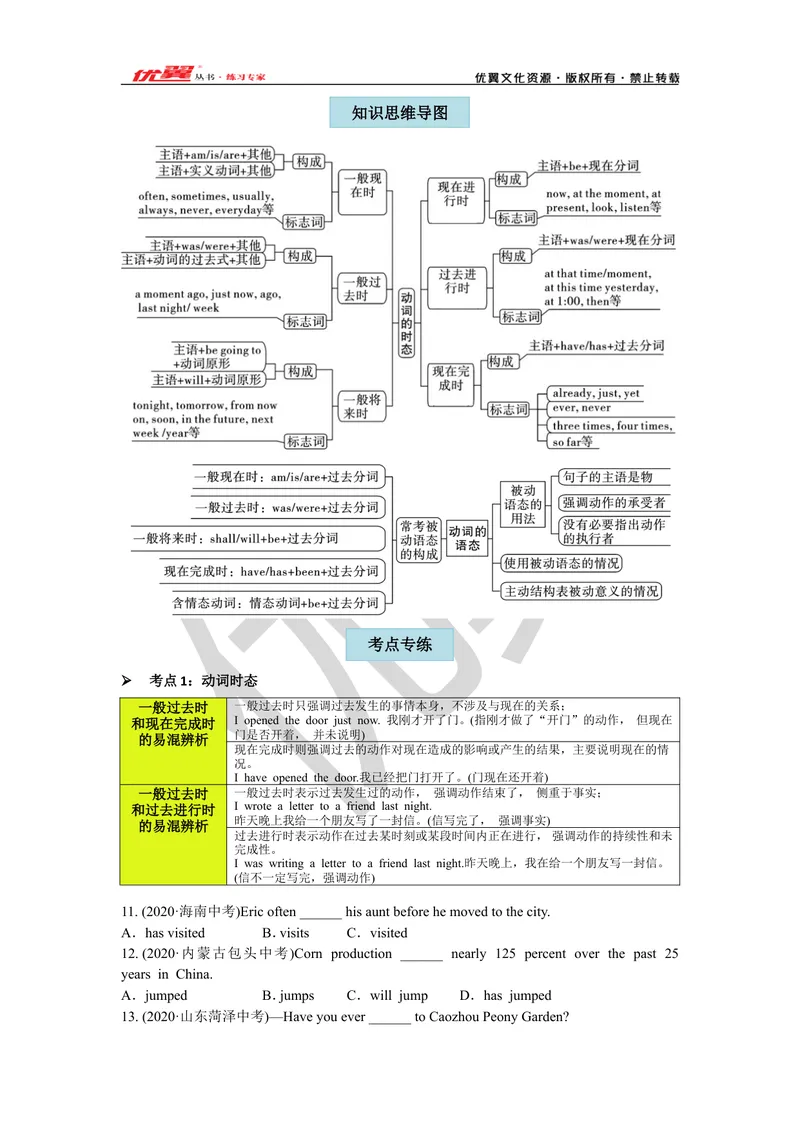
Every little helps
不同时态/语态下的英文俚语
Actions speak louder than words.行胜于言。 Practice makes perfect. 熟能生巧
barely made it on time差点没赶上 be in the air 将要发生的事情
been there and done that 谋其政;经历过了 All things are difficult before they are easy.
born yesterday 乳臭未干 万事开头难。
come to the point 直截了当地说 If you snooze, you lose!
cook the book 做假账 如果你不注意, 就错过良机了。
Cross that bridge when we come to it. Well begun is half done.
船到桥头自然直 良好的开端是成功的一半。
中考复习专项(十一)——动词的时态和语态
真题演练
1. (2020·重庆中考)Listen! Our teacher ______ in the music classroom.
A.sings B.sang C.will sing D.is singing
2. (2020·重庆中考)Don’t drink coffee before going to bed, or you ______ easily.
A.don’t fall asleep B.won’t fall asleep
C.didn’t fall asleep D.haven’t fallen asleep
3. (2020·甘肃中考)I want a mobile phone which ______ good pictures.
A.took B.is taking C.takes D.take
4. My mother ________ a good example for me since I was young.
A. was B. has been C. will be D. is
5. When I was in primary school, the books ________ me to a wonderful world.
A. brought B. are bringing C. bring D. have brought
6. (2020·吉林中考)Tom ______ when I called him yesterday.
A.read B.is reading C.was reading
7. (2020·重庆A卷中考)Another bridge over the Jialing River ______ last year.
A.builds B.built C.is built D.was built
8. (2020·海南中考)Many successful businessmen ______ to Hainan to give advice on how to
build Hainan Free Trade Port.
A.invite B.are invited C.are inviting
9. (2020·扬州中考)—Have you tasted baozza, a mixture of pizza and baozi?
—Sure.Thousands of baozza ______ at a baozi factory in Yangzhou each day next month.
A.will make B.makes C.was made D.will be made
10. (2020·泰州中考)This pair of trousers ______ smooth because they are made of Chinese silk.
A.feels B.feel C.is felt D.are felt
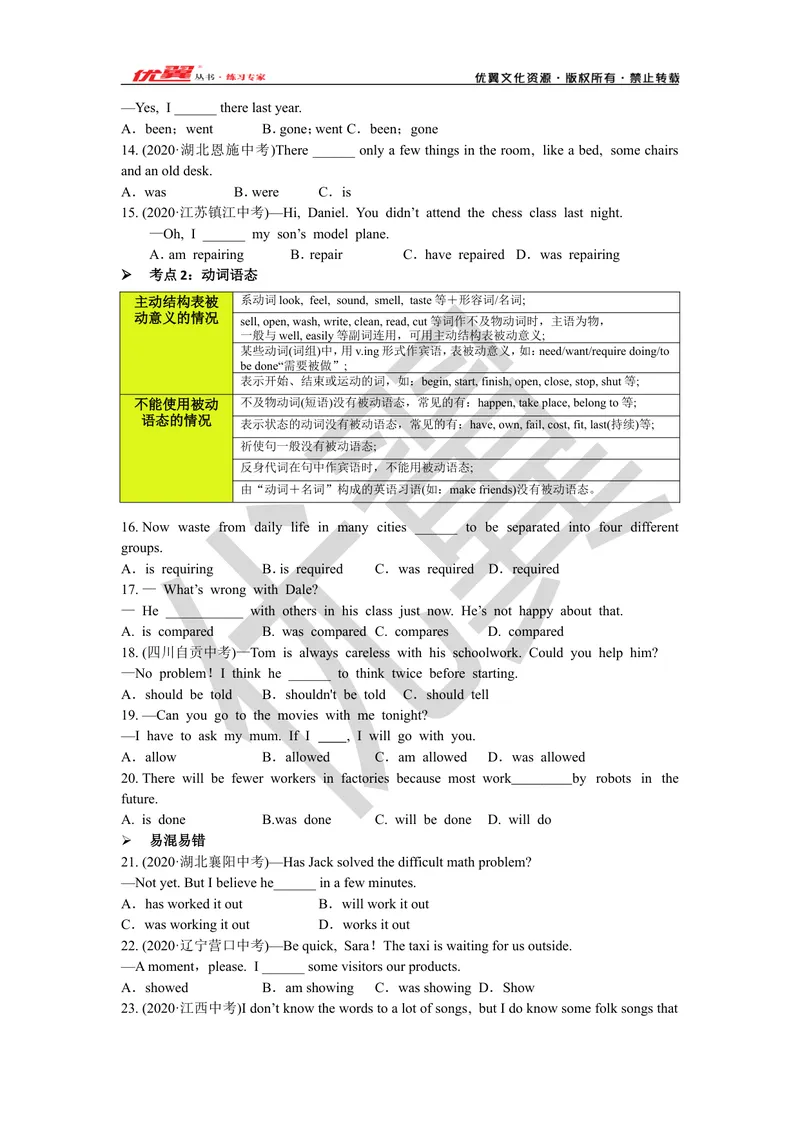
思考并总结:中考真题中关于动词的时态和语态的考点主要有哪些?你觉得自己哪一部分
最需加强?请在下述思维导图中用红笔重点标出自己的易错点并分享出来。知识思维导图
考点专练
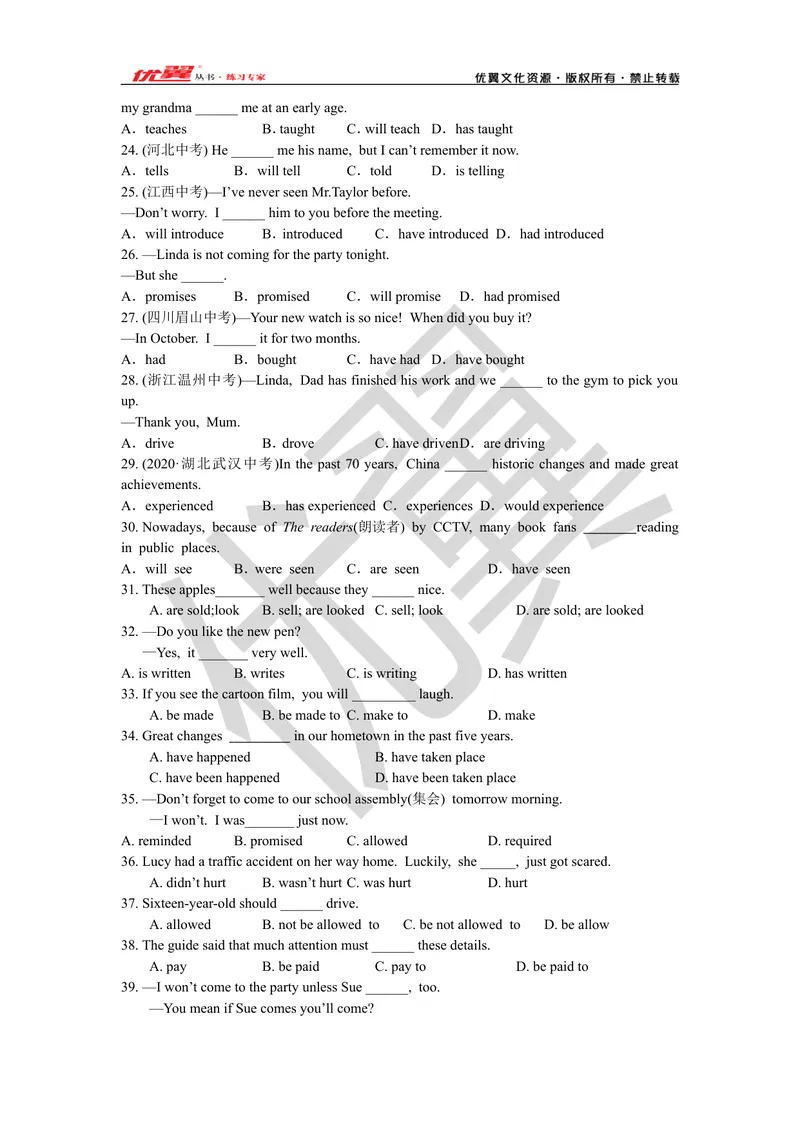
考点1:动词时态
一般过去时 一般过去时只强调过去发生的事情本身,不涉及与现在的关系;
和现在完成时 I opened the door just now. 我刚才开了门。(指刚才做了“开门”的动作, 但现在
的易混辨析
门是否开着, 并未说明)
现在完成时则强调过去的动作对现在造成的影响或产生的结果,主要说明现在的情
况。
I have opened the door.我已经把门打开了。(门现在还开着)
一般过去时 一般过去时表示过去发生过的动作, 强调动作结束了, 侧重于事实;
和过去进行时 I wrote a letter to a friend last night.
的易混辨析
昨天晚上我给一个朋友写了一封信。(信写完了, 强调事实)
过去进行时表示动作在过去某时刻或某段时间内正在进行, 强调动作的持续性和未
完成性。
I was writing a letter to a friend last night.昨天晚上,我在给一个朋友写一封信。
(信不一定写完,强调动作)
11. (2020·海南中考)Eric often ______ his aunt before he moved to the city.
A.has visited B.visits C.visited
12. (2020·内蒙古包头中考)Corn production ______ nearly 125 percent over the past 25
years in China.
A.jumped B.jumps C.will jump D.has jumped
13. (2020·山东菏泽中考)—Have you ever ______ to Caozhou Peony Garden?—Yes, I ______ there last year.
A.been;went B.gone;went C.been;gone
14. (2020·湖北恩施中考)There ______ only a few things in the room, like a bed, some chairs
and an old desk.
A.was B.were C.is
15. (2020·江苏镇江中考)—Hi, Daniel. You didn’t attend the chess class last night.
—Oh, I ______ my son’s model plane.
A.am repairing B.repair C.have repaired D.was repairing
考点2:动词语态
主动结构表被 系动词look, feel, sound, smell, taste等+形容词/名词;
动意义的情况
sell, open, wash, write, clean, read, cut等词作不及物动词时,主语为物,
一般与well, easily等副词连用,可用主动结构表被动意义;
某些动词(词组)中,用v.ing形式作宾语,表被动意义,如:need/want/require doing/to
be done“需要被做”;
表示开始、结束或运动的词,如:begin, start, finish, open, close, stop, shut等;
不能使用被动 不及物动词(短语)没有被动语态,常见的有:happen, take place, belong to等;
语态的情况
表示状态的动词没有被动语态,常见的有:have, own, fail, cost, fit, last(持续)等;
祈使句一般没有被动语态;
反身代词在句中作宾语时,不能用被动语态;
由“动词+名词”构成的英语习语(如:make friends)没有被动语态。
16. Now waste from daily life in many cities ______ to be separated into four different
groups.
A.is requiring B.is required C.was required D.required
17. — What’s wrong with Dale?
— He ___________ with others in his class just now. He’s not happy about that.
A. is compared B. was compared C. compares D. compared
18. (四川自贡中考)—Tom is always careless with his schoolwork. Could you help him?
—No problem!I think he ______ to think twice before starting.
A.should be told B.shouldn't be told C.should tell
19. —Can you go to the movies with me tonight?
—I have to ask my mum. If I , I will go with you.
A.allow B.allowed C.am allowed D.was allowed
20. There will be fewer workers in factories because most work by robots in the
future.
A. is done B.was done C. will be done D. will do
易混易错
21. (2020·湖北襄阳中考)—Has Jack solved the difficult math problem?
—Not yet. But I believe he______ in a few minutes.
A.has worked it out B.will work it out
C.was working it out D.works it out
22. (2020·辽宁营口中考)—Be quick, Sara!The taxi is waiting for us outside.
—A moment,please. I ______ some visitors our products.
A.showed B.am showing C.was showing D.Show
23. (2020·江西中考)I don’t know the words to a lot of songs, but I do know some folk songs thatmy grandma ______ me at an early age.
A.teaches B.taught C.will teach D.has taught
24. (河北中考) He ______ me his name, but I can’t remember it now.
A.tells B.will tell C.told D.is telling
25. (江西中考)—I’ve never seen Mr.Taylor before.
—Don’t worry. I ______ him to you before the meeting.
A.will introduce B.introduced C.have introduced D.had introduced
26. —Linda is not coming for the party tonight.
—But she ______.
A.promises B.promised C.will promise D.had promised
27. (四川眉山中考)—Your new watch is so nice! When did you buy it?
—In October. I ______ it for two months.
A.had B.bought C.have had D.have bought
28. (浙江温州中考)—Linda, Dad has finished his work and we ______ to the gym to pick you
up.
—Thank you, Mum.
A.drive B.drove C.have drivenD.are driving
29. (2020·湖北武汉中考)In the past 70 years, China ______ historic changes and made great
achievements.
A.experienced B.has experienced C.experiences D.would experience
30. Nowadays, because of The readers(朗读者) by CCTV, many book fans reading
in public places.
A.will see B.were seen C.are seen D.have seen
31. These apples_______ well because they ______ nice.
A. are sold;look B. sell; are looked C. sell; look D. are sold; are looked
32. —Do you like the new pen?
—Yes, it _______ very well.
A. is written B. writes C. is writing D. has written
33. If you see the cartoon film, you will _________ laugh.
A. be made B. be made to C. make to D. make
34. Great changes in our hometown in the past five years.
A. have happened B. have taken place
C. have been happened D. have been taken place
35. —Don’t forget to come to our school assembly(集会) tomorrow morning.
—I won’t. I was_______ just now.
A. reminded B. promised C. allowed D. required
36. Lucy had a traffic accident on her way home. Luckily, she _____, just got scared.
A. didn’t hurt B. wasn’t hurt C. was hurt D. hurt
37. Sixteen-year-old should ______ drive.
A. allowed B. not be allowed to C. be not allowed to D. be allow
38. The guide said that much attention must ______ these details.
A. pay B. be paid C. pay to D. be paid to
39. —I won’t come to the party unless Sue ______, too.
—You mean if Sue comes you’ll come?A. will be invited B. is invited C. will invite D. invites
40. —A nice car! Is it yours?
—No, it isn’t. I ________ it from a friend of mine.
A. borrow B. have borrowed C. will borrow D. borrowed
41. —Where are the flowers?
—You see, someone_______ them at the window.
A. moves B. had moved C. has moved D. would move
42. I don’t feel well, Jack. I’m afraid you _______ me your cold.
A. give B. had given C. have given D. would give
43. (武汉中考) —Do you still play basketball?
—Oh, no. I it for the past two years.
A. haven’t played B. didn’t play C. won’t play D. hadn’t played
44. (青岛中考)—It’s time to work now.
—OK. I’ll wake Carl up. He for an hour.
A. has fallen asleep B. has been asleep
C. fell asleep D.falls asleep
45. (眉山中考)— Are you a basketball player in your school?
—Yes, I the team 3 years ago. I in it for 3 years.
A. joined; was B. was joined; am
C. have joined; have been D. joined; have been
综合提升
A Language Only for Women
In the past, most Chinese women couldn’t go to school. But this doesn’t mean that they
didn’t want to learn.
In a remote(偏远的) part of China, girls were also not allowed to have any kind of
education, so Nȕshu 1 (create) in secret. Nȕshu 2 (mean) “Women’s Writing” in
Chinese. It is created and used only by women.
Hundreds of years ago in Jiangyong County of Hunan Province, Nȕshu 3 (teach) at
home by elderly women to girls. And in villages, women 4 (use) these words to
write poems or songs. Many old poems 5 (write) in Nȕshu by women talked about
their life, whether it was happy or sad, easy or hard. The words 6 (be) full of
encouragement and positive energy(正能量).
Ji Xianlin, an expert, once said that Nȕshu was a women’s symbol since it was created
by talented women who were not allowed to receive any education. The unique (独特的)
written words 7 (show) Chinese people’s strong spirit.
Nȕshu 8 (call) the world’s only surviving words for women. However, the beautiful
language is 9 ( die). Today girls have rights to go to school. Nȕshu is not widely used
in daily life. And there are only a few women who can still read and write in this
language.
Much to our relief , experts are 10 (try) their best to keep these beautiful andinteresting words alive.
阅读链接
Seek out honest advice
国学故事:裴矩佞于隋而诤于唐。
Pei Ju was a government official who served during both the Sui(581-618) and Tang
(618-907) dynasties, but he had very different reputations (名声) in these two periods.
According to historical records, Pei often flattered (奉承) Emperor Yangdi of the Sui
Dynasty. He never disagreed with the emperor’s ideas, even though he knew they might
be wrong. Knowing that Emperor Yangdi was very warlike, Pei suggested fighting many
wars. This, however, led to Sui’s downfall, as the wars cost too many human and
material resources.
When the Tang Dynasty was established (建立), Pei started to work for the new
government. He seemed to become a totally different person. Instead of flattering Emperor
Taizong, Pei always spoke out against his wrongs and tried his best to help Taizong make
the right decisions.
Why did Pei change? According to Chinese historian Sima Guang(1019-1086), Pei was
affected by who he worked for. Emperor Yangdi hated to be criticized(批评), while
Emperor Taizong loved to hear frank (直率的) advice. That made the difference.
1. What was Pei like when he was an official during the Sui Dynasty?
A. He always agreed with the emperor.
B. He knew very little about the emperor.
C. He fought many wars for the emperor.
D. He never spoke in front of the emperor.
2. Why was Pei so honest with Emperor Taizong?
A. Because Taizong treated him well.
B. Because he enjoyed challenging others.
C. Because Taizong could accept frank advice.
D. Because he didn’t like the new government.
3. What does Xie Cun think about Pei?
A. He was a perfect role model.
B. He did many undesirable things.
C. He was influenced by his environment.
D. He should've chosen a better master to serve.
4. What can we learn from the story?A. We shouldn’t make friends with people like Pei.
B. We should be open-minded and welcome frank advice.
C. Being frank with others can stop us from making new friends.
D. Criticizing others can help us improve.