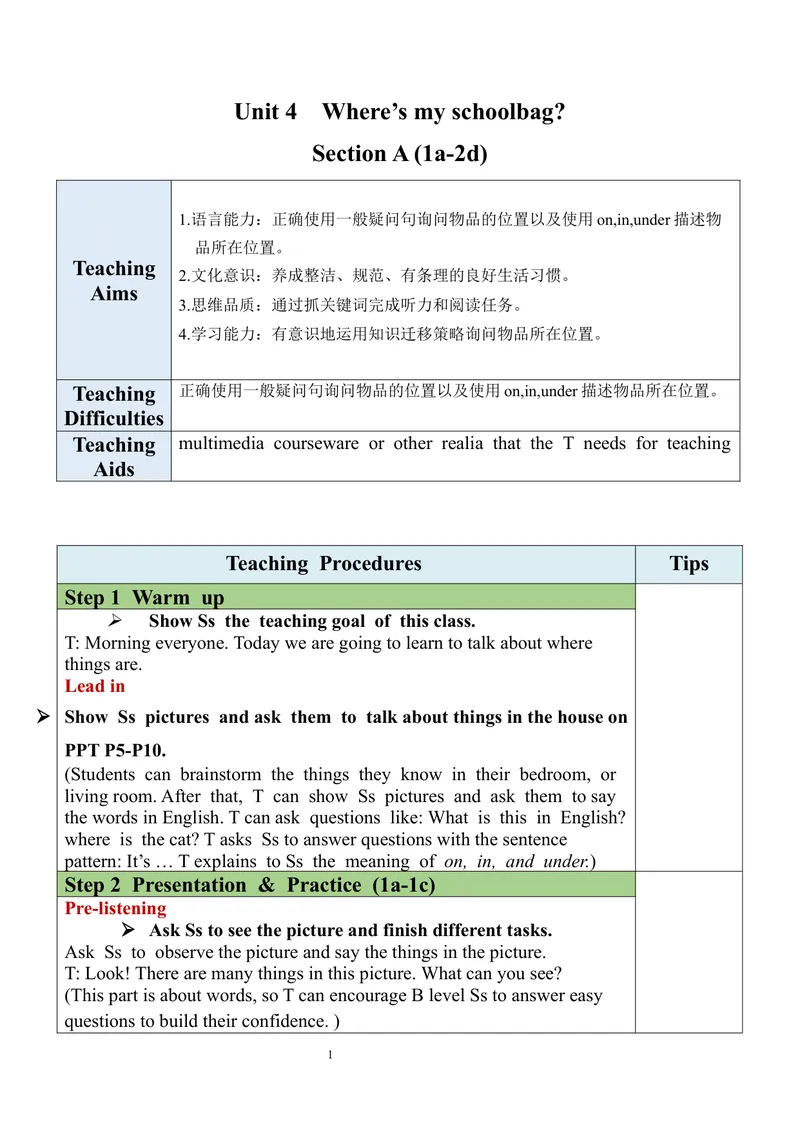
文档文本内容
Unit 4 Where’s my schoolbag?
Section A (1a-2d)
1.语言能力:正确使用一般疑问句询问物品的位置以及使用on,in,under描述物
品所在位置。
Teaching
2.文化意识:养成整洁、规范、有条理的良好生活习惯。
Aims
3.思维品质:通过抓关键词完成听力和阅读任务。
4.学习能力:有意识地运用知识迁移策略询问物品所在位置。
Teaching 正确使用一般疑问句询问物品的位置以及使用on,in,under描述物品所在位置。
Difficulties
Teaching multimedia courseware or other realia that the T needs for teaching
Aids
Teaching Procedures Tips
Step 1 Warm up
Show Ss the teaching goal of this class.
T: Morning everyone. Today we are going to learn to talk about where
things are.
Lead in
Show Ss pictures and ask them to talk about things in the house on
PPT P5-P10.
(Students can brainstorm the things they know in their bedroom, or
living room. After that, T can show Ss pictures and ask them to say
the words in English. T can ask questions like: What is this in English?
where is the cat? T asks Ss to answer questions with the sentence
pattern: It’s … T explains to Ss the meaning of on, in, and under.)
Step 2 Presentation & Practice (1a-1c)
Pre-listening
Ask Ss to see the picture and finish different tasks.
Ask Ss to observe the picture and say the things in the picture.
T: Look! There are many things in this picture. What can you see?
(This part is about words, so T can encourage B level Ss to answer easy
questions to build their confidence. )
11a
Ask Ss to match the words with the things in the picture in 1a.
(Ask Ss to share the words one by one to make sure they can say the
school things correctly and can spell the words correctly.)
Answers: b e h g d a f c
Ask Ss to see pictures and answer questions one by one.
(Ask Ss to use the sentence pattern: —Where is …? —It’s on/in/under…
T must correct Ss grammar mistakes when they share their conversation
in class. T can make a summary about the sentence pattern: —Where is
…? T should also give examples about the sentence pattern: Where are …
They are …)
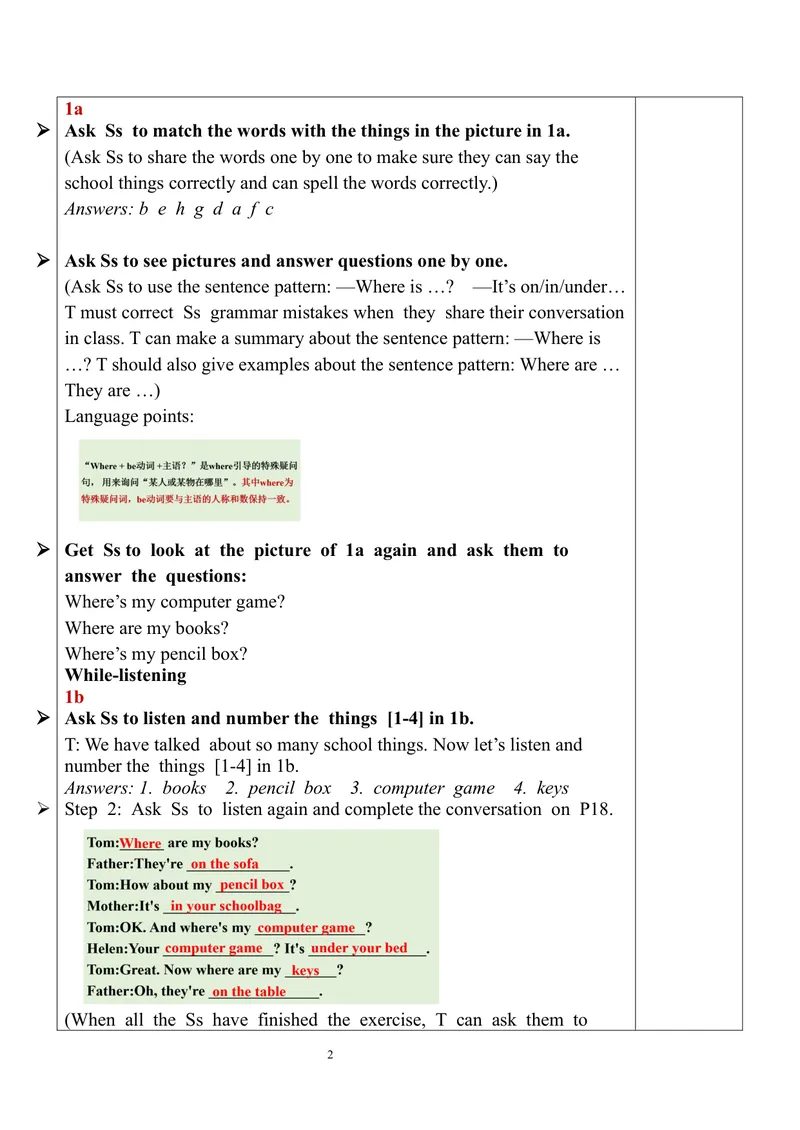
Language points:
Get Ss to look at the picture of 1a again and ask them to
answer the questions:
Where’s my computer game?
Where are my books?
Where’s my pencil box?
While-listening
1b
Ask Ss to listen and number the things [1-4] in 1b.
T: We have talked about so many school things. Now let’s listen and
number the things [1-4] in 1b.
Answers: 1. books 2. pencil box 3. computer game 4. keys
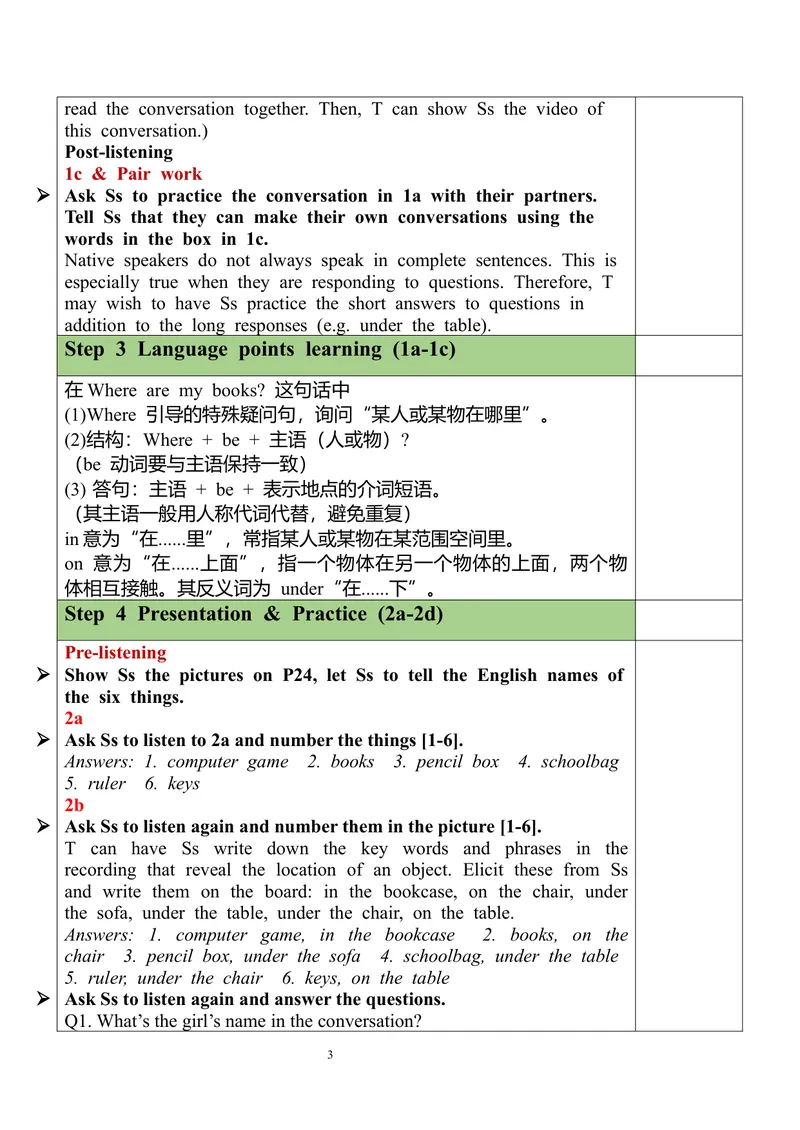
Step 2: Ask Ss to listen again and complete the conversation on P18.
(When all the Ss have finished the exercise, T can ask them to
2read the conversation together. Then, T can show Ss the video of
this conversation.)
Post-listening
1c & Pair work
Ask Ss to practice the conversation in 1a with their partners.
Tell Ss that they can make their own conversations using the
words in the box in 1c.
Native speakers do not always speak in complete sentences. This is
especially true when they are responding to questions. Therefore, T
may wish to have Ss practice the short answers to questions in
addition to the long responses (e.g. under the table).
Step 3 Language points learning (1a-1c)
在Where are my books? 这句话中
(1)Where 引导的特殊疑问句,询问“某人或某物在哪里”。
(2)结构:Where + be + 主语(人或物)?
(be 动词要与主语保持一致)
(3) 答句:主语 + be + 表示地点的介词短语。
(其主语一般用人称代词代替,避免重复)
in意为“在......里”,常指某人或某物在某范围空间里。
on 意为“在......上面”,指一个物体在另一个物体的上面,两个物
体相互接触。其反义词为 under“在......下”。
Step 4 Presentation & Practice (2a-2d)
Pre-listening
Show Ss the pictures on P24, let Ss to tell the English names of
the six things.
2a
Ask Ss to listen to 2a and number the things [1-6].
Answers: 1. computer game 2. books 3. pencil box 4. schoolbag
5. ruler 6. keys
2b
Ask Ss to listen again and number them in the picture [1-6].
T can have Ss write down the key words and phrases in the
recording that reveal the location of an object. Elicit these from Ss
and write them on the board: in the bookcase, on the chair, under
the sofa, under the table, under the chair, on the table.
Answers: 1. computer game, in the bookcase 2. books, on the
chair 3. pencil box, under the sofa 4. schoolbag, under the table
5. ruler, under the chair 6. keys, on the table
Ask Ss to listen again and answer the questions.
Q1. What’s the girl’s name in the conversation?
3Q2. Is the boy’s computer game on the table?
Q3. Are the boy’s books in the bookcase?
Answers: 1. Helen. 2. No, it isn’t. 3. No, they aren’t.
Ask Ss to read the listening scripts.
(After Ss finish reading, T can ask Ss to underline the Wh-question and
their answer: —Where is …? —It’s on/in/under… and the
interrogative sentence and its answer: — Is my computer game on the
table? — No, it isn’t. It’s in the bookcase. Explain the usage of these
two sentence patterns. Then ask Ss to ask and answer questions with the
two sentence patterns in pairs. )
2c
Remind Ss that they can say things in more than one way. It
can be useful to use word subtraction drills to show Ss the
acceptable variations in answering.
For example:
T: Are the keys on the sofa? (Gesture for Ss to repeat.)
T: No, they aren’t. They are on the table. (Gesture for Ss to
repeat.)
T: No, they aren’t. (Gesture for Ss to repeat.)
T: No. (Gesture for Ss to repeat.)
2d
T asks to role-play a conversation between Mom and Jack.
T: Now let’s role-play a conversation between Mom and Jack. Let’s read
the conversation first. Group 1&2 will be Mom and Group 3&4 will be
Jack. Here we go.
(After reading together, T asks Ss to choose one partner on their own and
role-play. One or two pairs of Ss volunteer to share.)
Step 4 Language points learning (2a-2d)
1) come 是不及物动词,其反义词为 go,意为“去”。come 常与介
词 to 搭配使用, 后面跟地点名词,表示“来到某地”。当 come 后
跟here,home等地点副词时,其后不带介词to。
2) come on 在此处表示催促, 意为“快点儿”。英语中还可以用
“Hurry up!”表示催促。
3. I think it’s in your grandparents’ room. (教材P20 2d)
1) think v. 认为; 想;思考
2) 常用短语有:think about “认为、思考” think of “想起、认为……
(怎么样)”
4Step 5 Exercises & Homework
Exercises
Ask Ss to do the exercises on PPT P37-P39.
T asks Ss to make a summary about what we have learned today.
(Some students may make mistakes on PPT P38, so teachers must correct
them.)
Homework
Read the conversation in 2d.
Do the exercises in students’ book.
The most difficult part in this period is to help students understand the
differences between the two sentences patterns: 1. —Where is/are …? —
Teaching It’s/ They’re on/in/under… 2. — Is my computer game on the table?
Reflection — No, it isn’t. It’s in the bookcase. Another sentence pattern is
important too: I think it's in your grandparents’ room. But I didn’t talk
about the differences between s’ and ’s.
5