文档文本内容
Unit 2 This is my sister.
Section A(1a-2d)
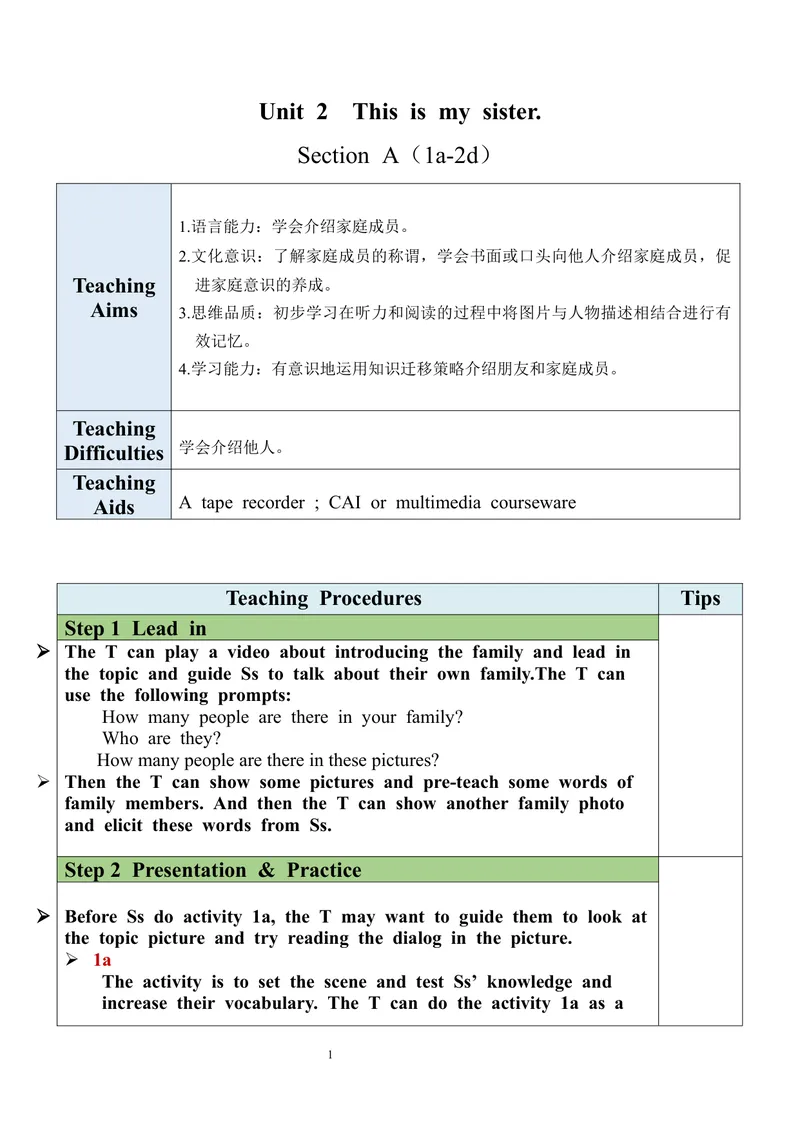
1.语言能力:学会介绍家庭成员。
2.文化意识:了解家庭成员的称谓,学会书面或口头向他人介绍家庭成员,促
Teaching 进家庭意识的养成。
Aims 3.思维品质:初步学习在听力和阅读的过程中将图片与人物描述相结合进行有
效记忆。
4.学习能力:有意识地运用知识迁移策略介绍朋友和家庭成员。
Teaching
Difficulties 学会介绍他人。
Teaching
Aids A tape recorder ; CAI or multimedia courseware
Teaching Procedures Tips
Step 1 Lead in
The T can play a video about introducing the family and lead in
the topic and guide Ss to talk about their own family.The T can
use the following prompts:
How many people are there in your family?
Who are they?
How many people are there in these pictures?
Then the T can show some pictures and pre-teach some words of
family members. And then the T can show another family photo
and elicit these words from Ss.
Step 2 Presentation & Practice
Before Ss do activity 1a, the T may want to guide them to look at
the topic picture and try reading the dialog in the picture.
1a
The activity is to set the scene and test Ss’ knowledge and
increase their vocabulary. The T can do the activity 1a as a
1class or have Ss do this alone or in pairs first before doing
the activity as a class.
Answers:
1. a 2.c 3.b 4.h 5.f 6.e 7.i 8.d 9.g
Then the T can present a family tree to Ss to help Ss to
understand the family relations.
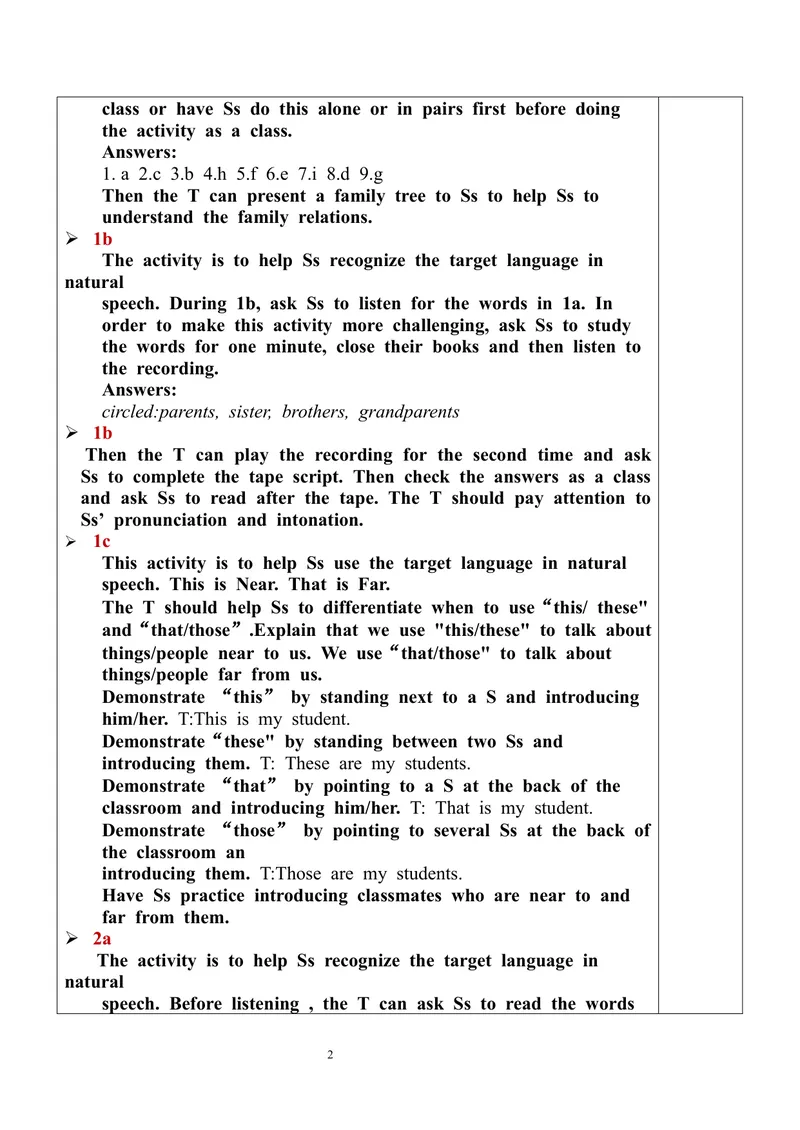
1b
The activity is to help Ss recognize the target language in
natural
speech. During 1b, ask Ss to listen for the words in 1a. In
order to make this activity more challenging, ask Ss to study
the words for one minute, close their books and then listen to
the recording.
Answers:
circled:parents, sister, brothers, grandparents
1b
Then the T can play the recording for the second time and ask
Ss to complete the tape script. Then check the answers as a class
and ask Ss to read after the tape. The T should pay attention to
Ss’ pronunciation and intonation.
1c
This activity is to help Ss use the target language in natural
speech. This is Near. That is Far.
The T should help Ss to differentiate when to use“this/ these"
and“that/those”.Explain that we use "this/these" to talk about
things/people near to us. We use“that/those" to talk about
things/people far from us.
Demonstrate “this” by standing next to a S and introducing
him/her. T:This is my student.
Demonstrate“these" by standing between two Ss and
introducing them. T: These are my students.
Demonstrate “that” by pointing to a S at the back of the
classroom and introducing him/her. T: That is my student.
Demonstrate “those” by pointing to several Ss at the back of
the classroom an
introducing them. T:Those are my students.
Have Ss practice introducing classmates who are near to and
far from them.
2a
The activity is to help Ss recognize the target language in
natural
speech. Before listening , the T can ask Ss to read the words
2in the box and say out their Chinese meanings. Then play the
recording for the first time and make Ss to finish the task in
2a. Then check answers as a class.
Answers:
circled:parents, mother, father, sister, grandparents, brother
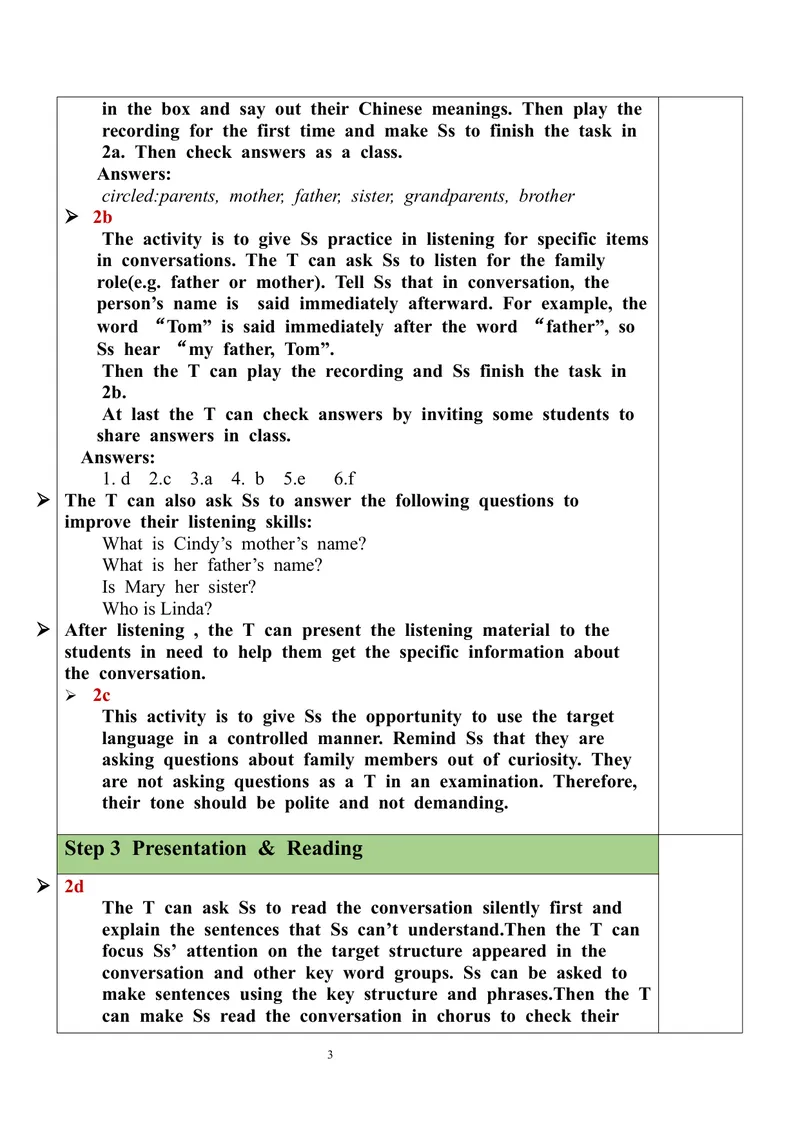
2b
The activity is to give Ss practice in listening for specific items
in conversations. The T can ask Ss to listen for the family
role(e.g. father or mother). Tell Ss that in conversation, the
person’s name is said immediately afterward. For example, the
word “Tom” is said immediately after the word “father”, so
Ss hear “my father, Tom”.
Then the T can play the recording and Ss finish the task in
2b.
At last the T can check answers by inviting some students to
share answers in class.
Answers:
1. d 2.c 3.a 4. b 5.e 6.f
The T can also ask Ss to answer the following questions to
improve their listening skills:
What is Cindy’s mother’s name?
What is her father’s name?
Is Mary her sister?
Who is Linda?
After listening , the T can present the listening material to the
students in need to help them get the specific information about
the conversation.
2c
This activity is to give Ss the opportunity to use the target
language in a controlled manner. Remind Ss that they are
asking questions about family members out of curiosity. They
are not asking questions as a T in an examination. Therefore,
their tone should be polite and not demanding.
Step 3 Presentation & Reading
2d
The T can ask Ss to read the conversation silently first and
explain the sentences that Ss can’t understand.Then the T can
focus Ss’ attention on the target structure appeared in the
conversation and other key word groups. Ss can be asked to
make sentences using the key structure and phrases.Then the T
can make Ss read the conversation in chorus to check their
3pronunciation and intonation. At last the T can invite some Ss
to role-play the conversation as open pairs.
Step 4 Language points
介绍他人的句型
1) This is ... 意为“这是······”,用来介绍离说话人较近的第三方。
2) 介绍离说话人较远的第三方时, 可以用“That is ... ”意为“那
是······” 。 “That is”可以缩写成“That’s”。
3) 被介绍的人不止一个时,可以使用句型“These/Those are ...”。
【拓展延伸】
在打电话用语中,“This is ...”表示“我是······”,用于介绍自己。
特别提醒:
“That is”可以缩写成“That’s”,但是 This is, These are 和 Those are 均
不能缩写。
family作主语时,如果指整个家庭,谓语动词用单数形式;如果指家庭
中的成员,谓语动词用复数形式。
1) those 是指示代词“那些”,用来指代较远的人或物,其单数形式为
that。
2) these是指示代词“这些”,用来指代较近的人或物,其单数形式
为this。
who为疑问代词,常用在句首引导特殊疑问句,对人进行提问。
Who引导的特殊疑问句:Who + be动词 + 主语?
主语是单数时,be动词用is;主语是复数时,be动词用are。
1) Is this ...? 意为“这是······吗?”;Is that ...? 意为“那是······
吗?”。
2) 上述两个一般疑问句,常用“Yes, it is./No, it isn't.”进行回答。
1) Are these ...? 意为“这(些)是······吗?”;Are those ...? 意为“那
(些)是······吗?”。
2) 上述两个一般疑问句,常用“Yes, they are./No, they aren't.”进行
回答。
Step 5 Summary & Homework
Summary The T can encourage Ss to summarize the key points of
4this class to help Ss consolidate the knowledge.
Homework:
Read and recite the conversation in 2d.
Do the exercises in students’ book.
This is the first period of the unit.During this period, teachers interact
with students through high-density questions according to the topic
picture, which is helpful for students to learn new vocabulary, and
also help students review the language content they have learned.
Teaching Teachers' questions can play a good demonstration role for students in
Reflection pronunciation, intonation, expression and sentence making. At the
same time, they can quickly activate the relevant schemata in
students' brain and enter the state of language learning. Therefore,
teachers should make effective use of the topic picture and improve
their questioning skills.
5