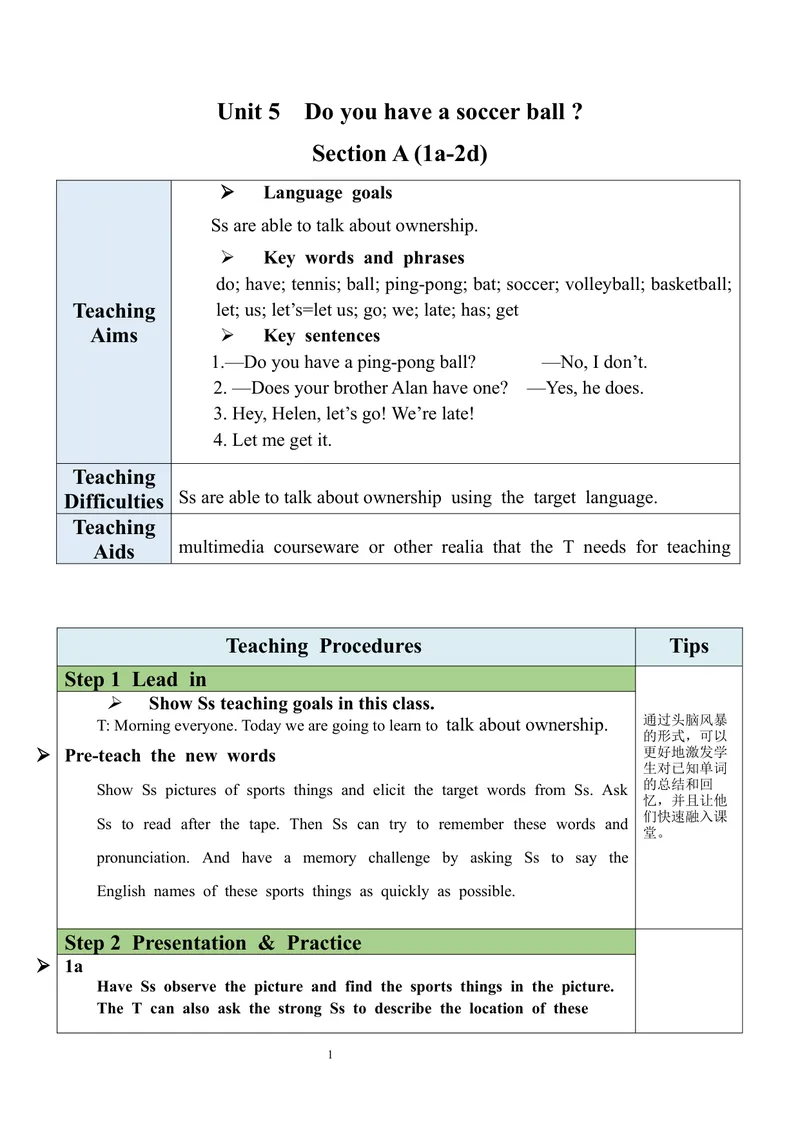
Unit 5 Do you have a soccer ball ?
Section A (1a-2d)
Language goals
Ss are able to talk about ownership.
Key words and phrases
do; have; tennis; ball; ping-pong; bat; soccer; volleyball; basketball;
Teaching let; us; let’s=let us; go; we; late; has; get
Aims Key sentences
1.—Do you have a ping-pong ball? —No, I don’t.
2. —Does your brother Alan have one? —Yes, he does.
3. Hey, Helen, let’s go! We’re late!
4. Let me get it.
Teaching
Difficulties Ss are able to talk about ownership using the target language.
Teaching
Aids multimedia courseware or other realia that the T needs for teaching
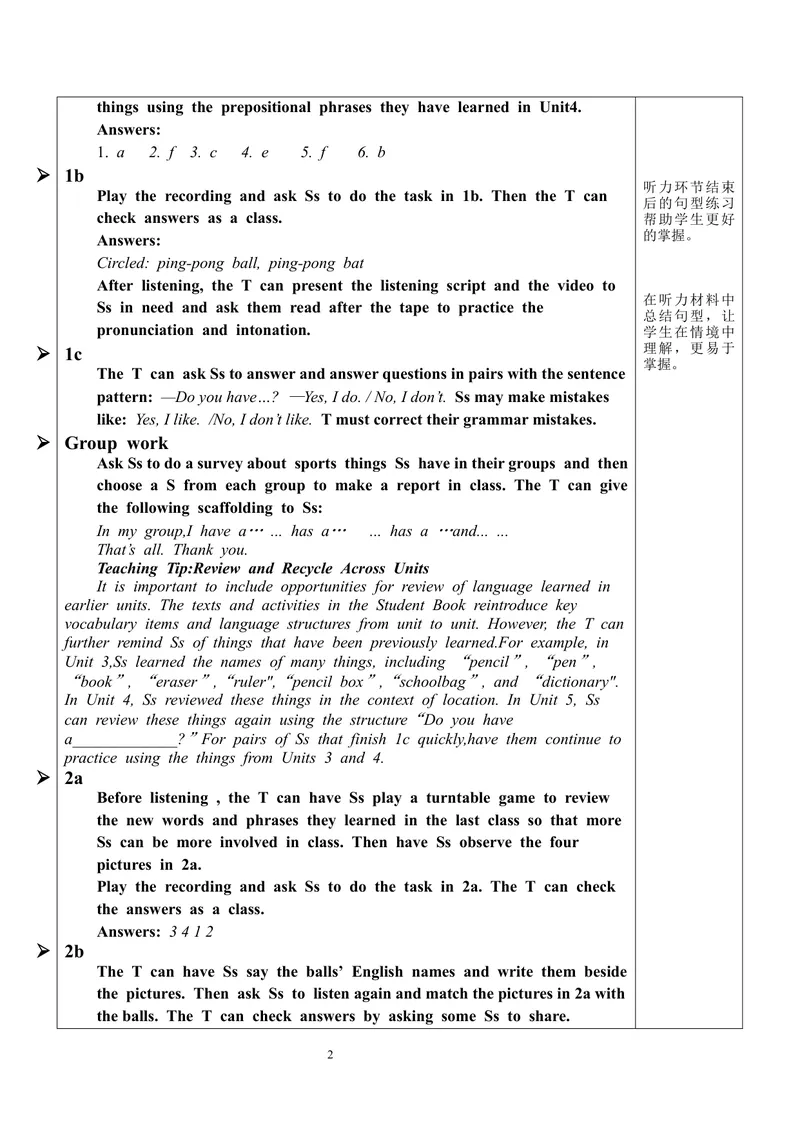
Teaching Procedures Tips
Step 1 Lead in
Show Ss teaching goals in this class.
T: Morning everyone. Today we are going to learn to talk about ownership. 通过头脑风暴
的形式,可以
Pre-teach the new words 更好地激发学
生对已知单词
的总结和回
Show Ss pictures of sports things and elicit the target words from Ss. Ask
忆,并且让他
们快速融入课
Ss to read after the tape. Then Ss can try to remember these words and
堂。
pronunciation. And have a memory challenge by asking Ss to say the
English names of these sports things as quickly as possible.
Step 2 Presentation & Practice
1a
Have Ss observe the picture and find the sports things in the picture.
The T can also ask the strong Ss to describe the location of these
1things using the prepositional phrases they have learned in Unit4.
Answers:
1. a 2. f 3. c 4. e 5. f 6. b
1b
听力环节结束
Play the recording and ask Ss to do the task in 1b. Then the T can
后的句型练习
check answers as a class. 帮助学生更好
Answers:
的掌握。
Circled: ping-pong ball, ping-pong bat
After listening, the T can present the listening script and the video to
在听力材料中
Ss in need and ask them read after the tape to practice the
总结句型,让
pronunciation and intonation. 学生在情境中
理解,更易于
1c
掌握。
The T can ask Ss to answer and answer questions in pairs with the sentence
pattern: —Do you have…? —Yes, I do. / No, I don’t. Ss may make mistakes
like: Yes, I like. /No, I don’t like. T must correct their grammar mistakes.
Group work
Ask Ss to do a survey about sports things Ss have in their groups and then
choose a S from each group to make a report in class. The T can give
the following scaffolding to Ss:
In my group,I have a… ... has a… ... has a …and... ...
That’s all. Thank you.
Teaching Tip:Review and Recycle Across Units
It is important to include opportunities for review of language learned in
earlier units. The texts and activities in the Student Book reintroduce key
vocabulary items and language structures from unit to unit. However, the T can
further remind Ss of things that have been previously learned.For example, in
Unit 3,Ss learned the names of many things, including “pencil”, “pen”,
“book”, “eraser”,“ruler",“pencil box”,“schoolbag”, and “dictionary".
In Unit 4, Ss reviewed these things in the context of location. In Unit 5, Ss
can review these things again using the structure“Do you have
a_____________?”For pairs of Ss that finish 1c quickly,have them continue to
practice using the things from Units 3 and 4.
2a
Before listening , the T can have Ss play a turntable game to review
the new words and phrases they learned in the last class so that more
Ss can be more involved in class. Then have Ss observe the four
pictures in 2a.
Play the recording and ask Ss to do the task in 2a. The T can check
the answers as a class.
Answers: 3 4 1 2
2b
The T can have Ss say the balls’ English names and write them beside
the pictures. Then ask Ss to listen again and match the pictures in 2a with
the balls. The T can check answers by asking some Ss to share.
2Answers: 3 2 1 4
Teaching Tip:Has and Doesn’t have
Once you have completed 2b, challenge Ss to listen again and write “has”
or “doesn’t have” to complete the sentences you write on the board:
Paul______a soccer ball.
Mike______a basketball.
Jane ______ a tennis ball.
Dale ______ a volleyball.
Answers: 1.doesn’t have 2.has 3.doesn’t have 4.has
2c
The activity is to give Ss the opportunity to use the target language in
a controlled manner.
Teaching Tip: Stress Important Words
Teach Ss to stress the important words in a sentence.For example,in 2c,the
words “Jane”and“tennis ball” would be stressed in the model question
because they convey meaning.The word “no" would be the important word
in the model answer because it also conveys meaning. Ss can be taught
that the other words (e.g. does, have, a, she, doesn't) are often spoken
faster than the stressed words and with less emphasis. Nevertheless, all
words in a sentence should be spoken clearly and with the correct
pronunciation.
Step 3 Presentation & Reading
2d 2d的对话部分
The T can ask Ss to read the conversation silently first and explain the
对重点句型的
翻译和造句让
sentences that Ss can’t understand. Then the T can focus Ss’ attention
学生在真实情
on the
境中感知语言
target structure appeared in the conversation and other key word groups.
的运用。
Ss
can be asked to make sentences using the key structure and phrases.Then
the T
can make Ss read the conversation in chorus to check their
pronunciation and
intonation. At last the T can invite some Ss to role-play the conversation
as open
pairs.
Step 4 Language points
1. ping-pong作不可数名词,指“乒乓球运动”,表示“乒乓球运动中的球” 要
用ping-pong ball。此外, table tennis也表示“乒乓球运动”。
2. bat n. 球棒;球拍 bat作名词, 还有“蝙蝠”的意思。
3. have作及物动词,意为“有”,其第三人称单数形式是has。
表示“拥有”, 强调所属关系, 意为“某人有某
have 物”。
there be 强调存在关系, 意为“某地有某人/ 某物”。
4. Let's... 咱们……吧。该句型常用于提出建议或请求对方与自己一起做某事,
3Let's后接动词原形。
肯定回答:OK./All right./That sounds good./Good idea./...
否定回答:Sorry, I... 对不起,我……
Step 5 Exercises & Homework
Exercises
Ask Ss to do the exercises on P41-P43.
Have Ss make a summary about what we have learned today.
(Some students may make mistakes on P43, so teachers must
correct them and guide them how to answer the question.)
Homework
1. Read the conversation in 2d.
2. Do the exercises in students’ book.
I spent too much time on the words in this period so we don't have enough
time to learn the conversation in 2d. I should delete some word activities
Teaching
to save more time for 2d. Some students didn’t master the sentence
Reflection
patterns: 1.be late for…2. let sb. do. More dictation about the sentence
patterns should be done.
4