Unit 3 Is this your pencil?
Section A (1a-2d)
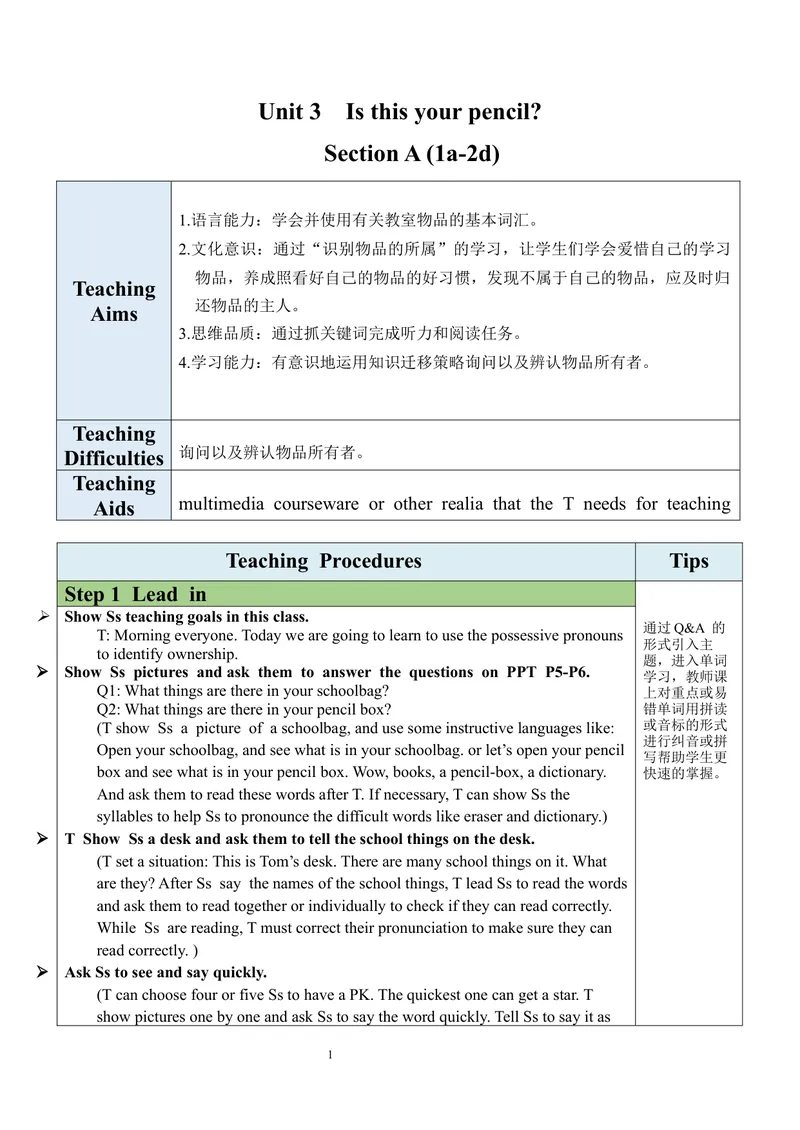
1.语言能力:学会并使用有关教室物品的基本词汇。
2.文化意识:通过“识别物品的所属”的学习,让学生们学会爱惜自己的学习
物品,养成照看好自己的物品的好习惯,发现不属于自己的物品,应及时归
Teaching
还物品的主人。
Aims
3.思维品质:通过抓关键词完成听力和阅读任务。
4.学习能力:有意识地运用知识迁移策略询问以及辨认物品所有者。
Teaching
询问以及辨认物品所有者。
Difficulties
Teaching
Aids multimedia courseware or other realia that the T needs for teaching
Teaching Procedures Tips
Step 1 Lead in
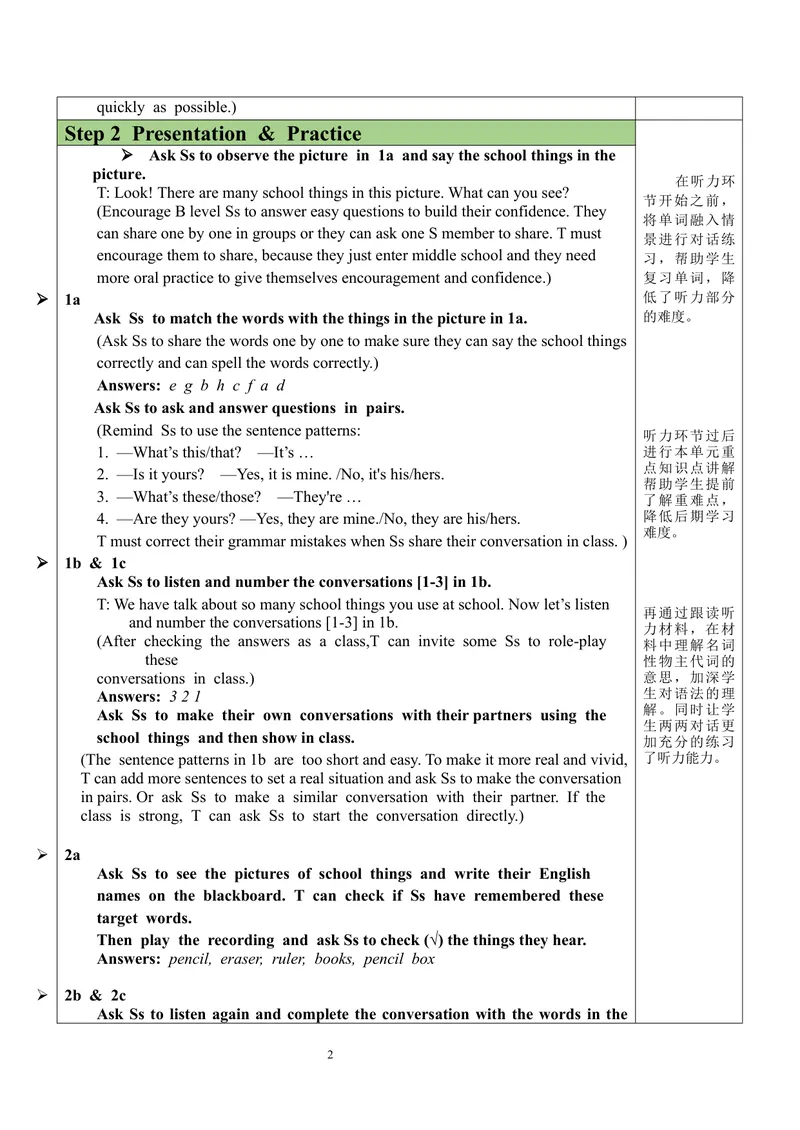
Show Ss teaching goals in this class.
通过Q&A 的
T: Morning everyone. Today we are going to learn to use the possessive pronouns
形式引入主
to identify ownership.
题,进入单词
Show Ss pictures and ask them to answer the questions on PPT P5-P6.
学习,教师课
Q1: What things are there in your schoolbag? 上对重点或易
Q2: What things are there in your pencil box? 错单词用拼读
(T show Ss a picture of a schoolbag, and use some instructive languages like: 或音标的形式
进行纠音或拼
Open your schoolbag, and see what is in your schoolbag. or let’s open your pencil
写帮助学生更
box and see what is in your pencil box. Wow, books, a pencil-box, a dictionary. 快速的掌握。
And ask them to read these words after T. If necessary, T can show Ss the
syllables to help Ss to pronounce the difficult words like eraser and dictionary.)
T Show Ss a desk and ask them to tell the school things on the desk.
(T set a situation: This is Tom’s desk. There are many school things on it. What
are they? After Ss say the names of the school things, T lead Ss to read the words
and ask them to read together or individually to check if they can read correctly.
While Ss are reading, T must correct their pronunciation to make sure they can
read correctly. )
Ask Ss to see and say quickly.
(T can choose four or five Ss to have a PK. The quickest one can get a star. T
show pictures one by one and ask Ss to say the word quickly. Tell Ss to say it as
1quickly as possible.)
Step 2 Presentation & Practice
Ask Ss to observe the picture in 1a and say the school things in the
picture.
在听力环
T: Look! There are many school things in this picture. What can you see?
节开始之前,
(Encourage B level Ss to answer easy questions to build their confidence. They
将单词融入情
can share one by one in groups or they can ask one S member to share. T must
景进行对话练
encourage them to share, because they just enter middle school and they need 习,帮助学生
more oral practice to give themselves encouragement and confidence.) 复习单词,降
1a 低了听力部分
Ask Ss to match the words with the things in the picture in 1a. 的难度。
(Ask Ss to share the words one by one to make sure they can say the school things
correctly and can spell the words correctly.)
Answers: e g b h c f a d
Ask Ss to ask and answer questions in pairs.
(Remind Ss to use the sentence patterns:
听力环节过后
1. —What’s this/that? —It’s … 进行本单元重
点知识点讲解
2. —Is it yours? —Yes, it is mine. /No, it's his/hers.
帮助学生提前
3. —What’s these/those? —They're … 了解重难点,
4. —Are they yours? —Yes, they are mine./No, they are his/hers. 降低后期学习
难度。
T must correct their grammar mistakes when Ss share their conversation in class. )
1b & 1c
Ask Ss to listen and number the conversations [1-3] in 1b.
T: We have talk about so many school things you use at school. Now let’s listen
再通过跟读听
and number the conversations [1-3] in 1b.
力材料,在材
(After checking the answers as a class,T can invite some Ss to role-play 料中理解名词
these 性物主代词的
conversations in class.) 意思,加深学
Answers: 3 2 1 生对语法的理
解。同时让学
Ask Ss to make their own conversations with their partners using the
生两两对话更
school things and then show in class.
加充分的练习
(The sentence patterns in 1b are too short and easy. To make it more real and vivid, 了听力能力。
T can add more sentences to set a real situation and ask Ss to make the conversation
in pairs. Or ask Ss to make a similar conversation with their partner. If the
class is strong, T can ask Ss to start the conversation directly.)
2a
Ask Ss to see the pictures of school things and write their English
names on the blackboard. T can check if Ss have remembered these
target words.
Then play the recording and ask Ss to check (√) the things they hear.
Answers: pencil, eraser, ruler, books, pencil box
2b & 2c
Ask Ss to listen again and complete the conversation with the words in the
2box in 2b.
(T can check answers by having Ss to role-play the conversation.)
Ask Ss to read the listening scripts so that they can have a better
understanding of the conversation. The T should explain some difficult
sentences or phrases that Ss can’t understand clearly.
Answers: pencil, eraser, ruler, books, pencil box
At last, Ss can be encouraged to make their own conversations using
the school things around them.
Step 3 Presentation & Reading
2d 2d的对话部分
The T can ask Ss to read the conversation silently first and explain 对知识点进行
了再一次总结
the sentences that Ss can’t understand.Then the T can focus Ss’ attention
和练习,让学
on the target structure appeared in the conversation and other key word
生在真实情境
groups. Ss can be asked to make sentences using the key structure and
中感知语言的
phrases.Then the T can make Ss read the conversation in chorus to check 运用。
their pronunciation and intonation. At last the T can invite some Ss to
role-play the conversation as open pairs.
Step 4 Language points
1.含be动词的一般疑问句
(1)结构:Be动词(am/is/are)+主语+其他?
(2)肯否回答:Yes, 主语+be动词(am/is/are).
No, 主语+be动词(am/is/are)+not.
(3)一般疑问句主语是 this, that, these, those,回答时用 it 指代 this/that;用
they指代these/those。
2. 名词性物主代词
3. Excuse me, Grace.
(1) excuse me用于礼貌地引起他人注意,尤其是问路、问姓名等。
(2) 对打断别人等失礼行为表示歉意。
(3) 用于婉转地表示不赞成对方的观点。
4. me pron.(I 的宾格)我
me是I的宾格形式, 用在动词或介词后面作宾语。
5 . What about this dictionary?
. “What about ...?” 等同于 “How about ...?”,是口语中常用的句型, 常用
于以下情景:
1) 向对方提出建议或请求;
32) 征求对方的看法或意见;
3) 用以将注意力转向另一人或物。
6. about prep.关于 adv.大约
(1)about在此处作介词,意为“关于”,后常接名词、代词或动词-ing形式作
宾语。
(2)about还可作副词,意为“大约” 。
7. Thank you for your help, Anna.
thank you for … 意为“为······感谢你”,等于Thanks for …,都是表达感谢的方
式。for是介词,后加名词、代词或动词-ing 形式,表示感谢的内容或原因,即
thank you for sth. 或 thank you for doing sth.
Step 5 Exercises & Homework Exercises的任
务是对本节课
重点知识点的
Exercises
总结与回顾,
Ask Ss to do the exercises on PPT P33-P35. 如果学生水平
T ask Ss to make a summary about what we have learned today. 较高,老师也
可以根据学生
Homework
情况适当增加
1. Recite the conversation in 2d. 练习量。
2. Do the exercises in students’ book.
In this period, the key and difficult part is to help Ss to use the possessive pronouns
well and can tell what these pronouns refer to in a passage. The most difficult thing is to
Teaching help them transform adjective pronouns (my, your, his, her, their…) + n. into the
Reflection possessive pronouns (mine, yours, hers, theirs …). Actually some weak Ss still can’t
master their meaning so well. So more practice and exercise must be done to help them
understand possessive pronouns.
4