Unit 8 When is your birthday?
Section A (1a-2e)
1.语言能力:能够掌握日期的询问与表达方式;能通过谈论自己、同学以及父
母家人的生日,理解生日更多的含义。
2.文化意识:通过互相询问生日的日期,可以增进同学之间的了解和友情并学
会
Teaching
在英语交流中注意他人的情感。
Aims
3.思维品质:通过本节课的学习培养学生相互之间的合作和竞争意识,能够形
成自主学习、有效交际和运用英语思维的能力。
4.学习能力:能在学习活动中积极与他人合作,共同完成学习任务。
Teaching 掌握日期的询问与表达方式。
Difficulties
Teaching multimedia courseware or other realia that the T needs for teaching
Aids
Teaching Procedures Tips
Step 1 Warm up
Show Ss teaching goals.
T: Morning everyone. Today we are going to learn to talk about likes and
dislikes.
Let’s sing a song
Let Ss sing a song about months with the video together. Ask them to
try to remember as many words as possible to express months.
Read and write
Show Ss pictures and ask them to say the months.
(T shows pictures and ask Ss the questions: What is the first year of the
month? What is the second year of the month? Students say the months. T
can correct Ss’ pronunciations. Then T leads Ss to read the words and uses
syllables to spell the words. Ss can practice by themselves and try to write
them down on the exercise books.)
1 Let’s chant!
Ask the whole class to say the 12 months in English one by one
together.
Step 2 Presentation & Practice (1a-1c)
Pre-listening
1a
Ask Ss to listen and repeat the months.
Ss listen and repeat after the tape. Then ask Ss to fill in the blanks on PPT
P12.
(Tip: If Ss are already familiar with the months of the year, have
them try and chant the months in reverse order. To make this more
challenging, you can have Ss compete to see who can say it
fastest.)
Ask Ss to have a Memory challenge.
T: Now, I’m going to click an apple at random and you need to
say the month you see in English as quickly as possible. Here we
go.
Step3: Ask Ss to do Q&A on PPT P15-P16.
(Tip: Before Ss do Q&A, T can use Chinese to explain the meaning of
ordinal numbers: first, second, third…When Ss share the answers, they
must spell the words on the board. T can correct their pronunciations
and spell mistakes.)
While-listening
1b
Ask Ss to listen and number the conversations [1-3].
Answers: 1. 1 2. 2 3. 3
As an alternative listening exercise, encourage Ss to answer the
questions on PPT P17 by taking notes. Explain to Ss that when
they take notes they should write down the information that
related to the questions.
Answers: 1. Her birthday is on May 2nd.
2. Her birthday is on January 5th.
3. His birthday is on June 3rd.
Post-listening
1c
T asks Ss to practice the conversations in 1b with their partners.
2T plays the recording of 1b. When listening to a recording, pause
after each line or short sentence clause and have Ss repeat.
Encourage Ss imitate the speed, pronunciation, intonation, volume
and word stress. To make this more interesting, have Ss vote on
which of their classmates sounds the most similar to the speaker in
the recording.
Ask Ss to make an interview about the date of their classmates’
birthdays and make a report.
T: Now here is a task for you. Move from your seat and interview five
students the dates of their birthdays. Then do a report for your partner.
Now let’s see who is the best reporter.
(Ss are encouraged to use the sentences: When is your birthday? My
birthday is on ... When Ss are interviewing, T walk around and give
help.)
Step 3 Language points learning (1a-1c)
1) month为可数名词,其复数形式为months。
2) 常见短语:this / last / next month 这 /上 / 下个月
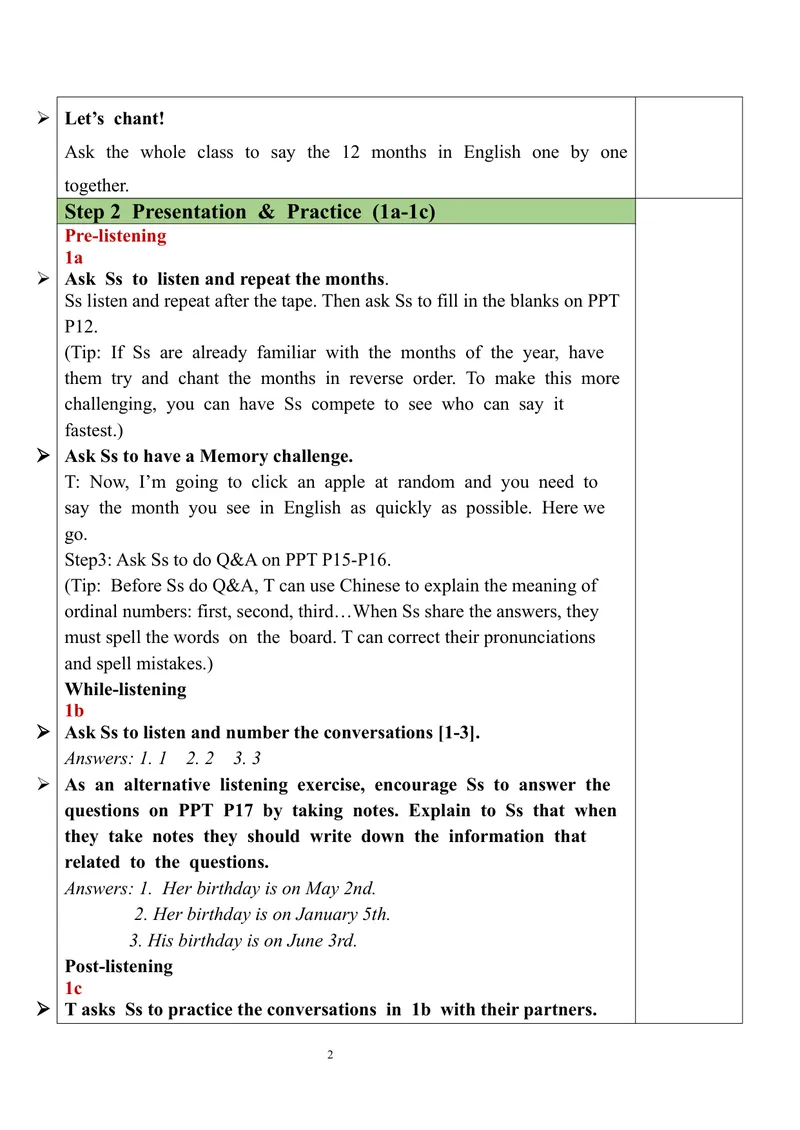
表示月份的名词都是专有名词,首字母必须大写。
“When is one's birthday?”为询问某人生日的句型,其答语通常为
“One's birthday is on+日期.”或“It's on+日期.”。
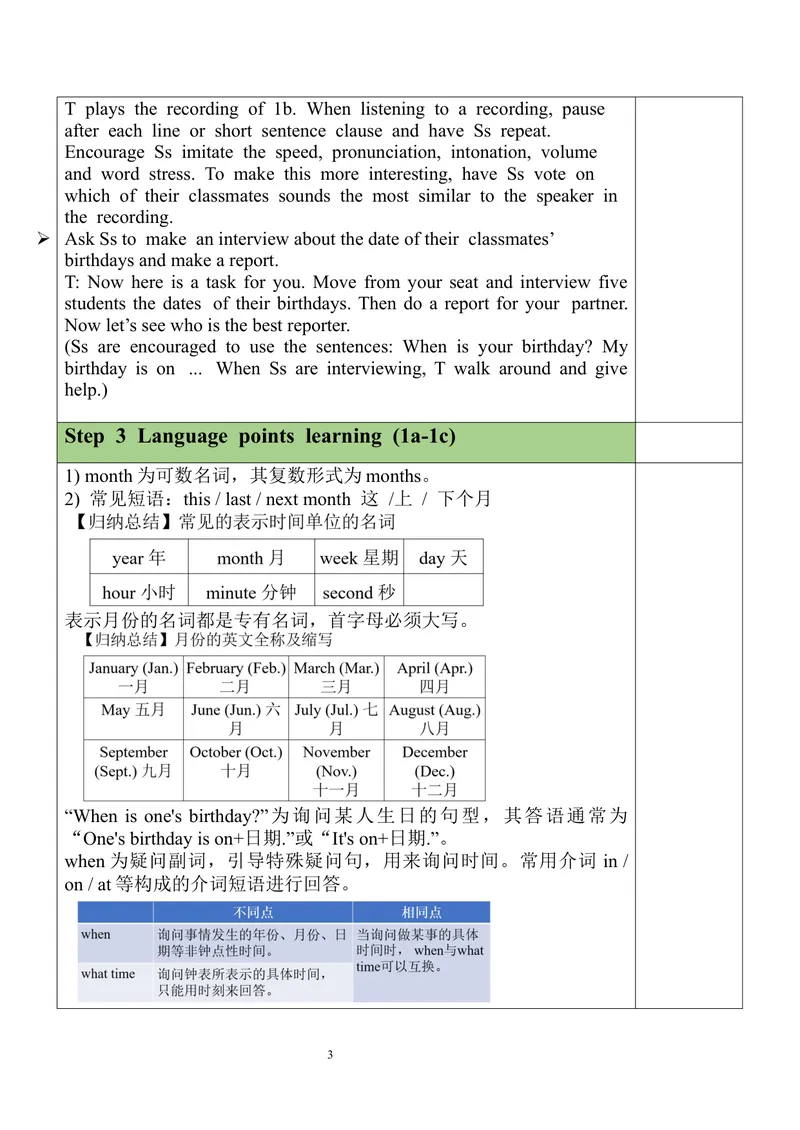
when 为疑问副词,引导特殊疑问句,用来询问时间。常用介词 in /
on / at等构成的介词短语进行回答。
3Step 4 Presentation & Reading (2a-2e)
Ask Ss to learn the ordinal numbers on PPT P26-P27.
(Ss observe the ordinal numbers on P26-P27 and find out the rules. T
shows the rules to Ss and explain the rules.)
Ask Ss to see the cardinal numbers and say the corresponding
ordinal numbers.
(When Ss see the numbers on the picture, they can stand up and say them
out.)
Ask Ss to read the dates on PPT P30.
(T can ask Ss to read in a line or a row. When Ss are reading, T can
correct their pronunciation mistakes and remind Ss to pay attention to.)
While-listening
2a
Ask Ss to listen and repeat.
Encourage Ss to notice that ordinal numbers usually end as follows:
1st, 21st, 31st — end in “st”
2nd, 22nd — end in “nd”
3rd, 23rd — end in “rd”
All other numbers end in “th”.
2b
Ask Ss to listen and circle the numbers they hear in 2a.
Answers: 1. 4th 2. 5th 3. 17th 4. 22nd
Ask Ss to put the dates they hear in order.
Answers: 1. 2 2. 4 3. 3 4. 1
(After Ss finish the task, T can lead Ss to read the dates again.)
2c
Ask Ss to listen again and match the names, months and dates.
Answers:
(After Ss finish the task, they can read the listening scripts together.)
2d
Ask Ss to do Q&A in pairs according to 2c.
T: Well, it’s your turn now. Talk about the children’s birthdays in 2c. Then
ask your partner about the birthdays in his or her family.
(T shows the sample conversation on the blackboard. When is your
father's birthday?
His /Her birthday is on ______________.
Group work
Ask Ss to do a survey in groups to talk about the birthdays of their
4group members’ family members.
(Ss use the sentence patterns to ask and answer, then fill the chart. They
must use complete sentences to share answers, T must correct their
mistakes.)
2e
Ask Ss to read the conversation and answer the questions.
1. How old is Alan?
2. How old is Bill?
3. When is Alan’s birthday party?
(The questions are very easy, so Ss share their answers one by one.)
Ask Ss to make their own conversations in pairs according to 2e.
Step 5 Language points learning (2a-2e)
名词的所有格
表示所属关系,即表示某物是“谁的”。名词所有格常见的结构有
两种:
’s 所有格
(1) 表示有生命的人或动物的名词所有格, 单数名词和不以 s 结尾的
复数名词一般在词尾加“ ’s”。
如: Kate’s cat 凯特的猫 Children’s Day 儿童节
(2) 名词后加 “ ’s” 表示所有, 意为“......的”。如: This is Tom’s
book. 这是汤姆的书。以s结尾的复数名词只在词尾加“ ’ ”。
如:the students’ book 学生用书the boys’ books 男孩们的书
(3) 如果表示两(几)个人共同拥有,在最后一个名词的词尾加“’s”
如: Eric and Cindy’s father 艾瑞克和辛迪的父亲(两个人的父亲是同
一个人)
(4) 如果表示两(几)个人各自拥有, 则须在每个名词后都加上“’s”
如:Jane’s and Helen’s rooms 珍的房间和海伦的房间(两人各自拥有
一个房间)
of 所有格
(1)无生命事物名词的所属关系,一般常用 “of + 名词”来表示,
即 of 所有格。如:a photo of my family 一张全家福 the name of the
tree 这棵树的名字
(2) of 所有格与 ’s 所有格有时可以互换,不过要注意它们物主的
位置不同。如: 狗的名字是甜甜。The name of the dog is Tiantian.
(of 结构, 物主the dog在后)
The dog’s name is Tiantian. (’s 结构, 物主the dog在前)
介词on, in, at表示时间的用法
5how old 意为“多大年纪;几岁”,常用于询问年龄。回答时可以直
接用基数词表示,也可以用“基数词 + year(s) old”表示。
What’s ... age?”和“How old is / are ...?”意思相同,可互换。如:
What’s your age? = How old are you? 你多大了?
Step 6 Exercises & Homework
Exercises
Ask Ss to do the exercises on PPT P49-P51.
T ask Ss to make a summary about what we have learned today.
(Some students may make mistakes on PPT P50, so teachers must correct
them and guide them how to answer the question.)
Homework
Read the conversation in 2e.
Do the exercises in students’ book.
There are too many language points in this period so I didn't finish them
all at the end of the class. I will spend more time on language points in
Teaching
the next class. Students were confused about the ordinal words and the rules
Reflection
of the ordinal words. A review and dictation of these ordinary words should
be done at the beginning of the next class.
6