Unit 7 How much are these socks ?
Section A (1a-2d)
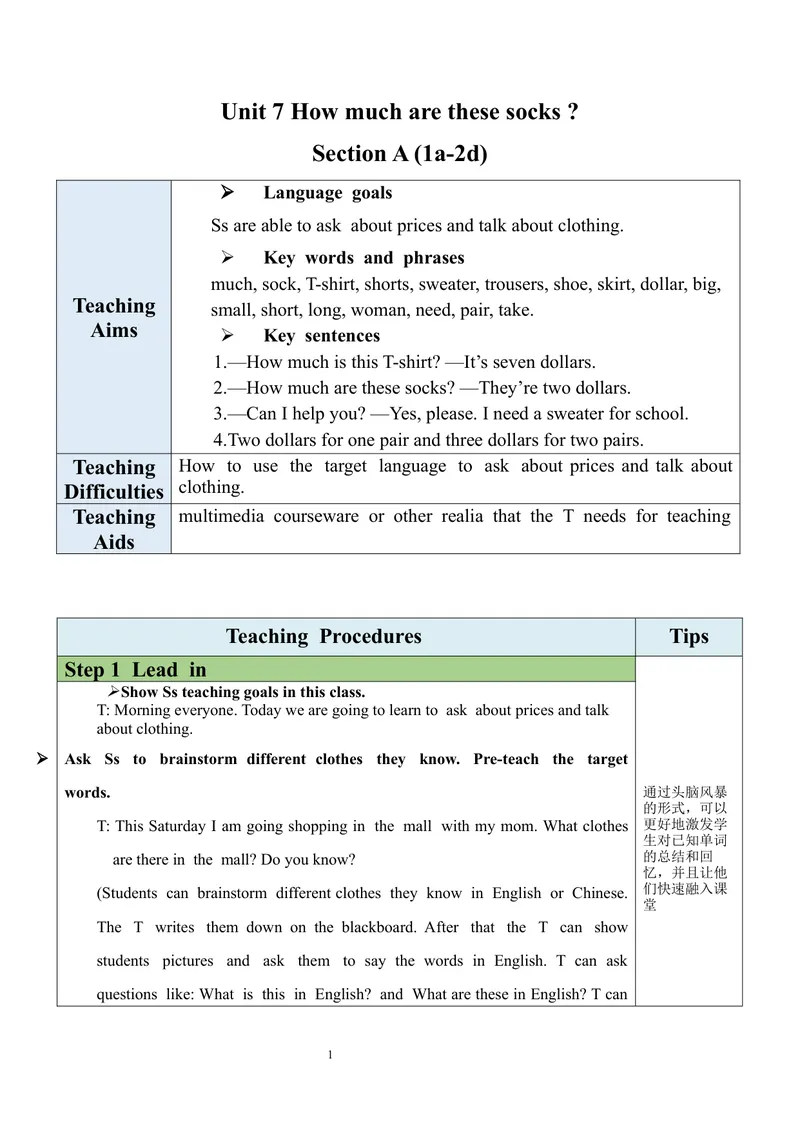
Language goals
Ss are able to ask about prices and talk about clothing.
Key words and phrases
much, sock, T-shirt, shorts, sweater, trousers, shoe, skirt, dollar, big,
Teaching
small, short, long, woman, need, pair, take.
Aims
Key sentences
1.—How much is this T-shirt? —It’s seven dollars.
2.—How much are these socks? —They’re two dollars.
3.—Can I help you? —Yes, please. I need a sweater for school.
4.Two dollars for one pair and three dollars for two pairs.
Teaching How to use the target language to ask about prices and talk about
Difficulties clothing.
Teaching multimedia courseware or other realia that the T needs for teaching
Aids
Teaching Procedures Tips
Step 1 Lead in
Show Ss teaching goals in this class.
T: Morning everyone. Today we are going to learn to ask about prices and talk
about clothing.
Ask Ss to brainstorm different clothes they know. Pre-teach the target
words. 通过头脑风暴
的形式,可以
T: This Saturday I am going shopping in the mall with my mom. What clothes 更好地激发学
生对已知单词
are there in the mall? Do you know? 的总结和回
忆,并且让他
(Students can brainstorm different clothes they know in English or Chinese.
们快速融入课
堂
The T writes them down on the blackboard. After that the T can show
students pictures and ask them to say the words in English. T can ask
questions like: What is this in English? and What are these in English? T can
1correct Ss’ pronunciation. Then ask Ss to read together to make sure Ss can read
correctly.)
The T can also play a game with Ss using the vocabulary about clothing:
Have Ss stand and tell them if you say something about that they are
wearing, ,they can be seated. Start off by saying a piece of clothing that
only one or a few Ss are wearing, e.g. red shoes, black trousers, purple
sweater. Continue the game until all Ss are seated.
Step 2 Presentation & Practice
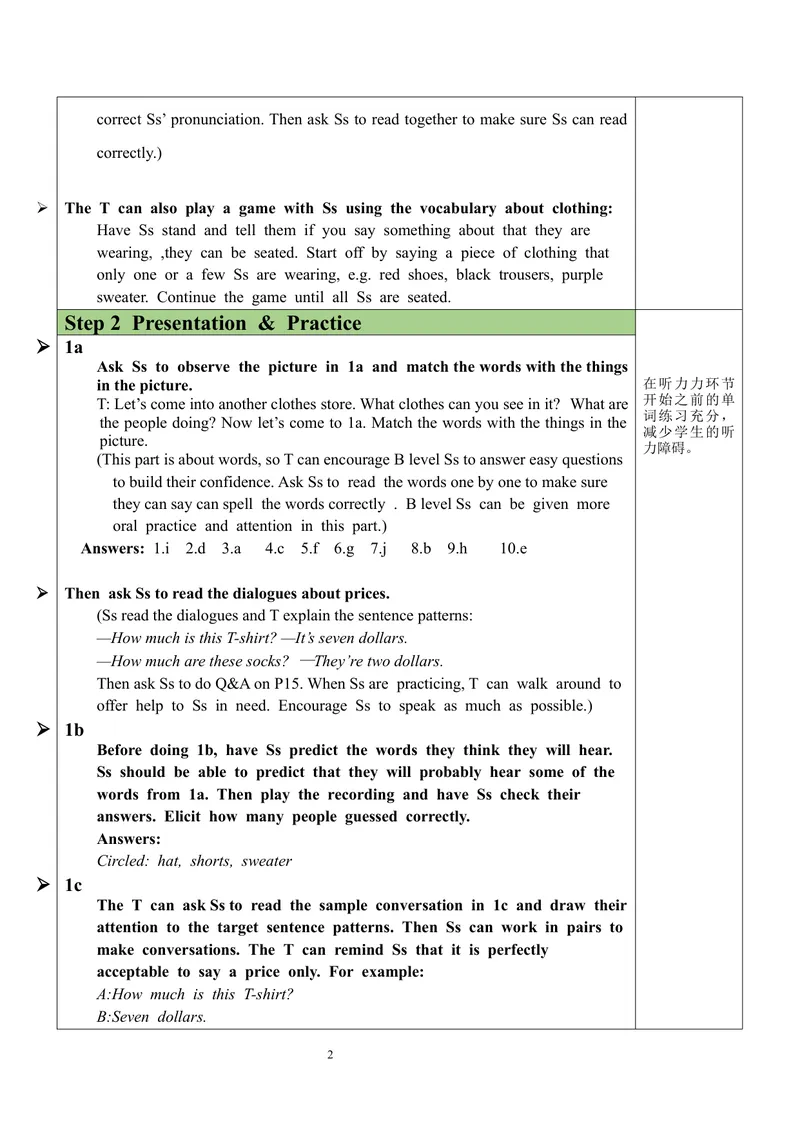
1a
Ask Ss to observe the picture in 1a and match the words with the things
in the picture. 在听力力环节
T: Let’s come into another clothes store. What clothes can you see in it? What are 开始之前的单
词练习充分,
the people doing? Now let’s come to 1a. Match the words with the things in the
减少学生的听
picture.
力障碍。
(This part is about words, so T can encourage B level Ss to answer easy questions
to build their confidence. Ask Ss to read the words one by one to make sure
they can say can spell the words correctly . B level Ss can be given more
oral practice and attention in this part.)
Answers: 1.i 2.d 3.a 4.c 5.f 6.g 7.j 8.b 9.h 10.e
Then ask Ss to read the dialogues about prices.
(Ss read the dialogues and T explain the sentence patterns:
—How much is this T-shirt? —It’s seven dollars.
—How much are these socks? —They’re two dollars.
Then ask Ss to do Q&A on P15. When Ss are practicing, T can walk around to
offer help to Ss in need. Encourage Ss to speak as much as possible.)
1b
Before doing 1b, have Ss predict the words they think they will hear.
Ss should be able to predict that they will probably hear some of the
words from 1a. Then play the recording and have Ss check their
answers. Elicit how many people guessed correctly.
Answers:
Circled: hat, shorts, sweater
1c
The T can ask Ss to read the sample conversation in 1c and draw their
attention to the target sentence patterns. Then Ss can work in pairs to
make conversations. The T can remind Ss that it is perfectly
acceptable to say a price only. For example:
A:How much is this T-shirt?
B:Seven dollars.
2 2a
Before Ss do the task in 2a, the T can guide Ss to review the
vocabulary about
color. Ask Ss to describe the rainbow on P27 to check their
pronunciation. Then pre-teach the four adjectives :big small short long.
The T show Ss how to describe thing using these adjectives and colors.
Explain to Ss that adjectives must be said in a certain order. (冠词+大
小/长短+颜色+中心名词
). Ask Ss to chant the examples.
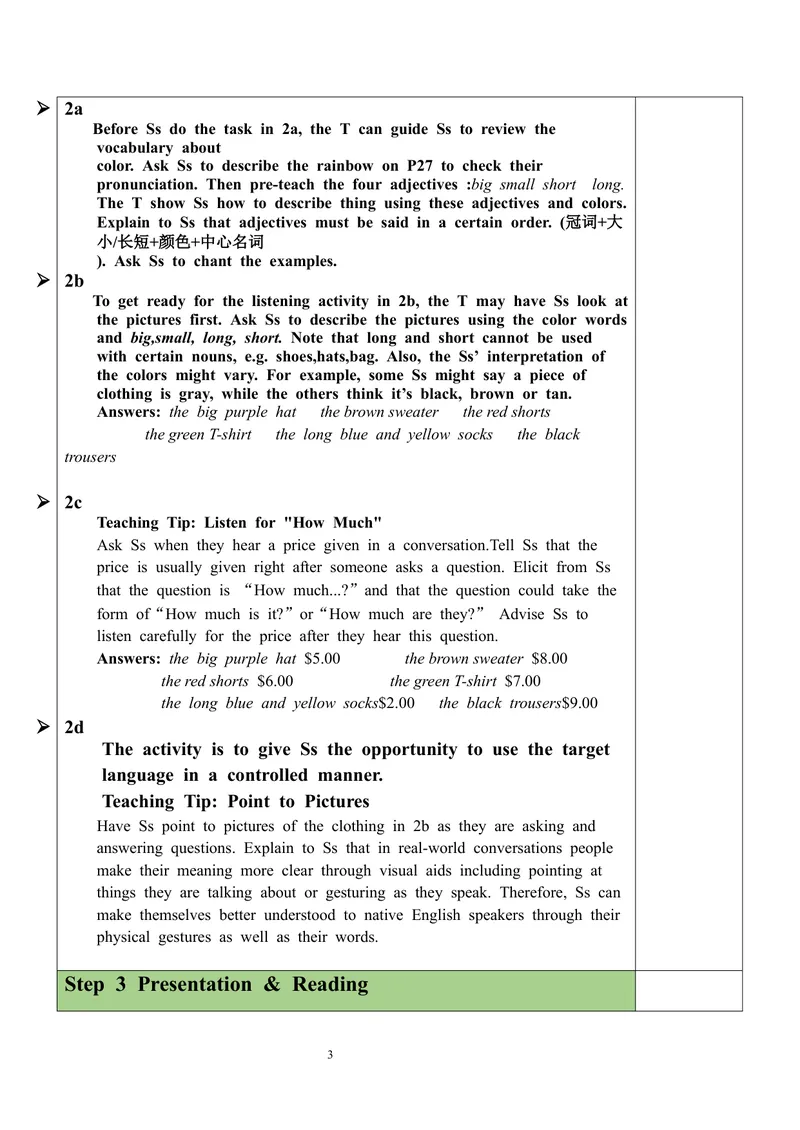
2b
To get ready for the listening activity in 2b, the T may have Ss look at
the pictures first. Ask Ss to describe the pictures using the color words
and big,small, long, short. Note that long and short cannot be used
with certain nouns, e.g. shoes,hats,bag. Also, the Ss’ interpretation of
the colors might vary. For example, some Ss might say a piece of
clothing is gray, while the others think it’s black, brown or tan.
Answers: the big purple hat the brown sweater the red shorts
the green T-shirt the long blue and yellow socks the black
trousers
2c
Teaching Tip: Listen for "How Much"
Ask Ss when they hear a price given in a conversation.Tell Ss that the
price is usually given right after someone asks a question. Elicit from Ss
that the question is “How much...?”and that the question could take the
form of“How much is it?”or“How much are they?” Advise Ss to
listen carefully for the price after they hear this question.
Answers: the big purple hat $5.00 the brown sweater $8.00
the red shorts $6.00 the green T-shirt $7.00
the long blue and yellow socks$2.00 the black trousers$9.00
2d
The activity is to give Ss the opportunity to use the target
language in a controlled manner.
Teaching Tip: Point to Pictures
Have Ss point to pictures of the clothing in 2b as they are asking and
answering questions. Explain to Ss that in real-world conversations people
make their meaning more clear through visual aids including pointing at
things they are talking about or gesturing as they speak. Therefore, Ss can
make themselves better understood to native English speakers through their
physical gestures as well as their words.
Step 3 Presentation & Reading
3 2e
The activity is to give Ss the opportunity to use the target language in
a
controlled manner.
Teaching Tip: A Pair Of...
In 2e, the speakers use the word “pair" when referring to shoes and
socks. Draw
a chart on the board and elicit some ideas about items of clothing that
come in
pairs.
A/one pair of socks shoes
Two pairs of trousers shorts
Ss have not yet learned the words for other clothing items,but they may
be able to add: glasses,gloves,etc.
You may want to explain to Ss that the phrase “ a pair of” isn't
necessary if the item is being used in the plural. You may also want to
explain that some items (e.g. trousers and shorts) are always plural. Give
Ss the following examples to study.
×I need sock.
√I need a sock.(Just one sock).
√I need socks./I need a pair of socks.
The T can ask Ss to read the conversation silently first and explain the
sentences that Ss can’t understand. Then the T can focus Ss’ attention
on the
target structure appeared in the conversation and other key word
groups. Ss
can be asked to make sentences using the key structure and
phrases.Then the
T can make Ss read the conversation in chorus to check their
pronunciation
and intonation. At last the T can invite some Ss to role-play the
conversation
as open pairs.
Step 4 Language points
1. “ How much is/are...?” 是 询 问 物 品 价 格 的 句 型 , 其 答 语 通 常 为
“It’s/They’re+价格”,也可直接说出价格。much可作形容词或代词,用来
指代或修饰不可数名词。
2. short作“短的”讲时,其反义词是long(长的);short作“矮的”讲时,其
反义词是tall(高的)
3. 介词“for” 表示目的,译为“为……;去做……”; need…for…表示“需
要……去做……”。
Step 5 Exercises & Homework
Exercises
Ask Ss to do the exercises on PPT P48-P50.
4 Ask Ss to make a summary about what we have learned today.
Homework
1. Read the conversation in 2e.
2. Do the exercises in students’ book.
The classroom procedures were too complex, and some repetitive activities can be
Teaching
deleted to make the classroom more efficient. The sentences in 2e part should be dictated
Reflection
in the next class because these sentences are often used in writing part.
5