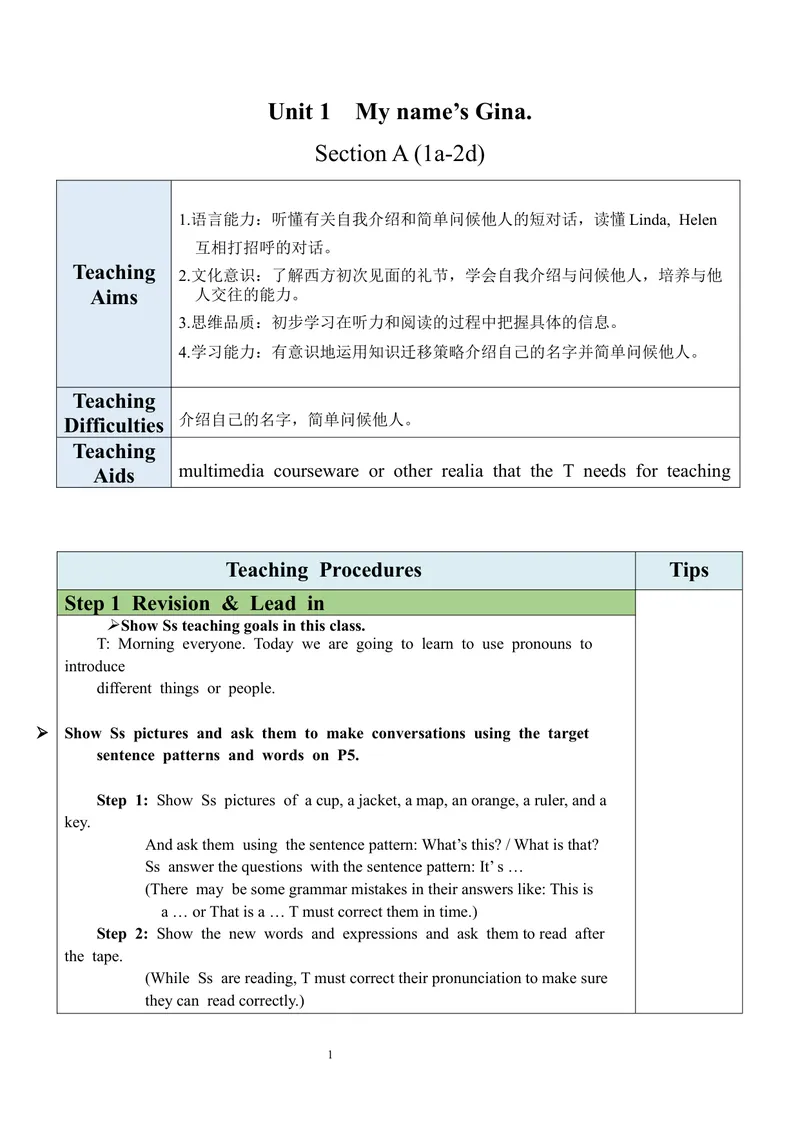
Unit 1 My name’s Gina.
Section A (1a-2d)
1.语言能力:听懂有关自我介绍和简单问候他人的短对话,读懂Linda, Helen
互相打招呼的对话。
Teaching
2.文化意识:了解西方初次见面的礼节,学会自我介绍与问候他人,培养与他
Aims 人交往的能力。
3.思维品质:初步学习在听力和阅读的过程中把握具体的信息。
4.学习能力:有意识地运用知识迁移策略介绍自己的名字并简单问候他人。
Teaching
介绍自己的名字,简单问候他人。
Difficulties
Teaching
Aids multimedia courseware or other realia that the T needs for teaching
Teaching Procedures Tips
Step 1 Revision & Lead in
Show Ss teaching goals in this class.
T: Morning everyone. Today we are going to learn to use pronouns to
introduce
different things or people.
Show Ss pictures and ask them to make conversations using the target
sentence patterns and words on P5.
Step 1: Show Ss pictures of a cup, a jacket, a map, an orange, a ruler, and a
key.
And ask them using the sentence pattern: What’s this? / What is that?
Ss answer the questions with the sentence pattern: It’ s …
(There may be some grammar mistakes in their answers like: This is
a … or That is a … T must correct them in time.)
Step 2: Show the new words and expressions and ask them to read after
the tape.
(While Ss are reading, T must correct their pronunciation to make sure
they can read correctly.)
1Step 3: ask Ss to watch a video about a hello song.
(Encourage Ss to sing after the song because the lyrics and melody are easy for
them.)
Step 2 Presentation & Practice
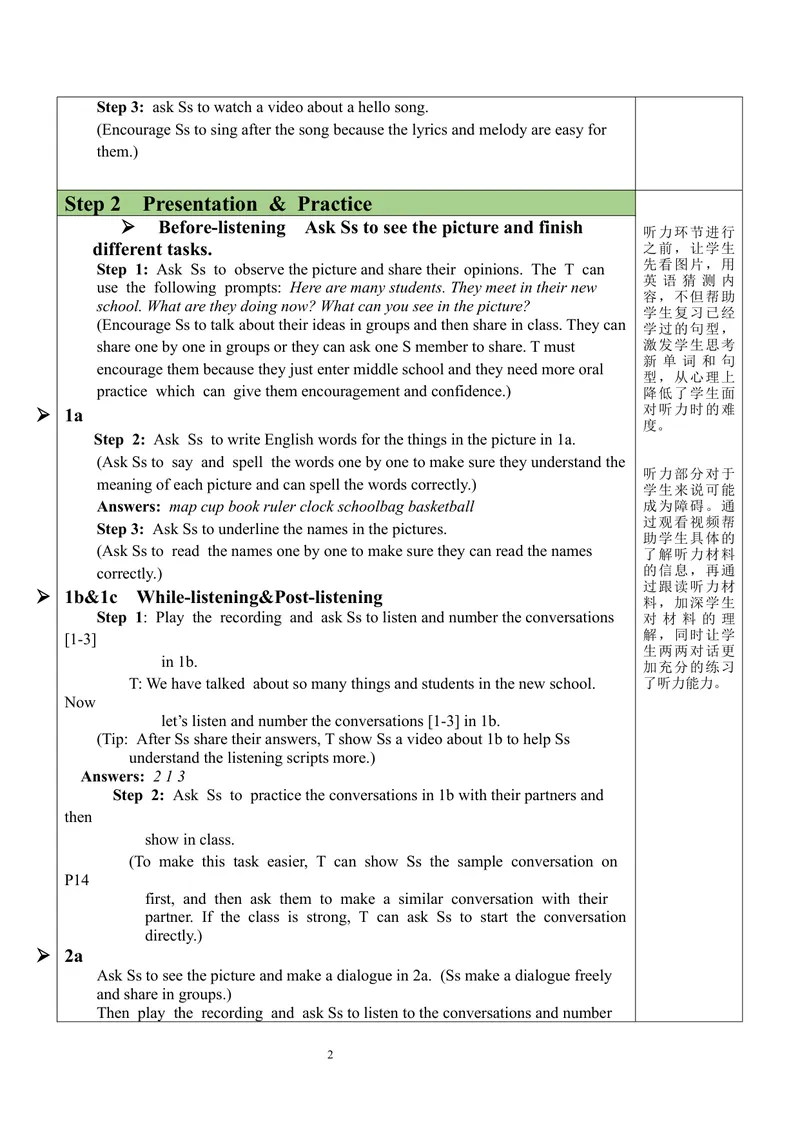
Before-listening Ask Ss to see the picture and finish
听力环节进行
different tasks. 之前,让学生
Step 1: Ask Ss to observe the picture and share their opinions. The T can
先看图片,用
英 语 猜 测 内
use the following prompts: Here are many students. They meet in their new
容,不但帮助
school. What are they doing now? What can you see in the picture?
学生复习已经
(Encourage Ss to talk about their ideas in groups and then share in class. They can
学过的句型,
share one by one in groups or they can ask one S member to share. T must 激发学生思考
新 单 词 和 句
encourage them because they just enter middle school and they need more oral
型,从心理上
practice which can give them encouragement and confidence.) 降低了学生面
对听力时的难
1a
度。
Step 2: Ask Ss to write English words for the things in the picture in 1a.
(Ask Ss to say and spell the words one by one to make sure they understand the
听力部分对于
meaning of each picture and can spell the words correctly.)
学生来说可能
Answers: map cup book ruler clock schoolbag basketball 成为障碍。通
过观看视频帮
Step 3: Ask Ss to underline the names in the pictures.
助学生具体的
(Ask Ss to read the names one by one to make sure they can read the names 了解听力材料
correctly.) 的信息,再通
过跟读听力材
1b&1c While-listening&Post-listening
料,加深学生
Step 1: Play the recording and ask Ss to listen and number the conversations 对 材 料 的 理
解,同时让学
[1-3]
生两两对话更
in 1b.
加充分的练习
T: We have talked about so many things and students in the new school. 了听力能力。
Now
let’s listen and number the conversations [1-3] in 1b.
(Tip: After Ss share their answers, T show Ss a video about 1b to help Ss
understand the listening scripts more.)
Answers: 2 1 3
Step 2: Ask Ss to practice the conversations in 1b with their partners and
then
show in class.
(To make this task easier, T can show Ss the sample conversation on
P14
first, and then ask them to make a similar conversation with their
partner. If the class is strong, T can ask Ss to start the conversation
directly.)
2a
Ask Ss to see the picture and make a dialogue in 2a. (Ss make a dialogue freely
and share in groups.)
Then play the recording and ask Ss to listen to the conversations and number
2the
pictures [1-4] in 2a. The T can check answers as a class.
Answers: Top row: 3,2
Bottom row: 1,4
2b
Ask Ss to listen to 2b and circle the names in the picture.
(T ask Ss to share the answers randomly to make sure they understand the
dialogues. )
Answers: Eric, Alice, Bob, Mike, Jack, Mary, Ms. Miller
2c
Ask Ss to make conversations according to the pictures on PPT 25.
Before Ss practice, they must read the phrases and sentence patterns in 2c twice
or three times to make sure they have mastered them well. Since they have practiced so
many times before this part, so T needn’t spend much time on this part. But T should
make Ss clear about these pronouns : my, your, his, her, their.
Step 3 Presentation & Reading
2d 2d的对话部分
The T can ask Ss to read the conversation silently first and
对知识点进行
了再一次总结
explain the sentences that Ss can’t understand.Then the T can
和练习,让学
focus Ss’ attention on the target structure appeared in the 生在真实情境
中感知语言的
conversation and other key word groups. Ss can be asked to
运用。
make sentences using the key structure and phrases.Then the T
can make Ss read the conversation in chorus to check their
pronunciation and intonation. At last the T can invite some Ss to
role-play the conversation as open pairs.
Step 4 Language Points
1. What’s one’s name? 用来询问他人姓名,表示“某人叫什么名字?”
回答这个问句有三种形式:
① My / His / Her / Its name’s …
② I’m / He’s / She’s / It’s …
③ 直接回答出名字。
2. I’m Ms. Brown.
3. Nice to meet you. 初次相识问候语
nice 作形容词,多用来形容天气或景色“宜人”以及人的感受“愉快”。
初次认识某人,常对他说“Nice to meet you.”, 意为“见到你很高兴。”
它的应答语通常为“Nice to meet you, too.”,意为“见到你也很高兴。”
4.his pron. 他的
3his是形容词性物主代词“他的”,后面要加名词,其对应的人称代词主格
是he。
5. and conj. 那么,于是;和; 又;而
and作连词,此处意为“那么,于是”,在本句中起到引起话题的作用。
6.her pron. 她的
her是形容词性物主代词“她的”,后面要加名词,其对应的人称代词主格是
she。
7.she pron. 她
she是代词, 用来指代女性,意为“她”。其对应词 he用来指代男性, 意为
“他”。“she”和“he”为人称代词的主格形式,通常在句中作主语, 此时谓语
动词应用单数形式。
8. —Is he Jack? —No, he isn’t.
Is he …? 他是······吗?
答语通常为:Yes, he is./No, he isn’t.
如果询问的对象是女性, 要用 “Is she …?”。
答语通常为:Yes, she is./No, she isn’t.
Step 5 Exercises & Homework Exercises的任
务是对本节课
重点知识点的
Exercises
总结与回顾,
Ask Ss to do the exercises on PPT P32-P34. 如果学生水平
T ask Ss to make a summary about what we have learned 较高,老师也
可以根据学生
today.
情况适当增加
Homework 练习量。
1. Read the conversation in 2d.
2. Do the exercises in students’ book.
In this period, the key and difficult part is to help Ss to introduce things with proper
pronouns: my, your, his, her, their, especially the last three words. Actually some weak
Teaching Ss still can’t master their meaning so well. So more practice and exercise must be done
Reflection to help them understand adjectival possessive pronouns. Guessing before listening can
remind Ss of the words they have learned, which is also a good way for Ss to think
about their new knowledge.
4