2025—2026 学年度下学期 2024 级
5 月月考英语试卷
考试时间:2026年5月21日
第一节 (共5小题;每小题1.5分,满分7.5分)
听下面5段对话。每段对话后有一个小题,从题中所给的A、B、C三个选项中选出最佳选项。
听完每段对话后,你都有10秒钟的时间来回答有关小题和阅读下一小题。每段对话读两遍。
1.How was the man’s homemade cake?
A. It tasted terrible. B. It was perfect. C. It was just so-so.
2. What does the woman think of the trip?
A. It was perfect. B. It could be improved. C. It was unsuitable for the old.
3. Where are the speakers?
A. At home. B. At a supermarket. C. At a restaurant.
4. What are the speakers talking about?
A. A football player. B. A football team. C. A football match.
5. What do we know about the woman?
A. She was overcharged.
B. She missed the promotion details.
C. She misunderstood the sign on the shelf.
第二节 (共15小题;每小题1.5分,满分22.5分)
听下面5段对话或独白。每段对话或独白后有几个小题,从题中所给的A、B、C三个选项中
选出最佳选项。听每段对话或独白前,你将有时间阅读各个小题,每小题5秒钟;听完后,各小题
将给出5秒钟的作答时间。每段对话或独白读两遍。
听第6段材料,回答第6、7题。
6. How did the woman get the band’s telephone number?
A. At a concert. B. From a member. C. On the Internet.
7. What does the man ask the woman about regarding the performance?
A. The date. B. The location. C. The length.
听第7段材料,回答第8、9题。
8. What can we learn about the man’s company?
A. It is quite famous. B. It is rapidly developing. C. It is newly established.
9. What can the woman find on the brochure’s second page?A. The company overview. B. The marketing strategy. C. The product introduction.
听第8段材料,回答第10至12题。
10. What makes Charlotte want to learn Tourism?
A. Her fondness. B. Her career plan. C. Her parents’ wishes.
11. What does Dr. Twain suggest Charlotte do?
A. Change her major. B. Chat with her parents. C. Find a job.
12. What is Charlotte’s advantage in the tourism field?
A. Communication skills. B. Language talent. C. Time management ability.
听第9段材料,回答第13至16题。
13. Who is probably the man?
A. A housekeeper. B. A professor. C. An administrator.
14. What contributes most to Martina’s decision to move?
A. The distance from the university. B. Conflicts with roommates. C. The landlady’s strict rules.
15. When does the conversation take place?
A. At the beginning of a term. B. In the middle of a term. C. At the end of a term.
16. What will the man do next?
A. Check Martina’s information. B. Show Martina around. C. Call the landlady.
听第10段材料,回答第17至20题。
17. What prize will the winner get from the contest this time?
A. A signed book. B. A membership card. C. A computer.
18. What kind of stories are expected?
A. Ones set in the future. B. Ones about daily life. C. Ones over 1,500 words.
19. How should the participants send their entries?
A. By email. B. In person. C. By post.
20. What month is it now?
A. January. B. February. C. March.
第二部分 阅读 (共两节,满分50分)
第一节 (共15小题;每小题2.5分,满分37.5分)
阅读下列短文,从每题所给的A、B、C、D四个选项中选出最佳选项。
A
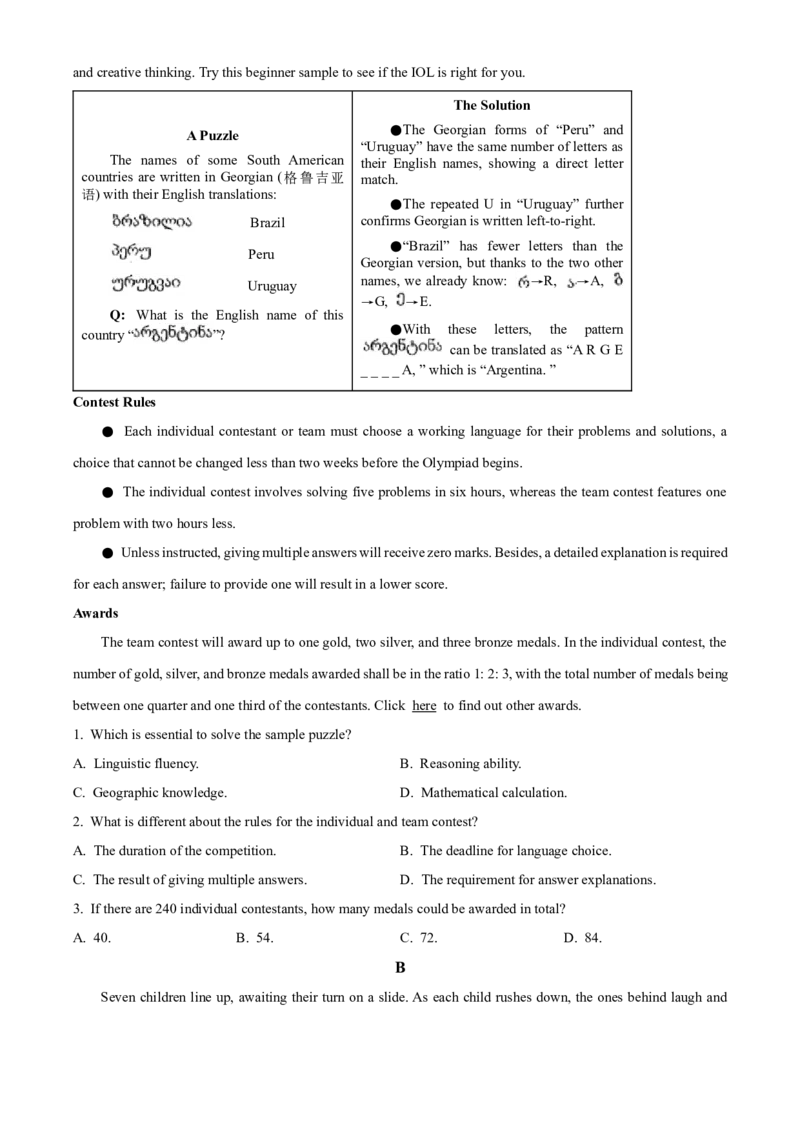
The International Linguistics Olympiad (IOL) is a competition for pre-university students, held in a different
country each year since 2003. It challenges participants, both individually and in teams, to solve linguistic (语言学
的) puzzles. To compete at the IOL, no special knowledge is required, only basic language concepts, logic, patience,and creative thinking. Try this beginner sample to see if the IOL is right for you.
The Solution
●The Georgian forms of “Peru” and
A Puzzle
“Uruguay” have the same number of letters as
The names of some South American their English names, showing a direct letter
countries are written in Georgian (格鲁吉亚 match.
语) with their English translations:
●The repeated U in “Uruguay” further
Brazil confirms Georgian is written left-to-right.
●“Brazil” has fewer letters than the
Peru
Georgian version, but thanks to the two other
names, we already know: →R, →A,
Uruguay
→G, →E.
Q: What is the English name of this
●With these letters, the pattern
country “ ”?
can be translated as “A R G E
_ _ _ _ A, ” which is “Argentina. ”
Contest Rules
● Each individual contestant or team must choose a working language for their problems and solutions, a
choice that cannot be changed less than two weeks before the Olympiad begins.
● The individual contest involves solving five problems in six hours, whereas the team contest features one
problem with two hours less.
● Unless instructed, giving multiple answers will receive zero marks. Besides, a detailed explanation is required
for each answer; failure to provide one will result in a lower score.
Awards
The team contest will award up to one gold, two silver, and three bronze medals. In the individual contest, the
number of gold, silver, and bronze medals awarded shall be in the ratio 1: 2: 3, with the total number of medals being
between one quarter and one third of the contestants. Click here to find out other awards.
1. Which is essential to solve the sample puzzle?
A. Linguistic fluency. B. Reasoning ability.
C. Geographic knowledge. D. Mathematical calculation.
2. What is different about the rules for the individual and team contest?
A. The duration of the competition. B. The deadline for language choice.
C. The result of giving multiple answers. D. The requirement for answer explanations.
3. If there are 240 individual contestants, how many medals could be awarded in total?
A. 40. B. 54. C. 72. D. 84.
B
Seven children line up, awaiting their turn on a slide. As each child rushes down, the ones behind laugh andcheer. Such scene is rare in Lagos, one of Africa’s fastest-growing cities, with a population of about 17 million. But
on the city’s outskirts, a garbage-site-turned-park is providing room for kids to play. The project is the brainchild of
17-year-old Amara Nwuneli, who wants to prove that even in Lagos’ most crowded corners, children can have fun.
For Amara, the path to building parks began when a terrible flood struck her hometown in 2020. Heavy rains
swallowed entire neighborhoods, leaving thousands of families homeless. “People just said it was government failure
or bad luck.” Amara recalls. But, later, she realized it was what was called Nigeria’s “climate apathy”: the tendency
to view floods, heat waves, and droughts as isolated (孤立的) incidents rather than consequences of a warming
planet.
“I wanted to change the mindset,” Amara says. “If people don’t feel connected to nature, they won’t fight to
protect it. And I knew that had to start with creating spaces people could actually see and feel.”
It was no easy task. Amara first approached the Lagos State Government, which offered land but imposed (施
加) restrictions that made long-term construction impossible. After months of dead ends, she shifted strategy and
started looking for alternative spaces that were accessible to high-risk communities. Eventually, Amara secured a
garbage site. She then mobilized a team of artists, volunteers, and small donors to clear the trash and rebuild the site
with recycled materials. Three months later, the park opened.
Amara is now planning two more parks. She says communities from across the country have been reaching out
to her team for advice on how to reclaim abandoned spaces for public use. “That creates a kind of cycle,” Amara
reflects. “I take action, others notice, they want to take action, too. And together, it grows.”
4. What might be a problem Lagos is facing?
A. Insufficient public areas. B. Poor garbage management.
C. Limited recreational activities. D. Uncontrolled population growth.
5. What made Amara determined to build parks?
A. Losses from natural disasters.
B. People’s ignorance of climate change.
C. Disappointment in government failure.
D. Nigeria’s inadequacy in public education.
6. What quality does Amara demonstrate when completing the project?
A. Integrity. B. Optimism. C. Flexibility. D. Confidence.
7. What does Amara want to convey in the last paragraph?
A. Small steps make a big difference. B. Every cloud has a silver lining.
C. All roads lead to Rome. D. It is never too late to act.
CResearchers from the University of Buenos Aires have successfully used a robotic tutor to teach the male
chingolo, a kind of small bird in South America, a song that was once part of the species’ culture but had been lost
for more than half a century.
Male chingolos learn their unique, two-second melody from adult males. “It is a distinctive song — like a
fingerprint, but learned,” says one of the researchers. “It serves to attract females and protect territory. It is the bird’s
way of saying, “This is me, and here I am.” However, urbanization and habitat loss have broken this learning chain,
causing local song “dialects” to disappear.
Driven by this problem, researchers took on a pioneering task: bringing back a song that had disappeared from
the wild — known only from a musical record made in the 1960s — to a population of chingolos.
Using physics-based modeling of the bird’s vocal tract (声道) , the team first created an accurate artificial version
of the lost song. They then engineered this model into a physical device designed to broadcast the forgotten melody
— a “robotic tutor.” This artificial song was introduced to the chingolos in the park during their critical learning
period from October to February. The sessions took place during peak singing hours and were limited to a maximum of
eight hours. There were random pauses (停顿) in between so that the birds interpreted the playback from the three
devices placed in the area as a real exchange, as if these devices were responding to each other. This stimulated the
birds’ vocal responses.
The results were impressive. Young chingolos learned and adopted the song, though they added their own
population’s “accent” to the final trill (颤音) , which showed that their singing is shaped by learned behaviors and
inborn characteristics.
“This is about preserving not just genetic, but cultural biodiversity,” says another researcher. The team is now
developing AI systems to automatically identify individual bird songs and planning to study cultural spread in bird
populations to ensure that bird culture is not lost again.
8. Why did the researchers teach the birds the song?
A. To save an endangered species. B. To study the birds’ brain structure.
C. To develop new robotic devices. D. To preserve the birds’ cultural heritage.
9. What is a role of chingolos’ song?
A. It keeps hunters away from them. B. It helps them adapt to urban growth.
C. It functions as their social identity. D. It makes them remember their habitat.
10. What is the purpose of the random pauses?
A. To protect the birds’ vocal tract. B. To test the birds’ reaction speed.
C. To push the birds to catch the beat. D. To trick the birds into interaction.
11. What can we learn from chingolos’ learning results?A. The song has spread to other bird species. B. Their singing shows special vocal features.
C. Their response to the song needs improving. D. The effectiveness depends on their population.
D
Secret codes (密码) once thought impossible to crack now face a challenge from quantum computers. Luckily,
to protect information, physicists have developed a theoretically foolproof system called device-independent quantum
key distribution (DI-QKD) , which uses entangled quantum particles (纠缠态量子粒子) to fix weak points in existing
methods. Now, a team in China has demonstrated the technique in real city conditions, an advance that could clear
the way for a secure quantum internet in which trust is taken for granted.
Most cryptography (密码学) works by encrypting messages with a secret code that requires a special key to
decode. The challenge lies in making sure the key can’t be decoded when sent. For instance, the keys in one popular
encryption scheme are based on the prime factors of large numbers, which take enormous effort to crack. But such
calculations could be quick work for the large quantum computers. QKD offers a solution, but it has a weakness:
hardware must be perfect.
DI-QKD removes the need for trust in the hardware, by employing another feature of quantum mechanics —
entanglement — which closely links properties of widely separated quantum particles. If the sender and receiver
entangle a pair of particles across the network, they can each perform tests that confirm the particles’ properties are
strongly linked, well beyond chance. After this “handshake”, they can be sure they’re the only ones on the channel.
Then, other measurements on the entangled particles can establish a key, which can be shared with confidence that
nobody can decode it.
In 2022, a UK-based team managed to create and share a DI-QKD key for only about 2 meters. Now, Jianwei
Pan and his colleagues have extended this to practically useful distances. After collecting data for 26 days, they
showed they had the statistics to establish and share a key across 11 kilometers. The researchers also showed that in
theory — and given about 23 years for data collection — they could have sent a key across 100 kilometers. Pan’s
group now plans to explore ways to perform DI-QKD using satellites in space.
12. What is the advance made by Chinese scientists?
A. They put forward a coding theory.
B. They enhanced DI-QKD practicality.
C. They set up the quantum internet.
D. They discovered quantum entanglement.
13. The author explains the encryption principle by __________.
A. providing a definition B. making a comparison
C. giving an example D. citing a statement14. What is the main idea of paragraph 3?
A. What entanglement is.
B. How DI-QKD works.
C. What prevents key sharing.
D. How particles connect.
15. What is the limitation implied in the last paragraph?
A. Long data collection time.
B. Strict laboratory conditions.
C. Unstable entangled particles.
D. Heavy reliance on satellites.
第二节(共5小题;每小题2.5分,满分12.5分)
根据短文内容,从短文后的选项中选出可以填入空白处的最佳选项。选项中有两项为多余选项。
In recent years, science fictions are becoming increasingly popular. Science fiction writers using their magical
imagination create imaginary worlds that attract a great number of readers especially teenagers. But how can they
make it so believable? ____16____
The way things work in your imaginary worlds will be based on actual science. So you must be familiar with
the scientific laws related to your creation. If you’re writing about humans living on a planet with zero gravity, then
you need to know the effects of zero gravity on the human body. ____17____ Only in this way can you gain the
readers’ trust.
Then the rules in your creation can be different from our daily life, so you have to figure out the exact rules of
your imaginary worlds. ____18____ For example, if humans in your creation are able to breathe underwater in
Chapter 1, your characters can’t drown (溺水) in a swimming pool or river in Chapter 3.
____19____ You should decide the following issues: the history of the world, the geography, what
possibilities it offers, how everything works in this new reality, as well as how all of these factors affect the way
your characters think, feel, and react. You don’t have to tell your readers all the rules in the first chapter. But you
have to let readers know enough to understand what’s going on.
When you are writing, remember to make it feel real. You are creating a new real world for the readers.
____20____ They are able to see, hear, feel, smell, and even taste what it’s like in the new world. Whether your
novel is about a world without disease or an undiscovered planet, help your readers feel like they’ re actually there.
A. And you have to follow them.
B. You are inviting them to visit the new world.
C. You have to get rich imagination to create science fictions.D. Make sure what you are writing is not against basic science.
E. Characters in the imaginary worlds always have super power.
F. Here you will find the answer if you are longing to create one.
G. Your preparation work also involves planning everything in great detail.
第三部分 语言运用(共两节,满分45分)
第一节(共15小题;每小题1.5分,满分22.5分)
阅读下面短文,从短文后各题所给的A、B、C和D四个选项中,选出可以填入空白处的最
佳选项。
When I was 12, I was diagnosed with scoliosis, where the spine curves to the side. After the 8-hour operation,
I spent three days in intensive care and a week in a general ward (病房), followed by being wheelchair-bound for
six days, requiring full ____21____ for all activities of daily living.
Even now, the period of recovery keeps ____22____ my mind. The paralysis (瘫痪) caused by my spinal
injury seemed psychologically ____23____, and it was so ____24____ to put up with it. I couldn’t get out of bed
or do anything for myself. I was filled with a sense of ____25____ for the entire experience — an emotion even I
couldn’t understand or explain. It was my mother who ____26____ how I perceived both the surgery and its
lasting influence.
She was ____27____. She’d ask me if she could present it to people, and then she’d turn me around and say,
“My daughter is a (n) ____28____ — you’ve got to check out her scar. Isn’t it a symbol of ____29____?”
Gradually, it evolved into a ____30____ part of my identity rather than a source of shame and even became a
powerful tool I now use to help others through their own ____31____.
Since then, I have not ____32____ discussing my operation — even wearing a wedding dress that showed off
the ____33____ when I married Jack Brooksbank in 2018. Now I am a mother of two, also sponsor of Horatio’s
Garden, which helps to improve the ____34____ of patients having spinal surgery by giving them garden spaces to
____35____ occasionally.
21. A. rest B. assistance C. participation D. energy
22. A. changing B. concentrating C. crossing D. blowing
23. A. unique B. dependent C. disastrous D. random
24. A. eager B. complex C. ridiculous D. difficult
25. A. shame B. regret C. dignity D. anger
26. A. reshaped B. presumed C. calculated D. recognized
27. A. strict B. cautious C. considerate D. easy-going
28. A. artist B. superman C. operator D. patient29. A. strength B. history C. love D. suffering
30. A. deserted B. revised C. valued D. destroyed
31. A. guilt B. training C. sympathy D. healing
32. A. got rid of B. put up with C. looked forward to D. backed away from
33. A. honor B. scar C. elegance D. spot
34. A. happiness B. status C. bonus D. right
35. A. extend B. deliver C. switch D. escape
第二节 语法填空(共10小题;每小题1.5分,满分15分)
阅读下面短文,在空白处填入1个适当的单词或括号内单词的正确形式。
With Chinese online literature becoming a global cultural phenomenon, creators and providers are rapidly
expanding overseas, acting as carriers of culture and helping writers from around the world get dream jobs.
Online literature, which is believed ____36____ (gain) a significant foothold in the Chinese mainland in the
1990s, has grown into a global trend over the past two decades. Works in Chinese, whether ____37____ (release)
online or published as physical books, ____38____ (enjoy) popularity worldwide now.
The rise of online reading platforms ___39___ the development of localization ecosystems have significantly
contributed to the global influence of Chinese online literature. It is now described as one of the world’s four major
cultural ____40____ (phenomenon), alongside US Hollywood movies, Japanese animation and South Korean TV
dramas. ____41____ (feature) great imagination, fascinating plots and compelling (扣人心弦的) stories, Chinese
online literature has drawn readers from all over the world. The charm of Chinese online literature is boundless. “It
breaks cultural barriers and resonates (引起共鸣) with readers worldwide. Themes like the ____42____ (pursue)
of dreams and the fight for justice are ____43____ (universe), uniting people across cultures,” said Carlo Maria
Rossi, ____44____ Italian fan of the popular Chinese web novel Lord of Mysteries.
Currently, Chinese online literature is breaking new ground by focusing on the global co-creation of
intellectual property (知识产权). Writers from different nations and regions are working together on the
development of web novel IPs, ____45____ has further promoted its international spread.
第四部分 写作(共两节,满分40分)
第一节(满分15分)
46. 假定你是李华,准备参加学校组织的英文诗朗诵(recitation)比赛。请给外教George写封邮件求助,
内容包括:
1. 说明比赛要求;
2. 请他推荐英文诗;
3. 请教朗诵技巧。注意:
1. 写作词数应为80个左右;
2. 请按如下格式在答题卡的相应位置作答。
Dear George,
____________________________________________________________________________________________
____________________________________________________________________________________________
____________________________________________________________________________________________
____________________________________________________________________________________________
________________________________________________________________________________________
Yours,
Li Hua
第二节(满分25分)
47. 阅读下面材料,根据其内容和所给段落开头语续写两段,使之构成一篇完整的短文。
It was supposed to be a perfect father-son biking adventure. Sixteen-year-old Tom and his dad had planned a
50-kilometer bike ride through the countryside to celebrate Tom’s birthday. The night before, Tom was so excited
that he could barely sleep. His mind was full of images of the open road and the beautiful scenery they would
encounter.
Before leaving, Tom’s dad put on an old silver watch. It was a family treasure passed down from his grandpa.
The watch’s glass was cracked, showing its long history, but it still kept time accurately, standing as a symbol of the
family’s toughness. “This watch has seen its share of tough times, just like all of us,” his dad said, smiling at Tom.
“But it keeps going, and so will we.” Tom nodded, feeling close to his dad when he looked at the watch.
In the warm morning sun, they set off. Their backpacks were filled with water, energy-boosting snacks and a
first-aid kit for any emergencies. Tom’s shiny red bike, which he had spent weeks cleaning and fixing, shone brightly
in the sun. As they cycled along the country roads, the fresh smell of grass and wildflowers filled the air. Tom felt
extremely happy and pedaled (踩踏板) even harder with excitement.
However, as the morning passed, the sun gradually disappeared behind thick dark clouds. By noon, a cold and
heavy rain started to fall. The dry dirt path quickly turned into a muddy mess. Tom’s legs, which had been moving
smoothly just a few hours ago, now ached with every push of the pedals. He took a deep breath and tried to focus on
the rhythm of his pedaling, trying to ignore the rain and the tiredness in his legs.
Although they were wet and uncomfortable, they kept going. They were determined not to let the weather stop
them. But when they turned a sharp corner, they saw a long, steep slope (斜坡). The rain was still pouring heavily,
and the path ahead looked very slippery with mud sliding down. Tom’s heart sank, and he began to doubt himself.注意:
1.续写词数应为150个左右;
2.请按如下格式在答题卡的相应位置作答。
Paragraph 1: As Tom hesitated, his dad placed a firm hand on his shoulder.
____________________________________________________________________________________________
____________________________________________________________________________________________
____________________________________________________________________________________________
Paragraph 2: Gradually, the rain stopped and they arrived at the top of the mountain.
____________________________________________________________________________________________
____________________________________________________________________________________________
____________________________________________________________________________________________