衔接点15 句子种类
初中视角
高中展望
初中阶段,学生主要学习简单句,即只包含一个主语
和谓语的句子。学生学习基本的句型结构,如主语+
谓语+宾语(SVO)。此外,学生也会开始接触复合
句,即包含一个主句和一个或多个从句的句子。
高中阶段,学生需要更深入地理解和使用复合
句,包括各种类型的从句(如名词性从句、定语
从句、状语从句等)。此外,学生需要掌握更复
杂的句型结构,如倒装句、强调句、省略句等。
衔接引导
初中阶段考查形式:侧重语法知识的识记和简单运用,多以单句填空、选择题等基础形式考查语法知识。
高中阶段考查形式:注重语法知识的灵活运用和理解,更多地在语篇语法填空中综合运用语法知识。
【初中句子种类考点聚焦】
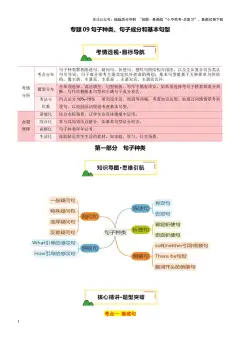
句子种类
一、英语句子按照其用途可分四种
1)陈述句(肯定、否定):He is six years old; She didn’t hear of you before.
2)疑问句(一般、特殊、选择、反意):Do they like skating? How old is he? Is he six or seven years old? Mary
can swim, can’t she?
3)祈使句:Be careful, boys; Don’t talk in class
4)感叹句:How clever the boy is!
二、英语句子按照其结构可分三大类
(1).简单句(Simple Sentences):只包含一个主谓结构的句子叫简单句,
All roads lead to Rome.
He got up, dressed quickly, washed himself and went out.
Is he a superman?
(2).并列句(Compound Sentences):包含两个或两个以上主谓结构的句子叫并列句,句与句之间通常用并
列连词或分号来连接,常用的并列连词有and,then,but,or,or else, so, for, while; both…and, either…or,
neither…nor, not only…,but also, as well as
He is a basketball fan, and his wife is a volleyball fan.
Honey is sweet, but the bee stings.
Don’t be late, for there is a meeting.
Hurry up, or you’ll be late.
He works hard while his brother is a lazy bone.
(3).复合句(Complex Sentences):复合句的某个成分,如主语、宾语、表语、同位语、定语、状语等,由
另一个句子承当。
China has the largest number of people who speak Chinese.
The film had been on when we got to the cinema.
【高中句子种类考点聚焦】
课标解读
英语句子按照使用目的可分为陈述句、疑问句、祈使句、感叹句四大类;按照句子结构(分句数量)
可分为简单句、并列句、复合句(名词性从句、定语从句、状语从句)三类。
陈述句细分肯定句与否定句;疑问句包含一般疑问、特殊疑问、选择疑问、反义疑问句;祈使句侧重
肯定结构与否定结构;感叹句聚焦what/how 两种核心句式。并列句依托and/but/or/so 等并列连词衔接分
句;复合句是高中重难点,三大从句依托从句引导词搭建主从复合结构。
总的来说,高中英语对句子种类不再局限于基础句式识别,侧重在完形、语法填空、短文改错、书面
表达中辨析句式类型、精准选用连词与句式结构,要求学生依托句式特征读懂长难句、规范写作造句。
考点清单
英语句子按照其结构分为简单句、并列句和复合句
1.简单句:简单句是指只有一套主、谓结构(或并列主语和并列谓语)并且句子各成分都只由单词或短语
构成的独立句子。简单句由五种基本句型构成,如下:
1)SVP(主+系+表)
2)SV(主+谓)
3)SVO(主+谓+宾)
4)SVoO(主+谓+间宾+直宾)
5)SVOC(主+谓+宾+宾补)
6)
there be 句型
1)主语+ 系动词+ 表语:这种句型结构主要指谓语动词为连系动词的情况。常见的系动词有
①be;②keep, remain, stay;③feel, taste, smell, sound, look;④seem, appear;⑤get, come, become, turn,
grow, go;⑥prove, turn out 等。
This is my English book.
The weather is getting windy and rainy.
The trouble is that they are short of money.
练习:划分句子成分
a. He looked unhappy at that time.
b. It seemed like a good idea at the time.
c. She turned 21 in June.
d. I was so pleased to hear from you.
2) 主语+ 谓语:此句式中的谓语动词为不及物动词(短语), 如live, travel, work, lie, arrive, stay, agree, rise,
fail, succeed, happen, get up,take place,
等。其后没有宾语。因为此句型中的动词表达的意思已经很明确,
所以不需要跟宾语。有时为了表示动作发生的频率、程度、原因、结果、目的、场所、时间等,可以带状
语修饰动词。
Poems don't translate easily.
My recent book sells very well.
The sun was shining.
练习:划分句子成分
a. Its economy has developed rapidly in the past ten years.
b. Great changes have taken place in our hometown these years.
c. This morning we met at the school gate and went there together.
3) 主语+ 谓语+ 宾语:此句式中的谓语动词为及物动词(短语), 如spend, visit, reach, forget, explain, take,
discover, waste, trust, do with, look forward to, look after 等,其后必须跟宾语才能使句意表达完整、准确。宾
语可以由名词、代词或相当于名词的词或短语充当,如动词的-ing 形式、动词不定式或从句等.。
I look forward to hearing from you soon.
You can put the dishes in the kitchen.
They ate what was left over.
练习:划分句子成分
a. In the afternoon, I’ll show you around and take you to some places of interest.
b. I’m looking forward to meeting you soon.
c. Last year I won first prize in the school computer competition.
d. In my spare time I enjoy listening to popular music and collecting stamps.
4) 主语+ 谓语+ 间接宾语+ 直接宾语:英语中有些及物动词能跟双宾语,即间接宾语(指人) 和直接宾语
(指物) 。通常情况下间接宾语在前,直接宾语在后。能跟双宾语的动词常见的有:give, offer, lend, teach,
bring,take, return, send, hand, pass, buy, make, cook, get, sing, ask 等。
The driver saved us a lot of trouble.
They have offered us $60,000 for the house.
I told him that the bus was late.
练习:划分句子成分
a. Mr Wang taught us English last year.
b. It took me two hours to finish my homework last night.
c. They offered him a job, but he turned it down.
d. Tomorrow I’ll write him a letter and tell him the good news.
5) 主语+ 谓语+ 宾语+ 宾语补足语:英语中,有些及物动词除能跟宾语外,有时还须加一个补足语,句意才
能完整。宾语补足语的作用是说明宾语的动作或状态。作宾语补足语的主要是名词、形容词、动词不定式
和分词,副词和介词短语等也可以用作宾语补足语。
本句型中的"宾语+ 宾语补足语",也可称之为复合宾语。宾语和宾语补足语之间有着逻辑上的主谓关系,因此,
逻辑上的主谓关系乃是本句型的特点,它不同于第四基本句型中的
"间接宾语+ 直接宾语","间接宾语+ 直
接宾语"之间并无逻辑上的主谓关系。例:
1) We elected Liu Lei monitor.
2) The news made him unhappy.
3) You shouldn't let him go there alone.
4) I had the bike repaired.
5) I feel it very pleasant to be with your family.
6) there be 句型表示人或事物"存在"的概念,一般译作"有",本句型句首的There 只是一个引导词,本身并无任
何词汇意义。句子的主语是处于动词be 后的那个名词。动词be 的人称和数应同其后的主语取得一致。动
词be 的时态随具体情况而变化。如果是单个的主语,动词be 则随这个主语的数和人称而变化。如果是并列
的主语,动词be 一般随最靠近be 的那个主语的人称和数而变化。反意问句的疑问句部分要用isn’t there?或
aren’t there?在本句型中,还可将谓语动词be 换成某些表示"来往,存在,发生"之类的不及物动词,
如arrive, come, go, exist, happen, live, remain, seem, stand 等。
a. There is a dictionary lying on the desk.
b. There will be a sports meet next week.
c. There stands a big tree in front of the classroom.
e. There used to be a shop on the corner of the street.
练习:划分句子成分
a. I saw the kids/children playing by the river at that time.
b. We are making our country more and more beautiful.
c. I had my wallet stolen on a bus yesterday afternoon.
d. I noticed Kate reading in the library all the morning.
e. Father asked/got me to bring him some newspapers.
f. She made it her business to find out who was responsible.
综合练习:指出下面句子分别属于哪个句型。
①I will spend this summer holiday in the countryside.
②In the modern city, there are some problems, such as air pollution, crowdness and noise.
③In the countryside I can enjoy a comfortable and quiet life.
④There, the air is fresh and the water is clean.
⑤I can hear birds singing in the green trees.
⑥I can also go boating, fishing, and swimming in the lake.
⑦He wished me good luck.
⑧So I want to go to the countryside for a change.
1. ( S + V ) _______________
2. ( S + V +O ) _________________
3. ( S + V + P ) ____________________
4. ( S + V + IO + DO ) _______________
5. ( S + V + O + C ) __________________
6. There be 句型______________
2. 并列句:两个或两个以上的简单句用并列连词或标点符号连接而成的句子叫并列句。
1)并列句的构成方式:用连接词连接,前面可加逗号。例:
These flowers are white and those flowers are red.
We fished all day, but we didn't catch a thing.
Hurry up; it's getting late.
I found a bucket, put it in the sink, and turned the tap on.
I took off my coat, searched all my pockets, but couldn't find my key.
2)并列句的分类:
(1)表示连接两个同等概念,常用and, not only…but also…, neither…nor…, then 等连接。
e. g. The teacher’s name is Smith, and the student’s name is John.
(2)表示选择,常用的连词有or, either…or…, otherwise 等。
e. g. Hurry up, or you’ll miss the train.
(3)表示转折,常用的连词有but, still, however, yet, while, when 等。
e. g. He was a little man with thick glasses, but he had a strange way of making his classes lively and
interesting.
(4)表示因果关系,常用的连词有so, for, therefore 等。
e. g. August is the time of the year for rice harvest, so every day I work from dawn until dark.
练习:指出下列划线词属于哪一类并列关系
a. Neither is he mistaken, nor am I.
b. Not only did the students dance, but (also) their teacher sang.
c. We love peace but we are not afraid of war.
d. He worked hard, yet he failed.
e. The news may be unexpected; nevertheless it is true.
f. Put on your coat, or you'll catch a cold.
g. Start out right away, or/ otherwise you'll miss the first train.
h. It was late, so we went home.
i. We listened eagerly, for he brought news of our families.
3. 复合句:复合句又称主从复合句,由一个主句和一个或一个以上的从句构成。主句为句子的主体,从句只
用作句子的一个次要成分,不能独立成为一个句子。从句通常由关联词引导,并由关联词将从句和主句联系在
一起。从句按其在复合句中的作用,分为名词性从句(主语从句、表语从句、宾语从句、同位语从句)、定
语从句和状语从句。
状语从句——状语从句在句中起状语作用,修饰主句中的谓语动词、形容词或副词。
定语从句——在复合句中,修饰某一名词或代词的从句叫做定语从句。定语从句的作用相当于形容词,用
来修饰主句中的某一名词或代词或整个主句,所以,也称作形容词性从句。
名词性从句
主语从句:作句子主语的从句叫主语从句
宾语从句:用作宾语的从句叫做宾语从句。
表语从句:用作表语的从句叫作表语从句,它位于主句中的连系动词之后。
同位语从句: 用作同位语的从句叫同位语从句。
例:1)How the book sells depends on its author. (主语从句)
2)I want to know whether/if he can arrive on time. (宾语从句)
3)That's because he didn't understand me. (表语从句)
4)The question who should come with me has not been settled. (同位语从句)
5)He has a friend whose father is a doctor. (定语从句)
6)By the time I graduate next year, I will have lived here for 5 years. (状语从句)
一.分析句子:阅读短文,判断加粗句子所属基本句型
A
Now autumn arrives quietly in our neighbourhood.①The weather becomes cool and comfortable.Our
community centre gives us ②many interesting outdoor activities every weekend.We find ③outdoor sports
relaxing and helpful for our health.④There are many maple trees along both sides of the street.We always
enjoy the beautiful scenery in fall.
B
Tom is a volunteer in the city library.①He works hard every weekday.He usually reads ②various science books
during his spare time.The librarian keeps ③the reading room tidy and quiet all year round.④There is a big
book sale in the library next Friday.Lots of readers look forward to the coming activity.
二、句子翻译
1.你应该保持你的房间干净且整齐。(SVOC) (汉译英)
______________________________________________________________
2.我们的英语老师说话太快了。(S+V+Ad) (汉译英)
______________________________________________________________________________
3.过去十年里,我的家乡发生了巨大的变化。(主语+谓语+状语) (汉译英)
______________________________________________________________________________
4.一群来自英国的交换生下个月要来我们学校参观。(SVOA) (汉译英)
______________________________________________________________.
5.我们学生应该经常与我们的父母交流想法。(SVOA)(汉译英)
__________________________________________________________________________________________
一、语法填空
阅读下面材料,在空白处填入适当的内容(1 个单词)或括号内单词的正确形式。
International Nurses Day is an annual celebration of the vital work and role of nurses around the world. The
event, which was first marked in 1965,
1
(create) by the International Council of Nurses.
Since January 1974, the global celebrations are traditionally held
2
12 May. But this year’s
celebrations will be “extra special”. The public has been asked to shine a light on Tuesday. The request is in
3
(recognize) of the World Health Organization. Chief nursing officer for England Ruth May has joined other leaders
in
4
(urge) people to shine a light from their window at 8:30 pm. on Tuesday
5
(mark) the day.
Ms May said of the event, “International Day of the Nurse is
6
(particular) special this year not
just because we mark the 200th anniversary of Florence Nightingale’s birthday,
7
because of the
extraordinary work all those who have followed in her footsteps are doing in
8
fight against the novel
coronavirus.
She continued “I want to thank each and every one of our fantastic nurses
9
are on the front line in
the battle against the greatest health emergency in NHS history. Their professionalism and skills are helping to save
and rebuild countless lives. I know how much the public’s support has cheered my
10
(colleague) during
this testing time. It would mean a great deal if people once again showed their gratitude by shining a light for
nurses this Tuesday.”
二、阅读理解
Whether you shop for food in a traditional grocery store or a big-box store, most of your options are junk
foods. Terms on food packaging like “low fat,” “gluten-free,” “keto-friendly” and “a good source of fiber” don’t
answer the fundamental question: Is this food good for me? There is little reliable guidance available for people
who don’t have the time, patience or skill to analyze the nutrition labels (标签).
But what we really need is a bold (大胆的) move that would be to prevent people from food that’s bad for
them: a warning sign that a high-sugar soda or breakfast cereal product, for example, is an unhealthy choice.
Chile, Mexico, Brazil and dozens of other countries have worked to change food labeling. Research has
suggested that these labels can help people understand nutritional quality and change their purchasing habits.
Finally, the goal of the labels is to improve nutrition and reduce the consumption of over-processed foods.
After Chile adopted several rules in 2016, researchers found that the consumption of drinks high in sugar and
sodium declined by nearly 25 percent. In Uruguay a survey published in 2020 assessing the early effects of
nutritional warnings found that 58 percent of participants who noticed the warning changed their decisions about
buying a product. Of those who changed their decisions, 17 percent said they chose a similar product with fewer
warnings, and 18 percent decided not to buy a similar product at all.
In the United States, new labeling laws will be much more challenging to take effect. As you might expect,
food producers will surely try to stop warning labels from being required. They are arguing that these plans would
be costly and that those costs would be passed on to consumers. But research conducted soon after Chile’s food
labeling and advertising law passed showed no effects on total employment, with negligible effects on wages (工资)
and profit, even as consumer consumption of unhealthy foods declined.
To be clear, this is just one of many steps toward providing all Americans with a healthy diet. But knowable
front-of-package labeling is one of the best levers (杠杆) available to policymakers, and it is already working
elsewhere. It can work here, too.
11.What does paragraph 1 focus on?
A.The lack of nutrition.
B.The problem with labels.
C.The shortage of food.
D.The doubt about package.
12.What do the examples of Chile and Uruguay show?
A.The consumption of over-processed foods has been stopped.
B.People in the two countries have better nutrition awareness.
C.Food producers there work well with the government.
D.Warning labels can effectively change people’s buying behavior.
13.What does the underlined word “negligible” mean in paragraph 5?
A.Obvious.
B.Lasting.
C.Insignificant.
D.Undesired.
14.What’s the author’s attitude towards adopting warning labels in the United States?
A.Unclear.
B.Opposed.
C.Doubtful.
D.Supportive.