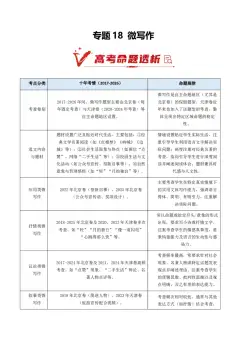
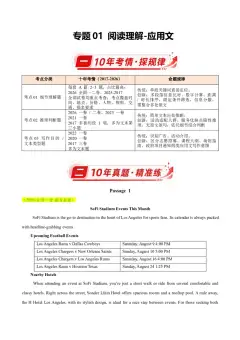
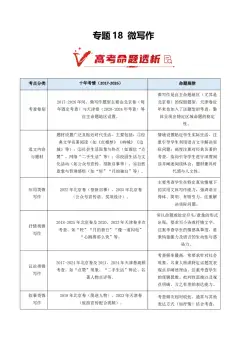
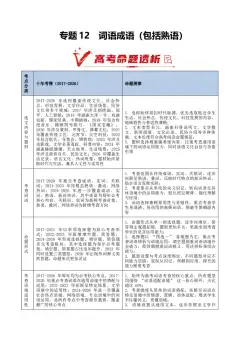
专题02 阅读理解-记叙文

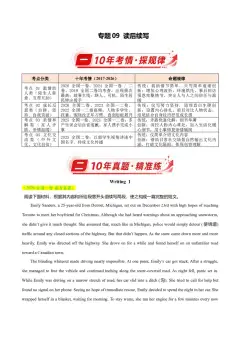
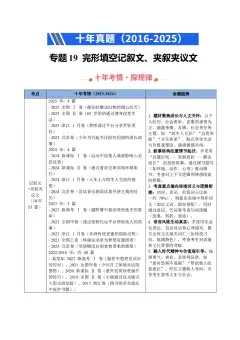
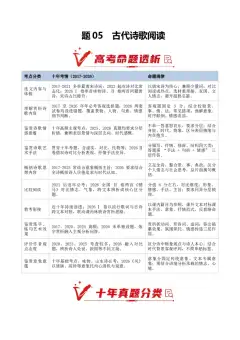
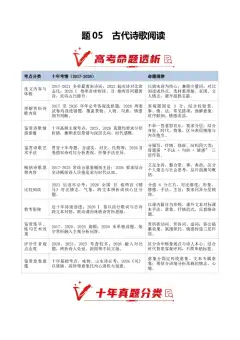
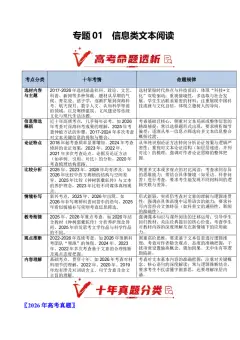
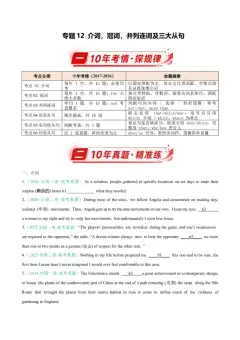
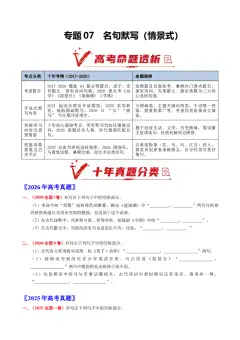
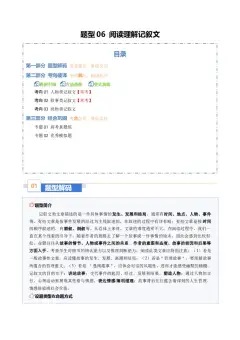
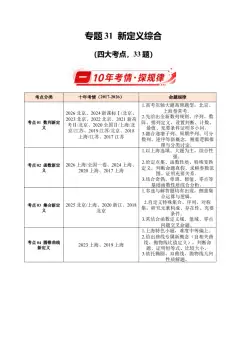
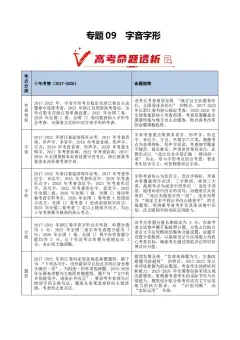
考点分类
十年考情(2017-2026)
命题规律
考点01 细节理解题
每套 B 篇 2 道高频题;
2017-2026 全部全国卷均考查;覆
盖人物行为、事件原因、事物特征
传统:单句定位找原句;
创新:跨段整合细节、因果倒置设问,需
区分表层行为与深层目的
考点02 词义猜测题
2022/2021/2019/2017 多套各
1 道固定题型
传统:近义替换;
创新:依托人物情绪、故事语境推断动词
/ 短语,少单纯字面释义
考点03 推理判断题
每套文末 26、27 必考
2026 一二卷
2025 全卷重点考查
传统:人物性格推断;
创新:主旨感悟、作者深层观点、故事隐
含人生道理,无原文直接依据
考点04 主旨 / 写作
意图题
2017 二卷
2020 一卷
2026 一卷考查
传统:概括故事内容;
创新:区分记事抒情、人物赞美、反思社
会三类写作目的

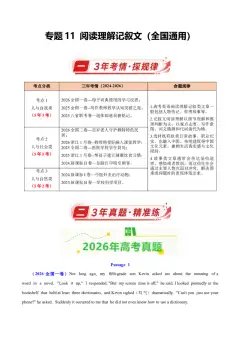
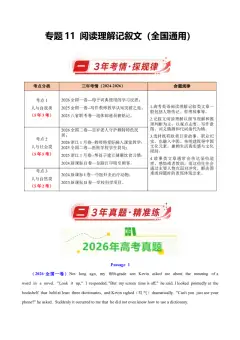
Passage 1
(2026·全国一卷·高考真题)
 Not long ago, my fifth-grade son Kevin asked me about the meaning of a word in a novel. “Look it up,” I
responded. “But my screen time is off,” he said. I looked pointedly at the bookshelf that held at least three
dictionaries, and Kevin sighed dramatically. “Can’t you just use your phone?” he asked. Suddenly it occurred to me
that he did not even know how to use a dictionary.
I took down one of the dictionaries, and we read it together for a few minutes before I handed it to him. It took
him a few tries to find the word in question. While going through the pages, he kept saying, wide-eyed: “How can
there be this many words?” After a while, he looked at me and asked, “Do you know all these words, Mom?” I
smiled, “I definitely do not know all these words,” I said. “But that’s why this is one of my favorite books.”
I had my first dictionary as a gift for my 13th birthday. I decided that I wanted to learn as many words as I
could and started marking every entry I looked up with a pencil to measure my progress. I continued to make these
pencil marks for years, and when I went off to college, I packed that dictionary in my suitcase.
Kevin wanted to see the dictionary. I felt a small pain in my chest. The dictionary was stolen at the end of my
freshman year of college. “That’s so sad,” he said, “but you still know all those words, even without the book.” I
realized that this was true. I still made it through the next three years of college, even without the book. And it
wasn’t, ultimately, the dictionary that got me there — not really.
Now I understand that although my son may be learning differently, he is still learning. It’s not about the
words themselves or how we learn them, but the wanting to know them, the curiosity and the appetite.
24. What does Kevin usually do to get the meaning of a word?
A. Use electronic devices.      B. Consult a paper dictionary.
B. Guess from the context.     D. Turn to his English teacher.
25. How did Kevin feel while looking up the word in the dictionary?
A. Annoyed. B. Disappointed. C. Encouraged. D. Astonished.
26. What can we learn about the author’s first dictionary?
A. It helped her through college.
B. It was given to Kevin as a gift.
B. It bore witness to her efforts.
D. It was a valuable limited edition.
27. What has the author come to realize about learning?
A. It is never too late to start.
B. Motivation is what really matters.
C. Children need role models.
D. Dictionaries are still a useful tool.
Passage 2
(2026·全国二卷·高考真题)
Roland Reisley turned 101 years old in May and is in remarkable health. But that’s not the thing he prides
himself on. “I am the last original client of Frank Lloyd Wright, still living in the home he designed for me,”
Reisley said, sitting in the bright open living room of the home designed by the famous architect.
The house where Reisley has lived for 73 years is located in the woods of Westchester County, New York, just
30 miles north of Manhattan. It’s one of 47 that make up the peaceful mid-20th-century modern village of Usonia.
Back in 1951, Reisley was just 26, newly married and ready to put down roots. He and his wife began looking
for a place in Manhattan. But what they liked, they couldn’t afford on his sound engineer’s salary and what they
could, they didn’t like. Then they heard about Usonia. On their first trip out, they were greeted with such
enthusiasm from the 10 families who’d already established homes there that they decided to join.
The house has signature Wright features. It is made with local materials, has a flat roof, wood paneling,
concrete floors and custom-made furniture. Over the decades, Reisley has opened his doors to visitors. The house is
now listed on the National Register of Historic Places. Reisley said he’s tried his best to be a good steward (管家)
not just of the Wright creation he lives in, but all others as well. He co-founded the Frank Lloyd Wright Building
Conservancy, an organization engaged in the preservation of all of Wright’s remaining buildings. Reisley believes
that his devotion to the home and the community are what have kept him in such good health all of these years.
24. How does Reisley feel about having Wright as his house designer?
A. Honored.         B. Amused.         C. Stressed.          D. Inspired.
25. What made Reisley finally decide to settle down in Usonia?
A. Its natural environment.                    B. Its large-sized houses.
C. The convenience of its location.              D. The warmth of its residents.
26. What can we learn about Reisley’s house?
A. It is older than its owner.
B. It uses local materials.
C. It has a pointed roof.
D. It is put up for sale.
27. What can be inferred about Reisley from the last paragraph?
A. He is very attached to Wright buildings.
B. He is devoted to health education.
C. He is an expert in home decoration.
D. He is passionate about tourism.
Passage 3
(2025·全国一卷·高考真题)
In my ninth-grade writing class last year, I met a cowboy who saved his town, a strict father who demanded
his son earn straight A’s, and a modern-day Juliet who died of heartbreak after her parents rejected the love of her
young life. More than once, I found myself wondering just how my students, who’d created these people, knew
their subjects so well.
But things were different for their first essay, which was about the question: “Why is writing important?” Most
of the essays filled less than one page, and few contained a sentence that could be interpreted as a thesis (论点)
statement. I was shocked. Then I realized that the problem was the question itself. They could have written pages
on the necessity of computers, but writing, in and of itself, simply didn’t strike them as important. This would have
to change.
As a new unit started, I asked everyone to write a persuasive piece on a health-related topic of their choice.
This time they found the exercise much more interesting. For the next two assignments, a personal-narrative unit
followed by a creative-writing workshop, I only required that the piece meet the specifications of its genre (体裁)
and that it contain a thesis. The results were staggering. The students took on diverse topics and turned in stories,
10 to 20 pages each, with characters that broadened my view and touched my heart.
I walked into class believing that writing is important as a means of communication. However, my students
demonstrated something more important to me. When the final bell rang in June, I walked away with a yearbook
full of messages about writing’s most powerful significance — the ability to connect people, to put us in another’s
skin, to teach us what it means to be human.
24. Who are the people mentioned at the beginning of paragraph 1?
A. Ninth graders.
B. Students’ parents.
C. Modern writers.
D. Fictional characters.
25. Why did the students perform poorly in writing their first essay?
A. They were not given enough time.
B. They had a very limited vocabulary.
C. They misunderstood the question.
D. They had little interest in the topic.
26. What does the underlined word “staggering” in paragraph 3 mean?
A. Mixed.
B. Amazing.
C. Similar.
D. Disturbing.
27 What does the author’s experience show?
A. Teaching is learning.
B. Still waters run deep.
C. Knowledge is power.
D. Practice makes perfect.
Passage 4
(2025·全国二卷·高考真题)
Kathy Ho teaches high school inside Lucile Packard Children’s Hospital Stanford (LPCH). “Sometimes I
don’t like saying that I’m a teacher,” says Ho. “People get in their minds an idea of what teachers do, but that’s not
really what it is here.”
“Here” is room 386, where each year, about 500 LPCH patients also become students. The hospital school is
free of parents, doctors, and medical procedures. It’s a place of learning. About half of Ho’s students stay for a
week or less; others are there for more than a year. Most of Ho’s students will recover, which means that preparing
them to return to school is an increasingly important component of care.
Still, in room 386, academics don’t come first. Physical health and mental health are the priority. “If you’re
scared about something and thinking only about that, there’s no way you’re going to be able to learn,” Ho says.
“I’m a coach, an adviser, and a comforter, and that’s what it means to be a hospital teacher.”
There are up to 30 students at any given time in Ho’s class. She generally works with their regular teachers to
get lessons and tests being used at their home schools. Some teachers don’t give the kids any assignments; they
express sympathy instead. “I feel like it is a disservice to the kids,” Ho says. “They think their teachers don’t care
about their schoolwork.”
Ho recognizes the psychological benefit of helping kids keep up with their peers (同龄人) outside the hospital.
“I actually think the medicine is only a small piece for some problems,” says Julie Good, director of pain
management services at LPCH. “It’s about problem-solving around what it means to have a full life. Those kids
have dreams. School can keep those dreams alive by giving kids a way to learn and grow.”
24. Who does Ho teach at LPCH?
A. Sick children.
B. Young nurses.
C. Medical students.
D. Patients’ parents.
25. What is a characteristic of Ho’s job?
A. Prioritizing academics.
B. Encouraging innovation.
C. Treating various diseases.
D. Playing multiple roles.
26. What does the underlined word “it” refer to in paragraph 4?
A. Offering regular lessons.
B. Paying extra attention.
C. Assigning no schoolwork.
D. Showing no sympathy.
27. How does the hospital school benefit the students according to Good?
A. It eases peer pressure.
B. It helps them live in hope.
C. It frees them from aches.
D. It entertains them with stories.
Passage 5
(2024·全国一卷·高考真题)
“I am not crazy,"says Dr. Wlliam Fartber, shortly after performing acupuncture (针灸) on a rabbit. "I am ahead
of my time. "If he seems a little defensive, it might be because even some of his coworkers occasionally laugh at
his unusual methods. But Farber is certain he'll have the last laugh. He's one of a small but growing number of
American veterinarians( 兽医) now practicing"holistic"medicine-combining traditional Western treatments with
acupuncture,  chiropractic(按摩疗法)and herbal medicine.
Farber, a graduate of Colorado State University, started out as a more conventional veterinarian. He became
interested in alternative treatments 20 years ago when he suffered from terrible back pain. He tried muscle-
relaxing drugs but found little relief. Then he tried acupuncture, an ancient Chinese practice, and was amazed that
he improved after two or three treatments. What worked on a veterinarian seemed likely to work on his patients.
So, after studying the techniques for a couple of years, he began offering them to pets.
Leigh Tindale's dog Charlie had a serious heart condition. After Charlie had a heart attack, Tindale says, she
was prepared to put him to sleep, but Farber's treatments eased her dog's suffering so much that she was able to
keep him alive for an additional five months. And Priscilla Dewing reports that her horse, Nappy,"moves more
easily  and  rides more comfortably"after a chiropractic adjustment.
Farber is certain that the holistic approach will grow more popular with time, and if the past is any indication,
he may be right: Since 1982, membership  in the American Holistic  Veterinary Medical Association has grown
from 30 to over 700. “Sometimes it surprises me  that it works so well,"he says. "I will do anything to help an
animal. That's my job. "
24. What do some of Farber's coworkers think of him?
A. He's odd.         B. He's  strict.               C. He's brave        D. He's rude.
25. Why did Farber decide to try acupuncture on pets?
A. He was trained in it at university.
B. He was inspired by another veterinarian.
C. He benefited from it as a patient.
D. He wanted to save money for pet owners.
26. What does paragraph 3 mainly talk about?
A. Steps of a chiropractic treatment.
B. The complexity of veterinarians' work.
C. Examples of rare animal diseases.
D. The effectiveness of holistic medicine.
27. Why does the author mention the American Holistic Veterinary Medical Association?
A. To prove Farber's point.       B. To emphasize its importance.
C. To praise veterinarians.       D. To advocate animal protection.
Passage 6
(2023·全国一卷·高考真题)
When John Todd was a child, he loved to explore the woods around his house, observing how nature solved
problems. A dirty stream, for example, often became clear after flowing through plants and along rocks where tiny
creatures lived. When he got older, John started to wonder if this process could be used to clean up the messes
people were making.
After studying agriculture, medicine, and fisheries in college, John went back to observing nature and asking
questions. Why can certain plants trap harmful bacteria (细菌)? Which kinds of fish can eat cancer-causing
chemicals? With the right combination of animals and plants, he figured, maybe he could clean up waste the way
nature did. He decided to build what he would later call an eco-machine.
The task John set for himself was to remove harmful substances from some sludge (污泥). First, he
constructed a series of clear fiberglass tanks connected to each other. Then he went around to local ponds and
streams and brought back some plants and animals. He placed them in the tanks and waited. Little by little, these
different kinds of life got used to one another and formed their own ecosystem. After a few weeks, John added the
sludge.
He was amazed at the results. The plants and animals in the eco-machine took the sludge as food and began to
eat it! Within weeks, it had all been digested, and all that was left was pure water.
Over the years, John has taken on many big jobs. He developed a greenhouse — like facility that treated
sewage (污水) from 1,600 homes in South Burlington. He also designed an eco-machine to clean canal water in
Fuzhou, a city in southeast China.
“Ecological design” is the name John gives to what he does. “Life on Earth is kind of a box of spare parts for
the inventor,” he says. “You put organisms in new relationships and observe what’s happening. Then you let these
new systems develop their own ways to self-repair.”
24. What can we learn about John from the first two paragraphs?
A. He was fond of traveling.
B. He enjoyed being alone.
C. He had an inquiring mind.
D. He longed to be a doctor.
25. Why did John put the sludge into the tanks?
A. To feed the animals.
B. To build an ecosystem.
C. To protect the plants.
D. To test the eco-machine.
26. What is the author’s purpose in mentioning Fuzhou?
A To review John’s research plans.
B. To show an application of John’s idea.
C. To compare John’s different jobs.
D. To erase doubts about John’s invention.
27. What is the basis for John’s work?
A. Nature can repair itself.
B. Organisms need water to survive.
C. Life on Earth is diverse.
D. Most tiny creatures live in groups.
Passage 7
(2022·全国一卷·高考真题)
Like most of us, I try to be mindful of food that goes to waste. The arugula(芝麻菜)was to make
a nice green salad, rounding out a roast chicken dinner. But I ended up working late. Then friends called
with a dinner invitation. I stuck the chicken in the freezer. But as days passed, the arugula went bad. Even
worse, I had unthinkingly bought way too much; I could have made six salads with what I threw out.
In a world where nearly 800 million people a year go hungry, "food waste goes against the moral
grain," as Elizabeth Royte writes in this month's cover story. It's jaw-dropping how much perfectly good
food is thrown away—from “ugly"(but quite eatable)vegetables rejected by grocers to large amounts of
uneaten dishes thrown into restaurant garbage cans.
Producing food that no one eats wastes the water, fuel, and other resources used to grow it. That
makes food waste an environmental problem. In fact, Royte writes, "if food waste were a country, it
would be the third largest producer of greenhouse gases in the world."
If that's hard to understand, let's keep it as simple as the arugula at the back of my refrigerator.
Mike Curtin sees my arugula story all the time — but for him, it's more like 12 bones of donated
strawberries nearing their last days. Curtin is CEO of DC Central Kitchen in Washington, D.C., which recovers
food and turns it into healthy meals. Last year it recovered more than 807,500 pounds of food by taking
donations and collecting blemished(有瑕疵的)produce that otherwise would have rotted in fields. And
the strawberries? Volunteers will wash, cut, and freeze or dry them for use in meals down the road.
Such methods seem obvious, yet so often we just don't think. "Everyone can play a part in reducing
waste, whether by not purchasing more food than necessary in your weekly shopping or by asking
restaurants to not include the side dish you won't eat," Curtin says.
24. What does the author want to show by telling the arugula story?
A. We pay little attention to food waste.      B. We waste food unintentionally at times.
C. We waste more vegetables than meat.      D. We have good reasons for wasting food.
25. What is a consequence of food waste according to the text?
A. Moral decline.        B. Environmental harm.
C. Energy shortage.      D. Worldwide starvation.
26. What does Curtin's company do?
A. It produces kitchen equipment.      B. It turns rotten arugula into clean fuel.
C. It helps local farmers grow fruits     D. It makes meals out of unwanted food.
27. What does Curtin suggest people do?
A. Buy only what is needed.        B. Reduce food consumption.
C. Go shopping once a week.       D. Eat in restaurants less often.
Passage 8
(2022·全国一卷·高考真题)
The elderly residents(居民)in care homes in London are being given hens to look after to stop
them feeling lonely.
The project was dreamed up by a local charity(慈善组织)to reduce loneliness and improve elderly
people's wellbeing, It is also being used to help patients suffering dementia, a serious illness of the mind.
Staff in care homes have reported a reduction in the use of medicine where hens are in use.
Among those taking part in the project is 80-year-old Ruth Xavier. She said: “I used to keep hens
when I was younger and had to prepare their breakfast each morning before I went to school.
"I like the project a lot. I am down there in my wheelchair in the morning letting the hens out and down there
again at night to see they've gone to bed.
"It's good to have a different focus. People have been bringing their children in to see the hens and residents
come and sit outside to watch them. I'm enjoying the creative activities, and it feels great to have done something
useful."
There are now 700 elderly people looking after hens in 20 care homes in the North East, and the charity has
been given financial support to roll it out countrywide.
Wendy Wilson, extra care manager at 60 Penfold Street, one of the first to embark on the project, said:
"Residents really welcome the idea of the project and the creative sessions. We are looking forward to the benefits
and fun the project can bring to people here."
Lynn Lewis, director of Notting Hill Pathways, said: "We are happy to be taking part in the project. It will
really help connect our residents through a shared interest and creative activities."
28. What is the purpose of the project?
A. To ensure harmony in care homes.        B. To provide part-time jobs for the aged.
C. To raise money for medical research.      D. To promote the elderly people's welfare.
29. How has the project affected Ruth Xavier?
A. She has learned new life skills.      B. She has gained a sense of achievement.
C. She has recovered her memory.      D. She has developed a strong personality.
30. What do the underlined words "embark on" mean in paragraph 7?
A. Improve.      B. Oppose.      C. Begin.      D. Evaluate.
31. What can we learn about the project from the last two paragraphs?
A. It is well received.         B. It needs to be more creative.
C. It is highly profitable.      D. It takes ages to see the results.
Passage 9
(2022·全国二卷·高考真题)
We journalists live in a new age of storytelling, with many new multimedia tools. Many young people don't
even realize it's new. For them, it's just normal.
This hit home for me as I was sitting with my 2-year-old grandson on a sofa over the Spring Festival
holiday. I had brought a children's book to read. It had simple words and colorful pictures—a perfect match for his
age.
Picture this: my grandson sitting on my lap as I hold the book in front so he can see the pictures. As I read, he
reaches out and pokes(戳)the page with his finger.
What's up with that? He just likes the pictures, I thought. Then I turned the page and continued. He poked the
page even harder. I nearly dropped the book. I was confused: Is there something wrong with this kid?
Then I realized what was happening. He was actually a stranger to books. His father frequently amused the
boy with a tablet computer which was loaded with colorful pictures that come alive when you poke them. He
thought my storybook was like that.
Sorry, kid. This book is not part of your high-tech world. It's an outdated, lifeless thing. An antique, Like your
grandfather. Well, I may be old, but I'm not hopelessly challenged, digitally speaking. I edit video and produce
audio. I use mobile payment. I've even built websites.
There's one notable gap in my new-media experience, however: I've spent little time in front of a camera,
since I have a face made for radio. But that didn't stop China Daily from asking me last week to share a personal
story for a video project about the integration of Beijing, Tianjin and Hebei province.
Anyway, grandpa is now an internet star—two minutes of fame! I promise not to let it go to my head. But I
will make sure my 2-year-old grandson sees it on his tablet.
24. What do the underlined words "hit home for me" mean in paragraph 2?
A. Provided shelter for me.          B. Became very clear to me.
C. Took the pressure off me.         D. Worked quite well on me.
25. Why did the kid poke the storybook?
A. He took it for a tablet computer.           B. He disliked the colorful pictures.
C. He was angry with his grandpa.           D. He wanted to read it by himself.
26. What does the author think of himself?
A. Socially ambitious.           B. Physically attractive.
C. Financially independent.       D. Digitally competent.
27. What can we learn about the author as a journalist?
A. He lacks experience in his job.            B. He seldom appears on television.
C. He manages a video department.          D. He often interviews internet stars.
Passage 10
(2021·全国一卷·高考真题)
By day, Robert Titterton is a lawyer. In his spare time though he goes on stage beside pianist Maria Raspopova
— not as a musician but as her page turner. “I’m not a trained musician, but I’ve learnt to read music so I can help
Maria in her performance.”
Mr Titterton is chairman of the Omega Ensemble but has been the group’s official page turner for the past
four years. His job is to sit beside the pianist and turn the pages of the score so the musician doesn’t have to break
the flow of sound by doing it themselves. He said he became just as nervous as those playing instruments on stage.
“A lot of skills are needed for the job. You have to make sure you don’t turn two pages at once and make
sure you find the repeats in the music when you have to go back to the right spot.” Mr Titterton explained.
Being a page turner requires plenty of practice. Some pieces of music can go for 40 minutes and require up
to 50 page turns, including back turns for repeat passages. Silent onstage communication is key, and each pianist
has their own style of “nodding” to indicate a page turn which they need to practise with their page turner.
But like all performances, there are moments when things go wrong. “I was turning the page to get ready
for the next page, but the draft wind from the turn caused the spare pages to fall off the stand,” Mr Titterton said,
“Luckily I was able to catch them and put them back.”
Most page turners are piano students or up-and-coming concert pianists, although Ms Raspopova has once
asked her husband to help her out on stage.
“My husband is the worst page turner,” she laughed. “He’s interested in the music, feeling every note, and I
have to say: ‘Turn, turn!’ “Robert is the best page turner I’ve had in my entire life.”
24.
 What should Titterton be able to do to be a page turner?
A. Read music.
B. Play the piano.
C. Sing songs.
D. Fix the instruments.
25. Which of the following best describes Titterton’s job on stage?
A. Boring.
B. Well-paid.             C. Demanding.            D. Dangerous.
26. What does Titterton need to practise?
A. Counting the pages.
B. Recognizing the “nodding”.
C. Catching falling objects.
D. Performing in his own style.
27.
Why is Ms Raspopova’s husband “the worse page turner”?
A. He has very poor eyesight.
B. He ignores the audience.
C. He has no interest in music.
D. He forgets to do his job.
Passage 11
(2021·全国二卷·高考真题)
I have worked as a keeper at the National Zoo, Paris for 11 years. Spot and Stripe are the first tiger cubs that
have ever been born here. Globally, a third of Sumatran cubs in zoos don't make it to adulthood, so I decided to
give them round-the-clock care at home.
I've got two children—the younger one, Kynan, was extremely happy about the tigers arriving - but all of us
really looked forward to being part of their lives and watching them grow. I wasn't worried about bringing them
into my home with my wife and kids. These were cubs. They weighed about 2.5 kg and were so small that there
was absolutely no risk.
As they grew more mobile, we let them move freely around the house during the day, but when we were
asleep we had to contain them in a large room, otherwise they'd get up to mischief. We'd come down in the
morning to find they'd turned the room upside down, and left it looking like a zoo.
Things quickly got very intense due to the huge amount of energy required to look after them. There were
some tough times and I just felt extremely tired. I was grateful that my family was there to help. We had to have a
bit of a production line going, making up “tiger milk”, washing baby bottles, and cleaning the floors.
When Spot and Stripe were four months old, they were learning how to open doors and jump fences, and we
knew it really was time for them to go. It was hard for us to finally part with them. For the first few days, Kynan
was always a bit disappointed that the cubs weren't there.
I'm not sad about it. I'm hands-on with them every day at the zoo, and I do look back very fondly on the time
that we had them.
24. Why did the author bring the tiger cubs home?
A. To ensure their survival.
B. To observe their differences.
C. To teach them life skills.
D. To let them play with his kids.
25. What do the underlined words “get up to mischief” mean in paragraph 3?
A Behave badly.
B. Lose their way.
C. Sleep soundly.
D. Miss their mom.
26. What did the author think of raising the tiger cubs at home?
A. Boring.
B. Tiring.
C. Costly.
D. Risky.
27. Why did the author decide to send Spot and Stripe back to the zoo?
A. They frightened the children.
B. They became difficult to contain.
C. They annoyed the neighbours.
D. They started fighting each other.
Passage 12
(2021·全国二卷·高考真题)
A British woman who won a S1 million prize after she was named the World's Best Teacher will use the cash
to bring inspirational figures into UK schools.
Andria Zafirakou,a north London secondary school teacher, said she wanted to bring about a classroom
revolution (变革). “We are going to make a change, ”she said.“I’ve started a project to promote the teaching of the
arts in our schools.”
The project results from the difficulties many schools have in getting artists of any sort - whether an up-and-
coming local musician or a major movie star - into schools to work with and inspire children.
Zafirakou began the project at Alperton Community School, her place of work for the past twelve years. “I've
seen those magic moments when children are talking to someone they are inspired by - their eyes are shining and
their faces light up,” she said. “We need artists . more than ever in our schools."
Artist Michael Craig-Martin said: “Andria's brilliant project to bring artists from all fields into direct contact
with children is particularly welcome at a time when the arts are being downgraded in schools." It was a mistake to
see the arts as unnecessary, he added.
Historian Sir Simon Schama is also a supporter of the project. He said that arts education in schools was not
just an add-on. “It is absolutely necessary. The future depends on creativity and creativity depends on the young.
What will remain of us when artificial intelligence takes over will be our creativity, and it is our creative spirit, our
visionary sense of freshness,that has been our strength for centuries."
28. What will Zafirakou do with her prize money?
A. Make a movie.
B. Build new schools.
C. Run a project.
D. Help local musicians.
29. What does Craig-Martin think of the teaching of the arts in UK schools?
A. It is particularly difficult.
B. It increases artists' income.
C. It opens children's mind.
D. It deserves greater attention.
30. What should be stressed in school education according to Schama?
A. Moral principles.
B. Interpersonal skills.
C. Creative abilities.
D. Positive worldviews.
31. Which of the following is a suitable title for the text?
A. Bring Artists to Schools
B. When Historians Meet Artists
C. Arts Education in Britain
D. The World's Best Arts Teacher
Passage 13
(2020·全国一卷·高考真题)
Returning to a book you’ve read many times can feel like drinks with an old friend. There’s a welcome
familiarity — but also sometimes a slight suspicion that time has changed you both, and thus the relationship. But
books don’t change, people do. And that’s what makes the act of rereading so rich and transformative.
The beauty of rereading lies in the idea that our bond with the work is based on our present mental register. It’s
true, the older I get, the more I feel time has wings. But with reading, it’s all about the present. It’s about the
now and what one contributes to the now, because reading is a give and take between author and reader. Each has
to pull their own weight.
There are three books I reread annually. The first, which I take to reading every spring, is Ernest
Hemingway’s A Moveable Feast. Published in 1964, it’s his classic memoir of 1920s Paris. The language is
almost intoxicating (令人陶醉的),an aging writer looking back on an ambitious yet simpler time. Another is
Annie Dillard’s Holy the Firm, her poetic 1975 ramble (随笔) about everything and nothing. The third book is
Julio Cortazar’s Save Twilight: Selected Poems, because poetry. And because Cortazar.
While I tend to buy a lot of books, these three were given to me as gifts, which might add to the meaning I
attach to them. But I imagine that, while money is indeed wonderful and necessary, rereading an author’s work is
the highest currency a reader can pay them. The best books are the ones that open further as time passes. But
remember, it’s you that has to grow and read and reread in order to better understand your friends.
24. Why does the author like rereading?
A. It evaluates the writer-reader relationship.
B. It’s a window to a whole new world.
C. It’s a substitute for drinking with a friend.
D. It extends the understanding of oneself.
25. What do we know about the book A Moveable Feast?
A. It’s a brief account of a trip.
B. It’s about Hemingway’s life as a young man.
C. It’s a record of a historic event.
D. It’s about Hemingway’s friends in Paris.
26. What does the underlined word "currency" in paragraph 4 refer to?
A. Debt.
B. Reward.
C. Allowance.
D. Face value.
27. What can we infer about the author from the text?
A. He loves poetry. B. He’s an editor.
C. He’s very ambitious. D. He teaches reading.
Passage 14
(2020·全国二卷·高考真题)
I have a special place in my heart for libraries. I have for as long as I can remember. I was always an
enthusiastic reader, sometimes reading up to three books a day as a child. Stories were like air to me and while
other kids played ball or went to parties, I lived out adventures through the books I checked out from the library.
My first job was working at the Ukiah Library when I was 16 years old. It was a dream job and I did
everything from shelving books to reading to the children for story time.
As I grew older and became a mother, the library took on a new place and an added meaning in my life. I had
several children and books were our main source(来源) of entertainment. It was a big deal for us to load up and go
to the local library, where my kids could pick out books to read or books they wanted me to read to them.
I always read, using different voices, as though I were acting out the stories with my voice and they loved it!
It was a special time to bond with my children and it filled them with the wonderment of books.
Now, I see my children taking their children to the library and I love that the excitement of going to the library
lives on form generation to generation.
As a novelist, I’ve found a new relationship with libraries. I encourage readers to go to their local library
when they can’t afford to purchase a book. I see libraries as a safe haven(避风港) for readers and writers, a bridge
that helps put together a reader with a book. Libraries, in their own way, help fight book piracy( 盗版行为) and I
think all writers should support libraries in a significant way when they can. Encourage readers to use the library.
Share library announcements on your social media. Frequent them and talk about them when you can.
32. Which word best describes the author’s relationship with books as a child?
A. Cooperative.
B. Uneasy.
C. Inseparable.
D. Casual.
33. What does the underlined phrase “an added meaning” in paragraph 3 refer to?
A. Pleasure from working in the library.
B. Joy of reading passed on in the family.
C. Wonderment from acting out the stories.
D. A closer bond developed with the readers.
34. What does the author call on other writers to do?
A. Sponsor book fairs.
B. Write for social media.
C. Support libraries.
D. Purchase her novels.
35. Which can be a suitable title for the text?
A. Reading: A Source of Knowledge
B. My Idea about Writing
C. Library: A Haven for the Young
D. My Love of the Library
Passage 15
(2019·全国一卷·高考真题)
For Canaan Elementary’s second grade in Patchogue, N.Y.,today is speech day, and right now it’s
Chris Palaez’s turn. The 8-year-old is the joker of the class. With shining dark eyes, he seems like the kind
of kid who would enjoy public speaking.
But he’s nervous."I’m here to tell you today why you should … should…"Chris trips on the"-ld,"a
pronunciation difficulty for many non-native English speakers. His teacher, Thomas Whaley, is next to him,
whispering support."…Vote for …me …"Except for some st  u  m  bles

 , Chris is doing amazingly well. When
he brings his speech to a nice conclusion, Whaley invites the rest of the class to praise him.
A son of immigrants, Chris started learning English a little over three years ago. Whaley recalls(回想
起)how at the beginning of the year, when called upon to read, Chris would excuse himself to go to the
bathroom.
Learning English as a second language can be a painful experience. What you need is a great teacher who lets
you make mistakes. "It takes a lot for any student, " Whaley explains, "especially for a student who is
learning English as their new language, to feel confident enough to say, ‘I don’t know,but I want to know.’"
Whaley got the idea of this second-grade presidential campaign project when he asked the children one day to
raise their hands if they thought they could never be a president. The answer broke his heart. Whaley says the
project is about more than just learning to read and speak in public. He wants these kids to learn to boast(夸耀)
about themselves.
"Boasting about yourself, and your best qualities," Whaley says, "is very difficult for a child who came
into the classroom not feeling confident."
24. What made Chris nervous?
A. Telling a story.
B. Making a speech.
C. Taking a test.
D. Answering a question.
25. What does the underlined word "stumbles" in paragraph 2 refer to?
A. Improper pauses.
B. Bad manners.
C. Spelling mistakes.
D. Silly jokes.
26. We can infer that the purpose of Whaley’s project is to _________.
A. help students see their own strengths
B. assess students’ public speaking skills
C. prepare students for their future jobs
D. inspire students’ love for politics
27. Which of the following best describes Whaley as a teacher?
A. Humorous.
B. Ambitious.
    C. Caring.
  D. Demanding.
Passage 16
(2019·全国二卷·高考真题)
"You can use me as a last resort(选择), and if nobody else volunteers, then I will do it." This was an actual
reply from a parent after I put out a request for volunteers for my kids' lacrosse(长曲棍球)club.
I guess that there's probably some demanding work schedule, or social anxiety around stepping up to help for
an unknown sport. She may just need a little persuading. So I try again and tug at the heartstrings. I mention the
single parent with four kids running the show and I talk about the dad coaching a team that his kids aren’t even
on… At this point the unwilling parent speaks up, "Alright. Yes, I’ll do it."
I’m secretly relieved because I know there’s real power in sharing volunteer responsibilities among many. The
unwilling parent organizes the meal schedule, sends out emails, and collects money for end-of-season gifts.
Somewhere along the way, the same parent ends up becoming an invaluable member of the team. The coach is able
to focus on the kids while the other parents are relieved to be off the hook for another season. Handing out sliced
oranges to bloodthirsty kids can be as exciting as watching your own kid score a goal.
Still, most of us volunteers breathe a sigh of relief when the season comes to a close. That relief is coupled
with a deep understanding of why the same people keep coming back for more: Connecting to the community(社
区)as you freely give your time, money, skills, or services provides a real joy. Volunteering just feels so good.
In that sense, I’m pretty sure volunteering is more of a selfish act than I’d freely like to admit. However, if
others benefit in the process, and I get some reward too, does it really matter where my motivation lies?
24. What can we infer about the parent from her reply in paragraph l?
A. She knows little about the club.
B. She isn't good at sports.
C. She just doesn't want to volunteer.
D. She's unable to meet her schedule.
25. What does the underlined phrase "tug at the heartstrings" in paragraph 2 mean?
A. Encourage team work.
B. Appeal to feelings.
C. Promote good deeds.
D. Provide advice.
26. What can we learn about the parent from paragraph 3?
A. She gets interested in lacrosse.
B. She is proud of her kids.
C. She’ll work for another season.
D. She becomes a good helper.
27. Why does the author like doing volunteer work?
A. It gives her a sense of duty.
B. It makes her very happy.
C. It enables her to work hard.
D. It brings her material rewards.
Passage 17
(2017·全国一卷·高考真题)
I work with Volunteers for Wildlife, a rescue and education organization at Bailey Arboretum in Locust
Valley. Trying to help injured, displaced or sick creatures can be heartbreaking; survival is never certain. However,
when it works, it is simply beautiful.
I got a rescue call from a woman in Muttontown. She had found a young owl (猫头鹰) on the ground. When I
arrived, I saw a 2-to 3-week-old owl. It had already been placed in a carrier for safety.
I examined the chick (雏鸟) and it seemed fine. If I could locate the nest, I might have been able to put it
back, but no luck. My next work was to construct a nest and anchor it in a tree.
The homeowner was very helpful. A wire basket was found. I put some pine branches into the basket to make
this nest safe and comfortable. I placed the chick in the nest, and it quickly calmed down.
Now all that was needed were the parents, but they were absent. I gave the homeowner a recording of the
hunger screams of owl chicks. These advertise the presence of chicks to adults; they might also encourage our
chick to start calling as well. I gave the owner as much information as possible and headed home to see what news
the night might bring.
A nervous night to be sure, but sometimes the spirits of nature smile on us all! The homeowner called to say
that the parents had responded to the recordings. I drove over and saw the chick in the nest looking healthy and
active. And it was accompanied in the nest by the greatest sight of all — LUNCH!The parents had done their duty
and would probably continue to do so.
25. What is unavoidable in the author’s rescue work according ro paragraph 1?
A. Efforts made in vain.
B. Getting injured in his work.
C. Feeling uncertain about his future.
D. Creatures forced out of their homes.
25.Why was the author called to Muttontown?
A. To rescue a woman.          B. To take care of a woman.
C. To look at a baby owl.        D. To cure a young owl.
26.What made the chick calm down?
A. A new nest.                 B. Some food.
C. A recording.                D. Its parents.
27.How would the author feel about the outcome of the event?
A.It’s unexpected.             B. It’s beautiful.
C. It’s humorous.              D. It’s discouraging.
Passage 18
(2017·全国二卷·高考真题)
I first met Paul Newman in 1968, when George Roy Hill, the director of Butch Cassidy and the Sundance
Kid, introduced us in New York City. When the studio didn’t want me for the film— it wanted somebody as well
known as Paul— he stood up for me. I don’t know how many people would have done that; they would have
listened to their agents or the studio powers.
The friendship that grew out of the experience of making that film and The Sting four years later had its root
in the fact that although there was an age difference, we both came from a tradition of theater and live TV. We were
respectful of craft(技艺)and focused on digging into the characters we were going to play. Both of us had the
qualities and virtues that are typical of American actors: humorous, aggressive, and making fun of each other— but
always with an underlying affection. Those were also at the core (核心)of our relationship off the screen.
We shared the brief that if you’re fortunate enough to have success, you should put something back— he
with his Newman’s Own food and his Hole in the Wall camps for kids who are seriously ill, and me with Sundance
and the institute and the festival. Paul and I didn’t see each other all that regularly, but sharing that brought us
together. We supported each other financially and by showing up at events.
I last saw him a few months ago. He’d been in and out of the hospital. He and I both knew what the deal
was, and we didn’t talk about it. Ours was a relationship that didn’t need a lot of words.
24. Why was the studio unwilling to give the role to author at first?
A. Paul Newman wanted it.
B. The studio powers didn’t like his agent.
C. He wasn’t famous enough.
D. The director recommended someone else.
25. Why did Paul and the author have a lasting friendship?
A. They were of the same age.
B. They worked in the same theater.
C. They were both good actors.
D. They had similar characteristics.
26. What does the underlined word “that” in paragraph 3 refer to?
A. Their belief.
B. Their care for children.
C. Their success.
D. Their support for each other.
27. What is the author’s purpose in writing the test?
A. To show his love of films.
B. To remember a frienD.
C. To introduce a new movie.
D. To share his acting experience.
Passage 19
(2017·全国三卷·高考真题)
Minutes after the last movie ended yesterday at the Plaza Theater, employees were busy sweeping up
popcorns and gathering coke cups. It was a scene that had been repeated many times in the theater's 75-year
history. This time, however, the cleanup was a little different. As one group of workers carried out the rubbish,
another group began removing seats and other theater equipment in preparation for the building's end.
The film classic The Last Picture Show was the last movie shown in the old theater. Thought he movie is 30
years old, most of the 250 seats were filled with teary-eyed audience wanting to say good-bye to the old building.
Theater owner Ed Bradford said he chose the movie because it seemed appropriate. The movie is set in a small
town where the only movie theater is preparing to close down.
Bradford said that large modern theaters in the city made it impossible for the Plaza to compete. He added
that the theater's location (i ) was also a reason. "This used to be the center of town," he said. "Now the area is
mostly office buildings and warehouses."Last week some city officials suggested the city might be interested in
turning the old theater into a museum and public meeting place. However, these plans were abandoned because of
financial problems. Bradford sold the building and land to a local development firm, which plans to build a
shopping complex on the land where the theater is located.The theater audience said good-bye as Bradford locked
the doors for the last time. After 75years the Plaza Theater had shown its last movie. The theater will be missed.
24. In what way was yesterday's cleanup at the Plaza special?
A. It made room for new equipment.
B. It signaled the closedown of the theater.
C. It was done with the help of the audience.
D. It marked the 75th anniversary of the theater.
25. Why was The Last Picture Show put on?
A. It was an all-time classic.
C. The audience requested it.
B. It was about the history of the town.
D. The theater owner found it suitable.
26. What will probably happen to the building?
A. It will be repaired.
B. It will be turned into a museum.
C. It will be knocked down.
D. It will be sold to the city government.
27. What can we infer about the audience?
A. They are disappointed with Bradford.
B. They are sad to part with the old theater.
C. They are supportive of the city officials.
D. They are eager to have a shopping center.