专题11 阅读理解记叙文(全国通用)
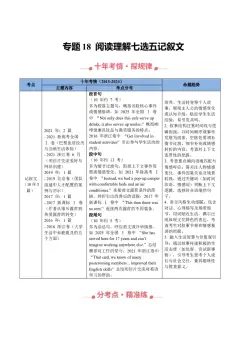
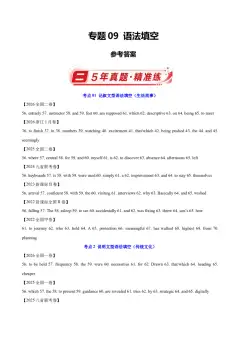
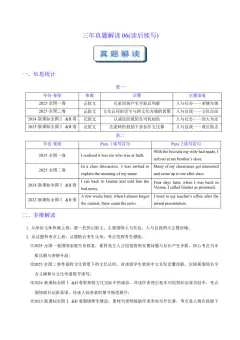
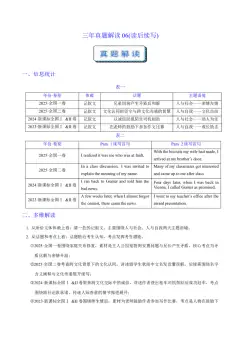
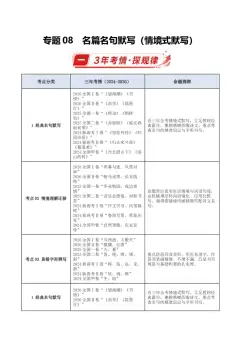
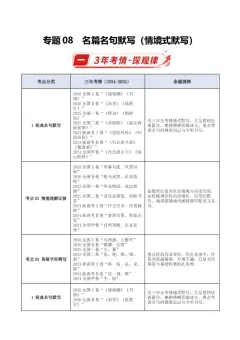
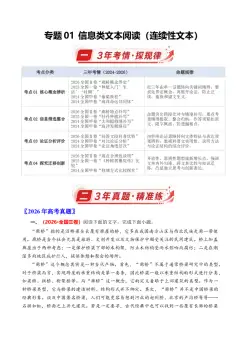
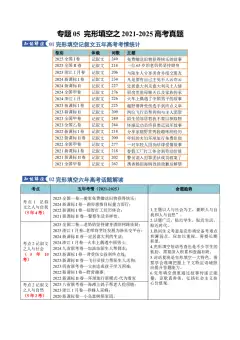
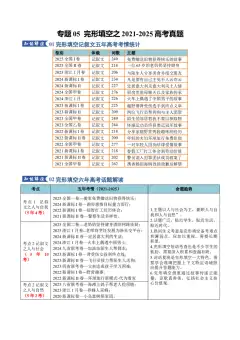
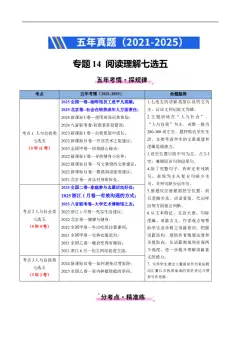
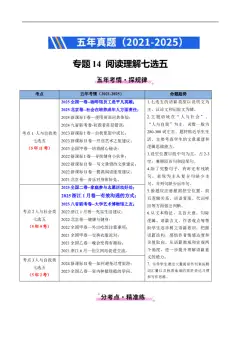
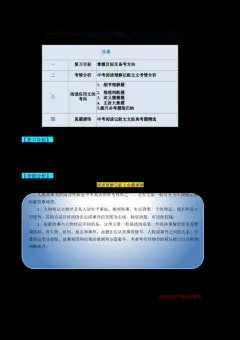
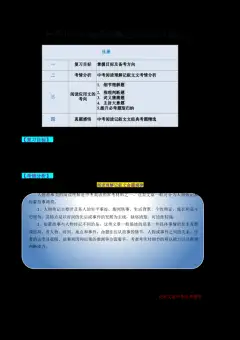
考点分类
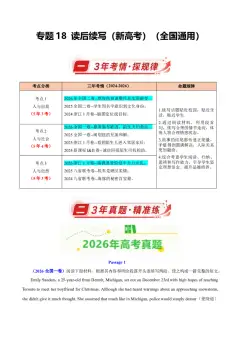
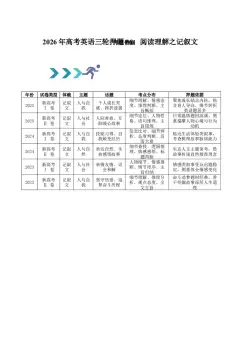
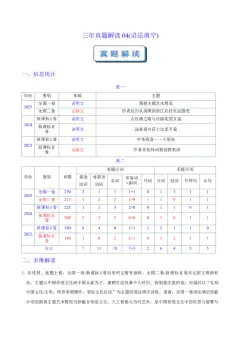
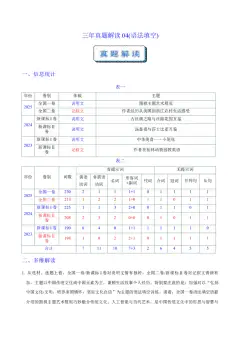
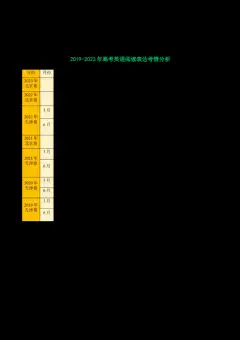
三年考情(2024-2026)
命题规律
考点1
人与自我类
(5 年3 考)
2026 全国一卷---母子词典使用的学习反思;
2025 全国一卷--写作教师教学认知突破之旅;
2025 八省联考卷—退休邮递员被铭记。
1.高考英语阅读理解记叙类文章一
般包括人物传记、哲理故事等。
2.记叙文阅读理解以细节理解和推
理判断为主,以观点态度、写作意
图、词义猜测和代词指代为辅。
3.选材既有欧美日常故事、职业纪
实,也融入中医、传统建筑等中国
文化元素,兼顾生活真实感与文化
浸润。
4.故事类文章通常会传达某些道
理、感悟或者教训,而这些往往会
通过主要人物在面对冲突、解决困
难或问题时的表现体现出来。
考点2
人与社会类
(5 年5 考)
2026 全国二卷---百岁老人守护赖特特色民
居;
2026 浙江1 月卷--教师将爱好融入课堂教学;
2025 全国二卷---医院学校学生益处;
2025 浙江1 月卷--帮孩子建立健康饮食习惯;
2024 新课标II 卷—创新打印吸引顾客。
考点3
人与自然类
(5 年2 考)
2024 新课标I 卷—中医针灸治疗动物;
2023 新课标II 卷—学校科学项目。
Passage 1
(2026·全国一卷)Not long ago, my fifth-grade son Kevin asked me about the meaning of a
word in a novel. "Look it up," I responded. "But my screen time is off," he said. I looked pointedly at the
bookshelf that held at least three dictionaries, and Kevin sighed(叹气)dramatically. "Can't you just use your
phone?" he asked. Suddenly it occurred to me that he did not even know how to use a dictionary.
I took down one of the dictionaries, and we read it together for a few minutes before I handed it to
him. It took him a few tries to find the word in question. While going through the pages, he kept saying,
wide-eyed: "How can there be this many words?"After a while, he looked at me and asked, "Do you know all
these words, Mom?" I smiled. "I definitely do not know all these words," I said. "But that's why this is one of
my favorite books."
I had my first dictionary as a gift for my 13th birthday. I decided that I wanted to learn as many words as I
could and started marking every entry I looked up with a pencil to measure my progress. I continued to
make these pencil marks for years, and when I went off to college, I packed that dictionary in my suitcase.
Kevin wanted to see the dictionary. I felt a small pain in my chest. The dictionary was stolen at the
end of my freshman year of college. "That's so sad," he said, "but you still know all those words,
even without the book." I realized that this was true. I still made it through the next three years of college, even
without the book. And it wasn't, ultimately, the dictionary that got me there — not really.
Now I understand that although my son may be learning differently, he is still learning. It's not about the
words themselves or how we learn them, but the wanting to know them, the curiosity and the appetite.
24. What does Kevin usually do to get the meaning of a word?
A. Use electronic devices.
B. Consult a paper dictionary.
C. Guess from the context.               D. Turn to his English teacher.
25. How did Kevin feel while looking up the word in the dictionary?
A. Annoyed.         B. Disappointed.   C. Encouraged.             D. Astonished.
26. What can we learn about the author's first dictionary?
A. It helped her through college.
B. It was given to Kevin as a gift.
C. It bore witness to her efforts.
D. It was a valuable limited edition.
27. What has the author come to realize about learning?
A. It is never too late to start.             B. Motivation is what really matters.
C. Children need role models.
D. Dictionaries are still a useful tool.
Passage 2
(2026·全国二卷)Roland Reisley turned 101 years old in May and is in remarkable health. But that’s not
the thing he prides himself on. “I am the last original client of Frank Lloyd Wright, still living in the home he
designed for me,” Reisley said, sitting in the bright open living room of the home designed by the famous architect.
The house where Reisley has lived for 73 years is located in the woods of Westchester County, New York, just
30 miles north of Manhattan. It’s one of 47 that make up the peaceful mid-20th-century modern village of Usonia.
Back in 1951, Reisley was just 26, newly married and ready to put down roots. He and his wife began looking
for a place in Manhattan. But what they liked, they couldn’t afford on his sound engineer’s salary and what they
could, they didn’t like. Then they heard about Usonia. On their first trip out, they were greeted with such
enthusiasm from the 10 families who’d already established homes there that they decided to join.
The house has signature Wright features. It is made with local materials, has a flat roof, wood paneling,
concrete floors and custom-made furniture. Over the decades, Reisley has opened his doors to visitors. The house is
now listed on the National Register of Historic Places. Reisley said he’s tried his best to be a good steward (管家)
not just of the Wright creation he lives in, but all others as well. He co-founded the Frank Lloyd Wright Building
Conservancy, an organization engaged in the preservation of all of Wright’s remaining buildings. Reisley believes
that his devotion to the home and the community are what have kept him in such good health all of these years.
24. How does Reisley feel about having Wright as his house designer?
A. Honored.
B. Amused.
C. Stressed.
D. Inspired.
25. What made Reisley finally decide to settle down in Usonia?
A. Its natural environment.
B. Its large-sized houses.
C. The convenience of its location.
D. The warmth of its residents.
26. What can we learn about Reisley’s house?
A. It is older than its owner.
B. It uses local materials.
C. It has a pointed roof.
D. It is put up for sale.
27. What can be inferred about Reisley from the last paragraph?
A. He is very attached to Wright buildings.
B. He is devoted to health education.
C. He is an expert in home decoration.
D. He is passionate about tourism.
Passage 3
(2026·浙江1 月卷)TWhen you’re a teacher, a big part of your job is battling student misconceptions.
Often students come to the classroom believing that learning can’t be fun and that what they learn isn’t relevant to
the real world — much less to their personal interests. I’ve discovered that if I show students how what they learn
is relevant to my hobbies, they’re much more willing to make connections to their personal interests and develop
their own hobbies.
No matter what subject I’m teaching, I find ways to bring my hobbies into the classroom. For example, I’m a
car enthusiast, so when I teach physics, I contextualize concepts with my knowledge about cars. If we’re covering
friction, for example, I bring different tires ( 轮胎) into my classroom so that my students can conduct lab
experiments with them to see how friction works in real-life applications.
When I first brought my hobbies to my classroom, I was focused on how doing so would build engagement
and help my students understand concepts in science. But I quickly learned that the practice also helped me build
stronger relationships with them. When I let them see an aspect of my life outside of school, some students who
were also interested in cars connected with me more and became more engaged in my courses. Even those who
didn’t share that interest with me seemed more engaged once I showed a different side of myself.
What started as an experiment is now more of a philosophy. Even when I’m planning classes, I tend to think
about how I can bring in my hobbies. I find that doing so energizes my instruction, engages my students, and
demonstrates to them how abstract concepts play out in the real world. Best of all, my passion for my hobbies
seems to inspire them to be passionate about finding their own.
24. What poses a challenge to teachers according to the author?
A. Students’ misunderstandings about teachers.
B. Students’ false assumptions about learning.
C. The irrelevance of textbooks to students’ life.
D. The gap between teachers’ and students’ hobbies.
25. Why does the author bring tires into the classroom?
A. To teach an engineering skill.
B. To explain the structure of a car.
C. To share a real-life experience.
D. To illustrate a scientific concept.
26. What was the unexpected outcome of the author’s teaching method?
A. A higher class attendance rate.
B. Better examination results.
C. A closer teacher-student bond.
D. More spare time for students.
27. Which of the following best describes the author as a teacher?
A. Innovative.
B. Humorous.
C. Decisive.
D. Sympathetic.
Passage 1
(2025·全国一卷)In my ninth-grade writing class last year, I met a cowboy who saved his town, a strict
father who demanded his son earn straight A’s, and a modern-day Juliet who died of heartbreak after her parents
rejected the love of her young life. More than once, I found myself wondering just how my students, who’d created
these people, knew their subjects so well.
But things were different for their first essay, which was about the question: “Why is writing important?” Most
of the essays filled less than one page, and few contained a sentence that could be interpreted as a thesis ( 论点)
statement. I was shocked. Then I realized that the problem was the question itself. They could have written pages
on the necessity of computers, but writing, in and of itself, simply didn’t strike them as important. This would have
to change.
As a new unit started, I asked everyone to write a persuasive piece on a health-related topic of their choice.
This time they found the exercise much more interesting. For the next two assignments, a personal-narrative unit
followed by a creative-writing workshop, I only required that the piece meet the specifications of its genre (体裁)
and that it contain a thesis. The results were staggering. The students took on diverse topics and turned in stories,
10 to 20 pages each, with characters that broadened my view and touched my heart.
I walked into class believing that writing is important as a means of communication. However, my students
demonstrated something more important to me. When the final bell rang in June, I walked away with a yearbook
full of messages about writing’s most powerful significance — the ability to connect people, to put us in another’s
skin, to teach us what it means to be human.
24. Who are the people mentioned at the beginning of paragraph 1?
A. Ninth graders.
B. Students’ parents.
C. Modern writers.
D. Fictional characters.
25. Why did the students perform poorly in writing their first essay?
A. They were not given enough time.
B. They had a very limited vocabulary.
C. They misunderstood the question.
D. They had little interest in the topic.
26. What does the underlined word “staggering” in paragraph 3 mean?
A. Mixed.
B. Amazing.
C. Similar.
D. Disturbing.
27. What does the author’s experience show?
A. Teaching is learning.
B. Still waters run deep.
C. Knowledge is power.
D. Practice makes perfect.
Passage 2
(2025· 全国二卷)Kathy Ho teaches high school inside Lucile Packard Children’s Hospital Stanford
(LPCH). “Sometimes I don’t like saying that I’m a teacher,” says Ho. “People get in their minds an idea of what
teachers do, but that’s not really what it is here.”
“Here” is room 386, where each year, about 500 LPCH patients also become students. The hospital school is
free of parents, doctors, and medical procedures. It’s a place of learning. About half of Ho’s students stay for a
week or less; others are there for more than a year. Most of Ho’s students will recover, which means that preparing
them to return to school is an increasingly important component of care.
Still, in room 386, academics don’t come first. Physical health and mental health are the priority. “If you’re
scared about something and thinking only about that, there’s no way you’re going to be able to learn,” Ho says.
“I’m a coach, an adviser, and a comforter, and that’s what it means to be a hospital teacher.”
There are up to 30 students at any given time in Ho’s class. She generally works with their regular teachers to
get lessons and tests being used at their home schools. Some teachers don’t give the kids any assignments; they
express sympathy instead. “I feel like it is a disservice to the kids,” Ho says. “They think their teachers don’t care
about their schoolwork.”
Ho recognizes the psychological benefit of helping kids keep up with their peers (同龄人) outside the hospital.
“I actually think the medicine is only a small piece for some problems,” says Julie Good, director of pain
management services at LPCH. “It’s about problem-solving around what it means to have a full life. Those kids
have dreams. School can keep those dreams alive by giving kids a way to learn and grow.”
24. Who does Ho teach at LPCH?
A. Sick children.
B. Young nurses.
C. Medical students.
D. Patients’ parents.
25. What is a characteristic of Ho’s job?
A. Prioritizing academics.
B. Encouraging innovation.
C. Treating various diseases.
D. Playing multiple roles.
26. What does the underlined word “it” refer to in paragraph 4?
A. Offering regular lessons.
B. Paying extra attention.
C. Assigning no schoolwork.
D. Showing no sympathy.
27. How does the hospital school benefit the students according to Good?
A. It eases peer pressure.
B. It helps them live in hope.
C. It frees them from aches.
D. It entertains them with stories.
Passage 3
(2025·浙江1 月卷)When I was a child I was often told what not to eat. “You don’t want to get fat” was on
constant repeat throughout my childhood. It really messed up my relationship with food — something that took me
years to overcome. Because of this, I’m careful not to connect what my kids weigh with their worth as people. I
encourage my daughter to make healthy snack choices and often dissuade (劝阻) her from a second dessert. But
one day when I heard her saying “I think I’m too fat,” my heart sank. It made me wonder if giving her advice on
snacks was having an unintentionally negative impact.
According to Charlotte Markey, a professor of psychology, food is one of the rare subjects where, as parents,
saying less is more. “There are so many things in parenting that are good to talk through, but I’m not convinced
that food is one of them,” she says. “It just creates some worries and insecurities in kids that aren’t necessarily
healthy.”
Instead, she recommends applying a well-known concept among nutrition experts called the “Division of
Responsibility,” where parents provide a variety of mostly healthy foods to their kids at fixed times, and the kids
themselves decide what and how much they want to consume — even if that means occasionally eating more
cookies than carrots.
Allowing kids to eat what they want also exposes them to the natural consequences of their decisions. “When
your child says, ‘My stomach hurts,’ you can say, ‘Well you had a lot of sugary foods and you might feel better if
you made some other choices,’” says Markey. “Let them feel like they have some control over it.”
I’ve been trying out these strategies and I’ve found that when I’m less restrictive, they do make better
decisions. “Feeding is a long game,” says Markey. “The food you have available makes a huge difference. Even if
they don’t eat it, they’ re seeing it. And then all of a sudden it clicks.”
24. What can be inferred about the author from the first paragraph?
A. She is upset by her kids’ weight.
B. She is critical of the way she was fed.
C. She is interested in making food.
D. She is particular about what she eats.
25. Which of the following would Markey disapprove of?
A. Allowing kids to eat cookies occasionally.
B. Offering various foods to kids at fixed times.
C. Explaining to kids the risks of taking snacks.
D. Talking with kids about school at mealtimes.
26. What should kids do according to the “Division of Responsibility”?
A. Make diet decisions on their own.
B. Share their food with other kids.
C. Eat up what is provided for them.
D. Help their parents do the dishes.
27. What does the author think of the strategies she has been following?
A. Costly.
B. Complex.
C. Workable.
D. Contradictory.
Passage 4
(2025·北京卷)Throughout our Junior year, my classmates and I have been worried about what colleges
will see when they look at our whole life story reduced to a single 200-word essay. Will the golden word “success”
form in their minds when they review our achievements? Or will they see the big word “fail” in red? The shadow
of this mysterious (神秘的) institution steals away what success means to us.
My first step of redefining success began with course registrations. It is a well-known fact, especially in my
school, that Junior year is the time of packing many AP classes into the schedule. When asked why they chose so
many AP classes, my friends responded: “I don’t know.” They themselves don’t know why they are following the
crowd and longing for the pressures of academic difficulty. Therefore, they do not feel the satisfaction of being
academically challenged.
Completing many courses no longer brings out the feeling of success because more than four AP classes per
year is a norm set by top universities. Determined to follow my instincts (本能) on what I felt success means, I only
chose two classes that I knew I would enjoy. The feeling of success was no longer attached to what grade I received
but to the pure joy of learning.
Even my failures are attached to a feeling of success; after I take a step back and look at the big picture, I see
them as a launching pad (平台) for my next big achievement. In the ninth grade, I went in for my first group
interview for a leadership position as a shy girl. Not standing a chance against competitive applicants, I came out of
the interview with an upset look. Nevertheless, this interview wasn’t a wasted opportunity. I talked to one of the
senior applicants who answered questions in a way that reflected the faith she had in herself.
This year, with an open mind and new knowledge in mind, I walked into another group interview while telling
myself I was that cool senior. I managed to secure a leadership position. Ultimately, success came little by little.
24. Throughout the Junior year, what was the author’s major concern?
A. Pressure from choosing AP classes.
B. Performance in group interviews.
C. Competition with seniors.
D. Recognition by colleges.
25. The author chose fewer AP classes because of _______.
A. her own understanding of success
B. her desire for academic challenges
C. her strong urge to follow the crowd
D. her dream of entering a top university
26. Which would best describe the author’s first group interview?
A Dignifying.
B. Rewarding.
C. Engaging.
D. Relaxing.
27. What can we learn from this passage?
A. Everyone is the maker of their own success.
B. Success favours those with a golden heart.
C. Success knocks at your door only once.
D. A college holds the key to success.

Passage 1
(2024·新课标I 卷)“I am not crazy,” says Dr. William Farber, shortly after performing acupuncture (针
灸) on a rabbit. “I am ahead of my time.” If he seems a little defensive, it might be because even some of his
coworkers occasionally laugh at his unusual methods. But Farber is certain he’ll have the last laugh. He’s one of a
small but growing number of American veterinarians ( 兽医) now practicing “holistic” medicine-combining
traditional Western treatments with acupuncture, chiropractic (按摩疗法) and herbal medicine.
Farber, a graduate of Colorado State University, started out as a more conventional veterinarian. He became
interested in alternative treatments 20 years ago when he suffered from terrible back pain. He tried muscle-relaxing
drugs but found little relief. Then he tried acupuncture, an ancient Chinese practice, and was amazed that he
improved after two or three treatments. What worked on a veterinarian seemed likely to work on his patients. So,
after studying the techniques for a couple of years, he began offering them to pets.
Leigh Tindale’s dog Charlie had a serious heart condition. After Charlie had a heart attack, Tindale says, she
was prepared to put him to sleep, but Farber’s treatments eased her dog’s suffering so much that she was able to
keep him alive for an additional five months. And Priscilla Dewing reports that her horse, Nappy, “moves more
easily and rides more comfortably” after a chiropractic adjustment.
Farber is certain that the holistic approach will grow more popular with time, and if the past is any indication,
he may be right: Since 1982, membership in the American Holistic Veterinary Medical Association has grown from
30 to over 700. “Sometimes it surprises me that it works so well,” he says. “I will do anything to help an animal.
That’s my job.”
24. What do some of Farber’s coworkers think of him?
A. He’s odd.
B. He’s strict.
C. He’s brave.
D. He’s rude.
25. Why did Farber decide to try acupuncture on pets?
A. He was trained in it at university.
B. He was inspired by another veterinarian.
C. He benefited from it as a patient.
D. He wanted to save money for pet owners.
26. What does paragraph 3 mainly talk about?
A. Steps of a chiropractic treatment.
B. The complexity of veterinarians’ work.
C. Examples of rare animal diseases.
D. The effectiveness of holistic medicine.
27. Why does the author mention the American Holistic Veterinary Medical Association?
A. To prove Farber’s point.
B. To emphasize its importance.
C. To praise veterinarians.
D. To advocate animal protection.
Passage 2
(2024·新课标II 卷)Do you ever get to the train station and realize you forgot to bring something to read?
Yes, we all have our phones, but many of us still like to go old school and read something printed.
Well, there’s a kiosk (小亭) for that. In the San Francisco Bay Area, at least.
“You enter the fare gates (检票口) and you’ll see a kiosk that is lit up and it tells you can get a one-minute, a
three-minute, or a five-minute story,” says Alicia Trost, the chief communications officer for the San Francisco Bay
Area Rapid Transit — known as BART. “You choose which length you want and it gives you a receipt-like short
story.”
It’s that simple. Riders have printed nearly 20,000 short stories and poems since the program was launched
last March. Some are classic short stories, and some are new original works.
Trost also wants to introduce local writers to local riders. “We wanted to do something where we do a call to
artists in the Bay Area to submit stories for a contest,” Trost says. “And as of right now, we’ve received about 120
submissions. The winning stories would go into our kiosk and then you would be a published artist.”
Ridership on transit (交通) systems across the country has been down the past half century, so could short
stories save transit?
Trost thinks so.
“At the end of the day all transit agencies right now are doing everything they can to improve the rider
experience. So I absolutely think we will get more riders just because of short stories,” she says.
And you’ll never be without something to read.
24. Why did BART start the kiosk program?
A. To promote the local culture.
B. To discourage phone use.
C. To meet passengers’ needs.
D. To reduce its running costs.
25. How are the stories categorized in the kiosk?
A. By popularity.
B. By length.
C. By theme.
D. By language.
26. What has Trost been doing recently?
A. Organizing a story contest.
B. Doing a survey of customers.
C. Choosing a print publisher.
D. Conducting interviews with artists.
27. What is Trost’s opinion about BART’s future?
A. It will close down.
B. Its profits will decline.
C. It will expand nationwide.
D. Its ridership will increase.
Passage 3
(2024·浙江1 月卷)When was the last time you used a telephone box? I mean to make an actual phone call
— not to shelter from the rain. Ages ago right? The last time I used a phone box for its intended purpose was…
2006. I was conducting auditions (试演) for my play in my tiny old shared house in London. Hoping to impress
some talented actors to come and work for me for nothing, I spread some throws over the sofas and lit candles to
make it seem a bit more ”young professional”.
As I rushed outdoors to empty the wastepaper baskets, the door swung shut behind me. Suddenly I was locked
outside. My mobile phone was inside, but luckily there was a telephone box across the street. So, I called Directory
Assistance, got put through to our landlady’s managing agent, and had a spare key sent to me with just enough time
to get back in before the actors arrived.
As it has been many years since I last used one, I should hardly be surprised that then are no longer any public
telephones near my house. The last one standing has just been turn into a “mini community library”: any passer-by
can “borrow” a book from its shelves return it later, or replace it with another title from their own collection.
For a few months after the “library” opened, I didn’t bother taking a look, as I had assumed that it would be
stuffed full of cheese love stories. Then I noticed fork conducting spring cleans dropping boxes of voluminous
books on various subjects there. And these books were free. This unbeatable price-point encouraged me to
experiment with dozens of titles that I would never normally consider buying. And I’ve discovered some great
books!
If I ever get trapped outside my house again, my local telephone box will, sadly no longer be able to connect
me with my keys. But it can certainly keep me entertained while I wait for my wife to rescue me.
24. What does the underlined word “it” in the first paragraph refer to?
A. The play.
B. The shared house.
C. The sofa.
D. The telephone box.
25. Why did the author use the telephone box in 2006?
A. To place an urgent call.
B. To put up a notice.
C. To shelter from the rain.
D. To hold an audition.
26. What do we know about the “mini community library”?
A. It provides phone service for free.
B. Anyone can contribute to its collection.
C. It is popular among young readers.
D. Books must be returned within a month.
27. Why did the author start to use the “library”?
A. He wanted to borrow some love stories.
B. He was encouraged by a close neighbour.
C. He found there were excellent free books.
D. He thought it was an ideal place for reading.
Passage 1
(2026·重庆·模拟预测)I have a favorite footballer: Chris Bush, a defender for Boreham Wood, a National
League team in Hertfordshire. Yet for most of my life, I wasn’t into football — the “beautiful game” never held my
attention.
This lifelong disinterest took root back in my primary school days. While my classmates enjoyed playing
keepie-uppie on the playground and happily traded colorful football cards with one another, I preferred staying
alone and reading quiet books. In PE lessons, I was put in defense, chatting with friends and pretending to care
about the ball, mastering the art of imitating fans’ reactions without understanding the rules. When I was in my
twenties, my strong distaste for football gradually became a fixed part of my personal identity. I would purposely
skip the sports sections in newspapers, avoid watching big matches on TV, and fear awkward conversations about
different teams and football seasons, which often created distance and closed off many chances to build friendships.
Everything completely changed when I became a father. Unwilling to let my two little sons miss out on this
important social bond shared by most people around us, I decided to take them to watch our local team, Boreham
Wood, play at Meadow Park Stadium. To my great surprise, I was deeply touched by the warm, lively environment
around me, and the match experience was surprisingly affordable for ordinary families. Surrounded by crowds of
joyful families and devoted lifelong fans, I unexpectedly found myself genuinely cheering loudly for every goal
and groaning disappointed at all the missed chances.
My elder son Harvey soon fell deeply in love with this exciting game, and we have returned to the stadium
to watch matches together many times since then. After one thrilling match, we even had the chance to meet Chris
Bush in person, who kindly high five Harvey and patiently posed for a lovely photo with us. For the first time in
my life, I had a real and confident answer to the question “Who do you support?” — and football, once a terrible
source of loneliness for me, has finally become a precious joy I happily share with my whole family.
1.What can we learn about the author in his childhood?
A.He faked interest in football.
B.He mastered the rules of football.
C.He often collected football cards.
D.He avoided talking about football.
2.Why did the author take his sons to the stadium?
A.To let them acquire skills.
B.To enjoy family activities.
C.To meet his favorite player.
D.To help them fit in socially.
3.What impressed the author most at the stadium?
A.Aggressive fans.
B.Positive atmosphere.
C.Excellent players.
D.Overpriced tickets.
4.What is the best title for the text?
A.Childhood Memories: My Dislike of Football.
B.Dad and Sons: A Family Bonding Story.
C.Hater to Fan: A Dad’s Football Journey.
D.Chris Bush: A Local Football Legend.
Passage 2
(2026·四川成都·模拟预测)Mike Pavlik plays a unique role in the battle against bike theft. Dressed
casually, he once contacted a bike seller and pretended to be a potential buyer. He carefully checked and recorded
the bike’s marks and features to make sure it was the stolen one reported by its owner. After that, he made up an
excuse to test the bike and rode it away. Later, the seller sent him a message, “I guess you’re not coming back?”
What the seller didn’t know, however, was that Pavlik is part of an unusual group of volunteer investigators
determined to reunite stolen bikes with their owners.
As bike theft becomes highly profitable, local volunteer groups like Twin Cities Stolen Bikes are emerging
nationwide. Combining detective work with a sense of civilian justice, these volunteers track stolen bikes online,
confront illegal sellers, and often find their work thrilling.
Pavlik, 51, balances part-time work with tracking stolen bikes for his group, which has 11,000 Facebook
members. They hunt thieves on platforms like Facebook Marketplace and eBay, relying on owners’ reports and
bike registrations. “I love helping victims and also giving thieves what they deserve,” he says. That passion once
earned him an award: in 2021, the Minneapolis Police Department honored him after he trapped a wanted criminal.
Bike theft is a booming industry. It is estimated that 2 million bikes are stolen each year in North America,
costing $ 1 billion, twice the figure from ten years ago. Bryan Hance, who runs a free online bike registration
system, confirms that such cases are on the rise, with reported numbers climbing from 11,000 in 2019 to 16,000 last
year. As the number of thefts rises and police resources remain limited, volunteers like Pavlik fill the gap.
The work isn’t without risks. Pavlik has faced physical attacks, and has used pepper spray to stop attackers.
To keep other volunteers safe, he advises caution: “Meet the seller at a bank with security cameras.” While the
police praise such community involvement, they also stress the importance of non-violent methods. For Pavlik and
his fellow investigators, however, the thrill of justice matters most. “Stopping thieves feels like winning,” he says,
continuing his work without fear.
5.What is the main reason for Pavlik’s trick of riding the bike away?
A.To recover the stolen bike for its owner.
B.To expose the illegal trade of bikes online.
C.To teach dishonest bike sellers a bitter lesson.
D.To perform a secret task assigned by his group.
6.What must victims do to get help from the group?
A.Join the volunteer group and receive training.
B.Provide related reports and bike registrations.
C.Monitor illegal bike sales on online platforms.
D.Share their loss experiences on social platforms.
7.What is the main reason for the emergence of volunteer investigators?
A.Victims turn to volunteers for timely assistance.
B.Increasing bike thefts challenge police manpower.
C.Common people long for better community security.
D.Bike thefts have aroused widespread public concern.
8.What words can best describe those volunteer investigators?
A.Cautious and fearful.
B.Violent and competitive.
C.Committed and brave.
D.Ambitious and creative.
Passage 3
(25-26 高三下·山西·阶段检测)On a sunny morning in a small courtyard at Walt Whitman Middle
School, a 14-year-old held a chicken gently in her arms.
“Her name is Betsy,” Maicy Nealy, an eighth-grader, said. Nealy used to be afraid of chickens as a young
child. Now she spends hours after school collecting their eggs and cleaning the coop (鸡舍). For her, the chickens
make her life organized and develop her interest in agriculture. Now she can’t imagine adulthood without chickens
involved. She says when she grows up, she plans to be “a lawyer that owns chickens”.
The chicken program at Whitman started about a year ago, when after-school program specialist Lee
Maguire planned a month-long embryo (胚胎) development program for kids to learn about biology. Throughout
the school year, they’ve observed students gaining not only companionship from the animals but some life skills.
The students refill the feed supply — which costs about $25 for 50 pounds — with money from selling some of the
eggs the chickens produce at $5 to $10 a dozen, making the project self-sustaining.
The chickens make the school a calmer place. This good part of the program was soon noticed by the
school’s counselors (辅导员) who help students with problems. Sometimes they take students who are having a
hard time to the chicken coop outside, to help them relax and clear their bad feelings. “At this moment, they don’t
have to worry about having no place to live, no enough food, or how to improve their grades,” one counselor said.
“The chickens don’t judge. They just give love. It’s a quiet place to get away from stress.”
As school ends, students head home to prepare for high school, while the chickens stay with Maguire for the
summer. But first, he has a surprise.
“I bought more baby chicks,” he said. “I got them eight more and I’m looking forward to boosting my
students’ learning interest further.”
9.What can be learned from Maicy Nealy’s story?
A.She chose her job by caring for animals.
B.She mastered professional farming skills.
C.She went from fear to lifelong love for chickens.
D.She kept close relationships with outdoor animals.
10.Why did Maguire start the chicken program first?
A.To improve students’ teamwork skills.
B.To help students deal with loneliness.
C.To create a sustainable food source for the school.
D.To provide hands-on science learning experiences.
11.What impressed the school counselors about the program?
A.Its potential to generate school income.
B.Its healing value for troubled students.
C.Its improvement in academic performance.
D.Its popularity among small animal lovers.
12.What is the best title for the passage?
A.Education with Wings
B.Life with Chickens
C.Skills from Nature
D.Peace from Animals
Passage 4
(2026·青海辽宁·模拟预测)Every morning before sunrise, Zain starts his patrol along the muddy shores
of the mangrove forest in southern Malaysia. As a mangrove ranger, his job is to protect this unique coastal
ecosystem. For Zain, this is not just a job; it’s a duty passed down from his father.
The work of a ranger is physically demanding and solitary. Zain walks for hours through knee-deep water,
under the thick canopy of trees. He checks for signs of illegal logging, monitors the health of the trees, and records
any unusual changes in the water. The silence is broken only by the calls of birds and the soft sound of his boots in
the mud. He knows every creek and every tree like the back of his hand.
One afternoon, Zain noticed fresh cuts on several young trees — a sign of illegal activity. He followed the
faint footprints and soon found a man gathering wood. Instead of shouting, Zain approached calmly. He explained
how each cut tree weakens the forest’s defense against storms. The man, looking ashamed, put down his axe. “They
are not just trees,” Zain said softly. “They are walls that protect our homes.” The man nodded silently and left,
promising not to return.
Sitting on a root at the end of the day, Zain felt a deep satisfaction. He knew his work was vital. These
mangrove forests were more than a workplace. They acted as a natural shield, reducing the power of waves and
winds during storms and protecting the villages behind them. They were also rich nurseries for fish, supporting the
livelihood of local fishermen. As the sun set, painting the sky in orange and purple, Zain smiled. His quiet watch
continued, guarding the green wall between the sea and the land.
13.What is Zain’s job?
A.A fisherman.
B.A scientist.
C.A mangrove ranger. D.A village teacher.
14.What is a main feature of Zain’s work according to paragraph 2?
A.Highly paid and exciting.
B.Physically demanding and solitary.
C.Focused on planting new trees.
D.Full of team meetings and cooperation.
15.What does the word “They” in paragraph 4 refer to?
A.The roots Zain sat on.
B.The man’s promises.
C.The mangrove forests.
D.The local fishermen’s boats.
16.What is one important function of protecting the mangroves?
A.They provide wood for building houses.
B.They attract many tourists for sightseeing.
C.They serve as a natural defense against storms.
D.They are mainly used for scientific research.
Passage 5
(2026·广东东莞·三模)My small backyard had been neglected for years with overgrown weeds and dry
soil. Last summer, I determined to transform it: I bought seeds, soil, and basic tools, eager to start my gardening
project.
The first few weeks were disheartening. The seeds either failed to grow or were eaten by birds. I watered
tirelessly every day, adjusted sunlight, and tended to them constantly, yet nothing grew. I was ready to quit,
convinced I had no talent for gardening. One afternoon, my neighbor Mr. Henderson, who tended his roses daily,
watched me and said gently: “You’re trying too hard. Plants need care, but also space to grow on their own.”
His words made sense. I relaxed: watered less often, let rain do its part, and stopped overthinking. Soon, tiny
green buds emerged. By August, my backyard bloomed with color and scent; I’d sit there evenings, tasting tea,
amazed by their beauty.
Then a storm hit — strong winds knocked over my sunflowers. Heartbroken, I planned to pull them up, but
Mr. Henderson appeared again: “Don’t give up. The strongest plants survive storms — they’ll heal if you give them
a chance.”
Weeks later, those sunflowers stood taller and stronger, their golden heads turning to the sun. I realized
gardening wasn’t just about growing plants. All things have their own rhythm of recovery; what we struggle to
control often fails, while what we gently trust finds its way back to light. The world does not always bend to our
hurry, and neither do the things we care for. Some winds are meant to strengthen us, not break us.
This summer, I’ll plant more seeds, both in the garden and in my heart. Growth takes time, and even life’s
hardest moments are our greatest teachers.
17.Why does the author think she has no talent for gardening?
A.She didn’t know how to use tools.
B.She worked hard caring plants but in vain.
C.She didn’t have a good taste for plants. D.She was slow in learning plant knowledge.
18.How did the author respond to Mr. Henderson’s advice?
A.Let nature take its course.
B.Stop watering the seeds.
C.Ask him to look after her garden.
D.Learn to enjoy the garden’s beauty.
19.Why are the sunflowers mentioned in the text?
A.To present the risks of gardening.
B.To highlight the delicacy of young plants.
C.To illustrate the cruelty of natural disasters.
D.To show the strength and energy of plants.
20.What can be inferred about the author?
A.She never gives up when things get difficult.
B.She believes success comes from effort and luck.
C.She considers gardening the top priority in her life.
D.She reshapes her gardening mindset in light of experiences.
Passage 6
(2026·湖北·模拟预测)I was floating on cloud nine because my first children’s book had just been
published. Eager to share the joy, I arrived thirty minutes early for my monthly writers’ meeting at the library.
While I was waiting in the dim hallway, a big man wearing a cowboy hat and leather boots approached me with a
warm smile.
Sensing my excitement, the gentleman politely asked how I was doing. His simple question opened the
floodgates of my enthusiasm. I told him everything about my book and even pushed a promotional poster in his
face, reading it to him as if he couldn’t understand it on his own. Had I been in my right mind, I might have
realized I was frightening a stranger with my extreme excitement. However, the man seemed genuinely interested,
studying the text carefully and encouraging me to cherish such happy moments. He made me feel like I could
accomplish anything.
When the meeting finally started, I was shocked to see the “hallway gentleman” standing behind the
platform. He was Dusty Richards — a famous award-winning writer who had authored dozens of books! I had been
babbling about my little book to a writing superstar. Dusty fascinated the audience with his stories and passion for
the craft. Before leaving, he made eye contact with me and gave me a thumbs-up, as if to say, “Go get ’em. ”
Sadly, Dusty passed away in an accident not long after. However, I will never forget his kindness. He treated
a stranger like a lifetime friend and an equal. Never before had I met someone who was so sincerely pleased in
another’s success. Today, whenever I face rejections or doubts, I think of Dusty’s twinkling eyes in that dim
hallway. His image always drove away my negative thoughts and encourages me to keep moving ahead. Truly,
encouragement is like water to the soul; it makes everything grow.
21.What do we know about the author from the first two paragraphs?
A.She was proud of her poster.
B.She was lost in her excitement.
C.She felt afraid of the stranger.
D.She was admiring of the man.
22.Which of the following best describe Dusty?
A.Creative and reliable.
B.Modest and ambitious.
C.Kind and encouraging.
D.Humorous and determined.
23.What do the underlined words “babbling about” mean in paragraph 3?
A.Talking casually about.
B.Speaking excitedly about.
C.Explaining carefully about.
D.Whispering nervously about.
24.What does the author’s experience show?
A.Nothing is impossible.
B.Every cloud has a silver lining.
C.Enthusiasm makes a difference.
D.Encouragement can go a long way.
Passage 7
(2026·福建厦门·三模)Throwing oneself in native plants may not seem like a recipe for success as a
social media influencer. But meet Kyle Lybarger.
It all started with what Lybarger now recognizes as a terrible mistake. About a decade ago, he was managing
a private forest where the owner let him hunt. The land included an open area, where he decided to plant food for
wildlife. He sprayed (喷洒) it with herbicide (除草剂), put down seeds and cut down some trees to let in more
light. In the dry, shallow soil, the seeds didn’t take. But around the edges of the area, where he hadn’t sprayed or
seeded, the additional sunlight released a beautiful surprise. “I came back up the next summer and it was just like
color everywhere, really crazy-looking plants,” says Lybarger. “I feel like I should know what this plant is.”
After he posted photos of the flowers on Facebook, an expert pointed out some rare and endangered species.
Lybarger realized that he had killed off an area with a wild seed bank of countless species that were ideal for
attracting wildlife, all in order to plant two or three species that weren’t part of the native ecosystem.
Lybarger, a forester by training, found a mission: to save these native species. In a state where more than
90% of the land is privately owned, that has meant knocking on doors to speak with landowners who are
unknowing hosts to rare plants. One morning last spring found Lybarger chatting with Pat Eaton, who has a spot of
endangered glade cress growing on her family’s property. A few miles away, Lybarger pointed out another
endangered species that his social media followers had been instrumental in protecting.
Lybarger thinks his biggest contribution comes through education on social media, influencing people to
grow the native plants that best support declining pollinators (传粉昆虫) and other insects. “One person, one yard,
one-tenth of an acre can make a bigger difference than you think,” he says.
25.What was Lybarger’s mistake?
A.He mixed seeds up.
B.He removed the soil.
C.He posted photos online.
D.He killed native species.
26.Why did Lybarger visit landowners?
A.To purchase their properties.
B.To protect private land plants.
C.To teach planting skills.
D.To seek hunting permission.
27.What does Lybarger do through social media?
A.Keep track of his daily work.
B.Build up his reputation.
C.Educate people about local plants.
D.Offer professional training.
28.What is the text about?
A.A forester’s mission shift.
B.A herbicide spraying method.
C.Endangered plant species.
D.Tips for becoming an influencer.
Passage 8
(2026·黑龙江哈尔滨·模拟预测)Vanessa Becker-Hughes remembers when eels (鳗) were plentiful on the
Somerset Levels. As a little girl, she would fish for eels. On a good night, she could catch up to 200.
Last summer, Becker-Hughes decided to go fishing for eels for the first time since her childhood, after
receiving the necessary permits. She managed to catch (and release) only one. “Relating that back to my childhood
experiences, I felt rather out of sorts,” she says.
Determined to help bring this endangered fish back, Becker-Hughes and other residents founded the
Somerset Eel Recovery Project (SERP). To successfully restore eels to Somerset’s waterways, Becker-Hughes
believes, they also need to be restored in the hearts and minds of the local people.
To this end, they are trying hard to restore the “lost connection” between people and eels. For example, they
hold monthly “eel cafes” to record older residents’ oral histories about eels while also inspiring the next generation.
Last year, primary school teacher Hannah Strode set up 59 elver (幼鳗鱼) tanks in various schools. Strode
describes the children as “full of excitement” as she carried boxes containing elvers into the classrooms. For several
weeks the children fed the elvers and cleaned their tanks, while studying resources Strode had prepared. Strode
says both children and elvers benefited, including in one unanticipated way. “For children who struggle with the
school environment, having the tank in their classroom helped them feel calmer and learn to take responsibility,”
says Strode.
Local artists also contributed their efforts. They created artworks, which were displayed at SERP’s “eel
conference”. “Combining science and art is a winner,” believes Becker-Hughes when it comes to raising awareness.
She says people often have no idea about the threats facing eels before seeing the prints.
Becker-Hughes is determined to see eels repopulating in Somerset once again. “I really hope that the eel
could become a household symbol of our water, like the honey bee is for clean air.”
29.How did Becker-Hughes feel after fishing last summer?
A.Upset.
B.Guilty.
C.Relaxed.
D.Embarrassed
30.What is the aim of “eel cafes”?
A.To train volunteers for SERP.
B.To offer leisure to older residents.
C.To rebuild people’s bond with eels.
D.To learn about Somerset’s history.
31.What unexpected benefit did the elver tanks bring?
A.Improving the school environment.
B.Giving children inspiration for artworks.
C.Boosting children’s academic performance.
D.Helping struggling children adapt to school.
32.What does Beecher-Hughes stress by mentioning the honey bee?
A.Eels and bees are equally important to the ecosystem.
B.Eels and bees face similar environmental threats.
C.Eels should gain wide public attention like bees.
D.Eels are encountered as frequently as bees in our daily life.
Passage 9
(2026·浙江·三模)The Amazon rainforest may be shifting from a massive carbon sink to a net carbon
emitter. Since 1985, human activity has destroyed more than 10% of the Amazon's forest cover, releasing
substantial amounts of CO2 previously sequestered in trees and soil. Deforestation through fires releases 1.5
billion tonnes of CO2 annually, driving climate warming. Vegetation changes alter atmospheric composition,
surface reflectivity, and cloud properties, which can either intensify or slow warming.  The replacement of dark
forest cover by brighter grasses increases  surface reflectivity, leading to more reflection of solar radiation, though
weaker than in snow-covered regions. Among these, how clouds respond to forest loss remains the least
understood.
Previous studies on cloud cover yielded conflicting results: some reported reductions after deforestation,
while others reported increases. This difference arises from strong regional and seasonal variations. Notably, prior
studies examined long-term associations rather than immediate deforestation impacts such as fire aerosols. To
resolve this, Dror and Feingold analyzed two decades of MODIS and CERES satellite data, comparing deforested
regions with nearby undisturbed areas. Their findings reveal that cloud cover rises systematically with deforestation
year-round,peaking during the dry season. In areas where forest loss surpassed 50%, cloud cover grew by 3.1% on
average,reaching 5.1% in the most heavily cleared zones.
Moreover, cloud tops sat at lower altitudes over cleared lands. These low-altitude clouds enhanced reflection
of incoming solar radiation rather than trapping outgoing heat. The resulting cooling effect from this cloud increase
proved at least twice as strong as that from surface reflectivity changes alone.
While increased cloudiness thus reduces part of the CO2-driven warming, other factors like non-CO2
greenhouse gases remain uncertain. and aerosols such as methane and ozone remain uncertain, with either warming
or cooling effects through complex pathways. Current evidence suggests that even combined biophysical effects
cannot fully cancel out the warming. Therefore, maintaining and restoring Amazon forest cover remains essential
for climate protection.
33.What does the underlined word“sequestered” in paragraph 1 most probably mean?
A.Stored.
B.Produced.
C.Released.
D.Transformed.
34.How did Dror and Feingold carry out their study?
A.By measuring CO2 levels in heavily cleared forest areas.
B.By conducting ground surveys of vegetation in Amazon areas.
C.By analyzing seasonal rainfall patterns across Amazon regions.
D.By comparing satellite data between cleared and undisturbed areas.
35.What accounts for the stronger cooling effect over cleared lands?
A.Greater ground reflectivity from grasses.
B.More trapping of outgoing heat by low clouds.
C.Higher altitude of cloud tops over cleared lands.
D.Lower cloud tops reflecting more solar radiation.
36.What can be inferred from the last paragraph?
A.Cloud feedback alone stabilizes climate.
B.Future drying will enhance cloud cooling.
C.Biophysical factors lead to ineffective results.
D.Forest restoration is essential despite partial cooling.
Passage 10
(2026·重庆·模拟预测)The extinction of species occurred long before humans arrived on Earth. By that
definition, it’s a natural process. But today, extinctions are increasing rapidly and are very often being linked to
human activities. Take the Bramble melomys for example, a tiny animal on a remote island. In 2016, it became the
first mammal to be wiped out due to climate change. Some conservationists mourned, but others questioned
whether every extinction is something to worry about, leading to two different attitudes toward species protection.
For Peter Kareiva, the president of the Aquarium of the Pacific, the term biodiversity crisis wrongly
overstates the importance of individual species, when in reality, entire ecosystems are more important. Kareiva
explains that nature is like an airplane, and species are the rivets (铆钉) that hold it together. Without a few rivets, a
plane can still fly, but if you take too many out, the plane will fall apart and crash. The trouble is, Kareiva says, we
don’t know how many rivets we can take out. Instead of trying to nail down that number, we would be better served
focusing on an ecosystem’s functions; that is, keeping the plane in the sky, rather than saving every rivet.
“The first question you may ask is, if this species goes functionally extinct, what will be different about the
world?” A scientist’s role, he says, should be to answer that question as the evidence society uses to decide whether
a species needs to be saved.
However, Tierra Curry, a scientist and activist, believes that valuing the natural world in terms of how each
individual species benefits humans may be too narrow a view. “Actually, genetic diversity can make ecosystems
robust in the face of dramatic changes like climate change and disease,” she notes. A single invasive ( 侵入的)
species may replace native ones and accomplish an ecosystem function in the short term, but a disease would more
easily wipe it out in the future.
Curry’s main motivation is morality. Mass global extinctions have happened five times before, but humans
have the capacity to understand that we are causing this one. “Because we know,” she says, “we have the moral
responsibility to take care of all the species.”
37.Why is the Bramble melomys mentioned in Paragraph 1?
A.To prove species extinctions are natural.
B.To illustrate how serious climate change is.
C.To support the view of human-caused extinction.
D.To urge people to take action to conserve wildlife.
38.How does Peter Kareiva mainly develop his idea?
A.By making a comparison.
B.By explaining concepts.
C.By analyzing statistics.
D.By referring to a study.
39.What does the underlined word “robust” probably mean?
A.Delicate.
B.Complex.
C.Powerless.
D.Strong.
40.What is the main idea of the text?
A.Moral responsibility for the ecosystem. B.Divided attitudes to species extinction.
C.Reasons for the death of some species.
D.Significance of ecosystem diversity.