专题04 阅读理解(记叙文)


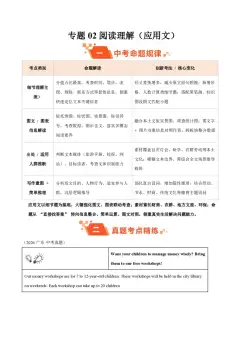
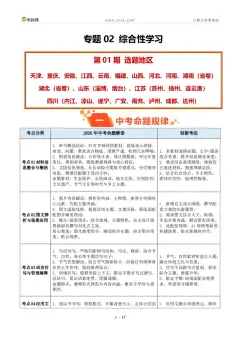
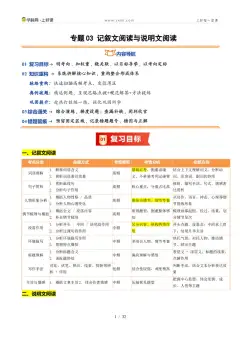
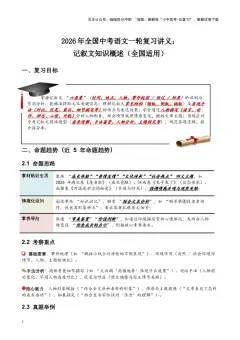
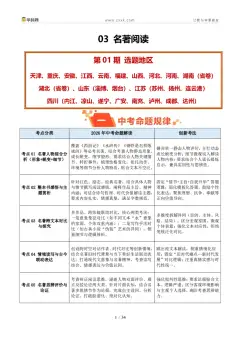
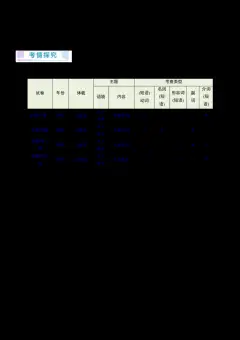
考点类别
命题解读
创新考法 / 核心变化
情节细节 + 事件排序
基础必考,梳理时
间、人物行为、先后
流程,定位表层信息
跨段分散线索,增设多步骤排序题;搭配实景插
图匹配情节;同义替换增多,极少原文原句
人物情感 / 性格推理
依托动作、对话、心
理描写判断情绪变
化、人物品质
隐性情感增多,无直白情绪词;新增情感变化排
序;素材融入戍边英雄、非遗匠人、中外文化交
流人物
词义 & 代词指代
考查熟词生义、跨段
代词 it/this、短语释义
侧重文化类熟词新义(mirror 表反映、bridge 表
纽带);指代需整合前后多段内容判断
主旨 / 标题 / 道理提炼
概括故事内核,挖掘
结尾育人哲理
弱化浅层情节概括,侧重家国、劳动、文化自
信;标题选项区分局部细节与全文主旨
逻辑推断(行文 / 后续
/ 出处)
预判下文、判断文章
板块、补全段落语句
新增文段语句回填;推断杂志板块;融合乡村振
兴、非遗、生态等本土时代素材
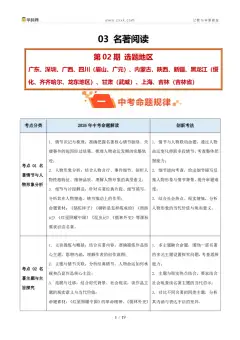
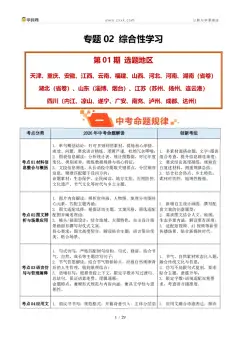
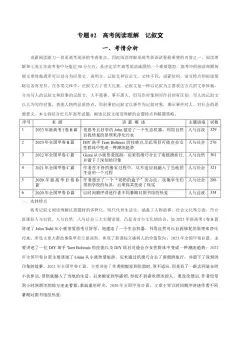
记叙文强化逻辑梳理与价值引领;大量融入中国非遗、戍边、乡村振兴、中外文化交流素材;命题从单一
信息查找转向多段整合、情感脉络梳理、文化词义辨析,突出立德树人。
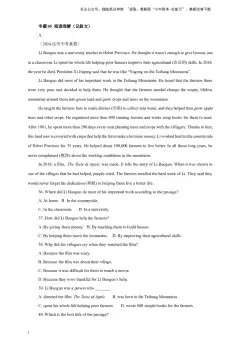
(2026·北京·中考真题)Linda always dreamed of having many great toys, but buying them all was almost
impossible.
One afternoon, exploring behind her apartment building, Linda discovered something wonderful. An elderly
woman was creating beautiful playthings using thrown-away materials and natural objects. She built a tower from
parts of cardboard boxes, and a tiny house with sticks, leaves, and stones.
“How do you make such wonderful toys without buying anything?” Linda asked, amazed.
“The best toys aren’t bought in stores,” the woman smiled warmly. “They’re created with your own hands and
imagination. Everything, even the things people throw away, can become something magical. You just need a little
creativity.”
Inspired (受到启发), Linda began trying out some ideas at home. She found treasures everywhere. A shoe box
became a toy theatre. Old socks turned into materials for fashion dolls and old magazines became their clothes. Plastic
bottles were used to build rocket ships. Soon, Linda’s bedroom became a world of wonder. Each creation taught her
something about design, engineering, and storytelling.
One day, Linda went to see her teacher, Mr. Thompson, with an idea. “What if we have a toy-making workshop
where students can make their own toys for show-and-tell?” Mr. Thompson was uncertain. Linda then presented the
toys she had made, showing him how well-designed and interesting they were.
Surprised by her creativity, Mr. Thompson decided to have an activity named “Invention and Innovation (创
新) Week” to encourage students to make and show their creative works. Linda was excited and began to teach other
students her toy-making skills.
During the week, something magical happened. The handmade toys fired everyone’s imagination in ways store
toys never could, inspiring stories, games and plays. Some teachers even started to include creative toy-making in
their lessons. A local newspaper reported on these young inventors. Other schools wanted to follow their creative
practice.
The big success of the activity filled Linda with pride. She realised creativity can also be about finding
possibilities in seemingly useless materials.
1.How did Linda feel when she saw the elderly woman making playthings?
A.Proud.
B.Satisfied.
C.Warm.
D.Amazed.
2.What activity did Linda suggest to Mr. Thompson?
A.A fashion design show.
B.A toy-making workshop.
C.A storytelling competition
D.A second-hand magazine fair
3.What did Linda learn from her experience?
A.Teaching others helps us learn more quickly.
B.Friendship may develop from sharing stories.
C.Creativity can mean finding hidden possibilities.
D.Exploring nature leads to the discovery of beauty.
(2026·广西·中考真题)After living away from the coast for more than 25 years, I came back to my
hometown in Scotland. One of the things I enjoy most here is the sound of seagulls (海鸥).
I grew up in a village by the sea. Only 26 people lived here, but seagulls were everywhere. Their calls were
around us all the time. During my childhood, I often heard the seagulls call down the chimney (烟囱). I imagined they
were using the chimney as a phone to send messages to us.
My family even had a “pet” seagull. We named him Willy. The top of the wall of our garden was his favourite
place. From there, he had a good view of our dining room. As soon as we sat down for a meal, he usually landed by
the window and waited patiently for food. Sometimes, when Willy was very hungry, he would knock at the window
to ask for food. Then, we would throw him bits of bread through the window. And he would skillfully catch the bread
in mid-air.
Once, when my mum was feeding Willy with a spoon, he took the spoon with food and swallowed (吞下) it
whole. We were worried that he would get hurt. To our surprise, when he appeared for his meal the next day, he
looked all right. And later we found the spoon in the garden! He was probably the only seagull in Scotland to return
cutlery (餐具).
I have a deep love for seagulls. When I wake up to their calls or see them flying in the sky, a feeling of
happiness washes over me. I know I’m home.
根据语篇内容,选择最佳选项。
1.What does the writer enjoy most about seagulls?
A.Their shape.
B.Their size.
C.Their sound.
2.What did seagulls use the chimney as according to the writer?
A.A radio.
B.A bell.
C.A phone.
3.Why would Willy knock at the window?
A.To ask for food.
B.To greet the family.
C.To enter the house.
4.What is Paragraph 4 mainly about?
A.A daily habit of feeding Willy.
B.An unusual story of Willy and a spoon.
C.The surprising discovery of a lost feeding spoon.
5.What do seagulls bring to the writer?
A.Happiness.
B.Success.
C.Health.
(2026·河北·中考真题)Nina is a seventh grade student. On January 1st of each year, she chooses to buy a
book to read, instead of shopping for a dress as her new year gift. And then she reads lots of books through the year.
In fact, the girl thought reading was a waste of time before she met her teacher, Mr. White, in the fourth grade.
Mr. White believed reading was great and he thought that students needed to read more.
With Mr. White’s help, Nina changed her idea about reading and found pleasure in books. In that year alone,
the girl read over 100 books. She was chosen as Reading Star of the Year in her school and got a chance to interview
her favorite writer at the school’s reading festival. And she began working as a volunteer in the community to help
young readers enjoy the pleasure of reading.
Reading has become part of Nina’s life. Now Nina spends at least two hours reading books every day. She
writes book reviews when she finishes reading each book. Sometimes, she reads interesting parts of a book again and
again.
In her eyes, books are a treasure for human creativity and a form of human expression. Reading books is an
act of discovering fresh views with each new book. She advises kids to make lifelong friends with books because
reading helps learn more about human imagination and personal experiences from different cultures.
1.What do we know about Nina from paragraph 1?
A.She reads a lot.
B.She has wide interests.
C.She often goes shopping.
D.She likes January best.
2.Who helped Nina change her idea about reading?
A.A volunteer.
B.A teacher.
C.A famous writer.
D.A young reader.
3.What is paragraph 4 mainly about?
A.Nina’s daily plan.
B.Nina’s school life.
C.Nina’s favorite books.
D.Nina’s reading habits.
4.What does Nina advise kids to do?
A.Describe their experiences.
B.Design creative reading activities.
C.Express their own opinions.
D.Make lifelong friends with books.
(2026·四川成都·中考真题)I couldn’t have a happy summer holiday anymore! No sleeping in. No games.
No Internet. My parents gave me a big speech. And then they sent me to a classical music camp. Help!
The first day was scary. A boy asked about my favorite composer (作曲家). Composer? I didn’t know any.
Everyone played classical music, but I played electronic music from my computer. It was an electronic remix (a mix
of different songs) I made. Nobody said anything. The teacher, John, said it was good, but I wasn’t sure.
The next week was worse. I tried every instrument. The violin sounded like a crying cat. The tuba made no
sound. The kids laughed at me. I didn’t think I’d survive.
But something changed. John played a piece of music for me. It was amazing. “Beethoven (贝多芬),” he said.
He suggested doing a remix of a classical Beethoven piece and presenting it to the other kids. I accepted the challenge.
When I played my remix, I was nervous. What if the kids said that boy wasn’t playing “real music”? What a
surprise! They liked it.
With their help, I chose another Beethoven piece. We decided to remix it together. During the following two
weeks, we practiced every day. How crazy! One kid even gave me a piano lesson.
On the last day, we performed for the parents. I started the remix. The other kids joined in. When we finished,
everyone cheered. Dad was smiling. Mom was crying. Beethoven and electronic music were a great match!
1.Which is closest in meaning to “a big speech” in Paragraph 1?
A.A daily dialogue.
B.A serious talk.
C.An interesting conversation.
2.Why did the writer feel the first day was scary?
A.The kids refused to talk with him.
B.Everyone had their favorite music.
C.He felt he was different from others.
3.Which word best describes the teacher?
A.Kind.
B.Polite.
C.Hard-working.
4.What made the kids accept the writer at last?
A.The parents’ effort.
B.The common love for music.
C.The respect for each other.
5.What can be a suitable title for this text?
A.No music, no fun
B.Beauty in classical music
C.When Beethoven meets a remix
(2026·湖南·中考真题)Will you chat with strangers (陌生人)? Some people would say no. However,
research shows that starting a conversation with a stranger can make you enjoy your day more.
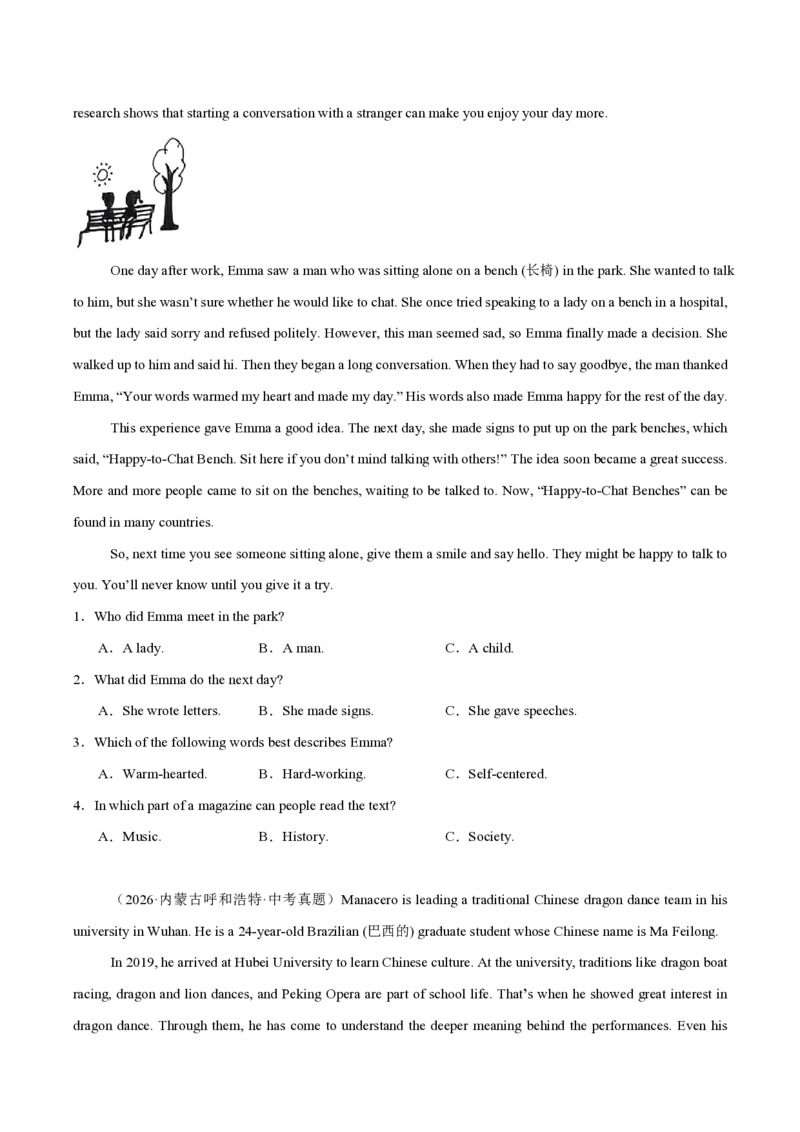
One day after work, Emma saw a man who was sitting alone on a bench (长椅) in the park. She wanted to talk
to him, but she wasn’t sure whether he would like to chat. She once tried speaking to a lady on a bench in a hospital,
but the lady said sorry and refused politely. However, this man seemed sad, so Emma finally made a decision. She
walked up to him and said hi. Then they began a long conversation. When they had to say goodbye, the man thanked
Emma, “Your words warmed my heart and made my day.” His words also made Emma happy for the rest of the day.
This experience gave Emma a good idea. The next day, she made signs to put up on the park benches, which
said, “Happy-to-Chat Bench. Sit here if you don’t mind talking with others!” The idea soon became a great success.
More and more people came to sit on the benches, waiting to be talked to. Now, “Happy-to-Chat Benches” can be
found in many countries.
So, next time you see someone sitting alone, give them a smile and say hello. They might be happy to talk to
you. You’ll never know until you give it a try.
1.Who did Emma meet in the park?
A.A lady.
B.A man.
C.A child.
2.What did Emma do the next day?
A.She wrote letters.
B.She made signs.
C.She gave speeches.
3.Which of the following words best describes Emma?
A.Warm-hearted.
B.Hard-working.
C.Self-centered.
4.In which part of a magazine can people read the text?
A.Music.
B.History.
C.Society.
(2026·内蒙古呼和浩特·中考真题)Manacero is leading a traditional Chinese dragon dance team in his
university in Wuhan. He is a 24-year-old Brazilian (巴西的) graduate student whose Chinese name is Ma Feilong.
In 2019, he arrived at Hubei University to learn Chinese culture. At the university, traditions like dragon boat
racing, dragon and lion dances, and Peking Opera are part of school life. That’s when he showed great interest in
dragon dance. Through them, he has come to understand the deeper meaning behind the performances. Even his
Chinese name has a strong connection with his love. “Feilong” means “flying dragon”, which shows his wishes to
carry the tradition across cultures.
In fact, he already brought dragon and lion dance performances to Brazil in 2023, where the dances got a warm
welcome.
In mid-April, he returned to Brazil for a five-city cultural tour, where the dragon dance was among the
activities. People in these cities felt his great love for showing them how the Chinese dragon came alive before their
eyes.
His journey mirrors a wider moment of culture communication. China and Brazil have named 2026 as the
China-Brazil Year of Culture, with activities including performances, arts, music and tourism.
“People both in China and Brazil are very open to different cultures,” he says, “When I’m in China, the Chinese
people teach me how to perform dragon dance. And when it is brought to Brazil, it wins the hearts of Brazilian
people. ▲ ”
As for his next step, whether he stays in China or returns to Brazil, his goal is clear: to keep the dragon moving
between cultures. Dragon dance not only helps him understand China, but also makes him love Chinese culture.
1.When did Manacero become interested in dragon dance?
A.In 2019.
B.In 2023.
C.In 2026.
2.Which “mirrors” in the following sentences has the same meaning as the underlined word in paragraph 5?
A.Our clean classroom mirrors our good habits.
B.There are different kinds of mirrors in the museum.
C.The calm lake mirrors the blue sky and the white clouds.
3.Which of the following can be put in “ ▲ ”?
A.It’s a five-city tour.
B.It’s a two-way connection.
C.It’s a seven-year school life.
4.What is the best title for the text?
A.History of Chinese Dragon Dance
B.A Brazilian Student’s Journey to China
C.Dancing Dragons Bridge Brazil and China
(2026·陕西·中考真题)
This is a true story of a four-legged hero as well as animal friendship and care. Everything took place in Nairobi,
Kenya—a country in East Africa.
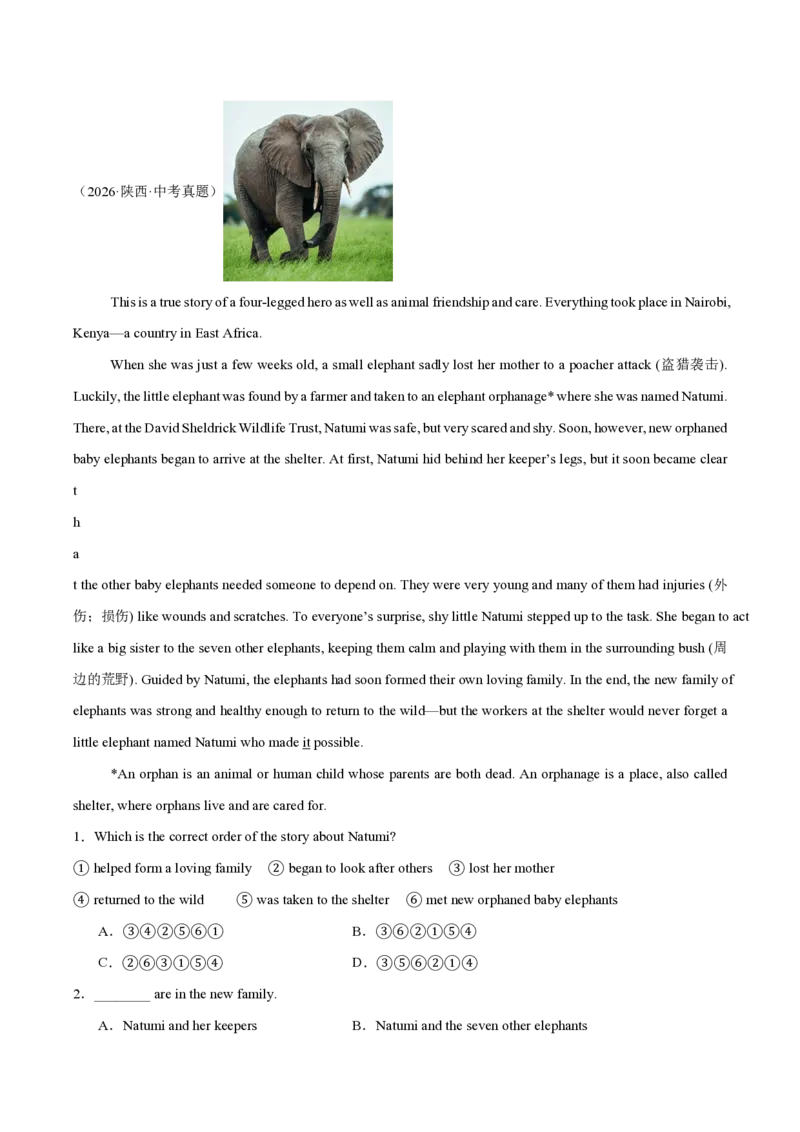
When she was just a few weeks old, a small elephant sadly lost her mother to a poacher attack (盗猎袭击).
Luckily, the little elephant was found by a farmer and taken to an elephant orphanage* where she was named Natumi.
There, at the David Sheldrick Wildlife Trust, Natumi was safe, but very scared and shy. Soon, however, new orphaned
baby elephants began to arrive at the shelter. At first, Natumi hid behind her keeper’s legs, but it soon became clear
t
h
a
t the other baby elephants needed someone to depend on. They were very young and many of them had injuries (外
伤;损伤) like wounds and scratches. To everyone’s surprise, shy little Natumi stepped up to the task. She began to act
like a big sister to the seven other elephants, keeping them calm and playing with them in the surrounding bush (周
边的荒野). Guided by Natumi, the elephants had soon formed their own loving family. In the end, the new family of
elephants was strong and healthy enough to return to the wild—but the workers at the shelter would never forget a
little elephant named Natumi who made it possible.
*An orphan is an animal or human child whose parents are both dead. An orphanage is a place, also called
shelter, where orphans live and are cared for.
1.Which is the correct order of the story about Natumi?
① helped form a loving family    ② began to look after others    ③ lost her mother
④ returned to the wild        ⑤ was taken to the shelter    ⑥ met new orphaned baby elephants
A.③④②⑤⑥①
B.③⑥②①⑤④
C.②⑥③①⑤④
D.③⑤⑥②①④
2.________ are in the new family.
A.Natumi and her keepers
B.Natumi and the seven other elephants
C.The workers and the seven other elephants
D.The workers and all the elephants
3.What does the underlined word “it” in the last sentence refer to?
A.The baby elephants being safe at the shelter.
B.The seven elephants playing with Natumi.
C.The elephants in the story going back to the wild.
D.The workers at the shelter remembering a little elephant.
(2026·云南·中考真题)Do you know the Ali Plateau? It is a very cold area which is nearly 5,000 meters
a
bove sea level in the western part of China. Qi Fabao, the “hero regiment commander for defending the border” (卫
国戍边英雄团长), has guarded our land with his life there.
Qi Fabao was born into a common family in Wuwei City, Gansu Province. He was always a top student at
school in his childhood and had a strong wish to join the army. At the age of 18, he realized his dream. He chose to
set foot on the land of the Ali Plateau in Xizang and began his career of defending the border. He said, “Not everyone
can understand my choice, but I have never regretted it.”
For over 20 years, he has defended the border and experienced many life-and-death moments. When the
communication lines didn’t work, he stood in the cold water for hours to repair them. When facing the falling stones,
he even used his body to stop them. Once in 2005, he rode a horse in the snow mountains to carry out a task. He and
the horse fell into the river from the cliff (悬崖). His back was badly hurt, but the great pain never broke him. More
than 1,000 patrols (巡逻) saw his promise of defending the border of our land.
With his youth and blood, Qi Fabao has written a chapter of loyalty (忠诚) and responsibility. He shows us that
loving our country is not empty words, but real actions.
1.How does the writer start the text?
A.By using a saying.
B.By asking a question.
C.By giving a suggestion.
D.By explaining a reason.
2.How old was Qi Fabao when he realized his dream of joining the army?
A.18.
B.20.
C.26.
D.38.
3.What does the underlined word “career ”in paragraph 2 probably mean?
A.Report.
B.Study.
C.Interview.
D.Work.
4.What did Qi Fabao do when the communication lines didn’t work?
A.He asked others to fix them.
B.He rode a horse to find a new way.
C.He stood in the cold water to repair them.
D.He used his body to stop the falling stones.
5.What can be the best title for the text?
A.The Introduction of the Ali Plateau
B.The Way of Becoming a Top Student
C.The Life of a Hero Defending the BorderD.The Importance of Overcoming Difficulties
(2026·四川自贡·中考真题)On a spring morning, a student named Le Zongyan from Shenzhen Bao’an
Middle School, was studying for exams while a bird kept calling loudly outside the window. He was troubled by the
noise, so he wrote a letter to the headmaster, suggesting taking away the bird’s nest (巢).
The headmaster Yuan Weixing was touched by the letter. He realized the students’ need for a quiet study
environment, and then he wrote a thoughtful reply.
Yuan expressed his understanding of the pressure students faced. He explained birds sing loudly for dating
and communication instead of making noise. “The world does not only belong to humans.” Yuan wrote, “Learning
to live peacefully with all living things is a necessary part of growing up. The real goal of education is not to ask the
world to change for us, but to help us learn how to get along with the world.”
“Simply driving the birds away wouldn’t be suitable, but doing nothing wasn’t good, either,” Yuan said. The
school then invited environmental experts and students to discuss practical solutions—to provide earplugs (耳塞) to
the students in the dorms (寝室) near the wooded areas. At the same time, man-made nests were set up to guide the
birds away from the classrooms and dorm buildings.
This simple problem became a life lesson about living in peace with nature.
1.How does the writer start the text?
A.By listing numbers.
B.By describing a scene.
C.By asking a question.
2.Why do birds sing loudly?
A.To express joy.
B.To trouble students.
C.To date and communicate.
3.What’s the right order of the following events?
① The student wrote a letter to the headmaster.
② Headmaster Yuan wrote a thoughtful reply to the student.
③ The school provided earplugs and set up man-made nests.
④ The school invited environmental experts to discuss solutions.
A.①②④③
B.①④②③
C.③①④②
4.Which of the following best describes the character of Headmaster Yuan?
A.Warm.
B.Crazy.
C.Strict.
5.What can the students learn from this experience?
A.Schools should meet the students’ needs.
B.Humans should live with nature peacefully.
C.Birds are more important than students’ exams.
(2026·四川广安·中考真题)In a small village, there lived a famous old carpenter (木匠). People travelled
from far and wide to buy his furniture.
One day, a young man came to learn from him. The young man loved working with wood but was always
hurrying to finish things. After a few days of learning from the carpenter, the young man thought, “I can make
furniture faster.”
The old carpenter noticed this and said, “I can teach you to make furniture quickly, but first, you need to do a
simple job.” He then passed the young man a rough board and said, “Make this board smooth.”
The man thought it was easy. He sanded (用砂纸打磨) the board a few times and soon gave it back confidently.
The old carpenter felt the board and said, “It is not smooth enough. Try again.”
A little impatient, the young man sanded harder. But the old carpenter shook his head once again.
Feeling sad, the young man started to think more. He wasn’t in a hurry anymore and sanded every part of the
board carefully. Finally, the board was as smooth as a mirror. He was so pleased with his work.
This time, the old carpenter smiled and said, “You have learned an important lesson. Success needs not only
skill but also patience. The simpler the job is, the more patience we need. When you perfect every part, you can make
a perfect piece.”
The young man understood that carpentry was not only about making things but also about shaping the mind.
Life is like this — a successful person moves forward step by step.
1.Why did the young man visit the old carpenter?
A.To travel around.
B.To buy furniture.
C.To help him.
D.To learn from him.
2.What does the underlined word “it” in Paragraph 4 refer to?
A.Making furniture faster.
B.Making the board smooth.
C.Working with wood.
D.Sanding the board several times.
3.How did the young man finish the job?
A.He finished it as quickly as he could.
B.He succeeded for the second time.
C.He sanded every part carefully.
D.He made a board with a mirror.
4.Which of the following can best describe the change of the young man’s feelings during sanding the board?
A.Confident → Sad → Pleased → Impatient.
B.Impatient → Confident → Sad → Pleased.
C.Pleased → Impatient → Sad → Confident.
D.Confident → Impatient → Sad → Pleased.
5.What can we learn from the story?
A.Success needs skill and patience.
B.The simple job needs less patience.
C.Carpentry isn’t about shaping the mind.
D.A successful person moves forward quickly.
(2026·四川遂宁·中考真题)Berlinda Black is thirteen years old, and he comes from a small village in South
Australia. He has two sisters — Jennifer is eleven and Lisa is seven. They are all studying at the School of the Air.
The School of the Air is a school for children who are in a place which does not have a local school. So they
have “air” lessons over the radio or on the computer. Their teachers are in Port Augusta, a city which is about 160
kilometers away.
In the morning, they go to the classroom at 8:45. It is really just a small building. When they get there, they
turn on the radio or computer and listen to what they should do. From then until twelve, they just do their usual
lessons. In the afternoon, their mum makes them do more housework around the house.
They send their exercise “books” to their teachers by email on Friday night. On Monday and Tuesday, their
teachers mark them, and then send them back. They get them on Wednesday.
The Internet and the telephone help them get in touch with their teachers quickly and easily. They talk to their
teachers once a week for about ten minutes. The teachers tell them if they are making progress.
Next year he will start at a new school in Port Augusta. He will spend the weekdays there and come home at
weekends. He thinks it will be good to be with teenagers of his age, but he will miss his family. He hopes he will be
happy there.
1.Why does Berlinda have “air” lessons?
A.Because he has classes at home.
B.Because he studies at weekends.
C.Because he talks to teachers every day.
D.Because he lives in a place without a local school.
2.What is the right order for Berlinda’s daily life?
a. Do usual lessons.    b. Get to the classroom.    c. Do some housework.
d. Turn on the radio or computer.    e. Listen to what he should do.
A.b-d-e-a-c
B.b-d-a-e-c
C.d-b-a-e-c
D.d-b-e-c-a
3.What can we know from Paragraph 5?
A.Students have lessons from 8:45 to 12:00.
B.Students hand in exercise “books” by email.
C.Students can speak to teachers every week.
D.Students will study in a new school next year.
4.What will most probably be talked about next?
A.Teenagers around him.
B.His free time activities.
C.Weekday plans at home.
D.His life in the new school.
5.What is the best title for the text?
A.A Trip by Air.
B.The School of the Air.
C.The Life in Port Augusta.
D.The Days of Home Study.
(2026·四川泸州·中考真题)
Chao Ziyi and Chao Ziwei are brothers from Henan province. More than 20 years ago, making large bowls
was their job. If someone told them they would one day become artists, they would just laugh at it as a joke. But you
can never predict what life will bring you next. Today, they both teach at a university, and their works are shown at
home and abroad.
They learned every step of making ceramics (陶瓷) on their own from a young age, and this gave them
something even more valuable — a deep love for their material. Artists and teachers later led them into the world of
ceramic art. Although receiving no professional art training, the brothers gradually developed a style — using
ceramics, an old Chinese material, to express modern ideas and personal memories.
Their most fascinating artwork is a huge ceramic tractor (拖拉机) called Dongfanghong. It is over two meters
long and weighs two tons, with no support inside. Different thicknesses and thin parts let the clay break easily. They
worked day and night, trying special materials and changing the heat levels again and again. The artwork finally
looked like real metal through their years of efforts.
Thanks to their efforts and new ideas, the brothers have won many prizes, and their artworks are kept in famous
museums. Their story shows us that with patience and strong mind, even the most common journey can lead to
something amazing.
1.What did the brothers do in the past?
A.They decided to be artists.
B.They taught at a university.
C.They lived by making big bowls.
D.They worked in foreign countries.
2.How did artists and teachers help the brothers?
A.By telling them teaching methods.
B.By giving them professional training.
C.By asking them to produce ceramics.
D.By guiding them into the world of art.
3.What do we know about the ceramic tractor?
A.It seems like real metal.
B.It needs months of work.
C.It is nearly two meters high.
D.It has strong support inside.
4.Which of the following best describes the brothers?
A.Caring and cool-minded.
B.Patient and well-educated.
C.Talented and warm-hearted.
D.Creative and hard-working.
5.What would be the best title for the passage?
A.A deep love for the past
B.An amazing turn in life
C.A modern style of clay bowls
D.An unexpected art class
(2026·四川南充·中考真题)Ugochin is a foreign student studying in China. She took part in the show A
Foreign Apprentice Comes to the Mountains in Yunhe, Zhejiang Province, to know more about Chinese country life.
She fully experienced it in the show.
In front of the camera, she worked together with local villagers to dig potatoes, make tofu, catch fish and cook
tasty meals. Away from the camera, she was interested in this peaceful country life. Such a life was shaped more by
land, weather and old customs rather than busy work.
“China’s rural revitalization (乡村振兴) is really amazing.” Ugochin said. In Yunhe, she met local young
villagers who had made a big difference. Instead of selling farm produce (农产品) in the old way, they packed it
differently to make it look cooler. They also used livestreaming to reach customers across the country. By trying
these new methods, they brought fresh energy to their hometown.
Apart from new looks in the countryside, Yunhe’s respect for traditions also impressed (留下印象) Ugochin.
“This experience tells me that while we push forward rural revitalization, we should also protect old buildings, carry
forward history and keep traditional skills alive.” she shared.
When the filming ended, Ugochin was not ready to leave the experience behind. She planned to go back to
Yunhe and spend more time enjoying the priceless giving of the countryside. She said from the bottom of her heart,
“Clear water and green mountains are as valuable as mountains of gold and silver.  ▲ ”
1.What does the underlined word “it” refer to in paragraph 1?
A.The filming activity.
B.The country life.
C.The learning method.
D.The mountain trip.
2.What did Ugochin do in the show?
A.She planted potatoes.
B.She took photos.
C.She fed fish.
D.She made meals.
3.Which word can best describe local young villagers in Ugochin’s eyes?
A.Creative.
B.Polite.
C.Outgoing.
D.Humorous.
4.What can we infer from Ugochin’s words in paragraph 4?
A.Keeping traditions should be put in the first place.
B.Development and tradition should go hand in hand.
C.Traditional knowledge is more useful than new ideas.
D.Protecting old buildings may slow down development.
5.Which of the following can be put in the  ▲ ?
A.The countryside needs more money.
B.A good environment means a better future.
C.China’s countryside is truly a treasure.
D.Traditional village life has great value today.
(2026·四川达州·中考真题)Every time I think of kindness, the word reminds me of a very small but warm
moment in my life.
It was about 6 o’clock on a Friday afternoon. I walked back home after a tiring but exciting basketball game.
I passed by my neighbor Mr. Li’s house and wanted to greet him as usual. He usually did some gardening at that
time. But this time, he wasn’t in his yard, and the light in his house wasn’t on. Mr. Li was a sixty-year-old man with
heart disease. He lived alone and hardly ever went out. I wondered: Where could he be? Although I was tired and
wanted to go home as soon as possible, I decided to check on him.
I knocked on his door, but there was no answer. The big window was open and I peeked (窥视) in. I saw him
lying on the ground. His face was pale and there was sweat (汗水) on his forehead. I was shocked, but I didn’t know
how to deal with such an emergency. I told myself to calm down and called 120 at once. Later, he was taken to the
hospital.
A week later, Mr. Li came back home and told everything to my parents. He was so thankful for my care and
help. This experience influences me deeply: Even a small act of kindness can sometimes make a big difference.
1.What did Mr. Li usually do at about 6 p.m.?
A.Walked back home.
B.Did some gardening.
C.Cleaned his window.
D.Watched a basketball game.
2.How did the writer help Mr. Li?
A.By calling 120.
B.By asking neighbors for help.
C.By helping him calm down.
D.By knocking on a doctor’s door.
3.Which of the following best describes the writer?
A.Honest.
B.Creative.
C.Talented.
D.Warm-hearted.
4.What is the correct order of the story?
① I saw Mr. Li lying on the ground.    ② I passed by Mr. Li’s house.
③ Mr. Li was thankful for my help.    ④ Mr. Li was taken to the hospital.
A.①→②→④→③
B.①→④→②→③
C.②→①→④→③
D.②→④→①→③
5.What did the writer learn from this experience?
A.Old habits die hard.
B.Every coin has two sides.
C.Failure is the key to success.
D.A small act of kindness makes a difference.