专题06 阅读理解(记叙文)
主题 01 人与自我
Passage 1
(2026·辽宁沈阳·一模)I stood at the trail head, looking up at the mountain appearing ahead. My heart was
drumming against my ribs. Everyone else in the group seemed so prepared — their boots worn in, their breathing
calm. I was there for the wrong reasons, I thought. I was there to prove something, to conquer the peak and post a
picture that screamed, “I have my life together.”
The first hour was great pain. My lungs burned, and my new boots rubbed my heels. I spent the entire time
watching the backs of the others, their figures getting smaller and smaller as they pushed ahead. I felt every ounce of
my limitation. My goal was the summit (山顶), and every step that wasn’t there felt like a failure.
It was when I stopped for the third time and bent over with my hands on my knees that something shifted. I
happened to glance away from the path ahead and noticed a small, perfect wildflower growing from a crack in a rock.
It was delicate and resilient, utterly unaware of the race to the top. In that moment, I let go of the summit.
I started walking again, but this time, I wasn’t hiking to the top. I was just walking. I felt the solid earth beneath
my feet. I listened to the wind rustle the leaves of the trees. I noticed the sunlight painting patterns on the forest floor.
The journey became a series of small, present moments, not a torture to be endured.
I did eventually reach the summit. The view was breathtaking, a vast expanse of green and blue under an endless
sky. But as I stood there, the surprising truth settled over me: the view from the top wasn’t the prize. The transformation
had happened on the path below. The real victory wasn’t conquering the mountain; it was silencing the frantic voice
in my head that measured everything by a final destination. I learned to see the path, not just the summit.
1.How did the author feel during the first hour of the hike?
A.Confident and excited.
B.Competitive and ambitious.
C.Connected to nature peacefully.
D.Physically and mentally exhausted.
2.What made the author’s attitude towards the hike change?
A.Feeling the pain in her heels.
B.Reaching the summit to enjoy the view.
C.Noticing a wildflower among rocks.
D.Watching the other hikers push ahead quickly.
3.What does “the frantic voice in my head” in the last paragraph refer to?
A.The conversations of other hikers.
B.The sound of the wind in the trees.
C.The instructions from the hiking guide.
D.The inner pressure to achieve a final goal.
4.What did the author realize after reaching the summit?
A.It pays to set clear goals in life.
B.It is a success to reach the peak.
C.The summit view is the greatest.
D.The real gain comes from the process.
Passage 2
(2026·辽宁丹东·一模)The air smells of fresh earth and sweat, filled with the sounds of over 30 children
training. “This art dates back to the Qing Dynasty,” Bai Hejiang begins, his voice thick with pride. “My grandfather
was a bodyguard and wrestling coach and my father and uncles were all wrestlers. Can you imagine? Carrying this
legacy for six generations...”
Born into a wrestling family, Bai started practicing basic skills with his family from the age of 4. His excellent
wrestling skills later got him into Hebei’s professional wrestling team. After retiring, he returned to his hometown to
do business but could never let go of his dream to promote and pass down Chinese-style wrestling. Bai found Baoding,
once a birthplace of Chinese wrestling, had no schools teaching its iconic type of wrestling. So Bai decided to open
a wrestling school. He transformed his neglected factory into a training gym — a 4,000-square-meter outdoor training
ground and a 300-square-meter indoor training facility.
Since the school was established in 2013, it has been providing completely voluntary teaching without charging
a penny. “The program accepts students regardless of ethnicity, gender, age or region, and anyone willing to learn
can sign up,” Bai says. Eighteen-year-old Guo Yuhang, from a nearby village, has been training for nine years. “Guo
was a 70-kilogram couch potato when he started,” Bai chuckles. Today, he has gained a future. Of course, he has
already lost weight and become well-built, muscular. According to Guo, he has applied to Shandong Sport University
for the Chinese-style wrestling major. “I want to be a physical education teacher in the future and teach Chinese-style
wrestling like my master,” Guo says.
Over the past decade, Bai’s school has not only kept Baoding Fast Wrestling alive but also nurtured many
young enthusiasts like Guo. From reviving the fading wrestling style to guiding youngsters toward their goals, Bai
keeps moving forward, letting every drop of sweat and every shared skill tell the story of how he chases what his
heart has long been tied to.
5.What made Bai begin practising wrestling?
A.His family’s influence.
B.His father’s expectation.
C.His coach’s encouragement.
D.His grandfather’s requirement.
6.Which of the following can best describe Bai’s wrestling school?
A.Well-equipped and spacious.
B.Inclusive and neat.
C.Influential and charitable.
D.Professional and selective.
7.What is the most significant change in Guo after nine years’ training?
A.He has had a well-defined aim.
B.He has become a couch potato.
C.He has become a handsome boy.
D.He has developed an interest in learning.
8.Which of the following can be the best title for the text?
A.Aiming for a New Career
B.Fighting for His Calling
C.Striving for National Glory
D.Struggling for His Family
Passage 3
(2026·辽宁沈阳·一模)In my childhood, whenever I was being unreasonable, or questioning whatever
direction my mother was giving, she would say “I’m the momma and you’re the baby.” End of discussion. Until one
day she asked me to do something for her and I said, “No. You’re the momma; I’m the baby.” It gave her a good
laugh.
But, at 31, I’m realizing the dynamic might be shifting. She’s the momma; I’m the baby. But I’m also something
else now. More will be asked of me to take care of her. My mother is getting older.
The realization hit me during a recent visit home. In my memory, our house wasn’t spotless, but I’d call it tidy.
Weekends were for cleaning. Yet during this visit I was taken aback by piles upon piles of mail and papers and junk. A
fridge full of spoiled food. A mountain of clothes begging to be located. Was it always this way? When did she
become a hoarder (囤积者)? A symptom of aging?
But my mother would like you to know something: She is not a hoarder. She spoke frankly with more self-
awareness than I expected about life and time and happiness. “The time that I have to go through those things would
be my weekends. Do I want to spend my Saturday afternoon going through all the junk? Or do I want to go hang out
with my friends? I think the latter. I don’t want to spend one minute of my free time doing anything that doesn’t bring
me joy,” she says.
It’s not that my mother has no worries about aging, but she came to terms with it long before. “Trey, you could
spend so much time worrying about things that aren’t perfect. Then time slips by, and they’re never going to be,” she
continues. “I think happiness is a moment-to-moment, day-to-day kind of thing. It’s not something you sustain. I still
think I’m hot- that might be in my head, but so what.”
9.What was the author’s tone in his response to Mom in paragraph 1?
A.Unwilling.
B.contented.
C.Serious.
D.Sympathetic.
10.What made the author label Mom as a hoarder at first?
A.Her refusal to donate old stuff.
B.The mess in Mom’s house.
C.Her preference for an economical life.
D.The decline of Mom’s health.
11.Why didn’t Mom tidy the house on weekends?
A.She had plans with her friends.
B.She was too old to do it on her own.
C.She had trouble sorting out the junk.
D.She desired a pleasant time for herself.
12.Which of the following may best describe Mom’s philosophy of life ?
A.An idle youth, a needy age.
B.Haste makes waste.
C.No thorn, no throne.
D.Living in the present.
Passage 4
(2026·吉林长春·一模)Hannah was an adventurous spirit with an imagination far beyond her time. She
loved to explore and would spend hours in the woods looking for new things. One afternoon, when Hannah was on
one of her adventurous quests (探险), she came upon a deserted cottage. She slowly opened the door and was left
shocked. In front of her was a room full of books! Hannah took a deep breath as she realized that she had found a
hidden treasure. She knew in her heart that she had to read all of them, from which she learned the power of love and
friendship, and that the true strength lies within one’s own heart!
The little girl was so inspired by what she had read that she decided to share the tales with the people of her
village. She knew it would be a difficult journey, but she wanted to share the gold with everyone. Making this her
mission, Hannah started telling tales every day at her cottage. She added her own touch of curiosity every now and
then to different stories, making them more engaging.
In the start, only her very good friend, Sanuki, and her family came to the readings. But the word of her famous
tales spread rapidly, drawing more and more people to come to the readings. Seeing the interest of her own people,
Hannah started writing stories of her own too! Soon, the word of Hannah’s storytelling spread to far-off towns. People
traveled from different places to just listen to her stories. Hannah helped the lost find their destined path. She
conducted workshops in which she taught her fellows how to read and write. She reminded everyone through her
tales of the importance of human connection, empathy, and love.
The old cottage was no longer fading away as people from her own village helped build the cottage again. And
thus, the forgotten treasure lying in an old cottage transformed into a world of infinite adventures and possibilities.
13.What astonished Hannah when she entered the abandoned cottage?
A.The poor condition of the cottage.
B.The large number of books inside.
C.The delicate decoration of the room.
D.The high-priced objects beyond her expectation.
14.Why did Hannah add her own ideas to the stories she told?
A.To show her rich imagination.
B.To teach people about friendship.
C.To make the stories more attractive.
D.To help people remember the tales easily.
15.What can be inferred from paragraph 3?
A.Hannah’s storytelling became increasingly popular.
B.Sanuki was the first person to tell Hannah’s tales to others.
C.People from faraway towns came to Hannah’s cottage to read books.
D.Hannah’s tales mainly talked about her own adventurous experiences.
16.What is the text mainly about?
A.An abandoned cottage was rebuilt by a village.
B.Hannah learned important life lessons from books.
C.Friendship played an important role in Hannah’s storytelling.
D.Hannah’s devotion breathed new life into the cottage and people.
Passage 5
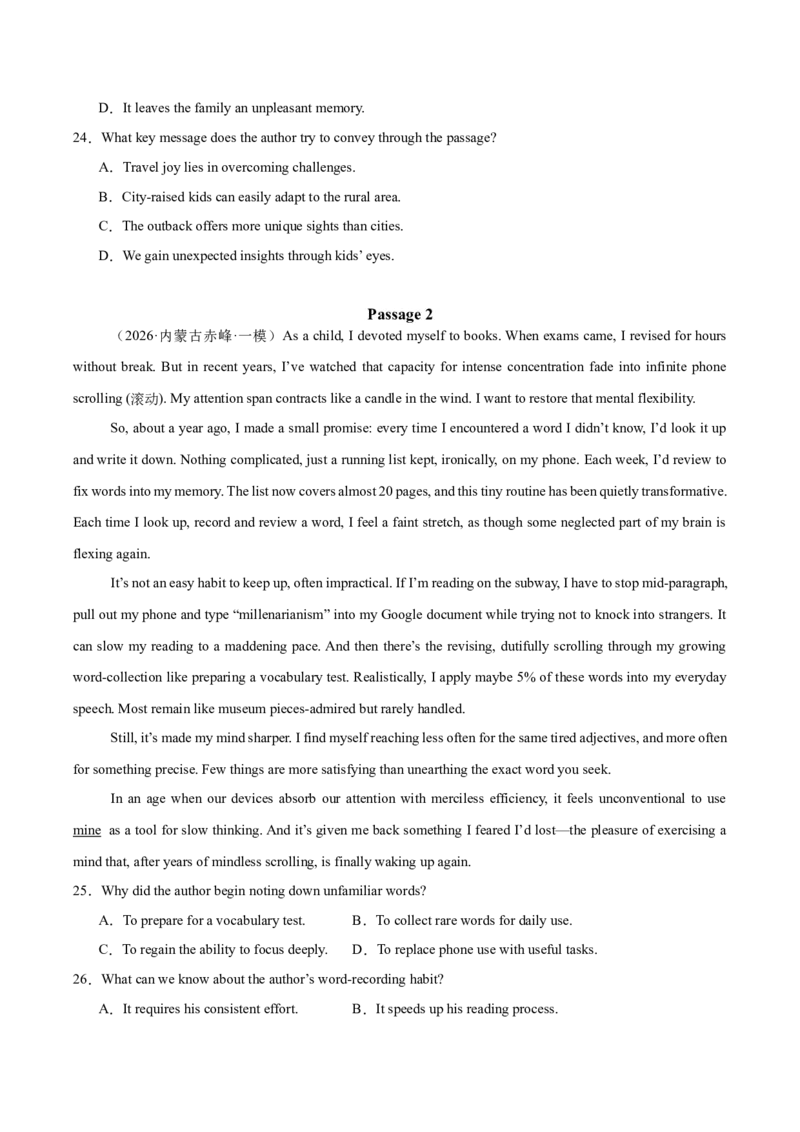
(2025·吉林辽源·一模)It was July 2023. Tens of thousands of pencils lay on the tables of the Colfax
Historical Society Museum in the U.S. state of Iowa. None of them was sharpened. Some were in plastic containers.
Others were simply held together with rubber bands (橡皮筋).
All of them belonged to Aaron Bartholmey. The 36-year-old started collecting pencils after his first-grade
teacher gifted each student a colored pencil for Christmas. He then started buying interesting pencils at flea markets
(旧货市场). In high school, he joined the American Pencil Collectors Society. His collection quickly grew into the
thousands.
Some of Bartholmey’s pencils are from World War II. On these pencils, the band around the eraser is made
with cardboard or plastic. That’s because metal had to be saved for the war. One of Bartholmey’s favorite pencils is
a 1926 gold-and-silver one. It marked the 150th birthday of the United States. “I’ve always enjoyed the stories behind
the pencils,” the man said. “What I collect is much more than just the plain pencils themselves.”
Bartholmey has always kept a detailed record of his collection. But that was not enough for him to apply for a
Guinness World Record. The organization required a public count.
Ahead of the event, Bartholmey made five trips in his car to deliver about 470 boxes of pencils to the museum.
The count began at 8 a.m. on July 1, 2023. Bartholmey watched as two counters from the American Pencil Collectors
Society went through one box at a time. The first counter counted and recorded a number before passing it to the
second for a recount. By 9 p.m., they still hadn’t finished. They started again the next morning. After another five
hours of counting, one of the counters finally held up the last pencil. In all, there were 69,255 pencils.
Bartholmey now holds the record for the largest collection of pencils in the world. But the number is only part
of the story. He can never contain (克制)his excitement when he finds another unusual pencil and learns its history.
Choose the best answer.
17.How many pencils does Bartholmey have now?
A.About 470.
B.About 2,350.
C.Nearly 60,000.
D.Nearly 70,000.
18.According to the article, how long did it take the counters from the American Pencil Collectors Society to
count all the pencils?
A.Five hours.
B.Thirteen hours.
C.Eighteen hours.
D.Twenty-four hours.
19.According to the article, all of Bartholmey’s collections ______.
A.are unsharpened
B.are over 80 years old
C.lie in a public museum
D.are in plastic containers
20.According to the article, Bartholmey enjoys collecting pencils because ______.
A.most pencils are not very expensive
B.pencils come in many different colors
C.each pencil has a different story to tell
D.pencils are commonly used in people’s daily lives
主题02 人与自然
Passage 1
(2026·黑龙江哈尔滨·一模)I packed my family into our old car and set off on a 3,000 km trip from Sydney
to the outback (内陆), hoping to create lasting memories for the kids. My plan seemed ambitious — covering such
distances with two young kids in the back might sound crazy to a sensible person.
For most of the journey, we often felt annoyed, arguing about the remaining distance and the discomfort in the
car. I’d had outback road trip memories as a kid and wanted my city-raised children to see the vast open spaces.
At a bird-hide near Forbes, we watched a swamp with bright green water and dead trees. Eager to share
Australian folk stories, I confidently told the kids that a mysterious creature lived there — but stumbled when they
asked me follow-up questions. Their enthusiasm for the smallest joy blew my mind. At a roadside motel that looked
like a movie set, the kids loved being woken by the night trains, cheering each time.
After three days, we reached Broken Hill — a town dominated by a big slag heap (矿渣堆), just as remarkable as
I remembered. Surrounded by kilometers of mineral-rich land, its streets imply its mining roots. I feared the mineral
museum would bore the kids, but they yelled with joy, thinking it was real-life Minecraft.
The trip wasn’t fantastic — I even complained about hard mattresses on the bed and small towels. But on
Easter morning, the kids went wild for a simple egg hunt in our cheap motel room, thrilled to search every corner. I
set out to teach the kids about the far reaches of our state, when in fact the kids were the best perspective I could ask
for all along.
21.Why did the author organize the trip?
A.To explore the locals’ unique lifestyle.
B.To document the kids’ exposure to nature.
C.To make shared memories for the family.D.To relive the special outback experiences.
22.What does the underlined word “stumbled” in paragraph 3 probably mean?
A.Reflected on the memories.
B.Agreed with their views.
C.Argued about the stories.
D.Tripped over my words.
23.What does the author think of the trip?
A.It is worthwhile despite inconveniences.
B.It went in line with the author’s original plans.
C.It is an ambitious but disappointing attempt.
D.It leaves the family an unpleasant memory.
24.What key message does the author try to convey through the passage?
A.Travel joy lies in overcoming challenges.
B.City-raised kids can easily adapt to the rural area.
C.The outback offers more unique sights than cities.
D.We gain unexpected insights through kids’ eyes.
Passage 2
(2026·内蒙古赤峰·一模)As a child, I devoted myself to books. When exams came, I revised for hours
without break. But in recent years, I’ve watched that capacity for intense concentration fade into infinite phone
scrolling (滚动). My attention span contracts like a candle in the wind. I want to restore that mental flexibility.
So, about a year ago, I made a small promise: every time I encountered a word I didn’t know, I’d look it up
and write it down. Nothing complicated, just a running list kept, ironically, on my phone. Each week, I’d review to
fix words into my memory. The list now covers almost 20 pages, and this tiny routine has been quietly transformative.
Each time I look up, record and review a word, I feel a faint stretch, as though some neglected part of my brain is
flexing again.
It’s not an easy habit to keep up, often impractical. If I’m reading on the subway, I have to stop mid-paragraph,
pull out my phone and type “millenarianism” into my Google document while trying not to knock into strangers. It
can slow my reading to a maddening pace. And then there’s the revising, dutifully scrolling through my growing
word-collection like preparing a vocabulary test. Realistically, I apply maybe 5% of these words into my everyday
speech. Most remain like museum pieces-admired but rarely handled.
Still, it’s made my mind sharper. I find myself reaching less often for the same tired adjectives, and more often
for something precise. Few things are more satisfying than unearthing the exact word you seek.
In an age when our devices absorb our attention with merciless efficiency, it feels unconventional to use
mine as a tool for slow thinking. And it’s given me back something I feared I’d lost—the pleasure of exercising a
mind that, after years of mindless scrolling, is finally waking up again.
25.Why did the author begin noting down unfamiliar words?
A.To prepare for a vocabulary test.
B.To collect rare words for daily use.
C.To regain the ability to focus deeply.
D.To replace phone use with useful tasks.
26.What can we know about the author’s word-recording habit?
A.It requires his consistent effort.
B.It speeds up his reading process.
C.It improves his everyday speech.
D.It enables him to use most words.
27.What can be inferred from paragraph 4?
A.Common adjectives might be misused. B.Using precise words fulfills the author.
C.Poor vocabulary does harm to thinking. D.The author no longer uses simple adjectives.
28.What does the underlined word “mine” refer to in the last paragraph?
A.The author’s attention.
B.The author’s time.
C.The author’s vocabulary. D.The
author’s phone.
Passage 3
(2026·内蒙古乌兰察布·一模)On a hot day in July, Kenya was entering her new home. After 30 minutes,
the 13,200-pound African elephant briefly explored her surroundings, and then proceeded to roll in the red earth.
“It was the first time in the last three years of working with her that I had seen her play like a little girl, bathe
her entire body, and even enjoy food,” says Juan Ignacio Haudet, director of the Ecopark of Mendoza City in
Argentina.
Kenya was the last captive (圈养的) elephant in Argentina. She arrived at the Global Sanctuary (保护区) for
Elephants in Brazil, the only elephant sanctuary in South America, after several months of treatment at the Ecopark
of Mendoza City, where she had lived her entire 40 years of life in captivity.
In the wild, the average age of a healthy elephant is between 60 and 70 years, but that average changes
significantly for elephants forced into captivity. In Kenya’s case, decades spent in captivity led to her leg problems
from lack of movement, muscle loss, intestinal disorders, and liver disease.
“The winters were very cold, the summers were very hot, and the space we had was limited and on hard
ground,” Haudet says about the conditions at Mendoza Zoo, which closed in 2016 and was turned into the Ecopark,
a center designed for the conservation of endangered native species without keeping them in captivity. “We didn’t
have the facilities or the budget to provide the specialized, intensive care elephants require.”
Mendoza Zoo has remained off-limits to the public ever since its closure. Over the past decade, more than
1,500 rare animals from the zoo have been relocated to sanctuaries and rescue centers in Argentina and abroad.
Kenya’s arrival to join Asian elephant Mara and African elephant Pupy — animals from other zoos in Argentina
who reached the Brazilian sanctuary in 2020 — stands as proof of years of struggle and patience. Her first roll in the
red earth is not just a moment of freedom, but a victory of conservation.
29.How did Kenya generally behave in her new home?
A.Cheerfully.
B.Quietly.
C.Rudely.
D.Cautiously.
30.What can be known about Kenya when she lived at Mendoza Zoo?
A.She could roll in the red earth.
B.She was in poor condition.
C.She lived in a pleasant climate.
D.She was mistreated by caregivers.
31.What happened to Mendoza Zoo?
A.It was transformed into a conservation center.
B.It started receiving captive elephants recently.
C.It became off-limits to the public before 2016.
D.It only relocated its animals to other local zoos.
32.What does the author say about Kenya’s entry into the Brazilian sanctuary?
A.It is a way to save a zoo.
B.It stands as proof of luck.
C.It is truly meaningful.
D.It leads to more challenges.
Passage 4
(2026·辽宁·一模)For 34-year-old Megan Swann, turning magic into something green was trickier than it
first appeared. “You soon realize when you’re working as a magician and doing parties that no one wants to hear
about deforestation while you are performing the ‘torn and restored newspaper’. ‘Happy birthday: the world is
burning!’ doesn’t really work,” she laughs.
But she kept working hard to create “environmental magic” — a new take on the age-old art form that aims to
inspire climate awareness. In a show designed for schoolchildren, she performed many tricks such as the “needle
through balloon” representing heat being trapped and “endless water” demonstrating the impact of turning off the
tap. “I tried to link the tricks to actions that people watching could take. The element of surprise in magic can be quite
good because your brain tries to think back to whether you could have seen that coming and so you remember it,”
she says.
Now, Swann is working with Ilan Kelman, professor of disasters and health, and the pair are challenging
climate pessimism through her magic. “Professor Kelman is really keen to work with me on the message of hope.
Our job is to get people taking action and committed to sustainability,” as she puts it. “It’s about turning that
hopelessness into action.”
Swann tries to avoid anything too dark. “I think I have the positivity element exactly right. which people don’t
expect when they hear it’s climate themed.” And she has new tricks up her sleeve, including an act that sees her
predict the future outcome of our actions, producing flags from around the world with various positive stories about
their climate policies.
But why is magic such a remarkable way of turning those who’ve given up on sustainability into climate
advocates? “It’s an unusual way to engage people and it’s really visual. It appeals to everyone,” she answers, before
puzzling over the question further. “It reminds us that even impossible things can be done.”
33.How did Swann find her environmental magic after first trying it out?
A.Promising.
B.Engaging.
C.Heartbreaking.
D.Demanding.
34.What does Swann consider when designing her environmental tricks?
A.The difficulty of performance.
B.The potential climate benefits.
C.The relevance to practical actions.
D.The inclusion of climate science.
35.Why is magic a great way to raise climate awareness according to Swann?
A.It inspires a sense of possibility.
B.It encourages creative thinking.
C.It shows the gravity of climate issues.
D.It teaches children how to perform magic tricks.
36.What is the main purpose of the passage?
A.To profile Swann’s magic for climate awareness.
B.To promote Swann’s upcoming magic shows worldwide.
C.To argue that magic is superior to traditional climate lectures.
D.To evaluate the long-term impact of magic on carbon reduction.
Passage 5
(2025·吉林长春·一模)Environmental groups have claimed success after bringing local wildlife back to
Hackney Marshes in East London following the destruction of habitats in recent years.
Weasels (鼬), wood mice and other small mammals (哺乳动物) had been disappearing from around the River
Lea until hundreds of volunteers began rebuilding their ecosystems. All he volunteers had been on edge realizing the
increasingly urgent problem. Now, all paid off. Ian Phillips, an ecologist as well as one of the volunteers, said, “It
finally happened. It was absolutely a comfort and pleasure to see everything fall into place.”
With funding from Hackney Council, the mission was undertaken. Mr. Phillips explained wood mice’s
disappearing caused a chain reaction. Weasels left the habitat, and that in turn impacted the population of a type of
local bind, “It’s like a classic sort of building block game — if you pull any piece out of the local ecosystem,
everything can collapse,” he said. “So three years ago, when we realized we were at a critical point, we took it upon
ourselves to do something.”
The departure of wildlife resulted mainly from larger numbers of visitors and houseboaters taking logs from
the area to use for firewood. While these gatherings made the headlines, the loud noise and log burning caused great
disturbance to local species, driving kingfishers and small birds to abandon their nests. A rise in dog ownership also
posed a threat to Hackney Marshes’ mammals. “When you’ve got 3,000 dogs coming through here a day sometimes,
there’s going to be death,” Mr. Philips added.
This project shows what can be done with local knowledge and devotion in partnership with the council. The
rewilders said they’re working to expand their efforts across the region into Millfields Park and London Fields. They
are also actively training council staff to help them recover species in the wider area. Meanwhile, Hackney Council
has given them the green light to introduce other species like slow worms into Hackney Marshes.
37.How did Phillips’ feeling change?
A.From doubtful to proud.
B.From alarmed to astonished.
C.From helpless to hopeful.
D.From pressured to relieved.
38.What do Phillips’ words imply in paragraph 3?
A.Wood mice will disappear completely.
B.The ecosystem has been unstable.
C.Every species in the ecosystem is vital. D.Their success relies on a joint effort.
39.What is mainly talked about in paragraph 4?
A.Causes of the disappearance of wildlife. B.Biological diversity in Hackney Marshes.
C.Death threat from dogs to local mammals.
D.Conflicts between tourism and conservation.
40.What are the rewilders attempting to do?
A.Gain support of the local council.
B.Educate the public on wildlife protection.
C.Restore biodiversity in more areas.
D.Monitor the foreign species in the region.
主题03 人与社会
Passage 1
(2026·辽宁·一模)On a cool November 2025 evening, Su Bingtian held up his track shoes after the 15th
National Games men’s 4x100m relay, marking the end of a pioneering career that redefined Asian sprinting (短跑).
Born in 1989, Su started his athletic journey with constant effort to pursue excellence, a trait that would push
him to break down long-standing barriers. Prior to 2015, no Chinese male sprinter had ever gone below the 10-second
mark in the 100m, a milestone widely regarded as the limit of world-class speed. That barrier broke at the 2015
Diamond League in Eugene, United States, when Su clocked an astonishing 9.99 seconds, becoming the first Chinese
man to break through this psychological and physical limit.
His rise to greatness continued uninterrupted. In 2018, at the World Challenge in Madrid, Su matched the
existing Asian record of 9.91 seconds, a feat (功绩) that strengthened his position as a dominant force in international
sprinting. Yet, it was at the 2021 Tokyo Olympics that Su achieved his most important milestone. In the men’s 100m
semifinal, he raced through the track in 9.83 seconds — breaking his previous Asian record and becoming the first
Chinese male athlete to qualify for an Olympic 100m final. Though he finished sixth in the final, the significance of
his achievement resonated far beyond the result: it proved that Asian sprinters could compete at the top levels of a
sport long dominated by Western athletes. Additionally, Su and his teammates won the bronze medal in the 4 x 100m
relay, marking China’s first Olympic medal in a men’s sprint relay event.
After two decades in the sport, Su announced his retirement in December 2025. His legacy goes beyond records
to perseverance — maintaining top form into his mid-30s, an age when most athletes decline, inspired countless
young athletes. He transformed Asian sprinting’s global standing, proving that with perseverance and scientific
training, even the toughest barriers can be overcome.
41.What was the significance of Su’s run at the 2015 Diamond League?
A.It qualified him for his first Olympic final.
B.It earned him a bronze medal in the relay event.
C.It matched the existing Asian record at that time.
D.It witnessed the first Chinese man breaking the barrier.
42.What can be inferred from Su’s performance at the 2021 Tokyo Olympics?
A.He won a gold medal in the men’s 100m final.
B.Asian sprinters can compete in the men’s 100m final.
C.He set a new world record in the men’s 100m semifinal.
D.Asian sprinters took part in the 100m semifinal for the first time.
43.What does the underlined word “resonated” in paragraph 3 mean?
A.Paused.
B.Mattered.
C.Differed.
D.Faded.
44.What is the main idea of the passage?
A.The records and milestones Su set during his career.
B.Su’s retirement ceremony at the 15th National Games.
C.The impact of Su Bingtian’s career on Asian athletics.
D.Su’s journey from a young athlete to a global sprinting legend.
Passage 2
(2026·吉林·一模)Siegfried Sassoon remains a towering figure in 20th-century English literature. His
journey from a young writer to a celebrated war poet reflects a significant personal and artistic transformation.
Born into a comfortable family in Kent in 1886, Sassoon enjoyed a wealthy early life. He studied at Cambridge
University and spent the years before the Great War writing and playing cricket, publishing his first poetic work in
1913.
The outbreak of the war in 1914 marked a dramatic turning point. His experiences as a soldier on the Western
Front deeply affected his worldview and, consequently, his poetry. The grim reality of warfare drove him to write
with raw honesty in his verses (诗句), which powerfully expressed the suffering he witnessed. This is clearly reflected
in his famous anti-war poems Does It Matter? and The General, in which he uses simple yet powerful language to
reveal the deep physical and psychological wounds caused by the war.
A significant chapter in his life unfolded in 1917. He made a public statement against the continuation of the
war, an act that led to his being declared unfit for duty and sent to a military hospital. It was there that he met the
younger poet Wilfred Owen. Sassoon became a trusted teacher to Owen, offering guidance and feedback that helped
shape the younger poet’s own powerful body of war poetry.
Alter the war, Sassoon focused entirely on his literary career. He played a key role in building Wilfred Owen’s
reputation after his death by actively supporting his work. Sassoon himself found great success with his series of
fictionalized autobiographies, most notably Memoirs of a Fox-Hunting Man (1928). These works, which explored
the disappearing world of his youth, strengthened his status as a many-sided and major literary voice, establishing a
reputation that extends far beyond his wartime poetry.
45.What did Sassoon do in the years before the WWI?
A.He studied at Cambridge.
B.He wrote anti-war poems.
C.He fought on the Western Front.
D.He opposed the war publicly.
46.What does the underlined word “grim” in paragraph 3 probably mean?
A.Happy.
B.Terrible.
C.Boring.
D.Easy.
47.Why does the author mention Memoirs of a Fox-Hunting Man?
A.To show his love for fox-hunting.
B.To introduce his pre-war childhood.
C.To explain Sassoon’s war experience.
D.To prove Sassoon’s literary success.
48.What can we infer from the text?
A.Owen died before the war ended.
B.Sassoon quit writing after the war.
C.Owen and Sassoon shared a deep bond.
D.Sassoon hated writing autobiographies.
Passage 3
(2026·吉林·一模)Hunter never thought she’d total her car. But in 2021, she stood by the remainder (残
骸) of her 2008 Nissan Versa on the Dallas Highway, grateful to be alive.
Hunter had promised herself that when she graduated and moved to downtown Dallas, she’d get rid of her car.
The accident sped up her timeline. Now, the 28-year-old is one of more than 200,000 Dallasites using Dallas Area
Rapid Transit (DART) to make their everyday commute (通勤).
In order to cut costs, Colorado, a software developer, sold his car. When he owned a car, Colorado said he
spent around $450 a month on payments and insurance alone. On top of that, he paid for gas, maintenance, and more
— making his car expenses well above twice the amount he pays without one, he said.
In 2022, DART made updates to its bus network that made using public transportation a lot easier for some
riders, like Colorado. But no matter how DART develops, riding public transportation takes some amount of pre-
planning based on bus and train schedules, Colorado said. His advice for new riders is: “Don’t give up when things
get difficult.”
Riding DART is more environmentally conscious, too, Hunter said, and she regularly runs into several of her
neighbors while on transit.
For Hunter, living without a car gives her peace from the stress of traffic and has helped her mental stability.
“At the end of a workday, you can enjoy the process of getting home.” Hunter said.
Colorado said he takes the time he would be driving to read on the train, observe the world around him, explore
his neighborhood, or meet someone new.
“You learn to see, appreciate, and soak in the value of taking a little time,” Colorado said. “It’s more about the
journey than the destination. I think there’s a philosophy to it that you start to learn.”
49.What made Hunter use public transport earlier than planned?
A.A serious car crash.
B.Her move to downtown Dallas.
C.Her graduation from university.
D.The high cost of car maintenance.
50.What can be learned about DART from the text?
A.It advocates a low-carbon transportation.
B.It’s the primary cause of reduced car ownership.
C.It has flexible schedules tailored for its users.
D.It has been improved to better serve its users.
51.What do both Hunter and Colorado appreciate about their new lifestyle?
A.The chance to make more friends.
B.The stability of the public transport system.
C.The personal time gained during the commute.
D.The positive comments from their neighbors.
52.Which of the following would be the best title for the passage?
A.When the Car Is Gone, the Journey Begins
B.A Crash That Changed Dallas Traffic
C.DART’s New Routes Win Riders Back
D.Commute Options in Modern Cities
Passage 4
(2026·吉林长春·一模)Amalia Garcia Lopez and Carlos Lafuente Picazo, two final-year university students
from Spain, have just wrapped up a nine-day trip to Shanghai — a city they might one day consider calling home.
They were participants in the Young Explorer Program, a program designed to bring international members of
Gen Z to China and introduce them to Shanghai. The program offers overseas youth the opportunity to experience
Chinese culture firsthand and foster people-to-people exchange and mutual understanding.
Twenty-two young people from different cultural backgrounds took part in the immersive journey. Their route
included guided city walks and visits to companies in the city, offering a deep dive into Shanghai’s society and
culture. The group explored museums and heritage sites to learn about the city’s history, visited iconic tourist
attractions to experience its modern vibe, engaged with traditional Chinese culture in local communities, and
discovered thriving business hubs and revitalized (焕发活力的) historic neighborhoods.
All participants described the trip as both enjoyable and rewarding. During the trip, they were particularly
impressed by Shanghai’s diversity — describing the city as “cosmopolitan (国际性的)” and “dynamic”.
“I was coming to Shanghai with the impression that it’s like a city of the future, and so far, I feel like I’m
seeing it for real,” said Lopez. “I think Shanghai is a city made for everyone. I’ve seen people from all over the world
here, and you can find whatever you need. It has so much to offer to make whoever comes feel comfortable.”
“Another thing that surprised me is that Shanghai has a lot of nature, and it is so green,” Lopez added. “It’s
the perfect mix between society and nature, and it’s a city that’s growing every day. So, for me it was quite shocking
because I think when cities expand, they tend to just get rid of the trees and nature.”
53.What does the underlined phrase “wrapped up” in the first paragraph mean?
A.Ended successfully.
B.Packed carefully.
C.Covered completely.
D.Celebrated joyfully.
54.What is the Young Explorer Program for?
A.Training Gen Z in global business.
B.Exploring Shanghai’s natural scenery.
C.Recruiting overseas talents for Shanghai.
D.Promoting cultural exchange with China.
55.What did the participants do during the immersive journey?
A.They visited some business areas in rural Shanghai.
B.They stayed in local communities to start business hubs.
C.They visited iconic tourist attractions to understand the city’s cultural roots.
D.They learned about Shanghai’s historical past through museums and heritage sites.
56.Which words can best describe Lopez’s impression of modern Shanghai?
A.Artificial and diverse.
B.Young and dynamic.
C.Inclusive and green.
D.Shocking and luxury.
Passage 5
(2026·吉林·一模)Jim Glaub and Dylan Parker had barely turned the key in their new Manhattan apartment
on 22nd Street when the previous outgoing renter tossed them a last-minute heads-up: “Letters addressed to Santa
come to the apartment. It had been coming for years and no one knows why.”
They settled into their new home, and for the first two years, only a few letters arrived — asking “Santa” for
gifts they could not otherwise afford: Toys, coats, a doll. Then in the months leading to Christmas 2022, the mailbox
overflowed every day.
They wrote back and bought what they could, but the endless wishes foundered on the rock of their tight
budgets. But one night, when they threw a Christmas party, guests noticed the hundreds of letters they’d yet to act
upon hidden in the corner of their dining room and asked about them. “I told them the story,” Glaub says. “Many
were like, ‘I’ll take a letter. I’ll fulfill it!’”
And so was born Miracle on 22nd Street, a community-based volunteer organization, which then started a
website and a Facebook page. Families posted wishes; donors signed up as “elves” and bought gifts, each parcel
tagged with a note signed “Elf Maya,” “Elf Luis,” or simply “Someone who still believes.”
Letters from around the country typically request popular items, such as Paw Patrol for little kids, makeup and
bikes for older ones. Yet some letters were heartbreaking: “Dear Santa, help my younger brother in the wheelchair
walk again.” That’s a tough task for any elf. But Miracle did send the children gift cards and a kind note.
Last year alone, the Miracle helped more than 1800 homes. A mother wrote on Facebook: “You helped give
this newly single momma of 4 the best present. You gave my kids smiles after everything we’d lost.”
Now putting in the long hours to help the families is what it’s all about for Glaub. “It’s part of Christmas for
me,” he says, “It’s the same for the elves and families. They look forward to it. Not to do it would be very sad for a
lot of people. It wouldn’t be Christmas without it.”
57.What does the underlined phrase “foundered on the rock” in paragraph 3 probably mean?
A.Were inspired by.
B.Were beaten by.
C.Piled up on.
D.Gave way to.
58.What critical change happened at the Christmas party?
A.The burden was ended.
B.The letters’ origin emerged.
C.A plan was publicly announced.
D.More people determined to help.
59.How does Miracle on 22nd Street help families in need?
A.It sends a parcel to every child.
B.It raises money for poor families.
C.It meets people’s wishes through donors.
D.It gives medical help to disabled children.
60.What is a characteristic of the Miracle?
A.Relying on stable government funding.
B.Becoming a cherished yearly tradition.
C.Serving only the local Manhattan community.
D.Requiring complex application procedures.
Passage 6
(2026·黑龙江哈尔滨·一模)Ramla Ali, Somali-born boxer, model and ambassador of United Nations
International Children’s Emergency Fund (UNICEF) , has spent her life fighting, first for survival, then for change.
From escaping Somalia’s civil war to stepping into the Olympic ring, she’s turned her own story of struggle into a
powerful mission to uplift others.
Following her brother’s death in the chaos of war, Ali and her family spent a year as refugees (难民) before
resettling in London, where Ali chanced upon boxing. What began as a means to prevent herself from being bullied
has matured into both a lifelong calling and a source of comfort and a passion. Her amateur career saw her claim
England’s National, Great British, and 2019 African Zone Featherweight titles. In 2021 she made history as Somalia’s
first Olympic boxer, a symbol of perseverance and determination.
Guided by the belief “You can’t be what you can’t see — if people witness my journey, they may dare to dream
too”, Ali journeyed back to Kenya and visited the Dadaab refugee camp with UNICEF in 2025, during which she
joined the Kasarani Sasa recycling group, a collective of over 200 refugee women waste pickers, helping sort plastic
and cardboard. The program provides childcare, informal education for kids and safe income for struggling mothers.
“Witnessing the things firsthand struck me. This could have been me, had I not left. It’s heartbreaking — you want
to help everyone, but there’re so many,” Ali said.
At FilmAid Kenya, a learning program teaching the young displaced filmmaking and storytelling, Ali shared
how education transformed her life with the students, many of whom dreamed of careers in medicine or psychology,
despite hardships. Though moved by a teenager who desired to be a film director after her first exposure to a camera,
Ali feared the program, a lifeline for refugee children’s dreams, was at risk from global aid cuts.
Deeply concerned about this, Ali partnered with UNICEF to provide sustained financial backing for refugee
children’s education. Meanwhile, she’s expanded her free women’s boxing club worldwide. She made an appeal,
saying “If my story can help just one girl see hope, my efforts will be fully worth it.” Ali’s power as a role model
stimulates numerous disadvantaged youth’s ambition, lifting them out of despair and into dignity.
61.What initially drew Ramla Ali to boxing?
A.The need for self- defense.
B.The desire for pleasure.
C.The pursuit of an athletic career.
D.The influence of her brother.
62.What did Ali do in 2025?
A.She set up a recycling program for refugee women.
B.She collected waste materials for UNICEF in person.
C.She organized childcare services in the Dadaab camp.
D.She dedicated herself to a women’s recycling group in Kenya.
63.What was Ali’s major concern about the program FilmAid Kenya?
A.Qualification.
B.Accessibility.
C.Funding.
D.Equipment.
64.Which of the following best summarizes Ramla Ali’s life journey?
A.From a refugee to an advocate.
B.From isolation to connection.
C.From ignorance to wisdom.
D.From a victim to a victor.