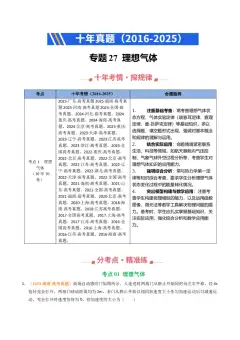
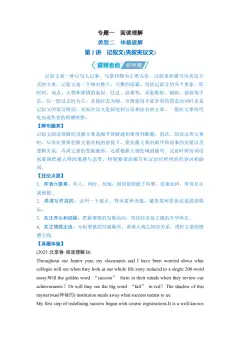
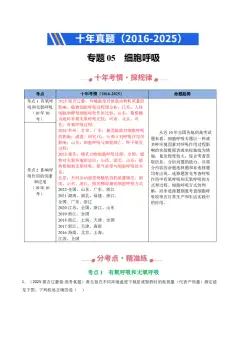
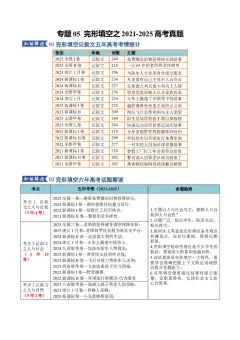
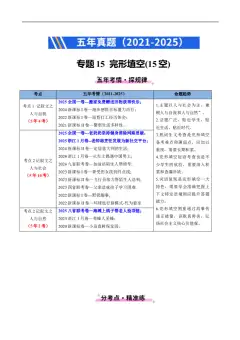
专题13 阅读理解记叙文
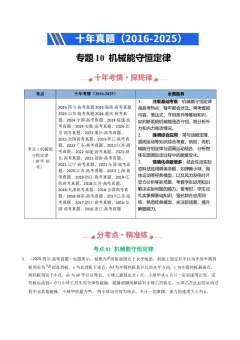
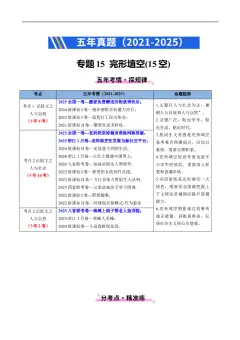
考点
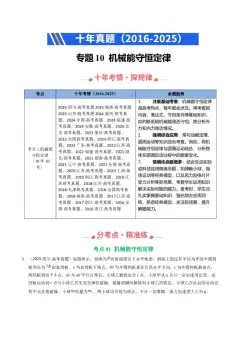
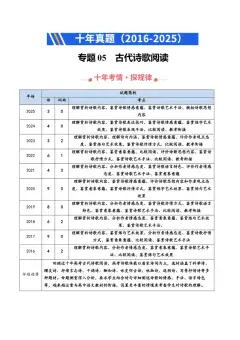
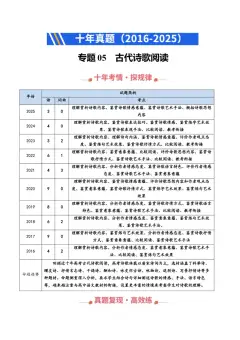
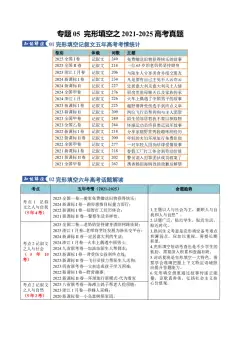
十年考情(2015-2024)
命题趋势
主题内容
考点分布
记叙文
(10 年
56 篇)
2025 年:全国 Ⅰ 卷(写作课教师的教学感
悟)、全国 Ⅱ 卷(医院教师 Kathy Ho 的
工作)、浙江 1 月卷(作者对孩子饮食教育
的反思)、北京卷(高三学生对成功的重新
定义、作者对社会比较的思考)共 5 篇
2024 年:新课标 Ⅰ 卷(兽医 Farber 的整
体医疗实践)、北京卷(作者重拾油画
梦)、浙江 1 月卷(电话亭变社区图书馆)
共 3 篇
2023 年:新高考全国 Ⅰ 卷(John Todd 的
生态机器)、新高考全国 Ⅱ 卷(Urban
Sprouts 项目)、全国乙卷(风景摄影师的经
历)、全国甲卷(Terri Bolton 的 DIY 经
历)、北京卷(作者的科研经历、零浪费生
活)、浙江 1 月卷(零浪费生活实践)共 6
篇
2022 年:新高考全国 Ⅱ 卷(祖孙对电子设
备的认知差异)、北京卷(Alice 参与自然
保护项目)、浙江卷(作者的跨文化经历、
Merebeth 的宠物运输工作)、天津卷(作者
的自我接纳历程)共 6 篇
2021 年:新高考全国 Ⅰ 卷(律师兼职翻页
员)、新高考全国 Ⅱ 卷(动物园饲养员照
顾虎崽、Andria Zafirakou 的艺术教育项
目)、全国甲卷(作者的滑板经历)、全国
乙卷(Benjamin 的艺术成长、作者的自然探
索)、北京卷(作者参与 OIC 项目)、浙
江卷(Saroo Brierley 寻亲、作者的阅读经
历)、天津卷(作者的写作坚持)共 10 篇
2020 年:新高考全国 Ⅰ 卷(Jenifer Mauer
的求学经历)、新高考全国 Ⅱ 卷(教师的
“奶奶的盒子” 方法)、北京卷(Paula
Smith 重现古代技艺)、浙江卷(作者与图
书馆的故事)共 4 篇
细节理解题
(10 年 42 考)
主要涉及时间、地
点、人物行为、事件
起因等具体信息的查
找与筛选。如 2025
年全国 Ⅱ 卷中 Ho
教授的教学对象,
2024 年新课标 Ⅰ
卷中 Farber 尝试针
灸的原因。
推理判断题
(10 年 10 考)
要求考生根据文中信
息进行合理推断,答
案不能直接从原文找
到。比如 2023 年全
国乙卷中推断作者对
魔鬼湖照片的态度;
2022 年北京卷中从
Alice 的经历推断行
动对焦虑的影响。
主旨大意题
(10 年 3 考)
主要考查对文章整体
内容的把握,理解主
旨或目的。例如
2025 年北京卷中概
括作者对成功的重新
定义;2024 年浙江
卷中总结电话亭变图
书馆的故事核心。
词义猜测题
(10 年 1 考)
考查内容:考查对生
1. 主题贴近生活与成
长:多围绕个人经历、
成长感悟、社会温情等
主题,如个人克服困难
实现目标、人与人之间
的互助与理解、对人生
价值的探索等,注重传
递积极的价值观。
2. 叙事结构相对清晰:
多按时间顺序或事件发
展顺序展开,线索明
确,便于考生梳理情
节,理解故事的起因、
经过和结果,同时会通
过细节描写丰富人物形
象和场景氛围。
3. 考查重点偏向细节与
推理:细节理解题主要
考查对人物、事件、时
间、地点等具体信息的
把握;推理判断题侧重
考查对人物情感、态
度、行为动机以及文章
主旨的推断,要求考生
结合上下文进行合理分
析。
4. 语言风格多样:既有
简洁明了的日常叙事,
也有蕴含情感的细腻描
写,词汇和句式难度适
中,注重考查考生对语
境中词汇含义的理解以
及长难句的分析能力。
5. 融入文化与时代元
素:部分文章会涉及不
同国家的文化习俗、社
2019 年:全国卷 Ⅰ(二年级移民男孩的演
讲)、全国卷 Ⅱ(家长参与志愿者工作)、
北京卷(Alice Moore 的创业经历)、江苏
卷(Steve Goodwin 的音乐救赎)共 4 篇
2018 年:浙江卷(作者的暑期阅读、跨文化
经历)、全国 Ⅲ 卷(作者对极简生活的实
践)、北京卷(作者的马拉松经历)、天津
卷(作者误闯民宅的经历)共 4 篇
2017 年:新课标 Ⅰ 卷(野生动物救助经
历)、新课标 Ⅱ 卷(Paul Newman 与作者
的友谊)、新课标 Ⅲ 卷(Plaza 剧院的最
后时光)、浙江卷(Benjamin West 的艺术
启蒙、移民 Svetlana 的经历)、北京卷
(Taylor 救助同学)、天津卷(作者的摄影
感悟)共 6 篇
2016 年:新课标 Ⅰ 卷(干细胞运输员的经
历)、新课标 Ⅱ 卷(教师的教学方法、南
极探险)、新课标 Ⅲ 卷(Eudora Welty 的
邂逅)、浙江卷(母亲对作者的教育)、北
京卷(Natalie 在飓风后的行动)、江苏卷
(Shelly-Ann 的运动生涯)、上海卷(作者
与诗歌的故事)、天津卷(作者对儿子的认
知转变、克服疲惫的经历)共 8 篇
词或短语含义的推
测。如 2023 年浙江
卷中猜测 “jump on
that bandwagon” 的含
义。
会现象或时代背景,引
导考生关注社会现实,
培养跨文化理解能力。
记叙文
2025 年
Passage 1
【2025 全国一卷】In my ninth-grade writing class last year, I met a cowboy who saved his town, a strict
father who demanded his son earn straight A’s, and a modern-day Juliet who died of heartbreak after her parents
rejected the love of her young life. More than once, I found myself wondering just how my students, who’d created
these people, knew their subjects so well.
But things were different for their first essay, which was about the question: “Why is writing important?”
Most of the essays filled less than one page, and few contained a sentence that could be interpreted as a thesis (论
点) statement. I was shocked. Then I realized that the problem was the question itself. They could have written
pages on the necessity of computers, but writing, in and of itself, simply didn’t strike them as important. This
would have to change.
As a new unit started, I asked everyone to write a persuasive piece on a health-related topic of their choice.
This time they found the exercise much more interesting. For the next two assignments, a personal-narrative unit
followed by a creative-writing workshop, I only required that the piece meet the specifications of its genre (体裁)
and that it contain a thesis. The results were staggering. The students took on diverse topics and turned in stories,
10 to 20 pages each, with characters that broadened my view and touched my heart.
I walked into class believing that writing is important as a means of communication. However, my students
demonstrated something more important to me. When the final bell rang in June, I walked away with a yearbook
full of messages about writing’s most powerful significance — the ability to connect people, to put us in another’s
skin, to teach us what it means to be human.
24.Who are the people mentioned at the beginning of paragraph 1?
A.Ninth graders.
B.Students’ parents.
C.Modern writers.
D.Fictional characters.
25.Why did the students perform poorly in writing their first essay?
A.They were not given enough time.
B.They had a very limited vocabulary.
C.They misunderstood the question.
D.They had little interest in the topic.
26.What does the underlined word “staggering” in paragraph 3 mean?
A.Mixed.
B.Amazing.
C.Similar.
D.Disturbing.
27.What does the author’s experience show?
A.Teaching is learning.
B.Still waters run deep.
C.Knowledge is power.
D.Practice makes perfect.
Passage 2
【2025 全国二卷】Kathy Ho teaches high school inside Lucile Packard Children’s Hospital Stanford
(LPCH). “Sometimes I don’t like saying that I’m a teacher,” says Ho. “People get in their minds an idea of what
teachers do, but that’s not really what it is here.”
“Here” is room 386, where each year, about 500 LPCH patients also become students. The hospital school is
free of parents, doctors, and medical procedures. It’s a place of learning. About half of Ho’s students stay for a
week or less; others are there for more than a year. Most of Ho’s students will recover, which means that preparing
them to return to school is an increasingly important component of care.
Still, in room 386, academics don’t come first. Physical health and mental health are the priority. “If you’re
scared about something and thinking only about that, there’s no way you’re going to be able to learn,” Ho says.
“I’m a coach, an adviser, and a comforter, and that’s what it means to be a hospital teacher.”
There are up to 30 students at any given time in Ho’s class. She generally works with their regular teachers
to get lessons and tests being used at their home schools. Some teachers don’t give the kids any assignments; they
express sympathy instead. “I feel like it is a disservice to the kids,” Ho says. “They think their teachers don’t care
about their schoolwork.”
Ho recognizes the psychological benefit of helping kids keep up with their peers ( 同龄人) outside the
hospital. “I actually think the medicine is only a small piece for some problems,” says Julie Good, director of pain
management services at LPCH. “It’s about problem-solving around what it means to have a full life. Those kids
have dreams. School can keep those dreams alive by giving kids a way to learn and grow.”
24.Who does Ho teach at LPCH?
A.Sick children.
B.Young nurses.
C.Medical students.
D.Patients’ parents.
25.What is a characteristic of Ho’s job?
A.Prioritizing academics.
B.Encouraging innovation.
C.Treating various diseases.
D.Playing multiple roles.
26.What does the underlined word “it” refer to in paragraph 4?
A.Offering regular lessons.
B.Paying extra attention.
C.Assigning no schoolwork.
D.Showing no sympathy.
27.How does the hospital school benefit the students according to Good?
A.It eases peer pressure.
B.It helps them live in hope.
C.It frees them from aches.
D.It entertains them with stories.
Passage 3
【2025 浙江1 月卷】When I was a child I was often told what not to eat. “You don’t want to get fat” was
on constant repeat throughout my childhood. It really messed up my relationship with food — something that took
me years to overcome. Because of this, I’m careful not to connect what my kids weigh with their worth as people. I
encourage my daughter to make healthy snack choices and often dissuade (劝阻) her from a second dessert. But
one day when I heard her saying “I think I’m too fat,” my heart sank. It made me wonder if giving her advice on
snacks was having an unintentionally negative impact.
According to Charlotte Markey, a professor of psychology, food is one of the rare subjects where, as parents,
saying less is more. “There are so many things in parenting that are good to talk through, but I’m not convinced
that food is one of them,” she says. “It just creates some worries and insecurities in kids that aren’t necessarily
healthy.”
Instead, she recommends applying a well-known concept among nutrition experts called the “Division of
Responsibility,” where parents provide a variety of mostly healthy foods to their kids at fixed times, and the kids
themselves decide what and how much they want to consume — even if that means occasionally eating more
cookies than carrots.
Allowing kids to eat what they want also exposes them to the natural consequences of their decisions.
“When your child says, ‘My stomach hurts,’ you can say, ‘Well you had a lot of sugary foods and you might feel
better if you made some other choices,’” says Markey. “Let them feel like they have some control over it.”
I’ve been trying out these strategies and I’ve found that when I’m less restrictive, they do make better
decisions. “Feeding is a long game,” says Markey. “The food you have available makes a huge difference. Even if
they don’t eat it, they’ re seeing it. And then all of a sudden it clicks.”
24.What can be inferred about the author from the first paragraph?
A.She is upset by her kids’ weight.
B.She is critical of the way she was fed.
C.She is interested in making food.
D.She is particular about what she eats.
25.Which of the following would Markey disapprove of?
A.Allowing kids to eat cookies occasionally.
B.Offering various foods to kids at fixed times.
C.Explaining to kids the risks of taking snacks.
D.Talking with kids about school at mealtimes.
26.What should kids do according to the “Division of Responsibility”?
A.Make diet decisions on their own.
B.Share their food with other kids.
C.Eat up what is provided for them.
D.Help their parents do the dishes.
27.What does the author think of the strategies she has been following?
A.Costly.
B.Complex.
C.Workable.
D.Contradictory.
Passage 4
【2025 北京卷】Throughout our Junior year, my classmates and I have been worried about what colleges
will see when they look at our whole life story reduced to a single 200-word essay. Will the golden word “success”
form in their minds when they review our achievements? Or will they see the big word “fail” in red? The shadow of
this mysterious (神秘的) institution steals away what success means to us.
My first step of redefining success began with course registrations. It is a well-known fact, especially in my
school, that Junior year is the time of packing many AP classes into the schedule. When asked why they chose so
many AP classes, my friends responded: “I don’t know.” They themselves don’t know why they are following the
crowd and longing for the pressures of academic difficulty. Therefore, they do not feel the satisfaction of being
academically challenged.
Completing many courses no longer brings out the feeling of success because more than four AP classes per
year is a norm set by top universities. Determined to follow my instincts (本能) on what I felt success means, I only
chose two classes that I knew I would enjoy. The feeling of success was no longer attached to what grade I received
but to the pure joy of learning.
Even my failures are attached to a feeling of success; after I take a step back and look at the big picture, I see
them as a launching pad (平台) for my next big achievement. In the ninth grade, I went in for my first group
interview for a leadership position as a shy girl. Not standing a chance against competitive applicants, I came out of
the interview with an upset look. Nevertheless, this interview wasn’t a wasted opportunity. I talked to one of the
senior applicants who answered questions in a way that reflected the faith she had in herself.
This year, with an open mind and new knowledge in mind, I walked into another group interview while telling
myself I was that cool senior. I managed to secure a leadership position. Ultimately, success came little by little.
24. Throughout the Junior year, what was the author’s major concern?
A. Pressure from choosing AP classes.
B. Performance in group interviews.
C. Competition with seniors.
D. Recognition by colleges.
25. The author chose fewer AP classes because of _______.
A. her own understanding of success
B. her desire for academic challenges
C. her strong urge to follow the crowd
D. her dream of entering a top university
26. Which would best describe the author’s first group interview?
A Dignifying.
B. Rewarding.
C. Engaging.
D. Relaxing.
27. What can we learn from this passage?
A. Everyone is the maker of their own success.
B. Success favours those with a golden heart.
C. Success knocks at your door only once.
D. A college holds the key to success.
Passage 5
【2025 北京卷】Not too long ago, on a cold winter night, there was a teenager who wanted more screen time
and a parent who said no. The teenager was advocating for her right to scroll (翻屏) for an extra 30 minutes. The
parent argued that none of her friends’ parents let them have screens after 9 o’clock. “I thought, in this family, we
don’t compare ourselves with other people, Dad?” the teenager replied. The parent — who was me, by the way —
just got served. Since they were young, I have told my kids not to compare themselves with other people. I have
argued countless times that comparisons are the “thief of joy”.
Although my daughter didn’t win, she did help expose one of the worst pieces of advice I have ever given. In
my defence, I did what we’ve all done before, which is repeat received wisdom without exploring the nuances. But
now is the time to set the record straight, which starts with questioning the idea that all social comparison is
unhealthy.
Social comparisons do, of course, often get us into emotional trouble. But they can be harnessed (利用) for
our betterment if we understand how they work. The social comparisons we make — ones that lead us to feel good
or bad about ourselves — are vital to our ability to thrive (成长). Science provides a guide we can use to harness
the way we perform these comparisons to reduce their negative emotional impacts.
Comparing yourself with someone who is outperforming you could result in feelings of envy if you focus on
the things they have and you don’t, or it can be energizing and inspiring if you use these comparisons as a source of
motivation, for example, “If they can achieve that, so can I.” Comparing yourself with someone who is doing worse
than you could result in fear and worry if you think about how you could fall into similar circumstances, or it can
draw out feelings of gratitude and appreciation if you use that comparison to broaden your views — for example,
“Wow, things could be much worse; I’m doing great.”
What I wish I taught my daughter earlier are these nuances. How we feel about ourselves rests not just on
whom we compare ourselves with but also on how we think about that comparison. That’s something we all have
control over.
28. How did the author feel about his daughter’s argument?
A. Excited.
B. Inspired.
C. Energized.
D. Relieved.
29. What does the word “nuances” underlined in Paragraph 2 most probably mean?
A. Major achievements.
B. Complex feelings.
C. Significant impacts.
D. Fine differences.
30. Which would be the best title for the passage?
A. Comparing Ourselves with Others Can Become a Healthy Habit
B. Comparing Ourselves with Others Can Strengthen Family Ties
C. Social Comparisons Can Get Us into Emotional Trouble
D. Social Comparisons Can Be Controlled by Science
2024 年
Passage 1
【2024 新课标Ⅰ卷】“I am not crazy,” says Dr. William Farber, shortly after performing acupuncture (针
灸) on a rabbit. “I am ahead of my time.” If he seems a little defensive, it might be because even some of his
coworkers occasionally laugh at his unusual methods. But Farber is certain he’ll have the last laugh. He’s one of a
small but growing number of American veterinarians ( 兽医) now practicing “holistic” medicine-combining
traditional Western treatments with acupuncture, chiropractic (按摩疗法) and herbal medicine.
Farber, a graduate of Colorado State University, started out as a more conventional veterinarian. He became
interested in alternative treatments 20 years ago when he suffered from terrible back pain. He tried muscle-relaxing
drugs but found little relief. Then he tried acupuncture, an ancient Chinese practice, and was amazed that he
improved after two or three treatments. What worked on a veterinarian seemed likely to work on his patients. So,
after studying the techniques for a couple of years, he began offering them to pets.
Leigh Tindale’s dog Charlie had a serious heart condition. After Charlie had a heart attack, Tindale says, she
was prepared to put him to sleep, but Farber’s treatments eased her dog’s suffering so much that she was able to
keep him alive for an additional five months. And Priscilla Dewing reports that her horse, Nappy, “moves more
easily and rides more comfortably” after a chiropractic adjustment.
Farber is certain that the holistic approach will grow more popular with time, and if the past is any indication,
he may be right: Since 1982, membership in the American Holistic Veterinary Medical Association has grown from
30 to over 700. “Sometimes it surprises me that it works so well,” he says. “I will do anything to help an animal.
That’s my job.”
24. What do some of Farber’s coworkers think of him?
A. He’s odd.
B. He’s strict.
C. He’s brave.
D. He’s rude.
25. Why did Farber decide to try acupuncture on pets?
A. He was trained in it at university.
B. He was inspired by another veterinarian.
C. He benefited from it as a patient.
D. He wanted to save money for pet owners.
26. What does paragraph 3 mainly talk about?
A. Steps of a chiropractic treatment.
B. The complexity of veterinarians’ work.
C. Examples of rare animal diseases.
D. The effectiveness of holistic medicine.
27. Why does the author mention the American Holistic Veterinary Medical Association?
A. To prove Farber’s point.
B. To emphasize its importance.
C. To praise veterinarians.
D. To advocate animal protection.
Passage 2
【2024 北京卷】When I was a little girl, I liked drawing, freely and joyously making marks on the walls at
home. In primary school, I learned to write using chalks. Writing seemed to be another form of drawing. I shaped
individual letters into repeating lines, which were abstract forms, delightful but meaningless patterns.
In secondary school, art was my favourite subject. Since. I loved it so much I thought I was good at it. For the
art O-level exam I had to present an oil painting. I found it difficult, but still hoped to pass. I failed, with a low
grade. I’d been over-confident. Now I’d been declared talentless.
But other channels of creativity stayed open: I went on writing poems and stories. Still, I went to exhibitions
often. I continued my habitual drawing, which I now characterised as childish doodling (乱画). In my 30s, I made
painter friends and learned new ways of looking at art. However, I couldn’t let myself have a go at actually doing it.
Though these new friends were abstract painters using oil paints, or were printmakers or sculptors, I took oil
painting as the taboo (禁忌) high form I wasn’t allowed to practice.
One night, in my early 40s, I dreamed that a big woman in red approached me, handed
me a bag of paints, and told me to start painting. The dream felt so authoritative that it shook me. It was a form of
energy, giving me back something I’d lost. Accordingly, I started by experimenting with water colours. Finally, I
bought some oil paints.
Although I have enjoyed breaking my decades-long taboo about working with oil paints, I have discovered I
now prefer chalks and ink. I let my line drawings turn into cartoons I send to friends. It all feels free and easy. Un-
anxious. This time around, I can accept my limitations but keep going.
Becoming a successful painter calls for being resolute. I realised I was always afraid of wanting too much.
That dream reminded me that those fears and desires could encourage me to take risks and make experiments.
24. How did the author feel about the result of the art exam?
A. Scared.
B. Worried.
C. Discouraged.
D. Wronged.
25. In her 30s, the author _________.
A. avoided oil painting practice
B. sought for a painting career
C. fancied abstract painting
D. exhibited child paintings
26. Which word would best describe the author’s dream?
A. Confusing.
B. Empowering.
C. Disturbing.
D. Entertaining.
27. What can we learn from this passage?
A. Actions speak louder than words.
B. Hard work is the mother of success.
C. Dreams are the reflections of realities.
D. Creative activities involve being confident.
Passage 3
【2024 浙江1 月卷】When was the last time you used a telephone box? I mean to make an actual phone
call — not to shelter from the rain. Ages ago right? The last time I used a phone box for its intended purpose
was…2006. I was conducting auditions (试演) for my play in my tiny old shared house in London. Hoping to
impress some talented actors to come and work for me for nothing, I spread some throws over the sofas and lit
candles to make it seem a bit more ”young professional”.
As I rushed outdoors to empty the wastepaper baskets, the door swung shut behind me. Suddenly I was locked
outside. My mobile phone was inside, but luckily there was a telephone box across the street. So, I called Directory
Assistance, got put through to our landlady’s managing agent, and had a spare key sent to me with just enough time
to get back in before the actors arrived.
As it has been many years since I last used one, I should hardly be surprised that then are no longer any public
telephones near my house. The last one standing has just been turn into a “mini community library”: any passer-by
can “borrow” a book from its shelves return it later, or replace it with another title from their own collection.
For a few months after the “library” opened, I didn’t bother taking a look, as I had assumed that it would be
stuffed full of cheese love stories. Then I noticed fork conducting spring cleans dropping boxes of voluminous
books on various subjects there. And these books were free. This unbeatable price-point encouraged me to
experiment with dozens of titles that I would never normally consider buying. And I’ve discovered some great
books!
If I ever get trapped outside my house again, my local telephone box will, sadly no longer be able to connect
me with my keys. But it can certainly keep me entertained while I wait for my wife to rescue me.
4. What does the underlined word “it” in the first paragraph refer to?
A. The play.
B. The shared house.
C. The sofa.
D. The telephone box.
5. Why did the author use the telephone box in 2006?
A. To place an urgent call.
B. To put up a notice.
C. To shelter from the rain.
D. To hold an audition.
6. What do we know about the “mini community library”?
A. It provides phone service for free.
B. Anyone can contribute to its collection.
C. It is popular among young readers.
D. Books must be returned within a month.
7. Why did the author start to use the “library”?
A. He wanted to borrow some love stories.
B. He was encouraged by a close neighbour.
C. He found there were excellent free books.
D. He thought it was an ideal place for reading.
2023 年
Passage 1
【2023 年新高考全国Ⅰ卷】When John Todd was a child, he loved to explore the woods around his house,
observing how nature solved problems. A ditry stream, for example, often became clear after flowing through
plants and along rocks where tiny creatures lived. When he got older, John started to wonder if this process could
be used to clean up the messes people were making.
After studying agriculture, medicine, and fisheries in college, John went back to observing nature and asking
questions. Why can certain plants trap harmful bacteria (细菌)? Which kinds of fish can eat cancer-causing
chemicals? With the right combination of animals and plants, he figured, maybe he could clean up waste the way
nature did. He decided to build what he would later call an eco-machine.
The task John set for himself was to remove harmful substances from some sludge (污泥). First, he
constructed a series of clear fiberglass tanks connected to each other. Then he went around to local ponds and
streams and brought back some plants and animals. He placed them in the tanks and waited. Little by little, these
different kinds of life got used to one another and formed their own ecosystem. After a few weeks, John added the
sludge.
He was amazed at the results. The plants and animals in the eco-machine took the sludge as food and began to
eat it! Within weeks, it had all been digested, and all that was left was pure water.
Over the years John has taken on many big jobs. He developed a greenhouse-like facility that treated sewage
(污水) from 1,600 homes in South Burlington. He also designed an eco-machine to clean canal water in Fuzhou, a
city in southeast China.
“Ecological design” is the name John gives to what he does. “Life on Earth is kind of a box of spare parts for
the inventor,” he says. “You put organisms in new relationships and observe what’s happening. Then you let these
new systems develop their own ways to self-repair.”
4. What can we learn about John from the first two paragraphs?
A. He was fond of traveling.
B. He enjoyed being alone.
C. He had an inquiring mind.
D. He longed to be a doctor.
5. Why did John put the sludge into the tanks?
A. To feed the animals.
B. To build an ecosystem.
C. To protect the plants.
D. To test the eco-machine.
6. What is the author’s purpose in mentioning Fuzhou?
A. To review John’s research plans.
B. To show an application of John’s idea.
C. To compare John’s different jobs.
D. To erase doubts about John’s invention.
7. What is the basis for John’s work?
A. Nature can repair itself.
B. Organisms need water to survive.
C. Life on Earth is diverse.
D. Most tiny creatures live in groups.
Passage 2
【2023 年新高考全国Ⅱ卷】Turning soil, pulling weeds, and harvesting cabbage sound like tough work for
middle and high school kids. And at first it is, says Abby Jaramillo, who with another teacher started Urban
Sprouts, a school garden program at four low-income schools. The program aims to help students develop science
skills, environmental awareness, and healthy lifestyles.
Jaramillo’s students live in neighborhoods where fresh food and green space are not easy to find and fast food
restaurants outnumber grocery stores. “The kids literally come to school with bags of snacks and large bottles of
soft drinks,” she says. “They come to us thinking vegetables are awful, dirt is awful, insects are awful.” Though
some are initially scared of the insects and turned off by the dirt, most are eager to try something new.
Urban Sprouts’ classes, at two middle schools and two high schools, include hands-on experiments such as
soil testing, flower-and-seed dissection, tastings of fresh or dried produce, and work in the garden. Several times a
year, students cook the vegetables they grow, and they occasionally make salads for their entire schools.
Program evaluations show that kids eat more vegetables as a result of the classes. “We have students who say
they went home and talked to their parents and now they’re eating differently,” Jaramillo says.
She adds that the program’s benefits go beyond nutrition. Some students get so interested in gardening that
they bring home seeds to start their own vegetable gardens. Besides, working in the garden seems to have a
calming effect on Jaramillo’s special education students, many of whom have emotional control issues. “They get
outside,” she says, “and they feel successful.”
4. What do we know about Abby Jaramillo?
A. She used to be a health worker.
B. She grew up in a low-income family.
C. She owns a fast food restaurant.
D. She is an initiator of Urban Sprouts.
5. What was a problem facing Jaramillo at the start of the program?
A. The kids’ parents distrusted her.
B. Students had little time for her classes.
C. Some kids disliked garden work.
D. There was no space for school gardens.
6. Which of the following best describes the impact of the program?
A. Far-reaching.
B. Predictable.
C. Short-lived.
D. Unidentifiable.
7. What can be a suitable title for the text?
A. Rescuing School Gardens
B. Experiencing Country Life
C. Growing Vegetable Lovers
D. Changing Local Landscape
Passage 3
【2023 年全国乙卷】 Living in Iowa and trying to become a photographer specializing in landscape (风景)
can be quite a challenge, mainly because the corn state lacks geographical variation.
Although landscapes in the Midwest tend to be quite similar, either farm fields or highways, sometimes I find
distinctive character in the hills or lakes. To make some of my landscape shots, I have traveled up to four hours
away to shoot within a 10-minute time frame. I tend to travel with a few of my friends to state parks or to the
countryside to go on adventures and take photos along the way.
Being at the right place at the right time is decisive in any style of photography. I often leave early to seek the
right destinations so I can set up early to avoid missing the moment I am attempting to photograph. I have missed
plenty of beautiful sunsets/sunrises due to being on the spot only five minutes before the best moment.
One time my friends and I drove three hours to Devil’s Lake, Wisconsin, to climb the purple quartz (石英)
rock around the lake. After we found a crazy-looking road that hung over a bunch of rocks, we decided to
photograph the scene at sunset. The position enabled us to look over the lake with the sunset in the background. We
managed to leave this spot to climb higher because of the spare time until sunset. However, we did not mark the
route (路线) so we ended up almost missing the sunset entirely. Once we found the place, it was stressful getting
lights and cameras set up in the limited time. Still, looking back on the photos, they are some of my best shots
though they could have been so much better if I would have been prepared and managed my time wisely.
4. How does the author deal with the challenge as a landscape photographer in the Midwest?
A. By teaming up with other photographers.
B. By shooting in the countryside or state parks.
C. By studying the geographical conditions.
D. By creating settings in the corn fields.
5. What is the key to successful landscape photography according to the author?
A. Proper time management.
B. Good shooting techniques.
C. Adventurous spirit.
D. Distinctive styles.
6. What can we infer from the author trip with friends to Devil’s Lake?
A. They went crazy with the purple quartz rock.
B. They felt stressed while waiting for the sunset.
C. They reached the shooting spot later than expected.
D. They had problems with their emipment.
7. How does the author find his photos taken at Devil’s Lake?
A. Amusing.
B. Satisfying.
C. Encouraging.
D. Comforting.
Passage 4
【2023 年全国甲卷】Terri Bolton is a dab hand when it comes to DIY (do-it-yourself). Skilled at putting up
shelves and piecing together furniture, she never pays someone else to do a job she can do herself.
She credits these skills to her late grandfather and builder Derek Lloyd. From the age of six, Terri, now 26,
accompanied Derek to work during her school holidays. A day’s work was rewarded with £5 in pocket money. She
says: “I’m sure I wasn’t much of a help to start with, painting the rooms and putting down the flooring throughout
the house. It took weeks and is was backbreaking work, but I know he was proud of my skills.”
Terri, who now rents a house with friends in Wandsworth, South West London, says DIY also saves her from
losing any deposit when a tenancy (租期) comes to an end. She adds: “I’ve moved house many times and I always
like to personalise my room and put up pictures, so, it’s been useful to know how to cover up holes and repaint a
room to avoid any charges when I’ve moved out.”
With millions of people likely to take on DIY projects over that coming weeks, new research shows that more
than half of people are planning to make the most of the long, warm summer days to get jobs done. The average
spend per project will be around £823. Two thirds of people aim to improve their comfort while at home. Two fifth
wish to increase the value of their house. Though DIY has traditionally been seen as male hobby, the research
shows it is women now leading the charge.
24. Which is closest in meaning to “a dab hand” in paragraph 1?
A. An artist.
B. A winner.
C. A specialist.
D. A pioneer.
25. Why did Terri’s grandfather give her £5 a day?
A. For a birthday gift.
B. As a treat for her work.
C. To support her DIY projects.
D. To encourage her to take up a hobby.
26. How did Terri avoid losing the deposit on the house she rented?
A. By making it look like before.
B. By furnishing it herself.
C. By splitting the rent with a roommate.
D. By cancelling the rental agreement.
27. What trend in DIY does the research show?
A. It is becoming more costly.
B. It is getting more time-consuming.
C. It is turning into a seasonal industry.
D. It is gaining popularity among females.
Passage 5
【2023 年北京卷】Sitting in the garden for my friend’s birthday. I felt a buzz (振动) in my pocket. My heart
raced when I saw the email sender’s name. The email started off: “Dear Mr Green, thank you for your interest” and
“the review process took longer than expected.” It ended with “We are sorry to inform you…”and my vision
blurred (模糊). The position—measuring soil quality in the Sahara Desert as part of an undergraduate research
programme — had felt like the answer I had spent years looking for.
I had put so much time and emotional energy into applying, and I thought the rejection meant the end of the
road for my science career.
So I was shocked when, not long after the email, Professor Mary Devon, who was running the programme,
invited me to observe the work being done in her lab. I jumped at the chance, and a few weeks later I was equally
shocked—and overjoyed—when she invited me to talk with her about potential projects I could pursue in her lab.
What she proposed didn’t seem as exciting as the original project I had applied to, but I was going to give it my all.
I found myself working with a robotics professor on techniques for collecting data from the desert remotely.
That project, which I could complete from my sofa instead of in the burning heat of the desert, not only survived
the lockdown but worked where traditional methods didn’t. In the end, I had a new scientific interest to pursue.
When I applied to graduate school, I found three programmes promising to allow me to follow my desired
research direction. And I applied with the same anxious excitement as before. When I was rejected from one that
had seemed like a perfect fit, it was undoubtedly difficult. But this time I had the perspective (视角) to keep it from
sending me into panic. It helped that in the end I was accepted into one of the other programmes I was also excited
about.
Rather than setting plans in stone, I’ve learned that sometimes I need to take the opportunities that are offered,
even if they don’t sound perfect at the time, and make the most of them.
24. How did the author feel upon seeing the email sender’s name?
A. Anxious.
B. Angry.
C. Surprised.
D. Settled.
25. After talking with Professor Devon, the author decided to ________.
A. criticise the review process
B. stay longer in the Sahara Desert
C. apply to the original project again
D. put his heart and soul into the lab work
26. According to the author, the project with the robotics professor was ________.
A. demanding
B. inspiring
C. misleading
D. amusing
27. What can we learn from this passage?
A. An invitation is a reputation.
B. An innovation is a resolution.
C. A rejection can be a redirection.
D. A reflection can be a restriction.
Passage6
【2023 年浙江1 月卷】Live with roommates? Have friends and family around you? Chances are that if
you’re looking to live a more sustainable lifestyle, not everyone around you will be ready to jump on that
bandwagon.
I experienced this when I started switching to a zero waste lifestyle five years ago, as I was living with my
parents, and I continue to experience this with my husband, as he is not completely zero waste like me. I’ve learned
a few things along the way though, which I hope you’ll find encouraging if you’re doing your best to figure out
how you can make the change in a not-always-supportive household.
Zero waste was a radical lifestyle movement a few years back. I remember showing my parents a video of Bea
Johnson, sharing how cool I thought it would be to buy groceries with jars, and have so little trash! A few days
later, I came back with my first jars of zero waste groceries, and my dad commented on how silly it was for me to
carry jars everywhere. It came off as a bit discouraging.
Yet as the months of reducing waste continued, I did what I could that was within my own reach. I had my
own bedroom, so I worked on removing things I didn’t need. Since I had my own toiletries (洗漱用品), I was able
to start personalising my routine to be more sustainable. I also offered to cook every so often, so I portioned out a
bit of the cupboard for my own zero waste groceries. Perhaps your household won’t entirely make the switch, but
you may have some control over your own personal spaces to make the changes you desire.
As you make your lifestyle changes, you may find yourself wanting to speak up for yourself if others
comment on what you’re doing, which can turn itself into a whole household debate. If you have individuals who
are not on board, your words probably won’t do much and can often leave you feeling more discouraged.
So here is my advice: Lead by action.
24.What do the underlined words “jump on that bandwagon” mean in the first paragraph?
A.Share an apartment with you.
B.Join you in what you’re doing.
C.Transform your way of living.
D.Help you to make the decision.
25.What was the attitude of the author’s father toward buying groceries with jars?
A.He disapproved of it.
B.He was favorable to it.
C.He was tolerant of it.
D.He didn’t care about it.
26.What can we infer about the author?
A.She is quite good at cooking.
B.She respects others’ privacy.
C.She enjoys being a housewife.
D.She is a determined person.
27.What is the text mainly about?
A.How to get on well with other family members.
B.How to have one’s own personal space at home.
C.How to live a zero waste lifestyle in a household.
D.How to control the budget when buying groceries.
2022 年记叙文
Passage1
【2022 年新高考全国Ⅱ卷】We journalists live in a new age of storytelling, with many new multimedia
tools. Many young people don’t even realize it’s new. For them, it’s just normal.
This hit home for me as I was sitting with my 2-year-old grandson on a sofa over the Spring Festival holiday.
I had brought a children’s book to read. It had simple words and colorful pictures — a perfect match for his age.
Picture this: my grandson sitting on my lap as I hold the book in front so he can see the pictures. As I read, he
reaches out and pokes (戳) the page with his finger.
What’s up with that? He just likes the pictures, I thought. Then I turned the page and continued. He poked the
page even harder. I nearly dropped the book. I was confused: Is there something wrong with this kid?
Then I realized what was happening. He was actually a stranger to books. His father frequently amused the
boy with a tablet computer which was loaded with colorful pictures that come alive when you poke them. He
thought my storybook was like that.
Sorry, kid. This book is not part of your high-tech world. It’s an outdated, lifeless thing. An antique, like your
grandfather. Well, I may be old, but I’m not hopelessly challenged, digitally speaking. I edit video and produce
audio. I use mobile payment. I’ve even built websites.
There’s one notable gap in my new-media experience, however: I’ve spent little time in front of a camera,
since I have a face made for radio. But that didn’t stop China Daily from asking me last week to share a personal
story for a video project about the integration of Beijing, Tianjin and Hebei province.
Anyway, grandpa is now an internet star — two minutes of fame! I promise not to let it go to my head. But I
will make sure my 2-year-old grandson sees it on his tablet.
4. What do the underlined words “hit home for me” mean in paragraph 2?
A. Provided shelter for me.
B. Became very clear to me.
C. Took the pressure off me.
D. Worked quite well on me.
5. Why did the kid poke the storybook?
A. He took it for a tablet computer.
B. He disliked the colorful pictures.
C. He was angry with his grandpa.
D. He wanted to read it by himself.
6. What does the author think of himself?
A. Socially ambitious.
B. Physically attractive.
C. Financially independent.
D. Digitally competent.
7. What can we learn about the author as a journalist?
A. He lacks experience in his job.
B. He seldom appears on television.
C. He manages a video department.
D. He often interviews internet stars.
Passage 2
【2022 年北京卷】My name is Alice. Early last year, I was troubled by an anxiety that crippled ( 削弱 ) my
ability to do anything. I felt like a storm cloud hung over me. For almost a year I struggled on, constantly staring at
this wall that faced me. My perfectionist tendencies were the main root of this: I wanted to be perfect at whatever I
did, which obviously in life is not possible, but it consumed me.
One day, I attended a presentation by wildlife conservationist Grant Brown at my high school. His
presentation not only awed and inspired me, but also helped emerge an inner desire to make a difference in the
world. I joined a pre-presentation dinner with him and that smaller setting allowed me to slowly build up my
courage to speak one-on-one with him—an idea that had seemed completely impossible. This first contact was
where my story began.
A month later, Brown invited me to attend the World Youth Wildlife Conference. Looking back, I now see that
this would be the first in a series of timely opportunities that my old self would have let pass, but that this new and
more confident Alice enthusiastically seized. Shortly after I received his invitation, applications to join the Youth
for Nature and the Youth for Planet groups were sent around through my high school. I decided to commit to
completing the applications, and soon I was a part of a growing global team of young people working to protect
nature. Each of these new steps continued to grow my confidence.
I am writing this just six months since my journey began and I’ve realised that my biggest obstacle ( 障碍 )
this whole time was myself. It was that voice in the back of my head telling me that one phrase that has stopped so
many people from reaching their potential: I can’t. They say good things come to those who wait; I say: grab every
opportunity with everything you have and be impatient. After all, nature does not require our patience, but our
action.
24. What was the main cause for Alice’s anxiety?
A. Her inability to act her age.
B. Her habit of consumption.
C. Her desire to be perfect.
D. Her lack of inspiration.
25. How did Grant Brown’s presentation influence Alice?
A. She decided to do something for nature.
B. She tasted the sweetness of friendship.
C. She learned about the harm of desire.
D. She built up her courage to speak up.
26. The activities Alice joined in helped her to become more ________.
A. intelligent
B. confident
C. innovative
D. critical
27. What can we learn from this passage?
A. Practice makes perfect.
B. Patience is a cure of anxiety.
C. Action is worry’s worst enemy.
D. Everything comes to those who wait.
Passage 3
【2022 年浙江卷6 月】Pasta and pizza were on everyone’s lunch menu in my native land of Italy. Everyone
who had such a lunch was fair-skinned and spoke Italian. A few years later, as I stood in the lunch line with my
kindergarten class in a school in Brooklyn, I realized things were no longer that simple. My classmates ranged from
those kids with pale skin and large blue eyes to those with rich brown skin and dark hair. The food choices were
almost as diverse as the students. In front of me was an array of foods I couldn’t even name in my native language.
Fearing that I would pick out something awful, I desperately tried to ask the boy ahead of me for a
recommendation. Unfortunately, between us stood the barrier of language.
Although my kindergarten experience feels like a century ago, the lessons I learned will stick in my mind
forever. For the past three summers, I have worked in a government agency in New York. New immigrants much
like the little girl in the lunch line flooded our office seeking help. I often had to be an interpreter for the Italian-
speaking ones. As I served the role of vital communication link, I was reminded of my desperate struggle to
converse before I learned English. I watched with great sympathy as elderly Italians tried to hold a conversation in
Italian with people who did not speak the language. It suddenly became very clear to me how lucky I was to be
fluent in two languages.
In New York, a multicultural city, students like me are blessed with a chance to work with a diverse
population. In my English to Italian translations, I’ve learned about social programs that I didn’t know existed. This
work expanded my mind in ways that are impossible inside the four walls of a classroom. Walking through the
streets of Brooklyn today, I am no longer confused by this city’s sounds and smells. Instead, enjoy its diversity.
1. What did the author realize after entering school in Brooklyn?
A. Time passed quickly.
B. English was hard to learn.
C. The food was terrible.
D. People were very different.
2. Who does “the little girl” in paragraph 2 refer to?
A. An Italian teacher.
B. A government official.
C. The author herself.
D. The author’s classmate.
3. How did the summer job benefit the author?
A. It strengthened her love for school.
B. It helped sharpen her sense of direction.
C. It opened her eyes to the real world.
D. It made her childhood dream come true.
Passage 4
【2022 年浙江卷1 月】 For nearly a decade now, Merebeth has been a self-employed pet transport
specialist. Her pet transport job was bom of the financial crisis (危机)in the late 2000s. The downturn hit the
real estate (房地产)firm where she had worked for ten years as an office manager. The firm went broke and left
her looking for a new job. One day, while driving near her home, she saw a dog wandering on the road, clearly lost.
She took it home, and her sister in Denver agreed to take it. This was a loving home for sure, but 1, 600 miles away.
It didn't take long for Merebeth to decide to drive the dog there herself. It was her first road trip to her new job.
Merebeth*s pet delivery service also satisfies her wanderlust. It has taken her to every state in the US except
Montana, Washington and Oregon, she says proudly. If she wants to visit a new place, she will simply find a pet
with transport needs there. She travels in all weathers. She has driven through 55 mph winds in Wyoming, heavy
flooding and storms in Alabama and total whiteout conditions in Kansas.
This wanderlust is inherited from her father, she says. She moved their family from Canada to California
when she was one year old, because he wanted them to explore a new place together. As soon as she graduated
from high school she left home to live on Catalina Island off the Californian coast, away from her parents, where
she enjoyed a life of sailing and off-road biking.
It turns out that pet transporting pays quite well at about $30, 000 per year before tax. She doesn't work in
summer, as it would be unpleasantly hot for the animals in the car, even with air conditioning. As autumn comes,
she gets restless—the same old wanderlust returning. It’s a call she must heed alone, though. Merebeth says,
*'When I am on the road, I'm just in my own world. I've always been independent-spirited and I just feel strongly
that I mush help animals.
1. Why did Merebeth changed her job?
A. She wanted to work near her home.
B. She was tired of working in the office.
C. Her sister asked her to move to Denver.
D. Her former employer was out of business.
2.
The word "wanderlust" in paragraph 2 means a desire to

 ?
A.
make money.
B. try various jobs.
C. be close to nature.
D. travel to different places.
3 What can we learn about Merebeth in her new job?
A.
She has chances to see rare animals.
B.
She works hard throughout the year.
C.
She relies on herself the whole time.
D.
She earns a basic and tax-free salary.
Passage 5
【2022 年浙江卷6 月】Pasta and pizza were on everyone’s lunch menu in my native land of Italy. Everyone
who had such a lunch was fair-skinned and spoke Italian. A few years later, as I stood in the lunch line with my
kindergarten class in a school in Brooklyn, I realized things were no longer that simple. My classmates ranged from
those kids with pale skin and large blue eyes to those with rich brown skin and dark hair. The food choices were
almost as diverse as the students. In front of me was an array of foods I couldn’t even name in my native language.
Fearing that I would pick out something awful, I desperately tried to ask the boy ahead of me for a
recommendation. Unfortunately, between us stood the barrier of language.
Although my kindergarten experience feels like a century ago, the lessons I learned will stick in my mind
forever. For the past three summers, I have worked in a government agency in New York. New immigrants much
like the little girl in the lunch line flooded our office seeking help. I often had to be an interpreter for the Italian-
speaking ones. As I served the role of vital communication link, I was reminded of my desperate struggle to
converse before I learned English. I watched with great sympathy as elderly Italians tried to hold a conversation in
Italian with people who did not speak the language. It suddenly became very clear to me how lucky I was to be
fluent in two languages.
In New York, a multicultural city, students like me are blessed with a chance to work with a diverse
population. In my English to Italian translations, I’ve learned about social programs that I didn’t know existed. This
work expanded my mind in ways that are impossible inside the four walls of a classroom. Walking through the
streets of Brooklyn today, I am no longer confused by this city’s sounds and smells. Instead, enjoy its diversity.
1. What did the author realize after entering school in Brooklyn?
A. Time passed quickly.
B. English was hard to learn.
C. The food was terrible.
D. People were very different.
2. Who does “the little girl” in paragraph 2 refer to?
A. An Italian teacher.
B. A government official.
C. The author herself.
D. The author’s classmate.
3. How did the summer job benefit the author?
A. It strengthened her love for school.
B. It helped sharpen her sense of direction.
C. It opened her eyes to the real world.
D. It made her childhood dream come true.
Passage 6
【2022 年天津卷第二次】I’m an 18-year-old pre-medical student, tall nd good-looking, with two short story
books and quite a number of essays my credit. Why am I singing such praises of myself? Just to explain that he
attainment of self-pride comes from a great deal of self-love, and to attain it, one must first learn to accept oneself
as one is. That was where my struggle began.
Born and raised in Africa,I had always taken my African origin as burden. My self-dislike was further fueled
when my family had to relocate to Norway, where I attended a high school. Compared to all the white girls around
me, with their golden hair and delicate lips, I ,a black girl, had curly hair and full, red lips. My nose often had a thin
sheet of sweat on it, whatever the weather was. I just wanted to bury myself in my shell crying “I’m so different!”
What also contributed to my self-dislike was my occasional stuttering (口吃), which had weakened my self-
confidence. It always stood between me and any fine opportunity. I’d taken it as an excuse to avoid any public
speaking sessions, and unknowingly let it rule over me.
Fortunately, as I grew older, there came a turning point. One day a white girl caught my eye on the school bus
when she suddenly turned back. To my astonishment, she had a thin sheet of sweat on her nose too, and it was in
November! “Wow,” I whispered to myself, “this isn’t a genetic(遗传的) disorder after all. It’s perfectly normal.”
Days later, my life took an-other twist(转折). Searching the internet for stuttering cures, I accidentally learned that
such famous people as Isaac Newton and Winston Churchill also stuttered. I was greatly relieved and then an idea
suddenly hit me—if I’m smart, I shouldn’t allow my stuttering to stand between me and my success.
Another boost to my self-confidence came days later as I was watching the news about Oprah Winfrey, the
famous talkshow host and writer—she’s black too! Whenever I think of her story and my former dislike of my
color, I’m practically filled with shame.
Today, I’ve grown to accept what I am with pride; it simply gives me feeling of uniqueness. The idea of self-
love has taken on a whole new meaning for me: there’s always something fantastic about us, and what w need to do
is learn to appreciate it.
41. What affected the author’s adjustment to her school life in Norway!
A. Her appearance
B. Social discrimɪnation.
C. Her changing emotions.
D. The climate in Norway.
42. What did the author’s occasional stuttering bring about according on Paragraph 3?
A. Her lack of self-confidence.
B. Her loss of interest in school.
C. Her unwillingness to greet her classmates.
D. Her desire for chances to improve herself.
43. How did the author feel on noticing the similarity between her and ne girl on the bus?
A. Blessed and proud.
B. Confused and afraid.
C. Amazed and relieved.
D. Shocked and ashamed.
44. What lesson did the author learn from the cases of Newton and Churchill?
A. Great minds speak alike.
B. Stuttering is no barrier to success.
C. Wisdom counts more than hard work.
D. Famous people can’t live with their weaknesses.
45. What can best summarize the message contained in the passage?
A. Pride comes before a fall.
B. Where there is a will, there is a way.
C. Self-acceptance is based on the love for oneself.
D. Self-love is key to the attainment of self-pride.
2021 年记叙文
Passage1
【2021 年新高考全国Ⅰ 卷】By day, Robert Titterton is a lawyer. In his spare on stage beside pianist Maria
Raspopova — not as a musician but as her page turner. “I’m not a trained musician, but I’ve learnt to read music so
I can help Maria in her performance.”
Mr Titterton is chairman of the Omega Ensemble but has been the group’s official page turner for the past four
years. His job is to sit beside  the pianist and turn the pages of the score so the musician doesn’t have to break the
flow of sound by doing it themselves. He said he became just as nervous as those playing instruments on stage.
“A lot of skills are needed for the job. You have to make sure you don’t turn two pages at once and make sure
you find the repeats in the music  when you have to go back to the right spot.” Mr Titterton explained.
Being a page turner requires plenty of practice. Some pieces of music can go for 40 minutes and require up to
50 page turns, including back turns for repeat passages. Silent onstage communication is key, and each pianist has
their own style of “nodding” to indicate a page turn which they need to practise with their page turner.
But like all performances, there are moments when things go wrong. “I was turning the page to get ready for
the next page, but the draft wind from the turn caused the spare pages to fall off the stand,” Mr Titterton said,
“Luckily I was able to catch them and put them back.”
Most page turners are piano students or up-and-coming concert pianists, although Ms Raspopova has once
asked her husband to  help her out on stage.
“My husband is the worst page turner,” she laughed. “He’s interested in the music, feeling every note, and I
have to say: ‘Turn, turn!’ “Robert is the best page turner I’ve had in my entire life.”
24. What should Titterton be able to do to be a page turner?
A. Read music.
B. Play the piano.
C. Sing songs.
D. Fix the instruments.
25. Which of the following best describes Titterton’s job on stage?
A. Boring.
B. Well-paid.
C. Demanding.
D. Dangerous.
26. What does Titterton need to practise?
A. Counting the pages.
B. Recognizing the “nodding”.
C. Catching falling objects.
D. Performing in his own style.
27. Why is Ms Raspopova’s husband “the worse page turner”?
A He has very poor eyesight.
B. He ignores the audience.
C. He has no interest in music.
D. He forgets to do his job.
Passage 2
【2021 年新高考全国Ⅱ 卷】I have worked as a keeper at the National Zoo, Paris for 11 years. Spot and
Stripe are the first tiger cubs that have ever been born here. Globally, a third of Sumatran cubs in zoos don't make it
to adulthood, so I decided to give them round-the-clock care at home.
I've got two children—the younger one, Kynan, was extremely happy about the tigers arriving - but all of us
really looked forward to being part of their lives and watching them grow. I wasn't worried about bringing them
into my home with my wife and kids. These were cubs. They weighed about 2.5 kg and were so small that there
was absolutely no risk.
As they grew more mobile, we let them move freely around the house during the day, but when we were
asleep we had to contain them in a large room, otherwise they'd get up to mischief. We'd come down in the
morning to find they'd turned the room upside down, and left it looking like a zoo.
Things quickly got very intense due to the huge amount of energy required to look after them. There were
some tough times and I just felt extremely tired. I was grateful that my family was there to help. We had to have a
bit of a production line going, making up “tiger milk”, washing baby bottles, and cleaning the floors.
When Spot and Stripe were four months old, they were learning how to open doors and jump fences, and we
knew it really was time for them to go. It was hard for us to finally part with them. For the first few days, Kynan
was always a bit disappointed that the cubs weren't there.
I'm not sad about it. I'm hands-on with them every day at the zoo, and I do look back very fondly on the time
that we had them.
4. Why did the author bring the tiger cubs home?
A. To ensure their survival.
B. To observe their differences.
C. To teach them life skills.
D. To let them play with his kids.
5. What do the underlined words “get up to mischief” mean in paragraph 3?
A. Behave badly.
B. Lose their way.
C. Sleep soundly.
D. Miss their mom.
6. What did the author think of raising the tiger cubs at home?
A. Boring.
B. Tiring.
C. Costly.
D. Risky.
7. Why did the author decide to send Spot and Stripe back to the zoo?
A. They frightened the children.
B. They became difficult to contain.
C. They annoyed the neighbours.
D. They started fighting each other.
Passage 3
【2021 年新高考全国Ⅱ 卷】A British woman who won a S1 million prize after she was named the World's
Best Teacher will use the cash to bring inspirational figures into UK schools.
Andria Zafirakou,a north London secondary school teacher, said she wanted to bring about a classroom
revolution (变革). “We are going to make a change, ”she said.“I’ve started a project to promote the teaching of
the arts in our schools.”
The project results from the difficulties many schools have in getting artists of any sort - whether an up-and-
coming local musician or a major movie star - into schools to work with and inspire children.
Zafirakou began the project at Alperton Community School, her place of work for the past twelve years. “I've
seen those magic moments when children are talking to someone they are inspired by - their eyes are shining and
their faces light up,” she said. “We need artists . more than ever in our schools."
Artist Michael Craig-Martin said: “Andria's brilliant project to bring artists from all fields into direct contact
with children is particularly welcome at a time when the arts are being downgraded in schools." It was a mistake to
see the arts as unnecessary, he added.
Historian Sir Simon Schama is also a supporter of the project. He said that arts education in schools was not
just an add-on. “It is absolutely necessary. The future depends on creativity and creativity depends on the young.
What will remain of us when artificial intelligence takes over will be our creativity, and it is our creative spirit, our
visionary sense of freshness,that has been our strength for centuries."
8. What will Zafirakou do with her prize money?
A. Make a movie.
B. Build new schools.
C. Run a project.
D. Help local musicians.
9. What does Craig-Martin think of the teaching of the arts in UK schools?
A. It is particularly difficult.
B. It increases artists' income.
C. It opens children's mind.
D. It deserves greater attention.
10. What should be stressed in school education according to Schama?
A. Moral principles.
B. Interpersonal skills.
C. Creative abilities.
D. Positive worldviews.
11. Which of the following is a suitable title for the text?
A. Bring Artists to Schools
B. When Historians Meet Artists
C. Arts Education in Britain
D. The World's Best Arts Teacher
Passage 4
【2021 年全国甲卷】When I was 9, we packed up our home in Los Angeles and arrived at Heathrow,
London on a gray January morning. Everyone in the family settled quickly into the city except me. Without my
beloved beaches and endless blue—sky days, I felt at a loss and out of place. Until I made a discovery.
Southbank, at an eastern bend in the Thames, is the center of British skateboarding, where the continuous
crashing of skateboards left your head ringing .I loved it. I soon made friends with the local skaters. We spoke our
own language. And my favorite: Safe. Safe meant cool. It meant hello. It meant don't worry about it. Once, when
trying a certain trick on the beam(横杆), I fell onto the stones, damaging a nerve in my hand, and Toby came
over, helping me up: Safe, man. Safe. A few minutes later, when I landed the trick, my friends beat their boards
loud, shouting: “ Safe! Safe! Safe!” And that's what mattered—landing tricks, being a good skater.
When I was 15, my family moved to Washington. I tried skateboarding there, but the locals were far less
welcoming. Within a couple of years, I'd given it up.
When I returned to London in 2004, I found myself wandering down to Southbank, spending hours there. I've
traveled back several times since, most recently this past spring. The day was cold but clear: tourists and Londoners
stopped to watch the skaters. Weaving(穿梭)among the kids who rushed by on their boards, I found my way to
the beam. Then a rail—thin teenager, in a baggy white T—shirt, skidded(滑)up to the beam. He sat next to me.
He seemed not to notice the man next to him. But soon I caught a few of his glances. “I was a local here 20 years
ago,” I told him. Then, slowly, he began to nod his head. “Safe, man. Safe.”
“Yeah,” I said. “Safe.”
8. What can we learn about the author soon after he moved to London?
A. He felt disappointed.
B. He gave up his hobby.
C. He liked the weather there.
D. He had disagreements with his family.
9. What do the underlined words “Safe! Safe! Safe!” probably mean?
A. Be careful!
B. Well done!
C. No way!
D. Don't worry!
10. Why did the author like to spend time in Southbank when he returned to London?
A. To join the skateboarding.
B. To make new friends.
C. To learn more tricks.
D. To relive his childhood days
11. What message does the author seem to convey in the text?
A. Children should learn a second language.
B. Sport is necessary for children's health.
C. Children need a sense of belonging
D. Seeing the world is a must for children.
Passage 5
【2021 年北京卷】I remember the day during our first week of class when we were informed about our
semester(学期) project of volunteering at a non-profit organization.When the teacher introduced us to the
different organizations that needed our help,my last choice was Operation Iraqi Children (OIC).My first
impression of the organization was that it was not going to make enough of a difference with the plans I had in
mind.
Then,an OIC representative gave us some details,which somewhat interested me.After doing some
research, I believed that we could really do something for those kids.When I went online to the OIC website,I
saw pictures of the Iraqi children.Their faces were so powerful in sending a message of their despair(绝望)
and need that I joined this project without hesitation.We decided to collect as many school supplies as possible,
and make them into kits——one kit,one child.
The most rewarding day for our group was project day,when all the efforts we put into collecting the items
finally came together.When I saw the various supplies we had collected,it hit me that every kit we were to build
that day would eventually be in the hands of an Iraqi child.Over the past four months,I had never imagined how
I would feel once our project was completed.While making the kits,I realized that I had lost sight of the true
meaning behind it.I had only focused on the fact that it was another school project and one I wanted to get a good
grade on.When the kits were completed,and ready to be sent overseas,the warm feeling I had was one I would
never forget.
In the beginning,I dared myself to make a difference in the life of another person.Now that our project is
over,I realize that I have affected not only one life,but ten.With our efforts,ten young boys and girls will
now be able to further their education.
24. How did the author feel about joining the OIC project in the beginning?
A. It would affect his/her initial plans.
B. It would involve traveling overseas.
C It would not bring him/her a good grade.
D. It would not live up to his/her expectations.
25. What mainly helped the author change his/her attitude toward the project?
A. Images of Iraqi children.
B. Research by his/her classmates.
C. A teacher's introduction.
D. A representative's comments.
26. The author's OIC project group would help ten Iraqi children to________..
A. become OIC volunteers
B. further their education
C. study in foreign countries
D. influence other children
27. What can we conclude from this passage?
A. One's potential cannot always be underrated.
B. First impression cannot always be trusted.
C. Actions speak louder than words.
D. He who hesitates is lost.
Passage 6
【2021 年浙江卷6 月】Leslie Nielsen’s childhood was a difficult one, but he had one particular shining star
in his life — his uncle, who was a well-known actor. The admiration and respect his uncle earned inspired Nielsen
to make a career (职业) in acting. Even though he often felt he would be discovered to be a no-talent, he moved
forward, gaining a scholarship to the Neighborhood Playhouse and making his first television appearance a few
years later in 1948. However, becoming a full-time, successful actor would still be an uphill battle for another eight
years until he landed a number of film roles that finally got him noticed.
But even then, what he had wasn’t quite what he wanted. Nielsen always felt he should be doing comedy but
his good looks and distinguished voice kept him busy in dramatic roles. It wasn’t until 1980 — 32 years into his
career — that he landed the role it would seem he was made for in Airplane! That movie led him into the second
half of his career where his comedic presence alone could make a movie a financial success even when movie
reviewers would not rate it highly.
Did Nielsen then feel content in his career? Yes and no. He was thrilled to be doing the comedy that he always
felt he should do but even during his last few years, he always had a sense of curiosity, wondering what new role
or challenge might be just around the comer. He never stopped working, never retired.
Leslie Nielsen’s devotion to acting is wonderfully inspiring. He built a hugely successful career with little
more than plain old hard work and determination. He showed us that even a single desire, never given up on, can
make for a remarkable life.
1. Why did Nielsen want to be an actor?
A. He enjoyed watching movies.
B. He was eager to earn money.
C. He wanted to be like his uncle
D. He felt he was good at acting.
2. What do we know about Nielsen in the second half of his career?
A. He directed some high quality movies.
B. He avoided taking on new challenges.
C. He focused on playing dramatic roles.
D. He became a successful comedy actor.
3. What does Nielsen’s career story tell us?
A. Art is long, life is short.
B. He who laughs last laughs longest.
C. It’s never too late to learn.
D. Where there’s a will there’s a way.
Passage 7
【2021 年浙江卷6 月】We live in a town with three beaches. There are two parts less than 10 minutes’ walk
from home where neighborhood children gather to play. However, what my children want to do after school is pick
up a screen — any screen — and stare at it for hours. They are not alone. Today's children spend an average of four
and a half hours a day looking at screens, split between watching television and using the Internet.
In the past few years, an increasing number of people and organisations have begun coming up with plans to
counter this trend. A couple of years ago film-maker David Bond realised that his children, then aged five and
three, were attached to screens to the point where he was able to say “chocolate” into his three-year-old son’s ear
without getting a response. He realised that something needed to change, and, being a London media type,
appointed himself “marketing director from Nature”. He documented his journey as he set about treating nature as a
brand to be marketed to young people. The result was Project Wild Thing, a film which charts the birth of the
World Network, a group of organisations with the common goal of getting children out into nature.
“Just five more minutes outdoors can make a difference,” David Bond says. “There is a lot of really interesting
evidence which seems to be suggesting that if children are inspired up to the age of seven, then being outdoors will
be on habit for life.” His own children have got into the habit of playing outside now: “We just send them out into
the garden and tell them not to come back in for a while.”
Summer is upon us. There is an amazing world out there, and it needs our children as much as they need it.
Let us get them out and let them play.
4. What is the problem with the author’s children?
A. They often annoy their neighbours.
B. They are tired of doing their homework.
C. They have no friends to play with
D. They stay in front of screens for too long.
5. How did David Bond advocate his idea?
A. By making a documentary film.
B. By organizing outdoor activities.
C. By advertising in London media.
D. By creating a network of friends.
6.  Which of the following can replace the underlined word “charts” in paragraph 2?
A. records
B. predicts
C. delays
D. confirms
7. What can be a suitable title for the text?
A. Let Children Have Fun
B. Young Children Need More Free Time
C. Market Nature to Children
D. David Bond: A Role Model for Children
Passage 8
【2021 年浙江卷1 月】 More than 25 years ago, Saroo Brierley lived in rural(农村)India. One day, he
played with his brother along the rail line and fell asleep. When he woke up and found himself alone, the 4-year-old
decided his brother might be on the train he saw in front of him-so he got on.
That train took him a thousand miles across the country to a totally strange city. He lived on the streets, and
then in an orphanage(孤儿院). There, he was adopted by an Australian family and flown to Tasmania.
As he writes in his new book, A Long Way Home, Brierley couldn't help but wonder about his hometown back
in India. He remembered landmarks, but since he didn't know his town's name, finding a small neighborhood in a
vast country proved to be impossible.
Then he found a digital mapping program. He spent years searching for his hometown in the program's
satellite pictures. In 2011, he came across something familiar. He studied it and realized he was looking at a town's
central business district from a bird's-eye view. He thought,  “On the right-hand side you should see the three-
platform train station”—and there it was. "And on the left-hand side you should see a big fountain"-and there it
was. Everything just started to match.
When he stood in front of the house where he grew up as a child, he saw a lady standing in the entrance.
"There's something about me, " he thought—and it took him a few seconds but he finally remembered what she
used to look like.
In an interview Brierley says, "My mother looked so much shorter than I remembered. But she came forth and
walked forward, and I walked forward, and my feelings and tears and the chemical in my brain, you know, it was
like a nuclear fusion(核聚变). I just didn't know what to say, because I never thought seeing my mother would
ever come true. And here I am, standing in front of her. ”
1.Why was Brierley separated from his family about 25 years ago?
A.He got on a train by mistake.
B.He got lost while playing in the street.
C.He was taken away by a foreigner.
D.He was adopted by an Australian family.
2.How did Brierley find his hometown?
A.By analyzing old pictures.
B.By travelling all around India.
C.By studying digital maps.
D.By spreading his story via his book.
3.What does Brierley mainly talk about in the interview?
A.His love for his mother.
B.His reunion with his mother.
C.His long way back home.
D.His memory of his hometown.
Passage 9
【2021 年天津卷第二次】When people ask me how I started writing, I find myself describing an urgent need
that I felt to work with language. Having said that, I did not know for a long time what I was looking for. It was not
until I followed this feeling to its source that I discovered I had a passion fbr writing. With some encouragement
from my colleagues, I had one of my poems published. This bit of success, however, was the point where my
problem began.
Back in 1978, I had to travel between three different campuses in the morning, teaching freshman
composition. Afternoons I spent taking my daughter to her ballet and horse-riding lessons. I composed my lectures
on the way, and that was all the thinking time I had. When I returned home, there was not enough of me left fbr
writing after a full working day.
As a way out, I decided to get up two hours before my usual time. My alarm was set fbr 5:00 A.M. The first
day I shut it off because I had placed it within arm's reach. The second day I set two clocks, one on my night table,
and one out in the hallway. I had to jump out of bed and run to silence it before my family was awoken. This was
when my morning writing began.
Since that first morning in 1978, I have been following the habit to this day, not making or accepting many
excuses for not writing. I wrote my poems in this manner for nearly ten years before my first book was published.
When I decided to write a novel, I divided my two hours: the first for poetry, the second fbr fiction. Well or badly, I
wrote at least two pages a day. This is how my novel, The Line of the Sun. was finished. If I had waited to have the
time, I would still be waiting to write my novel.
What I got out of getting up in the dark to work is the feeling that I am in control. For many people, the initial
sense of urgency to create easily dies away because it requires making the tough decision: taking the time to create,
stealing it from yourself if ifs the only way.
41. What motivated the author to start her writing career?
A. Her strong wish to share.
B. Her keen interest in writing.
C. Her urgent need to make a living.
D. Her passionate desire fbr fame.
42. What problem did the author face when she decided to begin her writing?
A. She was too exhausted to write after a busy day.
B. She had trouble in deciding on her writing style.
C. She had to take time to discipline her daughter.
D. She was unsure about her writing skills.
43. Why did the author place an alarm clock in the hallway?
A. In case the clock in her room broke down.
B. In case she failed to hear the ringing.
C. To force herself out of bed.
D. To wake up her family.
44. How did the author manage to finish her novel?
A. By sticking to writing every morning.
B. By writing when her mind was most active.
C. By drawing inspirations from classic novels.
D. By reducing her teaching hours at school.
45. What can we learn from the author's success in her writing career?
A. It is never too late to change your job.
B. Imaginative ideas die away if not taken in time.
C. A tight schedule is no excuse fbr lack of action.
D. Daily life provides ideas fbr creative writing.
2020 年记叙文
Passage1
【2020 年新高考全国Ⅰ 卷(山东卷)】Jenifer Mauer has needed more willpower than the typical college
student to pursue her goal of earning a nursing degree. That willpower bore fruit when Jennifer graduated from
University of Wisconsin-Eau Claire and became the first in her large family to earn a bachelor's degree.
Mauer, of Edgar, Wisconsin, grew up on a farm in a family of 10 children. Her dad worked at a job away from
the farm, and her mother ran the farm with the kids. After high school, Jennifer attended a local technical college,
working to pay her tuition(学费), because there was no extra money set aside for a college education. After
graduation, she worked to help her sisters and brothers pay for their schooling.
Jennifer now is married and has three children of her own. She decided to go back to college to advance her
career and to be able to better support her family while doing something she loves: nursing. She chose the UW-Eau
Claire program at Ministry Saint Joseph's Hospital in Marshfield because she was able to pursue her four-year
degree close to home. She could drive to class and be home in the evening to help with her kids. Jenifer received
great support from her family as she worked to earn her degree: Her husband worked two jobs to cover the bills,
and her 68-year-old mother helped take care of the children at times.
Through it all, she remained in good academic standing and graduated with honors. Jennifer sacrificed(牺
牲)to achieve her goal, giving up many nights with her kids and missing important events to study. ''Some nights
my heart was breaking to have to pick between my kids and studying for exams or papers,'' she says. However, her
children have learned an important lesson witnessing their mother earn her degree. Jennifer is a first-generation
graduate and an inspiration to her family-and that's pretty powerful.
4. What did Jennifer do after high school?
A. She helped her dad with his work.
B. She ran the family farm on her own.
C. She supported herself through college.
D. She taught her sisters and brothers at home.
5. Why did Jennifer choose the program at Ministry Saint Joseph's Hospital in Marshfield?
A. To take care of her kids easily.
B. To learn from the best nurses.
C. To save money for her parents.
D. To find a well-paid job there.
6. What did Jennifer sacrifice to achieve her goal?
A. Her health.
B. Her time with family.
C. Her reputation.
D. Her chance of promotion.
7. What can we learn from Jenifer's story?
A. Time is money.
B. Love breaks down barriers.
C. Hard work pays off.
D. Education is the key to success.
Passage2
【2020 年新高考全国Ⅱ 卷(海南卷)】The end of the school year was in sight and spirits were high. I
was back teaching after an absence of 15 years, dealing with the various kinds of "forbidden fruit" that come out of
book bags. Now was the spring of the water pistol.
I decided to think up a method of dealing with forbidden fruit.
"Please bring that pistol to me," I said. "I'm going to put it in my Grandma's Box."
"What's that?" they asked.
"It's a large wooden chest full of toys for my grandchildren," I replied,
"You don't have grandchildren " someone said.
"I don't now." I replied. "But someday I will. When I do, my box will be full of wonderful things for them."
My imaginary Grandma's Box worked like magic that spring, and later. Sometimes. students would ask me to
describe all the things I had in it. Then I would try to remember the different possessions I supposedly had taken
away—since I seldom actually kept them. Usually the offender would appear at the end of the day, and I would
return the belonging.
The-years went by, and my first grandchild Gordon was born. I shared my joy with that year's class. Then
someone said, "Now you can use your Grandma's Box." From then on instead of coming to ask their possessions
back, the students would say, "That's okay. Put it in your Grandma's Box for Gordon."
I loved talking about the imaginary box, not only with my students but also with my own children. They
enjoyed hearing about all the forbidden fruit I had collected. Then one Christmas I received a surprise gift—a large,
beautifully made wooden chest. My son Bruce had made my Grandma's Box a reality.
4. What was the author's purpose in having the conversation with the students?
A. To collect the water pistol.
B. To talk about her grandchildren.
C. To recommend some toys.
D. To explain her teaching method.
5. What do the underlined words "the offender" in paragraph 8 refer to?
A. The student's parent.
B. The maker of the Grandma's Box.
C. The author's grandchild
D. The owner of the forbidden fruit.
6. What did the students do after they learned about the birth of Gordon?
A. They went to play with the baby.
B. They asked to see the Grandma's Box.
C. They made a present for Gordon.
D. They stopped asking their toys back.
7. What can we infer about the author?
A. She enjoys telling jokes.
B. She is a strict and smart teacher.
C. She loves doing woodwork.
D. She is a responsible grandmother
Passage3
【2020 年北京卷】For the past five years, Paula Smith, a historian of science, has devoted herself to re-
creating long-forgotten techniques. While doing research for her new book, she came across a 16th-century French
manuscript(手稿)consisting of nearly 1,000 sets of instructions, covering subjects from tool making to finding
the best sand.
The author's intention remains as mysterious(神秘)as his name; he may have been simply taking notes for
his own records. But Smith was struck mainly by the fact that she didn't truly grasp any of the skills the author
described. "You simply can't get an understanding of that handwork by reading about it," she says.
Though Smith did get her hands on the best sand, doing things the old-fashioned way isn't just about playing
around with French mud. Reconstructing the work of the craftsmen(工匠)who lived centuries ago can reveal
how they viewed the world, what objects filled their homes, and what went on in the workshops that produced
them. It can even help solve present-day problems: In 2015, scientists discovered that a 10th-century English
medicine for eve problems could kill a drug-resistant virus.
The work has also brought insights for museums, Smith says. One must know how on object was made in
order to preserve it. What's more, reconstructions might be the only way to know what treasures looked like before
time wore them down. Scholars have seen this idea in practice with ancient Greek and Roman statues. These
sculptures were painted a rainbow of striking colours. We can't appreciate these kinds of details without seeing
works of art as they originally appeared-something Smith believes you can do only when you have a road map.
Smith has put the manuscript's ideas into practice. Her final goal is to link the worlds of art and science back
together: She believes that bringing the old recipes to life can help develop a kind of learning that highlights
experimentation, teamwork, and problem solving.
Back when science—then called “the new philosophy”—took shape, academics looked to craftsmen for help
in understanding the natural world. Microscopes and telescopes were invented by way of artistic tinkering(修
补), as craftsmen experimented with glass to better bend light.
If we can rediscover the values of hands-on experience and craftwork, Smith says, we can marry the best of
our modern insights with the handiness of our ancestors.
38. How did Smith, feel after reading the French manuscript?
A. Confused about the technical terms.
B. Impressed with its detailed instructions.
C. Discouraged by its complex structure.
D. Shocked for her own lack of hand skills.
39. According to Smith, the reconstruction work is done mainly to _____________.
A. restore old workshops
B. understand the craftsmen
C. improve visual effects
D. inspire the philosophers
40. Why does the author mention museums?
A. To reveal the beauty of ancient objects.
B. To present the findings of old science.
C To highlight the importance of antiques.
D. To emphasise the values of hand skills.
41. Which would be the best title for this passage?
A. Craftsmen Set the Trends for Artists
B. Craftsmanship Leads to New Theories
C. Craftsmanship Makes Better Scientists
D. Craftsmen Reshape the Future of Science
Passage4
【2020 年浙江卷1 月】I never knew anyone who’d grown up in Jackson without being afraid of Mrs.
Calloway our librarian. She ran Jackson’s Carnegie Library absolutely by herself. SILENCE in big black letters
was on signs hung everywhere. If she thought you were dressed improperly, she sent you straight back home to
change your clothes. I was willing;I would do anything to read.
My mother was not afraid of Mrs. Calloway. She wished me to have my own library card to check out books
for myself, She took me in to introduce me. “Eudora is nine years old and has my permission to read any book she
wants from the shelves, children or adults,” Mother said.
Mrs. Calloway made her own rules about books. You could not take back a book to the library on the same day
you`d taken it out;it made no difference to her that you’d read every word in it and needed another to start. You
could take out two books at a time and two only. So two by two, I read library books as fast as I could go, rushing
them home in the basket of my bicycle. From the minute I reached our house, I started to read. I knew this was
extreme happiness, knew it at the time.
My mother shared this feeling of mine. Now, I think of her as reading so much of the time while doing
something else. I remember her reading a magazine while taking the part of the Wolf in a game of "Little Red
Riding Hood" with my brother's two daughters. She'd just look up at the right time, long enough to answer– in
character –"The better to eat you with, my dear," and go back to her place in the magazine article.
21. Which of the following best described Mrs. Calloway?
A. diet.
B. Strict.
C. Humorous.
D. Considerate.
22. What do the underlined words "this feeling" refer to in the last paragraph?
A. Desire to read.
B. Love for Mrs. Calloway.
C. Interest in games.
D. Fear of the library rules.
23. Where is the text probably from?
A. guidebook.
B. an autobiography.
C. a news report.
D. book review.
2019 年记叙文
Passage1
【2019
 Ⅰ
年全国卷
】For Canaan Elementary’s second grade in Patchogue, N.Y.,today is speech day ,and
right now it’s Chris Palaez’s turn. The 8-year-old is the joker of the class. With shining dark eyes, he seems like the
of kid who would enjoy public speaking.
But he’s, nervous.“I’m here to tell you today why you should … should…”Chris trips on the“-ld,”a.
pronunciation difficulty for many non-native English speakers. His teacher ,Thomas Whaley ,is next to him,
whispering support.“…Vote for …me …”Except for some stumbles, Chris is doing amazingly well. When he
brings his speech to a nice conclusion ,Whaley invites the rest of the class to praise him.
A son of immigrants, Chris stared learning English a little over three years ago. Whaley recalls(回想起)how at
the beginning of the year,when called upon to read,Chris would excuse himself to go to the bathroom.
Learning English as a second language can be a painful experience. What you need is a great teacher who lets
you make mistakes. “It takes a lot for any student,” Whaley explains,“especially for a student who is learning
English as their new language,to feel confident enough to say,‘I don’t know,but I want to know.’”
Whaley got the idea of this second-grade presidential campaign project when he asked the children one day to
raise their hands if they thought they could never be a president. The answer broke his heart. Whaley says the
project is about more than just learning to read and speak in public. He wants these kids to learn to boast(夸
耀)about themselves.
“Boasting about yourself,and your best qualities,” Whaley says,“is very difficult for a child who came into
the classroom not feeling confident.”
24. What made Chris nervous?
A. Telling a story.
B. Making a speech.
C. Taking a test.
D. Answering a question.
25. What does the underlined word “stumbles” in paragraph 2 refer to?
A. Improper pauses.
B. Bad manners.
C. Spelling mistakes.
D. Silly jokes.
26. We can infer that the purpose of Whaley’s project is to _________.
A. help students see their own strengths
B. assess students’ public speaking skills
C. prepare students for their future jobs
D. inspire students’ love for politics
27. Which of the following best describes Whaley as a teacher?
A. Humorous.
B. Ambitious.
C. Caring.
D. Demanding.
Passage 2
【2019
Ⅱ
年全国卷】“You can use me as a last resort(选择), and if nobody else volunteers,then I will do it.”
This was an actual reply from a parent after I put out a request for volunteers for my kids lacrosse(长曲棍球)club.
I guess that there's probably some demanding work schedule, or social anxiety around stepping up to help for
an unknown sport. She may just need a little persuading. So I try again and tug at the heartstrings. I mention the
single parent with four kids running the show and I talk about the dad coaching a team that his kids aren’t even on
… At this point the unwilling parent speaks up,“Alright. Yes, I’ll do it.”
I’m secretly relieved because I know there’s real power in sharing volunteer responsibilities among many. The
unwilling parent organizes the meal schedule, sends out emails, and collects money for end-of-season gifts.
Somewhere along the way, the same parent ends up becoming an invaluable member of the team. The coach is able
to focus on the kids while the other parents are relieved to be off the hook for another season. Handing out sliced
oranges to bloodthirsty kids can be as exciting as watching your own kid score a goal.
Still, most of us volunteers breathe a sigh of relief when the season comes to a close. That relief is coupled
with a deep understanding of why the same people keep coming back for more: Connecting to the community(社
区)as you freely give your time, money, skills, or services provides a real joy. Volunteering just feels so good.
In that sense, I’m pretty sure volunteering is more of a selfish act than I’d freely like to admit. However, if
others benefit in the process, and I get some reward too, does it really matter where my motivation lies?
24. What can we infer about the parent from her reply in paragraph l?
A. She knows little about the club.
B. She isn't good at sports.
C. She just doesn't want to volunteer.
D. She's unable to meet her schedule.
25. What does the underlined phrase“tug at the heartstrings”in paragraph 2 mean ?
A. Encourage team work.
B. Appeal to feeling.
C. Promote good deeds.
D. Provide advice.
26. What can we learn about the parent from paragraph 3?
A. She gets interested in lacrosse.
B. She is proud of her kids.
C. She’ll work for another season.
D. She becomes a good helper.
27. Why does the author like doing volunteer work?
A. It gives her a sense of duty.
B. It makes her very happy.
C. It enables her to work hard.
D. It brings her material rewards.
Passage 3
【2019 年北京卷】Alice Moore is a teenager entrepreneur(创业者), who in May 2015 set up her business
AilieCandy. By the time she was 13,her company was worth millions of dollars with the invention of a super-
sweet treat that could save kids' teeth,instead of destroying them.
It all began when Moore visited a bank with her dad. On the outing, she was offered a
candy bar. However, her dad reminded her that sugary treats were bad for her teeth. But
Moore was sick of missing out on candies. So she desired to get round the warning, "Why
can't I make a healthy candy that's good for my teeth so that my parents can't say no to it?"
With that in mind, Moore asked her dad if she could start her own candy company. He
recommended that she do some research and talk to dentists about what a healthier candy
would contain.
With her dad's permission, she spent the next two years researching online and conducting trials to get a recipe
that was both tasty and tooth-friendly. She also approached dentists to learn more about teeth cleaning.
Consequently, she succeeded in making a kind of candy only using natural sweeteners, which can reduce oral
bacteria.
Moore then used her savings to get her business of the ground. Afterwards, she and her father secured their
first business meeting with a supermarket owner, who finally agreed to sell  Moore's product-Cancandy.
As CanCandy's success grows, so does Moore's credibility as a young entrepreneur. Moore is enthusiastic
about the candy she created, and she's also positive about what the future might bring. She hopes that every kid can
have a clean mouth and a broad smile.
Meanwhile, with her parents' help, Moore is generally able to live a normal teenage life. Although she founded
her company early on in life, she wasn't driven primarily by profit. Moore wants to use her unique talent to help
others find their smiles. She donates 10% of AilicCandy's profits to Big Smiles. With her talent and determination,
it appears that the sky could be the limit for Alice Moore.
34. How did Moore react to her dad's warning?
A. She argued with him.
B. She tried to find a way out.
C. She paid no attention.
D. She chose to consult dentists.
35. What is special about CanCandy?
A. It is beneficial to dental health.
B. It is free of sweeteners.
C. It is sweeter than other candies.
D. It is produced to a dentists' recipe.
36. What does Moore expect from her business?
A. To earn more money.
B. To help others find smiles.
C. To make herself stand out.
D. To beat other candy companies.
37. What can we learn from Alice Moore's story?
A. Fame is a great thirst of the young.
B. A youth is to be regarded with respect.
C. Positive thinking and action result in success.
D. Success means getting personal desires satisfied
Passage 4
【2019 年江苏卷】The 65-year-old Steve Goodwin was found suffering from early Alzheimer’s(阿尔楚海默
症). He was losing his memory.
A software engineer by profession, Steve was a keen lover of the piano, and the only musician in his family.
Music was his true passion, though he had never performed outside the family.
Melissa, his daughter, felt it more than worthwhile to save his music, to which she fell asleep catch night when
she was young. She thought about hiring a professional pianist to work with her father.
Naomi, Melissa’s best friend and a talented pianist, got to know about this and showed willingness to help.
“Why do this?” Steve wondered.
“Because she cares.” Melissa said.
Steve nodded, tears in eye.
Naomi drove to the Goodwin home. She told Steve she’d love to hear him play. Steve moved to the piano and
sat at the bench, hands trembling as he gently placed his fingers on the keys.
Naomi put a small recorder near the piano, Starts and stops and mistakes. Long pauses, heart sinking. But
Steve pressed on, playing for the first time in his life for a stranger.
“It was beautiful." Naomi said after listening to the recording. “The music was worth saving.”
Her responsibility, her privilege, would be to rescue it. The music was still in Steve Goodwin. It was bidden in
rooms with doors about to be locked.
Naomi and Steve met every other week and spent hours together. He’d move his fingers clumsily on the piano,
and then she’d take his place. He struggled to explain what he heard in his head. He stood by the piano, eyes
closed, listening for the first time to his own work being played by someone else.
Steve and Naomi spoke in musical code lines, beats, intervals, moving from the root to end a song in a new
key. Steve heard it. All of it. He just couldn’t play it.
Working with Naomi did wonders for Steve. It had excited within him the belief he could write one last song.
One day, Naomi received an email. Attached was a recording, a recording of loss and love, of the fight. Steve called
it “Melancholy Flower”.
Naomi heard multiple stops and starts, Steve struggling, searching while his wife Joni called him “honey” and
encouraged him. The task was so hard, and Steve, angry and upset, said he was quitting. Joni praised him, telling
her husband this could be his signature piece.
Naomi managed to figure out 16 of Steve’s favorite, and most personal songs. With Naomi’s help, the
Goodwin family found a sound engineer to record Naomi playing Steve’s songs. Joni thought that would be the
end. But it wasn’t.
In the months leading up to the 2016 Oregon Repertory Singers Christmas concert, Naomi told the director she
had a special one in mind: “Melancholy Flower”
She told the director about her project with Steve. The director agreed to add it to the playing list. But Naomi
would have to ask Steve’s permission. He considered it an honor.
After the concert, Naomi told the family that Steve’s music was beautiful and professional. It needed to be
shared in public.
The family rented a former church in downtown Portland and scheduled a concert. By the day of the show,
more than 300 people had said they would attend.
By then, Steve was having a hard time remembering the names of some of his friends. He knew the path his
life was now taking. He told his family he was at peace.
Steve arrived and sat in the front row, surrounded by his family. The house lights faded. Naomi took the stage.
Her fingers. His heart.
65. Why did Melissa want to save her father’s music?
A. His music could stop his disease from worsening.
B. She wanted to please her dying old father.
C. His music deserved to be preserved in the family.
D. She wanted to make her father a professional.
66. After hearing Steve’s playing, Naomi ________.
A. refused to make a comment on it
B. was deeply impressed by his music
C. decided to free Steve from suffering
D. regretted offering help to her friend
67. How can the process of Steve’s recording be described?
A. It was slow but productive.
B. It was beneficial to his health.
C. It was tiresome for Naomi.
D. It was vital for Naomi’s career.
68. Before Steve finished “Melancholy Flower," his wife Joni _______.
A. thought the music talent of Steve was exhausted
B. didn’t expect the damage the disease brought about
C. didn’t fully realize the value of her husband’s music
D. brought her husband’s music career to perfection
69. How did Steve feel at the concert held in downtown Portland?
A. He felt concerned about his illness.
B. He sensed a responsibility for music.
C. He regained his faith in music.
D. He got into a state of quiet.
70. What can be a suitable title for the passage?
A. The Kindness of Friends
 B. The Power of Music
C. The Making of a Musician  D. The Value of Determination
2018 年记叙文
Passage1
【2018 年浙江卷11 月】I start every summer with the best of intentions:to attack one big book from the
past, a classic that I was supposed to have read when young and ambitious. Often the pairings of books and settings
have been purely accidental: "Moby Dick" on a three-day cross-country train trip: “The Magic Mountain” in a New
England beachside cottage with no locks on the doors, no telephones or televisions in the rooms, and little to do
beyond row on the salt pond. Attempting "The Man Without Qualities" on a return to Hawaii, my native state,
however, was less fruitful: I made it through one and a quarter volumes (册), then decided that I'd got the point and
went swimming instead.
But this summer I find myself at a loss. I’m not quite interested in Balzac, say, or “Tristram Shandy.” There’s
always War and Peace, which I've covered some distance several times, only to get bogged down in the "War"
part, set it aside for a while, and realize that I have to start over from the beginning again, having forgotten
everyone’s name and social rank. How appealing to simply fall back on a favorite-once more into “The Waves” or
“Justine,” which feels almost like cheating, too exciting and too much fun to properly belong in serious literature.
And then there’s Stendhal’s “The Red and the Black,” which happens to be the name of my favorite cocktail
(鸡尾酒) of the summer, created by Michael Cecconi at Savoy and BackForty. It is easy to drink, and knocking
back three or four seems like such a delightful idea. Cecconi's theory: "I take whatever’s fresh at the green market
and turn it into liquid." The result is a pure shot of afternoon in the park, making one feel cheerful and peaceful all
at once, lying on uncut grass with eyes shut, sun beating through the lids...
27.What can we infer about the author from the first paragraph?
A.He has a cottage in New England.
B.He shows talents for literature.
C.He enjoys reading when traveling.
D.He admires a lot of great writers.
28.What do the underlined words "get bogged down" in paragraph 2 mean?
A.Get confused.
B.Be carried away.
C.Be interrupted.
D.Make no progress.
29.Why does the author say reading his favorite books feels like cheating?
A.He finishes them quickly.
B.He should read something serious.
C.He barely understands them.
D.He has read them many times before.
30.What can be a suitable title for the text?
A.The Books of Summer
B.My Summer Holidays
C.To Read or Not to Read
D.It’s Never Too Late to Read
Passage2
【2018 年全国Ⅲ卷】Adults understand what it feels like to be flooded with objects. Why do we often
assume that more is more when it comes to kids and their belongings? The good news is that I can help my own
kids learn earlier than I did how to live more with less.
I found the pre-holidays a good time to encourage young children to donate less-used things, and it worked.
Because of our efforts, our daughter Georgia did decide to donate a large bag of toys to a little girl whose mother
was unable to pay for her holiday due to illness. She chose to sell a few larger objects that were less often used
when we promised to put the money into her school fund(基金)(our kindergarten daughter is serious about
becoming a doctor)
For weeks, I've been thinking of bigger, deeper questions: How do we make it a habit for them? And how do
we train ourselves to help them live with, need, and use less? Yesterday, I sat with my son, Shepherd, determined to
test my own theory on this. I decided to play with him with only one toy for as long as it would keep his interest. I
expected that one toy would keep his attention for about five minutes, ten minutes, max. I chose a red rubber ball-
simple, universally available. We passed it, he tried to put it in his mouth, he tried bouncing it, rolling it, sitting on
it, throwing it. It was totally, completely enough for him. Before I knew it an hour had passed and it was time to
move on to lunch.
We both became absorbed in the simplicity of playing together. He had my full attention and I had his. My
little experiment to find joy in a single object worked for both of us.
32. What do the words “more is more” in paragraph 1 probably mean?
A. The more, the better.    B. Enough is enough.
C. More money, more worries.    D. Earn more and spend more.
33. What made Georgia agree to sell some of her objects?
A. Saving up for her holiday    B. Raising money for a poor girl
C. Adding the money to her fund    D. Giving the money to a sick mother
34. Why did the author play the ball with Shepherd?
A. To try out an idea
B. To show a parent's love
C. To train his attention
D. To help him start a hobby
35. What can be a suitable title for the text?
A. Take It or Leave It    B. A Lesson from Kids
C. Live More with Less    D. The Pleasure of Giving
Passage 3
【2018 年浙江卷6 月】 In 1812, the year Charles Dickens was born, there were 66 novels published in
Britain. People had been writing novels for a century — most experts date the first novel to Robinson
Crusoe in 1719 — but nobody wanted to do it professionally. The steam-powered printing press was still in its
early stages; the literacy(识字) rate in England was under 50%. Many works of fiction appeared without
the names of the authors, often with something like “By a lady.”Novels, for the most part, were looked
upon as silly, immoral, or just plain bad.
In 1870, when Dickens died, the world mourned him as its first professional
writer and publisher, famous and beloved, who had led an explosion in both the publication of novels and their
readership and whose characters — from Oliver Twist to Tiny Tim — were held up as moral touchstones.
Today Dickens’ greatness is unchallenged. Removing him from the pantheon(名人堂) of English literature
would make about as much sense as the Louvre selling off the Mona Lisa.
How did Dickens get to the top? For all the feelings readers attach to stories,
literature is a numbers game, and the test of time is extremely difficult to pass. Some 60,000 novels were
published during the Victorian age, from 1837 to 1901; today a casual reader might be able to name a half-
dozen of them. It’s partly true that Dickens’ style of writing attracted audiences from all walks of life. It’s
partly that his writings rode a wave of social, political and scientific progress. But it’s also that he rewrote the
culture of literature and put himself at the center. No one will ever know what mix of talent, ambition, energy and
luck made Dickens such a singular writer. But as the 200th anniversary of his birth approaches, it is possible
— and important for our own culture — to understand how he made himself a lasting one.
21. Which of the following best describes British novels in the 18th century?
A. They were difficult to understand.
B. They were popular among the rich.
C. They were seen as nearly worthless.
D. They were written mostly by women.
22. Dickens is compared with the Mona Lisa in the text to stress ________.
A. his reputation in France
B. his interest in modern art
C. his success in publication
D. his importance in literature
23. What is the author’s purpose in writing the text?
A. To remember a great writer.
B. To introduce an English novel.
C. To encourage studies on culture.
D. To promote values of the Victorian age.
Passage 4
【2018 年北京卷】 My First Marathon(马拉松)
A month before my first marathon, one of my ankles was injured and this meant not running for two weeks,
leaving me only two weeks to train.  Yet, I was determined to go ahead.
I remember back to my 7th year in school.  In my first P. E.  class, the teacher required us to run laps and
then hit a softball.  I didn’t do either well.  He later informed me that I was "not athletic".
The idea that I was "not athletic" stuck with me for years.  When I started running in my 30s, I realized
running was a battle against myself, not about competition or whether or not I was athletic.  It was all about the
battle against my own body and mind.  A test of wills!
The night before my marathon, I dreamt that I couldn’t even find the finish line.  I woke up sweating and
nervous, but ready to prove something to myself.
Shortly after crossing the start line, my shoe laces(鞋带) became untied.  So I stopped to readjust.  Not the
start I wanted!
At mile 3, I passed a sign: "GO FOR IT, RUNNERS!"
By mile 17, I became out of breath and the once injured ankle hurt badly.  Despite the pain, I stayed the
course walking a bit and then running again.
By mile 21, I was starving!
As I approached mile 23, I could see my wife waving a sign.  She is my biggest fan.  She never minded the
alarm clock sounding at 4 a. m.  or questioned my expenses on running.
I was one of the final runners to finish.  But I finished! And I got a medal.  In fact, I got the same medal as
the one that the guy who came in first place had. zxxk
Determined to be myself, move forward, free of shame and worldly labels(世俗标签), I can now call myself a
"marathon winner".
36.  A month before the marathon, the author ____________.
A.  was well trained    B.  felt scared
C.  made up his mind to run    D.  lost hope
37.  Why did the author mention the P. E.  class in his 7th year?
A.  To acknowledge the support of his teacher.
B.  To amuse the readers with a funny story.
C.  To show he was not talented in sports.
D.  To share a precious memory.
38.  How was the author’s first marathon?
A.  He made it.     B.  He quit halfway.
C.  He got the first prize.     D.  He walked to the end.
39.  What does the story mainly tell us?
A.  A man owes his success to his family support.
B.  A winner is one with a great effort of will.
C.  Failure is the mother of success.
D.  One is never too old to learn. Passage 5
【2018 年天津卷】When I was 17, I read a magazine article about a museum called the McNay, once the
home of a watercolorist named Marian McNay. She had requested the community to turn it into a museum upon her
death. On a sunny Saturday, Sally and I drove over to the museum. She asked, "Do you have the address? ""No, but
I'll recognize it, there was a picture in the magazine. "
"Oh, stop. There it is!”
The museum was free. We entered, excited. A group of people sitting in the hall stopped talking and stared at
us.
"May I help you?" a man asked. "No, "I said. "We're fine.” Tour guides got on my nerves. What if they talked
a long time about a painting you weren't that interested in? Sally had gone upstairs. The people in the hall seemed
very nosy(爱窥探的), keeping their eyes on me with curiosity. What was their problem? I saw some nice sculptures
in one room. Suddenly I sensed a man standing behind me. "Where do you think you are? " he asked. I turned
sharply. "The McNay Art Museum!" He smiled, shaking his head. "Sorry, the McNay is on New Braunfels Street."
"What’s this place?” I asked, still confused. "Well, it's our home." My heart jolted(震颤). I raced to the staircase
and called out, "Sally! Come down immediately! "
"There's some really good stuff(艺术作品) up there." She stepped down, looking confused. I pushed her
toward the front door, waving at the family, saying, "Sorry, please forgive us, you have a really nice place."
Outside, when I told Sally what happened, she covered her mouth, laughing. She couldn't believe how long they let
us look around without saying anything.
The real McNay was splendid, but we felt nervous the whole time we were there. Van Gogh, Picasso. This
time, we stayed together, in case anything else unusual happened.
Thirty years later, a woman approached me in a public place. "Excuse me, did you ever enter a residence, long
ago, thinking it was the McNay Museum?"
"Yes. But how do you know? We never told anyone."
"That was my home. I was a teenager sitting in the hall. Before you came over, I never realized what a
beautiful place I lived in. I never felt lucky before. You thought it was a museum. My feelings about my home
changed after that. I've always wanted to thank you."
41. What do we know about Marian McNay?
A. She was a painter.
B. She was a community leader.
C. She was a museum director.
D. She was a journalist.
42. Why did the author refuse the help from the man in the house?
A. She disliked people who were nosy.
B. She felt nervous when talking to strangers.
C. She knew more about art than the man.
D. She mistook him for a tour guide.
43. How did the author feel about being stared at by the people in the hall?
A. Puzzled.    B. Concerned.
C. Frightened.    D. Delighted.
44. Why did the author describe the real McNay museum in just a few words?
A. The real museum lacked enough artwork to interest her.
B. She was too upset to spend much time at the real museum.
C. The McNay was disappointing compared with the house.
D. The event happening in the house was more significant.
45. What could we learn from the last paragraph?
A. People should have good taste to enjoy life.
B. People should spend more time with their family.
C. People tend to be blind to the beauty around them.
D. People tend to educate teenagers at a museum.2017 年记叙文
Passage1
【2017 年新课标Ⅰ卷】I work with Volunteers for Wildlife, a rescue and education organization at
Bailey Arboretum in Locust Valley. Trying to help injured, displaced or sick creatures can be
heartbreaking; survival is never certain. However, when it works, it is simply beautiful.
I got a rescue call from a woman in Muttontown. She had found a young owl(猫头鹰) on the ground.
When I arrived, I saw a 2-to 3-week-old owl. It had already been placed in a carrier for safety.
I examined the chick(雏鸟) and it seemed fine. If I could locate the nest, I might have been able to put
it back, but no luck. My next work was to construct a nest and anchor it in a tree.
The homeowner was very helpful. A wire basket was found. I put some pine branches into the basket to
make this nest safe and comfortable. I placed the chick in the nest, and it quickly calmed down.
Now all that was needed were the parents, but they were absent. I gave the homeowner a recording of
the hunger screams of owl chicks. These advertise the presence of chicks to adults; they might also
encourage our chick to start calling as well. I gave the owner as much information as possible and
headed home to see what news the night might bring.
A nervous night to be sure, but sometimes the spirits of nature smile on us all! The homeowner called to say that
the parents had responded to the recordings. I drove over and saw the chick in the nest looking healthy and active.
And it was accompanied in the nest by the greatest sight of all — LUNCH! The parents had done their
duty and would probably continue to do so.
24. What is unavoidable in the author’s rescue work according to paragraph 1?
A. Efforts made in vain.
B. Getting injured in his work.
C. Feeling uncertain about his future.
D. Creatures forced out of their homes.
25. Why was the author called to Muttontown?
A. To rescue a woman.
B. To take care of a woman.
C. To look at a baby owl.
D. To cure a young owl.
26. What made the chick calm down?
A. A new nest.
B. Some food.       C. A recording.        D. Its parents.
27. How would the author feel about the outcome of the event?
A. It’s unexpected.
B. It’s beautiful.
C. It’s humorous.
D. It’s discouraging.
Passage 2
【2017 年新课标Ⅱ卷】I first met Paul Newman in 1968, when George Roy Hill, the director of Butch Cassidy
and the Sundance Kid, introduced us in New York City. When the studio didn’t want me for the film — it wanted
somebody as well known as Paul — he stood up for me. I don’t know how many people would have done that; they
would have listened to their agents or the studio powers.
The friendship that grew out of the experience of making that film and The Sting four years later had its root in the
fact that although there was an age difference, we both came from a tradition of theater and live TV. We were
respectful of craft(技艺) and focused on digging into the characters we were going to play. Both of us had the
qualities and virtues that are typical of American actors: humorous, aggressive, and making fun of each other —
but always with an underlying affection. Those were also at the core(核心) of our relationship off the screen.
We shared the belief that if you’re fortunate enough to have success, you should put something back — he with his
Newman’s Own food and his Hole in the Wall camps for kids who are seriously ill, and me with Sundance and the
institute and the festival. Paul and I didn’t see each other all that regularly, but sharing that brought us together. We
supported each other financially and by showing up at events.
I last saw him a few months ago. He’d been in and out of the hospital. He and I both knew what the deal was, and
we didn’t talk about it. Ours was a relationship that didn’t need a lot of words.
24. Why was the studio unwilling to give the role to the author at first?
A. Paul Newman wanted it.
B. The studio powers didn’t like his agent.
C. He wasn’t famous enough.
D. The director recommended someone else.
25. Why did Paul and the author have a lasting friendship?
A. They were of the same age.
B. They worked in the same theater.
C. They were both good actors.
D. They had similar characteristics.
26. What does the underlined word "that" in paragraph 3 refer to?
A. Their belief.
B. Their care for children.
C. Their success.
D. Their support for each other.
27. What is the author’s purpose in writing the text?
A. To show his love of films.
B. To remember a friend.
C. To introduce a new movie.
D. To share his acting experience.
Passage 3
【2017 年新课标Ⅲ卷】Minutes after the last movie ended yesterday at the Plaza Theater, employees were
busy sweeping up popcorns and gathering coke cups. It was a scene that had been repeated many times in the
theater’s 75-year history. This time, however, the cleanup was a little different. As one group of workers carried out
the rubbish, another group began removing seats and other theater equipment in preparation for the building’s end.
The film classic The Last Picture Show was the last movie shown in the old theater. Though the movie is 30 years
old, most of the 250 seats were filled with teary-eyed audience wanting to say good-bye to the old building. Theater
owner Ed Bradford said he chose the movie because it seemed appropriate. The movie is set in a small town where
the only movie theater is preparing to close down.
Bradford said that large modern theaters in the city made it impossible for the Plaza to compete. He added that
the theater’s location(位置) was also a reason. "This used to be the center of town," he said. "Now the area is
mostly office buildings and warehouses."
Last week some city officials suggested the city might be interested in turning the old theater into a museum
and public meeting place. However, these plans were abandoned because of financial problems. Bradford sold the
building and land to a local development firm, which plans to build a shopping complex on the land where the
theater is located.
The theater audience said good-bye as Bradford locked the doors for the last time. After 75 years the Plaza
Theater had shown its last movie. The theater will be missed.
24. In what way was yesterday’s cleanup at the Plaza special?
   A. It made room for new equipment.
   B. It signaled the closedown of the theater.
   C. It was done with the help of the audience.
   D. It marked the 75th anniversary of the theater.
25. Why was The Last Picture Show put on?
   A. It was an all-time classic.
B. It was about the history of the town.
   C. The audience requested it.
D. The theater owner found it suitable.
26. What will probably happen to the building?
   A. It will be repaired.
B. It will be turned into a museum.
   C. It will be knocked down.
D. It will be sold to the city government.
27. What can we infer about the audience?
A. They are disappointed with Bradford.
B. They are sad to part with the old theater.
C. They are supportive of the city officials.
D. They are eager to have a shopping center.
Passage 4
【2017 年浙江卷】Benjamin West, the father of American painting, showed his talent for art when he was
only six years of age. But he did not know about brushes before a visitor told him he needed one. In those days, a
brush was made from camel’s hair. There were no camels nearby. Benjamin decided that cat hair would work
instead. He cut some fur from the family cat to make a brush.
The brush did not last long. Soon Benjamin needed more fur. Before long, the cat began to look ragged(蓬乱).
His father said that the cat must be sick. Benjamin was forced to admit what he had been doing.
The cat’s lot was about to improve. That year, one of Benjamin’s cousins, Mr. Pennington, came to visit. He
was impressed with Benjamin’s drawings. When he went home, he sent Benjamin a box of paint and some brushes.
He also sent six engravings( 版画) by an artist. These were the first pictures and first real paint and brushes
Benjamin had ever seen.
In 1747, when Benjamin was nine years old, Mr.Pennington returned for another visit. He was amazed at what
Benjamin had done with his gift. He asked Benjamin’s parents if he might take the boy back to Philadelphia for a
visit.
In the city, Mr.Pennington gave Benjamin materials for creating oil paintings. The boy began a landscape( 风
景) painting. William Williams, a well-known painter, came to see him work. Williams was impressed with
Benjamin and gave him two classic books on painting to take home. The books were long and dull. Benjamin could
read only a little, having been a poor student. But he later said, "Those two books were my companions by day, and
under my pillow at night." While it is likely that he understood very little of the books, they were his introduction
to classical paintings. The nine-year-old boy decided then that he would be an artist.
21.What is the text mainly about?
A. Benjamin’s visit to Philadelphia.
B. Williams’ influence on Benjamin.
C. The beginning of Benjamin’s life as an artist.
D. The friendship between Benjamin and Pennington.
22.What does the underlined sentence in paragraph 3 suggest?
A. The cat would be closely watched.
B. The cat would get some medical care.
C. Benjamin would leave his home shortly.
D. Benjamin would have real brushes soon.
23.What did Pennington do to help Benjamin develop his talent?
A. He took him to see painting exhibitions.
B. He provided him with painting materials.
C. He sent him to a school in Philadelphia.
D. He taught him how to make engravings.
24.Williams’ two books helped Benjamin to   .
A. master the use of paints
B. appreciate landscape paintings
C. get to know other painters
D. make up his mind to be a painter
Passage 5
【2017 年浙江卷】FLORENCE, Italy — Svetlana Cojochru feels hurt. The Moldovan has lived here seven
years as a caregiver to Italian kids and the elderly, but in order to stay she’s had to prove her language skills by
taking a test which requires her to write a postcard to an imaginary friend and answer a fictional job ad.
Italy is the latest Western European country trying to control a growing immigrant( 移民)population by
demanding language skills in exchange for work permits, or in some cases, citizenship.
Some immigrant advocates worry that as hard financial times make it more difficult for natives to keep jobs,
such measures will become more a vehicle for intolerance than integration(融合).Others say it’s only natural that
newcomers learn the language of their host nation, seeing it as a condition to ensure they can contribute to society.
Other European countries laid down a similar requirement for immigrants, and some terms are even tougher.
The governments argue that this will help foreigners better join the society and promote understanding across
cultures.
Italy, which has a much weaker tradition of immigration, has witnessed a sharp increase in immigration in
recent years. In 1990, immigrants numbered some 1.14 million out of Italy’s then 56.7 million people, or about 2
percent. At the start of this year, foreigners living in Italy amounted to 4.56 million of a total population of 60.6
million, or 7.5 percent, with immigrants’ children accounting for an ever larger percentage of births in Italy.
Cojochru, the Moldovan caregiver, hoped obtaining permanent residence (居住权) would help her bring her
two children to Italy; they live with her sister in Moldova, where salaries are among the lowest in Europe. She was
skeptical that the language requirement would encourage integration.
Italians always "see me as a foreigner," an outsider, even though she’s stayed in the country for years and can
speak the local language fluently, she said.
28.Why does Cojochru have to take a language test?
A. To continue to stay in Italy.
B. To teach her children Italian.
C. To find a better job in Italy.
D. To better mix with the Italians.
29.Some people worry that the new language requirement may    .
A. reduce Italy’s population quickly
B. cause conflicts among people
C. lead to financial difficulties
D. put pressure on schools
30.What do we know about Cojochru?
A. She lives with her sister now in Italy.
B. She enjoys learning the Italian language.
C. She speaks Italian well enough for her job.
D. She wishes to go back to her home country.
Passage 6
  【2017 年北京卷】 It was a cold March day in High Point, North Carolina. The girls on the Wesleyan
Academy softball team were waiting for their next turns at bat during practice, stamping their feet to stay
warm. Eighth-grader Taylor Bisbee shivered(发抖) a little as she watched her teammate Paris White play.
The two didn’t know each other well — Taylor had just moved to town a month or so before.
    Suddenly, Paris fell to the ground,"Paris’s eyes rolled back," Taylor says. "She started shaking. I
knew it was an emergency."
    It certainly was, Paris had suffered a sudden heart failure. Without immediate medical care, Paris
would die.  At first, no one moved. The girls were in shock. Then the softball coach shouted out, "
Does anyone know CPR?"
    CPR is a life-saving technique. To do CPR, you press on the sick person’s chest so that blood
moves through the body and takes oxygen to organs. Without oxygen, the brain is damaged quickly.
Amazingly, Taylor had just taken a CPR course the day before. Still, she hesitated. She didn’t think
she knew it well enough. But when no one else came forward, Taylor ran to Paris and began doing
CPR. "It was scary. I knew it was the difference between life and death," says Taylor.
Taylor’s swift action helped her teammates calm down. One girl called 911. Two more ran to get the
school nurse, who brought a defibrillator, an electronic device(器械) that can shock the heart back into
work. Luck stayed with them: Paris’s heartbeat returned.
"I know I was really lucky," Paris says now. "Most people don’t survive this. My team saved
my life."
Experts say Paris is right: For a sudden heart failure, the single best chance for survival is having someone
nearby step in and do CPR quickly.
Today, Paris is back on the softball team. Taylor will apply to college soon. She wants to be a nurse. "I feel
more confident in my actions now," Taylor says. "I know I can act under pressure in a scary situation."
56. What happened to Paris on a March day?
A. She caught a bad cold.
B. She had a sudden heart problem.
C. She was knocked down by a ball.
D. She shivered terribly during practice.
57. Why does Paris say she was lucky?
A. She made a worthy friend.
B. She recovered from shock.
C. She received immediate CPR.
D. She came back on the softball team.
58. Which of the following words can best describe Taylor?
A. Enthusiastic and kind.
B. Courageous and calm.
C. Cooperative and generous.
D. Ambitious and professional.
Passage 7
【2017 年天津卷】Fifteen years ago, I took a summer vacation in Lecce in southern Italy. After
climbing up a hill for a panoramic(全景的) view of the blue sea, white buildings and green olive trees, I
paused to catch my breath and then positioned myself to take the best photo of this panorama.
Unfortunately, just as I took out my camera, a woman approached from behind, and planted herself right
in front of my view. Like me, this woman was here to stop, sigh and appreciate the view.
Patient as I was, after about 15 minutes, my camera scanning the sun and reviewing the shot I would
eventually take, I grew frustrated. Was it too much to ask her to move so I could take just one picture
of the landscape? Sure, I could have asked her, but something prevented me from doing so. She seemed
so content in her observation. I didn’t want to mess with that.
Another 15 minutes passed and I grew bored. The woman was still there. I decided to take the photo
anyway. And now when I look at it, I think her presence in the photo is what makes the image
interesting. The landscape, beautiful on its own, somehow comes to life and breathes because this woman
is engaging with it.
This photo, with the unique beauty that unfolded before me and that woman who “ ruined” it, now
hangs on a wall in my bedroom. What would she think if she knew that her figure is captured(捕捉) and
frozen on some stranger’s bedroom wall? A bedroom, after all, is a very private space, in which some
woman I don’t even know has been immortalized(使……永存). In some ways, she lives in my house.
Perhaps we all live in each others’ spaces. Perhaps this is what photos are for: to remind us that we all
appreciate beauty, that we all share a common desire for pleasure, for connection, for something that is
greater than us.
That photo is a reminder, a captured moment, an unspoken conversation between two women, separated
only by a thin square of glass.
41. What happened when the author was about to take a photo?
A. Her camera stopped working.
B. A woman blocked her view.
C. Someone asked her to leave.
D. A friend approached from behind.
42. According to the author, the woman was probably___________.
A. enjoying herself
B. losing her patience
C. waiting for the sunset
D. thinking about her past
43. In the author’s opinion, what makes the photo so alive?
A. The rich color of the landscape.
B. The perfect positioning of the camera.
C. The woman’s existence in the photo.
D. The soft sunlight that summer day.
44. The photo on the bedroom wall enables the author to better understand ____________.
A. the need to be close to nature
B. the importance of private space
C. the joy of the vacation in Italy
D. the shared passion for beauty
45. The passage can be seen as the author’s reflections upon _____________.
A. a particular life experience
B. the pleasure of traveling
C. the art of photography
D. a lost friendship
2016 年记叙文
Passage1
【2016 年新课标Ⅰ卷】I am Peter Hodes, a volunteer stem cell courier. Since March 2012, I’ve done 89 trips—
of those , 51 have been abroad. I have 42 hours to carry stem cells(干细胞)in my little box because I’ve got two
ice packs and that’s how long they last. In all, from the time the stem cells are harvested from a donor( 捐献者) to
the time they can be implanted in the patient, we’ve got 72 hours at most. So I am always conscious of time.
I had one trip last year where I was caught by a hurricane in America. I picked up the stem cells in Providence,
Rhode Island, and was meant to fly to Washington then back to London. But when I arrived at the check-in desk at
Providence, the lady on the desk said: "Well, I’m really sorry, I’ve got some bad news for you—there are no
flights from Washington." So I took my box and put it on the desk and I said:"In this box are some stem cells
that are urgently needed for a patient-please, please, you’ve got to get me back to the United Kingdom." She just
dropped everything. She arranged for a flight on a small plane to be held for me ,re-routed(改道)me through
Newark and got me back to the UK even earlier than originally scheduled.
For this courier job, you’re consciously aware that in that box you’re got something that is potentially going to
save somebody’s life.
29. Which of the following can replace the underlined word "courier" in Paragraph1?
A. provider
B. delivery man  C. collector
D. medical doctor
30. Why does Peter have to complete his trip within 42hours?
A. He cannot stay away from his job too long.
B. The donor can only wait for that long.
C. The operation needs that much time.
D. The ice won’t last any longer.
31. Which flight did the woman put Peter on first?
A. To London.
B. To New York.
C. To Providence.       D. To Washington.
Passage 2
【2016 年新课标Ⅱ卷】Five years ago, when I taught art at a school in Seattle, I used Tinkertoys as a test at the
beginning of a term to find out something about my students. I put a small set of Tinkertoys in front of each
student, and said: "Make something out of the Tinkertoys. You have 45 minutes today — and 45 minutes each day
for the rest of the week."
A few students hesitated to start. They waited to see what the rest of the class would do. Several others checked the
instructions and made something according to one of the model plans provided. Another group built something out
of their own imaginations.
Once I had a boy who worked experimentally with Tinkertoys in his free time. His constructions filled a shelf in
the art classroom and a good part of his bedroom at home. I was delighted at the presence of such a student. Here
was an exceptionally creative mind at work. His presence meant that I had an unexpected teaching assistant in class
whose creativity would infect(感染)other students.
Encouraging this kind of thinking has a downside. I ran the risk of losing those students who had a different style of
thinking. Without fail one would declare, "But I’m just not creative."
"Do you dream at night when you’re asleep?"
"Oh, sure."
"So tell me one of your most interesting dreams." The student would tell something wildly imaginative. Flying in
the sky or in a time machine or growing three heads. "That’s pretty creative. Who does that for you?"
"Nobody. I do it."
"Really — at night, when you’re asleep?"
"Sure."
"Try doing it in the daytime, in class, okay?"
5. The teacher used Tinkertoys in class in order to    .
A. know more about the students
B. make the lessons more exciting
C. raise the students’ interest in art
D. teach the students about toy design
6. What do we know about the boy mentioned in Paragraph 3?
A. He liked to help his teacher.
B. He preferred to study alone.
C. He was active in class.
D. He was imaginative.
7. What does the underlined word "downside" in Paragraph 4 probably mean?
A. Mistake.
B. Drawback.
C. Difficulty.
D. Burden.
8. Why did the teacher ask the students to talk about their dreams?
A. To help them to see their creativity.
B. To find out about their sleeping habits.
C. To help them to improve their memory.
D. To find out about their ways of thinking.
Passage 3
【2016 年新课标Ⅱ卷】A new collection of photos brings an unsuccessful Antarctic voyage back to life.
Frank Hurley’s pictures would be outstanding — undoubtedly first-rate photo-journalism — if they had been made
last week. In fact, they were shot from 1914 through 1916, most of them after a disastrous shipwreck(海难), by a
cameraman who had no reasonable expectation of survival. Many of the images were stored in an ice chest, under
freezing water, in the damaged wooden ship.
The ship was the Endurance, a small, tight, Norwegian-built three-master that was intended to take Sir Ernest
Shackleton and a small crew of seamen and scientists, 27 men in all, to the southernmost shore of Antarctica’s
Weddell Sea. From that point Shackleton wanted to force a passage by dog sled (雪橇) across the continent. The
journey was intended to achieve more than what Captain Robert Falcon Scott had done. Captain Scott had reached
the South Pole early in 1912 but had died with his four companions on the march back.
As writer Caroline Alexander makes clear in her forceful and well-researched story TheEndurance, adventuring
was even then a thoroughly commercial effort. Scott’s last journey, completed as he lay in a tent dying of cold and
hunger, caught the world’s imagination, and a film made in his honor drew crowds. Shackleton, a onetime British
merchant-navy officer who had got to within 100 miles of the South Pole in 1908, started a business before his
1914 voyage to make money from movie and still photography. Frank Hurley, a confident and gifted Australian
photographer who knew the Antarctic, was hired to make the images, most of which have never before been
published.
13. What do we know about the photos taken by Hurley?
A. They were made last week.B. They showed undersea sceneries.
C. They were found by a cameraman.D. They recorded a disastrous adventure.
14. Who reached the South Pole first according to the text?
A. Frank Hurley.B. Ernest Shackleton.
C. Robert Falcon Scott.D. Caroline Alexander.
15. What does Alexander think was the purpose of the 1914 voyage?
A. Artistic creation.
B. Scientific research.
C. Money making.
D. Treasure hunting.
Passage 4
【2016 年新课标Ⅲ卷】 On one of her trips to New York several years ago, Eudora Welty decided to take a
couple of New York friends out to dinner. They settled in at a comfortable East Side cafe and within minutes,
another customer was approaching their table.
"Hey, aren’t you from Mississippi? "the elegant, white-haired writer remembered being asked by the
stranger. "I’m from Mississippi too."
Without a second thought, the woman joined the Welty party. When her dinner partner showed up, she also
pulled up a chair.
"They began telling me all the news of Mississippi," Welty said. "I didn’t know what my New York
friends were thinking."
Taxis on a rainy New York night are rarer than sunshine. By the time the group got up to leave, it was pouring
outside. Welty’s new friends immediately sent a waiter to find a cab. Heading back downtown toward her hotel, her
big-city friends were amazed at the turn of events that had changed their Big Apple dinner into a Mississippi state
reunion(团聚).
"My friend said: ‘Now we believe your stories,’" Welty added. "And I said: ‘Now you know. These are
the people that make me write them.’"
Sitting on a sofa in her room, Welty, a slim figure in a simple gray dress, looked pleased with this explanation.
"I don’t make them up," she said of the characters in her fiction these last 50 or so years."I don’t have to."
Beauticians, bartenders, piano players and people with purple hats, Welty’s people come from afternoons spent
visiting with old friends, from walks through the streets of her native Jackson, Miss., from conversations overheard
on a bus. It annoys Welty that, at 78, her left ear has now given out. Sometimes, sitting on a bus or a train, she hears
only a fragment(片段) of a particularly interesting story.
25. What happened when Welty was with her friends at the cafe?
A. Two strangers joined her.
B. Her childhood friends came in.
  C. A heavy rain ruined the dinner.
D. Some people held a party there.
26. The underlined word "them" in Paragraph 6 refers to Welty’s _____________.
A. readers     B. parties C. friends  D. stories
27. What can we learn about the characters in Welty’s fiction?
  A. They live in big cities. B. They are mostly women.
  C. They come from real life. D. They are pleasure seekers.
Passage 5
【2016 年浙江卷】Two things changed my life: my mother and a white plastic bike basket. I have thought
long and hard about it and it’s true. I would be a different person if my mom hadn’t turned a silly bicycle accessory
into a life lesson I carry with me today.
My mother and father were united in their way of raising children, but it mostly fell to my mother to actually
carry it out. Looking back, I honestly don’t know how she did it. Managing the family budget must have been a
very hard task, but she made it look effortless. If we complained about not having what another kid did, we’d hear
something like, "I don’t care what so-and-so got for his birthday, you are not getting a TV in your room/a car for
your birthday/a lavish sweet-16 party." We had to earn our allowance(零用钱) by doing chores around the house. I
can still remember how long it took to polish the legs of our coffee table. My brothers can no doubt remember
hours spent cleaning the house. Like the two little girls growing up at the White House, we made our own beds (no
one left the house until that was done) and picked up after ourselves. We had to keep track of our belongings, and if
something was lost, it was not replaced.
It was summer and, one day, my mother drove me to the bike shop to get a tire fixed — and there it was in the
window. White, shiny, plastic and decorated with flowers, the basket winked at me and I knew — I knew — I had
to have it.
"It’s beautiful," my mother said when I pointed it out to her. "What a neat basket."
I tried to hold off at first. I played it cool for a short while. But then I guess I couldn’t stand it any longer:
"Mom, please can I please, please get it? I’ll do extra chores for as long as you say. I’ll do anything, but I need that
basket. I love that basket. Please, Mom. Please?"
I was desperate.
"You know," she said, gently rubbing my back while we both stared at what I believed was the coolest thing
ever, "If you save up you could buy this yourself."
"By the time I make enough it’ll be gone!"
"Maybe Roger here could hold it for you," she smiled at Roger, the bike guy.
"He can’t hold it for that long, Mom. Someone else will buy it. Please, Mom, please?"
"There might be another way," she said.
And so our paying plan unfolded. My mother bought the beautiful basket and put it safely in some hiding
place I couldn’t find. Each week I eagerly counted my growing savings increased by extra work here and there
(washing the car, helping my mother make dinner, delivering or collecting things on my bike that already
looked naked without the basket in front). And then, weeks later, I counted, re-counted and jumped for joy. Oh,
happy day! I made it! I finally had the exact amount we’d agreed upon....
Days later the unthinkable happened. A neighborhood girl I’d played with millions of times appeared with the
exact same basket fixed to her shiny, new bike that already had all the bells and whistles. I rode hard and fast home
to tell my mother about this disaster. This horrible turn of events.
And then came the lesson I’ve taken with me through my life:"Honey, your basket is extra-special," Mom
said, gently wiping away my hot tears. "Your basket is special because you paid for it yourself."
55.What can we learn from the first two paragraphs?
A. The children enjoyed doing housework.
B. The author came from a well-off family.
C. The mother raised her children in an unusual way.
D. The children were fond of the US president’s daughters.
56.When the author saw the basket in the window, she ________.
A. fell in love with itB. stared at her mother
C. recognized it at onceD. went up to the bike guy
57.Why did the author say many "pleases" to her mother?
A. She longed to do extra work.
B. She was eager to have the basket.
C. She felt tired after standing too long.
D. She wanted to be polite to her mother.
58.By using "naked" (Paragraph 12), the author seems to stress that the basket was ________.
A. something she could afford
B. something important to her
C. something impossible to get
D. something she could do without
59.To the author, it seemed to be a horrible turn of events that ________.
A. something spoiled her paying plan
B. the basket cost more than she had saved
C. a neighborhood girl had bought a new bike
D. someone else had got a basket of the same kind
60.What is the life lesson the author learned from her mother?
A. Save money for a rainy day.
B. Good advice is beyond all price.
C. Earn your bread with your sweat.D. God helps those who help themselves.
Passage 6
【2016 年北京卷】Surviving Hurricane Sandy(飓风桑迪)
Natalie Doan, 14, has always felt lucky to live in Rockaway, New York. Living just a few blocks from the
beach, Natalie can see the ocean and hear the waves from her house. "It’s the ocean that makes Rockaway so
special," she says.
On October 29, 2012, that ocean turned fierce. That night, Hurricane Sandy attacked the East Coast, and
Rockaway was hit especially hard. Fortunately, Natalie’s family escaped to Brooklyn shortly before the city’s
bridge closed.
When they returned to Rockaway the next day, they found their neighborhood in ruins. Many of Natalie’s
friends had lost their homes and were living far away. All around her, people were suffering, especially the elderly.
Natalie’s school was so damaged that she had to temporarily attend a school in Brooklyn.
In the following few days, the men and women helping Rockaway recover inspired Natalie. Volunteers came
with carloads of donated clothing and toys. Neighbors devoted their spare time to helping others rebuild. Teenagers
climbed dozens of flights of stairs to deliver water and food to elderly people trapped in powerless high-rise
buildings.
"My mom tells me that I can’t control what happens to me," Natalie says, "but I can always choose how
I deal with it."
Natalie’s choice was to help.
She created a website page, matching survivors in need with donors who wanted to help. Natalie posted
information about a boy named Patrick, who lost his baseball card collection when his house burned down. Within
days, Patrick’s collection was replaced.
In the coming months, her website page helped lots of kids: Christopher, who received a new basketball;
Charlie, who got a new keyboard. Natalie also worked with other organizations to bring much-needed supplies to
Rockaway. Her efforts made her a famous person. Last April, she was invited to the White House and honored as a
Hurricane Sandy Champion of Change.
Today, the scars(创痕) of destruction are still seen in Rockaway, but hope is in the air. The streets are clear,
and many homes have been rebuilt. "I can’t imagine living anywhere but Rockaway," Natalie declares. "My
neighborhood will be back, even stronger than before."
59. When Natalie returned to Rockaway after the hurricane, she found _________.
A. some friends had lost their lives
B. her neighborhood was destroyed
C. her school had moved to Brooklyn
D. the elderly were free from suffering
60. According to Paragraph 4, who inspired Natalie most?
A. The people helping Rockaway rebuild.
B. The people trapped in high-rise buildings.
C. The volunteers donating money to survivors.
D. Local teenagers bringing clothing to elderly people.
61. How did Natalie help the survivors?
A. She gave her toys to other kids.
B. She took care of younger children.
C. She called on the White House to help.
D. She built an information sharing platform.
62. What does the story intend to tell us?
A. Little people can make a big difference.
B. A friend in need is a friend indeed.
C. East or west, home is best.
D. Technology is power.
Passage 7
【2016 年江苏卷】Not so long ago, most people didn’t know who Shelly-Ann Fraser-Pryce was going to
become. She was just an average high athlete. There was every indication that she was just another Jamaican
teenager without much of a future. However, one person wanted to change this. Stephen Francis observed then
eighteen-year-old Shelly-Ann at a track meet and was convinced that he had seen the beginnings of true greatness.
Her times were not exactly impressive, but even so, he sensed there was something trying to get out, something the
other coaches had overlooked when they had assessed her and found her lacking. He decided to offer Shelly-Ann a
place in his very strict training sessions. Their cooperation quickly produced results, and a few years later at
Jamaica’s Olympic trials in early 2008, Shelly-Ann, who at that time only ranked number 70 in the world, beat
Jamaica’s unchallenged queen of the sprint (短跑).
"Where did she come from?" asked an astonished sprinting world, before concluding that she must be one of
those one-hit wonders that spring up from time to time, only to disappear again without signs. But Shelly-Ann was
to prove that she was anything but a one-hit wonder. At the Beijing Olympics she swept away any doubts about her
ability to perform consistently by becoming the first Jamaican woman ever to win the 100 metres Olympic gold.
She did it again one year on at the World Championships in Berlin, becoming world champion with a time of 10.73
— the fourth fastest time ever.
Shelly-Ann is a little woman with a big smile. She has a mental toughness that did not come about by chance.
Her journey to becoming the fastest woman on earth has been anything but smooth and effortless. She grew up in
one of Jamaica’s toughest inner-city communities known as Waterhouse, where she lived in a one-room apartment,
sleeping four in a bed with her mother and two brothers. Waterhouse, one of the poorest communities in Jamaica, is
a really violent and overpopulated place. Several of Shelly-Ann’s friends and family were caught up in the killings;
one of her cousins was shot dead only a few streets away from where she lived. Sometimes her family didn’t have
enough to eat. She ran at the school championships barefooted because she couldn’t afford shoes. Her mother
Maxime, one of a family of fourteen, had been an athlete herself as a young girl but, like so many other girls in
Waterhouse, had to stop after she had her first baby. Maxime’s early entry into the adult world with its
responsibilities gave her the determination to ensure that her kids would not end up in Waterhouse’s roundabout of
poverty. One of the first things Maxime used to do with Shelly-Ann was taking her to the track, and she was ready
to sacrifice everything.
It didn’t take long for Shelly-Ann to realize that sports could be her way out of Waterhouse. On a summer
evening in Beijing in 2008, all those long, hard hours of work and commitment finally bore fruit. The barefoot kid
who just a few years previously had been living in poverty, surrounded by criminals and violence, had written a
new chapter in the history of sports.
But Shelly-Ann’s victory was far greater than that. The night she won Olympic gold in Beijing, the routine
murders in Waterhouse and the drug wars in the neighbouring streets stopped. The dark cloud above one of the
world’s

toughest

criminal

neighbourhoods

simply

disappeared

for

a

few
days. "I    have

   so
    much

   fire

   burning

   for
    my
    country,"

  Shelly said. She plans to start a foundation for homeless
children and wants to build a community centre in Waterhouse. She hopes to inspire the Jamaicans to lay down
their weapons. She intends to fight to make it a woman’s as well as a man’s world.
As Muhammad Ali puts it, "Champions aren’t made in gyms. Champions are made from something they have
deep inside them. A desire, a dream, a vision." One of the things Shelly-Ann can be proud of is her understanding
of this truth.
65.Why did Stephen Francis decide to coach Shelly-Ann?
A. He had a strong desire to free her family from trouble.
B. He sensed a great potential in her despite her weaknesses.
C. She had big problems maintaining her performance.
D. She suffered a lot of defeats at the previous track meets.
66.What did the sprinting world think of Shelly-Ann before the 2008 Olympic Games?
A. She would become a promising star.
B. She badly needed to set higher goals.
C. Her sprinting career would not last long.
D. Her talent for sprinting was known to all.
67.What made Maxime decide to train her daughter on the track?
A. Her success and lessons in her career.
B. Her interest in Shelly-Ann’s quick profit.
C. Her wish to get Shelly-Ann out of poverty.
D. Her early entrance into the sprinting world.
68.What can we infer from Shelly-Ann’s statement underlined in Paragraph 5?
A. She was highly rewarded for her efforts.
B. She was eager to do more for her country.
C. She became an athletic star in her country.
D. She was the envy of the whole community.
69.By mentioning Muhammad Ali’s words, the author intends to tell us that ________.
A. players should be highly inspired by coaches
B. great athletes need to concentrate on patience
C. hard work is necessary in one’s achievements
D. motivation allows great athletes to be on the top
70.What is the best title for the passage?
A. The Making of a Great Athlete
B. The Dream for Championship
C. The Key to High Performance
D. The Power of Full Responsibility
Passage 8
【2016 年上海卷】 One early morning, I went into the living room to find my mother reading a thick book called
Best Loved Poems to Read Again and Again. My interest was aroused only by the fact that the word "Poems"
appeared in big, hot pink letters.
  "Is it good?" I asked her.
  "Yeah," she answered. "There’s one I really like and you’ll like it, too." I leaned forward.
  "‘Patty Poem,’" she read the title. Who is Patty? I wondered. The poem began:
She never puts her toys away,
                   Just leaves them scattered① where they lay,…      ①散乱的

The poem was just three short sections. The final one came quickly:

                     When she grows and gathers poise②,         ②稳重
                        I’ll miss her harum-scarum③ noise,         ③莽撞的
                        And look in vain④ for scattered toys.        ④徒劳地
And I’ll be sad.

A terrible sorrow washed over me. Whoever Patty was, she was a mean girl. Then, the
shock.

"It’s you, honey," My mother said sadly.

To my mother, the poem revealed a parent’s affection when her child grows up and
leaves. To me, the "she" in the poem was horror. It was my mama who would be sad. It was so terrible I burst
out crying.
  "What’s wrong?" my mother asked.
  "Oh Mama," I cried. "I don’t want to grow up ever!"
She smiled. "Honey, it’s okay. You’re not growing up anytime soon. And when you do, I’ll still love you,
okay?"
 "Okay," I was still weeping. My panic has gone. But I could not help thinking about that silly poem. After
what seemed like a safe amount of time, I read the poem again and was confused. It all fit so well together, like a
puzzle. The language was simple, so simple I could plainly understand its meaning, yet it was still beautiful. I was
now fascinated by the idea of poetry, words that had the power to make or break a person’s world.

I have since fallen in love with other poems, but "Patty Poem" remains my poem.
After all, "Patty Poem" gave me my love for poetry not because it was the poem that lifted my spirits, but
because it was the one that hurt me the most.
66. Why was the writer attracted by the book Best Loved Poems to Read Again and Again?
   A. It was a thick enough book.
   B. Something on its cover caught her eye.
   C. Her mother was reading it with interest.
   D. It has a meaningful title.
67. After her mother read the poem to her, the writer felt ______ at first.
   A. sad       B. excited      C. horrified      D. confused
68. The writer’s mother liked to read "Patty Poem" probably because______.
   A. it reflected her own childhood
   B. it was written in simple language
   C. it was composed by a famous poet
   D. it gave her a hint of what would happen
69. It can be concluded from the passage that"Patty Poem"leads the writer to _______.
  A. discover the power of poetry
  B. recognize her love for puzzles
  C. find her eagerness to grow up
  D. experience great homesickness
Passage 9
【2016 年天津卷】Every man wants his son to be somewhat of a clone, not in features but in
footsteps. As he grows you also age, and your ambitions become more unachievable. You begin to realize
that your boy, in your footsteps, could probably accomplish what you hoped for. But footsteps can be
muddied and they can go off in different directions.
My son Jody has hated school since day one in kindergarten. Science projects waited until the last
moment. Book reports weren’t written until the final threat.
I’ve been a newspaperman all my adult life. My daughter is a university graduate working toward
her master’s degree in English. But Jody? When he entered the tenth grade he became a “ vo-tech”
student(技校学生). They’re called “motorheads” by the rest of the student body.
When a secretary in my office first called him “motorhead”, I was shocked. “Hey, he’s a good kid,” I wanted
to say. “And smart, really.”
I learned later that motorheads are, indeed, different. They usually have dirty hands and wear dirty work
clothes. And they don’t often make school honor rolls(光荣榜).
    But being the parent of a motorhead is itself an experience in education. We who labor in clean shirts in
offices don’t have the abilities that motorheads have. I began to learn this when I had my car crashed. The cost to
repair it was estimated at $800. “Hey, I can fix it,” said Jody. I doubted it, but let him go ahead, for I had nothing to
lose.
   My son, with other motorheads, fixed the car. They got parts(零件) from a junkyard, and ability from vo-
tech classes. The lost was $25 instead of $80.
Since that first repair job, a broken air-conditioner, a non-functioning washer and a non-toasting toaster have
been fixed. Neighbors and co-workers trust their car repairs to him.
These kids are happiest when doing repairs. They joke and laugh and are living in their own relaxed world.
And their minds are bright despite their dirty hands and clothes.
I have learned a lot from my motorhead: publishers need printers, engineers need mechanics, and architects
need builders. Most important, I have learned that fathers don’t need clones in footsteps or anywhere else.
My son may never make the school honor roll. But he made mine.
41. What used to be the author’s hope for his son?
A. To avoid becoming his clone.  B. To resemble him in appearance.
C. To develop in a different direction.    D. To reach the author’s unachieved goals.
42. What can we learn about the author’s children?
A. His daughter does better in school.  B. His daughter has got a master’s degree.
C. His son tried hard to finish homework.  D. His son couldn’t write his book reports.
43. The author let his son repair the car because he believed that _____________.
A. His son had the ability to fix it.  B. it would save him much time
C. it wouldn’t cause him any more loss.  D. other motorheads would come to help
44. In the author’s eyes, motorheads are _____________.
A. tidy and hardworking
 B. cheerful and smart
C. lazy but bright
D. relaxed but rude
45. What did the author realize in the end?
A. It is unwise to expect your child to follow your path.
B. It is important for one to make the honor roll.
C. Architects play a more important role than builders.
D. Motorheads have greater ability than office workers.
Passage 10
【2016 年天津卷】Failure is probably the most exhausting experience a person ever has. There is
nothing more tiring than not succeeding.
We experience this tiredness in two ways: as start-up fatigue(疲惫) and performance fatigue. In the
former case, we keep putting off a task because it has either too boring or too difficult. And the longer
we delay it, the more tired we feel.
Such start-up fatigue is very real, even if not actually physical, not something in our muscles and
bones. The solution is obvious though perhaps not easy to apply: always handle the most difficult job
first.
Years ago, I was asked to write 102 essays on the great ideas of some famous authors. Applying my
own rule, I determined to write them in alphabetical order(按字母顺序), never letting myself leave out a
tough idea. And I always started the day’s work with the difficult task of essay-writing. Experience
proved that the rule works.
Performance fatigue is more difficult to handle. Though willing to get started, we cannot seem to do
the job right. Its difficulties appear so great that, however hard we work, we fail again and again. In
such a situation, I work as hard as I can — then let the unconscious take over.
When planning Encyclopaedia Britannica (《大英百科全书》), I had to create a table of contents
based on the topics of its articles. Nothing like this had ever been done before, and day after day I kept
coming up with solutions, but none of them worked. My fatigue became almost unbearable.
One day, mentally exhausted, I wrote down all the reasons why this problem could not be solved. I
tried to convince myself that the trouble was with the problem itself, not with me. Relieved, I sat back
in an easy chair and fell asleep.
An hour later, I woke up suddenly with the solution clearly in mind. In the weeks that followed, the
solution which had come up in my unconscious mind proved correct at every step. Though I worked as
hard as before, I felt no fatigue. Success was now as exciting as failure had been depressing.
Human beings, I believe must try to succeed. Success, then, means never feeling tired.
51. People with start-up fatigue are most likely to _____________.
A. delay tasks  B. work hard C. seek help
D. accept failure
52. What does the author recommend doing to prevent start-up fatigue?
A. Writing essays in strict order. B. Building up physical strength.
C. Leaving out the toughest ideas.D. Dealing with the hardest task first.
53. On what occasion does a person probably suffer from performance fatigue?
A. Before starting a difficult task.
B. When all the solutions fail.
C. If the job is rather boring.
D. After finding a way out.
54. According to the author, the unconscious mind may help us _____________.
A. ignore mental problemsB. get some nice sleep
C. gain complete relief D. find the right solution
55. What could be the best title for the passage?
A. Success Is Built upon Failure
B. How to Handle Performance Fatigue
C. Getting over Fatigue: A Way to Success
D. Fatigue: An Early Sign of Health Problems