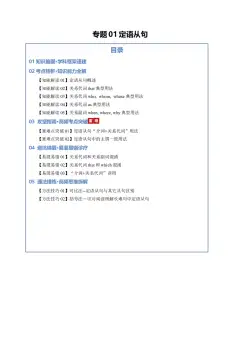
专题 03 状语从句(1)
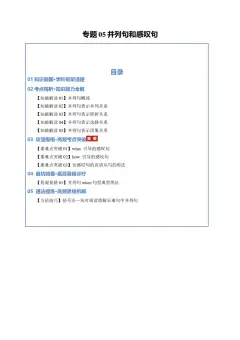
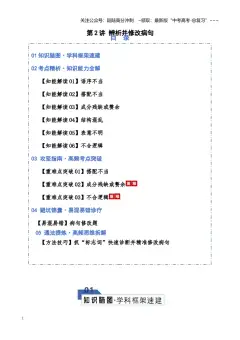
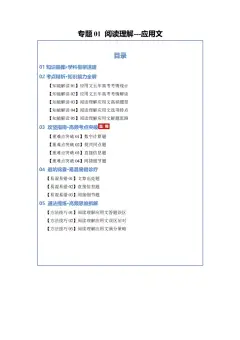
目录
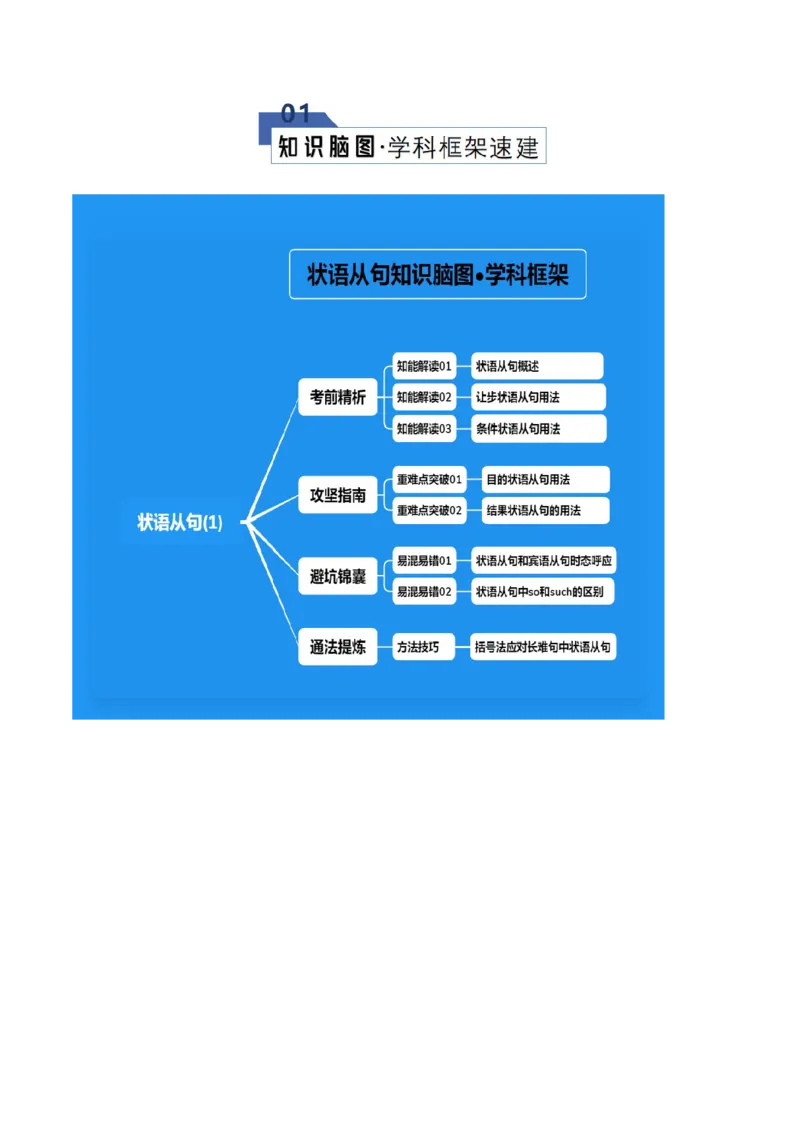
01知识脑图·学科框架速建
02考点精析·知识能力全解
【知能解读01】状语从句概述
【知能解读02】让步状语从句用法
【知能解读03】条件状语从句用法
03 攻坚指南·高频考点突破
【重难点突破01】目的状语从句用法
【重难点突破02】结果状语从句用法
04 避坑锦囊·易混易错诊疗
【易混易错01】状语从句和宾语从句时态呼应
【易混易错02】状语从句中so和such的区别
05 通法提炼·高频思维拆解
【方法技巧】括号法—应对阅读理解长难句中状语从句01 状语从句概述
状语从句:状语从句就是一个从句在句中相当于一个副词,表示时间、原因、条件、伴随、结果、让步等。
类型:根据功能,分让步状语从句、条件状语从句、目的状语从句、结果状语从句、时间状语从句、原因
状语从句、方式状语从句、地点状语从句、比较状语从句等。
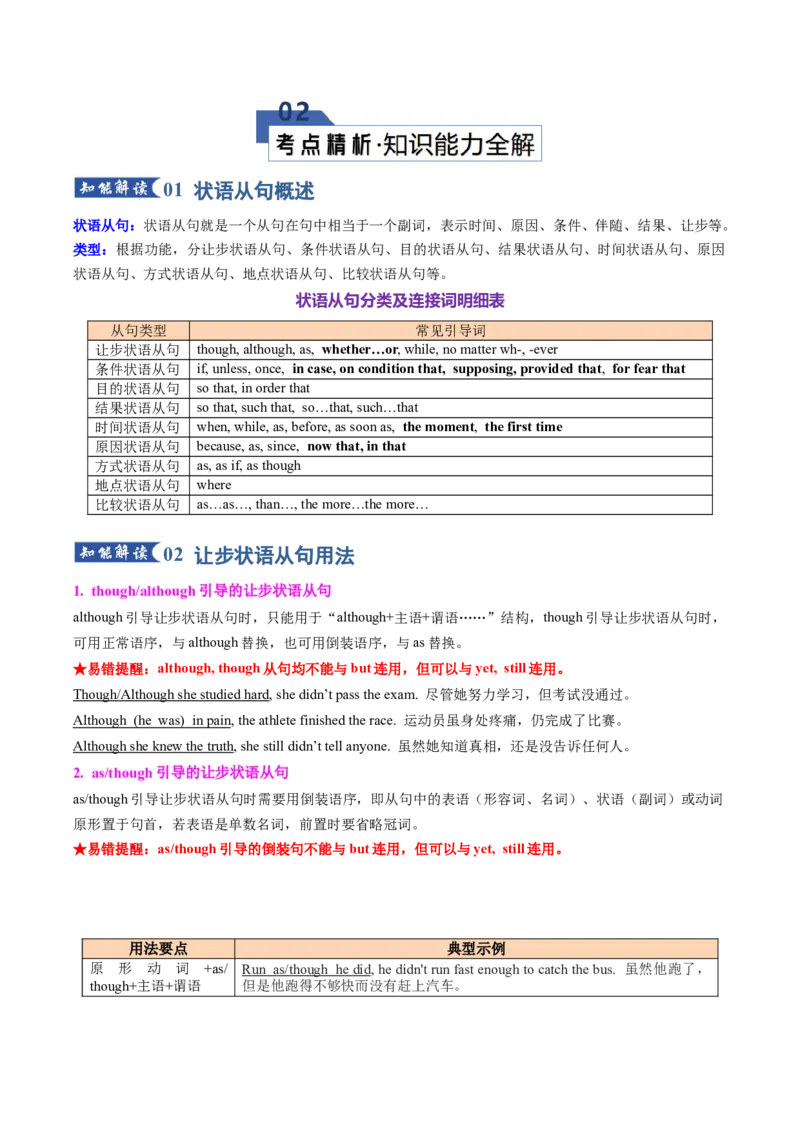
状语从句分类及连接词明细表
从句类型 常见引导词
让步状语从句 though, although, as, whether…or, while, no matter wh-, -ever
条件状语从句 if, unless, once, in case, on condition that, supposing, provided that, for fear that
目的状语从句 so that, in order that
结果状语从句 so that, such that, so…that, such…that
时间状语从句 when, while, as, before, as soon as, the moment, the first time
原因状语从句 because, as, since, now that, in that
方式状语从句 as, as if, as though
地点状语从句 where
比较状语从句 as…as…, than…, the more…the more…
02 让步状语从句用法
1. though/although引导的让步状语从句
although引导让步状语从句时,只能用于“although+主语+谓语……”结构,though引导让步状语从句时,
可用正常语序,与although替换,也可用倒装语序,与as替换。
★易错提醒:although, though从句均不能与but连用,但可以与yet, still连用。
Though/Although she studied hard, she didn’t pass the exam. 尽管她努力学习,但考试没通过。
Although (he was) in pain , the athlete finished the race. 运动员虽身处疼痛,仍完成了比赛。
Although she knew the truth, she still didn’t tell anyone. 虽然她知道真相,还是没告诉任何人。
2. as/though引导的让步状语从句
as/though引导让步状语从句时需要用倒装语序,即从句中的表语(形容词、名词)、状语(副词)或动词
原形置于句首,若表语是单数名词,前置时要省略冠词。
★易错提醒:as/though引导的倒装句不能与but连用,但可以与yet, still连用。
用法要点 典型示例
原 形 动 词 +as/ Run as/though he did , he didn't run fast enough to catch the bus. 虽然他跑了,
though+主语+谓语 但是他跑得不够快而没有赶上汽车。单 数 名 词 +as/ Child as/though he is , he knows to help others. 他虽是个孩子,但却知道帮助
though+主语+谓语 别人。
形容词+as/though+主 Strange as/though it may seem, nobody was injured in the accident. 这次意外虽
语+谓语 然显得不可思议,却没有人受伤。
副词+as/though+主语 Much as/though I admire his talen t , I disagree with his methods. 尽管我很欣赏
+谓语 他的才华,但不认同他的方法。
3. even if和even though引导的让步状语从句
even if和even though引导让步状语从句时,可以互换,都表示“即使,纵然”。
★易错提醒:as if/though表示“好像”,意思不同,后接从句根据需要可用虚拟语气或陈述语气。
She won’t forgive him even if he apologizes a hundred times. 即使他道歉一百次,她也不会原谅他。
He failed the exam even though he studied hard. 尽管他努力学习了,考试还是不及格。
She talks as though she knew everything . 她说话的样子好像什么都知道。
4.“no matter+疑问词”/“疑问词+¬ever”引导的让步状语从句
“no matter+疑问词”相当于“疑问词+¬ever”,二者都可以引导让步状语从句。whoever, whatever,
whomever, whichever还可以引导名词性从句,但“no matter+疑问词”不可以。
★易错提醒:遇到这类词核心是区分who, whom, which, where, when, how的基本用法。
No matter who/Whoever you are , you must obey the rules. 无论你是谁,都必须遵守规则。
No matter how /However hard he tried , he couldn’t solve the problem. 无论多努力,他都解不出问题。
No matter what /Whatever happens , stay calm. 无论发生什么,保持冷静。
No matter where /Wherever she goes , her dog follows. 无论她去哪里,狗都跟着。
5. while引导的让步状语从句
While引导让步状语从句多用于正式文体,多位于句首,表示“虽然,尽管”,可以与though, although替
换。
While I understand your point, I can’t agree with you. 虽然我理解你的观点,但我不能同意。
While many people like coffee, I prefer tea. 虽然很多人喜欢咖啡,但我更喜欢茶。
★易错提醒:while还可以位于句中,表示前后对比,意为“不过,但是”。
The new model is faster, while the old one is more reliable. 新模型速度更快,不过旧模型更可靠。
6. whether ... or...引导的让步状语从句
She will buy the book whether it is expensive or not. 无论这本书贵不贵,她都会买。
Whether rich or poor, everyone deserves equal respect. 无论贫穷还是富有,每个人都应得到平等尊重。
Whether at home or at school, he always studies hard. 无论在家还是在学校,他总是努力学习。
【跟踪训练】在空白处填1个适当的单词或括号内单词的正确形式。
1.— How about going hiking this weekend, just for a change?
—OK, _________ you want.
2._________ he was tired from the marathon, he still managed to finish with a personal best.
3.Ms. Wu is so graceful a lady that she wears fine jewelry no matter _________ she goes.
4.Hard _________ he tried, he failed to catch up with the first runner.5._________ difficulties we meet, we can work them out.
6.When you’re riding on trains, you won’t be provided with a blanket for free, even _________ your trip is an
overnight one.
7.No matter _________ I have to give a speech, I will get extremely nervous before I start.
8.I’ll try my best to help him, no matter _________ turns to me for help.
9._________ they go, animals find towns and cities in their way.
10._________ he was refused by the host, he insisted on entering the room.
03条件状语从句的用法
1. if引导的条件状语从句
if可引导真实条件状语从句,表示“假如,如果”。主句是一般将来时,从句要用一般现在时代替,即
“主将从现”。
If it rains tomorrow, we will stay at home. 如果明天下雨,我们就待在家里。
Plants will die if they don’t get enough water. 如果植物得不到足够的水,就会死亡。
2. unless引导的条件状语从句
unless引导的条件状语从句,在意义上相当于if...not,而且语气较强,表示“除非,如果不”。
I will go to the party unless it rains.= I will go to the party if it doesn’t rain. 我会去参加派对,除非下雨。
She will not get the job unless she has relevant experience. 除非她有相关经验,否则得不到这份工作。
3. only if引导的条件状语从句
only if在引导条件状语从句时意为"只有……(才);只有在……的时候,唯一的条件是……"。
★易错提醒:注意Only if…从句位于句首,主句部分倒装。
Only if you submit the essay by Friday will you get feedback. 只有你在周五前提交论文,才能得到反馈。
★易错提醒:if only意为“但愿;要是……就好了”,引导的从句要用虚拟语气(与现在的情况相反时,
从句用一般过去时;与过去的情况相反时,从句用过去完成时;与将来的情况相反时,谓语用“would/
could+动词原形”。)。
If only I had studied harder for the exam. 要是我当初为考试更努力学习就好了。
If only I had a million dollars . ≈ I wish I had a million dollars. 但愿我有一百万美元。
4. in case/for fear that/once等引导的条件状语从句
in case从句中的谓语动词可以是陈述语气形式,也可以是虚拟语气形式;for fear that引导的从句中的谓语
带有may,might,should等情态动词;once 引导条件状语从句表示“一旦,万一”。
Take an umbrella in case it rains. 带把伞,以防下雨。
He left early for fear that he would miss the train . 他早早出发,生怕错过火车。
Once you finish your homework, you can play games. 一旦你完成作业,就可以玩游戏。
5. as long as/ on condition that/ providing (that)/ supposing (that) 等引导的条件状语从句
as/so long as意为"只要;如果"; on condition that意为“条件是”;provided (that)/providing (that)意为
"假如;如果";suppose / supposing (that)(假设;如果)也可引导条件状语从句。
You can borrow the book as long as you return it on time. 只要你按时归还,就可以借这本书。The company will hire her on condition that she passes the interview. 公司会录用她,条件是她通过面试。
You can go out providing (that) you finish your homework first. 你可以出去,但要先完成作业。
Suppose (that) I were you, I would accept the offer. 要是我是你,我会接受这个提议。
【跟踪训练】在空白处填1个适当的单词或括号内单词的正确形式。
1.I can lend you my bike __________ condition that you must return it before Friday.
2.You will really get into trouble __________ (provide) that you can’t show enough evidence to the police.
3.We will give you a good price __________ you are thinking of buying it.
4.__________ (assume) that there weren’t the hard work of the dustman, what can you imagine our city will be
like?
5.__________ (assume) I have an opportunity to travel to a nearby country, I must keep my eyes open for the
customs.
6.__________ (suppose) that you listen to the doctor and do as he/she tells you, you’ll get better soon.
7.Jim says we can stay in his house as long __________ we leave it clean and tidy.
8.__________ you study harder, you won’t be able to pass the final exam.
9.We won’t get there as scheduled__________ we get everything done today.
10.__________ environmental damage is done, it takes many years for the ecosystem to recover.
01目的状语从句用法
so that"为了;以便"。so that通常可以与in order that换用,它所引导的目的状语从句总是放在主句之
后,在非正式文体中,常省略that。in order that"为了;以便"。多用于正式文体,通常可以与 so that换
用。
I called him in advance so that he wouldn’t miss the meeting. 我提前给他打电话,为了让他不错过会议。
The team practiced daily in order that they might win the championship. 团队每天训练,为了赢得冠军。
★易错提醒:so that 也可以引导的结果状语从句,前边多有逗号。
They missed the train, so that they had to wait for another hour. 他们没赶上火车,以至于不得不等一个小时。
【跟踪训练】在空白处填1个适当的单词或括号内单词的正确形式。
1.He worked day and night __________ order that he could succeed.
2.The little boy saved every coin so __________ he could buy his mother a present on Mother’s Day.
3.Come a little bit closer __________that you can get a better view.
4.I’ll find a way to improve on my own so __________ I can make the team the next year.
5.The police officers in our city work hard in order __________citizens can live a safe life.
02结果状语从句用法
1. so that/such that引导的结果状语从句。
so that引导的结果状语从句只能位于主句之后,中间可以有逗号。such that引导的结果状语从句多用于正式文体,主句为"主—系—表"句型。
It was very cold, so that the river froze.
天气寒冷, 河水都结冰了。
Her voice was such that it could calm even the most anxious child.
她的声音具有这样的特质,以至于能安抚最焦虑的孩子。
2. so/such...that引导的结果状语从句
so...that表示"如此……以致",that在非正式文体中可以省略,so后面接形容词或副词;such后接名词,
又是名词前可以有形容词修饰。
★易错提醒:so…that…常见于以下四种句型:
①…so+形容词+that…
②…so+副词+that…
③…so+形容词+a(n) +名词+that…
④…so+动词+that…
★易错提醒:such…that…常见于以下四种句型:
①such +a(n)+形容词+单数名词+that…
②such +形容词+不可数名词+that…
③such +形容词+复数名词+that…
She was so excited that she couldn’t sleep the night before the trip.
她太兴奋了,以至于旅行前一晚都睡不着。
It was so beautiful a day that we decided to have a picnic.
天气如此晴朗,我们决定去野餐。
It so happened that we were both staying at the same hotel during our trip to Paris.
我们去巴黎旅行时,碰巧住在同一家酒店。
It was such a hot day that we decided to stay indoors.
那天如此炎热,以至于我们决定待在室内。
They are such interesting books that I can’t put them down.
这些书如此有趣,以至于我爱不释手。
3.易错点分析:so….as/that, such…as/that…句型的区别
so/such…as….引导定语从句,as是关系代词,充当从句的主语、宾语;so/such…that….引导结果状语从
句,从句不缺少成分。
This is such an interesting movie as I have never seen before.(定语从句)
这是一部我从未看过的如此有趣的电影。
They are such kind people that everyone loves them. (结果状语从句)
他们是如此善良的人,以至于所有人都喜欢他们。
The math problem was so difficult as no one could solve . (定语从句)
这道数学题太难了,以至于没人能解出来。
The math problem was so difficult that no one could solve it. (结果状语从句)
这道数学题太难了,以至于没人能解出来。【跟踪训练】在空白处填1个适当的单词或括号内单词的正确形式。
1.The water here was so dirty _________even the animals didn't want to drink.
2.He roared so loudly _________ all the children were almost scared to death.
3.It used _________ much energy that when it turned on, the lights in the local town went out.
4.We have _________ much time that we can finish the work very well.
5.She is such a lovely girl _________ we love her very much.
6.The Great Wall is _________ well-known a tourist attraction that lots of tourists visit the city every year.
7.The Great Wall is _________ a well-known tourist attraction that lots of tourists visit the city every year.
8.He came up with _________ good advice at the conference that we all agreed to follow it.
9.He made _________ rapid progress that the teacher praised him in our class.
10.I felt such relief when I knew I didn’t have to make the speech _________ I fell asleep as soon as I lay on the
bed.
01 状语从句和宾语从句时态呼应
1.如果主句是祈使句或用一般将来时,时间、条件状语从句中常用一般现在时代替将来时,即“主将从
现”。
He will call you as soon as he arrives. 他一到就会给你打电话。
Even if it rains tomorrow , we will still go hiking. 即使下雨,我们还是会去徒步。
2.宾语从句中从句谓语的时态较为灵活,但不存“主将从现”。
Can you tell me when you will finish the project? 你能告诉我你什么时候会完成这个项目吗?
She isn’t sure if they will come to the party. 她不确定他们是否会来参加派对。
【跟踪训练】根据所给汉语和提示翻译下列各句。
1.我想知道她是否会同意我们的计划。(whether)
2.如果明天下雨,我们就取消野餐。(if)
3. 我不知道她明天是否会来。如果她来,我会带她参观我们的博物馆。(if)
02 状语从句中so和such 的区别
so和such都可以表示“如此”但是二者词性不同:so是程度副词,修饰形容词、副词或者动词,而 such
是形容词,中心词必须是名词。“so+形容词+a(n) +名词+that…”句型可与“such +a(n)+形容词+单数名词
+that…”转换。
1.The team achieved __________ great success in the competition that their coach was awarded a medal.2.She is __________ an accomplished pianist that she performs globally with renowned orchestras.
3.There were __________ few tickets left for the concert that we had to queue for hours.
4.It was __________ intense a match that the players collapsed from exhaustion afterward.
5.He made __________ rapid progress in learning Mandarin that he passed the HSK 6 exam in six months.
6.He has __________ much experience in international trade that he advises governments on policy.
7.The novel is __________ a profound exploration of human nature that it’s required reading in universities.
8.She spoke __________ persuasively at the conference that the committee approved her proposal unanimously.
9. The company invested __________ large an amount in R&D that it secured three patents this year.
10.It’s __________ hot today that even the air conditioning can’t keep the room cool.
括号法—应对阅读理解长难句中状语从句
阅读理解长难句应对最简单有效的办法是遇到各种从句、非谓语、介词短语等用括号括起来视为一个单位,
从而达到“去枝叶,留主干”删繁就简的目的,快速理解句子含义。
1. (2025全国一卷阅读B篇) When the final bell rang in June, I walked away with a yearbook full of messages
about writing’s most powerful significance — the ability to connect people, to put us in another’s skin, to teach us
what it means to be human.
翻译:六月的终场铃声响起时,我带着一本写满留言的年鉴离开了。那些留言都在诉说着写作最强大的意
义 —— 它能够联结人心,让我们设身处地为他人着想,让我们明白何为人性。
理解:(When the final bell rang in June) (时间状语从句), I walked away with a yearbook (full of messages
about writing’s most powerful significance) (形容词短语作定语)— (the ability to connect people, to put us in
another’s skin, to teach us what it means to be human) (三个不定式短语作定语修饰名词the ability; 破折号后
面的the ability对前面的从句起解释说明作用).
2. (2025全国一卷阅读C篇) Although these campaigns were widespread, the reality is that the majority of
the western cities were completely redesigned around the needs of the motor car.
翻译:尽管这些运动广泛开展,但实际情况是,大多数西方城市完全围绕汽车的需求进行了重新设计。
理解:(Although these campaigns were widespread) (让步状语从句), the reality is (that the majority of the
western cities were completely redesigned around the needs of the motor car)(表语从句).
【跟踪训练】用括号法把下列各句的状语从句括起来。
1. (2025北京卷阅读D篇) If you want to turn over a new leaf, though, one top tip is that it helps to choose a
significant date that signals the start of a new “chapter”.
2. (20255北京卷阅读七选五) If these life cycles are delayed, interrupted, or denied, you feel incapable of
accessing your states of self, controlling unpleasant feelings, and manipulating (操控) the energy that puts
together the fabric of your inner world.
3. (2025全国二卷阅读C篇) If you’re among the groups of people who are enjoying the mental and physical
health benefits of surrounding yourself with plants, don’t beat yourself up if one (or a few!) doesn’t make it.4. (2025全国二卷语法填空) Nothing in my life before prepared me for this one-and to be sure, the first time I
came here I never imagined I would ever feel comfortable in this area.
5. (2025 浙江 1 月卷阅读 D 篇) When women are put into positions of leadership like running companies, it
reduces negative stereotypes about women.
状语从句从句(1)综合能力提升
一、单项语法填空
在空白处填1个适当的单词或括号内单词的正确形式。
1.We should be able to do the job for you quickly, so long __________ you give us all the necessary information.
2.So angry was I __________ I avoided her during school all day.
3.Even __________you are right, you should not have been so rude.
4.One can always manage to do more things, no matter __________ full one’s schedule is in life.
5.__________ (assume) it rains tomorrow, what should we do?
6.__________ (suppose) that it rains tomorrow, what shall we do?
7.I will agree to go __________ (provide) that my expenses are paid.
8.Rainforests are being cut and burned at such a rate __________ they could well disappear from the earth’s
surface before the year 2050.
9.He spoke at the top of his voice, so __________ the students at the back heard him.
10.We are so used to advertisements __________ we often do not even realize how many we see and hear in a
day.
11.They decide to have more workers for the project so __________ it won’t be delayed.
12.__________ case you’re wondering, here’s why mobile data are so expensive in South Africa when compared
with other countries.
13.So excited was I on hearing this news __________ I signed up without much thought.
14.Bill had so many falls __________ he got black and blue all over.
15.So in physics class on Monday, I did the same, but the teacher spoke so fast __________ I couldn’t take
everything down.
16.__________ obstacles she faces, the poet continues to write with passion.
17.I can lend you my bike __________ condition that you must return it before Friday.
18.She burned the letters so __________her husband would never read them.
19.Hot __________ it was, we had a sound sleep because we were so tired after a long journey.
20.So __________in trouble, just face it bravely and you are sure to make it sooner or later.二、状语从句助力写作能力升格
1. (2025全国一卷) 看着托比轻轻把头靠在我弟弟的腿上,我知道我们终于踏上了治愈之路。
2. (2024新课标I卷) “先生,你要信守诺言。”听到他的话,我心中充满了感激之情。
_________________________________________________________________________________________
3. (2024新课标I卷)四天后,当我回到维也纳时,我按照承诺给冈特打了电话。
_________________________________________________________________________________________
4. (2024新课标I卷)我如此惊讶和感动,以至于一句话也说不出来。
_________________________________________________________________________________________
5. (2024新课标I卷)冈特一拿起电话,我就迫不及待地自我介绍。
_________________________________________________________________________________________
6. (2023新课标I卷)当我走上舞台,观众的掌声充满了我的耳朵。
_________________________________________________________________________________________
7. (2023新课标I卷)直到我参加了颁奖典礼并拿到了证书,我还是觉得很难相信。
_________________________________________________________________________________________
8. (2023新课标I卷)他走上前,拍了拍我的肩膀,轻声说:“有志者事竟成。”
_________________________________________________________________________________________
9. (2023新课标I卷)当我进去的时候,他抬起头来微笑,他的眼睛反映出他对我的成就感到骄傲。
_________________________________________________________________________________________
10. (2023新课标I卷)每当回首这件事,我都对他感激不尽。
_________________________________________________________________________________________