专题04 阅读理解---议论文
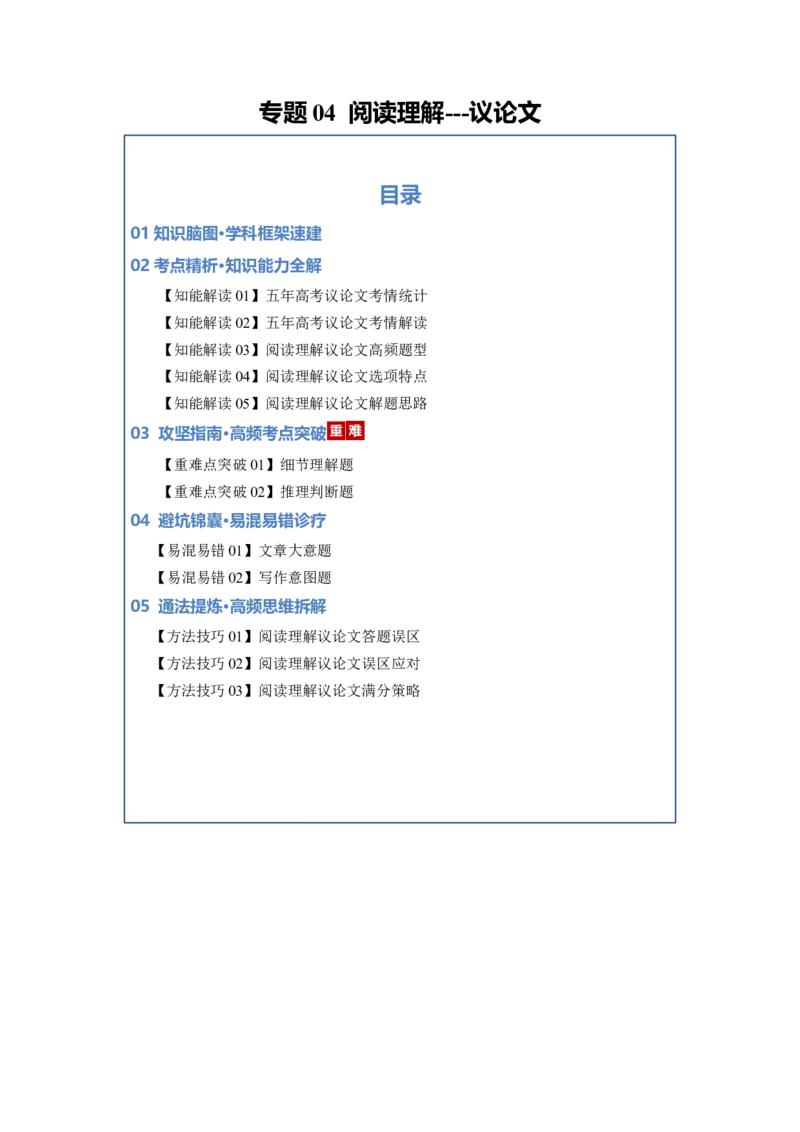
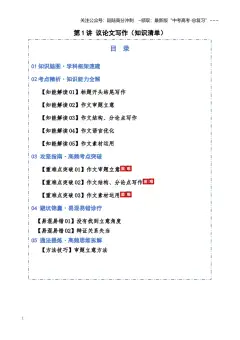
目录
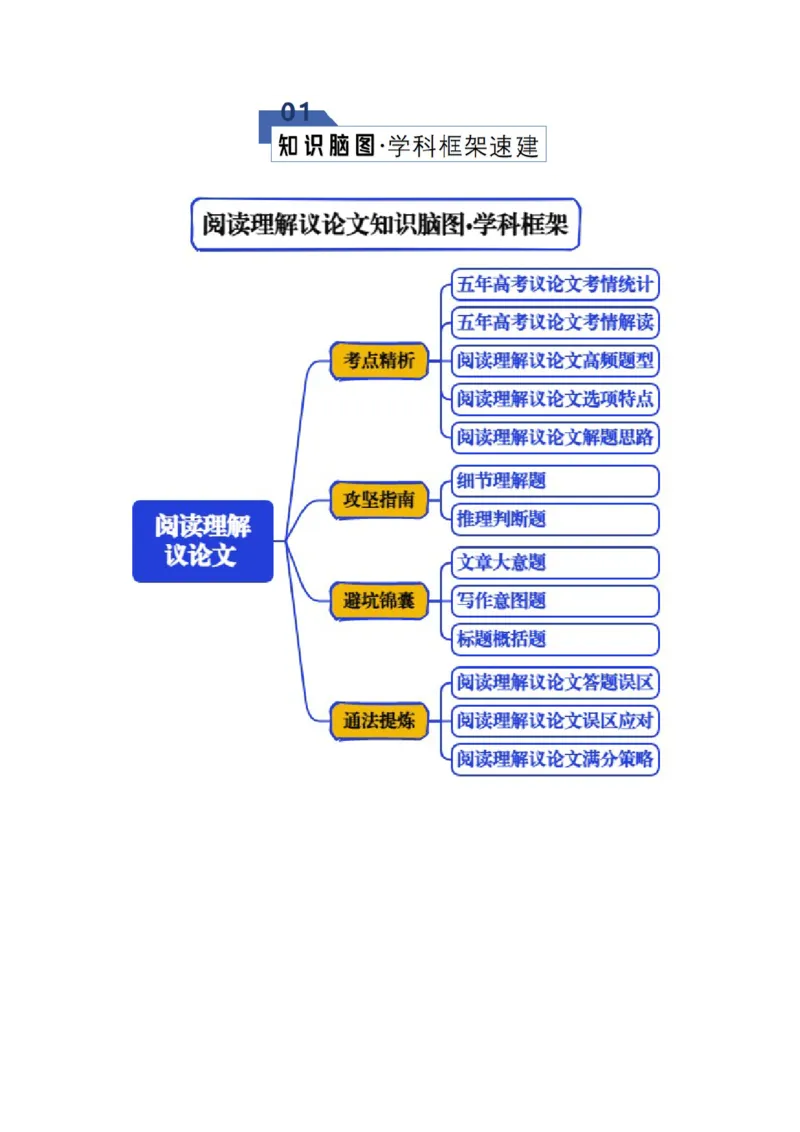
01 知识脑图·学科框架速建
02 考点精析·知识能力全解
【知能解读01】五年高考议论文考情统计
【知能解读02】五年高考议论文考情解读
【知能解读03】阅读理解议论文高频题型
【知能解读04】阅读理解议论文选项特点
【知能解读05】阅读理解议论文解题思路
03 攻坚指南·高频考点突破
【重难点突破01】细节理解题
【重难点突破02】推理判断题
04 避坑锦囊·易混易错诊疗
【易混易错01】文章大意题
【易混易错02】写作意图题
05 通法提炼·高频思维拆解
【方法技巧01】阅读理解议论文答题误区
【方法技巧02】阅读理解议论文误区应对
【方法技巧03】阅读理解议论文满分策略
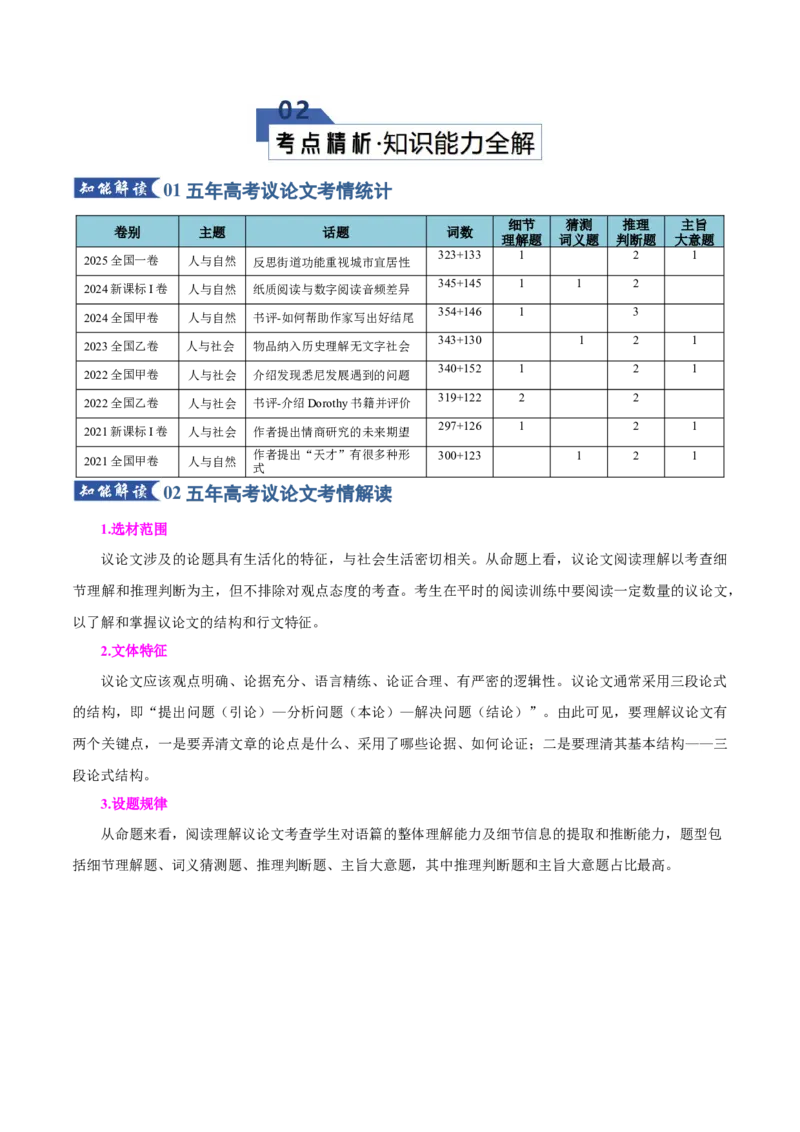
01 五年高考议论文考情统计
卷别
主题
话题
词数
细节
理解题
猜测
词义题
推理
判断题
主旨
大意题
2025 全国一卷
人与自然
反思街道功能重视城市宜居性
323+133
1
2
1
2024 新课标I 卷
人与自然
纸质阅读与数字阅读音频差异
345+145
1
1
2
2024 全国甲卷
人与自然
书评-如何帮助作家写出好结尾
354+146
1
3
2023 全国乙卷
人与社会
物品纳入历史理解无文字社会
343+130
 1
2
1
2022 全国甲卷
人与社会
介绍发现悉尼发展遇到的问题
340+152
1
2
1
2022 全国乙卷
人与社会
书评-介绍Dorothy 书籍并评价
319+122
2
2
2021 新课标I 卷
人与社会
作者提出情商研究的未来期望
297+126
1
2
1
2021 全国甲卷
人与自然
作者提出“天才”有很多种形
式
300+123
1
2
1
02 五年高考议论文考情解读
1.选材范围
议论文涉及的论题具有生活化的特征,与社会生活密切相关。从命题上看,议论文阅读理解以考查细
节理解和推理判断为主,但不排除对观点态度的考查。考生在平时的阅读训练中要阅读一定数量的议论文,
以了解和掌握议论文的结构和行文特征。
2.文体特征
议论文应该观点明确、论据充分、语言精练、论证合理、有严密的逻辑性。议论文通常采用三段论式
的结构,即“提出问题(引论)—分析问题(本论)—解决问题(结论)”。由此可见,要理解议论文有
两个关键点,一是要弄清文章的论点是什么、采用了哪些论据、如何论证;二是要理清其基本结构——三
段论式结构。
3.设题规律
从命题来看,阅读理解议论文考查学生对语篇的整体理解能力及细节信息的提取和推断能力,题型包
括细节理解题、词义猜测题、推理判断题、主旨大意题,其中推理判断题和主旨大意题占比最高。
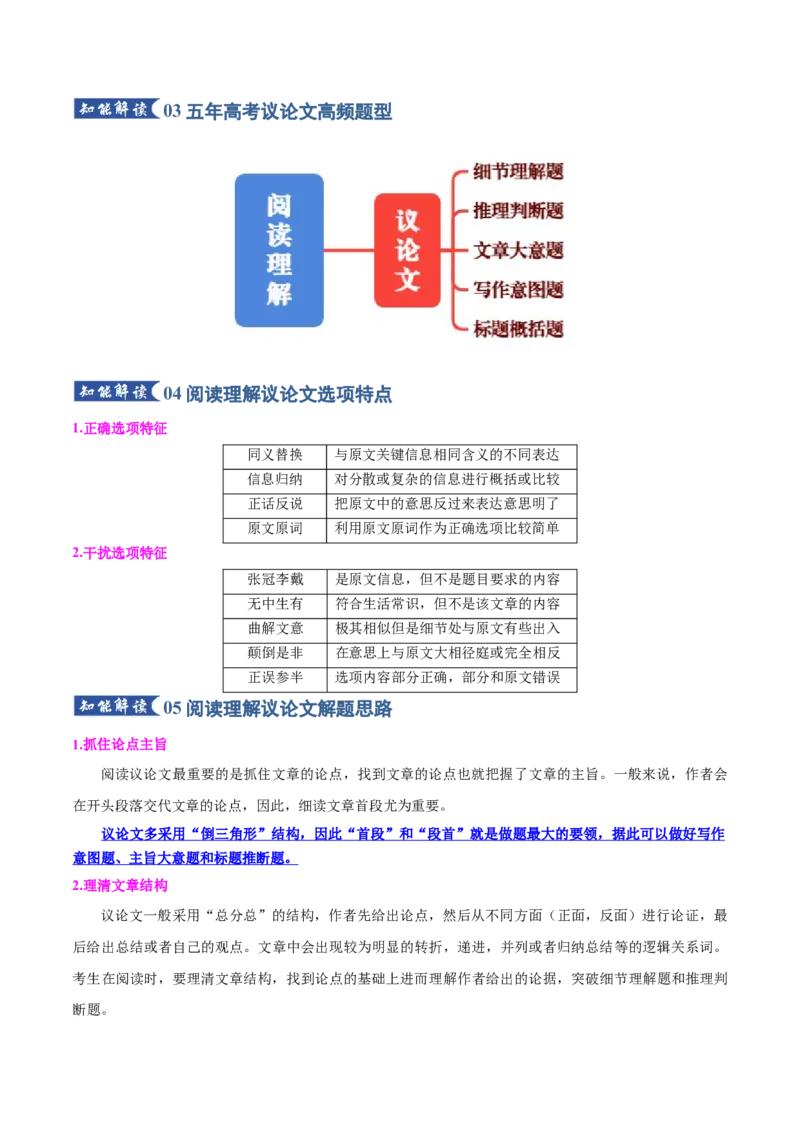
03 五年高考议论文高频题型
04 阅读理解议论文选项特点
1.正确选项特征
同义替换
与原文关键信息相同含义的不同表达
信息归纳
对分散或复杂的信息进行概括或比较
正话反说
把原文中的意思反过来表达意思明了
原文原词
利用原文原词作为正确选项比较简单
2.干扰选项特征
张冠李戴
是原文信息,但不是题目要求的内容
无中生有
符合生活常识,但不是该文章的内容
曲解文意
极其相似但是细节处与原文有些出入
颠倒是非
在意思上与原文大相径庭或完全相反
正误参半
选项内容部分正确,部分和原文错误
05 阅读理解议论文解题思路
1.抓住论点主旨
阅读议论文最重要的是抓住文章的论点,找到文章的论点也就把握了文章的主旨。一般来说,作者会
在开头段落交代文章的论点,因此,细读文章首段尤为重要。
    议论文多采用“倒三角形”结构,因此“首段”和“段首”就是做题最大的要领,据此可以做好写作
意图题、主旨大意题和标题推断题。
2.理清文章结构
议论文一般采用“总分总”的结构,作者先给出论点,然后从不同方面(正面,反面)进行论证,最
后给出总结或者自己的观点。文章中会出现较为明显的转折,递进,并列或者归纳总结等的逻辑关系词。
考生在阅读时,要理清文章结构,找到论点的基础上进而理解作者给出的论据,突破细节理解题和推理判
断题。
3.体会语言特点
能否正确把握作者的观点和态度是体现阅读能力的重要方面。一般来说,对作者的总的态度和倾向,
必须在通读全文,掌握了论点和论据后,方能做出判断。在判断作者观点态度时,我们应注意,有时候作
者的观点和态度并不是明确地表达出来的,需要我们认真体察。做推理判断时,一定要遵循逻辑规律,以
事实为依据进行合理的推理。
4.注意干扰规律
①包含项原则
在答案选项分析中,假如对A 选项的理解概括了对其他三项 (或其中某一项)的理解,那么我们就说选
项A 与其他三项是包含或概括关系,包含项A 往往就是正确答案。如在"花"与"玫瑰"两选项中,正确
答案肯定是"花",花包含了玫瑰。
②正反项原则
所谓正反项,是指两选项陈述的命题完全相矛盾。两个相互矛盾的陈述不能都是假的,其中必有一真。
所以,假如四选项中A、B 互为正反项,那我们通常先排除C、D 项,正确答案一般在A、B 项当中。
③委婉项原则
所谓委婉,这里是指说话不能说死,要留有余地。阅读理解选项中语气平和、委婉的往往是正确答案。
这些选项一般含有不十分肯定或试探性语气的表达,如:probably, possibly, may, usually, might, most of,
more or less, relatively, be likely to, not necessary, although, yet, in addition, tend to 等等,而含有绝对语气的表
达往往不是正确答案,如:must, always, never, all, every, any, merely, only, completely, none, hardly, already
等等。
④同形项原则
命题者往往先将正确答案设置在一个大命题范围,然后通过语言形式的细微变化来考查考生的理解能
力与分析能力。同形项原则告诉我们:词汇与句法结构相似的选项中有正确答案的存在。
⑤常识项原则
议论文中,那些符合一般常识、意义深刻富有哲理、符合一般规律、属于普遍现象的往往是正确答案。
⑥因果项原则
阅读理解的逻辑推理基本都是通过因果链进行的,前因后果,一步步循序渐进。然而,在推理题的选
项中,有的选项会推理不到位(止于前因),或者推理过头(止于后果),这就是所谓的干扰项。因果项原则启
示我们:假如四个选项中有两项互为同一事物推理过程中的因果关系,那么正确答案就是两个因果项中的
其中之一。如果因项可产生几个结果,那么答案就是因;如果果项可以对应几个原因,那么答案就是果。
01 细节理解题
1.命题方式
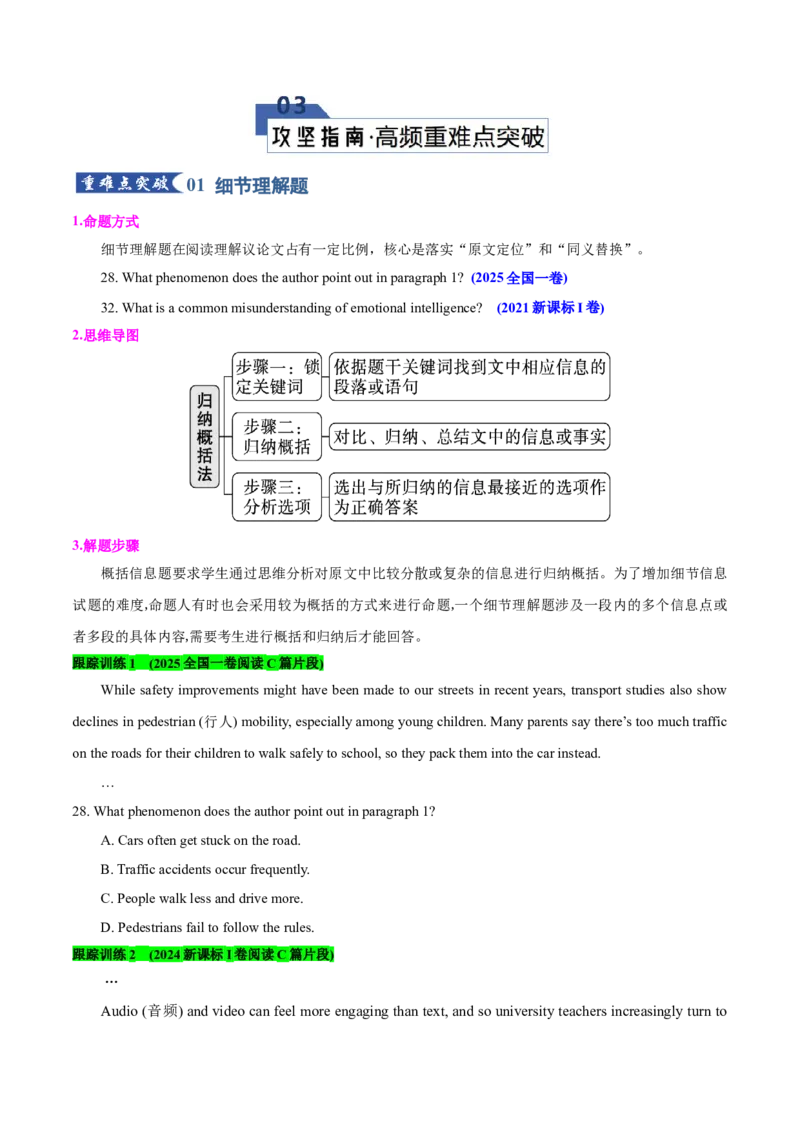
细节理解题在阅读理解议论文占有一定比例,核心是落实“原文定位”和“同义替换”。
28. What phenomenon does the author point out in paragraph 1? (2025 全国一卷)
32. What is a common misunderstanding of emotional intelligence?  (2021 新课标I 卷)
2.思维导图
3.解题步骤
概括信息题要求学生通过思维分析对原文中比较分散或复杂的信息进行归纳概括。为了增加细节信息
试题的难度,命题人有时也会采用较为概括的方式来进行命题,一个细节理解题涉及一段内的多个信息点或
者多段的具体内容,需要考生进行概括和归纳后才能回答。
跟踪训练1 (2025 全国一卷阅读C 篇片段)
While safety improvements might have been made to our streets in recent years, transport studies also show
declines in pedestrian (行人) mobility, especially among young children. Many parents say there’s too much traffic
on the roads for their children to walk safely to school, so they pack them into the car instead.
…
28. What phenomenon does the author point out in paragraph 1?
A. Cars often get stuck on the road.
B. Traffic accidents occur frequently.
C. People walk less and drive more.
D. Pedestrians fail to follow the rules.
跟踪训练2 (2024 新课标I 卷阅读C 篇片段)
…
Audio (音频) and video can feel more engaging than text, and so university teachers increasingly turn to
these technologies – say, assigning an online talk instead of an article by the same person. However,
psychologists have demonstrated that when adults read news stories, they remember more of the content than
if they listen to or view identical pieces.
…
30. Why are audio and video increasingly used by university teachers?
A. They can hold students’ attention.
B. They are more convenient to prepare.
C. They help develop advanced skills.
D. They are more informative than text.
02 推理判断题
1.命题形式
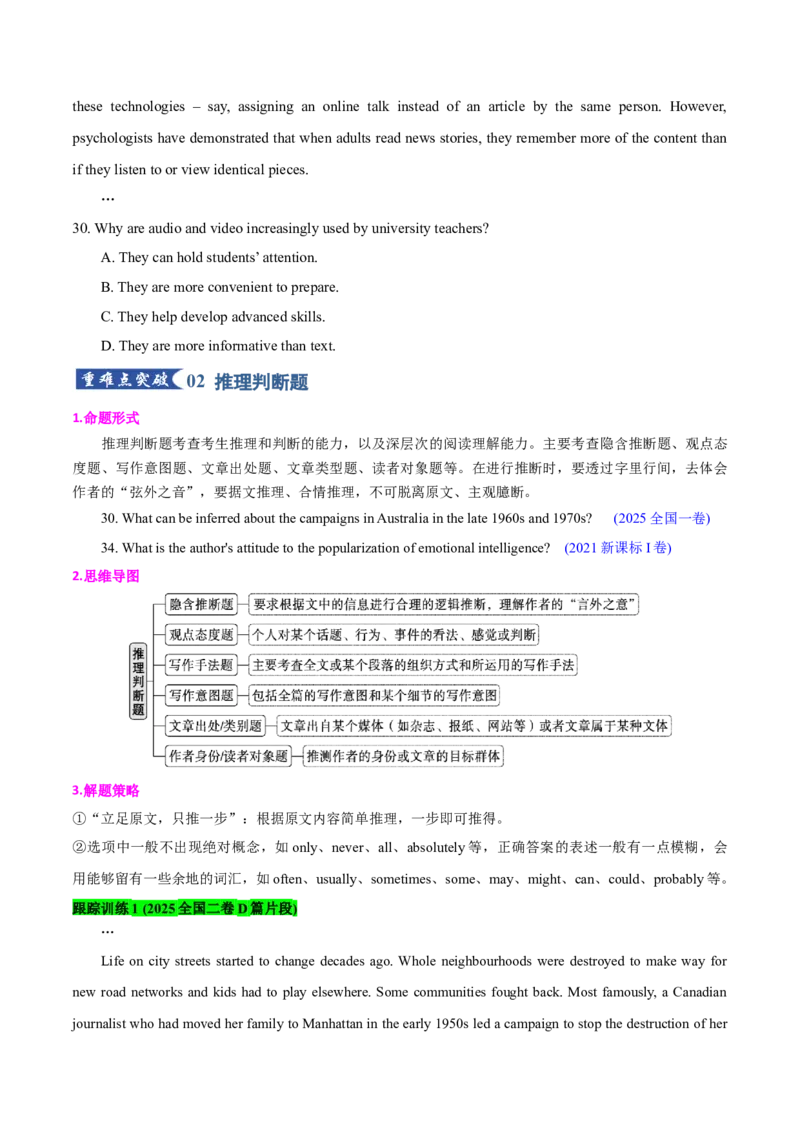
推理判断题考查考生推理和判断的能力,以及深层次的阅读理解能力。主要考查隐含推断题、观点态
度题、写作意图题、文章出处题、文章类型题、读者对象题等。在进行推断时,要透过字里行间,去体会
作者的“弦外之音”,要据文推理、合情推理,不可脱离原文、主观臆断。
30. What can be inferred about the campaigns in Australia in the late 1960s and 1970s?   (2025 全国一卷)
34. What is the author's attitude to the popularization of emotional intelligence?  (2021 新课标I 卷)
2.思维导图
3.解题策略
①“立足原文,只推一步”:根据原文内容简单推理,一步即可推得。
②选项中一般不出现绝对概念,如only、never、all、absolutely 等,正确答案的表述一般有一点模糊,会
用能够留有一些余地的词汇,如often、usually、sometimes、some、may、might、can、could、probably 等。
跟踪训练1 (2025 全国二卷D 篇片段)
…
Life on city streets started to change decades ago. Whole neighbourhoods were destroyed to make way for
new road networks and kids had to play elsewhere. Some communities fought back. Most famously, a Canadian
journalist who had moved her family to Manhattan in the early 1950s led a campaign to stop the destruction of her
local park. Describing her alarm at its proposed replacement with an expressway, Jane Jacobs called on her mayor
(市长) to champion “New York as a decent place to live, and not just rush through.” Similar campaigns occurred in
Australia in the late 1960s and 1970s as well.
Although these campaigns were widespread, the reality is that the majority of the western cities were
completely redesigned around the needs of the motor car. The number of cars on roads has been increasing rapidly.
In Australia we now have over twenty million cars for just over twenty-six million people, among the highest rate
of car ownership in the world.
…
30. What can be inferred about the campaigns in Australia in the late 1960s and 1970s?
A. They boosted the sales of cars.
B. They turned out largely ineffective.
C. They won government support.
D. They advocated building new parks.
跟踪训练 (2021 新课标I 卷D 篇片段)
…
Although popular beliefs regarding emotional intelligence run far ahead of what research can
reasonably support, the overall effects of the publicity have been more beneficial than harmful. The most
positive aspect of this popularization is a new and much needed emphasis ( 重视) on emotion by
employers, educators and others interested in promoting social well-being. The popularization of emotional
intelligence has helped both the public and researchers re-evaluate the functionality of emotions and how
they serve people adaptively in everyday life.
…
34. What is the author's attitude to the popularization of emotional intelligence?
A. Favorable.
B. Intolerant.
C. Doubtful.
D. Unclear.
01 文章大意题
何一篇文章都有自己的主旨,所以我们在阅读一篇文章时,首先要弄清楚的就是文章的主旨,明确
主旨之后才能进一步理解文章的深层内容和主题意义。主旨大意题旨在考查考生把握文章整体内容和中心
思想的能力。
1.命题形式
31. What does the text mainly talk about? (2024 新课标II 卷)
31. What is the text mainly about? (2022 全国甲卷)
2.思维导图
3.解题策略
①利用主题句在段首位置推敲段落大意
说明文和议论文学会关注“首段”和“段首”。借鉴“七选五”小标题类型特点,段首句统领全段主旨大
意,由此推断段落大意。
②利用主题句在段中位置推敲段落大意
有时主题句出现在段中某句,这就需要考生耐心阅读揣摩段落各句之间内在逻辑关系,确定主题句位置,
进而明确段落主旨大意。
③利用主题句在段尾位置推敲段落大意
有时主题句出现在段尾,关注一些表征总结性,结论性的词: in brief/ short, all in all, in conclusion, in a word
等,这些词后面连接的通常是主题句。
④利用段落没有主题句推敲段落大意
有时候段落没有出现主题句,需要考生自己总结提炼,难度更大。
⑤利用“总-分-总”结构推敲语篇主旨大意题
有时候段落没有出现主题句,需要考生自己总结提炼,难度更大。
跟踪训练1 (2024 新课标I 卷C 篇)
We all know fresh is best when it comes to food. However, most produce at the store went through weeks of
travel and covered hundreds of miles before reaching the table. While farmer’s markets are a solid choice to reduce
the journey, Babylon Micro-Farm (BMF) shortens it even more.
BMF is an indoor garden system. It can be set up for a family. Additionally, it could serve a larger audience
such as a hospital, restaurant or school. The innovative design requires little effort to achieve a reliable weekly
supply of fresh greens.
Specifically, it’s a farm that relies on new technology. By connecting through the Cloud, BMF is remotely
monitored. Also, there is a convenient app that provides growing data in real time. Because the system is
automated, it significantly reduces the amount of water needed to grow plants. Rather than watering rows of soil,
the system provides just the right amount to each plant. After harvest, users simply replace the plants with a new
pre-seeded pod (容器) to get the next growth cycle started.
Moreover, having a system in the same building where it’s eaten means zero emissions ( 排放) from
transporting plants from soil to salad. In addition, there’s no need for pesticides and other chemicals that pollute
traditional farms and the surrounding environment.
BMF employees live out sustainability in their everyday lives. About half of them walk or bike to work. Inside
the office, they encourage recycling and waste reduction by limiting garbage cans and avoiding single-use plastic.
“We are passionate about reducing waste, carbon and chemicals in our environment,” said a BMF employee.
28. What can be learned about BMF from paragraph 1?
A. It guarantees the variety of food.
B. It requires day-to-day care.
C. It cuts the farm-to-table distance.
D. It relies on farmer’s markets.
29. What information does the convenient app offer?
A. Real-time weather changes.
B. Current condition of the plants.
C. Chemical pollutants in the soil.
D. Availability of pre-seeded pods.
30. What can be concluded about BMF employees?
A. They have a great passion for sports.        B. They are devoted to community service.
C. They are fond of sharing daily experiences.   D They have a strong environmental awareness.
31. What does the text mainly talk about?
A. BMF’s major strengths.
B. BMF’s general management.
C. BMF’s global influence.
D. BMF’s technical standards.
跟踪训练2 (24-25 高三下·云南·阶段练习)
I’m somebody who’s very realistic about everything. I don’t live in illusions and hopes, but tackle the things
which come at hand. Some days are extraordinary fantastic when I simply cannot stay away from my garden and
park. Garden isn’t doing anything great yet, but many plants have come up. Want your veggies to last and produce
well? Start from seeds, better yet, your own seeds. My favorites are tomatoes, bell peppers, zucchinis, cucumbers
and all herbs. Basically, I prefer meals with very few ingredients, and these vegetables fit the bill.
Yesterday, Jetpack sent a notification that AI assistant is available. Well, apparently, there’s a need to polish
everything to the most perfect perfection, make it impersonal, but grammatically correct. For me, the value of a
blog is the personal touch, the individual experience, the simple lives and the things we take for granted, but need
on a daily basis. I believe the most interesting blogs are the ones which disclose the personal experiences, give us
an insight in the personality of that blogger and show the very unique features he or she has.
Lots of people have already a very complex relationship with reality. Some live in the virtual bubble and
when they come out, the actual things make them inadequate for the real life. Why should I be worried about virtual
belongings and properties when I still need a real bed to sleep in and a real roof over my head? Our pain is also
real, and we don’t need virtual food, air or water to survive.
I’ve always been amazed by the human intelligence. By the unbelievable potential it has. I’ve been always
amazed by the power of the human brain. I certainly hope the human intelligence prevails (占上风). It has taken so
long to come to this high level of cognitive abilities. I enjoy discussions with real people. We all have shortages; we
all have flaws. That’s what it means to be human. Please, stop the AI. At least restrict its use instead of putting it
everywhere, like right now on your blog and website.
1.Why is the garden mentioned in paragraph 1?
A.Everything is very real in the garden.
B.The garden is worthy of being visited.
C.The author earns his living by gardening.
D.Author’s favorite veggies are growing in the garden.
2.Which is not favored by the author in blog?
A.To express one’s unique and personal qualities.
B.To disclose the individual experiences and lives.
C.To perfect everything without grammatical errors.
D.To give readers an insight in the personality of that blogger.
3.What’s the author’s attitude to AI?
A.Expectant.
B.Resistant.
C.Supportive.
D.Indifferent.
4.What’s the passage mainly about?
A.Comparing human and AI intelligence.
B.The author’s view on blogging and AI influence.
C.The author’s fondness for real life, against AI overuse.
D.The significance of balancing between virtual and real life.
02 写作意图题
1.命题设计
每篇文章都有一个特定的写作目的,或是向读者传递某个信息,或是愉悦读者,或是讲授某个道理。而
这些信息通常并不是明确表达出 来,而是隐含在文章 之中。因此,这类问题要求考生在理解文章总体内
容的基础上,去领会作者的言外之意。
35. What is the author's purpose in writing the text? (2024 新课标II 卷)
63. What would the author probably discuss in the paragraph that follows? (2011 安徽卷)
2.思维导图
3.解题思路
①主旨推断法。
写作意图与文章主旨密切相关,因此,解答这类题跟解答主旨大意题和选择文章标题一样,用略读法,即
重点关注文章首尾段和各段的首尾句,找到主题句,抓住文章主旨,然后由主旨来推断作者的写作目的。
议论文、新闻报道、说明文等,其主题句多在文首。
②文体推断法。
①应用文广告的目的是吸引更多顾客、游客、读者、订户、观众等订阅或前往(to attract readers)。
②记叙文的目的是分享有趣的经历、告诉一个有趣的故事(to entertain readers)、或给读者某种启示。
③说明文的目的是使读者获得某种知识(to inform readers),提出建议、劝告或呼吁有关部门给予重视。
④议论文的目的通常是说服读者接受或赞同某一观点(to persuade readers),倡导某种做法等。
跟踪训练1 (2025 全国一卷B 篇片段)
Given the astonishing potential of AI to transform our lives, we all need to take action to deal with our AI-powered
future, and this is where AI by Design: A Plan for Living with Artificial Intelligence comes in. This absorbing new
book by Catriona Campbell is a practical roadmap addressing the challenges posed by the forthcoming AI revolution (变
革).
In the wrong hands, such a book could prove as complicated to process as the computer code ( 代码)that powers
AI...
As we soon come to learn from AI by Design,...
AI will affect us all, and if you only read one book on the subject, this is it.
35.What is the author's purpose in writing the text?
A.To recommend a book on AI.
B.To give a brief account of AI history.
C.To clarify the definition of AI.
D.To honor an outstanding AI expert.
跟踪训练2 (2025·四川·二模)
In his new biography of Robert Crumb, Dan Nadel, a comics (漫画) expert, writes that his subject agreed to
participate in the project under one condition: “that I be honest about his faults, look closely at his urges, and
examine the racially charged aspects of his work.” Crumb, honest in his work as an underground comics pioneer,
expected the same from his biographer. And Nadel fulfilled.
That doesn’t mean Crumb: A Cartoonist’s life is a hatchet job. Far from it, Nadel expresses intense
admiration for Crumb’s art and deep sympathy for his troubled upbringing. Nadel tracks Crumb’s artistic progress,
from working with his brother Charles on adolescent comics influenced by childhood heroes like Carl Barks and
John Stanley, to designing greeting cards for American Greetings, and finally to sinking into a boundless release of
subconscious chaos.
When it comes time to explore Crumb’s problematic representations of black people, Nadel neither excuses
the artist nor issues simple criticism. Crumb’s work often embraced the racist prejudices he absorbed from his
white, postwar American upbringing, and his art was an unpleasant reflection of those influences. According to
Nadel, essentially it is both prejudiced and blaming, pointing fingers at himself, the reader and the entire culture,
and there are never happy endings in Crumb Land.
Nor happy beginnings. Crumb was born in 1943 in Philadelphia, the youngest of five children in a family
marked by mental illness and frequent moves. This instability shaped his early life and created a sense of
disconnection that would last throughout his career.
Nadel also investigates Crumb’s later years, including his time in San Francisco, where he became a major
figure in the counterculture, but always kept questioning it. Crumb’s fame grew, but he continued to refuse to be
categorized, seeing himself as separate from the very culture that celebrated him.
Generously illustrated with work throughout Crumb’s career, Crumb is an artist biography that connects the
work to the life story without forcing or simplifying anything. It works as cultural history; you won’t find a sharper
analysis of the underground comics movement. Nadel honors the complexity of his subject, even, perhaps
particularly, when it gets ugly.
35.What is the author’s purpose in writing the text?
A.To analyze the underground comics movement.
B.To recommend a book on a comics pioneer.
C.To examine the influence of upbringing on art.
D.To honor the friendship with a former colleague.
01 阅读理解议论文答题误区
1.混淆论点与论据,误将事实当观点
议论文中,作者会通过数据、研究结果、案例等论据支撑论点,但部分考生会将论据本身等同于作者
的核心观点。
真题例证:2024 年新课标I 卷C 篇对比纸质阅读与数字阅读,提到“研究表明纸质阅读在复杂任务中
更有效”,这是论据;而作者的观点是“不同媒介适合不同学习场景,纸质文本在需要专注的学习中不可
替代”。若误将“研究结果”当作作者观点,会错选与“数字阅读无效”相关的选项。
2.过度推断,脱离文本加戏
考生常基于自身经验或常识对原文进行过度解读,超出文本信息范围。
真题例证:2025 年全国一卷C 篇批判城市设计过度围绕汽车,提到“澳大利亚汽车保有率高”。部
分考生可能推断“作者反对发展汽车产业”,但原文仅强调“需平衡交通与行人需求”,并未否定汽车本
身,过度推断会导致选错态度相关选项。
3.忽视上下文逻辑,孤立理解词句
词义猜测或句意理解题中,考生易仅通过单词表面含义判断,忽略上下文的因果、转折等逻辑关系。
真题例证:2023 年全国乙卷D 篇提到“历史叙述需结合文本与物品”,其中conversation 一词需结合
上下文“literate 与 non-literate 社会的接触”“历史的另一半”,才能理解其指“历史(的完整叙述)”,
若孤立理解为“对话”则会选错。
4.主旨理解片面,聚焦细节忽略整体
考生常因过度关注某段细节(如举例、数据),而忽略全文核心论点。
真题例证:2024 年全国甲卷D 篇围绕“小说结局的合理性”展开,首段讨论《弗洛斯河上的磨坊》
的结局,中段分析不同文体的结局特点,末段引出《Writer’s Digest》的作用。若仅关注首段细节,会误以
为主旨是 “讨论某部小说的结局”,而实际主旨是 “如何理解和写作合理的结局”。
5.态度判断偏差,混淆 “客观陈述” 与 “主观态度”
作者可能客观引用不同观点,但考生易将 “引用的观点” 当作 “作者的态度”。
真题例证:2023 年全国乙卷C 篇提到 “英国烹饪节目影响饮食文化”,既引用 “节目促进多样化
烹饪”,也提到 “传统饮食减少”,但作者的态度是 “肯定节目对烹饪习惯的积极影响”。若误将
“传统饮食减少” 当作作者的否定态度,会错选负面倾向的选项。
02 阅读理解议论文误区应对
1.区分论点与论据,抓标志词定位核心观点
论点常出现在首尾段、转折句(如however,in fact)或总结句(如in conclusion)中;论据多为“研
究表明”“例如”“数据显示”等引导的内容,作用是支撑论点。
2025 年全国一卷D 篇关于微塑料治理,“煮沸过滤可减少80% 微塑料”是研究结果(论据),而作
者观点是“该方法为减少微塑料接触提供了潜在路径”(通过still, the findings show...明确)。
2.坚持“原文有据”,拒绝“无中生有”
选项必须在原文中找到直接依据,若选项内容是 “可能合理但原文未提及”,则为过度推断。
2024 年新课标I 卷D 篇提到“生物多样性数据存在偏差”,选项“应禁止公民科学家参与数据收集”
属于过度推断,原文仅建议“引导公民科学家补充不足数据”。
3.依托上下文逻辑,破解词句含义
词义猜测题需关注“同义/反义关系”(如 but,however 提示反义)、“指代关系”(如this,it 指代
前文内容)或“举例解释”(如 such as 后的具体例子)。
2024 年全国甲卷C 篇take...up a notch,前文提到“狗擅长取回物品”,后文说“猫能带回随机物品
给主人”,可推断该短语意为“做得更好”(通过对比逻辑判断)。
4.梳理逻辑结构,精准定位主旨
通读全文后,用 “首段+各段首句+末段” 梳理逻辑(如“提出问题—分析原因—给出建议”),主
旨通常是作者的核心主张。
2023 年全国乙卷D 篇,首段“历史不能仅靠文字”,中段举例“文字与物品结合的必要性”,末段
“需同时读文本与物品”,主旨可总结为“物品在历史叙述中不可或缺”。
5.通过情感词 判断作者态度
关注形容词(如 effective,problematic)、副词(如 unfortunately,surprisingly)及转折词(如 yet,
nevertheless),区分客观陈述(无情感词)与主观态度(有明确情感倾向)。
2024 年新课标I 卷B 篇中,作者描述 Farber 的整体医疗方法时,用 amazed,worked so well 等词体
现肯定态度,可直接对应appreciative 类选项。
03 阅读理解议论文满分策略
1.阅读理解议论文深层理解解题居多,落实“题文同序”和“同义替换”。
2.推理判断题注重“源于文章,高于文章”,弄清来龙去脉再推断。
3 主旨大意题要关注文章的结构,尤其是“首段”和“段首”及关键词。
4.遵循“倒金字塔”模式,重视首尾段照应和首段概括引领作用。
5.长难句落实“括号法”—(从句)(非谓语)(介词短语)(名词短语)。
6.满分策略:读题干→找原文→做标记→留痕迹→看选项→扣字眼。
真题专区:研读高考真题,洞悉高考命题规律,探寻满分做题技巧和应试思维
01 (2025 全国一卷)
While safety improvements might have been made to our streets in recent years, transport studies also show
declines in pedestrian (行人) mobility, especially among young children. Many parents say there’s too much traffic
on the roads for their children to walk safely to school, so they pack them into the car instead.
阅读理解议论文综合能力提升
Dutch authors Thalia Verkade and Marco te Brömmelstroet are bothered by facts like these. In their new book
Movement: How to Take Back Our Streets and Transform Our Lives, they call for a rethink of our streets and the
role they play in our lives.
Life on city streets started to change decades ago. Whole neighbourhoods were destroyed to make way for
new road networks and kids had to play elsewhere. Some communities fought back. Most famously, a Canadian
journalist who had moved her family to Manhattan in the early 1950s led a campaign to stop the destruction of her
local park. Describing her alarm at its proposed replacement with an expressway, Jane Jacobs called on her mayor
(市长) to champion “New York as a decent place to live, and not just rush through.” Similar campaigns occurred in
Australia in the late 1960s and 1970s as well.
Although these campaigns were widespread, the reality is that the majority of the western cities were
completely redesigned around the needs of the motor car. The number of cars on roads has been increasing rapidly.
In Australia we now have over twenty million cars for just over twenty-six million people, among the highest rate
of car ownership in the world.
We invest a lot in roads that help us rush through, but we fail to account for the true costs. Do we really
recognise what it costs us as a society when children can’t move safely around our communities? The authors of
Movement have it right: it’s time to think differently about that street outside your front door.
28. What phenomenon does the author point out in paragraph 1?
A. Cars often get stuck on the road.
B. Traffic accidents occur frequently.
C. People walk less and drive more.
D. Pedestrians fail to follow the rules.
29. What were the Canadian journalist and other campaigners trying to do?
A. Keep their cities livable.
B. Promote cultural diversity.
C. Help the needy families.
D. Make expressways accessible.
30. What can be inferred about the campaigns in Australia in the late 1960s and 1970s? (推理判断题)
A. They boosted the sales of cars.
B. They turned out largely ineffective.
C. They won government support.
D. They advocated building new parks.
31. What can be a suitable title for the text?  (标题概括题)
A. Why the Rush?
B. What’s Next?
C. Where to Stay?
D. Who to Blame?
02 (2024 新课标I 卷)
Is comprehension the same whether a person reads a text onscreen or on paper? And are listening to and
viewing content as effective as reading the written word when covering the same material? The answers to both
questions are often “no.” The reasons relate to a variety of factors, including reduced concentration, an
entertainment mindset (心态) and a tendency to multitask while consuming digital content.
When reading texts of several hundred words or more, learning is generally more successful when it’s on
paper than onscreen. A large amount of research confirms this finding. The benefits of print reading particularly
shine through when experimenters move from posing simple tasks – like identifying the main idea in a reading
passage – to ones that require mental abstraction – such as drawing inferences from a text.
The differences between print and digital reading results are partly related to paper’s physical properties. With
paper, there is a literal laying on of hands, along with the visual geography of distinct pages. People often link their
memory of what they’ve read to how far into the book it was or where it was on the page.
But equally important is the mental aspect. Reading researchers have proposed a theory called “shallowing
hypothesis (假说).” According to this theory, people approach digital texts with a mindset suited to social media,
which are often not so serious, and devote less mental effort than when they are reading print.
Audio (音频) and video can feel more engaging than text, and so university teachers increasingly turn to these
technologies – say, assigning an online talk instead of an article by the same person. However, psychologists have
demonstrated that when adults read news stories, they remember more of the content than if they listen to or view
identical pieces.
Digital texts, audio and video all have educational roles, especially when providing resources not available in
print. However, for maximizing learning where mental focus and reflection are called for, educators shouldn’t
assume all media are the same, even when they contain identical words.
28. What does the underlined phrase “shine through” in paragraph 2 mean? (猜测词义题)
A. Seem unlikely to last.
B. Seem hard to explain.
C. Become ready to use.
D. Become easy to notice.
29. What does the shallowing hypothesis assume?
A. Readers treat digital texts lightly.
B. Digital texts are simpler to understand.
C. People select digital texts randomly.
D. Digital texts are suitable for social media.
30. Why are audio and video increasingly used by university teachers?
A. They can hold students’ attention.
B. They are more convenient to prepare.
C. They help develop advanced skills.
D. They are more informative than text.
31. What does the author imply in the last paragraph? (推理判断题)
A. Students should apply multiple learning techniques.
B. Teachers should produce their own teaching material.
C. Print texts cannot be entirely replaced in education.
D. Education outside the classroom cannot be ignored.
03 (2021 全国甲卷)
Who is a genius? This question has greatly interested humankind for centuries.
Let's state clearly: Einstein was a genius. His face is almost the international symbol for genius. But we want
to go beyond one man and explore the nature of genius itself. Why is it that some people are so much more
intelligent or creative than the rest of us? And who are they?
In the sciences and arts, those praised as geniuses were most often white men, of European origin. Perhaps this
is not a surprise. It's said that history is written by the victors, and those victors set the standards for admission to
the genius club. When contributions were made by geniuses outside the club—women, or people of a different
color or belief—they were unacknowledged and rejected by others.
A study recently published by Science found that as young as age six, girls are less likely than boys to say that
members of their gender (性别) are “really, really smart.” Even worse, the study found that girls act on that belief:
Around age six they start to avoid activities said to be for children who are “really, really smart.” Can our planet
afford to have any great thinkers become discouraged and give up? It doesn't take a genius to know the answer:
absolutely not.
Here's the good news. In a wired world with constant global communication, we're all positioned to see flashes
of genius wherever they appear. And the more we look, the more we will see that social factors(因素)like gender,
race, and class do not determine the appearance of genius. As a writer says, future geniuses come from those with
“intelligence, creativity, perseverance (毅力), and simple good fortune, who are able to change the world.”
32. What does the author think of victors' standards for joining the genius club?
A. They're unfair.   B. They're conservative.    C. They're objective.
D. They're strict.
33. What can we infer about girls from the study in Science? (推理判断题)
A. They think themselves smart.
B. They look up to great thinkers.
C. They see gender differences earlier than boys.
D. They are likely to be influenced by social beliefs
34. Why are more geniuses known to the public?
A. Improved global communication.
B. Less discrimination against women.
C. Acceptance of victors' concepts.
D. Changes in people's social positions.
35. What is the best title for the text? (标题概括题)
A. Geniuses Think Alike
B. Genius Takes Many Forms
C. Genius and Intelligence
D. Genius and Luck
模拟专区:精选名校真题好题,帮你锤炼做题技巧,助力冲刺备考圆梦高考
04(25-26 高三上·广东深圳·开学考试)
Will artificial intelligence (AI) replace my job? This is a question that many people think about these days.
At present, the application of AI robotics in professional fields, as well as ChatGPT’s abilities to write essays, solve
complex problems and more, have heightened moral concerns.
Some people see AI as the ultimate cure for society’s most fundamental problems, while others fear that AI
will overtake human intelligence. These two views are based on the assumption that AI is better and smarter than
humanity and may ultimately replace human decision-making. But given the fact that technology is the product of
human civilization, the challenge from AI is something we have created for ourselves as we keep pushing our own
boundaries. In other words, AI’s progress, functions and future direction are all determined by the human brain.
Before AI becomes a threat to humanity, the international community should reach an agreement on the role
it is to play. More importantly, related laws and regulations must ensure that AI will benefit society and prevent it
from threatening human life. Robots, for example, are believed to develop emotional intelligence sometime, which
enables them to recognize, understand and express emotions in a way that is similar to humans, but we must avoid
AI copying human emotions. Without legal restrictions, AI may become a social disaster.
The AI-driven new industrial revolution is irreversible. This, like previous ones, which introduced changes
that had been unimaginable before, will certainly affect human employment. But it always turned out humanity was
able to adapt to each industrial revolution and create new forms of employment. Therefore, it’s unnecessary to
worry AI will replace our jobs. While technology advances at a rapid pace, what we need to do is to welcome the
AI era rather than block its unfolding for fear of the unknown.
1.What does the author imply about AI’s future? (推理判断题)
A.It will be too complex to control.
B.It depends on human innovation.
C.It will be regulated more strictly.
D.It may outperform the human brain.
2.How can we prevent AI’s potential threat?
A.By stirring emotions.
B.By blocking functions.
C.By setting restrictions.
D.By changing regulations.
3.What does the underlined word “irreversible” in the last paragraph mean? (猜测词义题)
A.Undesirable.
B.Unavoidable.
C.Unpredictable.
D.Unbelievable.
4.What does the writer suggest readers do with the coming of the AI era?
A.Deal with it positively.
B.Accept it passively.
C.Respond to it randomly.
D.Defend it unconditionally.
05(2026 高三·全国·专题练习)
Do you ever hear a friend speak on a topic with the belief that “everyone” thinks the same way? Do you
often find yourself surrounded in a social media feed that is completely tailored to you and your beliefs, reading
along without the immediate realization?
A social media echo chamber (回音室) is when one experiences a tailored media experience that leave out
opposing viewpoints and differing voices. Social media sites like Facebook, Twitter, and YouTube connect groups
of like-minded users together based on shared content preferences. As a result, people see and take in information
according to our preexisting beliefs and opinions. Social media companies therefore rely on algorithms (算法) to
assess our interests and flood us with information that will keep our attention. The algorithms focus on what we
“like”, and “share” to keep feeding content that makes us comfortable.
In order to truly get access to all information and to evaluate our media, we must give ourselves the
opportunity to step out of our comfort zone. While this becomes increasingly challenging, there are things we can
do. The first step is to beef up your media consumption sources. Adding in a few media sources with differing
opinions will allow you to at least understand what people are saying outside of your echo chamber. Next, read
each thing you see with a critical eye. Make sure that each thing you accept as truth is truly fact. Lastly, attempt to
search out reliable new sources that are known for trying their best to leave out false information. By accepting that
our media buffet on social media is a product of our present beliefs and opinions, we can work to make sure we are
not sim-ply stuck in a social media echo chamber.
1.What is a result of the social media echo chamber?
A.People contact like-minded online users effectively.
B.People keep reading for more differing viewpoints.
C.People rely on algorithms to evaluate their interests.
D.People only get information confirming their beliefs.
2.What does “beef up” underlined in Paragraph 3 mean? (猜测词义题)
A.Track.
B.Improve.
C.Provide.
D.Identify.
3.Which of the following can help us get out of the echo chamber?
A.Criticizing fake news on social media.
B.Exposing ourselves to opposing voices.
C.Researching primary sources of information.
D.Accepting our present beliefs and opinions.
4.What is the purpose of the text? (推理判断题)
A.To call on people to use algorithms frequently.
B.To ask people not to take in information blindly.
C.To promote the use of various social media sites.
D.To inform people of new technology developments.
06(2025·安徽合肥·模拟预测)
With all the wars, fighting and sadness in the world today, it’s not only necessary, but also essential to have a
good sense of humor just to help us get through each and every day of our lives. Putting a smile on someone’s face
when you know they are feeling down in the dumps (处于沮丧中), as the saying goes, makes me feel good and
warms my heart.
How would you feel if you could not joke around with your wife, husband, child, co-worker, neighbor, close
friend, or even just someone that you are standing in line with at your corner store? I am always saying things that
make others smile or laugh, even if I don’t know the person I’m joking around with. My grandma always found
humor in everything she did, even if it was the hardest job anyone could imagine. This not only relieves stress in
any situation, but also is common courtesy (礼貌) to speak to others that are around you.
I know of a few people that don’t have a funny bone in their bodies, as they say. Everyone around them
could be rolling on the floor after hearing a great joke and they would sit there without the slightest smile on their
face. They don’t get the joke that makes others laugh. I am busting a gut while they just sit there, looking at me as
if I were from outer space. How can people not get a really funny joke?
Laughing is essential to keep your stress levels under control. Without humor we would find ourselves with a
lot of psychological problems, or on a lot of medications to keep us from going crazy. There is too much sadness in
this present world. It drives people crazy. We all need to find a way to bypass the sadness and bring a little light into
our lives. So, I believe our best medicine is to get together and tell some jokes and have some fun laughing
together.
1.In which aspect is humor useful according to the author?
A.It makes people more confident.
B.It can pick up people’s spirits.
C.It can help rid the cruelty in the world.
D.It can help people get on well with others.
2.What does the phrase “busting a gut” in the third paragraph mean? (猜测词义题)
A.Explaining carefully.
B.Speaking loud.
C.Keeping silent.
D.Laughing hard.
3.What’s the main purpose of the text?
A.To talk about his own understanding of humor.
B.To encourage people to be humorous in daily life.
C.To introduce a practical way to get through daily life.
D.To convince people of the power of being optimistic about life.
4.What is the author’s attitude towards the present world? (态度推断题)
A.Neutral.
B.Satisfied.
C.Critical.
D.Indifferent
07(2025·河北秦皇岛·模拟预测)
I would never describe myself as being a cynic (愤世嫉俗者), it’s a person who has negative opinions about
other people and things people do. While I might be doubtful about our ability to unite and address significant
challenges, that’s based on evidence. Who wouldn’t be concerned when considering the current events we face?
That’s what I might have argued before I read Zaki’s new book, Hope for Cynics. Afterwards, I felt a sense of pity:
I might be part of the problem.
Zaki, a professor of psychology and the director of the Stanford Social Neuroscience Lab, presents a picture
of cynicism’s hold on us. And its potential impacts on our future and personal well-being. In 2018, only 32% of the
Americans surveyed said that “most people can be trusted”, compared with nearly 50% in 1972. During this
process, cynicism has taken root as a response to many challenges.
But, Zaki argues, it’s an own goal: expecting the most negative outcomes is self-harming. It weakens our
connections with others and discourages us from tackling issues that matter. Say climate crisis. Expecting the most
negative outcomes also harms our chances of finding happiness in the here and now. The popular belief that cynics
are just smarter and more realistic isn’t necessarily justifiable. Zaki points out that cynics perform worse at
cognitive (认知) tests and are less effective at identifying untrustworthy people and lies than non-cynics. “200,000
years ago, the people worrying about the dangers on the horizon probably did better than their friend relaxed by the
sunset, but now being overly anxious can lead us to overestimate the chances of frightening but rare events,” he
says.
As a self-described “recovering cynic”, Zaki has made small but powerful changes in his own life. First, he
has become more conscious of cynical thoughts, noticing when he is coming to “unnecessarily cold conclusions”
and interrupting them with facts. Tellingly, Zaki has noticed that coming to the conclusions is most common when
he’s sleep-lacking or stressed; cynicism is a kind of burnout. Zaki also practices what he calls “positive talk”:
spreading word, within his circles, of acts of generosity or kindness. I think it is this “personal counter-
programming” to cynicism.
1.Why did the author initially refuse to be labeled as a cynic?
A.Her doubt made much sense.
B.Her view was widely accepted.
C.She disliked such type of person.
D.She had great faith in her ability.
2.What may be the cause of cynicism? (推理判断题)
A.Burning desires for well-being.
B.Decreased faith in each other.
C.Constant emergence of challenges.
D.Negative attitudes to the future.
3.Why is it bad for a person to expect the worst?
A.It fuels ignorance of dangers.
B.It goes against the popular belief.
C.It discourages realistic thoughts.
D.It does damage to our social bonds.
4.What does Zaki’s practice of overcoming cynicism suggest?
A.Positive talk promotes kind acts.
B.Action speaks louder than words.
C.Minor yet impactful changes matter.
D.High mental pressures relate to burnout.
08(24-25 高三下·宁夏中卫·阶段练习)
Thinking back on the college recommendations I’ve written, a pattern occurs: The most successful students
are never merely great students. They are devoted to at least six other pursuits. How can a kid write such detailed
reading journals on Dante, excel in painting and find the time to edit the school newspaper, volunteer at her city
councilman’s office, run a half-marathon, take photography classes and write prize-winning poetry on the side?
“Our age respects the specialist,” writes Robert Twigger, “but humans are natural polymaths (博学者) .” It’s
not just the youngsters who can join the polymath party.
 The sumption that learning stops when you leave university is at odds with the evidence. It appears that a
great deal depends on the nucleus basalis. This bit of the brain produces significant amounts of acetylcholine that
regulates the rate at which new connections are made between brain cells. This in turn determines how readily we
form memories of various kinds.
 So what’s the trick to letting the acetylcholine flow more plentifully? Twigger again: People as old as 90
who actively acquire new interests retain their ability to learn. But if we stop taxing the nucleus basalis, it begins to
dry up. In some older people it has been shown to contain no acetylcholine. But simply attempting new things
seems to offer benefits to people. After only short periods of trying, the ability to make new connections develops.
 Two years ago, I had some newfound headspace to write a piece for The New York Times. I had no idea if
I’d be able to keep up the writing while being a dad and a teacher and a runner, but I thought I’d give it a try. And a
few months later I started blogging for The Economist as well. Adding new activities to my plate seems to have
given me a new source of energy, and sometimes when I’m worn out, I’m also, strangely, uplifted.
It undervalues our lives to willingly enter into mindless routines. Make stuff. Pursue a new interest. Consider
career changes, even if you don’t actually make one. Stop this, start that. Do something new. Come on, it’s good for
you.
1.What does the author find about the most successful students?
A.They are gifted in arts.
B.They are all-round athletes.
C.They have wide-ranging interests.
D.They make efforts to promote the public good.
2.What does the author intend to illustrate by quoting Twigger in paragraph 4? (推理判断题)
A.How to enhance the brain’s capacity for learning.
B.Why humans are natural polymaths.
C.What is the key to a good memory.
D.What to do to age slowly.
3.How does the author describe writing in his spare time? (推理判断题)
A.It makes him struggle to balance many roles.
B.It recharges his passion and enthusiasm.
C.It enables him to follow his daily routines.
D.It makes him question his career choices.
4.What does the author suggest readers do?
A.Find their true interest and specialize in it.
B.Prioritize academic achievement.
C.Break their comfort zones and enjoy new challenges.
D.Seek out groundbreaking and pioneering work.
09(25-26 高三上·湖北武汉·开学考试)
In 1910, the Los Angeles Times ran a story about a boy tasked with opening a valve ( 阀门) on a steam-
powered water pump to release built - up pressure. His entire job was staring at the machines all day, an incredibly
boring task. The “lazy” boy, however, invented an automatic release that let the pump run properly, winning his
freedom — and in doing so, creating the first automatic steam engine.
Though the story may be fictional, the boy’s behavior reflects a deeper truth: When we feel lazy, we often
look for easier ways, trying to improve processes and save time and effort. In other words, laziness can drive
innovation.
In recent years, some psychologists and business leaders have come to grasp this insight, shifting our view of
what laziness really means. Walter Chrysler is said to have noted: “I always choose a lazy person to do a hard job
because a lazy person will find an easy way to do it.”
Our brains are naturally inclined toward laziness. Unlike our ancestors, who had to conserve energy to
compete for food, flee predators, and fight, we no longer face survival as a daily concern. It might seem natural to
be “lazier,” but the opposite has happened. According to the U.S. Bureau of Labor Statistics, Americans now sleep
less and work more than before; worker productivity has risen 400 percent since 1950. Our culture teaches us that
our worth depends on how hard we work. So we push even harder to produce more.
Yet there’s a big, sad paradox: The harder we work, the less productive we become. When demands rise, we
tend to push harder. But without rest and recharge, we grow less efficient, make more mistakes, and feel less
engaged.
So how can we make labor more meaningful and life more fulfilling? Current research in psychology and
neuroscience points to valuing a wandering mind. Take breaks, let thoughts drift — learn to be idle. This week,
notice downtime in your day, empty spaces on your calendar. Instead of filling them with more work, just sit on the
sofa and be, as poet Mary Oliver put it, “idle and blessed.”
1.What is the author’s attitude to the boy opening the valve? (态度推断题)
A.Dismissive.
B.Supportive.
C.Ambiguous.
D.Doubtful.
2.What can be concluded from paragraph 4? (推理判断题)
A.Contemporary society respects creativity.
B.Americans are living a worse life than before.
C.Our ancestors considered work unbearable.
D.People nowadays still need to struggle with poverty.
3.What does the underlined word “paradox” in paragraph 5 mean? (猜测词义题)
A.Wild imagination.
B.Unclear explanation.
C.Strange contradiction.
D.Rare phenomenon.
4.What is the author’s purpose writing the text?
A.Compare the old and new views on laziness.
B.Criticize irresponsible attitude towards hard work.
C.Advise people to abandon the value of hard work.
D.Inspire people to stay refreshed for better work and life.
10(24-25 高三下·江苏盐城·阶段练习)
During a party, the host suggested we each share a significant moment from the year. As one woman shared
how her pottery (制陶技艺) class had allowed her to explore her creative side, another cheekily said, “Oh, you
could totally turn it into a side hustle ( 副业).” Before she even finished the sentence, I exclaimed, “No! Don’t
monetize your hobby!”
I am speaking this from my personal experience! My writing of financial opinion pieces stems from (源于)
what was once a hobby. I shared my experiences with personal finance on a little blog, which eventually became
opportunities for speaking engagements, freelance writing and even book deals. However, as this became my
fulltime career, the work, despite being aligned with (与……一致) my areas of interest and skill, lost the fun factor
that motivated me in the beginning.
It also shifted how my brain assessed my other hobbies. Every area of interest turned into a potential
moneymaker — or I eschewed certain hobbies when they were time and energy consuming, and wouldn’t yield a
profit in the short run.
Oh, how wrong I was.
The pandemic slowed down my work for a period, which forced me to face up to the fact that I otherwise
had little to fill my time outside of reading or watching television. As much as I find those activities relaxing, I
longed for more creativity and stimulation from a hobby. So in the last two years, I’ve taught myself to crochet (编
织). Although it doesn’t bring me any income, it has yielded significant, non-financial returns. There is a
reconnection with my creative self, a sense of accomplishment from learning a new skill, and the benefit of
challenging my mind and body to learn new ways of moving. Yes, crochet is a skill set I could easily monetize, but
profit margins would be nonexistent if you did the maths on cost of supplies and the hours of labor for one piece.
Instead, I donate my creations or give them away for birthdays and holidays.
As someone who has had multiple streams of income her entire adult life, I understand that there’s a benefit
to having more than one way to earn money. But some hobbies should simply be hobbies. We are allowed to create
and learn for personal enrichment, even if it costs us some money — and earns none.
1.What happened after the author turned her hobby into a career?
A.She discovered more of her potential.
B.She gained little pleasure out of the work.
C.She changed her areas of interest and skill.
D.She learned to assess hobbies in various ways.
2.What does the underlined word “eschewed” in paragraph 3 probably mean? (猜测词义题)
A.Pursued.
B.Enjoyed.
C.Avoided.
D.Considered.
3.What does the author say about her crochet hobby?
A.It is hardly profitable.
B.It helps improve her math skills.
C.It can make her birthday more meaningful.
D.It fails to give her a sense of accomplishment.
4.What can be the best title of the text? (标题概括题)
A.It’s okay to monetize a hobby
B.Never take up a hobby just for fun
C.It’s never too late to start a new hobby
D.Don’t turn your hobby into a side hustle