第04 讲  阅读理解——议论文
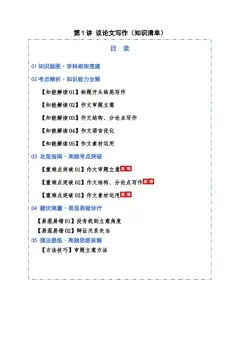
目录
01
考情解码·命题预警
2
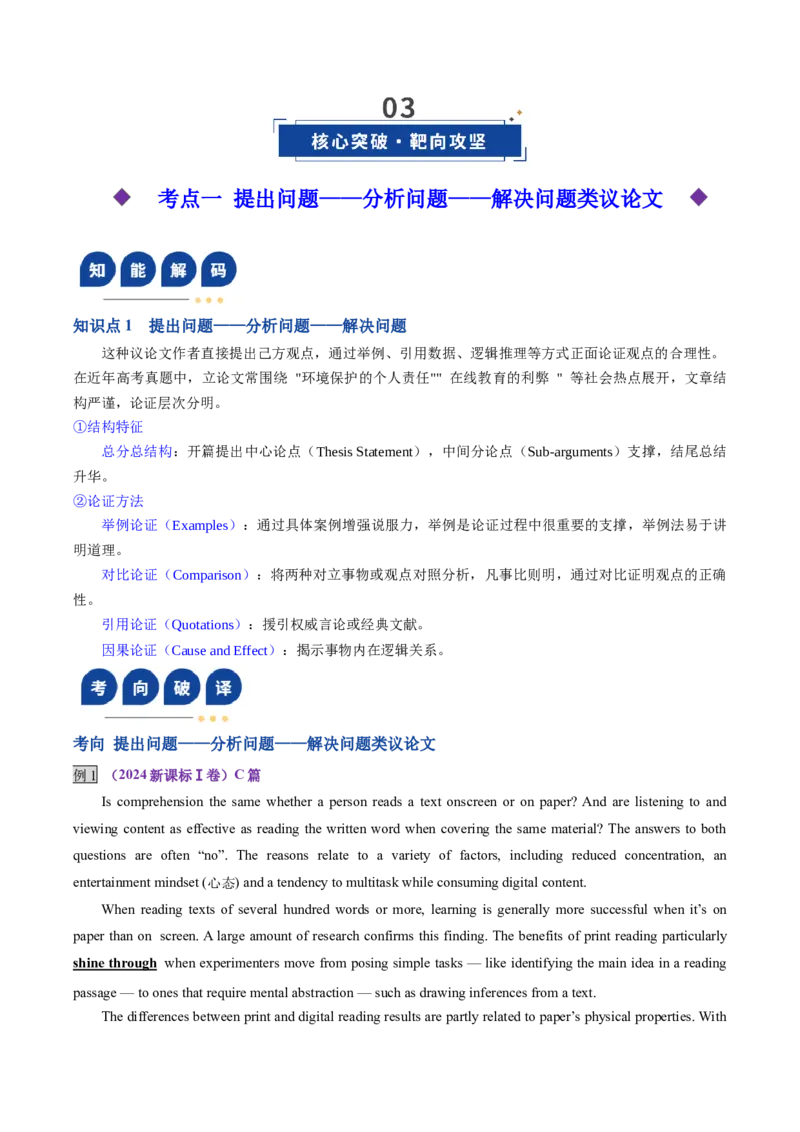
02 体系构建·思维可视.................................................................................................................................................3
03 核心突破·靶向攻坚.................................................................................................................................................4
考点一  提出问题——分析问题——解决问题类议论文.............................................................................4
知识点  提出问题——分析问题——解决问题类议论文................................................................................4
考向突破 提出问题——分析问题——解决问题类议论文..............................................................................5
考点二  错误的观点→批驳→立观点....................................................................................................................8
知识点  错误的观点→批驳→立观点................................................................................................................8
考向突破  错误的观点→批驳→立观点............................................................................................................8
考点三 列举几种事例——归纳总结观点或方法................................................................................................11
知识点  列举几种事例——归纳总结观点或方法..........................................................................................11
考向突破  列举几种事例——归纳总结观点或方法......................................................................................11
04 真题溯源·考向感知............................................................................................................................................13
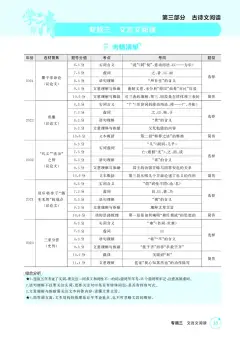
阅读理解之议论文
年份
卷别
主题语境
话题分类
2025
全国I 卷
人与社会
城市交通问题
北京卷
人与社会
能否延长看屏幕时间的争论
2024
新高考I 卷
人与社会
纸质阅读与数字阅读、音频和视频学习方式的差异和
效果
北京卷
人与社会
讨论科学问题:宇宙是否是由计算机模拟生成的
浙江卷1 月
人与自然
加拿大Alberta 防雹千预计划之争
2023
全国乙卷
人与社会
物品纳入历史叙事以更好地理解无文字社会的重要性
2022
全国甲卷
人与社会
悉尼发展中面临的问题
北京卷
人与社会
量子计算真的会像它的宣传那样成功吗?
天津卷
人与社会
美好生活的秘诀
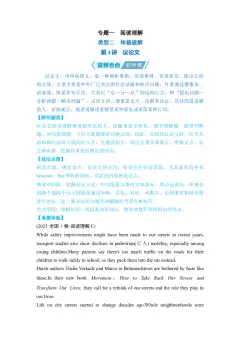
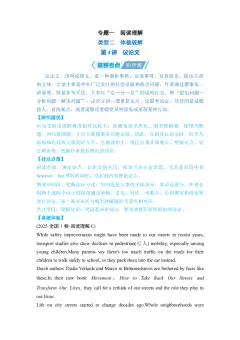
考情分析:
1.从命题内容上看,高考命题主要从以下几方面考查:记文章涉及的论题具有生活化的特
征,与社会生活密切相关。
2.从命题思路上看:
文章通过摆事实、讲道理、辨是非的方法,来论证某种观点正确与否,肯定或否定某种主
张。即提出问题(引论)--分析问题(本论)一一解决问题(结论)”。常见的有细节理解题、推理判
断题、主旨大意题、词义猜测题、情感态度题等题型。
预计2026 年议论文有可能考。复习过程中要熟练掌握议论文的命题特点和解题方法,做到成
功应对议论文阅读试题。
复习目标
1.掌握议论文的结构特点和命题形式。
2.掌握议论文的双管齐下阅读方式,侧重结构和内容两个方面。
3.熟悉议论文中常考查的观点态度词中的难词。
 考点一 提出问题——分析问题——解决问题类议论文

知识点1  提出问题——分析问题——解决问题
这种议论文作者直接提出己方观点,通过举例、引用数据、逻辑推理等方式正面论证观点的合理性。
在近年高考真题中,立论文常围绕 "环境保护的个人责任"" 在线教育的利弊 " 等社会热点展开,文章结
构严谨,论证层次分明。
①结构特征
总分总结构:开篇提出中心论点(Thesis Statement),中间分论点(Sub-arguments)支撑,结尾总结
升华。
②论证方法
举例论证(Examples):通过具体案例增强说服力,举例是论证过程中很重要的支撑,举例法易于讲
明道理。
对比论证(Comparison):将两种对立事物或观点对照分析,凡事比则明,通过对比证明观点的正确
性。
引用论证(Quotations):援引权威言论或经典文献。
因果论证(Cause and Effect):揭示事物内在逻辑关系。
考向 提出问题——分析问题——解决问题类议论文
例1 (2024 新课标
卷)
Ⅰ
C 篇
Is comprehension the same whether a person reads a text onscreen or on paper? And are listening to and
viewing content as effective as reading the written word when covering the same material? The answers to both
questions are often “no”. The reasons relate to a variety of factors, including reduced concentration, an
entertainment mindset (心态) and a tendency to multitask while consuming digital content.
When reading texts of several hundred words or more, learning is generally more successful when it’s on
paper than on screen. A large amount of research confirms this finding. The benefits of print reading particularly
shine through when experimenters move from posing simple tasks — like identifying the main idea in a reading
passage — to ones that require mental abstraction — such as drawing inferences from a text.
The differences between print and digital reading results are partly related to paper’s physical properties. With
paper, there is a literal laying on of hands, along with the visual geography of distinct pages. People often link their
memory of what they’ve read to how far into the book it was or where it was on the page.
But equally important is the mental aspect. Reading researchers have proposed a theory called “shallowing
hypothesis (假说)”. According to this theory, people approach digital texts with a mindset suited to social media,
which are often not so serious, and devote less mental effort than when they are reading print.
Audio (音频) and video can feel more engaging than text, and so university teachers increasingly turn to these
technologies — say, assigning an online talk instead of an article by the same person. However, psychologists have
demonstrated that when adults read news stories, they remember more of the content than if they listen to or view
identical pieces.
Digital texts, audio and video all have educational roles, especially when providing resources not available in
print. However, for maximizing learning where mental focus and reflection are called for, educators shouldn’t
assume all media are the same, even when they contain identical words.
28. What does the underlined phrase “shine through” in paragraph 2 mean?
A. Seem unlikely to last.
B. Seem hard to explain.
C. Become ready to use.
D. Become easy to notice.
29. What does the shallowing hypothesis assume?
A. Readers treat digital texts lightly.
B. Digital texts are simpler to understand.
C. People select digital texts randomly.
D. Digital texts are suitable for social media.
30. Why are audio and video increasingly used by university teachers?
A. They can hold students' attention.
B. They are more convenient to prepare.
C. They help develop advanced skills.
D. They are more informative than text.
31. What does the author imply in the last paragraph?
A. Students should apply multiple learning techniques.
B. Teachers should produce their own teaching material.
C. Print texts cannot be entirely replaced in education.
D. Education outside the classroom cannot be ignored.
例2(2023 年全国乙卷)D 篇
If you want to tell the history of the whole world, a history that does not privilege one part of humanity, you
cannot do it through texts alone, because only some of the world has ever had texts, while most of the world, for
most of the time, has not. Writing is one of humanity’s later achievements, and until fairly recently even many
literate (有文字的) societies recorded their concerns not only in writing but in things.
Ideally a history would bring together texts and objects, and some chapters of this book are able to do just that,
but in many cases we simply can’t. The clearest example of this between literate and non-literate history is perhaps
the first conflict, at Botany Bay, between Captain Cook’s voyage and the Australian Aboriginals. From the English
side, we have scientific reports and the captain’s record of that terrible day. From the Australian side, we have only
a wooden shield (盾) dropped by a man in flight after his first experience of gunshot. If we want to reconstruct
what was actually going on that day, the shield must be questioned and interpreted as deeply and strictly as the
written reports.
In addition to the problem of miscomprehension from both sides, there are victories accidentally or
deliberately twisted, especially when only the victors know how to write. Those who are on the losing side often
have only their things to tell their stories. The Caribbean Taino, the Australian Aboriginals, the African people of
Benin and the Incas, all of whom appear in this book, can speak to us now of their past achievements most
powerfully through the objects they made: a history told through things gives them back a voice. When we consider
contact (联系) between literate and non-literate societies such as these, all our first-hand accounts are necessarily
twisted, only one half of a dialogue. If we are to find the other half of that conversation, we have to read not just the
texts, but the objects.
32. What is the first paragraph mainly about?
A. How past events should be presented.
B. What humanity is concerned about.
C. Whether facts speak louder than words.
D. Why written language is reliable.
33. What does the author indicate by mentioning Captain Cook in paragraph 2?
A. His report was scientific.
B. He represented the local people.
C. He ruled over Botany Bay.
D. His record was one-sided.
34. What does the underlined word “conversation” in paragraph 3 refer to?
A. Problem.
B. History.
C. Voice.
D. Society.
35. Which of the following books is the text most likely selected from?
A. How Maps Tell Stories of the World
B. A Short History of Australia
C. A History of the World in 100 Objects
D. How Art Works Tell Stories
【变式训练·变载体】(2025·湖南省长沙市雅礼中学高三下学期模拟考试(二))
The convenience of modern life is nothing short of astonishing. As I write this, my phone is wirelessly
sending some hits from the 1700s to my portable speaker. The fact that, as a culture, we celebrate such short cuts is
understandable. That said, most people are able to sense that convenience has a darker side.
Before getting into that, we’d better understand why convenience is so seductive first. We often desist doing
the things we need to do to make progress. Behind every well-intentioned plan lies this horrible sense of inertia (惰
性). Why is this resistance — and our corresponding appetite for ease — such an essential part of our makeup?
Here, insights from evolutionary psychology (particularly the idea of“the evolutionary mismatch”) can help.
The evolutionary mismatch is the idea that we colved for a hunter-gather difostyle, and that while our
circumstances have changed completely, our brains and bodies haven’t. Resistance was a necessary counterbalance
(制衡) to the bursts of intense activity that characterized the lives of hunter-gatherers: searching for food in driving
rain, or running to escape a dangerous animal. It’s the reason we still ask: “Do I really have to be doing this?
Shouldn’t I save my energy?” The people choosing to remain sheltered during snowstorms, when the prospect of
obtaining food was low, were more likely to live and pass on their genes to the next generation.
Since then, of course, innovation has changed things greatly. We’ve altered technology and our environments
partly to serve our natural instinct ( 本能) to conserve energy. The question is: what do we stand to lose by
following our tendency to prioritize comfort and convenience?
Continually choosing the convenient path lessens your ability to deal with unavoidable difficulties. And,
from an evolutionary perspective, some measure of discomfort is as crucial to our survival as rest and relaxation.
Our ancestors didn’t survive purely by being lazy, but through a combination of playing it safe and taking necessary
risks.
This difficulty itself does shape our character. In the technological world we have fashioned, we must
sometimes make conscious efforts to act in opposition to our instincts. As a culture, we must remember while
convenience feels good in the moment, our capacity to adapt and overcome challenges is part of our evolutionary
inheritance (遗传) too, and central to the adventure of life.
1.What does the underlined word “seductive” in paragraph 2 most probably mean?
A.Attractive and inviting.
B.Useful and practical.
C.Harmful and dangerous.
D.Annoying and frustrating.
2.What does“the evolutionary mismatch” primarily refer to?
A.The inconsistency between personal goals and societal expectations.
B.The contrast between modern convenience and ancient challenges.
C.The argument over the hunter-gatherer lifestyle of ancient people.
D.The conflict between our natural instinct and the current environment.
3.What may prioritizing convenience in modern life result in?
A.It may lead to a lack of innovation and progress.
B.It may reduce our ability to overcome challenges.
C.It may make us overly dependent on technology.
D.It may cause a decline in physical fitness.
4.Which of the following can be the best title for the passage?
A.The Benefits of Modern Technology
B.Understanding Evolution in Today’s World
C.The Dark Side of Convenience in Modern Life
D.Rejecting Modern Convenience for a Better Life
 考点二 错误的观点→批驳→立观点
先引出对方观点,再通过反驳论据、指出逻辑漏洞等方式证明其错误,从而树立己方观点。这种文体
旨在通过批判性分析构建严谨的论证体系,常见于社会现象评论、学术争议探讨等文本。
1.结构特征:错误的观点→批驳→立观点
树靶阶段:文章开篇通常以客观陈述或引用他人观点的方式,明确摆出反方立场。例如在探讨 "网络
学习是否能完全取代传统课堂" 时,先阐述 "部分人认为网络学习灵活高效,应全面推广" 的观点。
批驳阶段:运用 "However""But""Nevertheless" 等转折词引出反驳内容,通过数据对比、事实例证等
方式削弱对方论点的可信度。如指出 "网络学习缺乏师生实时互动,据调查显示,73% 的学生存在自主学
习效率低下问题"。
立观点阶段:在瓦解反方观点后,系统阐述己方立场,通过递进式分析或多维度论证强化说服力,如
提出 "传统课堂与网络学习应优势互补" 的解决方案。
2.论证方法
归谬法:假设对方观点成立,通过合理推导得出荒谬结论,例如从 "读书无用论" 推导出 "社会将失
去科技创新能力"。
反证法:通过证明与己方论点相反的命题为假,间接确立正确观点,如通过证明 "不重视环保会导致
生态崩溃" 来支持可持续发展主张。
漏洞分析:聚焦对方论证中的逻辑缺陷,如指出统计样本偏差、因果关系误判等问题,例如批判 "因
个别成功案例否定教育重要性" 的以偏概全逻辑。
考向  错误的观点→批驳→立观点
例(2025 年河北部分学校联考)
Wolves with injured legs in the wild can basically do nothing but wait for death. But this was not the fate of
one injured wolf in the Hoh Xil National Nature Reserve (可可西里国家级自然保护区) in Qinghai. This limp
wolf went from poor and skinny (骨瘦如柴的) to happy and fat, thanks to tourists feeding it along the highway.
This “goodwill”, however, has sparked (引发) debate on whether tourists should feed the wolf. People who
support this act argue that without feeding, the poor wolf would die of starvation (饥饿). But those who hold an
opposite view think that humans should not go against the laws of nature and that the inevitable death of the wolf is
the result of natural selection. Each side has its reasons, but science can provide us with an ultimate answer.
Research published in Scientific Reports in June 2019 studied how human-provided food affected the
survival of bottlenose dolphins (宽吻海豚). Researchers followed the dynamics (动态) of 63 bottlenose dolphins
who live in the ocean off Bunbury, Australia, where the wild dolphins are legally allowed to be fed by the Dolphin
Discovery Centre there.
After looking at more than 10 years of data on the local dolphin population, the researchers found out that
the fatality rate (死亡率) of bottlenose dolphins who ask for food from vessels (船只) is much higher than that of
those who seek food by themselves. Asking for food from humans increases the risk of injuries and sometimes the
dolphins can even get killed by “boat strikes, propeller (螺旋桨) cut injuries and fishing gear entanglements (被渔
具缠住)”, said the study. And young dolphins tend to learn from their mothers, leading to more accidents.
Apart from accidents, feeding wildlife may also make them rely on us for survival, Dai Qiang, a researcher
at the Chengdu Institute of Biology of the Chinese Academy of Sciences, told Hongxing News. Moreover, any
diseases and bacteria ( 细菌) present in the animals may infect those who feed them. As Qi Xinzhang, deputy
director of Xining Wildlife Park, commented under a video featuring the wolf in Hoh Xil, “Kindness needs to be
supported by rationality (理性); otherwise, we may see adverse effects (不利影响).”
So, what should we do when coming across wild animals that seem to need our help? The best help for them
is to report the case to related authorities for professional aid instead of feeding them, said Qi.
1.What does paragraph 2 mainly talk about?
A.The debate on wolf feeding.
B.Survival problems of wildlife.
C.Explanations of the laws of nature.
D.Scientific reasons for human actions.
2.What has been found in the study of bottlenose dolphins being fed by humans?
A.They are more likely to be injured or killed.
B.They are more friendly to humans.
C.They face a higher risk of being caught.
D.They tend to care less about their young.
3.According to Dai Qiang, what might happen as a result of feeding wildlife?
A.An increase in wildlife populations.
B.A possible reduction in natural habitat.
C.Increased risk of animal diseases being passed on.
D.A strengthened bond between humans and animals.
4.What does Qi advise people who meet poorly wild animals to do?
A.Call the police.
B.Leave them alone.
C.Offer immediate help.
D.Inform relevant authorities.
【变式训练·变载体】(2025 届江苏省徐州市高三下学期考前打靶)
Our common sense is that professional excellence requires formal training, but excellence in the rest of life
does not. Work demands discipline and training; leisure is easy and enjoyable and comes naturally.
When our work is most demanding, we typically define leisure as its opposite: complete inactivity. For
example, when a burned-out 51-year-old CEO of a $68 billion investment firm abruptly quit his job in 2022, he
explained to reporters what he planned to do next: “I just want to go sit at the beach and do nothing.” Even if we’re
not finding our work so tiring as his, we still talk about taking a break from work, which allows us to reenergize —
in order to work more and better. Either way, we’re defining leisure in relation to work.
I reject this whole way of thinking. Leisure is a valuable, constructive part of life, and we misunderstand
leisure when we define it as work’s opposite. We may think that the best way to get happier is, like the CEO, to “go
sit at the beach and do nothing.” But researchers have found that this kind of do-nothing leisure, including vacation
travel, provides only minor, temporary boosts of happiness. What gives us more sustained well-being are pursuits
involving social engagement, personal reflection, and outdoor activities.
As a professor, I want everything I do to be generative, instead of wasting a minute on fruitless pursuits.
Leisure is not straightforward or easy. I’d like to use my nonwork activities, as much as my work ones, to become a
wiser, happier, more effective person. We must treat leisure with every bit as much seriousness as we do our
careers. When we understand and practice leisure properly, we can achieve our best selves — and even our capacity
to transform society for the better.
The point here is that just as we should be excellent at our jobs, we should become excellent at leisure.
Doing leisure well will generate the sort of growth in our well-being that work cannot provide. If you don’t do
leisure well, you will never find life’s full meaning.
1.Why does the author mention common sense at the beginning?
A.To make a comparison.
B.To introduce a concept.
C.To present an example.
D.To lead in an argument.
2.What does the example of the CEO convey?
A.People should retire when earning enough.
B.People should change attitudes towards work.
C.People tend to connect leisure with work.
D.People tend to make future plans in advance.
3.According to researchers, what contributes to continuous well-being?
A.Sunbathing on the beach.
B.Aimlessly wandering.
C.Community service.
D.Playing video games.
4.What is the author’s opinion about leisure?
A.Leisure is opposite to work.
B.Leisure is a state of inactivity.
C.Leisure means escaping work temporarily.
D.Leisure deserves to be treated seriously.
 考点三 列举几种事例——归纳总结观点或方法
列举几种事例——归纳总结观点或方法
开篇引出几种事例或现象,归纳作者的核心观点。注意抓取关键词、区分事例与观点。
例  (2025 年全国I 卷)C 篇 While safety improvements might have been made to our streets in recent
years, transport studies also show declines in pedestrian (行人) mobility, especially among young children. Many
parents say there’s too much traffic on the roads for their children to walk safely to school, so they pack them into
the car instead.
Dutch authors Thalia Verkade and Marco te Brömmelstroet are bothered by facts like these. In their new
book Movement: How to Take Back Our Streets and Transform Our Lives, they call for a rethink of our streets and
the role they play in our lives.
Life on city streets started to change decades ago. Whole neighbourhoods were destroyed to make way for
new road networks and kids had to play elsewhere. Some communities fought back. Most famously, a Canadian
journalist who had moved her family to Manhattan in the early 1950s led a campaign to stop the destruction of her
local park. Describing her alarm at its proposed replacement with an expressway, Jane Jacobs called on her mayor
(市长) to champion “New York as a decent place to live, and not just rush through.” Similar campaigns occurred in
Australia in the late 1960s and 1970s as well.
Although these campaigns were widespread, the reality is that the majority of the western cities were
completely redesigned around the needs of the motor car. The number of cars on roads has been increasing rapidly.
In Australia we now have over twenty million cars for just over twenty-six million people, among the highest rate
of car ownership in the world.
We invest a lot in roads that help us rush through, but we fail to account for the true costs. Do we really
recognise what it costs us as a society when children can’t move safely around our communities? The authors of
Movement have it right: it’s time to think differently about that street outside your front door.
1.What phenomenon does the author point out in paragraph 1?
A.Cars often get stuck on the road.
B.Traffic accidents occur frequently.
C.People walk less and drive more.
D.Pedestrians fail to follow the rules.
2.What were the Canadian journalist and other campaigners trying to do?
A.Keep their cities livable.
B.Promote cultural diversity.
C.Help the needy families.
D.Make expressways accessible.
3.What can be inferred about the campaigns in Australia in the late 1960s and 1970s?
A.They boosted the sales of cars.
B.They turned out largely ineffective.
C.They won government support.
D.They advocated building new parks.
4.What can be a suitable title for the text?
A.Why the Rush?
B.What’s Next?
C.Where to Stay?
D.Who to Blame?
【变式训练】China’s economy achieved 12.7 percent growth in the first half of 2021, increasing the
chances of employment for young graduates. The industrial sector, and State-owned and large enterprises have
recovered relatively well from the impacts of the novel coronavirus outbreak, but the service sector, and small and
medium-sized enterprises face bigger challenges.
Fortunately, China’s job market was relatively stable in the first half. Also, new reforms in the technology
sector have accelerated the transformation of the labor market and created several new occupations. Recent years
have seen graduates getting more career choices, beyond the traditional forms of employment.
But young migrant workers deserve greater attention, because they are not as well-educated as college
graduates, or do not have enough work experience. Most young migrant workers flock to affluent eastern coastal
areas, work in low-end manufacturing units and the service sector, and lack the ability to adapt to new technology
and thus can be more easily replaced by robots.
And although employment in the platform economy of e-commerce can increase the flexibility of the labor
market, make resource allocation more efficient, ease the impact of external factors and provide more opportunities
for low-skilled workers, it will increase instability in the labor market.
The traditional social security system based on employment relationship is facing challenges from the
platform economy, as some platform companies sign service contracts rather than labor contracts with their
employees, leaving a large number of workers uncovered by the country’s social insurance system.
The employment of youths is crucial for the well-being of the entire society, as well as social stability and
high-quality development. As such, the employment policy must be more inclusive and forward-looking, and the
government should optimize the social insurance system, encourage skill training and help improve young people’s
ability to adapt to the economic transformation, in order to prevent mass job losses.
1.What does the underlined word “accelerated” mean in Paragraph 2?
A.Changed.
B.Boosted.
C.Denied.
D.Prevented.
2.Why should young migrant workers be paid more attention to?
A.Because they have the priority.
B.Because they face more financial problems.
C.Because they are less educated and experienced.
D.Because they are working low-end sectors.
3.Which is not the advantage of e-commerce?
A.Making resources utilization more efficient.
B.Reducing outer factors.
C.Causing more instability.
D.Offering more job chances.
4.What is the last paragraph mainly about?
A.Some suggestions on how to ensure employment.
B.Some evidence for supporting employment.
C.Reasons for low employments.
D.Benefits of e-commerce.
1. (2025·北京卷)Not too long ago, on a cold winter night, there was a teenager who wanted more screen
time and a parent who said no. The teenager was advocating for her right to scroll (翻屏) for an extra 30 minutes.
The parent argued that none of her friends’ parents let them have screens after 9 o’clock. “I thought, in this family,
we don’t compare ourselves with other people, Dad?” the teenager replied. The parent — who was me, by the way
— just got served. Since they were young, I have told my kids not to compare themselves with other people. I have
argued countless times that comparisons are the “thief of joy”.
Although my daughter didn’t win, she did help expose one of the worst pieces of advice I have ever given. In
my defence, I did what we’ve all done before, which is repeat received wisdom without exploring the nuances. But
now is the time to set the record straight, which starts with questioning the idea that all social comparison is
unhealthy.
Social comparisons do, of course, often get us into emotional trouble. But they can be harnessed (利用) for
our betterment if we understand how they work. The social comparisons we make — ones that lead us to feel good
or bad about ourselves — are vital to our ability to thrive (成长). Science provides a guide we can use to harness
the way we perform these comparisons to reduce their negative emotional impacts.
Comparing yourself with someone who is outperforming you could result in feelings of envy if you focus
on the things they have and you don’t, or it can be energizing and inspiring if you use these comparisons as a
source of motivation, for example, “If they can achieve that, so can I.” Comparing yourself with someone who is
doing worse than you could result in fear and worry if you think about how you could fall into similar
circumstances, or it can draw out feelings of gratitude and appreciation if you use that comparison to broaden
your views — for example, “Wow, things could be much worse; I’m doing great.”
What I wish I taught my daughter earlier are these nuances. How we feel about ourselves rests not just on
whom we compare ourselves with but also on how we think about that comparison. That’s something we all have
control over.
28.How did the author feel about his daughter’s argument?
A.Excited.
B.Inspired.
C.Energized.
D.Relieved.
29.What does the word “nuances” underlined in Paragraph 2 most probably mean?
A.Major achievements.
B.Complex feelings.
C.Significant impacts.
D.Fine differences.
30.Which would be the best title for the passage?
A.Comparing Ourselves with Others Can Become a Healthy Habit
B.Comparing Ourselves with Others Can Strengthen Family Ties
C.Social Comparisons Can Get Us into Emotional Trouble
D.Social Comparisons Can Be Controlled by Science
2.【2021 年全国乙卷】When almost everyone has a mobile phone, why are more than half of Australian
homes still paying for a landline(座机)?
These days you’d be hard pressed to find anyone in Australia over the age of 15 who doesn’t own a mobile
phone. In fact plenty of younger kids have one in their pocket. Practically everyone can make and receive calls
anywhere, anytime.
Still, 55 percent of Australians have a landline phone at home and only just over a quarter (29%) rely only
on their smartphones according to a survey (调查). Of those Australians who still have a landline, a third
concede that it’s not really necessary and they’re keeping it as a security blanket — 19 percent say they never use
it while a further 13 percent keep it in case of emergencies. I think my home falls into that category.
More than half of Australian homes are still choosing to stick with their home phone. Age is naturally a factor
(因素)— only 58 percent of Generation Ys still use landlines now and then, compared to 84 percent of Baby
Boomers who’ve perhaps had the same home number for 50 years. Age isn’t the only factor; I’d say it’s also to do
with the makeup of your household.
Generation Xers with young families, like my wife and I, can still find it convenient to have a home phone
rather than providing a mobile phone for every family member. That said, to be honest the only people who ever
ring our home phone are our Baby Boomers parents, to the point where we play a game and guess who is calling
before we pick up the phone(using Caller ID would take the fun out of it).
How attached are you to your landline? How long until they go the way of gas street lamps and morning milk
deliveries?
24. What does paragraph 2 mainly tell us about mobile phones?
A. Their target users.
B. Their wide popularity.
C. Their major functions.
D. Their complex design.
25. What does the underlined word “concede” in paragraph 3 mean?
A. Admit.
B. Argue.
C. Remember.
D. Remark.
26. What can we say about Baby Boomers?
A. They like smartphone games.
B. They enjoy guessing callers’ identity.
C. They keep using landline phones.
D. They are attached to their family.
27. What can be inferred about the landline from the last paragraph?
A. It remains a family necessity.
B. It will fall out of use some day.
C. It may increase daily expenses.
D. It is as important as the gas light.
3.【2020 年北京卷】Certain forms of AI are indeed becoming ubiquitous. For example, algorithms (算法)
carry out huge volumes of trading on our financial markets, self-driving cars are appearing on city streets, and our
smartphones are translating from one language into another. These systems are sometimes faster and more
perceptive than we humans are. But so far that is only true for the specific tasks for which the systems have been
designed. That is something that some AI developers are now eager to change.
Some of today’s AI pioneers want to move on from today’s world of “weak” or “narrow” AI, to create
“strong” or “full” AI, or what is often called artificial general intelligence (AGI). In some respects, today’s
powerful computing machines already make our brains look weak. A GI could, its advocates say, work for us
around the clock, and drawing on all available data, could suggest solutions to many problems. DM, a company
focused on the development of AGI, has an ambition to “solve intelligence”. “If we’re successful,” their mission
statement reads, “we believe this will be one of the most important and widely beneficial scientific advances ever
made.”
Since the early days of AI, imagination has outpaced what is possible or even probable. In 1965, an
imaginative mathematician called Irving Good predicted the eventual creation of an “ultra-intelligent machine…
that can far surpass all the intellectual (智力的) activities of any man, however clever.” Good went on to suggest
that “the first ultra-intelligent machine” could be “the last invention that man need ever make.”
Fears about the appearance of bad, powerful, man-made intelligent machines have been reinforced (强化) by
many works of fiction — Mary Shelley’s Frankenstein and the Terminator film series, for example. But if AI does
eventually prove to be our downfall, it is unlikely to be at the hands of human-shaped forms like these, with
recognisably human motivations such as aggression (敌对行为). Instead, I agree with Oxford University
philosopher Nick Bostrom, who believes that the heaviest risks from A GI do not come from a decision to turn
against mankind but rather from a dogged pursuit of set objectives at the expense of everything else.
The promise and danger of true A GI are great. But all of today’s excited discussion about these possibilities
presupposes the fact that we will be able to build these systems. And, having spoken to many of the world’s
foremost AI researchers, I believe there is good reason to doubt that we will see A GI any time soon, if ever.
42. What does the underlined word “ubiquitous” in Paragraph I probably mean?
A. Enormous in quantity.
B. Changeable daily.
C. Stable in quality.
D. Present everywhere.
43. What could AGI do for us, according to its supporters?
A. Help to tackle problems.
B. Make brains more active.
C. Benefit ambitious people.
D. Set up powerful databases.
44. As for Irving Good’s opinion on ultra-intelligent machines, the author is ____________.
A. supportive
B. disapproving
C. fearful
D. uncertain
45. What can be inferred about AGI from the passage?
A. It may be only a dream.
B. It will come into being soon.
C. It will be controlled by humans.
D. It may be more dangerous than ever.
4.【2019 年天津卷】Would you BET on the future of this man?He is 53 years old. Most of his adult life has
been a losing struggle against debt and misfortune. A war injury has made his left hand stop functioning,and he
has often been in prison. Driven by heaven-knows-what motives,he determines to write a book.
The book turns out to be one that has appealed to the world for more than 350 years. That former prisoner was
Cervantes,and the book was Don Quixote(《堂吉诃德》). And the story poses an interesting question: why
do some people discover new vitality and creativity to the end of their days,while others go to seed long before?
We've all known people who run out of steam before they reach life's halfway mark. I'm not talking about
those who fail to get to the top. We can't all get there. I'm talking about people who have stopped learning on
growing because they have adopted the fixed attitudes and opinions that all too often come with passing years.
Most of us,in fact,progressively narrow the variety of our lives. We succeed in our field of specialization
and then become trapped in it. Nothing surprises us. We lose our sense of wonder. But,if we are willing to lean,
the opportunities are everywhere.
The things we learn in maturity seldom involve information and skills. We learn to bear with the things we
can't change. We learn to avoid self-pity. We learn that however much we try to please,some people are never
going to love us-an idea that troubles at first but is eventually relaxing.
With high motivation and enthusiasm,we can keep on learning. Then we will know how important it is to
have meaning in our life. However,we can achieve meaning only if we have made a commitment to something
larger than our own little egos(自我),whether to loved ones,to fellow humans,to work,or to some moral
concept.
Many of us equate(视
等同于)
……
“commitment” with such “caring” occupations as teaching and nursing.
But doing any ordinary job as well as one can is in itself an admirable commitment. People who work toward such
excellence whether they are driving a truck,or running a store-make the world better just by being the kind of
people they are. They've learned life's most valuable lesson.
51. The passage starts with the story of Cervantes to show that_________.
A. loss of freedom stimulates one's creativity
B. age is not a barrier to achieving one's goal
C. misery inspires a man to fight against his fate
D. disability cannot stop a man's pursuit of success
52. What does the underlined part in Paragraph 3 probably mean?
A. End one's struggle for liberty.
B. Waste one's energy taking risks.
C. Miss the opportunity to succeed.
D. Lose the interest to continue learning.
53. What could be inferred from Paragraph 4?
A. Those who dare to try often get themselves trapped.
B. Those who tend to think back can hardly go ahead.
C. Opportunity favors those with a curious mind.
D. Opportunity awaits those with a cautious mind.
54. What does the author intend to tell us in Paragraph 5?
A. A tough man can tolerate suffering.
B. A wise man can live without self-pity.
C. A man should try to satisfy people around him.
D. A man should learn suitable ways to deal with life.
55. What is the author's purpose in writing the passage?
A. To provide guidance on leading a meaningful adult life.
B. To stress the need of shouldering responsibilities at work.
C. To state the importance of generating motivation for learning.
D. To suggest a way of pursuing excellence in our lifelong career.
5.【2018 年全国Ⅱ卷】We’ve all been there: in a lift, in line at the bank or on an airplane, surrounded by
people who are, like us, deeply focused on their smartphones or, worse, struggling with the uncomfortable silence.
 What’s the problem? It’s possible that we all have compromised conversational intelligence. It’s more likely
that none of us start a conversation because it’s awkward and challenging, or we think it’s annoying and
unnecessary. But the next time you find yourself among strangers, consider that small talk is worth the trouble.
Experts say it’s an invaluable social practice that results in big benefits.
 Dismissing small talk as unimportant is easy, but we can’t forget that deep relationships wouldn’t
even exist if it weren’t for casual conversation. Small talk is the grease(润滑剂) for social communication, says
Bernardo Carducci, director of the Shyness Research Institute at Indiana University Southeast. "Almost every
great love story and each big business deal begins with small talk," he explains. "The key to successful small
talk is learning how to connect with others, not just communicate with them."
In a 2014 study, Elizabeth Dunn, associate professor of psychology at UBC, invited people on their way into
a coffee shop. One group was asked to seek out an interaction(互动) with its waiter; the other, to speak only when
necessary. The results showed that those who chatted with their server reported significantly higher positive
feelings and a better coffee shop experience. "It’s not that talking to the waiter is better than talking to your
husband," says Dunn. "But interactions with peripheral(边缘的) members of our social network matter for our
well-being also."
Dunn believes that people who reach out to strangers feel a significantly greater sense of belonging, a bond
with others. Carducci believes developing such a sense of belonging starts with small talk. "Small talk is the basis
of good manners," he says.
32. What phenomenon is described in the first paragraph?
A. Addiction to smartphones.
B. Inappropriate behaviours in public places.
C. Absence of communication between strangers.
D. Impatience with slow service.
33. What is important for successful small talk according to Carducci?
A. Showing good manners.    B. Relating to other people.
C. Focusing on a topic.    D. Making business deals.
34. What does the coffee-shop study suggest about small talk?
A. It improves family relationships.    B. It raises people’s confidence.
C. It matters as much as a formal talk.    D. It makes people feel good.
35. What is the best title for the text?
A. Conversation Counts    B. Ways of Making Small Talk
C. Benefits of Small Talk    D. Uncomfortable Silence
6.【2018 年北京卷】 Preparing Cities for Robot Cars
The possibility of self-driving robot cars has often seemed like a futurist’s dream, years away from
materializing in the real world.  Well, the future is apparently now.  The California Department of Motor
Vehicles began giving permits in April for companies to test truly self-driving cars on public roads.  The state also
cleared the way for companies to sell or rent out self-driving cars, and for companies to operate driverless taxi
services.  California, it should be noted, isn’t leading the way here.  Companies have been testing their vehicles
in cities across the country.  It’s hard to predict when driverless cars will be everywhere on our roads.  But
however long it takes, the technology has the potential to change our transportation systems and our cities, for
better or for worse, depending on how the transformation is regulated.
While much of the debate so far has been focused on the safety of driverless cars(and rightfully so),
policymakers also should be talking about how self-driving vehicles can help reduce traffic jams, cut emissions(排
放) and offer more convenient, affordable mobility options.  The arrival of driverless vehicles is a chance to make
sure that those vehicles are environmentally friendly and more shared.
Do we want to copy — or even worsen — the traffic of today with driverless cars? Imagine a future where
most adults own individual self-driving vehicles.  They tolerate long, slow journeys to and from work on packed
highways because they can work, entertain themselves or sleep on the ride, which encourages urban spread.  They
take their driverless car to an appointment and set the empty vehicle to circle the building to avoid paying for
parking.  Instead of walking a few blocks to pick up a child or the dry cleaning, they send the self-driving
minibus.  The convenience even leads fewer people to take public transport — an unwelcome side effect
researchers have already found in ride-hailing(叫车) services.
A study from the University of California at Davis suggested that replacing petrol-powered private cars
worldwide with electric, self-driving and shared systems could reduce carbon emissions from transportation 80%
and cut the cost of transportation infrastructure(基础设施) and operations 40% by 2050.  Fewer emissions and
cheaper travel sound pretty appealing.  The first commercially available driverless cars will almost certainly be
fielded by ride-hailing services, considering the cost of self-driving technology as well as liability and maintenance
issues(责任与维护问题).  But driverless car ownership could increase as the prices drop and more people become
comfortable with the technology. zxxk
 Policymakers should start thinking now about how to make sure the appearance of driverless vehicles doesn’t
extend the worst aspects of the car-controlled transportation system we have today.  The coming technological
advancement presents a chance for cities and states to develop transportation systems designed to move more
people, and more affordably.  The car of the future is coming.  We just have to plan for it.
47.  According to the author, attention should be paid to how driverless cars can __________.
A.  help deal with transportation-related problems
B.  provide better services to customers
C.  cause damage to our environment
D.  make some people lose jobs
48. As for driverless cars, what is the author’s major concern?
A. Safety.
B. Side effects.
C. Affordability.
D. Management.
49. What does the underlined word "fielded" in Paragraph 4 probably mean?
A. Employed.
B. Replaced.
C. Shared.
D. Reduced.
50. What is the author’s attitude to the future of self-driving cars?
A. Doubtful.
B. Positive.
C. Disapproving.
D. Sympathetic.
7.【2018 年江苏卷】In the 1760s, Mathurin Roze opened a series of shops that boasted(享有) a special meat soup
called consommé. Although the main attraction was the soup, Roze's chain shops also set a new standard for dining
out, which helped to establish Roze as the inventor of the modern restaurant.
Today, scholars have generated large amounts of instructive research about restaurants. Take visual hints that
influence what we eat: diners served themselves about 20 percent more pasta(意大利面食) when their plates
matched their food. When a dark-colored cake was served on a black plate rather than a white one, customers
recognized it as sweeter and more tasty.
Lighting matters, too. When Berlin restaurant customers ate in darkness, they couldn't tell how much they'd
had: those given extra-large shares ate more than everyone else, none the wiser—they didn’t feel fuller, and they
were just as ready for dessert.
Time is money, but that principle means different things for different types of restaurants. Unlike fast-food
places, fine dining shops prefer customers to stay longer and spend. One way to encourage customers to stay and
order that extra round: put on some Mozart(莫扎特).When classical, rather than pop, music was playing, diners
spent more. Fast music hurried diners out.
Particular scents also have an effect: diners who got the scent of lavender(薰衣草) stayed longer and spent
more than those who smelled lemon, or no scent.
Meanwhile, things that you might expect to discourage spending—"bad" tables, crowding. high prices — don't
necessarily. Diners at bad tables — next to the kitchen door, say — spent nearly as much as others but soon fled. It
can be concluded that restaurant keepers need not "be overly concerned about ‘bad’ tables," given that they're
profitable. As for crowds, a Hong Kong study found that they increased a restaurant's reputation, suggesting great
food at fair prices. And doubling a buffet's price led customers to say that its pizza was 11 percent tastier.
58. The underlined phrase "none the wiser" in paragraph 3 most probably implies that the customers were

.
A. not aware of eating more than usual
B. not willing to share food with others
C. not conscious of the food quality
D. not fond of the food provided
59. How could a fine dining shop make more profit?
A. Playing classical music.
B. Introducing lemon scent.
C. Making the light brighter,
D. Using plates of larger size.
60. What does the last paragraph talk about?
A. Tips to attract more customers.
B. Problems restaurants are faced with.
C. Ways to improve restaurants' reputation.
D. Common misunderstandings about restaurants.
8.【2018 年江苏卷】Children as young as ten are becoming dependent on social media for their sense of self-
worth, a major study warned.
It found many youngsters(少年)now measure their status by how much public approval they get online, often
through “likes”. Some change their behaviour in real life to improve their image on the web.
The report into youngsters aged from 8 to 12 was carried out by Children's Commissioner (专员)Anne
Longfield. She said social media firms were exposing children to major emotional risks, with some youngsters
starting secondary school ill-equipped to cope with the tremendous pressure they faced online.
Some social apps were popular among the children even though they supposedly require users to be at least
13.The youngsters admitted planning trips around potential photo-opportunities and then messaging friends—and
friends of friends — to demand “likes” for their online posts.
The report found that youngsters felt their friendships could be at risk if they did not respond to social media
posts quickly, and around the clock.
Children aged 8 to 10 were "starting to feel happy" when others liked their posts. However, those in the 10 to
12 age group were "concerned with how many people like their posts", suggesting a “need” for social recognition
that gets stronger the older they become.
Miss Longfield warned that a generation of children risked growing up "worried about their appearance and
image as a result of the unrealistic lifestyles they follow on platforms, and increasingly anxious about switching off
due to the constant demands of social media.
She said: "Children are using social media with family and friends and to play games when they are in primary
school. But what starts as fun usage of apps turns into tremendous pressure in real social media interaction at
secondary school."
As their world expanded, she said, children compared themselves to others online in a way that was "hugely
damaging in terms of their self-identity, in terms of their confidence, but also in terms of their ability to develop
themselves".
Miss Longfield added: "Then there is this push to connect—if you go offline, will you miss something, will
you miss out, will you show that you don't care about those people you are following, all of those come together in
a huge way at once." "For children it is very, very difficult to cope with emotionally." The Children's Commissioner
for England's study—life in Likes—found that children as young as 8 were using social media platforms largely for
play.
However, the research—involving eight groups of 32 children aged 8 to 12—suggested that as they headed
toward their teens, they became increasingly anxious online.
By the time they started secondary school—at age 11—children were already far more aware of their image
online and felt under huge pressure to ensure their posts were popular, the report found.
However, they still did not know how to cope with mean-spirited jokes, or the sense of incompetence they
might feel if they compared themselves to celebrities(名人)or more brilliant friends online. The report said they
also faced pressure to respond to messages at all hours of the day—especially at secondary school when more
youngsters have mobile phones.
The Children’s Commissioner said schools and parents must now do more to prepare children for the
emotional minefield(雷区)they faced online. And she said social media companies must also "take more
responsibility". They should either monitor their websites better so that children do not sign up too early, or they
should adjust their websites to the needs of younger users.
Javed Khan, of children's charity Bamardo's, said: "It's vital that new compulsory age- appropriate relationship
and sex education lessons in England should help equip children to deal with the growing demands of social media.
“It’s also hugely important for parents to know which apps their children are using.”
65. Why did some secondary school students feel too much pressure?
A. They were not provided with adequate equipment.
B. They were not well prepared for emotional risks.
C. They were required to give quick responses.
D. They were prevented from using mobile phones.
66. Some social app companies were to blame because            .
A. they didn't adequately check their users' registration
B. they organized photo trips to attract more youngsters
C. they encouraged youngsters to post more photos
D. they didn't stop youngsters from staying up late
67. Children's comparing themselves to others online may lead to           .
A. less friendliness to each other
B. lower self-identity and confidence
C. an increase in online cheating
D. a stronger desire to stay online
68. According to Life in Likes, as children grew, they became more anxious to         .
A. circulate their posts quickly
B. know the qualities of their posts
C. use mobile phones for play
D. get more public approval
69. What should parents do to solve the problem?
A. Communicate more with secondary schools.
B. Urge media companies to create safer apps.
C. Keep track of children's use of social media.
D. Forbid their children from visiting the web.
70. What does the passage mainly talk about?
A. The influence of social media on children.
B. The importance of social media to children.
C. The problem in building a healthy relationship.
D. The measure to reduce risks from social media.
9.【2018 年天津卷】Give yourself a test. Which way is the wind blowing? How many kinds of wildflowers
can be seen from your front door? If your awareness is as sharp as it could be, you’ll have no trouble answering
these questions.
Most of us observed much more as children than we do as adults. A child’s day is filled with fascination,
newness and wonder. Curiosity gave us all a natural awareness. But distinctions that were sharp to us as children
become unclear; we are numb(麻木的) to new stimulation(刺激), new ideas. Relearning the art of seeing the world
around us is quite simple, although it takes practice and requires breaking some bad habits.
The first step in awakening senses is to stop predicting what we are going to see and feel before it occurs. This
blocks awareness. One chilly night when I was hiking in the Rocky Mountains with some students, I mentioned
that we were going to cross a mountain stream. The students began complaining about how cold it would be. We
reached the stream, and they unwillingly walked ahead. They were almost knee-deep when they realized it was a
hot spring. Later they all admitted they’d felt cold water at first.
Another block to awareness is the obsession(痴迷) many of us have with naming things. I saw bird watchers
who spotted a bird, immediately looked it up in field guides, and said, a "ruby-crowned kinglet" and checked it off.
They no longer paid attention to the bird and never learned what it was doing.
The pressures of "time" and "destination" are further blocks to awareness. I encountered many hikers who
were headed to a distant camp-ground with just enough time to get there before dark. It seldom occurred to them to
wander a bit, to take a moment to see what’s around them. I asked them what they’d seen. "Oh, a few birds," they
said. They seemed bent on their destinations.
Nature seems to unfold to people who watch and wait. Next time you take a walk, no matter where it is, take
in all the sights, sounds and sensations. Wander in this frame of mind and you will open a new dimension to your
life.
51. According to Paragraph 2, compared with adults, children are more ________.
A. anxious to do wonders
B. sensitive to others’ feelings
C. likely to develop unpleasant habits
D. eager to explore the world around them
52. What idea does the author convey in Paragraph 3?
A. To avoid jumping to conclusions.
B. To stop complaining all the time.
C. To follow the teacher’s advice.
D. To admit mistakes honestly.
53. The bird watchers’ behavior shows that they ________.
A. are very patient in their observation
B. are really fascinated by nature
C. care only about the names of birds
D. question the accuracy of the field guides
54. Why do the hikers take no notice of the surroundings during the journey?
A. The natural beauty isn’t attractive to them.
B. They focus on arriving at the camp in time.
C. The forest in the dark is dangerous for them.
D. They are keen to see rare birds at the destination.
55. In the passage, the author intends to tell us we should ________.
A. fill our senses to feel the wonders of the world
B. get rid of some bad habits in our daily life
C. open our mind to new things and ideas
D. try our best to protect nature
10.【2017 年浙江卷】Getting less sleep has become a bad habit for most American kids. According to a new
survey(调查)by the National Sleep Foundation, 51% of kids aged 10 to 18 go to bed at 10 pm or later on school
nights, even though they have to get up early. Last year the Foundation reported that nearly 60% of 7- to 12-year-
olds said they felt tired during the day, and 15% said they had fallen asleep at school.
How much sleep you need depends a lot on your age. Babies need a lot of rest; most of them sleep about 18
hours a day! Adults need about eight hours. For most school-age children, ten hours is ideal(理想的). But the new
National Sleep Foundation survey found that 35% of 10- to 12-year-olds get only seven or eight hours. And guess
what almost half of the surveyed kids said they do before bedtime? Watch TV.
"More children are going to bed with TVs on, and there are more opportunities(机会)to stay awake, with more
homework, the Internet and the phone," says Dr. Mary Carskadon, a sleep researcher at Brown University Medical
School. She says these activities at bedtime can get kids all excited and make it hard for them to calm down and
sleep. Other experts say part of the problem is chemical. Changing levels of body chemicals called hormones not
only make teenagers’ bodies develop adult characteristics, but also make it hard for teenagers to fall asleep before
11 pm.
Because sleepiness is such a problem for teenagers, some school districts have decided to start high school
classes later than they used to. Three years ago, schools in Edina, Minnesota, changed the start time from 7:25 am
to 8:30 am. Students, parents and teachers are pleased with the results.
25.What is the new National Sleep Foundation survey on?
A. American kids’ sleeping habits.
B. Teenagers’ sleep-related diseases.
C. Activities to prevent sleeplessness.
D. Learning problems and lack of sleep.
26.How many hours of sleep do 11-year-olds need every day?
A.7 hours.
B.8 hours.
C.10 hours.
D.18 hours.
27.Why do teenagers go to sleep late according to Carskadon?
A. They are affected by certain body chemicals.
B. They tend to do things that excite them.
C. They follow their parents’ examples.
D. They don’t need to go to school early.