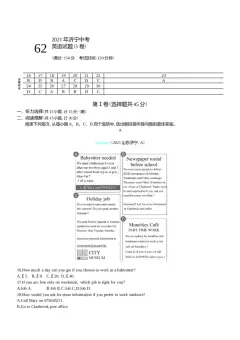
济宁一模
2024 RELEASED EXAMS 13
READING A
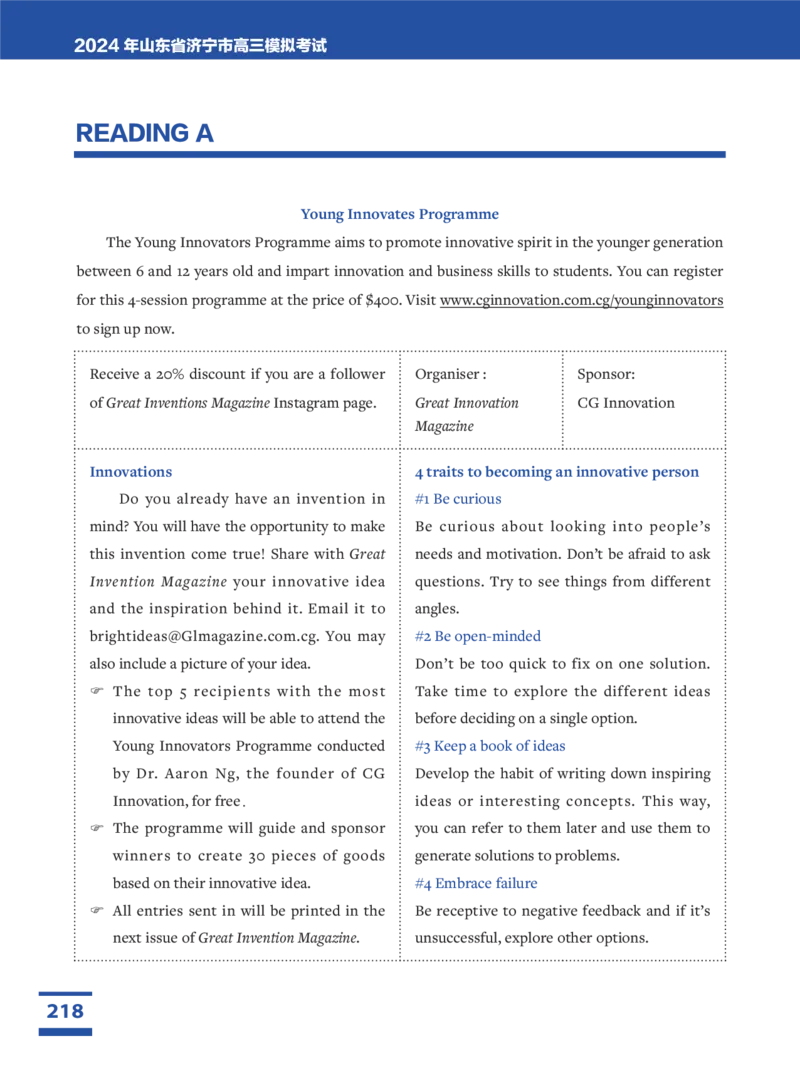
Young Innovates Programme
The Young Innovators Programme aims to promote innovative spirit in the younger generation
between 6 and 12 years old and impart innovation and business skills to students. You can register
for this 4-session programme at the price of $400. Visit www.cginnovation.com.cg/younginnovators
to sign up now.
Receive a 20% discount if you are a follower
of Great Inventions Magazine Instagram page.
Organiser :
Great Innovation
Magazine
Sponsor:
CG Innovation
Innovations
Do you already have an invention in
mind? You will have the opportunity to make
this invention come true! Share with Great
Invention Magazine your innovative idea
and the inspiration behind it. Email it to
brightideas@Glmagazine.com.cg. You may
also include a picture of your idea.

) The top 5 recipients with the most
innovative ideas will be able to attend the
Young Innovators Programme conducted
by Dr. Aaron Ng, the founder of CG
Innovation, for free.

) The programme will guide and sponsor
winners to create 30 pieces of goods
based on their innovative idea.

) All entries sent in will be printed in the
next issue of Great Invention Magazine.
4 traits to becoming an innovative person
#1 Be curious
Be curious about looking into people’s
needs and motivation. Don’t be afraid to ask
questions. Try to see things from different
angles.
#2 Be open-minded
Don’t be too quick to fix on one solution.
Take time to explore the different ideas
before deciding on a single option.
#3 Keep a book of ideas
Develop the habit of writing down inspiring
ideas or interesting concepts. This way,
you can refer to them later and use them to
generate solutions to problems.
#4 Embrace failure
Be receptive to negative feedback and if it’s
unsuccessful, explore other options.
218
2024 年山东省济宁市高三模拟考试
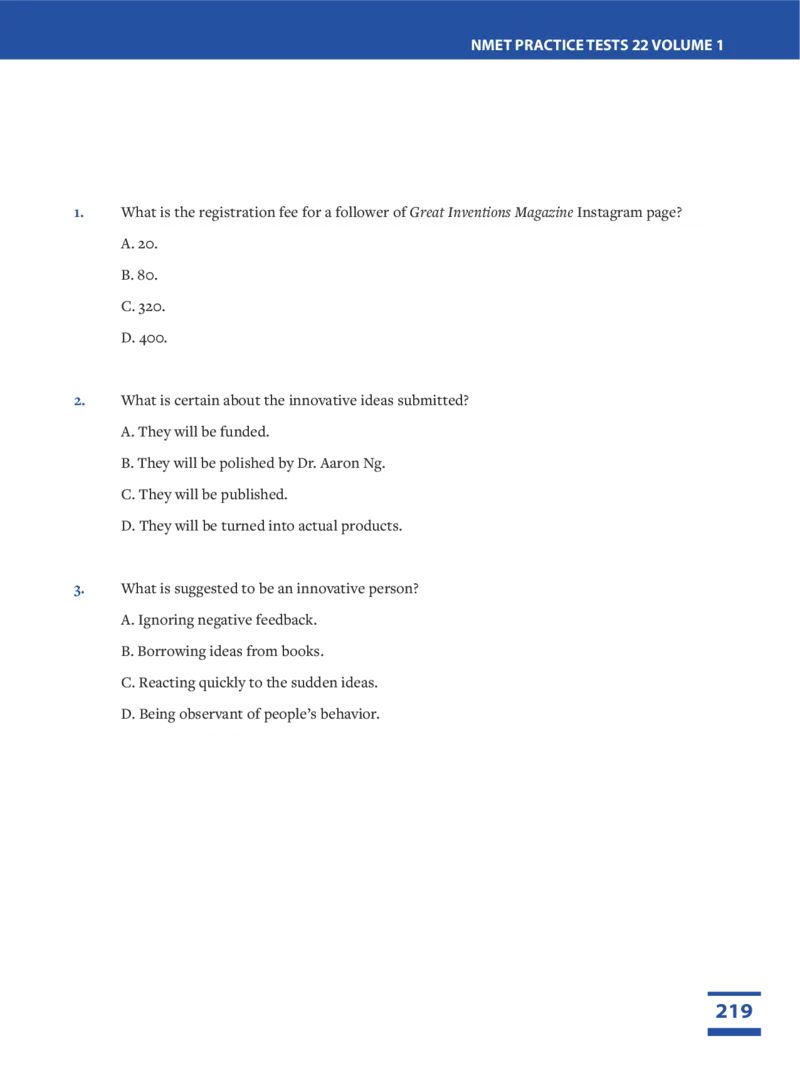
1.
What is the registration fee for a follower of Great Inventions Magazine Instagram page?

A. 20.

B. 80.

C. 320.

D. 400.
2.
What is certain about the innovative ideas submitted?

A. They will be funded.


B. They will be polished by Dr. Aaron Ng.

C. They will be published.


D. They will be turned into actual products.
3.
What is suggested to be an innovative person?

A. Ignoring negative feedback.

B. Borrowing ideas from books.

C. Reacting quickly to the sudden ideas.

D. Being observant of people’s behavior.
NMET PRACTICE TESTS 22 VOLUME 1
219
READING B
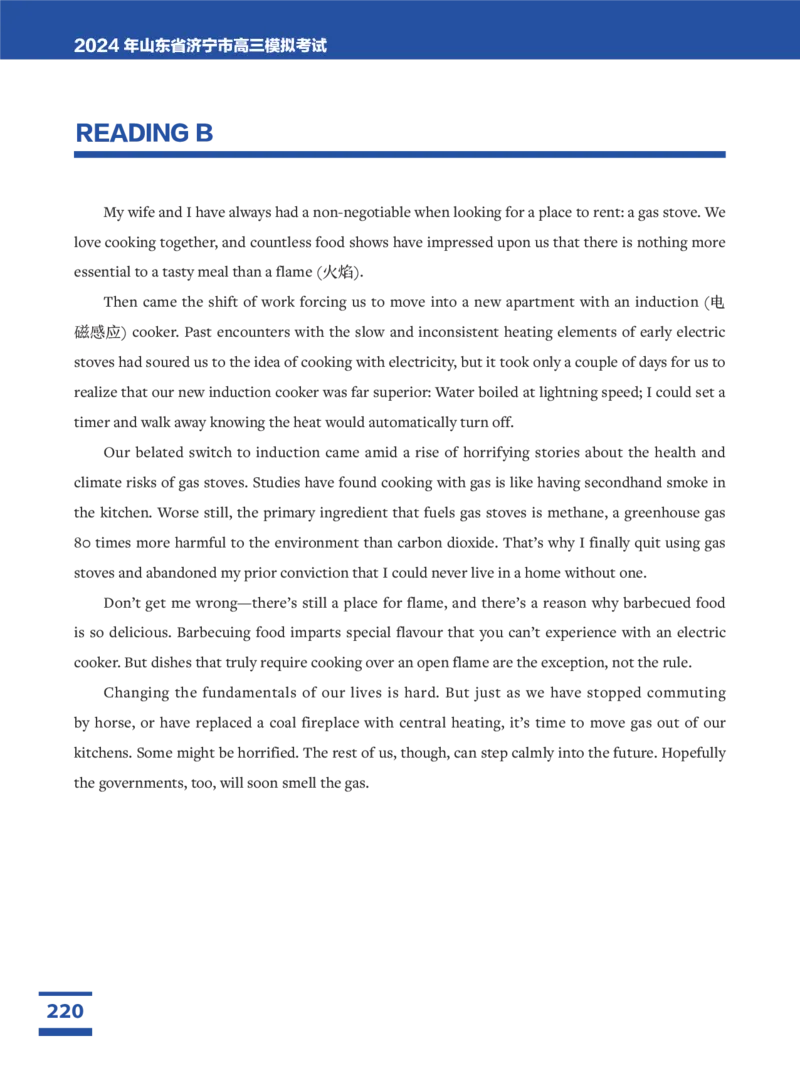
My wife and I have always had a non-negotiable when looking for a place to rent: a gas stove. We
love cooking together, and countless food shows have impressed upon us that there is nothing more
essential to a tasty meal than a flame (火焰).
Then came the shift of work forcing us to move into a new apartment with an induction (电
磁感应) cooker. Past encounters with the slow and inconsistent heating elements of early electric
stoves had soured us to the idea of cooking with electricity, but it took only a couple of days for us to
realize that our new induction cooker was far superior: Water boiled at lightning speed; I could set a
timer and walk away knowing the heat would automatically turn off.
Our belated switch to induction came amid a rise of horrifying stories about the health and
climate risks of gas stoves. Studies have found cooking with gas is like having secondhand smoke in
the kitchen. Worse still, the primary ingredient that fuels gas stoves is methane, a greenhouse gas
80 times more harmful to the environment than carbon dioxide. That’s why I finally quit using gas
stoves and abandoned my prior conviction that I could never live in a home without one.
Don’t get me wrong—there’s still a place for flame, and there’s a reason why barbecued food
is so delicious. Barbecuing food imparts special flavour that you can’t experience with an electric
cooker. But dishes that truly require cooking over an open flame are the exception, not the rule.
Changing the fundamentals of our lives is hard. But just as we have stopped commuting
by horse, or have replaced a coal fireplace with central heating, it’s time to move gas out of our
kitchens. Some might be horrified. The rest of us, though, can step calmly into the future. Hopefully
the governments, too, will soon smell the gas.
220
2024 年山东省济宁市高三模拟考试
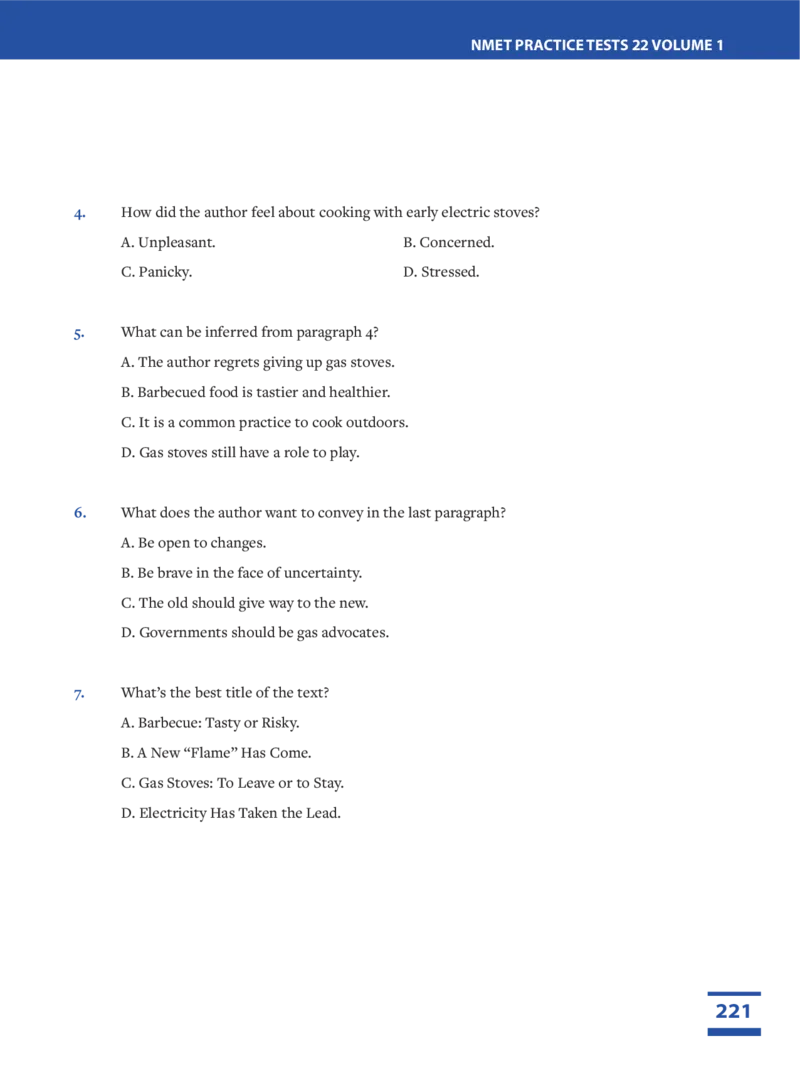
4.
How did the author feel about cooking with early electric stoves?

A. Unpleasant.


B. Concerned.

C. Panicky.


D. Stressed.
5.
What can be inferred from paragraph 4?

A. The author regrets giving up gas stoves.

B. Barbecued food is tastier and healthier.

C. It is a common practice to cook outdoors.

D. Gas stoves still have a role to play.
6.
What does the author want to convey in the last paragraph?

A. Be open to changes.


B. Be brave in the face of uncertainty.

C. The old should give way to the new.

D. Governments should be gas advocates.
7.
What’s the best title of the text?

A. Barbecue: Tasty or Risky.

B. A New “Flame” Has Come.

C. Gas Stoves: To Leave or to Stay.

D. Electricity Has Taken the Lead.
NMET PRACTICE TESTS 22 VOLUME 1
221
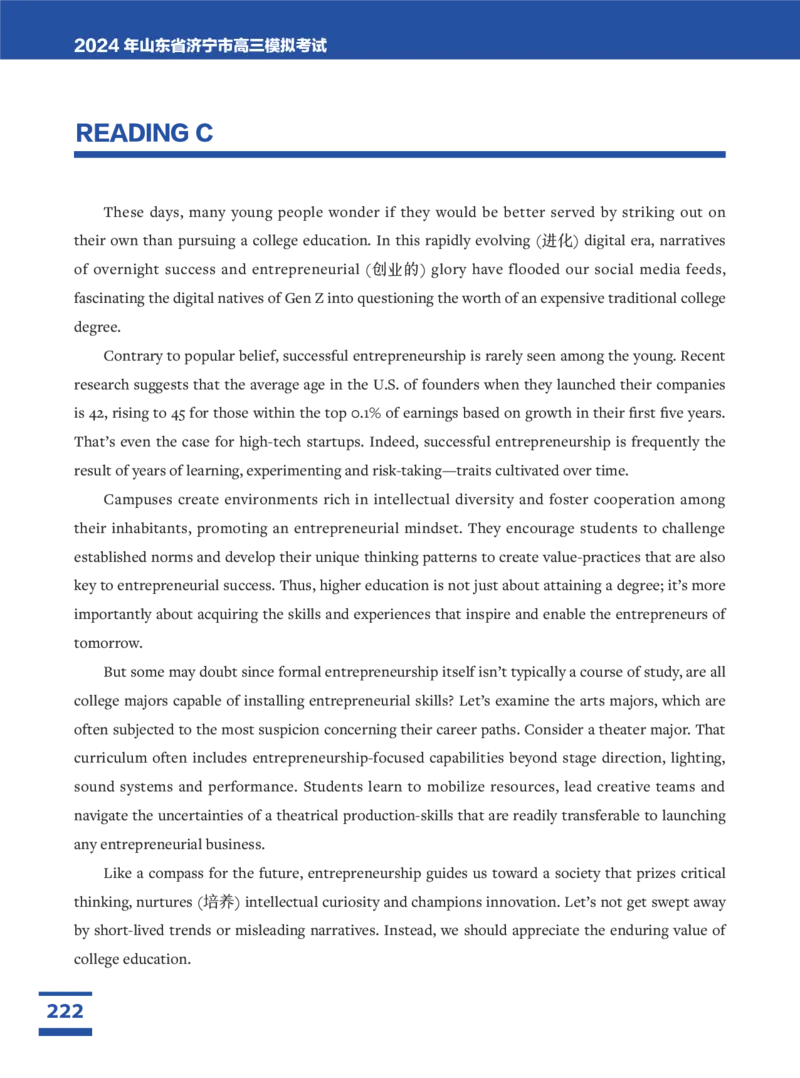
READING C
These days, many young people wonder if they would be better served by striking out on
their own than pursuing a college education. In this rapidly evolving (进化) digital era, narratives
of overnight success and entrepreneurial (创业的) glory have flooded our social media feeds,
fascinating the digital natives of Gen Z into questioning the worth of an expensive traditional college
degree.
Contrary to popular belief, successful entrepreneurship is rarely seen among the young. Recent
research suggests that the average age in the U.S. of founders when they launched their companies
is 42, rising to 45 for those within the top 0.1% of earnings based on growth in their first five years.
That’s even the case for high-tech startups. Indeed, successful entrepreneurship is frequently the
result of years of learning, experimenting and risk-taking—traits cultivated over time.
Campuses create environments rich in intellectual diversity and foster cooperation among
their inhabitants, promoting an entrepreneurial mindset. They encourage students to challenge
established norms and develop their unique thinking patterns to create value-practices that are also
key to entrepreneurial success. Thus, higher education is not just about attaining a degree; it’s more
importantly about acquiring the skills and experiences that inspire and enable the entrepreneurs of
tomorrow.
But some may doubt since formal entrepreneurship itself isn’t typically a course of study, are all
college majors capable of installing entrepreneurial skills? Let’s examine the arts majors, which are
often subjected to the most suspicion concerning their career paths. Consider a theater major. That
curriculum often includes entrepreneurship-focused capabilities beyond stage direction, lighting,
sound systems and performance. Students learn to mobilize resources, lead creative teams and
navigate the uncertainties of a theatrical production-skills that are readily transferable to launching
any entrepreneurial business.
Like a compass for the future, entrepreneurship guides us toward a society that prizes critical
thinking, nurtures (培养) intellectual curiosity and champions innovation. Let’s not get swept away
by short-lived trends or misleading narratives. Instead, we should appreciate the enduring value of
college education.
222
2024 年山东省济宁市高三模拟考试
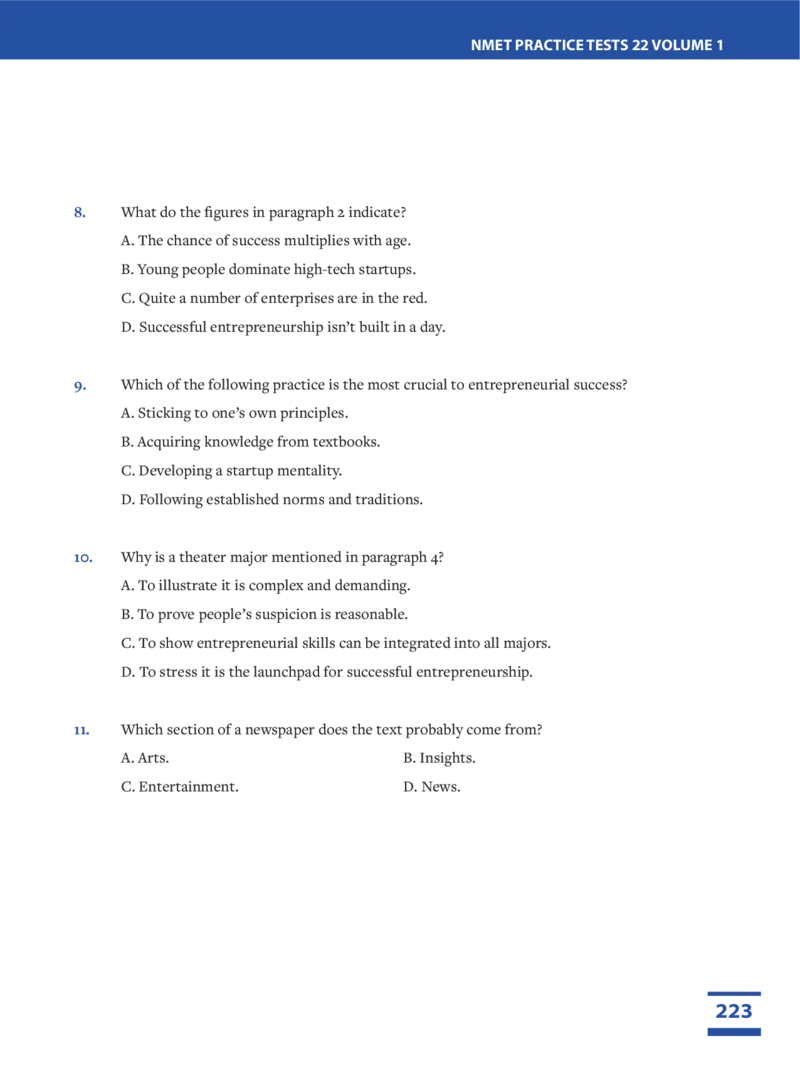
8.
What do the figures in paragraph 2 indicate?

A. The chance of success multiplies with age.

B. Young people dominate high-tech startups.

C. Quite a number of enterprises are in the red.

D. Successful entrepreneurship isn’t built in a day.
9.
Which of the following practice is the most crucial to entrepreneurial success?

A. Sticking to one’s own principles.

B. Acquiring knowledge from textbooks.

C. Developing a startup mentality.

D. Following established norms and traditions.
10.
Why is a theater major mentioned in paragraph 4?

A. To illustrate it is complex and demanding.

B. To prove people’s suspicion is reasonable.

C. To show entrepreneurial skills can be integrated into all majors.

D. To stress it is the launchpad for successful entrepreneurship.
11.
Which section of a newspaper does the text probably come from?

A. Arts.


B. Insights.

C. Entertainment.


D. News.
NMET PRACTICE TESTS 22 VOLUME 1
223
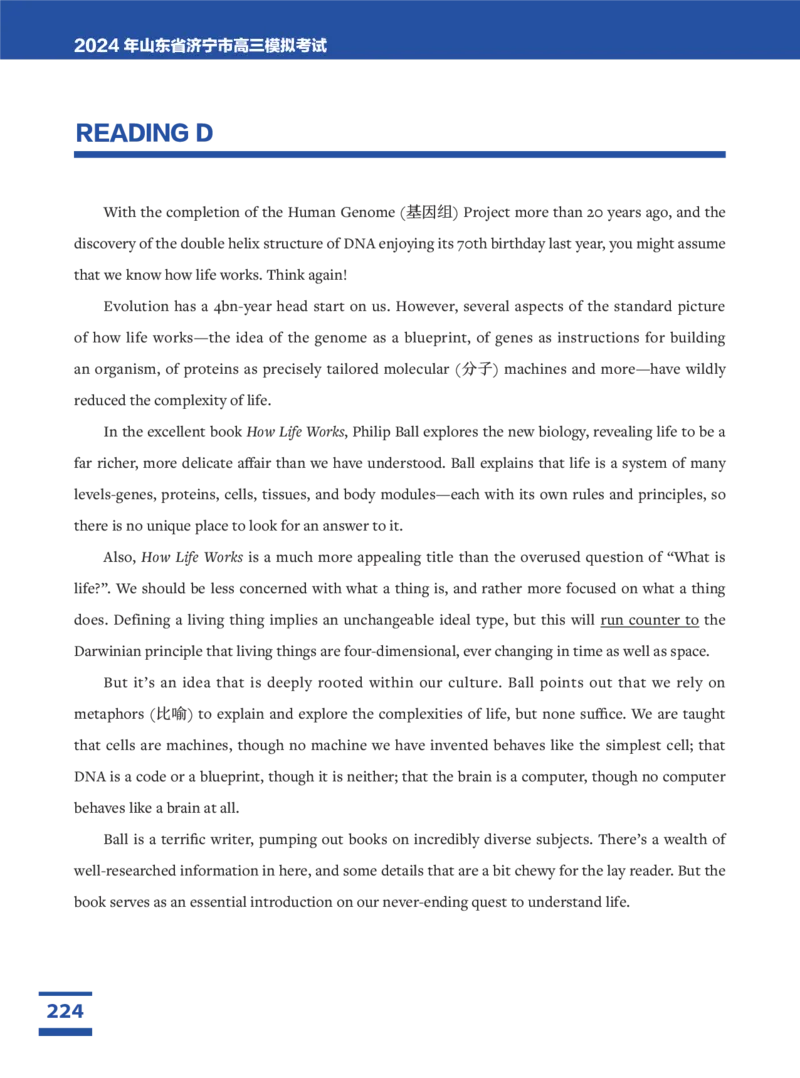
READING D
With the completion of the Human Genome (基因组) Project more than 20 years ago, and the
discovery of the double helix structure of DNA enjoying its 70th birthday last year, you might assume
that we know how life works. Think again!
Evolution has a 4bn-year head start on us. However, several aspects of the standard picture
of how life works—the idea of the genome as a blueprint, of genes as instructions for building
an organism, of proteins as precisely tailored molecular (分子) machines and more—have wildly
reduced the complexity of life.
In the excellent book How Life Works, Philip Ball explores the new biology, revealing life to be a
far richer, more delicate affair than we have understood. Ball explains that life is a system of many
levels-genes, proteins, cells, tissues, and body modules—each with its own rules and principles, so
there is no unique place to look for an answer to it.
Also, How Life Works is a much more appealing title than the overused question of “What is
life?”. We should be less concerned with what a thing is, and rather more focused on what a thing
does. Defining a living thing implies an unchangeable ideal type, but this will run counter to the
Darwinian principle that living things are four-dimensional, ever changing in time as well as space.
But it’s an idea that is deeply rooted within our culture. Ball points out that we rely on
metaphors (比喻) to explain and explore the complexities of life, but none suffice. We are taught
that cells are machines, though no machine we have invented behaves like the simplest cell; that
DNA is a code or a blueprint, though it is neither; that the brain is a computer, though no computer
behaves like a brain at all.
Ball is a terrific writer, pumping out books on incredibly diverse subjects. There’s a wealth of
well-researched information in here, and some details that are a bit chewy for the lay reader. But the
book serves as an essential introduction on our never-ending quest to understand life.
224
2024 年山东省济宁市高三模拟考试
12.
What does paragraph 2 intend to state?

A. The research of biology is tricky.

B. Human evolution is a lengthy process.

C. Genes determine the structure of living things.

D. Commonly held models of life are oversimplified.
13.
What does the underlined phrase “run counter to” in paragraph 4 mean?

A. Go against.

B. Refer to.

C. Account for.

D. Contribute to.
14.
What is Ball’s attitude to using metaphors to explain life?

A. Tolerant.


B. Disapproving.

C. Objective.


D. Indecisive.
15.
What is the purpose of the text?

A. To review a book.

B. To introduce genetic map.

C. To honour a writer.


D. To correct a misperception.
NMET PRACTICE TESTS 22 VOLUME 1
225
Recently, I carried out an investigation to discover what
it was that prevented people from journalling. (16) __________
So, today, I want to introduce a very simple tool—The
MicroMOVEment Wheel. It will help you pick up your journal
even at times when you really don’t feel like it.
 (17) __________ She describes creating this method so she
could use it as a creative planning tool for her writing projects
and goals. While it was originally aimed at writers, you can use this technique to help you complete
any project in a fun and creative way.
 (18) __________ Here’s how it works. Take a blank sheet of paper and draw a large circle, and
then another smaller circle in the middle. In the centre circle, write down what you are inspired
to achieve. Remember, journalling does not need to feel like a chore in your day. So come up with
descriptions for your journalling that are inspiring and energising. (19) __________ These are what
SARK refers to as the MicroMOVEments. Each MicroMOVEment is five minutes in length. So, in
the case of journalling, that would represent a minimum of up to five minutes of journalling in one
sitting, on any given day.
Let’s say you’re new to journalling. By setting aside five minutes out of your day, you could write
one word in your notebook that sums up a feeling or an experience. (20) __________ The idea of
the MicroMOVEment is to create easy steps to get your journal writing or writing projects moving.
When you keep the steps small, it will become double and achievable.
COMPLETION
226
2024 年山东省济宁市高三模拟考试
A.
Next, divide the rest of the circle into eight equal parts.
B.
It is the brainchild of international bestselling writer SARK.
C.
There are no hard-and-fast rules when it comes to journalling.
D.
Where to start and not having enough time were amongst the top responses.
E.
Daily tasks such as sweeping and washing are time-consuming and laborious.
F.
Then, list any associated words, images or thoughts that are generated by the word.
G.
The medicine with this approach is breaking your actions down into the tiniest steps.
NMET PRACTICE TESTS 22 VOLUME 1
227
CLOZE
On a Saturday morning, I drove my son Andrew to a shoe store. We (21) __________ the trip to
arrive right when the store opens, for Andrew is a nonspeaking autistic (自闭症患者) and prefers to
go shopping when it’s not (22) __________.
After the purchase, I thanked the two clerks and headed toward the door. What came next
only (23) __________ when the inner voice told you to do things differently. (24) __________ having
Andrew point to the “thank you” symbol on the picture chart he carries with him, I held up his
letterboard and asked how he’d like to (25) __________.
The picture chart only contains images that (26) __________ his most frequently used words.
The letterboard, however, (27) __________ an effective tool. He can (28) __________ more through the
use of a letterboard—by pointing to individual letters on an alphabet grid (网格). Using it requires
(29) __________ time and effort for him, though. He would not (30) __________ use of the letterboard
on his own. I need to present it to him and (31) __________ his wishes if he pushes it away.
“Thank you,” Andrew pointed to each letter. The two clerks’ (32) __________ almost dropped as
they watched. One spoke up: “My brother Jason doesn’t talk. Can I ask you…?” “Andrew, what do you
think?” I asked, (33) __________ that his patience might be running out.
Surprisingly, Andrew (34) __________ started pointing to letters: “Tell Jason he will change
everyone’s opinion of him in 26 letters.” I immediately (35) __________. Sometimes I forget just how
powerful the 26 letters are. Just how powerful Andrew is.
228
2024 年山东省济宁市高三模拟考试
21.
A. timed
B. started
C. extended
D. expected
22.
A. spacious
B. smelly
C. busy
D. bright
23.
A. changed
B. worked
C. happened
D. mattered
24.
A. Due to
B. As for
C. Apart from
D. Instead of
25.
A. translate
B. respond
C. comment
D. lecture
26.
A. summarize
B. match
C. identify
D. coin
27.
A. proves
B. witnesses
C. claims
D. remains
28.
A. shoulder
B. consume
C. predict
D. communicate
29.
A. significant
B. concrete
C. consistent
D. flexible
30.
A. resist
B. initiate
C. mind
D. promise
31.
A. tolerate
B. guarantee
C. challenge
D. respect
32.
A. hands
B. jaws
C. eyes
D. faces
33.
A. concerned
B. annoyed
C. embarrassed
D. ashamed
34.
A. helplessly
B. tirelessly
C. willingly
D. naturally
35.
A. checked out
B. cheered up
C. bent down
D. choked up
NMET PRACTICE TESTS 22 VOLUME 1
229
Recently, a Chinese college research team has released China’s first large language model (LLM)
“Xunzi”, (36) __________ uses deep learning techniques and massively big data sets to help conduct
research on ancient Chinese books. With the model, more information hidden in our cultural legacy
can (37) __________ (mine) for.
This model, named (38) __________ Xun Zi, one of the most celebrated philosophers in ancient
China for his Confucian classic Xunzi, (39) __________ (comprise) the majority of Chinese ancient
books and documents. (40) __________ (design) to intelligently process ancient texts, the system
aims to promote innovative development in the research and preservation of Chinese ancient books,
enhance the efficiency and quality of the legacy of traditional Chinese culture, (41) __________ boost
integration between LLM and ancient book processing.
The research on Chinese traditional classics is (42) __________ painstaking and laborious
challenge. Since 2013, the team have worked tirelessly to digitize Chinese classics like the Siku
Quanshu, (43) __________ (lay) a solid foundation for the large language model. Committed to the
philosophy of making their data and model (44) __________ (access) worldwide, the team have a
broader perspective targeting global users. To this end, they have (45) __________ (handsome) shared
the LLM on the Internet, enabling more individuals to appreciate traditional Chinese culture.
GRAMMAR
230
2024 年山东省济宁市高三模拟考试
WRITING
假定你是李华,作为“The Joy of Labor”项目组负责人,你将在下周英语口语课上作项目汇报,
请写一篇发言稿,内容包括:
1.	 开展情况;
2.	项目意义。
SAMPLE WRITING
Good morning, everyone! I’m Li Hua, thrilled to report on our project, “The Joy of Labor”.
At the beginning, our four-member team carefully planned and assigned tasks based on
individual strengths, guaranteeing that each of us had an equal opportunity to contribute. Over the
past four weeks, we have actively engaged in a diverse range of hands-on, labor-intensive activities,
ranging from gardening to park cleanup and community service. To our joy, this project has been
immensely rewarding. Not only does it underscore the value of hard work, but also highlights the
joy of labor and fosters team spirit, greatly strengthening our community bonds and environmental
responsibilities.
In conclusion, the “Joy of Labor” project has been an enriching and rewarding experience.
Thank you for your attention.
NMET PRACTICE TESTS 22 VOLUME 1
231
One morning, Father was helping Danny pack his bag for a holiday camp. “Do I really have to
go, Father?” Danny asked hesitantly. “Son, sometimes the best lessons in life are learnt at camps,”
Father encouraged. “But I never have the right words to say when talking to someone new,” Danny
complained. “Alright, let’s make a deal. If you learn something good at this camp, this shall be the
last holiday camp I sign you up for,” Father responded with a proposal. “Deal,” Danny replied.
Right after dinner on the first day at camp, everyone was busy packing their bags in preparation
for the night walk. Danny headed to the canteen to get a bottle of iced tea. Just as Danny was about
to secure the bottle cap, he was caught off-guard as someone suddenly brushed past him and hit his
arm. The bottle slipped out of his hands and fell to the floor. Light brown liquid flowed out, creating
ugly mess on the floor. Danny caught a flash of a boy in a green T-shirt running off into the distance.
“How rude!” Danny shouted, gritting his teeth. “Not even an apology!”
Just then, Mr Halim, the camp guide, approached Danny. “What are you doing here inste-” he
asked but stopped midway when he saw the mess on the floor. “It wasn’t me!” Danny raised his voice
in his defence. “You’ll fix this mess you created before we head out for the night walk,” Mr Halim
remarked, walking off in a hurry before Danny could explain himself.
“How unfortunate,” Danny thought to himself. “It wasn’t even my fault to begin with.” Getting
down on his knees, he started wiping up the mess. Twenty minutes passed and the floor was dry.
Danny managed to calm himself down and think clearly. He recalled how Father had given him a
second chance when he broke his vase by mistake a week ago. Realizing that what had happened just
now might have been an accident, Danny resolved to let the past rest.
CONTINUATION
232
2024 年山东省济宁市高三模拟考试
As Danny got up to leave, he saw the boy in the green T-shirt approaching him. “You…you...”
Danny started. “Please don’t yell at me,” the boy begged. “Let me explain, I’m Siva. I felt bad for
causing the spill earlier when I ran to get my torch for the night walk. I knew I had to make up for
what I had done earlier. That’s why I’m here to say sorry,” he said sincerely. “Well, I was upset at
first,” Danny admitted. “But not anymore. I figured you might not have done it on purpose,” he
added. For a few brief moments, their gazes locked, and then they burst into laughter, understanding
the mutual relief they felt. With this newfound friendship, they joyfully embarked on the night walk.
The next day when Father came to fetch Danny, he saw a cheerful Danny. Expecting to find
a disheartened and defeated boy, he was pleasantly surprised to see Danny engaging in lively
conversation with a boy in a green T-shirt, face radiating with joy and enthusiasm. Truly remarkable!
As they drove home, Danny couldn’t contain his excitement, eagerly sharing stories about his
newfound friend. “I had an amazing time and learned something truly valuable!” Danny exclaimed
enthusiastically. With a teasing grin, Father replied, “Well done, lad! So, according to our initial deal,
this camp is the last one, huh?” Danny shook his head vigorously, pleading eagerly for another trip to
the camp.
SAMPLE WRITING
NMET PRACTICE TESTS 22 VOLUME 1
233
READING
A
1. C
2. C
3. D
B
4. A
5. D
6. A
7. B
C
8. D
9. C
10. C
11. B
D
12. D
13. A
14. B
15. A
COMPLETION
16. D
17. B
18. G
19. A
20. F
CLOZE
21. A
22. C
23. C
24. D
25. B
26. B
27. A
28. D
29. A
30. B
31. D
32. B
33. A
34. C
35. D
GRAMMAR
36. which
37.  be mined
38. after / for
39. comprises
40. designed
41. and
42. a
43. laying
44. accessible
45. handsomely
ANSWER KEY
234
2024 年山东省济宁市高三模拟考试