高中英语外刊时文阅读训练
专题 07
中国首次月球背面“取壤”
Ⅰ.外刊原文阅读
Ⅱ.阅读理解专项针对性练习
Ш.新课标高频词汇提取及训练
Ⅳ.参考译文赏析
【原文·外刊阅读】
China Brings Samples From the Moon’s Far Side to Earth in First-Ever Feat
(文章来源:Smith Sonian Mag)
In a global first, the China National Space Administration (CNSA) has successfully retrieved rock and
soil samples from the far side of the moon, a feat
that will offer scientists an unprecedented opportunity
to study the lesser-understood lunar face that is never
visible from Earth.
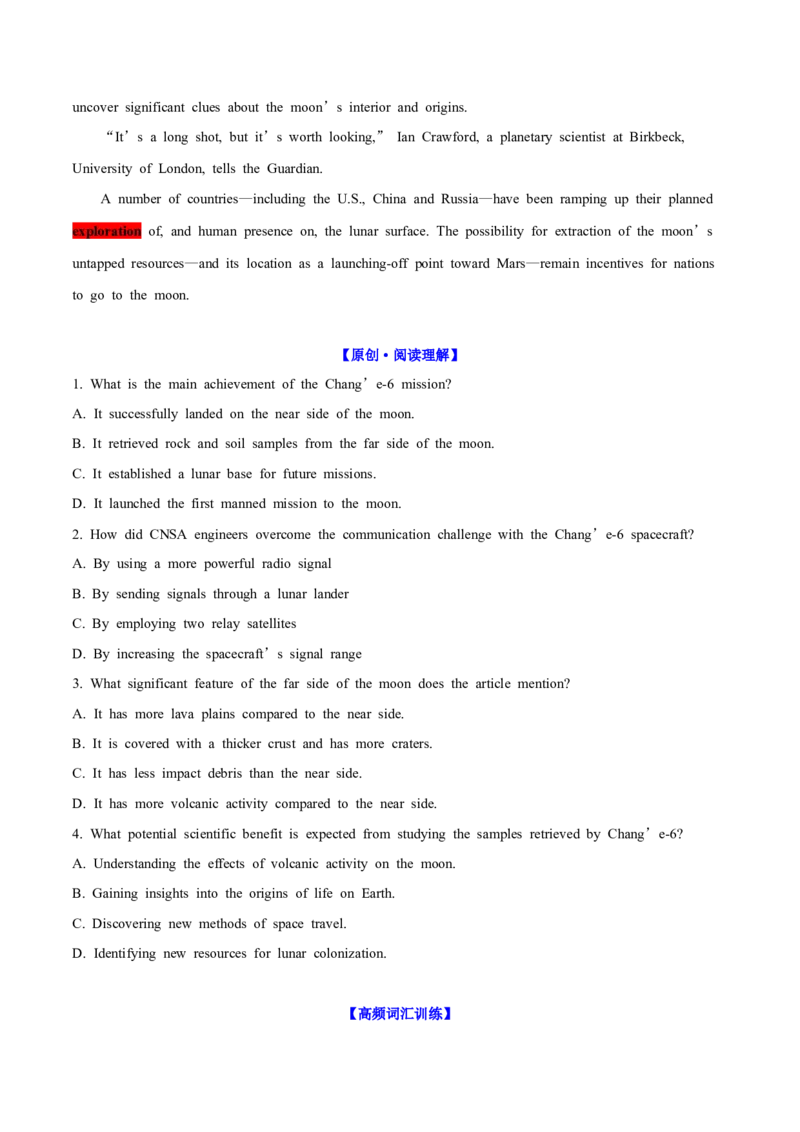
The samples re-entered Earth’s atmosphere on
Tuesday and landed via parachute in rural Inner
Mongolia, an autonomous region in northern China. They were secured in a re-entry capsule that
detached from a larger spacecraft, called Chang’e-6. The entire mission, the sixth leg of the Chinese
space agency’s Chang’e project, lasted nearly two months and marked a milestone for lunar research.
“Chang’e-6 is the first mission in human history to return samples from the far side of the
moon,” Long Xiao, a planetary geologist at China University of Geosciences, tells the New York
Times’ Katrina Miller. “This is a major event for scientists worldwide… a cause for celebration for all
humanity.”
Launched on May 3, the Chang’e-6 spacecraft consisted of four modules: an ascender, an orbiter, alunar lander and a return capsule. It reached lunar orbit five days later, where it remained for several
weeks. On June 1, the lander successfully descended and touched down on the far side of the moon in
its oldest and largest impact crater, known as the South Pole-Aitken basin.
This itself was no small feat: Directing the movement of a spacecraft on the far side of the moon is
difficult, because the moon blocks radio signals from Earth. To get around this problem, CNSA engineers
used two relay satellites, Queqiao and Queqiao-2, launched ahead of this mission, to communicate with
the spacecraft.
Once on the moon, Chang’e-6 used a robotic arm’s scoop and drill to collect 4.4 pounds of lunar
material from impact crater. Compared to the lunar face we can see, the far side of the moon has a
thicker crust, fewer ancient lava plains called maria and a greater number of craters and debris from
collisions.
“Recovering samples from the far side is tremendously exciting scientifically, as we only have very
limited information on the geology there,” Martin Barstow, an astrophysicist at the University of
Leicester in England, tells the Guardian’s Ian Sample. “It has been processed very differently to the
side of the moon facing us, which has been extensively resurfaced by volcanic activity in the past,
creating the maria from which most samples have been obtained.”
The collection of rocks launched from the lunar surface in the spacecraft’s ascender on June 3, then
united with the orbiter days later. It began its Earth-bound journey on June 21, culminating in its arrival
to China this week.
Scientists hope the newly secured material will offer clear evidence of the history of lunar asteroid
impacts, which could, in turn, shed light on impacts to the early Earth. Most known basins on the moon
formed from a barrage of space rocks some 3.9 billion years ago, during a period known as the Late
Heavy Bombardment. It is likely, astronomers say, that asteroid showers that hit the moon also hit our
home planet.
“This also has implications for understanding the origins of life on Earth,” the Planetary Society’s
Jason Davis wrote earlier this year. “It’s possible that asteroids carried water and organic materials to
Earth during the Late Heavy Bombardment. Understanding the timing and circumstances of this event is
critical for unpacking our origin story.”
There is also a possibility, because the South Pole-Aitken basin is so deep, that the lunar mantle is
exposed within it. If sediment from this layer were contained in the Chang’e-6 samples, scientists coulduncover significant clues about the moon’s interior and origins.
“It’s a long shot, but it’s worth looking,” Ian Crawford, a planetary scientist at Birkbeck,
University of London, tells the Guardian.
A number of countries—including the U.S., China and Russia—have been ramping up their planned
exploration of, and human presence on, the lunar surface. The possibility for extraction of the moon’s
untapped resources—and its location as a launching-off point toward Mars—remain incentives for nations
to go to the moon.
【原创·阅读理解】
1. What is the main achievement of the Chang’e-6 mission?
A. It successfully landed on the near side of the moon.
B. It retrieved rock and soil samples from the far side of the moon.
C. It established a lunar base for future missions.
D. It launched the first manned mission to the moon.
2. How did CNSA engineers overcome the communication challenge with the Chang’e-6 spacecraft?
A. By using a more powerful radio signal
B. By sending signals through a lunar lander
C. By employing two relay satellites
D. By increasing the spacecraft’s signal range
3. What significant feature of the far side of the moon does the article mention?
A. It has more lava plains compared to the near side.
B. It is covered with a thicker crust and has more craters.
C. It has less impact debris than the near side.
D. It has more volcanic activity compared to the near side.
4. What potential scientific benefit is expected from studying the samples retrieved by Chang’e-6?
A. Understanding the effects of volcanic activity on the moon.
B. Gaining insights into the origins of life on Earth.
C. Discovering new methods of space travel.
D. Identifying new resources for lunar colonization.
【高频词汇训练】1.Without telescope, many stars overhead are (visible) to the naked eye even in the clear night sky.
(所给词的适当形式填空)
2.Astronomers say this is a natural phenomenon that (happen) for a century. (所给词的适当形式填
空)
3.The rescue team (consist) of firefighters that have first aid skills. (所给词的适当形式填空)
4.Nixon’s (visit) China marked a new ear between U.S. and China diplomatic relations. (所给词
的适当形式填空)
5.In the face of a changing climate and an evergrowing population, strengthening the world’s future food
(secure) has never been more important. (所给词的适当形式填空)
6.With more problems related to environment appearing, the effects of climate change (explore) now by
scientists around the world. (所给词的适当形式填空)
7.Once (expose) to light, the film will be damaged and get useless., the film will be damaged and get
useless. (所给词的适当形式填空)
8.The (extend) of the subway will take several months. The bank plans various
(extension) to its credit facilities. (所给词的适当形式填空)
9.China (develop)at a tremendous rate, an outstanding achievement never seen before, during the past
two decades. (所给词的适当形式填空)
10.She (signal) the other girls that everything was all right. (所给词的适当形式填空)
11.Crossing the North Pole on foot was an amazing feat of human e . (根据首字母单词拼写)
12.For second degree burns, keep cloths cool by putting them in a basin of cold water, s the water out
and placing them on the burned area over and over again for about an hour.
【参考译文】
中国首次将月球背面的样本带回地球
在全球范围内,中国国家航天局(CNSA)首次成功地从月球背面取回了岩石和土壤样本,这一壮举
将为科学家提供前所未有的机会,研究地球上从未见过的鲜为人知的月球表面。
周二,这些样本重新进入地球大气层,并通过降落伞降落在中国北方自治区内蒙古农村。它们被固定
在一个从更大的航天器嫦娥六号上分离出来的返回舱中。整个任务是中国航天局嫦娥项目的第六站,持续
了近两个月,标志着月球研究的一个里程碑。“嫦娥六号是人类历史上第一次从月球远端返回样本的任务,”中国地质大学行星地质学家龙晓告诉
《纽约时报》的卡特琳娜·米勒。“这对全世界的科学家来说是一件大事……全人类都应该庆祝。”
嫦娥六号于5月3日发射,由四个模块组成:上升器、轨道器、月球着陆器和返回舱。五天后,它到
达了月球轨道,并在那里停留了几个星期。6月1日,着陆器成功下降并降落在月球最古老、最大的撞击
坑,即南极艾特肯盆地。
这本身就是一项不小的壮举:在月球背面指挥航天器的运动是困难的,因为月球会阻挡来自地球的无
线电信号。为了解决这个问题,中国国家航天局的工程师使用了在这次任务之前发射的两颗中继卫星“鹊
桥”和“鹊桥二号”与航天器进行通信。
一旦登上月球,嫦娥六号就使用机械臂的铲子和钻头从撞击坑中收集了 4.4磅的月球物质。与我们看
到的月球表面相比,月球的背面有更厚的地壳,更少的被称为玛丽亚的古老熔岩平原,以及更多的撞击坑
和碎片。
英国莱斯特大学的天体物理学家Martin Barstow告诉《卫报》的Ian Sample:“从远处回收样本在科
学上非常令人兴奋,因为我们对那里的地质信息非常有限。”。“它的处理方式与面向我们的月球侧面非
常不同,过去火山活动曾广泛地重新浮出月球表面,形成了大多数样本都是从中获得的玛丽亚。”
6月3日,在航天器的上升器中从月球表面发射的岩石集合,几天后与轨道器结合。它于 6月21日开
始了它的地球之旅,最终于本周抵达中国。
科学家们希望新获得的材料将为月球小行星撞击的历史提供明确的证据,这反过来又可以揭示对早期
地球的影响。月球上大多数已知的盆地是在大约39亿年前,即所谓的晚期重轰炸时期,由一系列太空岩石
形成的。天文学家说,撞击月球的小行星阵雨很可能也撞击了我们的家园星球。
行星学会的杰森·戴维斯今年早些时候写道:“这也对理解地球上生命的起源产生了影响。”。“在晚
期重轰炸期间,小行星可能将水和有机物质带到了地球。了解这一事件的时间和情况对于解开我们的起源
故事至关重要。”
还有一种可能性,因为南极艾特肯盆地太深,月球地幔暴露在其中。如果嫦娥六号样本中含有这一层
的沉积物,科学家们可能会发现有关月球内部和起源的重要线索。
伦敦大学伯克贝克分校的行星科学家伊恩·克劳福德告诉《卫报》:“(尽管)它可能性不大,但却值得试
一下。”。
包括美国、中国和俄罗斯在内的一些国家一直在加紧计划中的月球表面探索和人类活动。开采月球未
开发资源的可能性及其作为火星发射点的位置仍然是各国登月的动力。