热点话题04  猪肾脏移植实验——生物科学研究
目录
时文精读------------------------------------------------------------精选外刊原创阅读理解
  【原创·阅读理解】
【课标词汇积累】
【课标词汇训练】
【参考译文】
好题精练----------------------------------------------------------精选名校及联考话题专练
【阅读理解】
【阅读7 选5】
【完形填空】
【语法填空】
【话题·导语】
纽约某医院的医生们已启动一项试验计划,旨在验证特制猪肾是否可替代人类肾脏。该试验结
果有望帮助数千名等待新肾移植的患者。
【原文·时文阅读】
文章来源:外文网站文章改编
Transplanted organs usually come from people who have died, but who wanted their organs to be used to help
other people live. But there are far more patients with kidney trouble than there are kidneys.
For years, scientists have tried to figure out how to transplant organs from other animals into humans. This is
hard because the human body almost always rejects something that isn’t its own. More recently, scientists have
focused on transplants from pigs. In many ways, pigs’ bodies are similar to humans. It’s fairly easy to raise pigs,
and they grow quickly.
To prevent pig organs from being rejected by the patient’s body, scientists have been experimenting with
“gene editing” to change the pig’s DNA. Scientists have made several changes to the pig’s DNA, and even added
some things normally found in human DNA. Some kidneys have come from pigs with as many as 69 changes to
their DNA.
读时文精读
In the last few years, these methods have led to greatly improved results. Early pig transplants were
successful, but only for a short time. But in 2024, a woman lived with a pig kidney for over four months before
going on dialysis again.
Tim Andrews is a 67-year-old man.He set a new record by living with a pig kidney for nearly nine months
before going back on dialysis. Mr. Andrews is still waiting for a human transplant, but his long success with a pig
kidney has encouraged many people.
The pig transplant trial program could help scientists answer a lot of questions. It will provide new
information about the safety – as well as the challenges – of the process. It will also teach them about which gene
edits work best. Most importantly, it could help them discover how to help patients live longer with pig transplants.
【原创·阅读理解】(299words)
1.Why do scientists try to transplant organs from other animals into humans?
A.Because pigs’ bodies are similar to humans.
B.Because It is fairly easy to raise pigs
C.Because there are fewer kidneys than patients.
D.Because they want to do some experiments.
2.Why do the Scientists change the pig’s DNA?
A.To stop pig organs from being rejected.
B. To Raise pigs as many as possible.
C. To make the pigs grow quickly.
D.To meet the people’s need.
3.Which word has the similar meaning with the underlined word “dialysis”?
A.Analysis
B.Emphasis
C. Purification
D.Indication
4.What does the writer think of the pig transplant trial program?
A.Practical.
B.Helpful
C.Useless.
D.Doubtful.
【课标词汇积累】
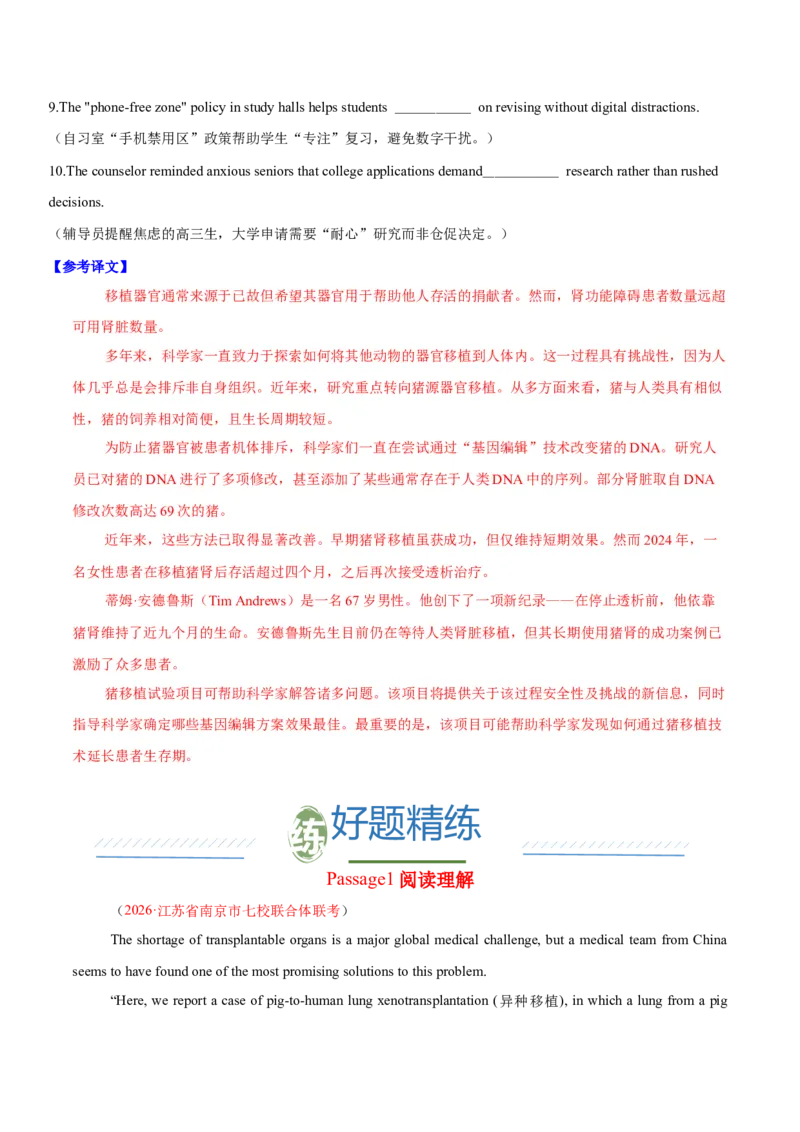
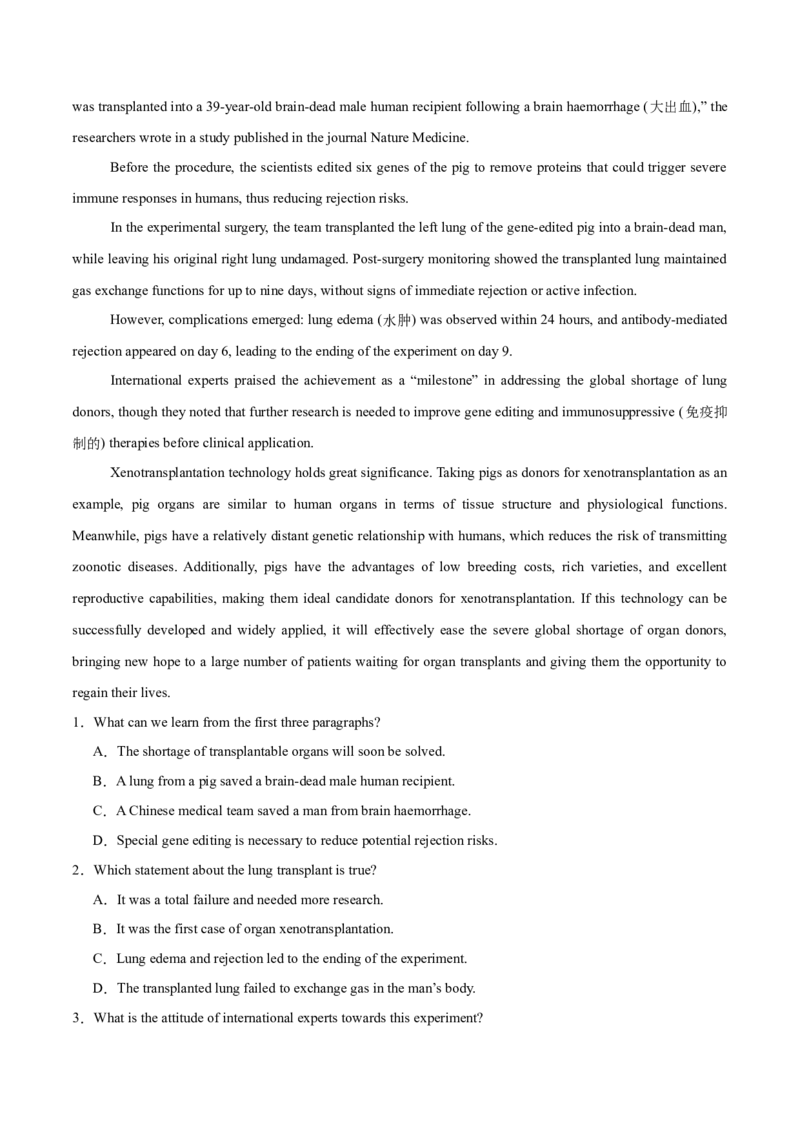
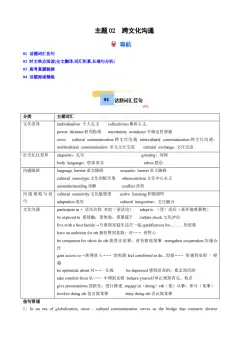
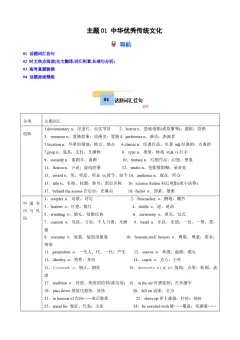
1.transplant vt.移植, 移种, 移植(器官、皮肤、头发等); n.移植, 移植物, 移植者; vi.迁移, 移居
After the school basketball team's captain was injured, the coach decided to transplant a new leadership strategy by
assigning the role to a sophomore player, which surprisingly boosted the team's morale.
(校篮球队队长受伤后,教练决定“移植”新的领导策略,将队长职务交给一名高二学生,意外提升了团队士
气。)
2.kidney n.肾,肾脏, (可食用的动物的)腰子, 脾气,性格
The school's charity week raised funds for a kidney disease patient, teaching students the value of empathy beyond
textbooks.
(校园慈善周为一名“肾脏”疾病患者筹款,让学生学到课本外的同理心。)
3. reject v.拒绝考虑, 摈弃, 不录用, 不出版, 冷漠对待n.残次品, 不合格者
The debate club had to reject the proposal of canceling practice sessions, emphasizing that persistence is key to
overcoming stage fright.
(辩论社不得不“拒绝”取消训练课的提议,强调坚持是克服怯场的关键。)
4.successful adj.成功的
The successful launch of the student-led coding club proved that passion could bridge the gap between limited
resources and innovation.
(学生主导的编程社“成功”成立,证明热情能弥补资源与创新间的差距。)
5.challenge n.挑战, 比赛邀请, 质疑; v.对…怀疑, 挑战,考验, 盘问
Adapting to a dormitory life with roommates from different backgrounds became an unexpected challenge for
introverted Emma.
(适应与不同背景室友的宿舍生活,成为内向艾玛的意外“挑战”。)
6.encourage v.鼓励, 使有希望, 劝说, 促进
Teachers encourage students to annotate textbooks with personalized symbols, turning passive reading into active
learning.
(老师“鼓励”学生用个性化符号标注课本,将被动阅读转化为主动学习。)
7.record n.记录,记载, 唱片,  v.记录;记载, 录制, 标明,显示; adj.创纪录的
Breaking the school's 100-meter sprint record became possible when Jason trained with a customized app.
(杰森用定制APP 训练后,打破校百米短跑“纪录”成为可能。)
8.normally adv.通常, 正常地
Normally, the library is quiet, but during exam weeks, it transforms into a 24/7 collaborative learning hub.
(“通常”图书馆很安静,但考试周它会变成全天候协作学习中心。)
9. focus v. 集中;调焦;聚焦;集中光束; n. 焦点;中心点;聚焦点;焦距;(使)集中目光;(使)逐渐
聚焦
Her ability to focus on math problems while her classmates chatted earned her the nickname "The Zen Master."
(同学聊天时她仍能“专注”数学题,因此得名“禅修大师”。)
10.patient n. 病人,患者 adj. 有耐心的,能忍耐的
Being patient with slow-learners in group projects, Sarah discovered that teaching others solidified her own
knowledge.
(在小组项目中“耐心”对待学得慢的同学,莎拉发现教别人能巩固自己的知识。)
【课标词汇训练】
根据语境,从上面的“课标词汇”中选用合适的单词及其正确形式将句子补充完整。
1.The biology club plans to _____________ the experiment of growing hydroponic vegetables into the school's
greenhouse to study plant adaptation.
(生物社计划将水培蔬菜实验“移植”到学校温室,研究植物适应性。)
2.In the anatomy class, the teacher used a vivid model to explain how a _____________ filters waste, comparing it to
students filtering useless information during exams.
(解剖课上,老师用生动模型解释“肾脏”过滤废物的过程,比喻为学生考试时筛选无用信息。)
3.When her poem was _____________ by the school magazine, Lisa revised it ten times until it was finally published.
(当诗歌被校刊“拒绝”后,丽莎修改了十遍直至最终发表。)
4.His _____________ balance between choir rehearsals and final exams became a time-management case study for
freshmen.
(他在合唱排练与期末考试间“成功”平衡,成为新生时间管理案例。)
5.The physics Olympiad was a tough _____________, but Mark found joy in solving problems that even textbooks
couldn't cover.
(物理奥赛是严峻“挑战”,但马克从解决课本未涵盖的难题中获得乐趣。)
6.The principal's speech about failing the college entrance exam but winning in life _____________ the graduating class.
(校长关于高考失利但人生赢家的演讲“鼓舞”了毕业班。)
7.The chemistry lab requires students to _____________ every step in detail, cultivating scientific rigor since high
school.
(化学实验室要求学生详细“记录”每个步骤,从高中培养科学严谨性。)
8.While _____________ hesitant to speak up, Tom delivered a flawless presentation after joining the drama club.
(尽管“通常”不善言辞,加入戏剧社后汤姆完成了完美演讲。)
9.The "phone-free zone" policy in study halls helps students _____________ on revising without digital distractions.
(自习室“手机禁用区”政策帮助学生“专注”复习,避免数字干扰。)
10.The counselor reminded anxious seniors that college applications demand_____________ research rather than rushed
decisions.
(辅导员提醒焦虑的高三生,大学申请需要“耐心”研究而非仓促决定。)
【参考译文】
移植器官通常来源于已故但希望其器官用于帮助他人存活的捐献者。然而,肾功能障碍患者数量远超
可用肾脏数量。
多年来,科学家一直致力于探索如何将其他动物的器官移植到人体内。这一过程具有挑战性,因为人
体几乎总是会排斥非自身组织。近年来,研究重点转向猪源器官移植。从多方面来看,猪与人类具有相似
性,猪的饲养相对简便,且生长周期较短。
为防止猪器官被患者机体排斥,科学家们一直在尝试通过“基因编辑”技术改变猪的DNA。研究人
员已对猪的DNA 进行了多项修改,甚至添加了某些通常存在于人类DNA 中的序列。部分肾脏取自DNA
修改次数高达69 次的猪。
近年来,这些方法已取得显著改善。早期猪肾移植虽获成功,但仅维持短期效果。然而2024 年,一
名女性患者在移植猪肾后存活超过四个月,之后再次接受透析治疗。
蒂姆·安德鲁斯(Tim Andrews)是一名67 岁男性。他创下了一项新纪录——在停止透析前,他依靠
猪肾维持了近九个月的生命。安德鲁斯先生目前仍在等待人类肾脏移植,但其长期使用猪肾的成功案例已
激励了众多患者。
猪移植试验项目可帮助科学家解答诸多问题。该项目将提供关于该过程安全性及挑战的新信息,同时
指导科学家确定哪些基因编辑方案效果最佳。最重要的是,该项目可能帮助科学家发现如何通过猪移植技
术延长患者生存期。
Passage1 阅读理解
(2026·江苏省南京市七校联合体联考)
The shortage of transplantable organs is a major global medical challenge, but a medical team from China
seems to have found one of the most promising solutions to this problem.
“Here, we report a case of pig-to-human lung xenotransplantation (异种移植), in which a lung from a pig
练好题精练
was transplanted into a 39-year-old brain-dead male human recipient following a brain haemorrhage (大出血),” the
researchers wrote in a study published in the journal Nature Medicine.
Before the procedure, the scientists edited six genes of the pig to remove proteins that could trigger severe
immune responses in humans, thus reducing rejection risks.
In the experimental surgery, the team transplanted the left lung of the gene-edited pig into a brain-dead man,
while leaving his original right lung undamaged. Post-surgery monitoring showed the transplanted lung maintained
gas exchange functions for up to nine days, without signs of immediate rejection or active infection.
However, complications emerged: lung edema (水肿) was observed within 24 hours, and antibody-mediated
rejection appeared on day 6, leading to the ending of the experiment on day 9.
International experts praised the achievement as a “milestone” in addressing the global shortage of lung
donors, though they noted that further research is needed to improve gene editing and immunosuppressive (免疫抑
制的) therapies before clinical application.
Xenotransplantation technology holds great significance. Taking pigs as donors for xenotransplantation as an
example, pig organs are similar to human organs in terms of tissue structure and physiological functions.
Meanwhile, pigs have a relatively distant genetic relationship with humans, which reduces the risk of transmitting
zoonotic diseases. Additionally, pigs have the advantages of low breeding costs, rich varieties, and excellent
reproductive capabilities, making them ideal candidate donors for xenotransplantation. If this technology can be
successfully developed and widely applied, it will effectively ease the severe global shortage of organ donors,
bringing new hope to a large number of patients waiting for organ transplants and giving them the opportunity to
regain their lives.
1.What can we learn from the first three paragraphs?
A.The shortage of transplantable organs will soon be solved.
B.A lung from a pig saved a brain-dead male human recipient.
C.A Chinese medical team saved a man from brain haemorrhage.
D.Special gene editing is necessary to reduce potential rejection risks.
2.Which statement about the lung transplant is true?
A.It was a total failure and needed more research.
B.It was the first case of organ xenotransplantation.
C.Lung edema and rejection led to the ending of the experiment.
D.The transplanted lung failed to exchange gas in the man’s body.
3.What is the attitude of international experts towards this experiment?
A.Negative.
B.Positive.
C.Doubtful.
D.Objective.
4.What is the main idea of the last paragraph?
A.Pigs are genetically similar to humans.
B.Pigs are perfect for xenotransplantation.
C.Xenotransplantation technology is of great importance.
D.Xenotransplantation technology still has a long way to go.
Passage2 阅读理解
(2026·江苏省盐城市七校联盟第二次联考)
Heart disease is the leading cause of death in the United States. A transplant (移植) is the only treatment
available to patients with end-stage heart failure, but there is a severe shortage of heart donors. That means there’s
an urgent need to develop new ways to regenerate a diseased heart. Now the good news is that the world’s first
complete 3D-printed heart, made using the patient’s own cells and materials, has been created in a lab.
Until now, success has been limited to printing only simple tissues without blood vessels (血管). “This is the
first time anyone has successfully printed an entire heart anywhere,” said team leader Tal Dvir.
The 3D-printed heart is only about a third the size of an actual human heart and it doesn’t actually work. But
it’s a groundbreaking step toward engineering customized (定制的) organs that can be transplanted with less risk of
rejection. Dvir noted that scientists have managed to print a 3D structure of a heart before, but not with cells or
blood vessels. The use of biological materials from a patient is key to successful engineering of tissues and organs.
Ideally, the biomaterial should possess the same biochemical and mechanical properties of the patients’ own
tissues. This way, their bodies will be less likely to reject the organ, making transplants much safer.
While the 3D-printed heart is about a third the size of a human heart, the same technology can be used to
print a normal-sized one. The team’s next step is to culture ( 培养) printed hearts in the lab and “teach them to
behave” like real hearts. Then, researchers plan to transplant the 3D-printed heart into lab animals.
“Our results demonstrate the potential of our approach to engineering personalized tissue and organ
replacement in the future,” Dvir said. “Maybe in 10 years, there will be organ printers in the finest hospitals around
the world, and these procedures will be conducted routinely.”
5.What can be inferred from the world’s first complete 3D-printed heart?
A.It makes organ transplants risk-free.
B.It bridges gaps in biological organ printing.
C.It solves the donor shortage for heart transplants.
D.It has the same properties as natural heart tissues.
6.What does Dvir imply about the previous 3D-printed heart structures in paragraph 3?
A.They were ready for transplant to animals.
B.They matched the size of real human hearts.
C.They lacked cell-based biological components.
D.They contained complete blood vessel networks.
7.What will Dvir’s team do in the future?
A.They will first test printed hearts on humans.
B.They will focus on curing early heart failure.
C.They will change the biological materials used.
D.They will improve the heart’s functional performance.
8.What’s Dvir’s attitude towards the 3D printing technology?
A.Positive.
B.Doubtful.
C.Negative.
D.Indifferent.
Passage 3 阅读七选五
阅读下面短文,在空白处填入1 个适当的单词或括号内单词的正确形式。(2026·河北省石家庄市正定中学
开学)
Doctors have successfully kept a heart beating in a container for 24 hours, bringing hope to thousands of
patients across the world in need of a life-saving transplant.


 1

  However, the "game-changing" device can preserve a heart up to six times longer than existing
methods. It provides the heart with oxygen and vital nutrients, allowing more time to transport it.
The device, named ULiSSES, fits into a carry-on box, so hearts can be flown around the world.

 2

  And
it is expected to cost under $ 100,000. University of Texas researchers have successfully tested on pig hearts, which
are similar to ours.

 3
Dr. Rafael Veraza presented the findings on pig hearts at the annual meeting of the American Association for
the Advancement of Science in Seattle.
"

 4

  Many years later, it is done much the same way," Dr. Veraza said. "Donated hearts generally remain
viable (可存活的) for around four hours using traditional preservation methods.

 5

  Being able to keep a
heart viable for 24 hours means you could transport it almost anywhere in the world, and this could save many
lives."
A.It is expected to come into use soon.
B.The extra time could bring more hope to patients.
C.Usually, a donated heart can only last about four hours.
D.It works without being affected by temperature or air pressure.
E.The pig hearts remained viable for 24 hours after they were removed.
F.The first heart was transported more than 50 years ago by putting it on ice.
G.They plan to test it on human hearts in three months and put it on the market within a year.
Passage 4 完形填空
阅读下面短文,从每题所给的 A、B、C、D 四个选项中选出最佳选项。(2026·山东省临沂
市高三期中)
When Dr. Nick Mondek learned his cancer had returned this spring, he didn’t know that his10-year-old son
Stephen would eventually become his lifesaving hero.
Mondek, a Los Angeles father of two, had previously

 1

  chemotherapy and a stem cell transplant
for acute blood cancer. His older brother Dave had

 2

  his stem cells to him in 2022. This time, instead
Mondek turned to

 3

  family members and the National Bone Marrow Registry, but he didn’t find any
suitable

 4

 . “It was so serious that I needed a donor immediately, but there was no one

 5

 ,”
Mondek said.
People with acute blood cancer typically need treatment sooner than later, as the cancer may

 6
quickly. Doctors may treat the cancer in various ways, but for Mondek, another stem cell transplant

 7
being his last hope after chemotherapy and radiation.
“I wasn’t sure if my son would be the one, but I did bring it up to my

 8

 ,” Mondek recalled. “Could
a 9-year-old who’s only 70 pounds potentially get us

 9

  stem cells to make this a successful transplant?”
As a doctor and parent, Mondek didn’t want Stephen to feel obliged or

 10


 . He didn’t even tell Stephen
they were down to him as their last

 11


 . Starting the conversation with his young son was “nerve-
wracking” but ultimately led to the best

 12


 .
“Would you consider potentially getting

 13


  to see if maybe you could be a donor?” Mondek
asked. Without

 14


 , Stephen, described as a “shy” and “quiet” boy, said, When do we go?
Doctors at Cedars-Sinai successfully

 15


  stem cells from Stephen, and Mondek received his second
stem cell transplant on July 30. Both father and son are now out of the hospital. Mondek said, Stephen is doing
great. He is my hero.
1.A.developed
B.undergone
C.tolerated
D.prescribed
2.A.donated
B.submitted
C.assigned
D.sacrificed
3.A.concerned
B.extended
C.close
D.anxious
4.A.cure
B.measure
C.match
D.method
5.A.dependable
B.qualified
C.willing
D.available
6.A.recover
B.occur
C.transform
D.worsen
7.A.ended up
B.accounted for
C.cared about
D.held on
8.A.physician
B.advisor
C.colleague
D.nurse
9.A.healthy
B.effective
C.enough
D.suitable
10.A.troubled
B.separated
C.forced
D.occupied
11.A.destination
B.option
C.schedule
D.stage
12.A.experience
B.outcome
C.discovery
D.treatment
13.A.started
B.volunteered
C.inspired
D.tested
14.A.hesitation
B.preparation
C.patience
D.negotiation
15.A.borrowed
B.delivered
C.pumped
D.extracted
Passage 5 语法填空
阅读下面短文,在空白处填入1 个适当的单词或括号内单词的正确形式。
Last Friday, doctors at the University of Maryland Medical Center successfully replaced

 1

  heart of a
very sick man with a specially-grown pig’s heart. It is the first time that doctors

 2

  (do) this surgery by
now. After three days, the patient appears to be doing very well. Dr. Bartley Griffith who is the first surgeon

 3
( perform ) the operation, said this had never been done before. David Bennett, 57, is the man offered the heart. He
was given special

 4

  (permit) to have the unusual operation because without it, he would have died.
Transplants (移植) usually come from people who have died, but want

 5

  (they) organs to be used to
help other people live. There are far

 6

  (large) numbers of patients who need organs than those of organs.
Over 3,800 Americans got heart transplants last year. But there are

 7

  (rough) 110,000 people who are
waiting for some kind of transplant. For years, scientists have tried to figure out

 8

  they transplant organs
from other animals into humans. This is hard because the human body almost always rejects something that isn’t its
own.
Muhammad is one of the

 9

  (doctor) who helped perform the surgery. He’s been working to develop
methods to help prevent pig organs

 10


  being rejected in humans. Doctors are watching Mr. Bennett’s
recovery.