热点话题01 重返月球—阿尔忒弥斯二号载人飞行
目录
时文精读------------------------------------------------------------精选外刊原创语法填空
  【原创·语法填空】
【课标词汇积累】
【课标词汇训练】
【参考译文】
好题精练----------------------------------------------------------精选名校及联考话题专练
【阅读理解】
【阅读7 选5】
【完形填空】
【语法填空】
【话题·导语】
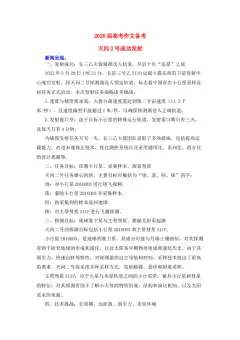
NASA is preparing for a historic space launch that could take astronauts around the moon for the first time
since 1972. The flight, called Artemis II, is a key step in NASA’s plan to return to the moon. 美国国家航空航天
局(NASA)正筹备一项具有历史意义的太空发射任务,这将是自1972 年以来首次载人绕月飞行。此次名
‘
’
为阿尔忒弥斯二号的发射任务,是NASA 重返月球计划的关键步骤。
【原文·时文阅读】
文章来源:https://newsforkids.net/articles/2026/04/01/artemis-ii-first-moon-mission-with-astronauts-in-50-years/
The Artemis II mission will be the first time astronauts have been launched into space on NASA’s powerful
new Space Launch System (SLS) rocket. The rocket, which is over 322 feet (100 meters) tall, will carry an Orion
spacecraft with four astronauts on board.
The four astronauts taking part in the Artemis II mission are NASA’s Reid Wiseman, Christina Koch, and
Victor Glover, along with the Canadian Space Agency’s Jeremy Hansen. If the mission goes as planned, it will be
the first time a woman (Ms. Koch), a person of color (Mr. Glover), and a non-American (Mr. Hanson) have gone
around the moon.
读时文精读
The SLS rocket is designed to boost the Orion capsule into orbit around the Earth. This will allow the
astronauts to test important spacecraft systems, like those for life support, communication, and controlling the
spacecraft.
If all systems are working well, the astronauts will use Orion’s “thrusters” to send it on a curving trip that
will loop around the moon. The path that the spacecraft will take around the Earth and Moon will look a little bit
like the number “8”.
The mission will take about 10 days, and the trip will cover over 230,000 miles (370,000 kilometers). At the
farthest, Orion is expected to travel 4,700 miles (7,600 kilometers) beyond the moon. That’s farther from Earth
than any astronauts have traveled before. For a short period, as it passes behind the moon, Orion will be out of
contact with NASA.
The Artemis II mission is designed to test out the spacecraft and its systems. If the mission is successful, it
will pave the way for future missions which will land on the moon, possibly as early as 2028.
【原创·语法填空】(288words)
The Artemis II mission will be the first time astronauts have been launched into space on NASA’s powerful
new Space Launch System (SLS) rocket. The rocket, 1._______ is over 322 feet (100 meters) tall, will carry an
Orion spacecraft with four astronauts on board.
The four astronauts2._______(take)part in the Artemis II mission are NASA’s Reid Wiseman, Christina
Koch, and Victor Glover, along with the Canadian Space Agency’s Jeremy Hansen. If the mission goes as
3._______(plan), it will be the first time a woman (Ms. Koch), a person of color (Mr. Glover), and a non-
American (Mr. Hanson) have gone around the moon.
The SLS rocket 4._______(design) to boost the Orion capsule into orbit around the Earth. This will allow
the astronauts to test important spacecraft systems, like those for life support, 5._______(communicate), and
controlling the spacecraft.
If all systems are working well, the astronauts will use Orion’s “thrusters” 6._______(send) it on a
curving trip that will loop around the moon. The path that the spacecraft will take around the Earth and Moon will
look a little bit like 7._______ number “8”.
The mission will take about 10 days, and the trip will cover over 230,000 miles (370,000 kilometers). At the
farthest, Orion is expected to travel 4,700 miles (7,600 kilometers) 8._______ the moon. That’s farther from Earth
than any astronauts 9._______(travel) before. For a short period, as it passes behind the moon, Orion will be
out of contact with NASA.
The Artemis II mission is designed to test out the spacecraft and its systems. If the mission is 10._______
(success), it will pave the way for future missions which will land on the moon, possibly as early as 2028.
【课标词汇积累】
1.mission  n. 使命v. 给…交代任务;派遣;把任务交给
The successful completion of our science project felt like a collective mission, requiring every team member to
contribute their unique research and problem-solving skills. (我们科学项目的成功完成就像一项集体使命,要求每
位团队成员贡献自己独特的研究和解决问题的能力。)
2.launch v. 开始从事;发起;发射 n. 发射;下水
After months of preparation, our debate club is ready to launch its first inter-school competition, aiming to showcase
our critical thinking abilities. (经过数月的准备,我们的辩论社准备发起首次校际比赛,旨在展示我们的批判性
思维能力。)
3. boost v. 使增长,推动;增强,提高 n. 帮助,激励;增长,提高
Regular group study sessions can significantly boost your understanding of complex subjects and improve your
grades. (定期的学习小组讨论能显著提升你对复杂科目的理解,并改善你的成绩。)
4.curve n. 曲线(面);(使)呈曲线型 v. 沿曲线运动
The learning curve for mastering advanced mathematics is steep, but with persistent practice, it becomes manageable.
(掌握高等数学的学习曲线很陡峭,但通过持续练习,它会变得可以驾驭。)
5.contact n.

联系,联络;熟人;接触,遇见v. 联系,联络
Maintaining close contact with teachers during office hours is crucial for clarifying doubts and gaining deeper insights.
(在办公时间与老师保持密切接触对于澄清疑问和获得更深见解至关重要。)
6.design v. 设计;计划;制定;制造 n. 设计;安排;设计艺术;构思;打算;计划
The student council worked together to design a more efficient and fair system for allocating club activity funds. (学
生会共同努力,设计了一个更高效、更公平的社团活动经费分配系统。)
7.astronaut n. 宇航员
Studying the rigorous training regimen of an astronaut inspires us to cultivate similar discipline and resilience in our
own academic pursuits. (研究宇航员严苛的训练计划,激励我们在自己的学术追求中培养同样的纪律性和韧
性。)
8.system n. 体系,制度;系统
The school’s online learning system integrates course materials, assignments, and discussion forums into a single,
accessible platform. (学校的在线学习系统将课程材料、作业和讨论论坛整合到一个统一、便捷的平台。)
9.capsule n. 胶囊;航天舱;密封小容器
Our history teacher created a “time capsule” project where we researched and presented on a specific decade,
encapsulating its key events and culture. (我们的历史老师设计了一个“时间胶囊”项目,让我们研究并展示某个
特定的十年,概括其关键事件和文化。)
10.powerful  adj. 有权力的;强有力的;强壮的;效力大的;极具感染力的
Reading widely exposes you to powerful ideas and diverse perspectives that can fundamentally shape your worldview.
(广泛阅读让你接触到强有力的思想和多样化的视角,这些能从根本上塑造你的世界观。)
【课标词汇训练】
根据语境,从上面的“课标词汇”中选用合适的单词及其正确形式将句子补充完整。
1.Embarking on the final exam revision is a personal academic ____________ that demands careful planning and
unwavering dedication. (开始期末复习是一项个人的学业使命,需要细致的规划和坚定不移的投入。)
2.The school will ____________ a new peer-tutoring program next semester to foster collaborative learning among
students from different grades. (学校将于下学期启动一个新的朋辈辅导项目,以促进不同年级学生之间的合作学
习。)
3.The teacher’s encouraging feedback provided a much-needed confidence ____________ before my important
presentation. (老师鼓励性的反馈在我重要的演讲前提供了急需的信心提升。)
4.Understanding the grading ____________ in competitive courses helps students set realistic expectations and focus on
mastering the material. (了解竞争激烈课程中的评分曲线,有助于学生设定现实的期望并专注于掌握知识本身。)
5.The career fair provided an excellent opportunity to make direct ____________ with university representatives and
industry professionals. (招聘会提供了一个与大学代表和行业专业人士直接接触的绝佳机会。)
6.Our engineering class project is to ____________ a water filtration system using basic principles of physics and
environmental science. (我们的工程课项目是运用物理和环境科学的基本原理,设计一个水过滤系统。)
7.The guest lecture by a former ____________ expanded our horizons, showing how science learned in school applies to
extraordinary real-world challenges. (一位前宇航员的客座讲座拓宽了我们的视野,展示了在学校学到的科学如何
应用于非凡的现实世界挑战。)
8.Developing an effective time management ____________ is key to balancing coursework, extracurricular activities,
and personal life. (建立一个有效的时间管理系统,是平衡课业、课外活动和个人生活的关键。)
9.The final review session acted like a knowledge ____________, condensing a semester’s worth of information into a
two-hour intensive study guide. (期末复习课就像一个知识胶囊,将一个学期的信息浓缩成一份两小时的强化学
习指南。)
10.Collaborative learning can be a ____________ tool, as explaining concepts to peers often deepens your own
understanding. (协作学习可以是一个强大的工具,因为向同伴解释概念常常能深化你自己的理解。)
【参考译文】
阿尔忒弥斯二号任务将是宇航员首次乘坐美国国家航空航天局(NASA)强大的新型太空发射系统
(SLS)火箭进入太空。这枚高度超过322 英尺(100 米)的火箭将搭载一艘载有四名宇航员的猎户座飞
船。
参与阿尔忒弥斯二号任务的四名宇航员分别是NASA 的里德·怀斯曼、克里斯蒂娜·科赫、维克多·格洛
弗,以及加拿大航天局的杰里米·汉森。如果任务按计划进行,这将是首次有女性(科赫女士)、有色人种
(格洛弗先生)和非美国籍宇航员(汉森先生)绕月飞行。
SLS 火箭的设计目的是将猎户座飞船助推至绕地轨道。这将使宇航员能够测试重要的飞船系统,例如
生命支持、通信和飞船控制系统。
“
”
如果所有系统运行良好,宇航员将使用猎户座飞船的推进器使其沿一条弯曲的轨迹绕月飞行。飞船
“
绕地球和月球飞行的路径看起来会有点像数字8”。
此次任务将持续约10 天,旅程将覆盖超过23 万英里(37 万公里)。在最远点,猎户座飞船预计将
飞行到月球背面4,700 英里(7,600 公里)处。这比以往任何宇航员到达的距离都要遥远。在飞船经过月
球背面的一小段时间内,它将与NASA 失去联系。
阿尔忒弥斯二号任务旨在测试飞船及其系统。如果任务成功,它将为未来的登月任务铺平道路,这些
任务最早可能在2028 年实施。
Passage1 阅读理解
(2026·南京市、盐城市高三一模)Our solar system is peppered with large rocks, called asteroids. If a big
asteroid strikes Earth, there are many possible outcomes. The space rock could drop into the ocean and not harm
anyone. Or it could wipe out a city. People have a hard time understanding the chances of an asteroid strike. So a
练好题精练
research team calculated the likelihood and compared it with other events — with some surprising results.
“A large or medium asteroid hitting Earth would be noticed worldwide,” says Carrie Nugent, a planetary
scientist at Olin College. While killer asteroids have hit before, such as the one that finished off the dinosaurs 66
million years ago, Nugent says a similar situation is not expected to occur in the future. “We try to put this event,
which is actually a preventable event, in context with other preventable events,” she adds.
Using a computer program, Nugent and her team modeled a group of asteroids similar to real near-Earth
objects (NEOs). They fed them into a program called JPL Horizons. Anyone can use that program to look up
predicted locations for objects in the solar system. For this project, her team determined whether each modeled
asteroid would cross paths with Earth.
That allowed the team to estimate the frequency of asteroids bigger than 140 meters across, which is around
the size of a large ship, Nugent says. An asteroid of this size would hit Earth roughly every 11,000 years.
However, that number is still hard to understand. So Nugent compared the chances of an asteroid hitting
Earth with other events that people may experience as follows.
One-In-X Chance Event Happens to an Individual, or the Planet, Over a Human Lifetime
Books and movies often describe asteroid run-ins as unstoppable events. “The truth is actually entirely the
opposite,” she says. NASA’s DART Mission in 2022 hit an asteroid that wasn’t in danger of hitting Earth. The test
changed the asteroid’s path. This showed that people might be able to avoid such a crash one day. So, it’s important
to do research, such as sky surveys, that locate these objects.
1.According to paragraph 2, what does Nugent think of asteroids striking Earth?
A.It’s hard to predict it.
B.It’s urgent to prevent it.
C.There’s no need to worry about it.
D.There’ll be disastrous outcomes.
2.What does the underlined word “That” in paragraph 4 refer to?
A.Computer modeling.
B.Frequency estimate.
C.System operation.
D.Project assessment.
3.Which of the following events is least likely to happen?
A.Coyote attack.
B.Elephant attack.
C.Carbon monoxide poisoning.
D.Asteroid impact.
4.What is the author’s purpose in writing the last paragraph?
A.To introduce various asteroid research methods.
B.To applaud NASA’s asteroid research findings.
C.To draw media attention to asteroid research.
D.To stress the importance of asteroid research.
Passage2 阅读理解
(2026·重庆市重庆市九龙坡区一模)Today, Mars is a cold and dry desert. But billions of years ago there
is evidence that it had a thick atmosphere and water, making it a promising place to look for past life. The
mudstones, found in a dusty riverbed by NASA’s Perseverance Rover, are dotted with interesting markings named
leopard spots and poppy seeds. Scientists believe these features contain minerals produced by chemical reactions
that could be associated with ancient Martian microbes (微生物).
The Perseverance Rover, which touched down on the Martian surface in 2021, was sent to search for signs of
biology. It has spent the last four years exploring a region called the Jezero Crater, which was once an ancient lake
with a river flowing into it. The rover found the leopard print rocks last year.They are about 3.5bn years old and are
a type of rock called mudstone, which is fine- grained rock formed from clays. The rover used several instruments
in its onboard lab to analyze the minerals in the rocks. This data was then sent back to Earth for scientists to study.
In similar conditions on Earth, chemical reactions creating minerals are typically driven by microbes. It’s
possible the minerals were produced by natural geological (地质的) processes, but at a press conference NASA
said the features could be the clearest signs of life ever found.
The only way to fully confirm if the minerals were made by microbes would be to bring the rocks back to
Earth for analysis. A Mars sample return mission has been proposed by NASA but its future looks highly uncertain.
The US Space Agency’s science budget is facing huge cuts that have been put forward in President Trump’s 2026
budget and a sample return mission is one of those facing cancellation.
NASA’s plans for such an effort hang in the balance because of the threatened budget cuts, but China is also
pursuing a sample return mission that could launch in 2028. While the decision is debated, scientists are desperate
to get their gloved hands on the rocks.
5.How does the author introduce the topic in the first paragraph?
A.By drawing a contrast.
B.By using an example.
C.By asking a question.
D.By citing an opinion.
6.What is the role of the Perseverance Rover according to the passage?
A.It sent back the rock samples.
B.It performed the entire analysis.
C.It confirms the biological origin.
D.It serves as a mobile laboratory.
7.Why is it difficult for scientist to get a Mars sample?
A.Because of the uncertain future.
B.Because of the funding quarrel.
C.Because of the reduced budget.
D.Because of the incomplete decision.
8.What can be inferred from the last paragraph?
A.Budget cuts don’t affect NASA.
B.NASA’s plan has been canceled.
C.China’s mission has not started.
D.Scientists long for rock samples.
Passage 3 阅读七选五
阅读下面短文,在空白处填入1 个适当的单词或括号内单词的正确形式。
Astronauts on the International Space Station often spend 6 to 12 months in space. It is hard to stay inside the
space station all that time, but they still need to do their everyday living, such as working, eating, and exercising
with limited resources. Imagine you are an astronaut on the space station right now.

 1
Keep learning
Astronauts are constantly learning. They do all the science experiments that need to happen on the space
station. Most of the time, these experiments were designed by scientists.

 2

  Astronauts also need to learn
how to operate parts of the space station, such as the robotic arm.
Do exercise
3

  One way they do this is by running on a designed treadmill (跑步机), which could hold them down so
they won’t float away. You can keep your muscles strong, too. Do some push ups, sit ups or jo g so that you’ll be
strong enough when you can go exploring.
Observe Earth
Astronauts love to take pictures and videos of Earth from the window of the space station.

 4

  You
can take pictures from your window, too. Think about what makes your street and city special and take notes of the
patterns you see.
Stay in touch
Astronauts keep in touch with their families by email and video-conference. You can keep in touch with your
family and friends in the same way. Make a list of the friends and relatives you want to stay in touch with and
contact with a few every day.

 5
A.What do you know about astronauts?
B.What activities would you do in space?
C.They will be glad to know you are thinking about them.
D.Astronauts need to keep their muscles strong to stay healthy.
E.Astronauts are learning how to grow food on the space station.
F.So they need to learn about the science by following the right steps provided.
G.Seeing Earth in a new way gets them thinking about what makes our planet unique.
Passage 4 完形填空
阅读下面短文,从每题所给的 A、B、C、D 四个选项中选出最佳选项。(2026·广东佛山顺
德区教学质量检测(二))
Mauna Loa in Hawaii is among the world’s most active volcanoes. However, this

 1

  spot is an ideal
place for simulating (模拟) a space mission to Mars. The site was chosen because it is relatively remote and

 2
to the conditions on Mars. The red planet has large volcanoes that are geologic cousins to Mauna Loa.


 3

 , six scientists were housed near the volcano in a small white dome (圆顶屋) for an 8-month
experiment, the

 4

  of which was to

 5

  information on how lengthy Mars missions could
psychologically affect astronauts. The six scientists closed themselves off from the outside world in order to study
what

 6

  on Mars would be like. Their task was to see how isolation affects the social aspects of explorers
who might one day

 7

  the red planet.
Conditions on Mars are tough, so the six had to manage without many of life’s

 8

 , like fresh fruit
and unlimited water. Leaving the habitat involved

 9

  heavy suits similar to those being designed for Mars
astronauts and waiting 5 minutes in an “airlock” to simulate how the air pressure drops. They only left the dome
once a week to

 10


  field studies that would happen during a Mars mission.
Outside, there was a lot to explore — lava flows, caves, and igneous rock. The

 11


  were a
particularly attractive destination. In an article, a participant noted her crew explored more than 100 caves. In one
particular cave, she detailed the

 12


  that came from exploring finger-shaped rock formations.
“We have examined the rock more closely, and

 13


  a suitable shelter for a possible evacuation (撤
离) from the dome,” she wrote. “On Mars this kind of lava tube (熔岩管) is hoped to provide shelter to astronauts
from the

 14


  space radiation during a solar storm.”
The research findings are expected to have considerable

 15


  on decisions when putting astronauts
for future missions to Mars.
1.A.uncertain
B.unimportant
C.unnecessary
D.unlikely
2.A.vital
B.linked
C.similar
D.beneficial
3.A.Therefore
B.Moreover
C.However
D.Still
4.A.cause
B.objective
C.result
D.challenge
5.A.send
B.store
C.change
D.download
6.A.weather
B.water
C.life
D.volcanoes
7.A.inhabit
B.pollute
C.picture
D.map
8.A.skills
B.fortunes
C.tools
D.luxuries
9.A.protecting
B.locating
C.carrying
D.wearing
10.A.keep an eye on B.carry out
C.break off
D.call off
11.A.shelters
B.rocks
C.caves
D.domes
12.A.relief
B.excitement
C.fear
D.peace
13.A.decorated
B.built
C.destroyed
D.found
14.A.harmful
B.random
C.mysterious
D.unexpected
15.A.limitations
B.pressure
C.influence
D.control
Passage 5 语法填空
阅读下面短文,在空白处填入1 个适当的单词或括号内单词的正确形式。
When Jessica Watkins was seven years old, she told her parents she wanted to become an astronaut. They
smiled,

 1

  (encourage) by her determination, but thought it was just a child’s dream. Twenty years later,
Watkins proved them wrong.
Growing up in a small town, she had limited access

 2

  science museums or space camps. Yet she
never gave up. Every night, she would study under the dim light,

 3

  (complete) her homework before
helping her younger siblings.
Her hard work paid off. She earned a scholarship to a top university,

 4

  she studied geology. After
graduation, she applied to NASA’s astronaut program — twice. The first time, she was turned

 5

 . But she
didn’t let failure define her. She gained more experience, earned a doctorate, and applied again.
In 2026, Watkins finally received

 6

  call she had been waiting for. She was selected as one of twelve
7

  (candidate) for the Mars mission training program. When asked about her journey, she said, “Success is not
about never

 8

  (fall). It’s about getting up one more time than you fall.”
Her story

 9

  (share) widely on social media, inspiring millions of young people. Today, she serves as
a powerful reminder that with persistence, even the

 10


  (far) dreams can become reality.