热点话题03
海洋探索——科学家重建了3 万年的海洋之旅
目录
时文精读------------------------------------------------------------精选外刊原创阅读理解
  【原创·阅读理解】
【课标词汇积累】
【课标词汇训练】
【参考译文】
好题精练----------------------------------------------------------精选名校及联考话题专练
【阅读理解】
【7 选5】
【完形填空】
【语法填空】
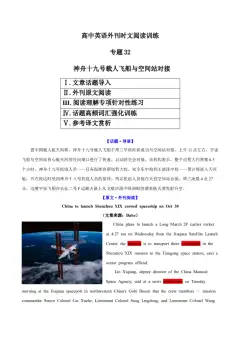
【话题·导语】
古代的人们如何用简单的工具和很少的科学知识进行漫长而危险的海洋旅行到新的地方?为了验证他
们的想法,研究人员用石头工具从一棵树上造了一艘独木舟重新演绎了这个过程。
【原文·时文阅读】
(文章来源:https://newsforkids.net/articles/2025/07/31/scientists-recreate-30000-year-old-ocean-journey/)
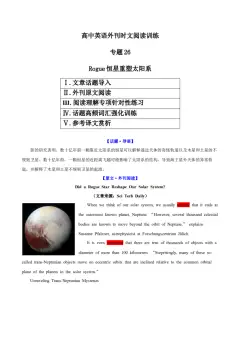
Scientists from Japan and Taiwan may have solved an old mystery: how did ancient people with simple tools
and little scientific knowledge make long, dangerous ocean trips to new places? To test their ideas, the researchers
made a trip of their own in a canoe they built from a tree using stone tools.
The first humans began appearing in Japan around 30,000-35,000 years ago. Some may have arrived using
land bridges that existed at the time. But scientists believe that others arrived by boat. It’s likely that ancient people
crossed the sea from Taiwan to reach Japan’s Ryukyu islands.
But it wasn’t clear what kinds of boats might have allowed ancient people to complete such a dangerous sea
voyage. There are 70 miles (110 kilometers) of open ocean between Taiwan and Yonaguni, the nearest of the
读时文精读
Ryukyu islands. To make things more difficult, the route crosses the Kuroshio current, which is one of the world’s
strongest ocean currents.
Yousuke Kaifu is a scientist at the University of Tokyo. He has long wondered what kinds of boats ancient
people could have used to make the trip. The people would have had no maps, no metal tools, and only the boats
they could make by hand.
Dr. Kaifu and his team began by exploring reed boats. Since reeds float, the researchers used large bundles of
reeds, strapped together with vines, to make boats. But a 2016 test showed that the boats were too slow to handle
the strong Kuroshio current. The same was true of the bamboo boats the team tried in 2017 and 2018.
Finally, the team decided to investigate a “dugout canoe”, made from a hollowed-out tree. Again, they tried to
do everything using only the tools available roughly 30,000 years ago. They made stone axes and used them to cut
down a cedar tree that was three feet (91 centimeters) across.
Then, still using stone tools, they hollowed out the log. Their efforts turned the log into a 25-foot (7.5-meter)
canoe.
In July of 2019, four men and one woman set out from Wushibi, Taiwan in the canoe. Their goal, Yonaguni,
was 140 miles (225 kilometers) away. And to get there, they’d have to make it across the Kuroshio current.
To guide them, the boat’s crew could only use things that they could see, like the stars and the sun. The trip
was exhausting. But after 45 hours – nearly two days – of paddling, they arrived at Yonaguni.
Dr. Kaifu says, “We now know that these canoes are fast and durable [tough] enough to make the crossing.”
But he adds that the success of such a crossing in the past would have depended greatly on the skill of the crew.
“Those male and female pioneers must have all been experienced paddlers,” he said. The researchers’ report
points out that in spite of their very basic tools, the ancient sailors managed to do something that was
“extraordinary”.
【原创·阅读理解】
1.Why didn't the bamboo boats make the trip from Wushibi to Yonaguni?
A.Because the boats were too weak to handle the strong Kuroshio current.
B.Because the boats were too slow to deal with the strong Kuroshio current.
C.Because the boats were difficult to control in the strong Kuroshio current.
D.Because the boats were not strong enough to make the long trip.
2.What made the trip from Wushibi to Yonaguni a success?
A.Stars and the sun.
B.Skill of the crew.
C.The bamboo boats.
D.The reed boats.
3.What does the underlined word “paddlers”mean in the last paragraph?
A.pioneers.
B. researchers .
C.ancient people.
D.Canoeists.
4.What is the main idea of the passage?
A.How did the ancient people arrive in Japan?
B.How to build the canoe.
C.How did ancient people make long ocean trips?
D.How to guide them in the ocean trips.
【课标词汇积累】
1.mystery  n.秘密,谜, 神秘,神秘的事物
 ● The sudden disappearance of the school hamster remains a mystery, though some suspect it escaped
through an open cage.学校仓鼠的突然失踪仍是个谜,尽管有人怀疑它是从打开的笼子里逃走的。
2.scientific adj.科学(上)的, 细致严谨的
  ●Our scientific experiment on plant growth showed that sunlight is crucial for photosynthesis.
 我们关于植物生长的科学实验表明,阳光对光合作用至关重要。
3.ancient adj.古代的, 古老的; n.古人
●The library has an ancient textbook from the 1950s, which still contains useful history notes.
图书馆有一本20 世纪50 年代的古老教科书,里面仍有有用的历史笔记。
4.voyage n.航行,航海, 航天; v.旅行, (尤指)航海旅行
   ●The school trip to the science museum felt like a voyage of discovery for the students.
对学生们来说,去科学博物馆的学校旅行就像一次探索之旅。
5.explore v.在…探险, 探讨, 勘探, 摸索
 ● Learning how to handle stress during exams is an important skill for students.
学会如何在考试期间应对压力是学生的一项重要技能。
6.handle n.拉手, 把手, 有柄的, 方法; v.应付, 处理
  ● Learning how to handle stress during exams is an important skill for students.
学会如何在考试期间应对压力是学生的一项重要技能。
7.investigate v.调查, 研究
 ● The student council decided to investigate why so many people were late to class.
学生会决定调查为什么这么多人上课迟到。
8.available adj.可用的,可获得的, 有空的
 ●The new study room will be available for students starting next Monday.
 新的自习室将从下周一开放给学生使用。
9.roughly adv.粗略地, 大体上, 大致上, 粗暴地
 ●Roughly 70% of the students prefer online assignments over handwritten ones.
大约70%的学生更喜欢在线作业而非手写作业。
10.durable adj.耐用的, 持久的
   ● The school’s new durable backpacks are designed to last for at least three years.
学校新推出的耐用书包设计至少能使用三年。
【课标词汇训练】
根据语境,从上面的“课标词汇”中选用合适的单词及其正确形式将句子补充完整。
1.The _____________ of the missing cafeteria food was solved when they found the raccoon hiding in the pantry.
2.Our science club conducted a _____________ survey on sleep habits among high school students.
3.The  _____________ tradition of signing yearbooks still brings students together at the end of term.
4.Joining the debate team felt like a _____________ into unknown territory for the shy freshman.
5. The geography assignment encouraged us to _____________ cultural differences through international pen pals.
6.Teachers taught us how to _____________disagreements respectfully during group projects.
 7.The principal asked the student council to _____________ complaints about noisy study halls.
8.Free tutoring is _____________ every Thursday in the library for math and physics.
9._____________ half the class voted to extend the lunch break by 10 minutes.
10.The _____________ lab coats can withstand frequent washing and chemical spills.
【参考译文】
日本和台湾的科学家可能破解了一个古老谜题:古代人类如何仅凭简陋工具和有限科学知识,完成漫
长而危险的远洋航行抵达新大陆?为验证这一猜想,研究人员用石器在树干上打造独木舟进行模拟航行。
约3 万至3.5 万年前,首批人类开始在日本出现。部分族群可能通过当时存在的陆桥迁徙而来,但科学家
认为更多人是乘船抵达。据推测,古人很可能从台湾渡海来到日本琉球群岛,但具体使用何种船只完成如
此危险的航海仍是个未解之谜。台湾与最近的琉球群岛——与那国岛之间,隔着长达70 英里(110 公里)
的开阔海域。更棘手的是,这条航线需穿越全球最强洋流之一的黑潮。东京大学科学家川井悠介长期研究
古船技术,他始终好奇古人究竟使用何种船只完成这段航程。当时人们既无地图也无金属工具,只能依靠
手工制作的船只。川井团队最初尝试芦苇船,由于芦苇易浮,他们用藤条捆绑成大束芦苇造船。但2016 年
的测试显示,这种船型在黑潮中速度过慢难以驾驭。2017 至2018 年间团队试水竹制船时也遭遇同样困
境。最终,研究团队决定考察一艘用挖空树木制成的“独木舟”。他们再次尝试仅使用约3 万年前的原始
工具完成所有操作:先制作石斧砍伐一棵直径达三英尺(91 厘米)的雪松,再用石器将原木挖空,最终打
造出一艘长达25 英尺(7.5 米)的独木舟。2019 年7 月,四名男性和一名女性从台湾武溪出发,目标是距
离140 英里(225 公里)外的与那国岛。为穿越黑潮,他们只能依靠肉眼观测的星辰太阳导航。这场跋涉异
常艰辛,经过近两天(45 小时)的划桨,他们终于抵达与那国岛。凯夫博士表示:“现在我们知道这些独
木舟既快速又足够坚固,足以完成横渡。”但他补充说,过去类似壮举的成功与否很大程度上取决于船员
的驾船技艺:“那些先驱者必定都是经验丰富的划手。”研究报告指出,尽管工具简陋,古代航海者仍完
成了堪称“非凡”的壮举。
Passage1 阅读理解
(2025·宁夏回族自治区银川一中高三下学期第一次模拟)
Scientists have uncovered communities of animals living in volcanic caves beneath the seafloor, revealing a
previously unknown but thriving ecosystem. Previous research had found microbes (微生物) living underground
near hydrothermal vents (热液喷口) , but this is the first reported discovery of larger animals such as tubeworms
and snails in the underground habitat.
Hydrothermal vents are cracks in the seafloor where hot water from the Earth’s core mixes with seawater.
Much of the ocean floor is considered nearly uninhabitable. But around hydrothermal vents there’s an explosion of
life. Communities of shrimp, crabs, tubeworms and hundreds of unique animal species have been previously found,
but not underneath, these vents. They’re known as “extremophiles,” or life that can survive under extremely high
temperatures and pressure. These species survive not on the sun’s energy, which fuels the food web elsewhere on
练好题精练
Earth, but on nutrients produced when seawater mixes with magma.
Recent scientific research has revealed that tubeworms and sea snails can be found not only on top of the
seafloor but also underneath rocky sections. This discovery has the potential to significantly advance our
understanding of these species’ life cycle and behavior. The researchers think tubeworms might disperse
throughout the caves, with some settling and growing in cracks on the seafloor and others staying in the caves and
growing to adulthood there—which would mean the seafloor and small caves underneath are an interconnected
ecosystem, where cold and warm water flows mix and promote tubeworm growth.
The hydrothermal vent ecosystem in this area is not restricted to what we see above but includes life in the
subsurface. Deep-sea mining, which involves extracting (获取) minerals from the deep seabed, is a major threat to
deep-sea ecosystems and is opposed by scientists and conservation organizations. “We don’t know how extensive
those connected little caves are, and we’re unable to assess the biodiversity within the subsurface. Since seafloor
ecosystems are likely interconnected. Large stretches of the seafloor need to be protected.” says Rachel Lauer, a
geologist at the University of Caigary.
1.What does the new study reveal?
A.Volcanic activity is frequent in the deep sea.
B.Larger animals thrive beneath the ocean floor.
C.There is a community of microbes underground.
D.Hydrothermal vents shape the marine ecosystem.
2.What do we know about species living around hydrothermal vents?
A.They feed on underwater plants.
B.They rely on sunlight for energy.
C.They can survive in extreme conditions.
D.They favor a relatively hot environment.
3.What does the underlined word “disperse” in paragraph 3 probably mean?
A.Float.
B.Evolve.
C.Frustrate.
D.Spread
4.What is the purpose of the last paragraph?
A.To call on people to protect seafloor ecosystems.
B.To stress the importance of conserving biodiversity.
C.To explain the link between volcanic caves and the seafloor.
D.To show the effect of deep-sea mining on life in the subsurface.
【长难句分析】
【文章原句】The researchers think tubeworms might disperse throughout the caves, with some settling and
growing in cracks on the seafloor and others staying in the caves and growing to adulthood there—which would
mean the seafloor and small caves underneath are an interconnected ecosystem, where cold and warm water flows
mix and promote tubeworm growth.
【句式分析】 这个长句是一个包含多层信息的复合句,通过破折号和连接词将多个分句逻辑串联。Think
后宾语从句,宾语从句中,with some settling and growing in cracks on the seafloor and others staying in
the caves and growing to adulthood there 是with 的独立主格结构,some 和others 并列,staying 和growing
并列,破折号解释作用,用非限制性定语从句引导,定语从句中mean 相当于系动词,其后是表语从句,
其中where 引导定语从句。
【翻译】研究人员认为,管状蠕虫可能会分散到整个洞穴中,一些管状蠕虫会在海底的裂缝中定居和生长,
另一些则留在洞穴中,在那里长大成年——这意味着海底和海底的小洞穴是一个相互联系的生态系统,冷
水和暖水混合流动,促进管状蠕虫的生长。
Passage2 阅读理解
(2026·广西部分学校高三上学期开学)
Enric Sala is a former university professor, and quit the academic field to become a full-time environmental
protector. In 2008, he founded Pristine Seas, a project that combines exploration, research, public policy and media
to inspire the creation of ocean protection areas. It aims to protect at least 30% of the ocean by 2030 for the benefit
of nature and humanity. Less than 8% is currently protected.
To date, the project has helped to create 29 of the largest ocean reserves on the planet, covering an area of
over 6.9 million square kilometers, an area which is twice the size of India. The achievements are the result of
Enric’s 36 trips across the globe, from the Southern Line Islands to Greenland and Alaska.
The ongoing ocean protection efforts show Enric’s lifelong passion. He says he admires a famous French
filmmaker and undersea explorer. Growing up in Catalonia in the 1970s, he would sit in front of TV watching his
hero every Sunday. He was fascinated by the amazing places, the brave underwater explorers and the wonderful
creatures. All was what he wanted to do in his life.
Enric writes that in the last century alone, humans have removed over 90% of the ocean’s large fish, yet less
than 8%of the ocean is under protection. It is possible to make the ocean continuously beneficial to people and the
planet. All humans must do is rewild the sea. Enric writes that preserving the planet’s wild places, on land and in
the ocean, is a matter of human survival and economic importance in his book, The Nature of Nature: Why We
Need the Wild, published in 2020. The process of rewilding, or recovering and protecting natural processes, allows
nature to do the hard work for us.
Mentioning the successes of wildlife recovery in Yellowstone National Park, Mozambique National Parks,
and the Southern Line Islands, Enric adds that our natural world can be a lasting and strong engine of regeneration
(再生), and that we just need to give it some space.
5.What is the goal of Pristine Seas by the year they set?
A.To protect at least a third of the ocean.
B.To conserve a minimum of 30% of the ocean.
C.To document underwater species in Catalonia.
D.To build 29 of the largest ocean reserves on Earth.
6.What inspired Enric to devote himself to ocean protection?
A.His dream of becoming a famous sea explorer.
B.His tiring experience as a university professor.
C.His passion for the unknown underwater world.
D.His admiration for what a French filmmaker did.
7.According to Enric, what is essential to hold the ocean’s benefits to humans?
A.Rewilding the sea.
B.Strengthening fishing activities.
C.Increasing ocean exploration.
D.Educating people on marine life.
8.Why does Enric mention the example of the wildlife recovery successes?
A.To highlight the importance of national parks.
B.To prove that nature can regenerate if given space.
C.To criticize the impact of human activities on wildlife.
D.To compare different methods of environmental protection.
【词汇积累】
1.quit .离开, 放弃,离任, 停止,戒掉, 退出(程序) 2.environmental adj.环境的, 自然/生态环境的
3.humanity n.人类, 人性, 人道, 人文学科 4. inspire v.激励, 启发, 赋予灵感, 唤起(感情), 吸入(空气)
5.fascinated adj.着迷的, 被深深吸引的 6.beneficial adj.有益的,有帮助的 7.continuously adv.连续不断地,
接连地, 时时刻刻 8.regeneration n.<生>再生, 恢复, <宗>(灵魂的)重生
Passage 3  7 选5
(2026·广东省部分学校高三上学期开学)
Tourists walking along Australia’s Sunshine Coast now find an unusual souvenir (纪念品) shop. Instead of
plastic toys, shelves are filled with sandcastle kits made from dried seaweed. These earth-friendly molds ( 模具)
create temporary sculptures.

 1
The “Ocean Shapes” company makes these special kits. Each $15 set includes three toys that break down
naturally and are shaped like sea turtles, starfish, and seashells, plus a small digging tool. Their website says: “
2

  Watch them return to the sea. This is how vacation memories should disappear.” Bright green packaging
shows children building a sandcastle that slowly disappears with the waves. “Every kit sold funds beach clean-up
programs,” says the company’s boss, a former surfing star.
Sunshine Coast’s white beaches attract millions yearly.

 3

  Last year, volunteers picked up over 12
tons of rubbish left by visitors just during Christmas. Old plastic beach toys make up 40% of this waste, taking 500
years to break down. Broken tools often hurt sea animals that think they’re food.


 4

  For twenty years, scientists have tried using seaweed instead of plastic. They boil seaweed into
thick liquid, and then press it into shapes. Old versions had bad smells, but new methods remove them while
keeping the material strong.
Mayor Tom Carter likes the idea but says, “We ask visitors to buy local honey or handmade hats. Our surf
schools now offer seaweed toys for free to make less waste. If you buy them and they don’t disappear fully, take the
pieces away.

 5

 ” Next summer, his team will add bright yellow seaweed recycling boxes shaped like
dolphins on busy beaches.
A.The ocean isn’t a rubbish bin.
B.Play with nature, not against it.
C.Keep the material strong enough for play.
D.Seaweed products are not completely new.
E.You have to return the seaweed toys in advance.
F.They can break down in the ocean within hours, not polluting it.
G.Famous for clear water and surfing, this area has growing plastic problems.
Passage 4 完形填空
(2025·河南省新郑双语高级中学提升卷03)
Using the natural elements around her, Kala Baybatan Tanaka navigated (航行) the ocean in a small boat.
Kala has deep ties to her Hawaiian roots. Her ancestors

 1

  the oceans for centuries using their
2

  of the stars, the sun, the currents and the wind. Today, she does the same. She uses the

 3
technology around her. It’s called Wayfinding, and it was

 4

  to her by her father. He taught her how to
read the stars and how to

 5

  them to hold the course.
During the day, Kala used the

 6

  until it hit a certain height. When she got closer to

 7

  , she
looked for certain species of land birds and stationary (不变的) clouds that

 8

  there was land below.
The

 9

  from California to Hawaii required Kala to spend long hours

 10


  the day and the
night skies. When she is not

 11


 , she teaches Wayfinding skills to school-aged children in hopes of
12


  the skills that her ancestors used to

 13


 .
It’s easy to get lost in the technology of our day, to be consumed by screens and

 14


  the nature
around us. But if we take the time to look up, to see the stars and the sun, the way the clouds move, we will
discover something that will

 15


  lead to happiness.
1.A.discovered
B.represented
C.protected
D.navigated
2.A.interest
B.inspiration
C.knowledge
D.background
3.A.artificial
B.natural
C.cultural
D.national
4.A.opposed
B.taught
C.moved
D.pushed
5.A.use
B.report
C.evaluate
D.avoid
6.A.star
B.wind
C.moon
D.sun
7.A.land
B.water
C.sand
D.desert
8.A.promised
B.described
C.showed
D.advocated
9.A.voyage
B.flight
C.adventure
D.experience
10.A.searching
B.enjoying
C.affecting
D.studying
11.A.cooking
B.sailing
C.cleaning
D.playing
12.A.preventing
B.producing
C.preserving
D.choosing
13.A.rely on
B.turn off
C.break away
D.calm down
14.A.appreciate
B.accept
C.notice
D.miss
15.A.hardly
B.always
C.never
D.seldom
Passage 5 语法填空
(2025·辽宁省名校联盟高考模拟卷押题卷英语(一))
阅读下面短文,在空白处填入1 个适当的单词或括号内单词的正确形式。
The Earth’s oceans are vast bodies of salty water that cover about 71% of the Earth’s surface. There are four
major oceans,

 1

  are divided by land masses.
The Pacific Ocean is the largest, covering over 63 million square miles. It stretches from the Arctic to the
Southern Ocean and

 2

  (bound) by Asia, Australia and the Americas.
The Atlantic Ocean, the second-largest,

 3

  (cover) an area of about 41 million square miles, lying
between the Americas, Europe and Africa, with the Arctic Ocean to the north and the Southern Ocean to the south.
The Indian Ocean is the third-largest, covering almost 20% of the world’s water surface. It is surrounded by
Asia, Africa, Australia and the Southern Ocean.
The Arctic Ocean,

 4

  (locate) in the Arctic polar region, is the smallest. It is almost centered on the
North Pole and is bordered by Eurasia, North America and Greenland.
These oceans are moving constantly due

 5

  currents and waves. They play a crucial role in

 6
(adjust) the Earth’s climate by absorbing heat from

 7

  atmosphere. The oceans are also home to a vast range
of sea life, including

 8

  (whale), the largest creatures on Earth.
Human activities have

 9

  (significance) impacts on the health of the oceans. Understanding the
oceans is essential for the

 10


  (survive) of our planet, as they are a critical part of the Earth’s life support
system.