Lesson 2 Chinese Family 中国家庭
Family is the cell of the society, and rulers of past dynasties all paid great attention to the stability of
families, which affected the stability of the society and the
ruler’s system of government as well.
In the Past
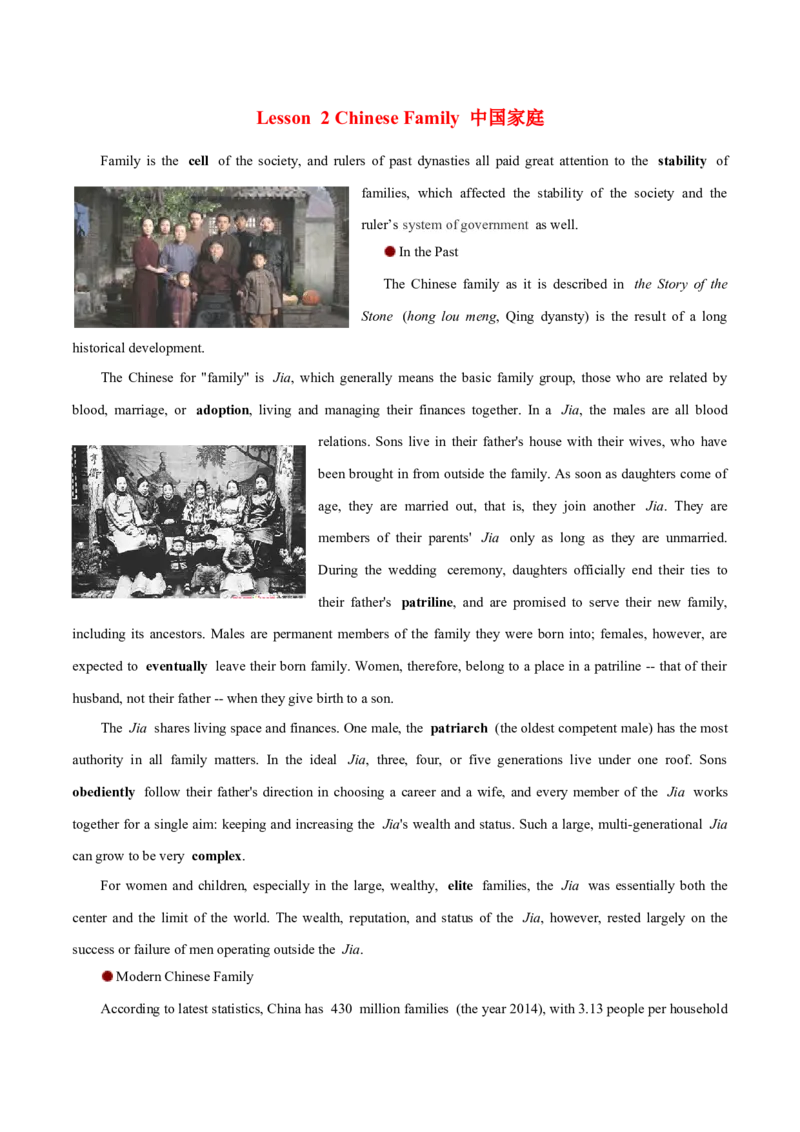
The Chinese family as it is described in the Story of the
Stone (hong lou meng, Qing dyansty) is the result of a long
historical development.
The Chinese for "family" is Jia, which generally means the basic family group, those who are related by
blood, marriage, or adoption, living and managing their finances together. In a Jia, the males are all blood
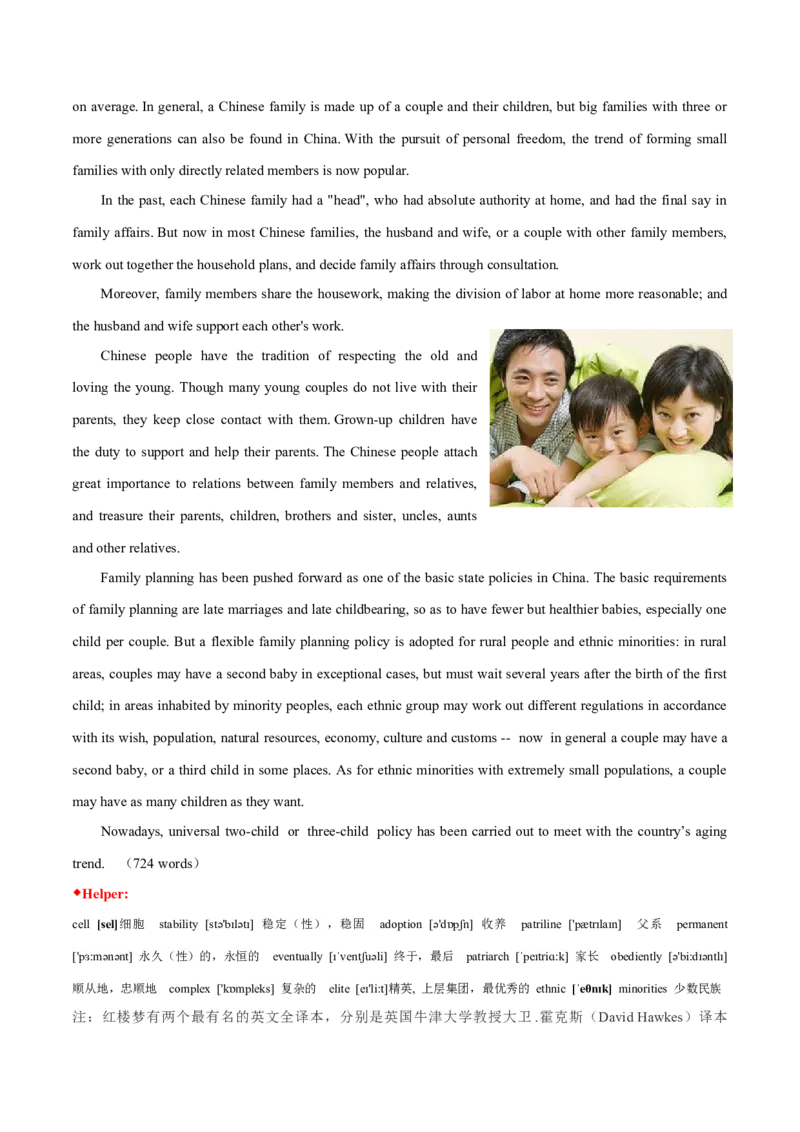
relations. Sons live in their father's house with their wives, who have
been brought in from outside the family. As soon as daughters come of
age, they are married out, that is, they join another Jia. They are
members of their parents' Jia only as long as they are unmarried.
During the wedding ceremony, daughters officially end their ties to
their father's patriline, and are promised to serve their new family,
including its ancestors. Males are permanent members of the family they were born into; females, however, are
expected to eventually leave their born family. Women, therefore, belong to a place in a patriline -- that of their
husband, not their father -- when they give birth to a son.
The Jia shares living space and finances. One male, the patriarch (the oldest competent male) has the most
authority in all family matters. In the ideal Jia, three, four, or five generations live under one roof. Sons
obediently follow their father's direction in choosing a career and a wife, and every member of the Jia works
together for a single aim: keeping and increasing the Jia's wealth and status. Such a large, multi-generational Jia
can grow to be very complex.
For women and children, especially in the large, wealthy, elite families, the Jia was essentially both the
center and the limit of the world. The wealth, reputation, and status of the Jia, however, rested largely on the
success or failure of men operating outside the Jia.
Modern Chinese Family
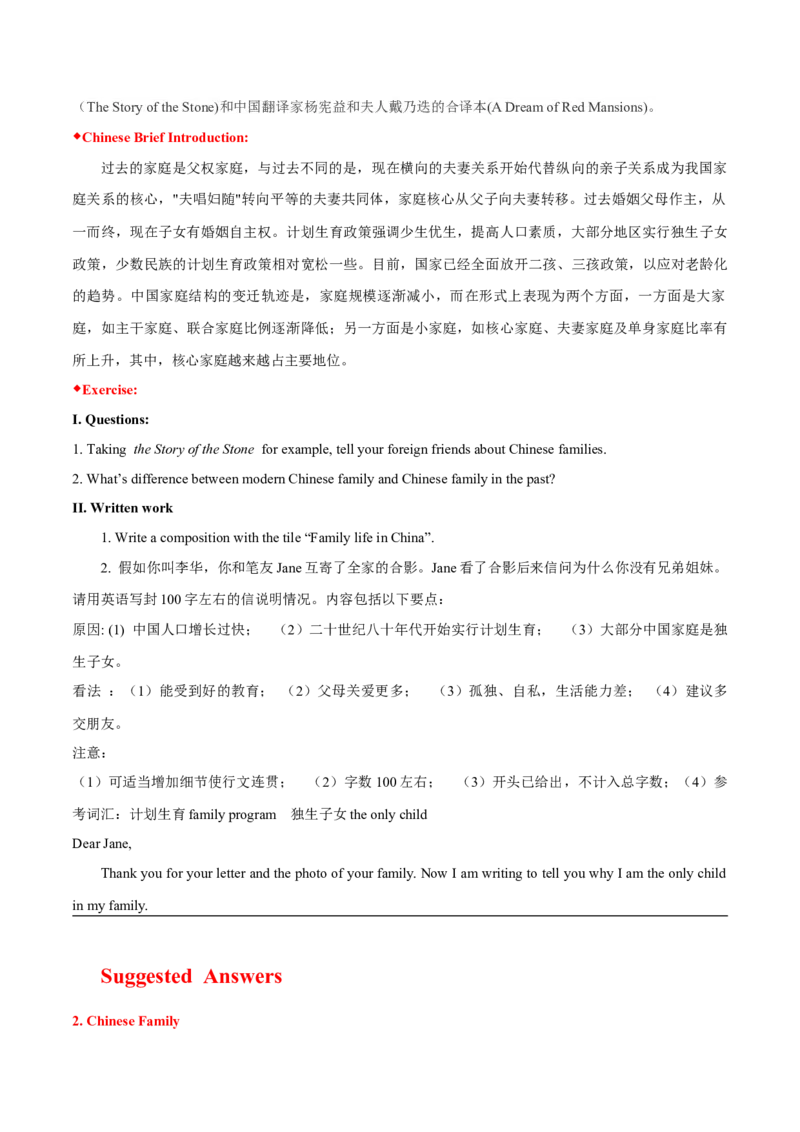
According to latest statistics, China has 430 million families (the year 2014), with 3.13 people per householdon average. In general, a Chinese family is made up of a couple and their children, but big families with three or
more generations can also be found in China. With the pursuit of personal freedom, the trend of forming small
families with only directly related members is now popular.
In the past, each Chinese family had a "head", who had absolute authority at home, and had the final say in
family affairs. But now in most Chinese families, the husband and wife, or a couple with other family members,
work out together the household plans, and decide family affairs through consultation.
Moreover, family members share the housework, making the division of labor at home more reasonable; and
the husband and wife support each other's work.
Chinese people have the tradition of respecting the old and
loving the young. Though many young couples do not live with their
parents, they keep close contact with them. Grown-up children have
the duty to support and help their parents. The Chinese people attach
great importance to relations between family members and relatives,
and treasure their parents, children, brothers and sister, uncles, aunts
and other relatives.
Family planning has been pushed forward as one of the basic state policies in China. The basic requirements
of family planning are late marriages and late childbearing, so as to have fewer but healthier babies, especially one
child per couple. But a flexible family planning policy is adopted for rural people and ethnic minorities: in rural
areas, couples may have a second baby in exceptional cases, but must wait several years after the birth of the first
child; in areas inhabited by minority peoples, each ethnic group may work out different regulations in accordance
with its wish, population, natural resources, economy, culture and customs -- now in general a couple may have a
second baby, or a third child in some places. As for ethnic minorities with extremely small populations, a couple
may have as many children as they want.
Nowadays, universal two-child or three-child policy has been carried out to meet with the country’s aging
trend. (724 words)
◆Helper:
cell [sel]细胞 stability [stə'bɪlətɪ] 稳定(性),稳固 adoption [ə'dɒpʃn] 收养 patriline ['pætrɪlaɪn] 父系 permanent
['pɜ:mənənt] 永久(性)的,永恒的 eventually [ɪˈventʃuəli] 终于,最后 patriarch [ˈpeɪtriɑ:k] 家长 obediently [ə'bi:dɪəntlɪ]
顺从地,忠顺地 complex ['kɒmpleks] 复杂的 elite [eɪ'li:t]精英, 上层集团,最优秀的 ethnic [ˈeθnɪk] minorities 少数民族
注:红楼梦有两个最有名的英文全译本,分别是英国牛津大学教授大卫.霍克斯(David Hawkes)译本(The Story of the Stone)和中国翻译家杨宪益和夫人戴乃迭的合译本(A Dream of Red Mansions)。
◆Chinese Brief Introduction:
过去的家庭是父权家庭,与过去不同的是,现在横向的夫妻关系开始代替纵向的亲子关系成为我国家
庭关系的核心,"夫唱妇随"转向平等的夫妻共同体,家庭核心从父子向夫妻转移。过去婚姻父母作主,从
一而终,现在子女有婚姻自主权。计划生育政策强调少生优生,提高人口素质,大部分地区实行独生子女
政策,少数民族的计划生育政策相对宽松一些。目前,国家已经全面放开二孩、三孩政策,以应对老龄化
的趋势。中国家庭结构的变迁轨迹是,家庭规模逐渐减小,而在形式上表现为两个方面,一方面是大家
庭,如主干家庭、联合家庭比例逐渐降低;另一方面是小家庭,如核心家庭、夫妻家庭及单身家庭比率有
所上升,其中,核心家庭越来越占主要地位。
◆Exercise:
I. Questions:
1. Taking the Story of the Stone for example, tell your foreign friends about Chinese families.
2. What’s difference between modern Chinese family and Chinese family in the past?
II. Written work
1. Write a composition with the tile “Family life in China”.
2. 假如你叫李华,你和笔友Jane互寄了全家的合影。Jane看了合影后来信问为什么你没有兄弟姐妹。
请用英语写封100字左右的信说明情况。内容包括以下要点:
原因: (1) 中国人口增长过快; (2)二十世纪八十年代开始实行计划生育; (3)大部分中国家庭是独
生子女。
看法 :(1)能受到好的教育; (2)父母关爱更多; (3)孤独、自私,生活能力差; (4)建议多
交朋友。
注意:
(1)可适当增加细节使行文连贯; (2)字数100左右; (3)开头已给出,不计入总字数;(4)参
考词汇:计划生育family program 独生子女the only child
Dear Jane,
Thank you for your letter and the photo of your family. Now I am writing to tell you why I am the only child
in my family.
Suggested Answers
2. Chinese FamilyII. Written work
1. Family life in China
I live with my father and mother in a very big house in Nanjing. My parents are both very busy. They leave
for work very early in the morning and don’t return home until late in the evening.
When I am home on weekends from school, we spend a lot of time together. We talk about my studies, my
health and my school life. I love my parents very much.
My grandparents are still living, but they don’t live with us. Their health is good and they both do sports very
early in the morning. My grandmother does gymnastics with elderly women of her age in the park. Both of my
grandfathers play basketball in the morning and sometimes they go swimming.
Chinese people eat rice for every meal, but I don’t like rice because I think it is tasteless! We eat meat, fish
and vegetables. My family eats noodles and porridge. My favorite is noodles.
I often play computer games because I like it so much. I often watch Japanese cartoon movies with my parents
on the weekends. On long holidays we take trips, too.
That is my description of typical family life in China.
2.
Dear Jane,
Thank you for your letter and the photo of your family. Now I am writing to tell you why I am the only child
in my family.
As you know, the population of China is growing very fast. In order to control the rapid increase of population,
in the 1980s the government of China began to put into practice the family program -- one child for each couple. As
a result, most families have only one child. Most people are in favor of the program because the child in the family
can get more love from the family and chances are better for the child to get better education. The only child is
selfish, and not so independent, though. Sometimes they feel lonely. I think, every the only child like me should
learn to make more friends.
Hope that we write more often. Best wishes.
Yours
Li Hua