Lesson 3 Cold Food Day寒食节
Haishi Day (or Cold Food Day) is the very day just before the Qingming Festival (also named Tomb
Sweeping Festival, or Clear and Bright Festival). On the day every year, no fire or
smoke is allowed and people shall eat cold food for the whole day.
According to the legend, the day is in memory of Jie Zhitui who lived in the Spring
and Autumn Period (770-476BC).
Jie was a good official in the Jin State, working for Crown Prince Chong'er. When Jin State was in
disorder, Chong'er was forced to leave for other states with his followers and supporters,
including Jie. On the way of exile they went through all kinds of hardships and difficulties.
To save the starving Chong'er, Jie even cut the flesh off his own leg and boiled for
Chong'er. After becoming the king, Chong'er began to forget Jie soon. Jie was so sad that
he prepared to leave and live in seclusion with his mother in mountains.
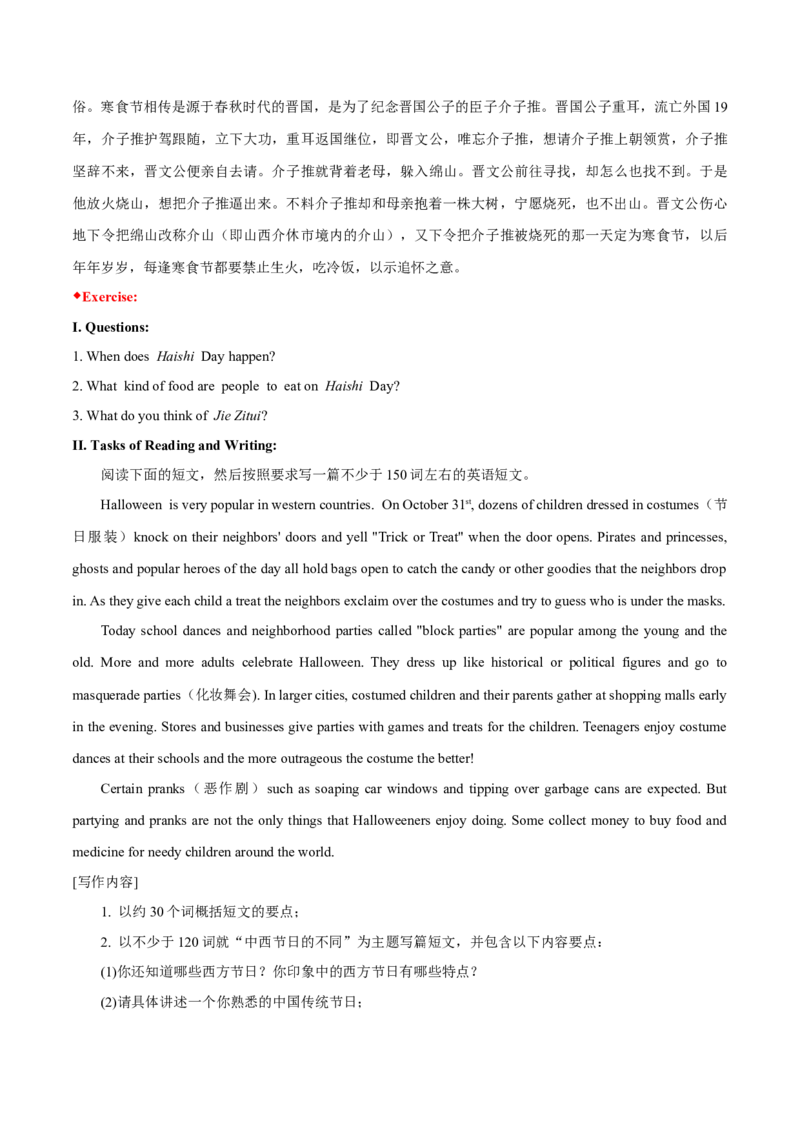
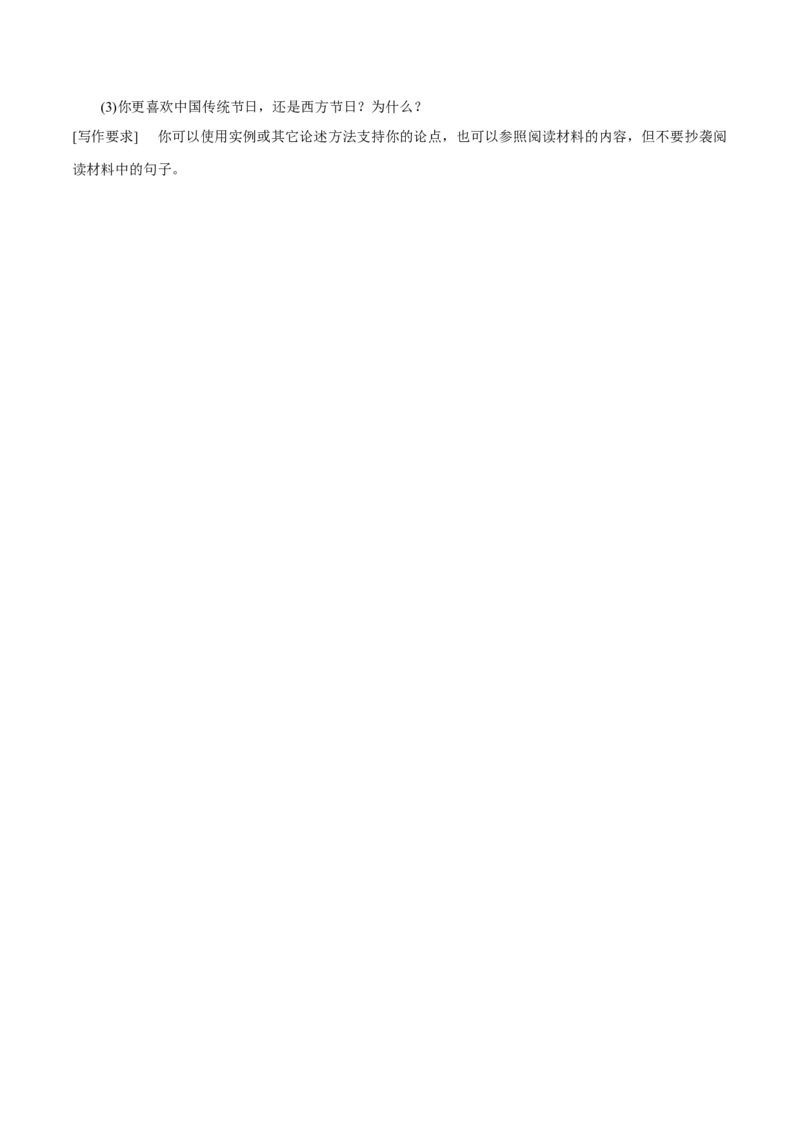
Chong'er felt so blamworthy that he in person went to the mountains to look for 重耳(献公子) 晋文公
Jie. For it was impossible to find him in the endless trees and hills,
Chong'er ordered to set the mountain on fire, so as to force Jie out. But Jie didn't show up; he
and his mother were found to be dead in arms after the fire was put out, together with a note
written by him in blood: I cut off my own flesh to devote to you, only to wish my king will always
be clear and bright. "
介子推
In order to keep in memory of Jie Zitui, Chong'er ordered to make the day Haishi Day, also
named Cold Food Day. And on the Cold Food Day every year, no fire or smoke was allowed and people should eat
cold food for the whole day.
It was not until the Qing Dynasty (1644-1911) about 300 years ago that the practice of Hanshi (or eating
cold food) was replaced by that of Qingming, which had now become an important occasion for people to offer
sacrifices to their ancestors. (348 words)
◆Helper:
exile ['eksaɪl] 流放 seclusion [sɪˈklu:ʒn] 隐居 sacrifice ['sækrɪfaɪs] 献祭,供奉
◆Chinese Brief Introduction:
寒食节亦称“禁烟节”、“冷节”、“百五节”,在夏历冬至后一百零五日,清明节前一二日。是日
初为节时,禁烟火,只吃冷食。并在后世的发展中逐渐增加了祭扫、踏青、秋千、蹴鞠、牵勾、斗卵等风俗。寒食节相传是源于春秋时代的晋国,是为了纪念晋国公子的臣子介子推。晋国公子重耳,流亡外国19
年,介子推护驾跟随,立下大功,重耳返国继位,即晋文公,唯忘介子推,想请介子推上朝领赏,介子推
坚辞不来,晋文公便亲自去请。介子推就背着老母,躲入绵山。晋文公前往寻找,却怎么也找不到。于是
他放火烧山,想把介子推逼出来。不料介子推却和母亲抱着一株大树,宁愿烧死,也不出山。晋文公伤心
地下令把绵山改称介山(即山西介休市境内的介山),又下令把介子推被烧死的那一天定为寒食节,以后
年年岁岁,每逢寒食节都要禁止生火,吃冷饭,以示追怀之意。
◆Exercise:
I. Questions:
1. When does Haishi Day happen?
2. What kind of food are people to eat on Haishi Day?
3. What do you think of Jie Zitui?
II. Tasks of Reading and Writing:
阅读下面的短文,然后按照要求写一篇不少于150词左右的英语短文。
Halloween is very popular in western countries. On October 31st, dozens of children dressed in costumes(节
日服装)knock on their neighbors' doors and yell "Trick or Treat" when the door opens. Pirates and princesses,
ghosts and popular heroes of the day all hold bags open to catch the candy or other goodies that the neighbors drop
in. As they give each child a treat the neighbors exclaim over the costumes and try to guess who is under the masks.
Today school dances and neighborhood parties called "block parties" are popular among the young and the
old. More and more adults celebrate Halloween. They dress up like historical or political figures and go to
masquerade parties(化妆舞会). In larger cities, costumed children and their parents gather at shopping malls early
in the evening. Stores and businesses give parties with games and treats for the children. Teenagers enjoy costume
dances at their schools and the more outrageous the costume the better!
Certain pranks(恶作剧)such as soaping car windows and tipping over garbage cans are expected. But
partying and pranks are not the only things that Halloweeners enjoy doing. Some collect money to buy food and
medicine for needy children around the world.
[写作内容]
1. 以约30个词概括短文的要点;
2. 以不少于120词就“中西节日的不同”为主题写篇短文,并包含以下内容要点:
(1)你还知道哪些西方节日?你印象中的西方节日有哪些特点?
(2)请具体讲述一个你熟悉的中国传统节日;(3)你更喜欢中国传统节日,还是西方节日?为什么?
[写作要求] 你可以使用实例或其它论述方法支持你的论点,也可以参照阅读材料的内容,但不要抄袭阅
读材料中的句子。Lesson 4 Water-Splashing Festival of the Dai People
傣族泼水节
Water-Splashing Festival is the most ceremonious traditional festival
of the Dai minority. It usually takes place in mid-April of the solar
calendar, often ten days before or after the Tomb-sweeping Day, and lasts
three to seven days. Water-Splashing Festival is the New Year in the Dai
calendar, and also a festival with the largest influence and maximum
participating population among lots of minority festivals in Yunnan
Province. In this festival, the Dai People without reference to age and sex will get dressed up and shoulder clean
water to the Buddhist Temple. They will first bathe the Buddha and then
begin to splash water with one another for wishing luck, happiness and
health. The more water one person is sprinkled, the more luck he/she
receives, and the happier he/she will be. Dai People will also invite people
from other ethnic minorities and tourists coming from afar to splash
water to celebrate the festival. The scene of water
splashing and spraying is really delighting, and when getting excited, people will burst out the
hurrah like "shui (water), shui and shui".
Besides water splashing, there are a lot of other conventions in the Water-splashing Festival.
Children will cut down bamboos to make squirt gun and play water game. People without
reference to age and sex are all dressed up and climb up the mountain in
groups to pick up wild flowers to make flower house. Young people who are
not married throw specially-made bags to pay court to each other. And
people let off Gaosheng fireworks and Kongming Lamp to memorialize thewisdom of Zhuge Liang in the ancient Three Kingdoms Period. Additionally, there are some other conventions such
as Dragon Boat Race, Release of Paper-made River Boat, Peacock Dancing and Cockfighting. In the festival,
people will decorate their own residence ceremoniously so that the doorframe and window of every household are
pasted with various paper cutting. Decorated archways, whose top stands a golden peacock that symbolizes
happiness and good luck, are also put up at the main streets in the town.
Water-Splashing Festival was once a religious ceremony in Indian
Brahmanism and then absorbed by Buddhism and passed to the Dai region in
Yunnan Province via Burma. It has enjoyed a history of
seven hundred years up to now. At present, the
convention of water splashing has actually become a
form of mutual wishing between one another. In the eye of the Dai People, water is a symbol
of sanctity, beauty and brightness. Only water can help everything on the earth grow, so
water is the god of life.(439 words)
◆ Helper:
splash [splæʃ] 使(液体)溅起 solar calendar [ˈsəulə ˈkælində] 阳历 maximum ['mæksɪməm]最大值的 participate
[pɑ:'tisipeit] 参加某事 sprinkle ['spriŋkl]洒,撒 afar [ə'fɑ:(r)] 从远处,遥远 hurrah [hə'rɑ:]好哇;万岁 convention [kən
ˈvenʃn] 习俗,规矩 squirt [skwɜ:t] 喷, 注射器 pay court to 追求(女人), 求爱 doorframe ['dɔ:freim] 门框
Brahmanism [ˈbrɑ:mənizm] 婆罗门教 Burma ['bɜ:mə]缅甸 sanctity ['sæŋktəti] 圣洁,神圣
◆ Chinese Brief Introduction:
泼水节是傣族最隆重的节日,也是云南少数民族中影响面最大,参加人数最多的节日。源于印度,是
古婆罗门教的一种仪式,后为佛教所吸收,约在公元十二世纪末至十三世纪初经缅甸随佛教传入中国云南
傣族地区,至今已数百年。泼水节是傣族的新年,相当于公历的四月中旬,一般持续3至7天。第一天傣
语叫“麦日”,与农历的除夕相似;第二天傣语叫“恼日”(空日);第三天是新年,叫“叭网玛”,意
为岁首,人们把这一天视为最美好,最吉祥的日子。泼水节的活动内容丰富,这期间,大家用纯净的清水
相互泼洒,祈求洗去过去一年的不顺,新的一年带着美好的愿望再次出发。其它的还有丢包、放高升、划
龙舟,跳象脚鼓舞、放河船、斗鸡、跳孔雀舞等,人们身着盛装,喜气洋洋,场面极为热闹。
◆ Exercise:
I. Questions:
1. When does Water-Splashing Festival happen?
2. Are Dai People the only ones who can participate in Water-Splashing?3. Which festival of Han people is Water-Splashing Festival similar to?
4. From the picture in the text, can you find which famous leader of the PRC took part in Water-Splashing?
5. List some activities appearing in the Water-Splashing Festival besides water-splashing?
6. What does it mean if you are watered much?
II. Written work
假如你是21st century的一位编辑,主持Q/A栏目,美国游客David给报社写信说,在云南旅游时,适
逢傣族的泼水节,他对被泼水很是不解。请你在Q/A栏目中给与回复。要求包括泼水节上的误解、解释、
和建议三个方面。Suggested Answers
3. Cold Food Day
I. Questions:
1. When does Haishi Day happen?
Key: Just before the Qingming Festival. This year, it falls on April 4, 2018.
2. What kind of food are people to eat on Haishi Day?
People should eat cold food for the whole day.
3. What do you think of Jie Zitui?
Key: He was loyal, devoted to his master.
II. Tasks of Reading and Writing:
On October 31st, people in western countries dress themselves in costumes to celebrate Halloween. School
dances and neighbourhood parties are popular on that day. Jokes are played for fun.
Many western festivals are very popular all over the world, such as Christmas, Thanksgiving Day, April Fool’s Day
and so on. Personally, I think the western festivals are romantic and exciting. Colourful decorations are filled with
all streets. People will gather together and hold parties. They have a good time singing and dancing during the
parties.
Traditional Chinese festivals are popular too. The Mid-autumn Festival is my favourite. It falls on the fifteenth
day of the eighth lunar month. On this day, the moon is said to be its biggest and brightest so people meet in the
evening and watch the moon. This festival is important because it is a special occasion for family. The traditional
food, moon cakes, are made with bean paste, but nowadays there many different kinds of moon cakes, including
fruit, coffee and even ice-cream moon cakes.In my opinion, I prefer the traditional Chinese festivals to western festivals. China has a long history and its
festivals are full of cultural meanings. Chinese people enjoy food, the traditional activities of the festivals as well as
the love of their motherland.
4. Water-Splashing Festival of the Dai People
I. Questions:
1. It usually takes place in mid-April of the solar calendar, often ten days before or after the Tomb-sweeping Day.
2. No. Dai People will also invite people from other ethnic minorities and tourists coming from a great distance to
splash water to celebrate the festival.
3. The Spring Festival
4. Zhou Enlai (March 5, 1898-January 8, 1976), served as Premier of the Government Administrative Council of
the People's Republic of China.
5. Making flower house, letting off Gaosheng fireworks and Kongming Lamp, Dragon Boat Race, Releasing of
Paper-made River Boat, Peacock Dancing and Cockfighting and so on.
6. It means you are more lucky, more healthy, and happier.
II. Written work
Dear David,
I fully understand why you are feeling annoyed. But what you have experienced is actually a blessing. The local
people didn’t mean to splash water at you.
As a matter of fact, it is merely Watering Splashing Festival celebrated by Dai Nationalities in joyful
expectation of the coming New Year. During the festival, Dai people will exchange goodwill by splashing water at
each other. Whoever comes to the festival will be involved in it, which just shows their best wishes to you. So you
must have misunderstood them.
I hope you can travel to more places in China so that you can have a better understanding of Chinese culture.
Your exposure to Chinese culture, I’m convinced, will surely help you a lot.
Best wishes!