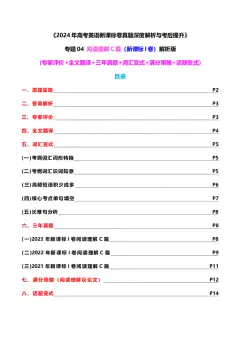
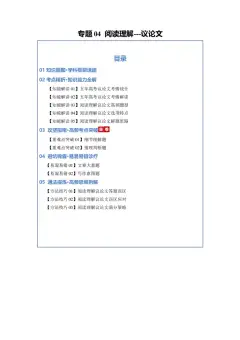
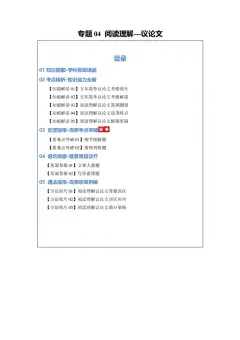
专题 04 阅读理解之议论文
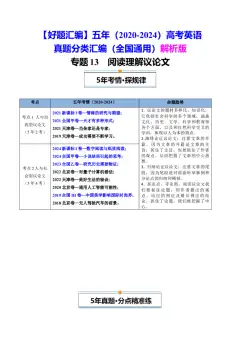
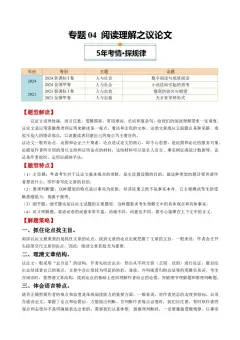
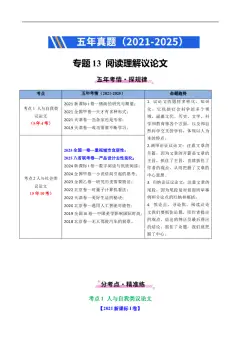
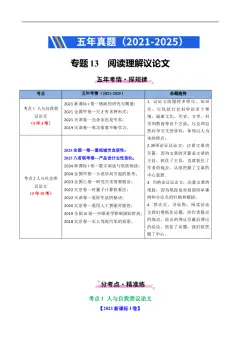
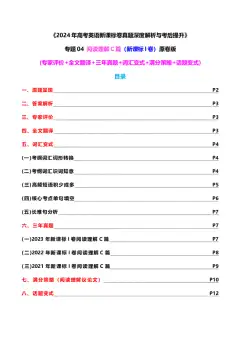
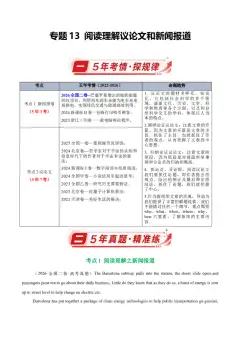
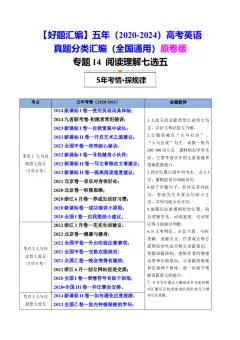
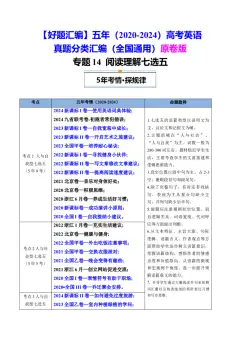
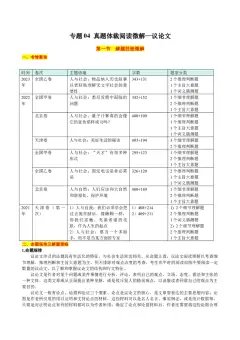
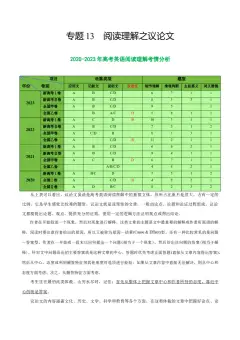
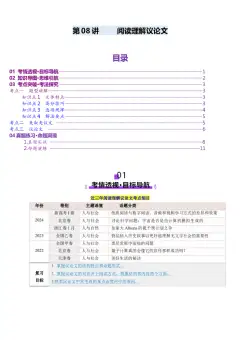
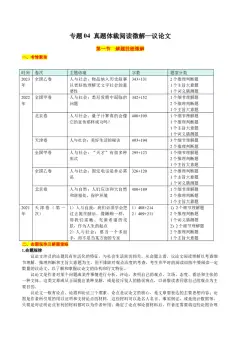
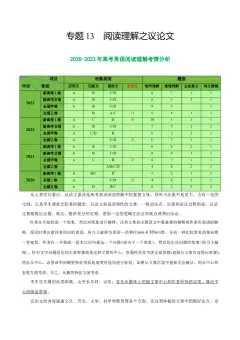
年份 卷别 主题 话题
2024新课标I卷 人与社会 数字阅读与纸质阅读
2024
2024全国甲卷 人与社会 小说结局引起的思考
2021新课标I卷 人与自我 情商的研究与期望
2021
2021全国甲卷 人与自我 天才有多种形式
【题型解读】
议论文说理性强,语言庄重,逻辑缜密,常用难词、长词和复杂句,给我们的阅读理解带来一定难度。
议论文是运用逻辑推理和证明来阐述某一观点、看法和主张的文体。这类文章或从正面提出某种见解,或
驳斥别人的错误观点,以说服读者同意自己的观点为主要目的。
议论文一般有论点、论据和论证三个要素。论点是议论文的核心,即中心思想,是论据和论证的服务对象。
论据是作者所引用的用以支持和证明论点的材料,这些材料可以是名人名言、事实例证或统计数据等。论
证是作者组织、运用论据的手法。
【题型特点】
(1)主旨题:考查考生对于议论文基本观点的理解,是主旨题设题的目的。做这种类型的题目要弄清作
者想说什么,即作者写此文章的目的。
(2)推理判断题:这种题型的特点是以事实为依据,但其结果又绝不是事实本身。它主要测试考生的逻
辑思维能力,侧重于推理。
(3)细节题:细节题也是议论文试题的主要题型。这种题要求考生理解文中的具体观点和具体事实。
(4)词义理解题。英语词语的词意非常丰富,语境不同,词意也不同,要专心揣摩在上下文中的含义。
【解题策略】
一、抓住论点找主旨。
阅读议论文最重要的是抓住文章的论点,找到文章的论点也就把握了文章的主旨。一般来说,作者会在开
头段落交代文章的论点,因此,细读文章首段尤为重要。
二、理清文章结构。
议论文一般采用“总分总”的结构,作者先给出论点,然后从不同方面(正面,反面)进行论证,最后给
出总结或者自己的观点。文章中会出现较为明显的转折,递进,并列或者归纳总结等的逻辑关系词。考生
在阅读时,要理清文章结构,找到论点的基础上进而理解作者给出的论据,突破细节理解题和推理判断题。
三、体会语言特点。
能否正确把握作者的观点和态度是体现阅读能力的重要方面。一般来说,对作者的总的态度和倾向,必须
在通读全文,掌握了论点和论据后,方能做出判断。在判断作者观点态度时,我们应注意,有时候作者的
观点和态度并不是明确地表达出来的,需要我们认真体察。做推理判断时,一定要遵循逻辑规律,以事实为依据进行合理的推理。
推理判断题解题技巧:排除法
1.如果要求对某段内容进行推断,推理,那么就只看题干要求的那段。
2.一般排除绝对项(must,always,never, all, only, have to, none, completely)
常选语气可能性不大的答案(may,might,could ,be likely to,possible,not necessarily)
3.排除照抄原文项或对原文作字面解释的项
【解题原则】
(1)忠实于原文上下文及全篇的逻辑关系,决不能主观臆断。
文章中心是论点,事实细节是论据或主要理由;有关细节问题常对文中某个词语、某句子、某段落等细节
及事实进行提问,所提问题一般可直接或间接在文章中找到答案。
提问的特殊疑问词常有:what, who, which, where, how, why 等。
在阅读理解中,要求查找主要事实和特定细节的问题常有以下几种命题方式:
①Which of the following statements is true?
②Which of the following is not mentioned in the text?
③The author (or the passage) states that __________.
④According to the passage, when (where, why, how, who, what, which, etc.) __________?
(2)干扰项:范围过大、过小;偷换概念;正误并存,某个分句是正确的。
阅读理解中细节理解题的干扰项的设置有以下几个原则:
①包含项原则
在答案选项分析中,假如对A选项的理解概括了对其他三项 (或其中某一项)的理解,那么我们就
说选项A与其他三项是包含或概括关系,包含项A往往就是正确答案。如在"花"与"玫瑰"两选项中,
正确答案肯定是"花",花包含了玫瑰。
②正反项原则
所谓正反项,是指两选项陈述的命题完全相矛盾。两个相互矛盾的陈述不能都是假的,其中必有一
真。所以,假如四选项中A、B互为正反项,那我们通常先排除C、D项,正确答案一般在A、B项当中。
③委婉项原则
所谓委婉,这里是指说话不能说死,要留有余地。阅读理解选项中语气平和、委婉的往往是正确答
案。这些选项一般含有不十分肯定或试探性语气的表达,如:probably, possibly, may, usually, might,
most of, more or less, relatively, be likely to, not necessary, although, yet, in addition, tend to等等,而含
有绝对语气的表达往往不是正确答案,如:must, always, never, all, every, any, merely, only, completely,
none, hardly, already等等。
④同形项原则
命题者往往先将正确答案设置在一个大命题范围,然后通过语言形式的细微变化来考查考生的理解能力与
分析能力。同形项原则告诉我们:词汇与句法结构相似的选项中有正确答案的存在。
⑤常识项原则
议论文中,那些符合一般常识、意义深刻富有哲理、符合一般规律、属于普遍现象的往往是正确答
案。⑥因果项原则
阅读理解的逻辑推理基本都是通过因果链进行的,前因后果,一步步循序渐进。然而,在推理题
的选项中,有的选项会推理不到位(止于前因),或者推理过头(止于后果),这就是所谓的干扰项。因果项原
则启示我们:假如四个选项中有两项互为同一事物推理过程中的因果关系,那么正确答案就是两个因果项
中的其中之一。如果因项可产生几个结果,那么答案就是因;如果果项可以对应几个原因,那么答案就是
果。
解题方法:原文定位法。
查读法:(1)带着问题找答案,把注意力集中在与who, what, when, where问题有关的细节上。(2)细心!
【2024新课标I卷】
Is comprehension the same whether a person reads a text onscreen or on paper? And are listening to and
viewing content as effective as reading the written word when covering the same material? The answers to both
questions are often “no.” The reasons relate to a variety of factors, including reduced concentration, an
entertainment mindset (心态) and a tendency to multitask while consuming digital content.
When reading texts of several hundred words or more, learning is generally more successful when it’s on
paper than onscreen. A large amount of research confirms this finding. The benefits of print reading particularly
shine through when experimenters move from posing simple tasks – like identifying the main idea in a reading
passage – to ones that require mental abstraction – such as drawing inferences from a text.
The differences between print and digital reading results are partly related to paper’s physical properties. With
paper, there is a literal laying on of hands, along with the visual geography of distinct pages. People often link their
memory of what they’ve read to how far into the book it was or where it was on the page.
But equally important is the mental aspect. Reading researchers have proposed a theory called “shallowing
hypothesis (假说).” According to this theory, people approach digital texts with a mindset suited to social media,
which are often not so serious, and devote less mental effort than when they are reading print.
Audio (音频) and video can feel more engaging than text, and so university teachers increasingly turn to these
technologies – say, assigning an online talk instead of an article by the same person. However, psychologists have
demonstrated that when adults read news stories, they remember more of the content than if they listen to or view
identical pieces.
Digital texts, audio and video all have educational roles, especially when providing resources not available in
print. However, for maximizing learning where mental focus and reflection are called for, educators shouldn’t
assume all media are the same, even when they contain identical words.
28. What does the underlined phrase “shine through” in paragraph 2 mean?
A. Seem unlikely to last. B. Seem hard to explain.
C. Become ready to use. D. Become easy to notice.
29. What does the shallowing hypothesis assume?
A. Readers treat digital texts lightly.B. Digital texts are simpler to understand.
C. People select digital texts randomly.
D. Digital texts are suitable for social media.
30. Why are audio and video increasingly used by university teachers?
A. They can hold students’ attention.
B. They are more convenient to prepare.
C. They help develop advanced skills.
D. They are more informative than text.
31. What does the author imply in the last paragraph?
A. Students should apply multiple learning techniques.
B. Teachers should produce their own teaching material.
C. Print texts cannot be entirely replaced in education.
D. Education outside the classroom cannot be ignored.
【2024全国甲卷】
“I didn’t like the ending,” I said to my favorite college professor. It was my junior year of undergraduate, and
I was doing an independent study on Victorian literature. I had just finished reading The Mill on the Floss by
George Eliot, and I was heartbroken with the ending. Prof. Gracie, with all his patience, asked me to think about it
beyond whether I liked it or not. He suggested I think about the difference between endings that I wanted for the
characters and endings that were right for the characters, endings that satisfied the story even if they didn’t have a
traditionally positive outcome. Of course, I would have preferred a different ending for Tom and Maggie Tulliver,
but the ending they got did make the most sense for them.
This was an aha moment for me, and I never thought about endings the same way again. From then on, if I
wanted to read an ending guaranteed to be happy, I’d pick up a love romance. If I wanted an ending I couldn’t
guess, I’d pick up a mystery (悬疑小说). One where I kind of knew what was going to happen, historical fiction.
Choosing what to read became easier.
But writing the end—that’s hard. It’s hard for writers because endings carry so much weight with readers. You
have to balance creating an ending that's unpredictable, but doesn’t seem to come from nowhere, one that fits
what’s right for the characters.
That’s why this issue (期) of Writer’s Digest aims to help you figure out how to write the best ending for
whatever kind of writing you’re doing. If it’s short stories, Peter Mountford breaks down six techniques you can try
to see which one helps you stick the landing. Elizabeth Sims analyzes the final chapters of five great novels to see
what key points they include and how you can adapt them for your work.
This issue won’t tell you what your ending should be—that’s up to you and the story you’re telling—bu it
might provide what you need to get there.
32. Why did the author go to Prof. Gracie?
A. To discuss a novel. B. To submit a book report.
C. To argue for a writer. D. To ask for a reading list.
33. What did the author realize after seeing Gracie?A. Writing is a matter of personal preferences.
B. Readers are often carried away by character.
C. Each type of literature has its unique end.
D. A story which begins well will end well.
34. What is expected of a good ending?
A It satisfies readers’ taste. B. It fits with the story development.
C. It is usually positive. D. It is open for imagination.
35. Why does the author mention Peter Mountford and Elizabeth Sims?
A. To give examples of great novelists. B. To stress the theme of this issue.
C. To encourage writing for the magazine. D. To recommend their new books.
【2021新课标I卷】
Popularization has in some cases changed the original meaning of emotional (情感的) intelligence. Many
people now misunderstand emotional intelligence as almost everything desirable in a person’s makeup that cannot
be measured by an IQ test, such as character, motivation, confidence, mental stability, optimism and “people skills.”
Research has shown that emotional skills may contribute to some of these qualities, but most of them move far
beyond skill-based emotional intelligence.
We prefer to describe emotional intelligence as a specific set of skills that can be used for either good or bad
purposes. The ability to accurately understand how others are feeling may be used by a doctor to find how best to
help her patients, while a cheater might use it to control potential victims. Being emotionally intelligent does not
necessarily make one a moral person.
Although popular beliefs regarding emotional intelligence run far ahead of what research can reasonably
support, the overall effects of the publicity have been more beneficial than harmful. The most positive aspect of this
popularization is a new and much needed emphasis (重视) on emotion by employers, educators and others
interested in promoting social well-being. The popularization of emotional intelligence has helped both the public
and researchers re-evaluate the functionality of emotions and how they serve people adaptively in everyday life.
Although the continuing popular appeal of emotional intelligence is desirable, we hope that such attention will
excite a greater interest in the scientific and scholarly study of emotion. It is our hope that in coming decades,
advances in science will offer new perspectives (视角) from which to study how people manage their lives.
Emotional intelligence, with its focus on both head and heart, may serve to point us in the right direction.
32. What is a common misunderstanding of emotional intelligence?
A. It can be measured by an IQ test.
B. It helps to exercise a person's mind.
C. It includes a set of emotional skills.
D. It refers to a person’s positive qualities.
33. Why does the author mention “doctor” and “cheater” in paragraph 2?
A. To explain a rule.
B. To clarify a concept.
C. To present a fact.D. To make a prediction.
34. What is the author's attitude to the popularization of emotional intelligence?
A. Favorable. B. Intolerant. C. Doubtful. D. Unclear.
35. What does the last paragraph mainly talk about concerning emotional intelligence?
A. Its appeal to the public.
B. Expectations for future studies.
C. Its practical application.
D. Scientists with new perspectives.
【2021全国甲卷】
Who is a genius? This question has greatly interested humankind for centuries.
Let's state clearly: Einstein was a genius. His face is almost the international symbol for genius. But we want
to go beyond one man and explore the nature of genius itself. Why is it that some people are so much more
intelligent or creative than the rest of us? And who are they?
In the sciences and arts, those praised as geniuses were most often white men, of European origin. Perhaps this
is not a surprise. It's said that history is written by the victors, and those victors set the standards for admission to
the genius club. When contributions were made by geniuses outside the club—women, or people of a different
color or belief—they were unacknowledged and rejected by others.
A study recently published by Science found that as young as age six, girls are less likely than boys to say that
members of their gender (性别) are “really, really smart.” Even worse, the study found that girls act on that belief:
Around age six they start to avoid activities said to be for children who are “really, really smart.” Can our planet
afford to have any great thinkers become discouraged and give up? It doesn't take a genius to know the answer:
absolutely not.
Here's the good news. In a wired world with constant global communication, we're all positioned to see flashes
of genius wherever they appear. And the more we look, the more we will see that social factors(因素)like gender,
race, and class do not determine the appearance of genius. As a writer says, future geniuses come from those with
“intelligence, creativity, perseverance (毅力), and simple good fortune, who are able to change the world.”
12. What does the author think of victors' standards for joining the genius club?
A. They're unfair.
B. They're conservative.
C. They're objective.
D. They're strict.
13. What can we infer about girls from the study in Science?
A. They think themselves smart.
B. They look up to great thinkers.
C. They see gender differences earlier than boys.
D. They are likely to be influenced by social beliefs
14. Why are more geniuses known to the public?
A. Improved global communication.B. Less discrimination against women.
C. Acceptance of victors' concepts.
D. Changes in people's social positions.
15. What is the best title for the text?
A. Geniuses Think Alike
B. Genius Takes Many Forms
C. Genius and Intelligence
D. Genius and Luck