专题13 阅读理解议论文和新闻报道
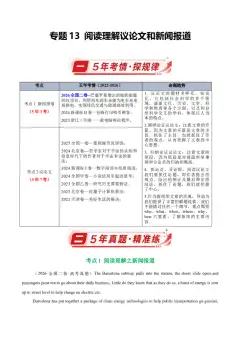
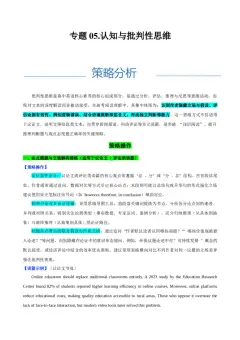
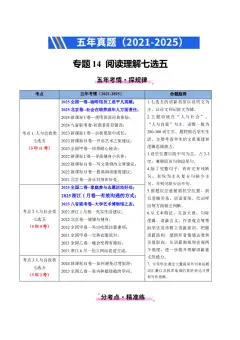
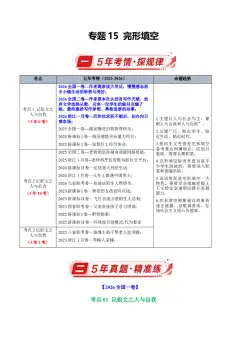
考点
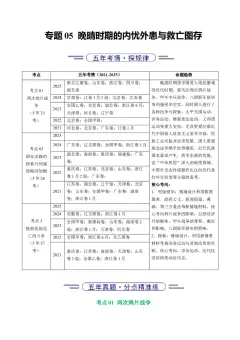
五年考情(2022-2026)
命题趋势
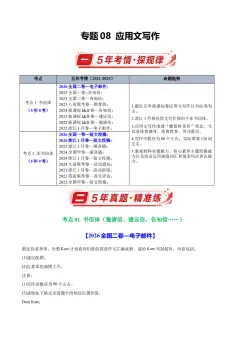
考点1 新闻报道
(5 年3 考)
2026 全国二卷--巴塞罗那推出的地铁能量
回收项目,利用列车刹车余能为电车充电
桩供电,实现绿色交通与能源高效利用。
2024 新课标II 卷—创新打印吸引顾客;
2023 浙江1 月卷—一款电脑辩论程序。
1. 议论文的题材多样化、知识
化,它包括社会科学的多个领
域,涵盖文化、历史、文学、科
学和教育等各个方面,以及和自
然科学交叉的学科,体现以人为
本的特点。
2.演绎论证议论文:注意文章的开
篇,因为文章的开篇是文章的主
旨,抓住了主旨,也就抓住了作
者的观点,从而把握了文章的中
心思想。
3. 归纳论证议论文:注意文章的
尾段,因为尾段是对前面所举事
例和分论点的归纳和概括。
4. 抓论点、寻论据。阅读议论文
我们要抓住论题,即作者提出的
观点、给出的例证及最后得出的
结论。抓住了论题,我们就把握
了中心。
5.作为新闻类文章的灵魂,导语为
我们提供了丰富的解题线索。我们
不能错过任何一个细节,重点甄别
who、what、when、where、why、
how 六要素,了解新闻的主要内
容。
考点2 议论文
(5 年7 考)
2025 全国一卷—重视城市宜居性;
2024 北京卷---哲学家对于宇宙的认知和
信息时代下的作者对于宇宙争论的看
法;
2024 新课标I 卷—数字阅读与纸质阅读;
2024 全国甲卷—小说结局引起的思考;
2023 全国乙卷—研究历史需要物证;
2022 北京卷—对量子计算机看法;
2022 天津卷—美好生活的秘诀;

考点1 阅读理解之新闻报道
(2026·全国二卷·高考真题)The Barcelona subway pulls into the station, the doors slide open and
passengers pour out to go about their daily business. Little do they know that as they do so, a burst of energy is sent
up to street level to help charge an electric car.
Barcelona has put together a package of clean energy technologies to help public transportation go greener,
while also doing its part to tackle climate change and aid Europe’s difficult shift to the privately owned electric
vehicle market.
Sixteen stations of Barcelona’s subway system are part of its new MetroCharge project, whereby the energy
from the underground trains’ brakes ( 刹车) is used to power the trains and the stations themselves, while the
remainder is sent snaking through cables ( 电缆) to the surface to power plug-in stations for privately owned
vehicles.
Bernardo Espinoza, an engineer who takes the subway every day, owns an electric car. “I am pleasantly
surprised, because I am always looking for where to plug it in,” Espinoza said before catching the subway in a
working-class area of southern Barcelona. “And if it is from energy from the trains’ brakes, then even better.”
Regenerative brakes have been in trains for decades and are also used in some cars. They consist of an
electric motor which collects energy used in the braking action that would be lost as heat by conventional brakes.
That energy can be immediately used to accelerate (加速) the vehicle or, in the case of the Barcelona subway
system, sent along cables to supply electricity for the station or for electric car chargers.
Alvaro Luna, a professor of electrical engineering, said that the system is innovative in so far as it allows for
recycled energy to be redirected to specific local uses — in this case powering electric cars parked nearby. That, he
said, boosts efficiency.
1.Why does Barcelona launch the MetroCharge project?
A.To fuel the city’s economy.
B.To enhance passengers’ experience.
C.To promote green transportation.
D.To raise the quality of electric cars.
2.What is Espinoza’s concern?
A.How to cut his travel expenses.
B.Where to get a parking space.
C.How to avoid rush-hour traffic.
D.Where to find a charging point.
3.What aspect of regenerative brakes is discussed in paragraph 5?
A.Their operating conditions.
B.Their conventional standard.
C.Their potential risks.
D.Their working mechanism.
4.What did Luna say about the system?
A.It uses reclaimed energy creatively.
B.It improves workers’ efficiency.
C.It prioritizes the safety of trains.
D.It generates jobs for the locals.
(2024·新课标Ⅱ卷·高考真题)Do you ever get to the train station and realize you forgot to bring
something to read? Yes, we all have our phones, but many of us still like to go old school and read something
printed.
Well, there’s a kiosk (小亭) for that. In the San Francisco Bay Area, at least.
“You enter the fare gates (检票口) and you’ll see a kiosk that is lit up and it tells you can get a one-minute, a
three-minute, or a five-minute story,” says Alicia Trost, the chief communications officer for the San Francisco Bay
Area Rapid Transit — known as BART. “You choose which length you want and it gives you a receipt-like short
story.”
It’s that simple. Riders have printed nearly 20,000 short stories and poems since the program was launched
last March. Some are classic short stories, and some are new original works.
Trost also wants to introduce local writers to local riders. “We wanted to do something where we do a call to
artists in the Bay Area to submit stories for a contest,” Trost says. “And as of right now, we’ve received about 120
submissions. The winning stories would go into our kiosk and then you would be a published artist.”
Ridership on transit (交通) systems across the country has been down the past half century, so could short
stories save transit?
Trost thinks so.
“At the end of the day all transit agencies right now are doing everything they can to improve the rider
experience. So I absolutely think we will get more riders just because of short stories,” she says.
And you’ll never be without something to read.
1.Why did BART start the kiosk program?
A.To promote the local culture.
B.To discourage phone use.
C.To meet passengers’ needs.
D.To reduce its running costs.
2.How are the stories categorized in the kiosk?
A.By popularity.
B.By length.
C.By theme.
D.By language.
3.What has Trost been doing recently?
A.Organizing a story contest.
B.Doing a survey of customers.
C.Choosing a print publisher.
D.Conducting interviews with artists.
4.What is Trost’s opinion about BART’s future?
A.It will close down.
B.Its profits will decline.
C.It will expand nationwide.
D.Its ridership will increase.
(2023·浙江一月·高考真题)A machine can now not only beat you at chess, it can also outperform you in
debate. Last week, in a public debate in San Francisco, a software program called Project Debater beat its human
opponents, including Noa Ovadia, Israel’s former national debating champion.
Brilliant though it is, Project Debater has some weaknesses. It takes sentences from its library of documents
and prebuilt arguments and strings them together. This can lead to the kinds of errors no human would make. Such
wrinkles will no doubt be ironed out, yet they also point to a fundamental problem. As Kristian Hammond,
professor of electrical engineering and computer science at Northwestern University, put it: “There’s never a stage
at which the system knows what it’s talking about.”
What Hammond is referring to is the question of meaning, and meaning is central to what distinguishes the
least intelligent of humans from the most intelligent of machines. A computer works with symbols. Its program
specifies a set of rules to transform one string of symbols into another. But it does not specify what those symbols
mean. Indeed, to a computer, meaning is irrelevant. Humans, in thinking, talking, reading and writing, also work
with symbols. But for humans, meaning is everything. When we communicate, we communicate meaning. What
matters is not just the outside of a string of symbols, but the inside too, not just how they are arranged but what
they mean.
Meaning emerges through a process of social interaction, not of computation, interaction that shapes the
content of the symbols in our heads. The rules that assign meaning lie not just inside our heads, but also outside, in
society, in social memory, social conventions and social relations. It is this that distinguishes humans from
machines. And that’s why, however astonishing Project Debater may seem, the tradition that began with Socrates
and Confucius will not end with artificial intelligence.
1.Why does the author mention Noa Ovadia in the first paragraph?
A.To explain the use of a software program.
B.To show the cleverness of Project Debater.
C.To introduce the designer of Project Debater.
D.To emphasize the fairness of the competition.
2.What does the underlined word “wrinkles” in paragraph 2 refer to?
A.Arguments.
B.Doubts.
C.Errors.
D.Differences.
3.What is Project Debater unable to do according to Hammond?
A.Create rules.
B.Comprehend meaning.
C.Talk fluently.
D.Identify difficult words.
4.What can we learn from the last paragraph?
A.Social interaction is key to understanding symbols.
B.The human brain has potential yet to be developed.
C.Ancient philosophers set good examples for debaters.
D.Artificial intelligence ensures humans a bright future.
考点2 阅读理解之议论文
(2025·全国一卷·高考真题)While safety improvements might have been made to our streets in recent
years, transport studies also show declines in pedestrian (行人) mobility, especially among young children. Many
parents say there’s too much traffic on the roads for their children to walk safely to school, so they pack them into
the car instead.
Dutch authors Thalia Verkade and Marco te Brömmelstroet are bothered by facts like these. In their new
book Movement: How to Take Back Our Streets and Transform Our Lives, they call for a rethink of our streets and
the role they play in our lives.
Life on city streets started to change decades ago. Whole neighbourhoods were destroyed to make way for
new road networks and kids had to play elsewhere. Some communities fought back. Most famously, a Canadian
journalist who had moved her family to Manhattan in the early 1950s led a campaign to stop the destruction of her
local park. Describing her alarm at its proposed replacement with an expressway, Jane Jacobs called on her mayor
(市长) to champion “New York as a decent place to live, and not just rush through.” Similar campaigns occurred in
Australia in the late 1960s and 1970s as well.
Although these campaigns were widespread, the reality is that the majority of the western cities were
completely redesigned around the needs of the motor car. The number of cars on roads has been increasing rapidly.
In Australia we now have over twenty million cars for just over twenty-six million people, among the highest rate
of car ownership in the world.
We invest a lot in roads that help us rush through, but we fail to account for the true costs. Do we really
recognise what it costs us as a society when children can’t move safely around our communities? The authors of
Movement have it right: it’s time to think differently about that street outside your front door.
1.What phenomenon does the author point out in paragraph 1?
A.Cars often get stuck on the road.
B.Traffic accidents occur frequently.
C.People walk less and drive more.
D.Pedestrians fail to follow the rules.
2.What were the Canadian journalist and other campaigners trying to do?
A.Keep their cities livable.
B.Promote cultural diversity.
C.Help the needy families.
D.Make expressways accessible.
3.What can be inferred about the campaigns in Australia in the late 1960s and 1970s?
A.They boosted the sales of cars.
B.They turned out largely ineffective.
C.They won government support.
D.They advocated building new parks.
4.What can be a suitable title for the text?
A.Why the Rush?
B.What’s Next?
C.Where to Stay?
D.Who to Blame?
(2024·北京·高考真题)The notion that we live in someone else’s video game is irresistible to many.
Searching the term “simulation hypothesis” (模拟假说) returns numerous results that debate whether the universe
is a computer simulation — a concept that some scientists actually take seriously. Unfortunately, this is not a
scientific question. We will probably never know whether it’s true. We can, instead, use this idea to advance
scientific knowledge.
The 18th-century philosopher Kant argued that the universe ultimately consists of things-in-themselves that
are unknowable. While he held the notion that objective reality exists, he said our mind plays a necessary role in
structuring and shaping our perceptions. Modern sciences have revealed that our perceptual experience of the world
is the result of many stages of processing by sensory systems and cognitive (认知的) functions in the brain. No one
knows exactly what happens within this black box. If empirical ( 实证的) experience fails to reveal reality,
reasoning won’t reveal reality either since it relies on concepts and words that are contingent on our social, cultural
and psychological histories. Again, a black box.
So, if we accept that the universe is unknowable, we also accept we will never know if we live in a computer
simulation. And then, we can shift our inquiry from “Is the universe a computer simulation? ” to “Can we model
the universe as a computer simulation? ” Modelling reality is what we do. To facilitate our comprehension of the
world, we build models based on conceptual metaphors ( 隐喻) that are familiar to us. In Newton’s era, we
imagined the universe as a clock. In Einstein’s, we uncovered the standard model of particle (粒子) physics.
Now that we are in the information age, we have new concepts such as the computer, information
processing, virtual reality, and simulation. Unsurprisingly, these new concepts inspire us to build new models of the
universe. Models are not the reality, however. There is no point in arguing if the universe is a clock, a set of
particles or an output of computation. All these models are tools to deal with the unknown and to make discoveries.
And the more tools we have, the more effective and insightful we can become.
It can be imagined that comparable to the process of building previous scientific models, developing the
“computer simulation” metaphor-based model will also be a hugely rewarding exercise.
1.What does the author intend to do by challenging a hypothesis?
A.Make an assumption.
B.Illustrate an argument.
C.Give a suggestion.
D.Justify a comparison.
2.What does the phrase “contingent on” underlined in Paragraph 2 probably mean?
A.Accepted by.
B.Determined by.
C.Awakened by.
D.Discovered by.
3.As for Kant’s argument, the author is _________.
A.appreciative
B.doubtful
C.unconcerned
D.disapproving
4.It is implied in this passage that we should _________.
A.compare the current models with the previous ones
B.continue exploring the classical models in history
C.stop arguing whether the universe is a simulation
D.turn simulations of the universe into realities up.
(2024·全国甲卷·高考真题)“I didn’t like the ending,” I said to my favorite college professor. It was my
junior year of undergraduate, and I was doing an independent study on Victorian literature. I had just finished
reading The Mill on the Floss by George Eliot, and I was heartbroken with the ending. Prof. Gracie, with all his
patience, asked me to think about it beyond whether I liked it or not. He suggested I think about the difference
between endings that I wanted for the characters and endings that were right for the characters, endings that
satisfied the story even if they didn’t have a traditionally positive outcome. Of course, I would have preferred a
different ending for Tom and Maggie Tulliver, but the ending they got did make the most sense for them.
This was an aha moment for me, and I never thought about endings the same way again. From then on, if I
wanted to read an ending guaranteed to be happy, I’d pick up a love romance. If I wanted an ending I couldn’t
guess, I’d pick up a mystery (悬疑小说). One where I kind of knew what was going to happen, historical fiction.
Choosing what to read became easier.
But writing the end — that’s hard. It’s hard for writers because endings carry so much weight with readers.
You have to balance creating an ending that's unpredictable, but doesn’t seem to come from nowhere, one that fits
what’s right for the characters.
That’s why this issue (期) of Writer’s Digest aims to help you figure out how to write the best ending for
whatever kind of writing you’re doing. If it’s short stories, Peter Mountford breaks down six techniques you can try
to see which one helps you stick the landing. Elizabeth Sims analyzes the final chapters of five great novels to see
what key points they include and how you can adapt them for your work.
This issue won’t tell you what your ending should be — that’s up to you and the story you’re telling — but it
might provide what you need to get there.
1.Why did the author go to Prof. Gracie?
A.To discuss a novel.
B.To submit a book report.
C.To argue for a writer.
D.To ask for a reading list.
2.What did the author realize after seeing Gracie?
A.Writing is a matter of personal preferences.
B.Readers are often carried away by character.
C.Each type of literature has its unique end.
D.A story which begins well will end well.
3.What is expected of a good ending?
A.It satisfies readers’ taste.
B.It fits with the story development.
C.It is usually positive.
D.It is open for imagination.
4.Why does the author mention Peter Mountford and Elizabeth Sims?
A.To give examples of great novelists.
B.To stress the theme of this issue.
C.To encourage writing for the magazine. D.To recommend their new books.
(2024 新课标I 卷)Is comprehension the same whether a person reads a text onscreen or on paper? And
are listening to and viewing content as effective as reading the written word when covering the same material? The
answers to both questions are often “no”. The reasons relate to a variety of factors, including reduced
concentration, an entertainment mindset (心态) and a tendency to multitask while consuming digital content.
When reading texts of several hundred words or more, learning is generally more successful when it’s on
paper than onscreen. A large amount of research confirms this finding. The benefits of print reading particularly
shine through when experimenters move from posing simple tasks — like identifying the main idea in a reading
passage — to ones that require mental abstraction — such as drawing inferences from a text.
The differences between print and digital reading results are partly related to paper’s physical properties.
With paper, there is a literal laying on of hands, along with the visual geography of distinct pages. People often link
their memory of what they’ve read to how far into the book it was or where it was on the page.
But equally important is the mental aspect. Reading researchers have proposed a theory called “shallowing
hypothesis (假说)”. According to this theory, people approach digital texts with a mindset suited to social media,
which are often not so serious, and devote less mental effort than when they are reading print.
Audio (音频) and video can feel more engaging than text, and so university teachers increasingly turn to
these technologies — say, assigning an online talk instead of an article by the same person. However, psychologists
have demonstrated that when adults read news stories, they remember more of the content than if they listen to or
view identical pieces.
Digital texts, audio and video all have educational roles, especially when providing resources not available
in print. However, for maximizing learning where mental focus and reflection are called for, educators shouldn’t
assume all media are the same, even when they contain identical words.
1.What does the underlined phrase “shine through” in paragraph 2 mean?
A.Seem unlikely to last.
B.Seem hard to explain.
C.Become ready to use.
D.Become easy to notice.
2.What does the shallowing hypothesis assume?
A.Readers treat digital texts lightly.
B.Digital texts are simpler to understand.
C.People select digital texts randomly.
D.Digital texts are suitable for social media.
3.Why are audio and video increasingly used by university teachers?
A.They can hold students' attention.
B.They are more convenient to prepare.
C.They help develop advanced skills.
D.They are more informative than text.
4.What does the author imply in the last paragraph?
A.Students should apply multiple learning techniques.
B.Teachers should produce their own teaching material.
C.Print texts cannot be entirely replaced in education.
D.Education outside the classroom cannot be ignored.
(2023·全国乙卷·高考真题)If you want to tell the history of the whole world, a history that does not
privilege one part of humanity, you cannot do it through texts alone, because only some of the world has ever had
texts, while most of the world, for most of the time, has not. Writing is one of humanity’s later achievements, and
until fairly recently even many literate (有文字的) societies recorded their concerns not only in writing but in
things.
Ideally a history would bring together texts and objects, and some chapters of this book are able to do just
that, but in many cases we simply can’t. The clearest example of this between literate and non-literate history is
perhaps the first conflict, at Botany Bay, between Captain Cook’s voyage and the Australian Aboriginals. From the
English side, we have scientific reports and the captain’s record of that terrible day. From the Australian side, we
have only a wooden shield (盾) dropped by a man in flight after his first experience of gunshot. If we want to
reconstruct what was actually going on that day, the shield must be questioned and interpreted as deeply and strictly
as the written reports.
In addition to the problem of miscomprehension from both sides, there are victories accidentally or
deliberately twisted, especially when only the victors know how to write. Those who are on the losing side often
have only their things to tell their stories. The Caribbean Taino, the Australian Aboriginals, the African people of
Benin and the Incas, all of whom appear in this book, can speak to us now of their past achievements most
powerfully through the objects they made: a history told through things gives them back a voice. When we consider
contact (联系) between literate and non-literate societies such as these, all our first-hand accounts are necessarily
twisted, only one half of a dialogue. If we are to find the other half of that conversation, we have to read not just
the texts, but the objects.
1.What is the first paragraph mainly about?
A.How past events should be presented.
B.What humanity is concerned about.
C.Whether facts speak louder than words. D.Why written language is reliable.
2.What does the author indicate by mentioning Captain Cook in paragraph 2?
A.His report was scientific.
B.He represented the local people.
C.He ruled over Botany Bay.
D.His record was one-sided.
3.What does the underlined word “conversation” in paragraph 3 refer to?
A.Problem.
B.History.
C.Voice.
D.Society.
4.Which of the following books is the text most likely selected from?
A. How Maps Tell Stories of the World
B. A Short History of Australia
C. A History of the World in 100 Objects D. How Art Works Tell Stories
(2022·天津·高考真题)Ralph Emerson once said that the purpose of life is not to be happy, but to be
useful, to be loving, to make some difference in he world. While we appreciate such words of wisdom, we rarely
try to follow them in our lives.
Most people prefer to live a good life themselves, ignoring their responsibilities for the world. This narrow
perception of a good life may provide short-term benefits, but is sure to lead to long-term harm and suffering. A
good life based on comfort and luxury may eventually lead to more pain be-cause we spoil our health and even our
character, principles, ideals, and relationships.
What then, is the secret of a good life? A good life is a process, not a state of being : a direction, not a
destination. We have to earn a good life by first serving others without any expectation in return because their
happiness is the very source of our own happiness. More importantly, we must know ourselves inside out. Only
when we examine ourselves deeply can we discover our abilities and recognize our limitations, and then work
accordingly to create a better world.
The first requirement for a good life is having a loving heart. When we do certain right things merely as a
duty, we find our job so tiresome that we’ll soon burn out. However, when we do that same job out of love, we not
only enjoy what we do, but also do it with an effortless feeling.
However, love alone is insufficient to lead a good life. Love sometimes blinds us to the reality.
Consequently, our good intentions may not lead to good results. To achieve desired outcome, those who want to do
good to others also need to equip themselves with accurate world knowledge. False knowledge is more dangerous
than ignorance. If love is the engine of a car knowledge is the steering wheel(方向盘). If the engine lacks power,
the car can’t move; if the driver loses control of the steering, a road accident probably occurs. Only with love in
heart and the right knowledge in mind can we lead a good life.
With love and knowledge, we go all out to create a better world by doing good to others. When we see the
impact of our good work on the world we give meaning to our life and earn lasting joy and happiness.
1.What effect does the narrow perception of a good life have on us?
A.Making us simple-minded
B.Making us short-sighted.
C.Leading us onto a busy road.
D.Keeping us from comfort and luxury.
2.According to the author, how can one gain true happiness?
A.Through maintaining good health.
B.By going through pain and suffering.
C.By recognizing one’s abilities and limitations.
D.Through offering help much needed by others.
3.According to Paragraph 4, doing certain right things with a loving heart makes one________.
A.less selfish
B.less annoying
C.more motivated
D.more responsible
4.In what case may good intentions fail to lead to desired results?
A.When we have wrong knowledge of the world.
B.When our love for the world is insufficient.
C.When we are insensitive to dangers in life.
D.When we stay blind to the reality.
5.According to Paragraph 5, life can be made truly good when ________.
A.inspired by love and guided by knowledge
B.directed by love and pushed by knowledge
C.purified by love and enriched by knowledge
D.promoted by love and defined by knowledge
(2022·北京·高考真题)Quantum ( 量子 ) computers have been on my mind a lot lately. A friend has
been sending me articles on how quantum computers might help solve some of the biggest challenges we face as
humans. I’ve also had exchanges with two quantum-computing experts. One is computer scientist Chris Johnson
who I see as someone who helps keep the field honest. The other is physicist Philip Taylor.
For decades, quantum computing has been little more than a laboratory curiosity. Now, big tech companies
have invested in quantum computing, as have many smaller ones. According to Business Weekly, quantum
machines could help us “cure cancer, and even take steps to turn climate change in the opposite direction.” This is
the sort of hype ( 炒作 ) that annoys Johnson. He worries that researchers are making promises they can’t keep.
“What’s new,” Johnson wrote, “is that millions of dollars are now potentially available to quantum computing
researchers.”
As quantum computing attracts more attention and funding, researchers may mislead investors, journalists,
the public and, worst of all, themselves about their work’s potential. If researchers can’t keep their promises,
excitement might give way to doubt, disappointment and anger, Johnson warns. Lots of other technologies have
gone through stages of excitement. But something about quantum computing makes it especially prone to hype,
Johnson suggests, perhaps because “‘quantum’ stands for something cool you shouldn’t be able to understand.”
And that brings me back to Taylor, who suggested that I read his book Q for Quantum.
After I read the book, Taylor patiently answered my questions about it. He also answered my questions about
PyQuantum, the firm he co-founded in 2016. Taylor shares Johnson’s concerns about hype, but he says those
concerns do not apply to PyQuantum.
The company, he says, is closer than any other firm “by a very large margin ( 幅度 )” to building a “useful”
quantum computer, one that “solves an impactful problem that we would not have been able to solve otherwise.”
He adds, “People will naturally discount my opinions, but I have spent a lot of time quantitatively comparing what
we are doing with others.”
Could PyQuantum really be leading all the competition “by a wide margin”, as Taylor claims? I don’t know.
I’m certainly not going to advise my friend or anyone else to invest in quantum computers. But I trust Taylor, just
as I trust Johnson.
1.Regarding Johnson’s concerns, the author feels ________.
A.sympathetic
B.unconcerned
C.doubtful
D.excited
2.What leads to Taylor’s optimism about quantum computing?
A.His dominance in physics.
B.The competition in the field.
C.His confidence in PyQuantum.
D.The investment of tech companies.
3.What does the underlined word “prone” in Paragraph 3 most probably mean?
A.Open.
B.Cool.
C.Useful.
D.Resistant.
4.Which would be the best title for the passage?
A.Is Johnson More Competent Than Taylor?
B.Is Quantum Computing Redefining Technology?
C.Will Quantum Computers Ever Come into Being?
D.Will Quantum Computing Ever Live Up to Its Hype?