高三英语一轮复习提分培优赋能(天津专用)
专题04 阅读理解满分技能讲练测(议论文)(技能+真题+模拟)解析版
一、阅读理解满分技能(议论文)
1
二、阅读理解真题再练(议论文)
2
三、阅读理解名校模拟(议论文)
11
一、阅读理解满分技能(议论文)
一、命题特点
1.选材范围:从命题上看,议论文阅读理解以考查细节理解和推理判断为主,但不排除对观点态度的
考查。考生在平时的阅读训练中要阅读一定数量的议论文,以了解和掌握议论文的结构和行文特征。
2.文体特征:议论文通常采用三段论式的结构,即“提出问题(引论)—分析问题(本论)—解决问
题(结论)”。议论文有两个关键点,一是弄清文章的论点、论据、论证方法;二是理清三段论式结构。
3.设题规律:从命题来看,阅读理解议论文考查学生对语篇整体理解能力及细节信息的提取和推断能
力,题型包括细节理解题、词义猜测题、推理判断题、主旨大意题,其中推理判断和主旨大意占比最高。
二、解题策略
1.抓住论点主旨: 议论文多采用“倒三角形”结构,因此“首段”和“段首”就是做题最大的要领,
据此可以做好写作意图题、主旨大意题和标题推断题。
2.理清文章结构:议论文一般采用“总分总”的结构,作者先给出论点,然后从不同方面论证,最后
给出总结或者自己的观点。文章中会出现较为明显的转折,递进,并列或者归纳总结等的逻辑关系词。
3.注意干扰规律:①包含项原则--在答案选项分析中,假如对A 选项的理解概括了对其他三项 (或其
中某一项)的理解,那么我们就说选项A 与其他三项是包含或概括关系,包含项A 往往就是正确答案。②
正反项原则--所谓正反项,是指两选项陈述的命题完全相矛盾。两个相互矛盾的陈述不能都是假的,其中
必有一真。所以,假如四选项中A、B 互为正反项,那我们通常先排除C、D 项,正确答案一般在A、B
项当中。③委婉项原则-所谓委婉,这里是指说话不能说死,要留有余地。阅读理解选项中语气平和、委
婉的往往是正确答案。这些选项一般含有不十分肯定或试探性语气的表达,如:probably, not necessary 等
等,而含有绝对语气的表达往往不是正确答案,如:must, never, only, completely 等。④同形项原则-命题
者往往先将正确答案设置在一个大命题范围,然后通过语言形式的细微变化来考查考生的理解能力与分
析能力。同形项原则告诉我们:词汇与句法结构相似的选项中有正确答案的存在。⑤常识项原则-议论文
中,那些符合一般常识、意义深刻富有哲理、符合一般规律、属于普遍现象的往往是正确答案。⑥因果
项原则-阅读理解的逻辑推理基本都是通过因果链进行的,前因后果,一步步循序渐进。因果项原则启示
我们:假如四个选项中有两项互为同一事物推理过程中的因果关系,那么正确答案就是两个因果项中的
其中之一。如果因项可产生几个结果,那么答案就是因;如果果项可以对应几个原因,那么答案就是果。
三、实用妙招
1.阅读理解议论文细节理解题注意落实“定位原文”和“同义替换”技巧。
2.重视议论文“总分(总)”结构,特别是首段和段首的独特引领作用。
3.形容词适配题注意原文定位,找到动词或形容词,确定最佳答案。
4.标题概括题重视三性:概括性、简洁性和新颖性;同时联系首段和关键词。
5.说明文长难句落实“括号法”--(从句)(非谓语)(介词短语)(名词短语)。
6.满分策略:读题干→找原文→做标记→留痕迹→看选项→扣字眼。
二、阅读理解真题再练(议论文)
真题专区:练真题
, 明方向
; 练技巧
, 提能力
; 练速度
, 提分数
!
01(2022·天津卷)Ralph Emerson once said that the purpose of life is not to be happy, but to be useful, to
be loving, to make some difference in he world. While we appreciate such words of wisdom, we rarely try to follow
them in our lives.
Most people prefer to live a good life themselves, ignoring their responsibilities for the world. This narrow
perception of a good life may provide short-term benefits, but is sure to lead to long-term harm and suffering. A
good life based on comfort and luxury may eventually lead to more pain be-cause we spoil our health and even our
character, principles, ideals, and relationships.
What then, is the secret of a good life? A good life is a process, not a state of being : a direction, not a
destination. We have to earn a good life by first serving others without any expectation in return because their
happiness is the very source of our own happiness. More importantly, we must know ourselves inside out. Only
when we examine ourselves deeply can we discover our abilities and recognize our limitations, and then work
accordingly to create a better world.
The first requirement for a good life is having a loving heart. When we do certain right things merely as a
duty, we find our job so tiresome that we’ll soon burn out. However, when we do that same job out of love, we not
only enjoy what we do, but also do it with an effortless feeling.
However, love alone is insufficient to lead a good life. Love sometimes blinds us to the reality. Consequently,
our good intentions may not lead to good results. To achieve desired outcome, those who want to do good to others
also need to equip themselves with accurate world knowledge. False knowledge is more dangerous than ignorance. If
love is the engine of a car knowledge is the steering wheel(方向盘). If the engine lacks power, the car can’t move;
if the driver loses control of the steering, a road accident probably occurs. Only with love in heart and the right
knowledge in mind can we lead a good life.
With love and knowledge, we go all out to create a better world by doing good to others. When we see the
impact of our good work on the world we give meaning to our life and earn lasting joy and happiness.
1. What effect does the narrow perception of a good life have on us?
A. Making us simple-minded
B. Making us short-sighted.
C. Leading us onto a busy road.
D. Keeping us from comfort and luxury.
2. According to the author, how can one gain true happiness?
A. Through maintaining good health.
B. By going through pain and suffering.
C. By recognizing one’s abilities and limitations.
D. Through offering help much needed by others.
3. According to Paragraph 4, doing certain right things with a loving heart makes one________.
A. less selfish
B. less annoying
C. more motivated
D. more responsible
4. In what case may good intentions fail to lead to desired results?
A. When we have wrong knowledge of the world.
B. When our love for the world is insufficient.
C. When we are insensitive to dangers in life.
D. When we stay blind to the reality.
5. According to Paragraph 5, life can be made truly good when ________.
A. inspired by love and guided by knowledge
B. directed by love and pushed by knowledge
C. purified by love and enriched by knowledge
D. promoted by love and defined by knowledge
【答案】1. B 2. D 3. C 4. A 5. A
【导语】本文是一篇议论文。文章主要论述了美好生活的秘诀是什么。人生的目的不是生而快乐,而是
生而有益。
1. 细节理解题。根据文章第二段“This narrow perception of a good life may provide short-term benefits,
but is sure to lead to long-term harm and suffering.(这种对美好生活的狭隘看法可能会带来短期的好处,但
肯定会导致长期的伤害和痛苦。)”可知,对美好生活的狭隘看法只能给我们带来短期的好处,所以时间长
了会让我们目光短浅、短视。故选B 项。
2. 细节理解题。根据文章第三段“We have to earn a good life by first serving others without any expectation
in return because their happiness is the very source of our own happiness.(我们必须先为他人服务而不求回
报,因为他人的幸福是我们自己幸福的源泉。)”可知,我们能够从帮助他人获得真正的幸福。故选D 项。
3. 推理判断题。根据文章第四段“However, when we do that same job out of love, we not only enjoy what
we do, but also do it with an effortless feeling.(然而,当我们出于热爱做同样的工作时,我们不仅享受我们
做的事情,而且也享受那种毫不费力的感觉。)”可知,带着热爱去做事会让人更加享受做这件事情;越享
受做某件事,做事越有动力。故选C 项。
4. 推理判断题。根据文章第五段“False knowledge is more dangerous than ignorance.(虚假的知识比无知
更危险。)”可以推测出,当我们对世界有错误的认识的时候,就算意图良好,也可能导致不好的、违背预
期的结局。故选A 项。
5. 细节理解题。根据文章最后一段“With love and knowledge, we go all out to create a better world by
doing good to others.(带着爱和知识,我们全力以赴,通过对他人做好事来创造一个更美好的世界。)”可知
有爱和知识,生活就会变得更美好。故选A 项。
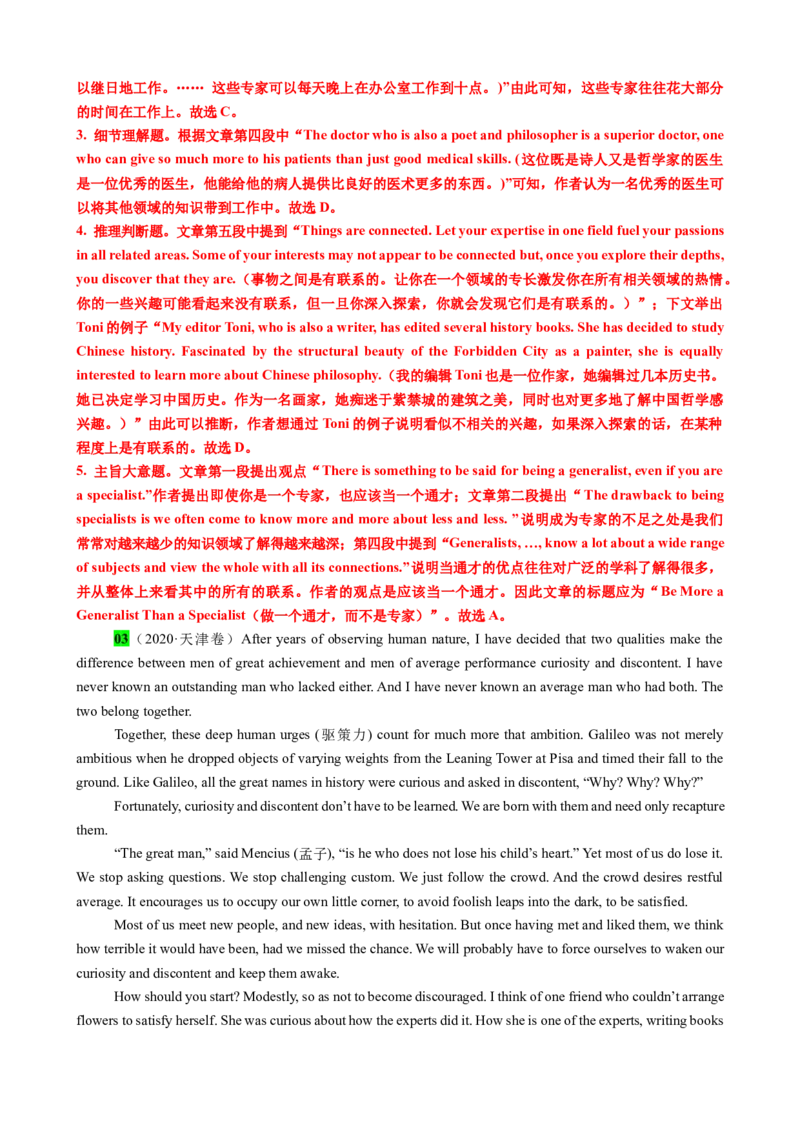
02(2021·天津卷)There is something to be said for being a generalist, even if you are a specialist. Knowing
a little about a lot of things that interest you can add to the richness of a whole, well-lived life.
Society pushes us to specialize, to become experts. This requires commitment to a particular occupation,
branch of study or research. The drawback to being specialists is we often come to know more and more about less
and less. There is a great deal of pressure to master one's field. You may pursue training, degrees, or increasing
levels of responsibility at work. Then you discover the pressure of having to keep up.
Some people seem willing to work around the clock in their narrow specialty. But such commitment can also
weaken a sense of freedom. These specialists could work at the office until ten each night, then look back and realize
they would have loved to have gone home and enjoyed the sweetness of their family and friends, or traveled to
exciting places, meeting interesting people. Mastering one thing to the exclusion (排 除)of others can hold back
your true spirit.
Generalists, on the other hand, know a lot about a wide range of subjects and view the whole with all its
connections. They are people of ability, talent, and enthusiasm who can bring their broad perspective (视角)into
specific fields of expertise (专长).The doctor who is also a poet and philosopher is a superior doctor, one who
can give so much more to his patients than just good medical skills.
Things are connected. Let your expertise in one field fuel your passions in all related areas. Some of your
interests may not appear to be connected but, once you explore their depths, you discover that they are. My editor
Toni, who is also a writer, has edited several history books. She has decided to study Chinese history. Fascinated by
the structural beauty of the Forbidden City as a painter, she is equally interested to learn more about Chinese
philosophy. "I don't know where it will lead, but I'm excited I'm on this pursuit."
These expansions into new worlds help us by giving us new perspectives. We begin to see the interconnectedness
of one thing to another in all aspects of our life, of ourselves and the universe. Develop broad, general knowledge
and experience. The universe is all yours to explore and enjoy.
1. To become a specialist, one may have to_____.
A. narrow his range of knowledge
B. avoid responsibilities at work
C. know more about the society
D. broaden his perspective on life
2. The specialists mentioned in Paragraph 3 tend to______.
A. treasure their freedom
B. travel around the world
C. spend most time working
D. enjoy meeting funny people
3. According to the author, a superior doctor is one who_____.
A. is fully aware of his talent and ability
B. is a pure specialist in medicine
C. should love poetry and philosophy
D. brings knowledge of other fields to work
4. What does the author intend to show with the example of Toni?
A. Passion alone does not ensure a person's success.
B. In-depth exploration makes discoveries possible.
C. Everyone has a chance to succeed in their pursuit.
D. Seemingly unrelated interests are in a way connected.
5. What could be the best title for the passage?
A. Be More a Generalist Than a Specialist
B. Specialist or Generalist: Hard to Decide
C. Turn a Generalist into a Specialist
D. Ways to Become a Generalist
【答案】1. A 2. C 3. D 4. D 5. A
【分析】本文是议论文。文章论述了要当一个多面手,而不是当某方面的专家。
1. 推理判断题。文章第二段中提到“This requires commitment to a particular occupation, branch of study
or research. The drawback to being specialists is we often come to know more and more about less and less.(成
为专家需要对特定的职业、研究领域的投入。成为专家的缺点是我们常常对越来越少的知识领域了解得
越来越多。)”根据“know … about less and less”可知,要成为一名专家,了解到的知识领域会越来越少
会缩小他的知识范围。故选A。
2. 细节理解题。第三段中提到“Some people seem willing to work around the clock in their narrow specialty.
…These specialists could work at the office until ten each night (有些人似乎愿意在他们狭隘的专业领域夜
以继日地工作。…… 这些专家可以每天晚上在办公室工作到十点。)”由此可知,这些专家往往花大部分
的时间在工作上。故选C。
3. 细节理解题。根据文章第四段中“The doctor who is also a poet and philosopher is a superior doctor, one
who can give so much more to his patients than just good medical skills. (这位既是诗人又是哲学家的医生
是一位优秀的医生,他能给他的病人提供比良好的医术更多的东西。)”可知,作者认为一名优秀的医生可
以将其他领域的知识带到工作中。故选D。
4. 推理判断题。文章第五段中提到“Things are connected. Let your expertise in one field fuel your passions
in all related areas. Some of your interests may not appear to be connected but, once you explore their depths,
you discover that they are.(事物之间是有联系的。让你在一个领域的专长激发你在所有相关领域的热情。
你的一些兴趣可能看起来没有联系,但一旦你深入探索,你就会发现它们是有联系的。)”;下文举出
Toni 的例子“My editor Toni, who is also a writer, has edited several history books. She has decided to study
Chinese history. Fascinated by the structural beauty of the Forbidden City as a painter, she is equally
interested to learn more about Chinese philosophy.(我的编辑Toni 也是一位作家,她编辑过几本历史书。
她已决定学习中国历史。作为一名画家,她痴迷于紫禁城的建筑之美,同时也对更多地了解中国哲学感
兴趣。)”由此可以推断,作者想通过Toni 的例子说明看似不相关的兴趣,如果深入探索的话,在某种
程度上是有联系的。故选D。
5. 主旨大意题。文章第一段提出观点“There is something to be said for being a generalist, even if you are
a specialist.”作者提出即使你是一个专家,也应该当一个通才;文章第二段提出“The drawback to being
specialists is we often come to know more and more about less and less. ”说明成为专家的不足之处是我们
常常对越来越少的知识领域了解得越来越深;第四段中提到“Generalists, …, know a lot about a wide range
of subjects and view the whole with all its connections.”说明当通才的优点往往对广泛的学科了解得很多,
并从整体上来看其中的所有的联系。作者的观点是应该当一个通才。因此文章的标题应为“Be More a
Generalist Than a Specialist(做一个通才,而不是专家)”。故选A。
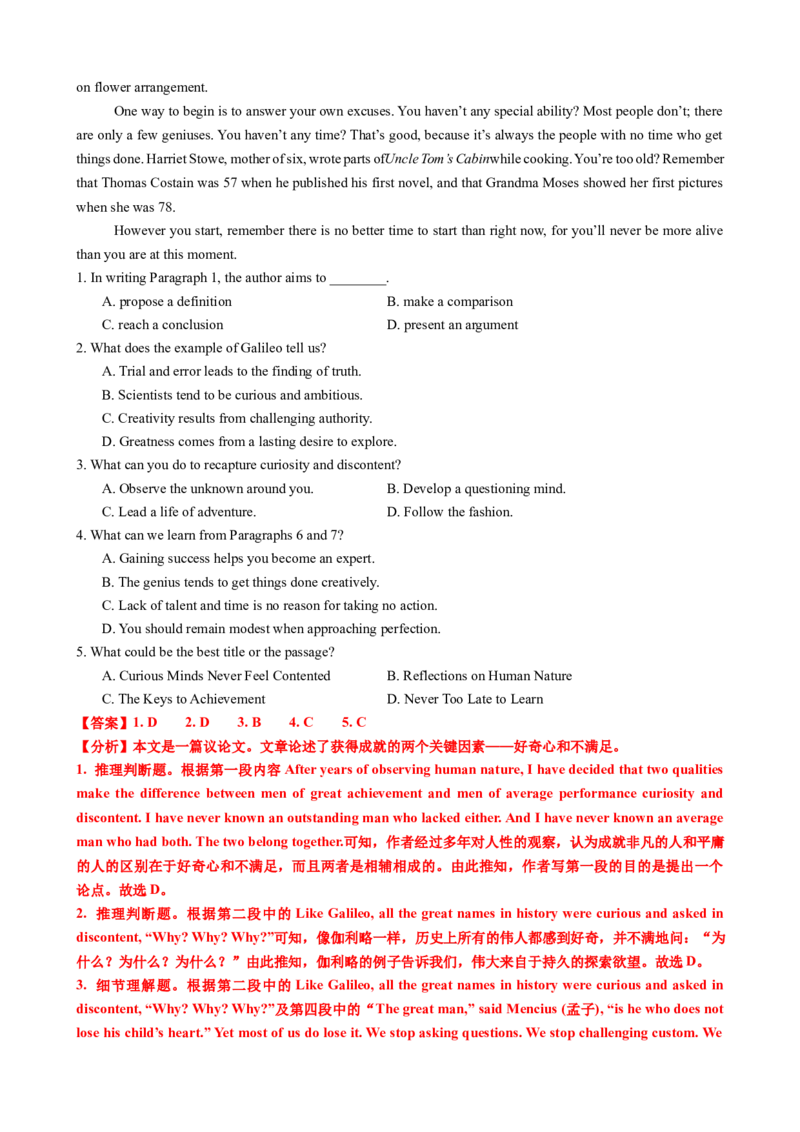
03(2020·天津卷)After years of observing human nature, I have decided that two qualities make the
difference between men of great achievement and men of average performance curiosity and discontent. I have
never known an outstanding man who lacked either. And I have never known an average man who had both. The
two belong together.
Together, these deep human urges (驱策力) count for much more that ambition. Galileo was not merely
ambitious when he dropped objects of varying weights from the Leaning Tower at Pisa and timed their fall to the
ground. Like Galileo, all the great names in history were curious and asked in discontent, “Why? Why? Why?”
Fortunately, curiosity and discontent don’t have to be learned. We are born with them and need only recapture
them.
“The great man,” said Mencius (孟子), “is he who does not lose his child’s heart.” Yet most of us do lose it.
We stop asking questions. We stop challenging custom. We just follow the crowd. And the crowd desires restful
average. It encourages us to occupy our own little corner, to avoid foolish leaps into the dark, to be satisfied.
Most of us meet new people, and new ideas, with hesitation. But once having met and liked them, we think
how terrible it would have been, had we missed the chance. We will probably have to force ourselves to waken our
curiosity and discontent and keep them awake.
How should you start? Modestly, so as not to become discouraged. I think of one friend who couldn’t arrange
flowers to satisfy herself. She was curious about how the experts did it. How she is one of the experts, writing books
on flower arrangement.
One way to begin is to answer your own excuses. You haven’t any special ability? Most people don’t; there
are only a few geniuses. You haven’t any time? That’s good, because it’s always the people with no time who get
things done. Harriet Stowe, mother of six, wrote parts ofUncle Tom’s Cabinwhile cooking. You’re too old? Remember
that Thomas Costain was 57 when he published his first novel, and that Grandma Moses showed her first pictures
when she was 78.
However you start, remember there is no better time to start than right now, for you’ll never be more alive
than you are at this moment.
1. In writing Paragraph 1, the author aims to ________.
A. propose a definition
B. make a comparison
C. reach a conclusion
D. present an argument
2. What does the example of Galileo tell us?
A. Trial and error leads to the finding of truth.
B. Scientists tend to be curious and ambitious.
C. Creativity results from challenging authority.
D. Greatness comes from a lasting desire to explore.
3. What can you do to recapture curiosity and discontent?
A. Observe the unknown around you.
B. Develop a questioning mind.
C. Lead a life of adventure.
D. Follow the fashion.
4. What can we learn from Paragraphs 6 and 7?
A. Gaining success helps you become an expert.
B. The genius tends to get things done creatively.
C. Lack of talent and time is no reason for taking no action.
D. You should remain modest when approaching perfection.
5. What could be the best title or the passage?
A. Curious Minds Never Feel Contented
B. Reflections on Human Nature
C. The Keys to Achievement
D. Never Too Late to Learn
【答案】1. D 2. D 3. B 4. C 5. C
【分析】本文是一篇议论文。文章论述了获得成就的两个关键因素——好奇心和不满足。
1. 推理判断题。根据第一段内容After years of observing human nature, I have decided that two qualities
make the difference between men of great achievement and men of average performance curiosity and
discontent. I have never known an outstanding man who lacked either. And I have never known an average
man who had both. The two belong together.可知,作者经过多年对人性的观察,认为成就非凡的人和平庸
的人的区别在于好奇心和不满足,而且两者是相辅相成的。由此推知,作者写第一段的目的是提出一个
论点。故选D。
2. 推理判断题。根据第二段中的Like Galileo, all the great names in history were curious and asked in
discontent, “Why? Why? Why?”可知,像伽利略一样,历史上所有的伟人都感到好奇,并不满地问:“为
什么?为什么?为什么?”由此推知,伽利略的例子告诉我们,伟大来自于持久的探索欲望。故选D。
3. 细节理解题。根据第二段中的Like Galileo, all the great names in history were curious and asked in
discontent, “Why? Why? Why?”及第四段中的“The great man,” said Mencius (孟子), “is he who does not
lose his child’s heart.” Yet most of us do lose it. We stop asking questions. We stop challenging custom. We
just follow the crowd.可知,历史上所有的伟人都感到好奇,并不满地问:“为什么?为什么?为什么?”
孟子认为“不失去孩子的心,就是伟大的人。”然而,我们大多数人确实失去了它。我们不再问问题。
我们不再挑战习俗。我们只是随大流。由此可知,你可以通过培养了一个善于提问的头脑,来重新获得
好奇心和不满。故选B。
4. 推理判断题。根据第六段中的How she is one of the experts, writing books on flower arrangement.及第
七段中的You haven’t any special ability? Most people don’t; there are only a few geniuses. You haven’t any
time? That’s good, because it’s always the people with no time who get things done.以及列举了Thomas
Costain 在57 岁时出版了他的第一部小说,Grandma Moses 在78 岁时展示了她的第一批照片。由此可知,
这两段想告诉我们“缺乏天赋和时间不是不采取行动的理由”。故选C。
5. 主旨大意题。根据第一段内容After years of observing human nature, I have decided that two qualities
make the difference between men of great achievement and men of average performance curiosity and
discontent. I have never known an outstanding man who lacked either. And I have never known an average
man who had both. The two belong together.及下文论述可知,本文主要论述了获得成就的两个关键因素
——好奇心和不满足。由此可知,C 项The Keys to Achievement(成就的关键)适合做本文最佳标题。故选
C。
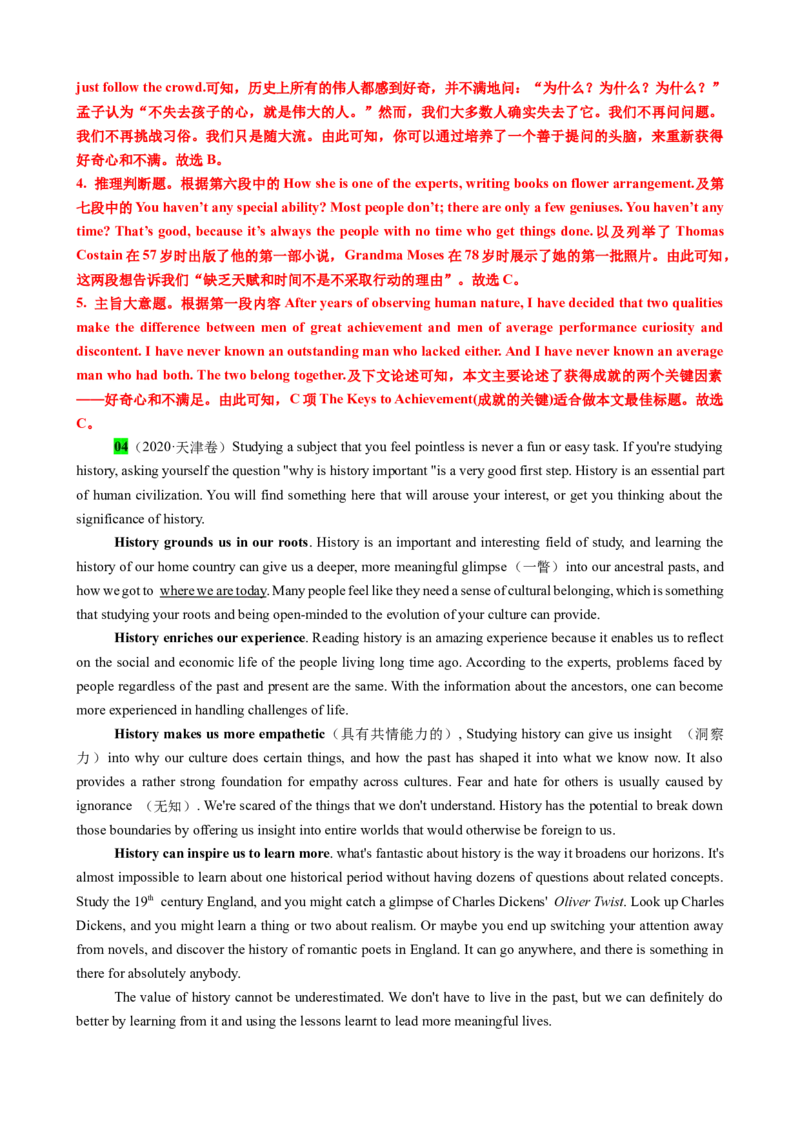
04(2020·天津卷)Studying a subject that you feel pointless is never a fun or easy task. If you're studying
history, asking yourself the question "why is history important "is a very good first step. History is an essential part
of human civilization. You will find something here that will arouse your interest, or get you thinking about the
significance of history.
History grounds us in our roots. History is an important and interesting field of study, and learning the
history of our home country can give us a deeper, more meaningful glimpse(一瞥)into our ancestral pasts, and
how we got to where we are today. Many people feel like they need a sense of cultural belonging, which is something
that studying your roots and being open-minded to the evolution of your culture can provide.
History enriches our experience. Reading history is an amazing experience because it enables us to reflect
on the social and economic life of the people living long time ago. According to the experts, problems faced by
people regardless of the past and present are the same. With the information about the ancestors, one can become
more experienced in handling challenges of life.
History makes us more empathetic(具有共情能力的), Studying history can give us insight (洞察
力)into why our culture does certain things, and how the past has shaped it into what we know now. It also
provides a rather strong foundation for empathy across cultures. Fear and hate for others is usually caused by
ignorance (无知). We're scared of the things that we don't understand. History has the potential to break down
those boundaries by offering us insight into entire worlds that would otherwise be foreign to us.
History can inspire us to learn more. what's fantastic about history is the way it broadens our horizons. It's
almost impossible to learn about one historical period without having dozens of questions about related concepts.
Study the 19th century England, and you might catch a glimpse of Charles Dickens' Oliver Twist. Look up Charles
Dickens, and you might learn a thing or two about realism. Or maybe you end up switching your attention away
from novels, and discover the history of romantic poets in England. It can go anywhere, and there is something in
there for absolutely anybody.
The value of history cannot be underestimated. We don't have to live in the past, but we can definitely do
better by learning from it and using the lessons learnt to lead more meaningful lives.
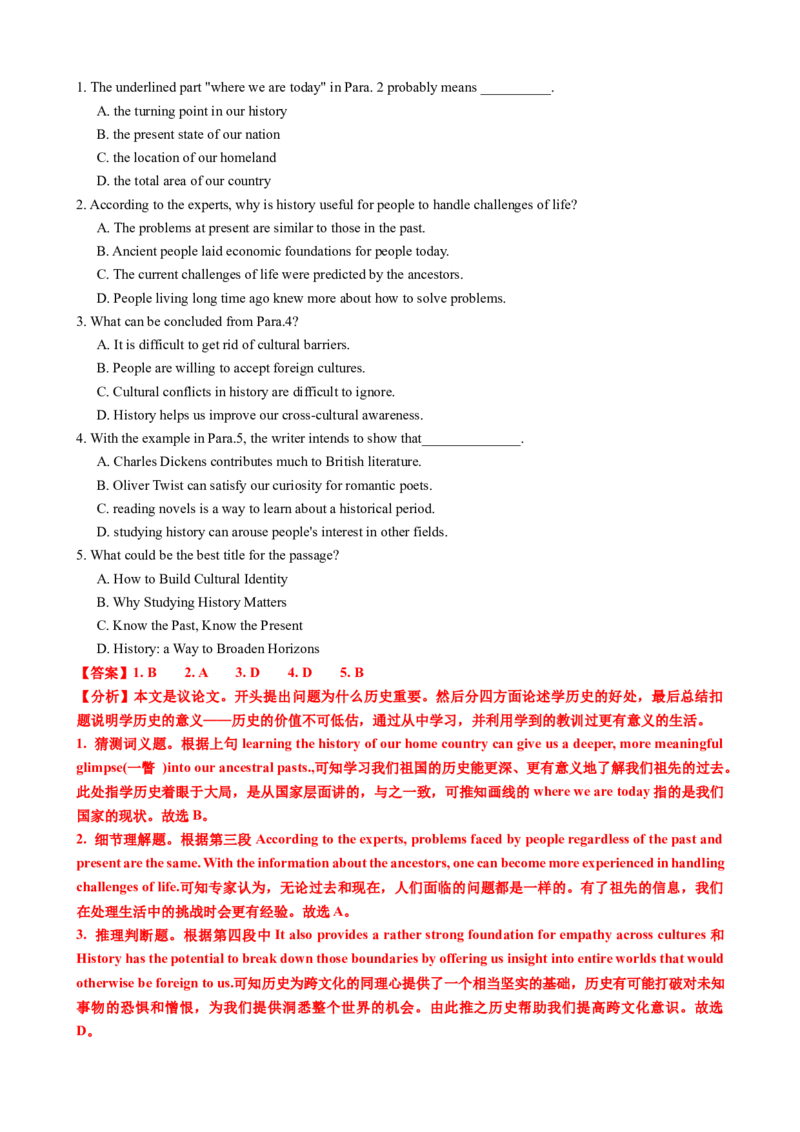
1. The underlined part "where we are today" in Para. 2 probably means __________.
A. the turning point in our history
B. the present state of our nation
C. the location of our homeland
D. the total area of our country
2. According to the experts, why is history useful for people to handle challenges of life?
A. The problems at present are similar to those in the past.
B. Ancient people laid economic foundations for people today.
C. The current challenges of life were predicted by the ancestors.
D. People living long time ago knew more about how to solve problems.
3. What can be concluded from Para.4?
A. It is difficult to get rid of cultural barriers.
B. People are willing to accept foreign cultures.
C. Cultural conflicts in history are difficult to ignore.
D. History helps us improve our cross-cultural awareness.
4. With the example in Para.5, the writer intends to show that______________.
A. Charles Dickens contributes much to British literature.
B. Oliver Twist can satisfy our curiosity for romantic poets.
C. reading novels is a way to learn about a historical period.
D. studying history can arouse people's interest in other fields.
5. What could be the best title for the passage?
A. How to Build Cultural Identity
B. Why Studying History Matters
C. Know the Past, Know the Present
D. History: a Way to Broaden Horizons
【答案】1. B 2. A 3. D 4. D 5. B
【分析】本文是议论文。开头提出问题为什么历史重要。然后分四方面论述学历史的好处,最后总结扣
题说明学历史的意义——历史的价值不可低估,通过从中学习,并利用学到的教训过更有意义的生活。
1. 猜测词义题。根据上句learning the history of our home country can give us a deeper, more meaningful
glimpse(一瞥 )into our ancestral pasts.,可知学习我们祖国的历史能更深、更有意义地了解我们祖先的过去。
此处指学历史着眼于大局,是从国家层面讲的,与之一致,可推知画线的where we are today 指的是我们
国家的现状。故选B。
2. 细节理解题。根据第三段According to the experts, problems faced by people regardless of the past and
present are the same. With the information about the ancestors, one can become more experienced in handling
challenges of life.可知专家认为,无论过去和现在,人们面临的问题都是一样的。有了祖先的信息,我们
在处理生活中的挑战时会更有经验。故选A。
3. 推理判断题。根据第四段中It also provides a rather strong foundation for empathy across cultures 和
History has the potential to break down those boundaries by offering us insight into entire worlds that would
otherwise be foreign to us.可知历史为跨文化的同理心提供了一个相当坚实的基础,历史有可能打破对未知
事物的恐惧和憎恨,为我们提供洞悉整个世界的机会。由此推之历史帮助我们提高跨文化意识。故选
D。
4. 推理判断题。根据第五段标题是 History can inspire us to learn more:(历史可以激励我们学习更多),下
面列举了阅读Oliver Twist 的例子,通过Oliver Twist 我们能去了解作者 Charles Dickens,还可能会学到一
些关于现实主义的东西,会发现英国浪漫主义诗人的历史。作者通过这个例子是为了说明学习历史可以
引起人们对其他领域的兴趣。故选D。
5. 主旨大意题。根据第一段If you're studying history, asking yourself the question" why is history
important" is a very good first step.提到学历史前先问自己为什么历史重要。下文分四方面论述学历史的
好处,最后一段总结扣题说明学历史的意义——历史的价值不可低估,通过从中学习,并利用学到的教
训过更有意义的生活。故Why Studying History Matters?能概括全文内容。故选B。
05(2019·天津卷)Would you BET on the future of this man? He is 53 years old. Most of his adult life has
been a losing struggle against debt and misfortune. A war injury has made his left hand stop functioning, and he
has often been in prison. Driven by heaven-knows-what motives, he determines to write a book.
The book turns out to be one that has appealed to the world for more than 350 years. That former prisoner was
Cervantes, and the book was Don Quixote(《堂吉诃德》). And the story poses an interesting question: why
do some people discover new vitality and creativity to the end of their days, while others go to seed long before?
We’ve all known people who run out of steam before they reach life’s halfway mark. I’m not talking about
those who fail to get to the top. We can’t all get there. I’m talking about people who have stopped learning on
growing because they have adopted the fixed attitudes and opinions that all too often come with passing years.
Most of us, in fact, progressively narrow the variety of our lives. We succeed in our field of specialization and
then become trapped in it. Nothing surprises us. We lose our sense of wonder. But, if we are willing to learn, the
opportunities are everywhere.
The things we learn in maturity seldom involve information and skills. We learn to bear with the things we
can’t change. We learn to avoid self-pity. We learn that however much we try to please, some people are never
going to love us—an idea that troubles at first but is eventually relaxing.
With high motivation and enthusiasm, we can keep on learning. Then we will know how important it is to
have meaning in our life. However, we can achieve meaning only if we have made a commitment to something
larger than our own little egos(自我), whether to loved ones, to fellow humans, to work, or to some moral
concept.
Many of us equate(视……等同于) “commitment” with such “caring” occupations as teaching and nursing.
But doing any ordinary job as well as one can is in itself an admirable commitment. People who work toward such
excellence—whether they are driving a truck, or running a store—make the world better just by being the kind of
people they are. They’ve learned life’s most valuable lesson.
1. The passage starts with the story of Cervantes to show that ________.
A. loss of freedom stimulates one’s creativity
B. age is not a barrier to achieving one’s goal
C. misery inspires a man to fight against his fate
D. disability cannot stop a man’s pursuit of success
2. What does the underlined part in Paragraph 3 probably mean?
A. End one’s struggle for liberty.
B. Waste one’s energy taking risks.
C. Miss the opportunity to succeed.
D. Lose the interest to continue learning.
3. What could be inferred from Paragraph 4?
A. Those who dare to try often get themselves trapped.
B. Those who tend to think back can hardly go ahead.
C. Opportunity favors those with a curious mind.
D. Opportunity awaits those with a cautious mind.
4. What does the author intend to tell us in Paragraph 5?
A. A tough man can tolerate suffering.
B. A wise man can live without self-pity.
C. A man should try to satisfy people around him.
D. A man should learn suitable ways to deal with life.
5. What is the author’s purpose in writing the passage?
A. To provide guidance on leading a meaningful adult life.
B. To stress the need of shouldering responsibilities at work.
C. To state the importance of generating motivation for learning.
D. To suggest a way of pursuing excellence in our lifelong career.
【答案】1. B 2. D 3. C 4. D 5. A
【解析】这是一篇议论文,本文讲述要成功,就需要不断的学习,这样的生活才会有意义。
1.推理判断题。第一段讲述塞万提斯一生不幸,负债累累,因为战争受伤左手残疾,同时还身陷囹圄,在
53 岁的时候决定写书,最终写出成名作《唐吉柯德》,根据后文可知,所有的困境都没有阻挡他的成功,
年龄也是如此,故选B。
2.词义猜测题。根据第三段I’m not talking about those who fail to get to the top. We can’t all get there. I’m
talking about people who have stopped learning on growing because they have adopted the fixed attitudes
and opinions that all too often come with passing years.可知,作者谈论的不是那些没有到达巅峰的人,而
是谈论那些不再学习成长的人,故可知run out of steam 可知,停止学习,故选D。
3.推理判断题。根据第四段中But, if we are willing to learn, the opportunities are everywhere.可知,我们
失去了好奇感,但是如果我们愿意学习,机会无处不在,故可知机会总是留给那些有好奇心的人,故选
C。
4.推理判断题。根据第五段We learn to bear with the things we can’t change. We learn to avoid self-pity. We
learn that however much we try to please, some people are never going to love us—an idea that troubles at
first but is eventually relaxing.可知,我们学会承受那些无法改变的事情,学会避免自怜,也学会了无论我
们怎么去取悦别人,有些人是无法喜欢我们的,这个观点起初让我们苦恼,但是之后会让我们释怀,故
可知本段作者告诉我们要学会使用恰当的方式来对待生活,故选D。
5.主旨大意题。本文讲述要成功,就需要不断的学习,这样的生活才会有意义,故本文作者的目的是为了
指导我们过一个有意义的成年人生活,故选A。
三、阅读理解名校模拟(议论文)
模拟专区:做好题才有好成绩
! 练技能
, 补漏洞
, 提分数
, 强信心
!
01(25-26 高三上·天津·阶段练习)Who doesn’t stand in awe of the advances that science and its STEM
siblings (technology, engineering, and math) have created to better our world? But since the time of Aristotle, it has
also been recognized that the hard sciences and the humanities must walk side by side in determining human
action.
The ancient Greek philosopher praised “practical wisdom” as the “middle ground” between scientific
knowledge and what he referred to as the “cunning ( 狡诈的) intelligence of politicians, military generals and
business leaders”. In his Nicomachean Ethics (伦理学), he rejected the idea that scientific knowledge alone could
determine the affairs of the human social world, which he recognized as too complex and unpredictable to govern
with certainty.
Likewise, he saw that cunning was insufficient to shape a society filled with the “good life.” Aristotle insisted
that practical wisdom was required for the advancement of the human race as it would take into account what he
called “the common good,” doing what is right for the majority of people living together in society.
Aristotle’s philosophy is still sound today. But to the extent that we side with him, we must challenge our
modern era’s overwhelming emphasis on the STEM disciplines as the key to progress. Yes, we will continue to
welcome advances in computerization, robotics, nanotechnologies, medicine and more. But to ensure these
innovations are in service of the good life, we must also advance our thinking in the humanities: philosophy, social
affairs and the arts.
Instead of just STEM, we should perhaps be promoting STEMMA. In that case, we will be able to raise a
new generation that has greater capacities for managing collective human efforts and appreciating the arts.
Management education — the new “M” in the acronym (缩略词) — has not always been integrated into humanistic
thinking, but it must become more so. Our goal must be to develop the thoughtful business leaders of the future.
Regarding the “A,” how could it be beneficial to the future without emphasizing the arts, which inform our knowledge
of beauty and meaning in human affairs? All the brilliant discoveries of STEM will not solve the grand challenges
of today’s world — ignorance, poverty, intolerance and political conflict — without the practical wisdom of
humanities-trained leaders.
We can’t march boldly into the future without demanding rapid advancement in the capabilities necessary for
preserving our human dignity in a world of artificial super intelligence. Humans are not robots and neurons (神经
元) are not digital switches. It is only through the humanities that we will be able to appreciate the answers that
superintelligent computers give us when we ask them the hard questions. It is only through the humanities that we
will increasingly recognize and build on what we humans uniquely are.
1. What is the primary limitation of relying only on STEM disciplines?
A. They lack the precision needed for modern innovations.
B. They cannot address complex human social challenges alone.
C. They prevent the development of artificial superintelligence.
D. They are too focused on theoretical rather than practical knowledge.
2. The term “practical wisdom” as used by Aristotle emphasizes ______.
A. a balanced approach that considers the common good
B. the need for military strategies in societal development
C. the importance of technological advancement above all else
D. the superiority of scientific knowledge over political cunning
3. What is the author’s purpose in proposing the term “STEMMA”?
A. To replace STEM entirely with a new educational framework.
B. To criticize the current emphasis on technology and engineering.
C. To argue for the inclusion of management and arts in STEM education.
D. To promote the study of ancient Greek philosophy in modern curricula.
4. Which of the following best summarizes Aristotle’s view on scientific knowledge and cunning intelligence?
A. Both are equally harmful to societal progress.
B. Neither is sufficient without practical wisdom.
C. Scientific knowledge is superior to cunning intelligence.
D. Cunning intelligence is more relevant to modern politics.
5. How does the author view the relationship between humans and artificial superintelligence?
A. Humans will eventually be replaced by intelligent robots.
B. Superintelligence will make human decision-making irrelevant.
C. STEM disciplines alone can ensure ethical use of superintelligence.
D. Human dignity and unique qualities must be preserved via humanities.
【答案】1. B 2. A 3. C 4. B 5. D
【导语】本文是一篇议论文。文章讨论了STEM 学科(科学、技术、工程和数学)在推动世界进步方面
的作用,同时强调了人文学科(哲学、社会事务和艺术)的重要性,并提出了STEMMA 的概念,主张
在STEM 教育中融入管理和艺术。
1. 细节理解题。根据第一段中“But since the time of Aristotle, it has also been recognized that the hard
sciences and the humanities must walk side by side in determining human action.(但自亚里士多德时代以来,
人们也认识到,在决定人类行为方面,硬科学和人文学科必须并驾齐驱)”和第三段中“he rejected the idea
that scientific knowledge alone could determine the affairs of the human social world, which he recognized
as too complex and unpredictable to govern with certainty.(他反对仅靠科学知识就能决定人类社会事务的
观点,他认为人类社会事务过于复杂和不可预测,无法确定地治理)”可知,仅依靠STEM 学科的主要限
制是它们无法单独解决复杂的人类社会挑战。故选B 项。
2. 细节理解题。根据第二段中“The ancient Greek philosopher praised “practical wisdom” as the “middle
ground” between scientific knowledge and what he referred to as the “cunning ( 狡诈的) intelligence of
politicians, military generals and business leaders”.(这位古希腊哲学家称赞“实践智慧”是科学知识和他所
说的“政治家、军事将领和商业领袖的狡诈智慧”之间的“中间地带”)”以及第三段中“Aristotle
insisted that practical wisdom was required for the advancement of the human race as it would take into
account what he called “the common good,” doing what is right for the majority of people living together in
society.(亚里士多德坚持认为,人类的进步需要实践智慧,因为它会考虑到他所说的“共同利益”,即为
社会上的大多数人做正确的事)”可知,亚里士多德所用的“实践智慧”一词强调的是一种考虑共同利益的
平衡方法。故选A 项。
3. 推理判断题。根据第五段中“Instead of just STEM, we should perhaps be promoting STEMMA. In that
case, we will be able to raise a new generation that has greater capacities for managing collective human
efforts and appreciating the arts.(我们不应只推崇STEM 教育,或许更应倡导STEMMA 理念。唯有如此
才能培养出具备更强人类协作管理能力与艺术鉴赏力的新一代)”可知,作者提出“STEMMA”一词的目的
是主张在STEM 教育中纳入管理和艺术。故选C 项。
4. 推理判断题。根据第二段“The ancient Greek philosopher praised “practical wisdom” as the “middle
ground” between scientific knowledge and what he referred to as the “cunning ( 狡诈的) intelligence of
politicians, military generals and business leaders”. In his Nicomachean Ethics (伦理学), he rejected the idea
that scientific knowledge alone could determine the affairs of the human social world, which he recognized
as too complex and unpredictable to govern with certainty.(这位古希腊哲学家称赞“实践智慧”是科学知
识和他所说的“政治家、军事将领和商业领袖的狡诈智慧”之间的“中间地带”。在他的《尼各马可伦
理学》中,他反对仅靠科学知识就能决定人类社会事务的观点,他认为人类社会事务过于复杂和不可预
测,无法确定地治理)”和第三段“Likewise, he saw that cunning was insufficient to shape a society filled
with the “good life.” Aristotle insisted that practical wisdom was required for the advancement of the human
race as it would take into account what he called “the common good,” doing what is right for the majority of
people living together in society.(同样,他也看到狡诈不足以塑造一个充满“美好生活”的社会。亚里士多
德坚持认为,人类的进步需要实践智慧,因为它会考虑到他所说的“共同利益”,即为社会上的大多数
人做正确的事)”可知,亚里士多德认为科学知识和狡诈的智慧都不足以单独推动社会进步,两者都需要实
践智慧的补充。故选B 项。
5. 推理判断题。根据最后一段“ We can’t march boldly into the future without demanding rapid
advancement in the capabilities necessary for preserving our human dignity in a world of artificial super
intelligence. Humans are not robots and neurons (神经元) are not digital switches. It is only through the
humanities that we will be able to appreciate the answers that superintelligent computers give us when we
ask them the hard questions. It is only through the humanities that we will increasingly recognize and build
on what we humans uniquely are.(在一个拥有超级人工智能的世界里,如果我们不要求迅速提高保护人类
尊严的能力,我们就不能大胆地走向未来。人类不是机器人,神经元也不是数字开关。只有通过人文学
科,当我们向超级智能计算机提出难题时,我们才能理解它们给出的答案。只有通过人文学科,我们才
能越来越多地认识并发展我们人类独有的特质)”可知,作者认为人类和超级人工智能的关系在于,必须通
过人文学科来维护人类的尊严和独特品质。故选D 项。
02(25-26 高三上·天津滨海新·阶段练习)Have you ever found that those so-called classical literature is
actually boring and wordy? Have you ever been employed to read such works with total reluctance and unwillingness?
However, these works, when published, suddenly became a hit all around the world, and won a large number of
followers. Why here exists the huge distinction between their venerable fames and your natural judgement?
The answer lies not in the works themselves, but in the mismatch between readers’ expectations and the
historical context in which these texts were created. Classics reflect the language, values, and concerns of their own
time, which can feel distant or irrelevant to modern readers. Long-winded descriptions, unfamiliar social customs,
and archaic sentence structures can be barriers to engagement. However, labeling them as boring overlooks the
lasting human truths they contain — truths that have resonated for generations.
One key reason we struggle to connect with classical literature is that these works explore deep emotions and
moral dilemmas — love, guilt, ambition, loss — that resonate most when we’ve lived through similar experiences
ourselves. It is difficult to appreciate Shakespeare’s meditation on mortality in Hamlet until we have lost someone we
love; it is hard to understand Jane Eyre’s moral independence without having struggled with our own identity.
These books don’t lack meaning — we simply haven’t grown into them yet.
Like a child who cannot fully grasp the complexities of adult life, an inexperienced reader may fail to see the
emotional depth of classic literature. That’s why the same book can feel entirely different when read at different
stages of life. A passage that once seemed dull may suddenly feel profound. A character’s decision that once seemed
irrational may now appear deeply human. Classics don’t change — but we do. Our growth brings new insights into
old texts.
More importantly, literature helps us practice empathy. By stepping into the shoes of people from different
times, cultures, and social classes, we broaden our emotional perspectives. We are exposed to ways of thinking and
feeling that may be unfamiliar but are essential to understanding the human experience.
So perhaps the problem is not with the books, but with how we approach them. Some books ask us to slow
down, think harder, and feel deeper. That is not a flaw ( 缺点) — it is their strength. And as we gain more life
experience, these works reveal their beauty, wisdom, and relevance. Through them, we don’t just understand
literature — we come to understand others, and ultimately, ourselves.
1. What is the main reason the author suggests modern readers may struggle with classical literature?
A. Classical literature uses outdated vocabulary
B. Classical works reflect values and concerns from a different historical context
C. Modern readers lack interest in older texts
D. Classical works are too short to engage with deeply
2. According to the article, why might a young reader find Hamlet or Jane Eyre difficult to relate to?
A. They carry many special designs of plots
B. They have not yet experienced similar emotions
C. They have little empathetic ability
D. The characters are too unrealistic
3. What is the primary purpose of literature, as described in the article?
A. To entertain readers with exciting plots
B. To expose readers to different historical periods
C. To help readers practice empathy and understand others
D. To teach readers about the complexities of life
4. What is the central argument of the article?
A. Classical literature is irrelevant to modern readers
B. We should approach classical works with openness and patience
C. Modern literature is superior to classical literature
D. Some classical literature should be rewritten for modern readers
5. Which of the following best summarizes the article’s view on classical literature?
A. Classical literature is outdated and should be replaced by modern works
B. Modern readers should learn to read classical literature carefully
C. Classical literature is useful for academic study and personal growth
D. Classical works have their necessary values behind
【答案】1. B 2. B 3. C 4. B 5. D
【导语】本文是一篇议论文。主要针对现代读者觉得古典文学枯燥冗长的现象展开分析,指出问题根源
并非作品本身,而是读者期待与作品创作的历史背景不匹配、读者缺乏相似生活体验等;同时强调古典
文学蕴含永恒的人类真理,能帮助读者培养同理心、实现自我理解,最终提出应以开放和耐心的态度对
待古典文学。
1. 细节理解题。根据第二段中的“The answer lies not in the works themselves, but in the mismatch between
readers’ expectations and the historical context in which these texts were created. Classics reflect the language,
values, and concerns of their own time, which can feel distant or irrelevant to modern readers. (答案不在于
作品本身,而在于读者的期望与这些文本创作时的历史背景之间的不匹配。经典作品反映了它们所处时
代的语言、价值观和关注点,这对现代读者来说可能会显得遥远或无关紧要)”可知,作者认为现代读者难
以理解古典文学的主要原因是古典文学反映了特定时代的价值观和关注点,与现代读者的认知存在历史
背景差异。故选B 项。
2. 细节理解题。根据第三段中的“One key reason we struggle to connect with classical literature is that
these works explore deep emotions and moral dilemmas — love, guilt, ambition, loss — that resonate most
when we’ve lived through similar experiences ourselves. It is difficult to appreciate Shakespeare’s meditation
on mortality in Hamlet until we have lost someone we love; it is hard to understand Jane Eyre’s moral
independence without having struggled with our own identity. (我们难以与古典文学产生共鸣的一个关键
原因是,这些作品探讨了深刻的情感和道德困境 —— 爱、愧疚、野心、失落 —— 而只有当我们亲身经
历过类似的事情时,才能最大程度地感受到这些情感和困境的共鸣。除非我们失去过挚爱的人,否则很
难体会莎士比亚在《哈姆雷特》中对死亡的沉思;若没有为自我身份而挣扎过,也很难理解简·爱那种道
德上的独立)”可知,年轻读者可能觉得《哈姆雷特》或《简·爱》难以理解是因为他们尚未经历作品中所
探讨的相似情感。故选B 项。
3. 细节理解题。根据倒数第二段中的“More importantly, literature helps us practice empathy. By stepping
into the shoes of people from different times, cultures, and social classes, we broaden our emotional
perspectives. (更重要的是,文学帮助我们培养共情能力。通过设身处地地站在来自不同时代、文化和社会
阶层的人的角度,我们拓宽了自己的情感视野)”可知,文章认为文学的主要目的是帮助读者培养同理心,
理解他人。故选C 项。
4. 主旨大意题。通读全文可知,作者先指出读者觉得古典文学枯燥的现象,再分析其原因,接着强调古
典文学的价值,在最后一段中提出核心观点:“So perhaps the problem is not with the books, but with how
we approach them. Some books ask us to slow down, think harder, and feel deeper. That is not a flaw— it is
their strength. (所以,或许问题不在于书籍本身,而在于我们对待它们的方式。有些书要求我们放慢速度、
深入思考、深刻感受。这并非缺点—— 而是它们的优势所在。)”,因此,文章的中心论点是我们应该以
开放和耐心的态度对待经典作品。故选B 项。
5. 推理判断题。根据第二段中的“However, labeling them as boring overlooks the lasting human truths
they contain — truths that have resonated for generations. (然而,将它们贴上“无聊”的标签,却忽视了
其中蕴含的持久的人类真理 —— 这些真理已经引起了几代人的共鸣)”以及最后一段中的“And as we gain
more life experience, these works reveal their beauty, wisdom, and relevance. (而且,随着我们积累更多的
生活经验,这些作品会展现出它们的美、智慧和现实意义)”可知,文章认为古典文学并非枯燥无用,其背
后蕴含着永恒的真理、美感与智慧,具有重要价值。故选D 项。
03(25-26 高三上·天津·阶段练习)Happiness is not natural. It is purely an idea created by human. A state
of contentment (let alone happiness) is discouraged by our genetic design because it would lower our guard against
possible threats to our survival.
Chasing happiness is like chasing an elusive (难以捉摸的) ghost. The positive thinking industry, however,
claims to know its secrets. Self-help was popularized by Norman Vincent Peale, an American pastor (牧师). He
invented “positive thinking”, a concept now deeply embedded in our culture and steadily growing in influence. The
global personal development industry was valued at $38. 28 billion in 2019 and is expected to keep growing at a
rate of 5.1 percent.
Popular films and books are full of supposedly inspirational statements which suggest all you need to do is
believe in yourself and then you will be able to achieve anything in life. This is simply, and obviously, not true. I
don’t think there is a need to explain that many obstacles and misfortunes in life are inevitable or unmanageable.
Our ancestors knew this. Many philosophical and religious traditions are based on the acceptance that being alive
is a very challenging task, which comes with significant amounts of suffering. It goes without saying that we should
do all that we can to maximize our sense of well-being and minimize our suffering, but the end result can’t be a state
of sustained bliss (极乐). We are not designed that way.
The self-help genre (类型) is not a homogeneous (同种类的) beast, however. It is, in fact, ironic how self-
help books on happiness and those on how to “make it big” are put together on the same bookshelf, given that many
of the former tell us that caring too much about success and fame is the main obstacle to happiness.
The inevitable clash between mandatory (强制的)optimism and the realities of our existence comes with a
heavy psychological price. It could be argued that positive psychology blames those who are suffering for their
suffering, as it is based on the false idea that unhappiness is entirely avoidable. It follows therefore that an unhappy
person must be inadequate and incompetent. Positive psychology encourages people who are struggling with a
particular goal to persevere in the face of unfavourable odds. This is much more punishing psychologically in the
long run than accepting failure.
I believe that coming to terms with life as it is, and not as the happiness industry tells us it could be, will
make us feel happier and more at peace with ourselves and with the world. Unfortunately, the devil always has the
best tunes.
1. What is author’s main purpose in writing the first three paragraphs?
A. To analyze how personal development industry works.
B. To explain how unrealistic it is to pursue happiness in life.
C. To contrast modern people’s view of life with our ancestors’.
D. To review how the concept of happiness has changed over years.
2. The word “this” in Paragraph 3 (“Our ancestors knew this”) refers to which of the following?
A. The positive thinking industry’s secrets to happiness are unreliable.
B. Many life obstacles and misfortunes are unavoidable or unmanageable.
C. Philosophical traditions emphasize the challenges of being alive.
D. Sustained bliss is impossible due to human genetic design.
3. It seems ironic to the author that putting self-help books on happiness and those on how to “make it big” together
because _______.
A. readers fail to notice they belong to distinct subgenres with unrelated content themes
B. the former advocates letting go of ambition; the latter urges aggressive success pursuit
C. readers rarely recognize the conflicting values these two types of books promote
D. one focuses on inner contentment and the other on external achievement, with little overlap
4. According to the article, which of the following quotes would the author most strongly disagree with?
A. Happiness is a choice, and so is suffering.
B. Happiness is ideal. It is the work of the imagination.
C. Happiness is a by-product. You cannot pursue it by itself.
D. The search for happiness is one of the chief sources of unhappiness.
5. What does the underlined sentence “the devil always has the best tunes” mean?
A. The core idea of the happiness industry is a beautiful lie.
B. The happiness industry has negative effects on the society.
C. Suffering contributes more to a meaningful life than happiness.
D. The one-sided interpretation of life proved more attractive to the public.
【答案】1. B 2. B 3. B 4. A 5. D
【导语】本文是一篇议论文。主要论述幸福并非天生,追逐幸福不切实际,以及积极心理学和自助类书
籍存在的问题,倡导接受生活本真。
1. 推理判断题。根据第一段中的“Happiness is not natural. It is purely an idea created by human. A state
of contentment (let alone happiness) is discouraged by our genetic design because it would lower our guard
against possible threats to our survival. (幸福并非天生,它纯粹是人类创造的一种观念。我们的基因构造
不支持满足的状态(更不用说幸福了),因为这会降低我们对生存可能面临的威胁的警惕。)”、第二段中
的“Chasing happiness is like chasing an elusive (难以捉摸的) ghost. (追逐幸福就像追逐一个难以捉摸的幽
灵。)”和第三段中的“Popular films and books are full of supposedly inspirational statements which suggest
all you need to do is believe in yourself and then you will be able to achieve anything in life. This is simply,
and obviously, not true. (热门电影和书籍中充斥着所谓的励志言论,声称你只需相信自己,就能在生活中
实现任何目标。显然,这是完全不正确的。)”可知,前三段主要是为了说明在生活中追求幸福是不切实际
的。故选B 项。
2. 词句猜测题。根据第三段中的“I don’t think there is a need to explain that many obstacles and misfortunes
in life are inevitable or unmanageable. Our ancestors knew this. (我认为无需解释,生活中的许多障碍和不
幸是不可避免或难以应对的。我们的祖先早就知道这一点。)”可知,“this”指代前文提到的“生活中的许
多障碍和不幸是不可避免或难以应对的”这一内容。故选B 项。
3. 细节理解题。根据第四段中的“It is, in fact, ironic how self-help books on happiness and those on how to
“make it big” are put together on the same bookshelf, given that many of the former tell us that caring too
much about success and fame is the main obstacle to happiness. (事实上,将关于幸福的自助书籍和关于如
何“大获成功”的自助书籍放在同一个书架上,是很讽刺的事情,因为前者中的许多书籍告诉我们,过
于在意成功和名声是获得幸福的主要障碍。)”可知,关于幸福的自助书籍主张放下对成功名声的执念,而
关于“大获成功”的书籍则鼓励追求成功,二者观点相悖,所以作者觉得将它们放在一起很讽刺。故选B
项。
4. 推理判断题。根据第五段中的“It could be argued that positive psychology blames those who are suffering
for their suffering, as it is based on the false idea that unhappiness is entirely avoidable. (可以说,积极心理
学将痛苦归咎于正在遭受痛苦的人,因为它基于一个错误的观点,即不幸福是完全可以避免的。)”可知,
作者认为不幸福并非完全能避免,而A 选项“幸福是一种选择,痛苦也是”表明痛苦是可以选择避免的,
与作者观点相悖,所以作者最不认同该说法。故选A 项。
5. 词句猜测题。根据最后一段中的“I believe that coming to terms with life as it is, and not as the happiness
industry tells us it could be, will make us feel happier and more at peace with ourselves and with the world.
Unfortunately, the devil always has the best tunes. (我相信,接受生活的本真,而不是幸福产业告诉我们的
那种理想状态,会让我们更快乐,更能与自己和世界和平相处。不幸的是,魔鬼总是有最动听的调子。)”
可知,作者认为接受生活本真更好,但不幸的是,幸福产业所宣扬的那种片面的生活解读,即“魔鬼的
调子”对大众更有吸引力。故选D 项。
04(25-26 高三上·天津南开·开学考试)How long does it take for a rose to bloom? For a boy to grow
into a man? How long does it take to prepare your favorite meal? How long does it take to build a house with a firm
foundation, or travel to your favorite destination?
My point is that good things take time. The best things in life not only take time, but are worth waiting for.
Why, then, do we yield to the temptation of instant satisfaction? A news piece pops on our Facebook, and we only read
the headline. We prefer articles that we can skim in 2 minutes but they never teach us anything new. We get annoyed
when the waiter takes too long to bring out our food or get angry when traffic keeps us for an extra 10 minutes. We
give up when it takes too long to achieve a goal or never start at all.
The best things in life take time, so train yourself to wait patiently for things to come. Patience is something
we can all work on. However, too much patience causes procrastination and inaction which can keep you stuck in a
bad place for a really long time. Passively waiting with no plan of action is not the same thing as having the virtue
of patience. When you think of the virtue of patience, think of Aristotle’s virtue theory and the golden mean… the
golden mean is the perfect midpoint between two extremes.
On one extreme is the lack of patience which causes impatience, intolerance and rashness— on the other
extreme is indifference and inaction. The perfect middle point is a virtuous patient individual who knows how to
wait until it is the right time to act.
So, to achieve your dreams, you have to have just the right amount. Lots of people have “too much patience” or
are comfortable passively waiting and end up wasting time. They are willing to put up with long commutes, bad
relationships and unfulfilling jobs just to pay the bills…… passively waiting keeps people right where they are,
stuck in the status quo(现状).
Living the life you’ve always imagined and achieving your dreams will require you at some point to say
“enough is enough!” In other words, to lose some patience and give yourself a push to achieve your dreams. If you
really want to change your life and achieve your dreams, you will need to work at it. The first step may be when
you finally say to yourself-enough is enough! And the right amount of patience will move you closer.
Be patient enough with yourself so you keep going. Don’t be so patient with yourself that you put off for
tomorrow what you could do today and you will achieve your goals.
1. The author asks several questions to________.
A. show a boy takes a long time to grow into a man
B. highlight it may take a long time to prepare a favourite meal
C. show his interest in building a house with a firm foundation
D. present his concerns about his observing in his life.
2. What is the closest meaning of the underlined words “yield to” in Paragraph 2?
A. stick to
B. give in to
C. hold back
D. hand over to
3. What can be inferred from the passage?
A. We tend to read the news quickly so that we can learn something new.
B. We may fail to be angry if we wait a long time for our food.
C. Too much patience is necessary sometimes for us to achieve our dreams.
D. Too much patience or too little of patience is harmful for to achieve our dreams.
4. According to the author, why do some people prefer to wait passively?
A. Because they have too little patience.
B. Because they have too much patience.
C. Because they are stuck in the status quo.
D. Because they will have to put up with bad relationship.
5. What is mainly discussed in the passage?
A. The significance of proper amount of patience.
B. The definition of patience.
C. The importance of patience.
D. The way to achieve the goals.
【答案】1. D 2. B 3. D 4. B 5. A
【导语】这是一篇议论文,文章开篇通过一系列问题引出生活中好事情需要时间这一观点,接着阐述了
生活中人们常急于获得即时满足的现象,随后讨论了耐心的重要性以及过度耐心和缺乏耐心的弊端,最
后强调要拥有适量的耐心以实现梦想。
1. 推理判断题。根据文章第一段“How long does it take for a rose to bloom? For a boy to grow into a man?
How long does it take to prepare your favorite meal? How long does it take to build a house with a firm
foundation, or travel to your favorite destination?(一朵玫瑰要多久才能绽放?一个男孩要多久才能长大成
人?准备你最喜欢的饭菜需要多长时间?建造一座有坚实基础的房子或前往你最喜欢的目的地需要多长
时间?)”以及第二段“My point is that good things take time. The best things in life not only take time, but
are worth waiting for.(我的观点是好事情需要时间。生活中最好的事情不仅需要时间,而且值得等待)”可
知,第一段提出了几个问题,第二段提到观点是好事情需要时间,生活中最好的事情不仅需要时间,而
且值得等待,可推理出作者提出这些问题是为了引出他对生活中观察到的一些现象的看法。故选D 项。
2. 词句猜测题。根据第二段“A news piece pops on our Facebook, and we only read the headline. We prefer
articles that we can skim in 2 minutes but they never teach us anything new. We get annoyed when the waiter
takes too long to bring out our food or get angry when traffic keeps us for an extra 10 minutes. We give up
when it takes too long to achieve a goal or never start at all.(一条新闻在我们的Facebook 上弹出,我们只
读标题。我们更喜欢能在2 分钟内浏览完的文章,但它们从来没有教给我们任何新的东西。当服务员上
菜太慢时,我们会生气,或者当交通让我们多等了10 分钟时,我们也会生气。当实现一个目标需要太长
时间时,我们会放弃,或者根本就不开始)”可知,我们很容易屈服于即时满足的诱惑,可推理出“yield
to”的意思是“屈服于”,与“give in to”意思相近,故选B 项。
3. 细节理解题。根据第三段“However, too much patience causes procrastination and inaction which can
keep you stuck in a bad place for a really long time.(然而,过多的耐心会导致拖延和无所作为,这会让你
长时间陷入困境。)”以及第四段“On one extreme is the lack of patience which causes impatience, intolerance
and rashness— on the other extreme is indifference and inaction.(一种极端是缺乏耐心,导致不耐烦、不
宽容和鲁莽——另一种极端是冷漠和无所作为。)”可知,过多的耐心会导致拖延和无所作为,会让你长时
间陷入困境,而缺乏耐心会导致不耐烦、不宽容和鲁莽,可知过度耐心或缺乏耐心都不利于实现梦想。
故选D 项。
4. 细节理解题。根据第五段“Lots of people have “too much patience” or are comfortable passively waiting
and end up wasting time.(很多人有“太多的耐心”或者乐于被动等待,最终浪费时间)”可知,有些人喜欢
被动等待是因为他们有太多的耐心。故选B 项。
5. 主旨大意题。根据文章第一段“How long does it take for a rose to bloom? For a boy to grow into a man?
How long does it take to prepare your favorite meal? How long does it take to build a house with a firm
foundation, or travel to your favorite destination?(一朵玫瑰要多久才能绽放?一个男孩要多久才能长大成
人?准备你最喜欢的饭菜需要多长时间?建造一座有坚实基础的房子或前往你最喜欢的目的地需要多长
时间?)”、第二段“A news piece pops on our Facebook, and we only read the headline. We prefer articles
that we can skim in 2 minutes but they never teach us anything new. We get annoyed when the waiter takes
too long to bring out our food or get angry when traffic keeps us for an extra 10 minutes. We give up when it
takes too long to achieve a goal or never start at all.(一条新闻在我们的Facebook 上弹出,我们只读标题。
我们更喜欢能在2 分钟内浏览完的文章,但它们从来没有教给我们任何新的东西。当服务员上菜太慢时,
我们会生气,或者当交通让我们多等了10 分钟时,我们也会生气。当实现一个目标需要太长时间时,我
们会放弃,或者根本就不开始)”、第三段“However, too much patience causes procrastination and inaction
which can keep you stuck in a bad place for a really long time.(然而,过多的耐心会导致拖延和无所作为,
这会让你长时间陷入困境。)”以及最后一段“Be patient enough with yourself so you keep going. Don’t be
so patient with yourself that you put off for tomorrow what you could do today and you will achieve your
goals(对自己保持足够的耐心,这样你才能坚持下去。但也不要过于迁就自己,以至于把今天能做的事拖
到明天——这样你就会实现目标)”可知,文章开篇通过一系列问题引出好事情需要时间这一观点,接着阐
述了生活中人们常急于获得即时满足的现象,随后讨论了耐心的重要性以及过度耐心和缺乏耐心的弊端
最后强调要拥有适量的耐心以实现梦想。由此可知,文章主要讨论的是适量耐心的重要性。故选A 项。
05(2025·天津·二模)Anybody can write. I believe it as much as I believe that nobody is boring. Are people
writing more? I believe so. There is a lot of writing going on. All kinds of writing — amateur writing, professional
writing, creative writing, boring writing, etc. Enthusiastic reader is hardly a thing anymore. Storyteller, published
author and productive blogger are words that decorate people’s bio more often. The trend of listing what one is
reading has been replaced by listing self-authored articles.
Reading is unavoidable. Reading generates the road map for a society’s progress. But then why write? The
most substantial reason could be ease of Expression, Record, and Reach. Enabled by present-day technology, the
ease of Record (digitally saved forever) and Reach (to readers anywhere in the world) are undoubtedly the more
straightforward motivations to write. But ease of Expression? We perhaps partly owe that to technology too. The
social shaping (e. g. messaging behaviors) caused by technology has resulted in the breakdown of structures and
rules of writing to a great extent, if not entirely, thus freeing up the technique of writing like music and art.
Consequently, writing in all forms (short-long), structures (words-graphics-sound), and shapes (books-blogs-posts-
tweets-open letters) has appeared like a movement.
Writing is a promise, It is a promise to deliver not just pleasure, information, or inspiration; it is a promise to
care. Writing can be intrusive (侵扰的). It can even be rude, as Joan Didion puts it in her essay Why I Write. The
readers are the victims of the writer’s thoughts and views. But that’s how writers challenge the readers to think, look
around and push back.
Even after we have managed to ease the disciplinary demands of good literature, it still wouldn’t take the
pain away from writing because thinking is the pain point of writing. We have to make things up or think about
things we see. One could be as local, raw, and not remain preoccupied with presenting a stylized piece of sentence
and still find a platform to write. But let us ensure we don’t ever give up thinking and never make writing completely
painless.
1. What phenomenon is described in paragraph 1?
A. Writing has become more popular.
B. People no longer enjoy reading books.
C. Readers are uninterested in others’ reading lists.
D. Listing self-authored articles is a new form of social networking.
2. How has technology influenced writing?
A. It has made writing more structured and formal.
B. It has strengthened the bonds between writing and art.
C. It has made writing more accessible and diverse.
D. It has decreased the number of professional writers.
3. What is the ultimate purpose of writing according to Joan Didion?
A. To entertain and amuse readers.
B. To deliver the latest information.
C. To impress readers with literary skills.
D. To inspire readers to form new thoughts.
4. What does the author expect of writing?
A. The challenges of thinking should be valued.
B. There will be various platforms to choose from.
C. There will be more works focusing on pain in life.
D. The disciplinary demands of good literature will stay.
5. Which of the following best summarizes the main idea of the passage?
A. The relationship between reading and writing.
B. The influence of technology on writing.
C. The various forms and trends of modern writing.
D. The reasons and nature of writing in modern society.
【答案】1. A 2. C 3. D 4. A 5. D
【导语】本文是一篇议论文,主要讲述写作在现代社会中的变化、技术对写作的影响、写作的本质(如
表达、挑战读者思考)以及作者对写作的期望(强调思考的重要性)。
1. 主旨大意题。根据第一段“Anybody can write. I believe it as much as I believe that nobody is boring. Are
people writing more? I believe so. There is a lot of writing going on. All kinds of writing — amateur
writing, professional writing, creative writing, boring writing, etc. Enthusiastic reader is hardly a thing
anymore. Storyteller, published author and productive blogger are words that decorate people’s bio more
often. The trend of listing what one is reading has been replaced by listing self-authored articles.(任何人都
能写作。我坚信这一点,就如同我坚信没有人是乏味的那样。人们是不是在写更多的东西呢?我认为是
这样的。有大量的写作活动正在进行。各种各样的写作——业余写作、专业写作、创意写作、乏味的写
作等等。热情的读者这个概念已经不复存在了。讲故事的人、已出版的作者和有产出的博主这些词汇在
人们个人简介中出现的频率越来越高。列出自己正在阅读的内容这一趋势已经被列出自己创作的文章这
一趋势所取代)”可知,第一段描述的是写作变得越来越流行了。故选A。
2. 细节理解题。根据第二段“Enabled by present-day technology, the ease of Record (digitally saved forever)
and Reach (to readers anywhere in the world) are undoubtedly the more straightforward motivations to
write.(借助当今的技术,记录(以数字化形式永久保存)的便捷性以及传播(面向全球任何地方的读者)
的便利性无疑成为了人们写作的更为直接的动机)”以及“Consequently, writing in all forms (short-long),
structures (words-graphics-sound), and shapes (books-blogs-posts-tweets-open letters) has appeared like a
movement.(因此,各种形式的写作(长短不一)、不同的结构(文字、图形、声音)以及不同的形式
(书籍、博客、帖子、推文、公开信)就像一场运动一样涌现出来)”可知,技术使写作变得更加容易且更
加多样化。故选C。
3. 细节理解题。根据第三段“It can even be rude, as Joan Didion puts it in her essay Why I Write. The
readers are the victims of the writer’s thoughts and views. But that’s how writers challenge the readers to
think, look around and push back.(它甚至可能显得很粗鲁,正如琼·迪登在其《我为何写作》一文中所言。
读者实际上是作者思想和观点的“受害者”。但正是这种形式让作家促使读者去思考、观察周围环境并
做出回应)”可知,写作的最终目的是激励读者产生新的想法。故选D。
4. 细节理解题。根据最后一段“But let us ensure we don’t ever give up thinking and never make writing
completely painless.(但让我们务必确保自己永远不要停止思考,也永远不要让写作变得毫无难度)”可知,
作者期望应当重视思考过程中所面临的挑战。故选A。
5. 主旨大意题。根据第1 段(写作流行现象)、第2 段(技术影响如表达、记录和触及)、第3 段(写作
本质为挑战思考)和第4 段(作者期望重视思考)可推知文章核心是现代社会写作的原因(如技术推
动)和本质(如表达和思考),可知,D 选项“现代社会中写作的原因及本质”最能概括这篇文章的主
要观点。故选D。
06(2025·天津·模拟预测)Imagine a not-too-distant future, where we each inhabit our own AI-driven
digital filter (过滤) bubble, crafted for us alone and designed to serve corporate interests. This future resembles
1998’s movie The Truman Show (楚门的世界), where the main character unknowingly lived his entire life within
a reality TV show designed by a production studio.
One subset of AI, large language models (LLM), won’t turn our lives into reality TV shows. Instead,
personalized AI agents threaten to cage each of us in an individualized and illusory (虚假的) unreality, profiting
from our digital activities and walling us off from genuine connections. Many companies are developing
individualized LLM. The underlying principle is that AI will learn about the individual user and adapt accordingly.
For example, if you’re a super fan of a football team, you’ll be fed updates, ads, and videos tailored to your interests
24 hours a day. Some algorithms (算法) may even learn your schedule, pushing information at you during precisely
those times when you’re most likely to be looking.
This may sound harmless. But the next step is to use LLM to create memes, or even fake articles, feeding
you conspiracy (密谋,阴谋) theories about rival teams. This is a miserable reality for at least two reasons. For
one, there are neither computational methods or ethical incentives (激励) in place to ensure that the information you
receive is true. But just as frightening as the lack of regard for the truth is an even scarier element. You will no
longer live with an accurate understanding of football team that is fully compatible (兼容的) with anyone else’s.
You will run on information generated only for yourself. This vision is unsettling, even in sports and entertainment.
But what of institutions that have more direct social consequences? Education? Politics?
With the fall of the press and polarization of everything, conversations around holiday table have already
become impossible for many extended families. Bad as the status might be, stranger times lie ahead that make us
long for today’s echo chambers (信息茧房). Soon, our bubbles will shrink further and further, until our digital
worlds involve only ourselves. In an AI-mediated future, everyone will live in a private Truman Show. As a society,
we will be completely incapable of making fruitful collective decisions because we will have no shared understanding
of the world.
What’s the way out? Find your entertainment in spaces with actual people, exchanging thoughts and creations
with each other. Even online, we must keep our understanding of the world grounded in human-authored documents
and artifacts. Valuing what humans create is not merely a matter of authenticity; it also ensures we focus on arguments
that an author cared enough to make, on conservations that speakers cared enough to have.
Otherwise, The Truman Show’s premise (假定) becomes our reality, unknowingly inhabiting a fake world
where our every experience is designed for profit. Even more existentially alienating? Living in a Truman Show
where the director, producer and the only one watching is an AI.
1. The author mentions The Truman Show in Paragraph 1 to ______.
A. make a comparison
B. illustrate a situation
C. support an argument
D. propose a suggestion
2. According to the passage, personalized AI agents may ______.
A. isolate individuals in false realities
B. confirm the credibility of the content
C. discourage the companies’ ethical incentives
D. improve user behavior by feeding targeted ads
3. What is the main function of individualized large language models (LLMs) mentioned in the passage?
A. To provide universal and objective information.
B. To learn about users and customize information delivery.
C. To fact-check all the information before pushing.
D. To promote communication among different users.
4. What can be inferred from the passage?
A. Algorithms have raised concerns over privacy.
B. LLMs are in great need of computational upgrade.
C. Echo chambers weaken collective decision-making.
D. Technology development results in polarized society.
5. Which would be the best title for this passage?
A. AI and the Future of Human Interaction
B. AI Might Turn Our Lives into The Truman Show
C. The Truman Show Predicts AI’s Impact on Media
D. Algorithmic Bubbles and the Value of Human Creations
【答案】1. B 2. A 3. B 4. C 5. B
【导语】本文是一篇议论文。文章通过描述一个由人工智能驱动的未来,人们可能会生活在各自的数字
过滤气泡中,被个性化的AI 代理隔离在虚假的现实中,从而讨论了这种现象对社会、教育、政治等方面
的影响,并提出了应对方法。
1. 推理判断题。根据第一段“Imagine a not-too-distant future, where we each inhabit our own AI-driven
digital filter (过滤) bubble, crafted for us alone and designed to serve corporate interests. This future resembles
1998’s movie The Truman Show (楚门的世界), where the main character unknowingly lived his entire life
within a reality TV show designed by a production studio. (想象一个不太遥远的未来,我们每个人都生活
在我们自己的人工智能驱动的数字过滤气泡中,这个气泡是专门为我们打造的,旨在为企业利益服务。
这个未来类似于1998 年的电影《楚门的世界》,在电影中,主角在不知情的情况下,一生都生活在一个
由制片厂设计的真人秀节目中。)”可知,作者在第一段提到《楚门的世界》是为了描述一种未来可能的情
况,即人们可能会生活在由人工智能驱动的数字过滤气泡中。故选B 项。
2. 细节理解题。根据第二段“Instead, personalized AI agents threaten to cage each of us in an individualized
and illusory (虚假的) unreality, profiting from our digital activities and walling us off from genuine connections.
(相反,个性化的AI 代理可能会将我们每个人囚禁在一个个体化的、虚假的非现实中,从我们的数字活动
中获利,并将我们与真实的联系隔绝开来。)”可知,个性化的AI 代理可能会将个人孤立在虚假的现实中。
故选A 项。
3. 细节理解题。根据第二段“Many companies are developing individualized LLM. The underlying principle
is that AI will learn about the individual user and adapt accordingly. (许多公司正在开发个性化的LLM。
其基本原则是,人工智能将了解个人用户,并相应地进行调整。)”可知,个性化的LLM 的主要功能是了
解用户并定制信息传递。故选B 项。
4. 推理判断题。根据第四段“In an AI-mediated future, everyone will live in a private Truman Show. As a
society, we will be completely incapable of making fruitful collective decisions because we will have no shared
understanding of the world. (在人工智能中介的未来,每个人都将生活在一个私人的《楚门的世界》中。
作为一个社会,我们将完全无法做出富有成效的集体决策,因为我们对世界没有共同的理解。)”可知,信
息茧房削弱了集体决策的能力。故选C 项。
5. 主旨大意题。通读全文,尤其是第一段“Imagine a not-too-distant future, where we each inhabit our
own AI-driven digital filter (过滤) bubble, crafted for us alone and designed to serve corporate interests. This
future resembles 1998’s movie The Truman Show (楚门的世界), where the main character unknowingly lived
his entire life within a reality TV show designed by a production studio. (想象一个不太遥远的未来,我们
每个人都生活在我们自己的人工智能驱动的数字过滤气泡中,这个气泡是专门为我们打造的,旨在为企
业利益服务。这个未来类似于1998 年的电影《楚门的世界》,在电影中,主角在不知情的情况下,一生
都生活在一个由制片厂设计的真人秀节目中。)”可知,文章主要讲述了人工智能可能会将我们的生活变成
《楚门的世界》,即我们每个人都可能生活在一个由人工智能驱动的数字过滤气泡中,被隔离在虚假的
现实中。因此,“AI Might Turn Our Lives into The Truman Show (人工智能可能会将我们的生活变成
《楚门的世界》)”准确概括了文章主旨,为最佳标题。故选B 项。
07 (2025· 天津宝坻· 二模)In modern society, people often measure life value through material
achievements: high salaries, prestigious job titles, or luxurious possessions. However, ancient philosophers like
Socrates argued that “the unexamined life is not worth living,” suggesting true value lies in continuous self-reflection
and intellectual growth.
Recent studies reveal an intriguing paradox: individuals who prioritize personal fulfillment over external
validation report 37% higher life satisfaction. Take Dr. Maya Lin for an example: she was a scientist who abandoned a
lucrative corporate career to research renewable energy in rural communities. Though her income dropped
significantly, she described her work as “a daily discovery of purpose.” This aligns with psychologist Abraham
Maslow’s theory that self-actualization — not basic needs — defines peak human experiences.
Cultural perspectives further complicate this discussion. In Eastern traditions, Confucianism emphasizes
contributing to societal harmony. A 2024 survey showed 68% of Japanese youth view “fulfilling family duties” as
central to life value, contrasting with Western emphasis on individualism. Yet Martin Luther King Jr.’s famous words
—“Life’s most urgent question is: what are you doing for others?” — bridge this gap, proposing that personal growth
and social responsibility are inseparable.
Ultimately, defining life value requires balancing three elements: self-awareness, contribution to others, and
adaptability in changing circumstances. As technology accelerates societal shifts, the ability to redefine one’s purpose
may become humanity’s greatest wealth.
1. What is the main topic discussed in the passage?
A. Various perspectives on life value.
B. Cultural differences in educational systems.
C. Historical views on wealth accumulation.
D. Psychological theories of happiness.
2. According to the author, what brings genuine fulfillment?
A. High social status.
B. Luxurious possessions.
C. Self-awareness and purpose.
D. Technological advancements.
3. Why does the author mention Martin Luther King Jr.?
A. To contrast Eastern and Western values.
B. To demonstrate universal aspects of life value.
C. To criticize materialistic lifestyles.
D. To explain Maslow’s hierarchy of needs.
4. The word “aligns” most likely means __________.
A. Conflicts
B. measures
C. complicates
D. agrees
5. Which statement would the author most likely agree with?
A. Adaptability enhances life’s meaningfulness.
B. Social media popularity reflects true self-worth.
C. Life value should be measured by material achievements levels.
D. Traditional values are outdated in modern society.
【答案】1. A 2. C 3. B 4. D 5. A
【导语】本文是一篇议论文。文章主要讨论了不同视角下的人生价值。
1. 主旨大意题。根据第一段“ In modern society, people often measure life value through material
achievements: high salaries, prestigious job titles, or luxurious possessions. However, ancient philosophers
like Socrates argued that “the unexamined life is not worth living,” suggesting true value lies in continuous
self-reflection and intellectual growth. (在现代社会,人们常常通过物质成就来衡量人生价值:高薪、声望
高的职位或奢侈的财产。然而,像苏格拉底这样的古代哲学家认为,“未经审视的人生不值得过”,这
表明真正的价值在于不断的自我反思和智力成长。)”、第三段中“Cultural perspectives further complicate
this discussion. (文化视角使这一讨论更加复杂。)”以及最后一段中“Ultimately, defining life value requires
balancing three elements: self-awareness, contribution to others, and adaptability in changing
circumstances. (最终,定义人生价值需要平衡三个要素:自我意识、对他人的贡献以及在变化环境中的适
应能力。)”可知,文章主要讨论了关于人生价值的不同观点。故选A。
2. 推理判断题。根据第二段中“Recent studies reveal an intriguing paradox: individuals who prioritize
personal fulfillment over external validation report 37% higher life satisfaction. (最近的研究揭示了一个有
趣的悖论:那些将个人成就感置于外部认可之上的人,其生活满意度要高出37%。)”以及“Though her
income dropped significantly, she described her work as “a daily discovery of purpose.” (尽管收入大幅下降,
但她将自己的工作描述为 “每天都在发现目标”。)”可知,作者认为自我意识和目标能带来真正的满足
感。故选C。
3. 推理判断题。根据第三段“Cultural perspectives further complicate this discussion. In Eastern traditions,
Confucianism emphasizes contributing to societal harmony. A 2024 survey showed 68% of Japanese youth
view “fulfilling family duties” as central to life value, contrasting with Western emphasis on individualism.
Yet Martin Luther King Jr.’s famous words —“Life’s most urgent question is: what are you doing for others?”
— bridge this gap, proposing that personal growth and social responsibility are inseparable. (文化视角使这
一讨论更加复杂。在东方传统中,儒家思想强调为社会和谐做贡献。2024 年的一项调查显示,68%的日
本年轻人将“履行家庭责任”视为人生价值的核心,这与西方强调个人主义形成对比。然而,马丁・路
德・金的名言——“生命最紧迫的问题是:你为他人做了什么?”—— 弥合了这一差距,提出个人成长
与社会责任不可分割。)”可知,作者提到马丁·路德·金是为了展示人生价值的普遍方面。故选B。
4. 词句猜测题。根据第二段中“Though her income dropped significantly, she described her work as “a
daily discovery of purpose.” This aligns with psychologist Abraham Maslow’s theory that self-actualization
—not basic needs—defines peak human experiences. (尽管收入大幅下降,但她将自己的工作描述为“每天
都在发现目标”。这aligns 心理学家亚伯拉罕·马斯洛的理论,即自我实现——而非基本需求——定义了
人类的巅峰体验。)”可知,尽管收入大幅下降,但她将自己的工作描述为“每天都在发现目标”,这与心
理学家亚伯拉罕・马斯洛的理论一致,所以aligns 意为“符合”。与agrees 意思相近。故选D。
5. 推理判断题。根据最后一段中“Ultimately, defining life value requires balancing three elements: self-
awareness, contribution to others, and adaptability in changing circumstances. As technology accelerates
societal shifts, the ability to redefine one’s purpose may become humanity’s greatest wealth. (最终,定义人
生价值需要平衡三个要素:自我认知、对他人的贡献,以及在变化环境中的适应能力。随着技术加速社
会变革,重新定义个人目标的能力可能成为人类最宝贵的财富。)”可知,作者认为适应能力增强生活的意
义。故选A。
08(2025·天津·二模)I watch documentaries, not movies. I read history books, not fiction. I use every free
moment to accomplish one of the tasks on my never-ending checklist, and I am completely filled with thoughts of
productivity. An hour sleeping is an hour wasted. And like the rest of 21st century America, I like it. But this
fixation (固恋) on productivity is increasingly destroying character and transforming men into robots.
New York Times columnist David Brooks warned American University students of this cultural decline in a
speech. “We cut off all things spiritual and emotional in a competitive urge to stand out”, he said, “The pressure to
succeed professionally, to acquire skills, to do the things you need to do to succeed in an information age
economy really became the overwhelming (难以应付的) pressure, and it sort of eclipses the thinking about character
and morality.”
Many students happily go to college, viewing it as a next step on their rise to professional achievement.
Forcing as many success-building activities into their schedules as they can, they enjoy keeping busy with little
sleep. “Today’s outstanding kids are likely to spend their afternoons and weekends shuttling from one skill-improving
activity to the next,” Brooks wrote in an article, “We fear failure more than we desire success.”
A century ago, college was about character building. Today, our characters are in decline. We are experts on
economics, material things and professional skills. We fail to discuss and understand relationships, emotions and all
things spiritual. Philosophers Karl Popper divided the world into two categories: Clocks and Clouds. Clock problems
are those that can be taken apart, examined and solved through deductive reasoning (演绎推理). Clouds cannot be
taken apart. Cloud problems represent whole systems that need to be understood in a different way.
“When we have a Cloud problem, we try to turn into a Clock problem,” Brooks said. And in a reason-centered
culture, adding titles to one’s resume becomes a trend. At American University, 85 percent of seniors (and 89 percent
of business majors) graduate with at least one practical experience which is often helpful to a student’s future career,
but can sometimes draw focus away from academics.
To prevent the death of man’s character, Brooks urges rediscovering our human matures through falling in
love. And by love he means love for a task, job, or another person. “Synchronicity (同步性) is key to happiness,”
he said. Rather than crazily increasing our long lists of accomplishments, we need to lose ourselves in what we do,
and success will come on its own.
1. From Paragraph 1, we can learn that people ________.
A. are controlled by time
B. are keen on reading books
C. are eager to achieve more
D. are changing their characters
2. According to Brooks’ warning, what is the ultimate consequence of emphasizing professional success?
A. A society driven by emotional intelligence.
B. A stronger focus on academic excellence.
C. A loss of moral and spiritual depth in individuals.
D. An increase in collaborative problem-solving skills.
3. Paragraph 4 is mainly developed by ________.
A. making comparisons
B. following the time order
C. giving examples
D. analyzing causes
4. The last paragraph mainly tells us that ________.
A. love is more important than focus
B. the focus on human natures counts
C. more work contributes to happiness
D. success comes from devotion to work.
5. The purpose of this passage is to ________.
A. raise awareness to character building
B. stress the importance of productivity
C. warn about the pressure to seek success
D. criticize students’ desire for achievements
【答案】1. C 2. C 3. A 4. D 5. A
【导语】本文是一篇议论文,主要讨论了现代社会对生产力的过度重视导致人们性格的缺失,并通过
Brooks 的观点呼吁重视品格培养。
1. 推理判断题。第一段中提到“I use every free moment to accomplish one of the tasks on my never - ending
checklist, and I am completely filled with thoughts of productivity. An hour sleeping is an hour wasted(我利
用每一个空闲的时间来完成我永无止境的清单上的一个任务,我完全充满了效率的想法。睡觉一小时就
是浪费一小时)” 说明人们利用每一刻空闲时间去完成任务,认为睡觉是浪费时间。由此推知,人们渴望
取得更多成就。故选C 项。
2. 细节理解题。根据第二段的句子“The pressure to succeed professionally, to acquire skills, to do the things
you need to do to succeed in an information age economy really became the overwhelming ( 难以应付的)
pressure, and it sort of eclipses the thinking about character and morality(在职业上取得成功的压力,获得
技能的压力,在信息时代经济中取得成功所需要做的事情的压力,真的变成了压倒性的压力,它在某种
程度上掩盖了对品格和道德的思考)”可知,强调职业成功的最终后果是个人在道德和精神层面的深度缺失。
故选C 项。
3. 推理判断题。根据第四段的内容“A century ago, college was about character building. Today, our
characters are in decline. We are experts on economics, material things and professional skills. We fail to
discuss and understand relationships, emotions and all things spiritual. Philosophers Karl Popper divided
the world into two categories: Clocks and Clouds. Clock problems are those that can be taken apart, examined
and solved through deductive reasoning (演绎推理). Clouds cannot be taken apart. Cloud problems represent
whole systems that need to be understood in a different way.(一个世纪前,大学教育的核心是品格塑造。
如今,我们的品格却在衰退。我们精于经济学、物质财富与专业技能,却疏于探讨和理解人际关系、情
感及一切精神层面的存在。哲学家卡尔·波普尔将世界划分为两类:钟表与云。钟表问题可被拆解、分析
并通过演绎推理解决;而云无法被拆解——云问题代表需要以不同方式理解的完整系统)”可知,第4 段通
过对比“百年前大学教育注重品格培养”与“如今品格衰退”,并引入“Clocks vs. Clouds”的哲学分类,
属于比较分析。故选A。
4. 主旨大意题。最后一段提到“Rather than crazily increasing our long lists of accomplishments, we need
to lose ourselves in what we do, and success will come on its own(与其疯狂地堆砌成就清单,不如全身心投
入所做之事,成功自会水到渠成)” ,强调我们不应疯狂追求成就清单,而应投入到所做的事情中,成功
会自然到来,即成功来自对工作的投入。故选D 项。
5. 推理判断题。通读全文,并结合第一段“But this fixation (固恋) on productivity is increasingly destroying
character and transforming men into robots.(但这种对生产力的执着正日益摧毁人的性格,把人变成机器
人)”,第四段“A century ago, college was about character building. Today, our characters are in decline. (一个
世纪前,大学教育的核心是品格塑造。如今,我们的品格却在衰退)”和最后一段“(To prevent the death of
man’s character, Brooks urges rediscovering our human matures through falling in love.为了防止人类性格
的死亡,布鲁克斯敦促人们通过恋爱来重新发现人类的成熟)”可知,文章通过阐述现代社会人们对生产力
的过度追求导致品格下降的现象,最后呼吁人们重新发现人性,投入工作,目的是唤起人们对品格培养
的意识。故选A 项。
09(2025·天津·二模)In today’s closely-connected world, silence is rare and undervalued. From morning
to night, we are flooded with notifications, social media, and distractions. But at what cost? Constant engagement
consumes our time and disturbs peace of mind. However, silence is of great significance nowadays.
Silence is as essential to mental health as nutrients are to physical well-being. We carefully choose what we
eat but rarely consider the mental input we absorb. Just as our bodies need rest, our minds need quiet to slow down,
process information, and restore cognitive (认知的) energy. Yet, the myth of multitasking makes this difficult.
Studies show it reduces efficiency and focus by forcing the brain to switch between tasks, consuming mental
resources.
We have grown so used to life’s constant stimulation that stillness feels uncomfortable. However, absence of
constant stimulation allows the brain to ease stress, enhance concentration and spark creativity. Even a brief pause,
like watching the clouds, can help reset the mind. As artist Leonard Koren noted, silence is “an emptiness full of
possibilities”.
Modern life fills us with sensory overload. Screens flash, notifications demand attention, and artificial noise
fills every space. Recognizing this, many turn to nature for relief. For example, the Japanese practice of shinrin-
yoku has been shown to lower stress, reduce blood pressure and improve cognition. Natural settings, with their soft
sounds and quiet atmosphere, provide a much-needed comfort zone for the mind.
Yet, true silence is increasingly difficult to approach. Whether at work, home or even on vacation, we remain
constantly connected. The habitual urge to reach for our phones during spare time reveals our discomfort with
stillness. But silence is not an absence — it is a space for reflection and self-connection. Small steps, like turning
off notifications for an hour or walking without a phone, help cultivate stillness. Over time, these moments become
essential for mental and emotional well-being.
In a world demanding constant connectivity, seeking silence is an act of self-preservation. Next time you feel
the urge to check your phone, pause. Sit in silence. Your mind will thank you.
1. In Paragraph 1, the author presents ________.
A. an imaginary scene
B. the brief conclusion
C. a vivid example
D. the main topic
2. According to the passage, how does multitasking affect the brain?
A. It enhances cognitive energy.
B. It increases the brain’s capacity.
C. It lowers focus and efficiency.
D. It chooses our mental output.
3. How does the author view modern life’s constant stimulation?
A. As a source of stress and distraction.
B. As something necessary in daily life.
C. As something beneficial to mental health. D. As a way to connect with others.
4. What might the Japanese practice of shinrin-yoku be?
A. Film watching.
B. Forest bathing.
C. Vehicle noises.
D. Amusement parks.
5. What might be the best title of the passage?
A. Multitasking: a Solution to Silence
B. Emptiness: a Limit for Possibilities
C. Silence: Well-being to Embrace
D. Connectivity: Space for Silence
【答案】1. D 2. C 3. A 4. B 5. C
【导语】本文是一篇议论文。文章主要论述了在当今信息高度连接的社会中,沉默对心理健康的重要性
分析了现代社会缺乏沉默的原因及其负面影响,并倡导人们主动寻求沉默以提升身心福祉。
1. 主旨大意题。根据第一段“In today’s closely-connected world, silence is rare and undervalued. From
morning to night, we are flooded with notifications, social media, and distractions. But at what cost? Constant
engagement consumes our time and disturbs peace of mind. However, silence is of great significance
nowadays.(在如今紧密相连的世界里,沉默变得稀有且被低估。从早到晚,我们淹没在通知、社交媒体和
干扰之中。但这需要付出什么代价呢?持续不断的参与消耗我们的时间,扰乱我们的内心平静。然而,
如今沉默具有重要意义)”可知,作者描述了现代世界中我们如何被通知、社交媒体和各种干扰所淹没,并
指出这种持续的参与消耗了我们的时间并扰乱了内心的平静。然而,作者随后提到“然而,沉默在当今
社会具有重要意义。”这句话引出了文章的主要话题,即沉默的价值和重要性。因此,第一段中作者呈
现的是文章的主要话题。故选D。
2. 细节理解题。根据第二段中的“Studies show it reduces efficiency and focus by forcing the brain to switch
between tasks, consuming mental resources. (研究表明,多任务处理会迫使大脑在不同任务之间切换,消
耗心智资源,从而降低效率和专注力)”可知,多任务处理会降低专注力和效率。故选C。
3. 推理判断题。根据第三段中“We have grown so used to life’s constant stimulation that stillness feels
uncomfortable. (我们已经如此习惯生活中持续不断的刺激,以至于寂静反而让人感到不适)”及第四段中的
“Modern life fills us with sensory overload. Screens flash, notifications demand attention, and artificial noise
fills every space.(现代生活让我们的感官不堪重负。屏幕闪烁,通知吸引注意力,人造噪音充斥每个空间)”
以及后文提到的这些刺激如何影响我们的心理健康,由此推断,作者认为现代生活中的持续刺激是压力
和分心的来源。故选A。
4. 词句猜测题。根据第四段中的“For example, the Japanese practice of shinrin-yoku has been shown to
lower stress, reduce blood pressure and improve cognition. Natural settings, with their soft sounds and quiet
atmosphere, provide a much-needed comfort zone for the mind.(例如,日本的shinrin-yoku 实践已被证明
可以减轻压力、降低血压并改善认知能力。自然环境以其柔和的声音和安静的氛围,为心灵提供了急需
的舒适空间)”可推知,shinrin-yoku 指的是一种亲近自然、缓解压力的活动,即森林浴。故选B。
5. 主旨大意题。根据第一段“In today’s closely-connected world, silence is rare and undervalued. From
morning to night, we are flooded with notifications, social media, and distractions. But at what cost? Constant
engagement consumes our time and disturbs peace of mind. However, silence is of great significance
nowadays.(在如今紧密相连的世界里,沉默变得稀有且被低估。从早到晚,我们淹没在通知、社交媒体和
干扰之中。但这需要付出什么代价呢?持续不断的参与消耗我们的时间,扰乱我们的内心平静。然而,
如今沉默具有重要意义)”及全文内容可知,全文围绕“沉默对心理健康的重要性”展开,强调在充满干扰
的现代社会中应拥抱沉默。因此,最适合这篇文章的标题是“Silence: Well-being to Embrace(沉默:值得
拥抱的幸福)”。故选C。
10(2025·天津河西·三模)People in business often make decisions based on their own personal feelings
or instincts. It is quite horrifying to see people being guided by some unknown force. But how wise is it, really, to
let your instincts drive your decisions?
In the decision-making process, relying on instincts only makes sense when you have a vast experience to
support you. Simply “feeling” that something is right or should be done is highly subjective and can drown you.
On the other hand, there is a more rational (理性) approach to making decisions. Data and analysis have long
been associated with informed decisions. These reduce the likelihood (可能性) of errors and increase the chances
of success. Big, systematic data is mostly the foundation of most of our decisions, personal and business alike. But
with its extreme usability comes a complication: what do you do if you strongly feel something should not be done,
even if the data insists that it should?
This seemingly easy question is what drives the need to understand the relationship between instincts and
data in the decision-making process. Without making things complicated, the solution to this dilemma is using data
and instincts in conjunction to arrive at the best possible decisions.
Instinctive decisions are always backed by previous experiences or information, which acknowledges that
instinctive decisions have worked in the past. Decisions are not about making the choice and braving the consequences
because you want to blindly trust your instincts. They are about combining your inner wisdom with the knowledge
of systematic data to make the best decisions.
Sometimes, rational analysis and data are impractical to be employed in certain situations. Absence of
definitive criteria, and time and resource constraints, and novel situations are instances which limit the practicality
of data. The only possible option is to rely on what your instincts tell you. In these situations, instincts can help you
make effective and quick decisions.
Combining instinctive and rational analysis produces well-rounded decisions. It reduces the chances of
making mistakes, and has increasingly become a favorite approach to decision-making among leaders of today.
1. What does the author say business people often do?
A. Strive to make sense of some unknown forces.
B. Avoid being driven by their own feelings.
C. Draw on a vast wealth of past experience.
D. Rely on instincts in decision-making.
2. What should we take into account in order to make informed decisions?
A. The likelihood of errors.
B. Systematic data and analysis.
C. The complexity of circumstances.
D. Personal feelings and business strategies.
3. What should people do in a decision-making process if instincts disagree with data?
A. Resolve the dilemma with previous experience.
B. Figure out which of the two is more reliable.
C. Combine the two together.
D. Prioritize instincts over data.
4. What should we do when facing various factors that limit the practicality of data?
A. Make a rational and systematic analysis. B. Explore the most feasible options.
C. Resort to our inner wisdom.
D. Apply definitive criteria.
5. What does it take for decisions to become the best according to the author?
A. Applying instincts and data in conjunction.
B. Assessing all factors when making a choice.
C. Recalling what has actually worked in the past.
D. Refraining from trusting instincts randomly.
【答案】1. D 2. B 3. C 4. C 5. A
【导语】本文是一篇议论文。文章探讨了商业决策中直觉和数据的关系,指出应结合二者做出最佳决策
还说明了在数据实用性受限的情况下可依靠直觉。
1. 细节理解题。根据第一段中“People in business often make decisions based on their own personal feelings
or instincts.(商界人士通常根据自己的个人感受或直觉来做决策)”可知,作者认为商界人士在做决策时经
常依靠直觉。故选D 项。
2. 细节理解题。根据第三段中“Data and analysis have long been associated with informed decisions. These
reduce the likelihood (可能性) of errors and increase the chances of success. Big, systematic data is mostly
the foundation of most of our decisions, personal and business alike.(数据和分析长期以来都与明智的决策
相关。它们可以减少出错的可能性并增加成功的机会。大量、系统的数据大多是我们大多数决策的基础
无论是个人决策还是商业决策)”可知,为了做出明智的决策,我们应该考虑系统的数据和分析。故选B 项。
3. 细节理解题。根据第四段中“Without making things complicated, the solution to this dilemma is using
data and instincts in conjunction to arrive at the best possible decisions.(不把事情复杂化,解决这个困境的
办法是结合使用数据和直觉,以做出尽可能好的决策)”可知,当直觉和数据不一致时,人们应该将两者结
合起来。故选C 项。
4. 细节理解题。根据第六段中“Sometimes, rational analysis and data are impractical to be employed in
certain situations. Absence of definitive criteria, and time and resource constraints, and novel situations are
instances which limit the practicality of data. The only possible option is to rely on what your instincts tell
you.(有时,在某些情况下,理性分析和数据是不实用的。缺乏明确的标准、时间和资源的限制以及新情
况都是限制数据实用性的例子。唯一可能的选择是依靠你的直觉告诉你的)”可知,当面临各种限制数据实
用性的因素时,我们应该依靠我们内心的智慧(即直觉)。故选C 项。
5. 推理判断题。根据第四段中“Without making things complicated, the solution to this dilemma is using
data and instincts in conjunction to arrive at the best possible decisions.(不把事情复杂化,解决这个困境的
办法是结合使用数据和直觉,以做出尽可能好的决策)”以及最后一段“Combining instinctive and rational
analysis produces well rounded decisions. It reduces the chances of making mistakes, and has increasingly
become a favorite approach to decision making among leaders of today.(将直觉和理性分析相结合能做出全
面的决策。它减少了犯错的机会,并且越来越成为当今领导者们最喜欢的决策方式)”可知,作者认为将直
觉和数据结合起来应用能使决策成为最佳决策。故选A 项。
11(2025·天津北辰·三模)If you ever feel that the world is against you, you are not alone. We all have a
tendency to assume that when anything goes wrong, the fault lies within some great intrigue (诡计) against us. If a
co-worker fails the deadline, they must be trying to ruin career. When Wi-Fi in a coffee shop is not working, the
staff must be lying about having it to attract you in.
But the simple fact is that these explanations, which we tend to jump to, are barely true. Maybe your co-
worker thought today was Tuesday, not Wednesday. Maybe the Wi-Fi router was just broken. This is where Hanlon’s
razor (汉隆剃刀) comes in — a useful mental model that tells us not to think someone is doing something bad on
purpose when it can be fully explained by ignorance.
Applying Hanlon’s razor, a useful tool for rapid decision-making and intelligent comprehension, in our day-
to-day lives allows us to become less judgmental, and improve reasoning skills. Meanwhile, Hanlon’s razor allows
us to give people the benefit of the doubt, have more empathy (共情) and teaches us not to assume the worst intention
in the actions of others, the value of which is most pronounced in relationships, business matters, and personal
happiness.
We all lead complex lives where things are constantly going wrong. When this occurs, a common response
is to blame the nearest person and assume they have bad intention. However, when someone messes up around us,
we forget how many times we, too, have done the same. Instead, the perpetrator ( 犯错者) becomes a source of
intense annoyance.
To assume intention in such a situation is likely to worsen the problem. None of us can ever know what
someone else wants to happen. Inability or ignorance is far more likely to be the cause than the desire to hurt. When a
situation causes us to become angry or upset, it can be valuable to consider if those emotions are justified. Often,
the best way to react to other people causing us problems is by seeking to educate them, not to dismiss them. In this
way, we can avoid repeats of the same situation.
1. How do people typically react to failures according to the text?
A. Face true ill intention.
B. Try to change the current circumstances.
C. Find reliable people for help.
D. Blame others without proper grounds.
2. What is the core concept emphasized by Hanlon’s razor?
A. It stresses punishing those who make errors.
B. It assumes evil intentions drive all incidents.
C. It claims technical failures are intentional.
D. It prioritizes ignorance over evil as causes.
3. Which of the following statements is TRUE aeeording to the passage?
A. Hanlon’s razor helps people make quick decisions in all situations.
B. People often forget their own past mistakes when others mess up.
C. Anger is always a reasonable reaction when others cause problems.
D. Dismissing others is the best way to deal with problems caused by them.
4. Which of the following proverbs best illustrates the application of Hanlon’s razor?
A. “A bad workman always blames his tools.”
B. “Don’t judge a book by its cover.”
C. “Think no ill where no ill intent appears.”
D. “Where there’s smoke, there’s fire.”
5. What is the passage most likely to discuss in the following paragraphs?
A. Strategies to control anger when facing technical failures.
B. Historical origins of the term “Hanlon’s razor”.
C. The impact of family size on workplace relationships.
D. Examples of how to teach others to avoid repeating mistakes.
【答案】1. D 2. D 3. B 4. C 5. D
【导语】本文是一篇议论文。文章主要探讨了汉隆剃刀理论,强调在解释错误时应优先考虑无知而非恶
意。
1. 细节理解题。根据第一段中“We all have a tendency to assume that when anything goes wrong, the fault
lies within some great intrigue (诡计) against us.(我们都有一种倾向,认为当任何事情出错时,错误都在于
某个针对我们的巨大阴谋)”以及第四段的“When this occurs, a common response is to blame the nearest
person and assume they have bad intention.(当这种情况发生时,一种常见的反应是责怪最近的人,并假设
他们有恶意)”可知,人们通常会在没有适当理由的情况下指责他人。故选D。
2. 细节理解题。根据第二段中“This is where Hanlon’s razor (汉隆剃刀) comes in — a useful mental model
that tells us not to think someone is doing something bad on purpose when it can be fully explained by
ignorance.(这就是汉隆剃刀的用武之地——一个有用的心理模型,它告诉我们,当某件事可以完全用无知
来解释时,不要认为某人是故意做坏事的)”可知,汉隆剃刀的核心概念是强调无知比恶意更可能是导致错
误的原因。故选D。
3. 细节理解题。根据第四段中“However, when someone messes up around us, we forget how many times
we, too, have done the same.(然而,当有人在我们身边搞砸时,我们忘记了我们自己也有过多少次同样的
经历)”可知,当别人搞砸时,人们常常忘记自己过去的错误。故选B。
4. 推理判断题。根据第二段中“This is where Hanlon’s razor (汉隆剃刀) comes in — a useful mental model
that tells us not to think someone is doing something bad on purpose when it can be fully explained by
ignorance.(这就是汉隆剃刀的用武之地——一个有用的心理模型,它告诉我们,当某件事可以完全用无知
来解释时,不要认为某人是故意做坏事的)”可知,汉隆剃刀强调不要在没有明显恶意的情况下恶意揣测他
人。由此可推知,C 选项“Think no ill where no ill intent appears.(在没有明显恶意的情况下,不要恶意揣
测)”最能体现汉隆剃刀的应用。故选C。
5. 推理判断题。根据最后一段中“Often, the best way to react to other people causing us problems is by
seeking to educate them, not to dismiss them. In this way, we can avoid repeats of the same situation.(通常,
对他人给我们造成问题的最好反应是寻求教育他们,而不是忽视他们。这样,我们就可以避免同样的情
况再次发生)”可推知,文章接下来可能会讨论如何教育他人避免重复犯错的例子。故选D。
12(2025·天津河北·二模)Ancient Greek philosopher Socrates famously declared that the unexamined life
wasn't worth living for a human being, implying that we should attempt to know ourselves, to think through our
actions, choices, prejudices, and attitudes. But when it comes to thinking about our own happiness and what makes
our lives go well, it really does seem that this reflective attitude can ruin our chances of finding what we seek. For
instance, constantly overthinking our social interactions or obsessing over minor details at work can lead to missed
opportunities and increased anxiety. Perhaps, in our quest for self-improvement, we need to achieve harmony
between reflection and action.
Perhaps it's not surprising that we are better designed for engaging in other activities than reflecting on how
best to achieve our own happiness and well-being. Doing things that enhance our growth in physical, social, and
intellectual areas tends to bring the reward of feeling good, and so stimulates us further to pursue those activities.
Sitting around reflecting on what will make us happy is a lot less efficient than chasing the things that make us
happy. If we think too much, there is an opportunity cost — time that we could have spent in a worthwhile activity
has gone while we were thinking deeply about the best way to develop.
The philosopher David has explored the role of reflective thinking in sports, and his observations offer
valuable insights. He notes that while athletes must think about the basic actions they perform, overthinking the
mechanics of those actions can be counterproductive. For instance, a footballer needs to focus on kicking the ball
low and hard to the left of the goalkeeper, but not on the minute movements of the legs and feet that produce the
desired outcome. Overthinking often leads to a poorer performance; instead, an automatic response to the situation
is required. This is because the human mind and body are designed to work in harmony when engaged in activities,
and overthinking disrupts this natural flow.
A similar dynamic could also be operating in our lives. Individuals who start detailed programs of self-
development in various dimensions, focusing on diet, habits, exercise, mental activity, work output, and so on, are
like the footballer overthinking their development. Their well-intentioned self-reflection might actually prevent
them from achieving a high level of fulfillment. Sometimes, it is better to engage in activities wholeheartedly rather
than constantly analyzing every aspect of our lives. After all, happiness may be found more easily through action
than through endless contemplation.
As we know, the path to fulfillment, then, may lie not in relentless self-dissection, but in the courage to act
— even imperfectly — while allowing reflection to guide, not govern, our lives.
1. By citing Socrates in Paragraph 1, the author primarily intends to ___________.
A. show the history of self-examination
B. compare ancient and modern views
C. criticize philosophical traditions
D. introduce the topic of reflection
2. What may cause an opportunity cost according to the passage?
A. Spending time on worthy activities.
B. Focusing on efficient physical exercises.
C. Spending too much time in self-reflection.
D. Participating actively in social interactions.
3. Why does the author mention David's observations?
A. To praise a wise philosopher.
B. To show overthinking effects.
C. To teach readers football skills.
D. To argue for reflective thinking.
4. The author believes happiness is primarily achieved by ___________ .
A. recording every life detail for analysis
B. balancing action with timely reflection
C. studying happiness theories extensively
D. following self-improvement checklists strictly
5. How does the author develop this passage?
A. By using numbers and test results.
B. By telling stories from his own life.
C. By comparing old and new ideas about thinking.
D. By giving examples from sports and philosophy.
6. What does the passage mainly tell us?
A. Thinking deeply guarantees success.
B. Philosophers misunderstand human nature.
C. Overthinking may prevent self-improvement.
D. Physical activities outweigh mental exercises.
【答案】1. D 2. C 3. B 4. B 5. D 6. C
【导语】本文是一篇议论文,主要论述了过度思考可能会阻碍自我提升,我们应在行动和反思之间找到
平衡,幸福可能更多地通过行动而非无尽的沉思来实现。
1. 推理判断题。根据第一段“Ancient Greek philosopher Socrates famously declared that the unexamined
life wasn't worth living for a human being, implying that we should attempt to know ourselves, to think
through our actions, choices, prejudices, and attitudes. (古希腊哲学家苏格拉底有句名言:未经审视的生活
对人类来说是不值得过的,这意味着我们应该努力了解自己,思考我们的行为、选择、偏见和态度。)”
可知,作者引用苏格拉底的话是为了引出反思这个话题。故选D。
2. 细节理解题。根据第二段“If we think too much, there is an opportunity cost — time that we could have
spent in a worthwhile activity has gone while we were thinking deeply about the best way to develop. ( 如果
我们思考得太多,就会有机会成本 —— 当我们在深入思考最佳发展方式时,我们本可以花在有价值活动
上的时间就过去了。)” 可知,花太多时间在自我反思上会导致机会成本。故选C。
3. 推理判断题。根据第三段“He notes that while athletes must think about the basic actions they perform,
overthinking the mechanics of those actions can be counterproductive .(他指出,虽然运动员必须考虑他们
所执行的基本动作,但过度思考这些动作的机制可能会适得其反。)” 可知,作者提到大卫的观察是为了
展示过度思考的影响。故选B。
4. 细节理解题。根据第一段“Perhaps, in our quest for self - improvement, we need to achieve harmony
between reflection and action. (也许,在我们追求自我提升的过程中,我们需要在反思和行动之间实现和
谐。)” 以及最后一段 “As we know, the path to fulfillment, then, may lie not in relentless self - dissection,
but in the courage to act — even imperfectly — while allowing reflection to guide, not govern, our lives. (正
如我们所知,通往实现自我的道路可能不在于无情的自我剖析,而在于有勇气去行动 —— 即使不完美
—— 同时让反思来引导,而不是支配我们的生活。)” 可知,作者认为幸福主要是通过平衡行动和及时反
思来实现的。故选B。
5. 推理判断题。文章第一段通过引用古希腊哲学家苏格拉底的话引入反思的话题,接着第二段指出过度
反思存在机会成本,第三段引用哲学家大卫在体育方面的观察,以足球运动员为例说明过度思考动作的
力学原理会适得其反,第四段将这种情况类比到生活中,说明在生活中过度的自我反思也可能阻碍实现
高度的满足感,最后一段得出结论。由此可见,作者是通过举体育和哲学方面的例子来展开文章的。故
选D。
6. 主旨大意题。文章开篇引用苏格拉底的话引出反思的话题,接着指出过度反思会破坏我们找到幸福的
机会,如第一段“But when it comes to thinking about our own happiness and what makes our lives go well,
it really does seem that this reflective attitude can ruin our chances of finding what we seek. (但当涉及到思
考我们自己的幸福以及什么能让我们的生活变得美好时,这种反思态度似乎确实会破坏我们找到所求之
物的机会。)”第二段提到过度思考存在机会成本,第三段以运动员为例说明过度思考动作技巧会适得其反,
第四段指出在生活中类似的情况也会发生,个体过度的自我发展反思可能阻碍他们实现高度的满足感,
最后一段总结实现满足感的途径在于行动,让反思起到引导作用。综合全文可知,文章主要讲述的是过
度反思可能会阻碍自我提升。故选C。