高三英语二轮复习提分培优赋能(天津专用)
专题02 阅读理解满分技能讲练测(记叙文)(技能+真题+模拟)原卷版
一、阅读理解满分技能(记叙文) 1
二、阅读理解真题再练(记叙文) 2
三、阅读理解名校模拟(记叙文) 8
一、阅读理解满分技能(记叙文)
一、题型解读
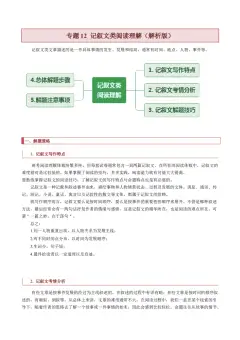
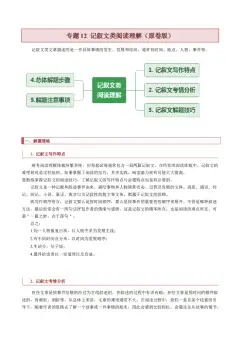
记叙文是以写人、记事、状物为主要内容,以记叙和描写为表达方式的文章。记叙文应该包括六要
素,即:时间、地点、人物、起因、经过和结果。可以按事件发生的时间顺序写,也可以按事件发生的
先后写。命题上,主要集中在多个事件的先后顺序与人物的情感态度上。选材上,新颖、生动、真实、
典型的素材描写,让读者有身临其境的感觉。形式上,顺叙、倒叙、插叙。语言上,一般过去时为主,
各种时态为辅。
二、体裁结构
1.记叙文的开头通常交代事件的背景,即事件发生的时间、地点、有关人物等内容。
2.记叙文的展开通常以人物活动的时间顺序、空间位置变换、事件发生的顺为行文线索。
3.记叙文的结尾通常是依照事件的发生、发展和结局这样一个自然的顺序来结尾。
三、解题策略
1.关注细节:记叙文中有大量的事件发展过程中的细节,包括记叙文的 5W(what, who, when,
where, why)要素。因此我们作答细节题的时候,一般只需要由前到后,从上到下,一题一题地做就可以
了。
2.读懂表象:主旨大意题或推理判断、作者意图题等实际上是同一类型的问题,或者说是可用同种方
法解答的题型。解答此类题目时候,不可被题干的表象所迷惑,要像剥洋葱一样,一层一层地剥,去排
除。
3.挖掘意义:每年的高考阅读题中,特别是记叙文的阅读题,都会出现一至两道词义猜测题。考核的
不是你的语法的熟练程度,也不是你的记忆力,而是你对文章通篇或者一个段落的整体把握和变通能力。
四、主旨概括题
1.聚焦首段法:首段主旨句;转折词后;破折号后
2.核心名词法:核心名词在文章中高频出现。可是“原词”或“同义词”不断曝光。
3.信息合并法:整合各段落大意,整合各段落首段信息
4.首位呼应法:整合首段和尾端信息
五、实用答题妙招
1.阅读理解记叙文细节理解题居多,落实“题文同序”和“同义替换”。
2.数据计算题注重“原文定位”“细节理解”,弄清来龙去脉再计算。
3.文章寓意题要注意言外之意,尤其是首尾段做出合理推测判断。
4.人物性格描述题注意捕捉原文褒贬性词汇再进行同义替换和排除。
5.满分策略:读题干→找原文→做标记→留痕迹→看选项→扣字眼。二、阅读理解真题再练(记叙文)
真题专区:练真题 , 明方向 ; 练技巧 , 提能力 ; 练速度 , 提分数 !
01(2025·天津卷)My great grandmother received the dollhouse (玩具小屋) from a family friend back in
the late 1800s. It was then passed down from generation to generation. I was seven when I discovered it underneath
the tree on Christmas morning.
In our house, Mom set up a sewing area. I sat at her sewing machine, my feet barely reaching the presser foot.
Mom bent over me, her hands on mine, gently guiding small bits of cloth under the needle to create dollhouse
bedding. She also taught me to make mini-blankets. With a little paint and glue, Mom demonstrated that anything
could be turned into dollhouse furniture. I learnt to view the world as a place of possibility. I spent hours of my
girlhood sitting before my dollhouse, telling made-up stories, and creating miniatures (缩微模型). But eventually
school activities took over, and the dollhouse was moved to the attic (阁楼).
Over the next 40 years, the storytelling skills I’d practiced with the dollhouse grew into novel writing skills,
and I developed a career as an author. One day, after hours of working on my fourth book, I took a break by surfing
the Internet and happened to notice the beautiful dollhouses people posted on social media. They reminded me of
mine. I went to the attic, brought it back to my room and started updating it.
During the mindless hours of sewing and furnishing (布置家具), I listened to audiobooks about the history of
dollhouses, learning that they were not invented for play. There’s a long, rich history of people in hardship turning
to dollhouses to find comfort. They weren’t produced as toys until mass production became standard after 1945.
This inspired me to create a novel where art saves the day.
The truth was I myself needed art to save the day. Mom was then slipping away from me owing to progressive
memory loss. The only topic we could discuss with any genuine joy was the update of the dollhouse. She loved
retelling its history — those old memories. Mom didn’t find it strange at all that her 50-year-old daughter was
updating the dollhouse. She just thought it fun and beautiful. And it was. It was a world where Mom and I were at
our best together.
1. What did the author’s mother teach her to do?
A. To sew and create miniatures.
B. To add imaginary figures to the dollhouse.
C. To make up fairy tales set in the dollhouse.
D. To do oil paintings and glue them onto the little walls.
2. Why did the author decide to update the dollhouse decades later?
A. She intended to follow the trend on social media.
B. She was eager to start a new career as a toy designer.
C. She felt the urge to compete with other dollhouse makers.
D. She was inspired by people sharing their dollhouses online.
3. What did the author learn about dollhouses from the audiobooks?
A. They were initially created for play.
B. People once sought comfort in them.
C. Rich people sold them for money during difficult times.
D. A uniform standard for their production was set in 1945.4. What role did the dollhouse play in strengthening the emotional ties between the author and her aging mother?
A. A reminder of their childhood dreams. B. A mirror of the eventful family history.
C. A tool to bring back good old memories. D. A means to improve her mother’s memory.
5. What would be the best title for the passage?
A. The Dollhouse: A Lifelong Toy B. Growing up with the Dollhouse
C. The Dollhouse: More Than Just a Toy D. Dollhouse Making and Novel Writing
02(2024·天津卷)Our teacher, Miss Chevalier was a small woman, with a moon face, fatty fingers and
curls that sprang straight up from her head, hence the funny name “Poodle (卷毛狗)”. She taught in our reading
club. Sometimes she would look in and ask what we were reading — not to check but to know.
That’s what happened the day my club was reading aloud a poem by Henry Longfellow. I guess I was better
than the others, for Miss Chevalier asked a while later, “Addie, I was wondering if you would recite the whole poem
to the Saturday evening’s club.” She said a famous professor was going to give a lecture about the poet, and a
presentation of that poem would be a fresh way to start.
She asked me to memorize it. “But that shouldn’t be a problem for a child of your ability,” she added. I’m
telling you, my happy feet barely touched the ground all the way home. To me, that was the biggest thing ever and
I soon learned the whole poem by heart, well prepared for our first rehearsal.
I was desperately nervous when I went to her office the next day. But the good thing was she always had the
smile that would make you feel like you just did something right.
Halfway through the poem, Miss Chevalier stopped me and asked if I knew what “impetuous” meant. Despite
her encouraging smile, I wanted to sink through the floor because I was unsure about its pronunciation as well as
its meaning. Miss Chevalier pretended not to have noticed my red face and handed me a dictionary, asking me to
read its definition aloud. “Impetuous has two definitions: rushing with great force or violence; acting suddenly, with
little thought. ”
She asked me which one fitted the poem. I read both definitions over again, trying to figure it out, but Miss
Chevalier must have read my mind. “There is no wrong answer,” she said, “I want to know your opinion, Addie.”
Hesitantly, I said, “Maybe… both.”
She liked that. “One has to be impetuous both ways or they wouldn’t dare to face up to any challenge. Would
you call yourself impetuous?”
I knew she was asking for an opinion. “My mother thinks being impetuous for girls is improper, anyway.”
She said my mom was somewhat right about that. “But girls should also be wise to take up challenges when
needed. I believe you are such a girl.”
After that, I would never call Miss Chevalier “Poodle” again.
1. Why was Addie asked to recite Longfellow’s poem to the Saturday evening’s club?
A. To help with her performance.
B. To get the attention of her classmates.
C. To set an example for the rest of the class.
D. To try a new way to warm up the coming lecture.
2. Why did Addie feel happy on her way home?
A. An event was going to happen.
B. She was fully ready for her first rehearsal.
C. She gained recognition for her performance.D. She memorized the poem sooner than others.
3. What can be learned about Miss Chevalier’s personality from the way she treated Addie?
A. Caring and considerate.
B. Easygoing and carefree.
C. Curious and open-minded.
D. Disciplined and strong-willed.
4. How did Miss Chevalier succeed in making Addie truly understand the word “impetuous”?
A. By asking Addie to define it in her own way.
B. By interpreting the two definitions separately.
C. By consulting the dictionary for its definitions.
D. By linking its definitions to Addie’s situations.
5. What is the probable reason that Addie would never call Miss Chevalier “Poodle” again?
A. She followed her mother’s advice.
B. She made up her mind to be a polite girl.
C. She was touched by Miss Chevalier’s trust.
D. She felt Miss Chevalier’s teaching funny.
03(2023·天津3月卷)One freezing morning last February, I walked through Ontario Place. Trees were
frosted sculptures. Large chunks of ice floated in the lake. Then I saw a group of people in bathing suits bouncing
up and down in the water. They held hands, shouting and yelling into the sky. They looked and sounded so free.
I’ve always found cold water thrilling. The shock of it is like pressing a switch. It seems to reset my body and
soul.
And last winter, I definitely needed a reset. I woke up most mornings with a dull, grey feeling as I forced myself
out of bed to start the day. I needed something to cheer myself up, but I didn’t know what, until that day.
The ice warriors (勇士) emerged from the lake, their skin steaming. Trembling, they were yet laughing and
hugging each other. I called out: “You guys are awesome!” One woman waved back, “Come and join us! We’ re
here every Monday morning.”
The night before my first dip (游泳), I was excited and nervous. Cold water was one thing, but this icy lake
was a whole other level. Should I back out? Eventually, I got up in the dark and drove to the meeting spot.
After some wild warm up, I charged into the lake along with others. We yelled into the sky. Teeth chattering
heart rates slowing, fingers and toes going numb (麻木), we stayed there for somewhere between two and five
minutes. Knowing it was my first time, people cheered me on. It felt amazing. I was stupid with cold, but I couldn’t
remember the last time I’d felt so happy.
Now I go dipping almost every day, and I’ve come to long for that moment when the cold becomes a second
skin and my internal voice goes silent. Apart from the thrill of those first heart-stopping dives, which, ironically,
saved me from going under, what has drawn me is this community of generous, open-hearted souls.
We laughed together, often, but from the stories we’ve shared about ourselves, I know I’m not the only one
who faces life’s challenges. Holding hands in the freezing lake, we looked out for each other last winter and will do
so through this one.
It won’t fix everything in our lives—but for some reason, it helps. At the end of each session I return home
feeling stronger, lighter, more able to carry on. As another winter sets in, I’m more than ready to embrace the cold
again.1. When the author saw the people in the lake, her feeling can be best described as __________
A. nervous B. amazed C. frightened D. calm
2. Why did the author think of joining the swimmers?
A. To expand her social circle. B. To lift her spirits again.
C. To adapt to the cold weather. D. To prepare for a new career
3. What can be learnt about the author’s first dipping?
A. She hesitated a bit before going.
B. She suffered from a heart problem.
C. She stayed in cold water too long.
D. She regretted not doing enough warm up.
4. What change has cold water swimming brought about in the author?
A. She is more intelligent.
B. She gets more competitive.
C. She becomes a better storyteller.
D. She regains her inner peace.
5. What message does the author most likely want to convey?
A. Severe cold builds up character
B. Group wisdom brightens our life.
C. Tackling the odds together cures.
D. Doing sports promotes friendship.
04(2023·天津6月卷)I looked through the window of the charming little violin shop, and my heart began
to race.
I'd been out to dinner that evening. Since it wasn't dark yet after the meal, I decided to walk home from the
restaurant. I had traveled that way before, yet I had never noticed that old little shop. But that night I felt drawn to
the violin shop the moment I came across it.
I wiped the dirt from the window to get a better look inside. Several violins hung from the dark walls, quietly
waiting to be chosen. As my eyes rested on them, I felt as though I were looking through a window into my own
past.
My childhood was all about the pursuits I had attempted, most of which had been chosen by Mom. She was
like, “Join the swim team, Tara. Your sister is a good swimmer;surely you will be, too. ”What she refused to
acknowledge, however, was that I was visibly afraid of water.
Every Saturday I begged Mom not to make me go to the swim meet, but had little chance of success. That said,
with a bang of the starting gun, I would dive into the cold water with all my strength and swim to the other side of
the pool as fast as I could, only to find that the other swimmers slid past me. I would have given it up if I had not
heard my father's encouraging shouts to cheer me on. When at last my hand would grab the edge of the pool, he
would always be there with a warm, dry towel, telling me how proud he was of my desperate efforts.
Then came a turning point in my life the day our school orchestra( 管弦乐队)visited my class, and gave a
demonstration. The drums annoyed me. The flutes(笛子)bored me. But the violin…ah, the violin. It made the
sweetest sound I'd ever heard!My heart was dancing along with its flowing tune. For the first time in my life, I went
so wild with joy.
Tightly holding the permission slip from the orchestra director, I ran all the way home after school, and shakilyhanded it to my parents with a fear that they might dismiss my desire. They didn't. Mom was thrilled to see me
finally excited about something, and Dad winked(眨眼示意)at me while eagerly signing the slip.
I began practicing the violin with great passion, and rose quickly in ability. Before long I had won the first seat
in the community orchestra …
1. What did the sight of the violins in that little shop bring to Tara's mind?
A. Her miserable past. B. An unforgettable sport event.
C. The stories behind the violins. D. Her childhood memory.
2. What Dad did for Tara during the swimming competition implies that he is ________.
A. mindless and bad-tempered B. caring and supportive
C. strict and demanding D. tolerant and sympathetic
3. What fascinated Tara during her school orchestra's demonstration?
A. The tune of the flutes. B. The beat of the drums.
C. The sound of the violin. D. The manner of the musicians.
4. What enabled Tara to win the first seat in the community orchestra?
A. The steady improvement in her taste.
B. Her strong desire for success.
C. Her natural gift for music.
D. The rapid progress in her ability.
5. What message does Tara's story convey?
A. It's never too young to learn. B. A passionate interest works wonders.
C. Hard work will pay off in the long run. D. Like mother, like daughter.
05 (2022天津卷) I’m an 18-year-old pre-medical student, tall nd good-looking, with two short story books
and quite a number of essays my credit. Why am I singing such praises of myself? Just to explain that he attainment of
self-pride comes from a great deal of self-love, and to attain it, one must first learn to accept oneself as one is. That
was where my struggle began.
Born and raised in Africa,I had always taken my African origin as burden. My self-dislike was further fueled
when my family had to relocate to Norway, where I attended a high school. Compared to all the white girls around
me, with their golden hair and delicate lips, I ,a black girl, had curly hair and full, red lips. My nose often had a thin
sheet of sweat on it, whatever the weather was. I just wanted to bury myself in my shell crying “I’m so different!”
What also contributed to my self-dislike was my occasional stuttering (口吃), which had weakened my self-
confidence. It always stood between me and any fine opportunity. I’d taken it as an excuse to avoid any public
speaking sessions, and unknowingly let it rule over me.
Fortunately, as I grew older, there came a turning point. One day a white girl caught my eye on the school bus
when she suddenly turned back. To my astonishment, she had a thin sheet of sweat on her nose too, and it was in
November! “Wow,” I whispered to myself, “this isn’t a genetic(遗传的) disorder after all. It’s perfectly normal.”
Days later, my life took an-other twist(转折). Searching the internet for stuttering cures, I accidentally learned that
such famous people as Isaac Newton and Winston Churchill also stuttered. I was greatly relieved and then an idea
suddenly hit me—if I’m smart, I shouldn’t allow my stuttering to stand between me and my success.
Another boost to my self-confidence came days later as I was watching the news about Oprah Winfrey, the
famous talkshow host and writer—she’s black too! Whenever I think of her story and my former dislike of my color,
I’m practically filled with shame.Today, I’ve grown to accept what I am with pride; it simply gives me feeling of uniqueness. The idea of self-
love has taken on a whole new meaning for me: there’s always something fantastic about us, and what w need to do
is learn to appreciate it.
1. What affected the author’s adjustment to her school life in Norway!
A. Her appearance B. Social discrimɪnation.
C. Her changing emotions. D. The climate in Norway.
2. What did the author’s occasional stuttering bring about according on Paragraph 3?
A. Her lack of self-confidence. B. Her loss of interest in school.
C. Her unwillingness to greet her classmates.D. Her desire for chances to improve herself.
3. How did the author feel on noticing the similarity between her and ne girl on the bus?
A. Blessed and proud. B. Confused and afraid.
C. Amazed and relieved. D. Shocked and ashamed.
4. What lesson did the author learn from the cases of Newton and Churchill?
A. Great minds speak alike.
B. Stuttering is no barrier to success.
C. Wisdom counts more than hard work.
D. Famous people can’t live with their weaknesses.
5. What can best summarize the message contained in the passage?
A. Pride comes before a fall.
B. Where there is a will, there is a way.
C. Self-acceptance is based on the love for oneself.
D. Self-love is key to the attainment of self-pride.
06 (2021天津卷) About five weeks ago, I noticed the skin of our pet lizard was growing dusty. It worried
me. I reported the strange surface on the skin of the lizard to my husband and children the next morning. Seconds
later, our lizard emerged from its tank with its old skin flowing behind it.
I didn't think about it much until a morning last week when I knocked my favorite teapot off the table. It burst
into hundreds of pieces. As I swept up the mess, I wondered why we had been breaking so many things over the
months.
The destruction started three months ago. It was my husband's birthday. He had just lost his job. The uncertainty
was starting to wear on us, so I wanted to do something special.
“Let's make a cake for Dad!” I cried.
My kids screamed with joy. We baked, iced and sprinkled for most of the day. Candles on the cake! Balloons
on the walls! Flowers on the table!
Two hours before my husband came back home from another job interview, my daughter climbed up to grab a
glass vase from a high shelf. It fell and crashed beside the cake. Tiny pieces of glass were everywhere. She sobbed
loudly as I threw the cake away. My husband had banana pudding for his birthday.
Three days ago, the light in our living room suddenly went out. After several frustrating hours of unsuccessful
attempts to fix it, my husband suggested watching the Michael Jordan documentary series The Last Dance.
The poignancy of Jordan retiring from his beloved basketball to play baseball and what had pushed him to
make such a tough decision took me by surprise. As I watched him take off his basketball uniform and replace it
with a baseball uniform, I saw him leaving behind the layer that no longer served him, just as our lizard had.Neither of them chose the moment that had transformed them. But they had to live with who they were after
everything was different. Just like us. I realized that we have to learn to leave the past behind.
Humans do not shed skin as easily as other animals. The beginning of change is upsetting. The process is tiring.
Damage changes us before we are ready. I see our lizard, raw and nearly new.
Jordan said that no matter how it ends, it starts with hope. With our tender, hopeful skin, that is where we
begin.
1. What can we learn about the pet lizard from Paragraph 1?
A. Its tank grew dirty. B. Its old skin came off.
C. It got a skin disease. D. It went missing.
2. Why did the author's husband have banana pudding for his birthday?
A. The birthday cake was ruined. B. The author made good puddings.
C. Pudding was his favorite dessert. D. They couldn't afford a birthday cake.
3. Why does the author mention The Last Dance in the passage?
A. To prove a theory. B. To define a concept.
C. To develop the theme. D. To provide the background.
4. The underlined part "leaving behind the layer" in Paragraph 8 can be understood as .
A. letting go of the past B. looking for a new job
C. getting rid of a bad habit D. giving up an opportunity
5. What does the author most likely want to tell us?
A. Love of family helps us survive great hardships.
B. It's not the end of the world if we break things.
C. We should move on no matter what happens.
D. Past experiences should be treasured.
三、阅读理解名校模拟(记叙文)
模拟专区:做好题才有好成绩 ! 练技能 , 补漏洞 , 提分数 , 强信心 !
01(25-26高三上·天津·期中)When Clara took over her grandfather’s Brooklyn bookshop in 2018, the
first thing she removed wasn’t the outdated books, but the WiFi router (路由器). Regulars protested. A lawyer even
said he would spend his money elsewhere. But Clara believed that “books need our full attention, just like loved
ones do.” She wanted people to focus on reading.
At first, her decision seemed risky, especially when other shops were closing. However, something wonderful
happened. By 2020, the shop had become a quiet and comfortable place for people. Teenagers read books on the
carpets, forgetting about their phones. A retired judge started a poetry group on Saturdays where people shared
poems from memory.
The COVID-19 pandemic (流行病) should have been their death knell. But Clara had an idea: she created
“Survival Bundles” — sets of books with her personal notes. To her astonishment, many people, even busy tech
managers, loved them. A CEO said it was the first real book he had held since university. Clara realized people were
“hungry for a real, touchable experience.”
Last winter, I found her confronted with a new threat. A real estate (房地产) developer bought the building
and greatly increased the rent overnight. However, Clara’s customers came to help. They protested outside the shop.The retired judge offered free legal help. Even the lawyer who once complained decided to support her and funded
their legal defense.
In court, Clara used a quote from the writer Melville: “We cannot live only for ourselves. Many things connect
us.” The judge, who was part of the poetry group, agreed that the rent increase was unreasonable. Clara won.
The shop now displays the court’s decision next to valuable books. It shows that it is our shared human bonds
that provide the deepest strength to face contemporary difficulties.
1.What made Clara’s approach to running the bookshop special?
A.Satisfying the needs of customers. B.Introducing modern technology.
C.Focusing on rare book collections. D.Prioritizing full concentration.
2.What does the underlined phrase “death knell” in paragraph 3 mean?
A.A moment of celebration. B.A desperate cry for survival.
C.An event marking the end. D.A sudden opportunity for growth.
3.Why is the lawyer mentioned again in paragraph 4?
A.To show his contradictory behavior.
B.To illustrate the content of a novel.
C.To stress the mass support Clara received.
D.To explain the difficulty Clara came across.
4.What does Clara’s use of the Melville quote in court primarily serve to do?
A.To present her deep knowledge of literature to the judge.
B.To highlight the value of community bonds in her defense.
C.To emphasize the legal definition of unreasonable rent increases.
D.To prove that physical books hold more value than digital content.
5.What can we learn from the story?
A.Profit-driven decisions may lead to unexpected outcomes.
B.Technology is harmful to traditional businesses and should be avoided.
C.Community and human connection can overcome modern challenges.
D.Small bookshops are bound to encounter many threats in the digital age.
02(25-26高三上·天津滨海新·期中)While most 4-year-olds are making mud pies or selling lemonade, Austin
Perine of Birmingham, Alabama decided to go one step further. With his red cape (披肩) covering his shoulders,
Austin Perine feeds the hungry and homeless population throughout the city in an effort to “show love” to those
who need “food and smiles”.
“Show love”, according to Austin, has become his superhero motto. His superhero name? President Austin, of
course.
Austin’s father, TJ Perine, told CNN that Austin has always been compassionate (有同情心的), as he acts like a
“little dad” for his brother, Taylor. However, it wasn’t until Austin learned that people are experiencing homelessness
that he decided to share what he has with the rest of his community. TJ noted that Austin’s first knowledge about
homelessness came after watching a nature documentary about a baby panda on television. “Austin and I were
watching an animal show and there was a mother panda that was leaving her baby,” TJ said. “Austin began to get
concerned, and I told him that the baby panda would be homeless.”
To better teach his son about homelessness, TJ took the young boy to the city shelter, at which point Austin
asked, “Can we feed them?” In response, TJ took Austin to Burger King where he enthusiastically volunteered topay for the chicken sandwiches using his weekly pocket money, thereby giving up new toys that week.
Austin and his father have plans to expand their community outreach efforts so they can also fight homelessness at
its roots. They have also started a GoFundMe as part of their Show Love Foundation.
“We’ve gotten a lot of support from the country, and what we want to do is expand and do more than just giving
out sandwiches,” TJ told CNN, saying that, finally, he and Austin hope to build a service center that deals with the
many causes and symptoms of homelessness. “Mental illness, drug abuse, addiction, and things like that,” he said.
“Austin and I want to build a service center and get some specialists in there that can actually help these people get
back into the workforce.”
1.What can we know about Austin from the first paragraph?
A.He has sympathy for the homeless.
B.He likes watching superhero movies.
C.He used to enjoy making mud pies best.
D.He frequently makes lemonade for the poor.
2.Where did Austin first learn about homelessness?
A.On the radio. B.On TV. C.In the newspaper. D.In the magazine.
3.How did Austin feel after he saw the nature documentary about pandas?
A.Worried. B.Excited. C.Ashamed. D.Regretful.
4.What did Austin do in Burger King?
A.He bought new toys for his brother.
B.He ate chicken sandwiches with TJ.
C.He visited the homeless baby panda.
D.He used up his pocket money for charity.
5.What do TJ and Austin intend to do?
A.Set up another GoFundMe.
B.Win support from the government.
C.Help the homeless become employed.
D.Give out more sandwiches to the poor.
03(25-26高三上·天津西青·期中)The first time I went to Germany with my boyfriend, I was very young
and hadn’t been to many places. As soon as we arrived, I had this incredible revelation. “I know all about this area
—the food, the language. I know all about the Schwarzwald, the Black Forest,” I said to his German family. “How
do you know about this?” they asked, in disbelief.
That was the first time it dawned on me how much I knew about the rest of the world, and how prepared I
was for it, just from growing up in New York City — that I had been everywhere before I’d ever actually gone
anywhere.
I grew up in the Chelsea Projects, 288 10th Avenue at 26th Street. A lot of kids there were first generation
Americans with immigrant parents who were still speaking Yiddish or Chinese or Portuguese, or just name a
language, and they were speaking it. You ate every imaginable food from the rest of the world there. You were
exposed to all different kinds of traditions.
It wasn’t just that. The whole city was a classroom. All over town, you learned stuff you didn’t even know
you were learning. You didn’t have to be rich to learn it, either. My mom was a teacher — a great Head Start
teacher — and she made sure I partook of everything New York had to offer people who didn’t have any money,because she knew it was the greatest education in the world.
We went to all the museums, which were free back then. We’d ride the bus to Lincoln Center, before it was
Lincoln Center, and watch dancers dancing there. Or we’d take the train to Coney Island. Those trips are among my
fondest memories.
New York City played a big part in making me who I am. It’s where I learned that I could pursue whatever I
loved, but that I couldn’t be a slacker (偷懒的人). The city is everything you’ve heard it is. It’s crazy, it’s horrible,
it’s magnificent, it’s beautiful. It’s a real live wire, hard to leave.
1.What contributed to the author’s knowledge of Germany?
A.Her childhood experience. B.Her boyfriend’s descriptions.
C.Her past travel adventures. D.Her previous school education.
2.What can we learn about the author’s neighborhood?
A.It was a tourist hotspot for traditions.
B.It was famous for its food and restaurants.
C.Kids there were born outside of America.
D.Parents there spoke their mother tongues.
3.What did New York provide?
A.Diverse learning opportunities. B.Quality education programs.
C.Financial support for parents. D.Welfare benefits for the poor.
4.What can be inferred from the above passage?
A.The author knew Black Forest well since she had been there before.
B.Most Chelsea immigrants come from European nations.
C.Mom chose free resources just to save money.
D.New York city helped the author understand the world well.
5.From which book is the text most likely taken?
A.Into Unknown Skies. B.Never Can Say Goodbye.
C.Mom is Always by My Side. D.Falling for the Hometown Girl.
04(25-26高三上·天津河北·期中)At 20, I was a lifeguard and swimming teacher at the council pool in
Cambridge. I told the club coach about my dream of swimming the Channel (英吉利海峡). She looked me over
and said, “Find another dream.”
Her words hurt me deeply. I wasn’t built for long-distance open-water swims. To swim distances, you need a
degree of body fat density, buoyancy (浮力) and power. I had none of this. I realised the coach was probably right,
and I let my dream fade away. But what I couldn’t have known was what would take its place, and how rewarding
it would be.
One day, I was asked to teach adults who wanted to learn swimming but had a terrible fear of water. My first
students were between 23 and 79 years old. Flora, the oldest, had never had time to swim; others still held on to the
pain from childhood accidents or moments of shame.
It requires real courage to share those fears, and even more to undress and step into the pool. For this reason,
there were no spectators. During those evening sessions, the pool was silent and still, and the building transformed
into a peaceful temple.
By week three, they were waist- deep in the shallow end, holding floats as they walked for 10 meters to the
other side. The last one to leave was Raj, who was much bigger than me and was terrified of the exercise most. Bythe seventh week, he was swimming, grasping the float, kicking the water hard with his legs. I loved these sessions.
Watching them overcome a deep-rooted fear was deeply pleasing.
By summer, we moved to an outdoor pool surrounded by trees. The cold water shocked them, but soon they
realised they were out of the indoor pool’s calm and safety. They were doing what they’d never imagined, and it
was glorious. What it took my class to overcome something so challenging — the hard work and willpower —
stayed with me for the rest of my life. None of them were ever going to swim the Channel, but of course, I never
told them that. But it no longer mattered. I had discovered that helping someone cross their own private ocean of
fear was a triumph far greater than any Channel swim.
1.Why did the author give up his dream of swimming the Channel?
A.He failed to get professional guidance. B.He got injured in an open-water swim.
C.He found a more rewarding alternative. D.He lacked the required physical qualities.
2.What did the author’s adult students have in common?
A.They had a deep fear of water. B.They hated any form of exercise.
C.They wanted to improve their health. D.They had never tried swimming before.
3.Which of the following best describes the students’ process of learning to swim?
A.Smooth and efficient. B.Gradual and determined.
C.Effortless and productive. D.Competitive and goal-driven.
4.What was the author’s primary gain from his teaching experience?
A.A sense of pleasure and achievement. B.Courage to pursue his own dream.
C.Deep friendship with his students. D.Better swimming teaching skills.
5.What message does the story convey?
A.Physical limits define one’s potential.
B.Helping others brings unexpected fulfillment.
C.Professional advice should never be questioned.
D.Childhood experiences determine future success.
05(25-26高三上·天津·期中)When I was a child I was often told what not to eat. “You don’t want to get
fat” was on constant repeat throughout my childhood. It really messed up my relationship with food — something
that took me years to overcome. Because of this, I’m careful not to connect what my kids weigh with their worth as
people. I encourage my daughter to make healthy snack choices and often dissuade (劝阻) her from a second
dessert. But one day when I heard her saying “I think I’m too fat,” my heart sank. It made me wonder if giving her
advice on snacks was having an unintentionally negative impact.
According to Charlotte Markey, a professor of psychology, food is one of the rare subjects where, as parents,
saying less is more. “There are so many things in parenting that are good to talk through, but I’m not convinced that
food is one of them,” she says. “It just creates some worries and insecurities in kids that aren’t necessarily
healthy.”
Instead, she recommends applying a well-known concept among nutrition experts called the “Division of
Responsibility,” where parents provide a variety of mostly healthy foods to their kids at fixed times, and the kids
themselves decide what and how much they want to consume — even if that means occasionally eating more cookies
than carrots.
Allowing kids to eat what they want also exposes them to the natural consequences of their decisions. “When
your child says, ‘My stomach hurts,’ you can say, ‘Well you had a lot of sugary foods and you might feel better ifyou made some other choices,’” says Markey. “Let them feel like they have some control over it.”
I’ve been trying out these strategies and I’ve found that when I’m less restrictive, they do make better
decisions. “Feeding is a long game,” says Markey. “The food you have available makes a huge difference. Even if
they don’t eat it, they’re seeing it. And then all of a sudden it clicks.”
1.What can be inferred about the author from the first paragraph?
A.She is upset by her kids’ weight. B.She is particular about what she eats.
C.She is interested in making food. D.She is critical of the way she was fed.
2.Which of the following would Markey disapprove of?
A.Explaining to kids the risks of taking snacks.
B.Offering various foods to kids at fixed times.
C.Allowing kids to eat cookies occasionally.
D.Talking with kids about school at mealtimes.
3.What should kids do according to the “Division of Responsibility”?
A.Eat up what is provided for them. B.Share their food with other kids.
C.Make diet decisions on their own. D.Help their parents do the dishes.
4.What does the author think of the strategies she has been following?
A.Costly. B.Workable. C.Complex. D.Contradictory.
5.What does the passage focus on?
A.Parents are supposed to strictly control children’s diet to avoid health problems.
B.Discussing food choices openly with kids is the best way to ensure healthy habits.
C.Children need constant guidance to understand nutritional values so as to keep healthy.
D.Offering children freedom in food choices helps build a healthy relationship with eating.
06(25-26高三上·天津河西·期中)After their three children grew up and left home, Margaret Thompson
and her husband, Kenneth, stretched their legs together on walking holidays in Switzerland. In Interlaken, they
would head up the mountain and watch the paragliders (滑翔伞运动员) launch themselves into the sky. Back in
town, in a large park, they watched them return to the earth. “Some day I’d love to do that.” Thompson told
Kenneth.
But there was always so much to do in Interlaken. Besides, Thompson didn’t know if Kenneth would have
enjoyed it. “He was not so keen on heights as I was,” she said. So she continued to watch the paragliders take flight
and land.
Kenneth died in 2005. Eleven years later, Thompson finally took to the skies herself, being a paraglider at
the age of 80. Although some people got scared while flying, she said she just felt free. Thompson did her second
paraglide when she turned 85, and raised nearly £2,000 for a local charity.
Before leaving Interlaken after her second flight, Thompson asked the organizers about the age limit for
paragliding. They said, “Any age, as long as you’re fit.” Thompson, now 86, plans her third flight for when she is
90.
Thompson grew up living above her parents’ shop in Belfast. At 18, she helped in the shop while studying
for her music diploma in Stranmillis University College in South Belfast. She started to teach the piano to local
children, and at the height of her teaching she gave 70 lessons a week. She still has 15 pupils on her books. “Over
the years I’ve had so many that I’m teaching their children now.”
Is she scared of getting older? “Fear? No. People say, ‘Isn’t getting old awful?’ I say, ‘No. You are free to domore things that you want to do.’” “People might worry about falling, it being the end of them. But that doesn’t
bother me at all. When it’s your time, it’s your time, no matter where you are,” Thompson added.
1.What can we know about Thompson from the first two paragraphs?
A.She appreciated being alone. B.She was crazy about paragliding.
C.She often worked overtime. D.She didn’t fit in with her husband.
2.Which of the following best describes Thompson?
A.Courageous and optimistic. B.Unexceptional and open-minded.
C.Romantic and cautious. D.Considerate and humorous.
3.What is the main function of the 5th paragraph introducing Thompson’s personal experience?
A.To highlight that Thompson’s love for piano teaching started when she was 18.
B.To show Thompson has kept an active and passionate life across different ages.
C.To prove Interlaken is a place that helps Thompson stay energetic in old age.
D.To prove that Thompson was very popular with local children.
4.What can we learn from Thompson’s story?
A.Aging makes a difference. B.Time and tide wait for no man.
C.Rome wasn’t built in a day. D.It’s never too late to fulfill a dream.
5.Why does the author mention Thompson’s words in the last paragraph?
A.To explain she avoids talking about the negative sides of aging.
B.To prove she only focuses on outdoor activities to kill time in old age.
C.To show getting old isn’t unpleasant.
D.To indicate she has to force herself to stay active despite disliking it.
07(25-26 高三上·天津·期中)In 2019, I began learning Chinese at the Confucius Institute in Rome.
Already fluent in several European languages, I sought a new challenge — something truly different that would
expand my worldview. Chinese, with its intricate characters resembling abstract art, melodic tones that sounded like
singing, and sentence structures reversing European logic, fascinated me from the first lesson.
However, my interest soon branched out beyond linguistics into China’s cultural heritage. I started with Tang
Dynasty poetry, renowned for its concise elegance and emotive power. Poems by Li Bai and Du Fu introduced me
to China’s poetic tradition. Intrigued by its roots, I then turned to earlier works like the Shi Jing (The Book of
Songs), an anthology of poems often attributed as one of the earliest reflections of the Chinese soul. Later, I explored
the Chu Ci (Songs of Chu, or Poetry of the South), further broadening my understanding of regional literary
expressions.
My classes soon multiplied, as I took courses on Chinese history, literature, philosophy and art history.
Confucianism’s emphasis on social harmony, Daoism’s natural spontaneity, and Buddhism’s cyclical worldview
formed a philosophical trial that explained many modern Chinese values. Yet it was Chinese art history, especially
scroll painting, that truly fired my imagination. The graceful brush-strokes, the interplay of ink and water, and the
visual storytelling contained within those scrolls made me see art in an entirely new light.
During my journey, I was particularly drawn to the stories of influential women in Chinese history, such as
military leader Fu Hao and Emperor Wu Zetian. Learning about these extraordinary women expanded my
understanding of China’s societal transformations and how women’s contributions have often been overlooked, yet
undeniably crucial.
These discoveries inspired me to create a bilingual English-Montenegrin magazine about Chinese culture.Unlike academic journals, it would mix thorough research with engaging stories — featuring Tang poetry analyses
alongside profiles of contemporary Chinese innovators. A planned column “From Terra Cotta to Tech” would trace
historical continuity, while a culinary section might explore how Sichuan peppercorns traveled the Silk Road.
This publishing venture (活动) is both exciting and challenging. From selecting articles to editing translations,
I’m constantly learning. And that, in itself, is part of what fascinates me so much about China: its cultural depth is
an ever-expanding puzzle — one that can never be fully completed, but becomes more fascinating with each piece
we add. Ultimately, my hope is that by creating this bilingual magazine, I can contribute to a mutual
understanding.
1.What initially motivated the author to learn Chinese?
A.The complexity of the Chinese language.
B.The desire to become a linguistic teacher.
C.The influence of several European languages.
D.The opportunity to study at the Confucius Institute.
2.In her exploration of Chinese culture, which of the following topics does the author NOT cover?
A.The principles of Confucianism and Taoism.
B.The expressive qualities of Tang Dynasty poetry.
C.The artistic skills involved in Chinese calligraphy.
D.The storytelling elements in Chinese scroll painting.
3.What does the author find most significant about the stories of influential women in Chinese history?
A.Their success in challenging traditional gender roles.
B.Their contributions to China’s societal transformations.
C.Their artistic achievements in both poetry and painting.
D.Their overlooked yet crucial thoughts of Chinese culture.
4.What makes the author’s magazine different from academic journals?
A.Use of bilingual content and comments from readers.
B.Exclusion of serious and deep historical analysis.
C.Focus mainly on modern technology and innovations.
D.Integration of academic depth and appealing stories.
5.Why does the author compare “Chinese cultural depth” to “an ever-expanding puzzle” in the last paragraph?
A.To emphasize that Chinese culture is too complicated to understand.
B.To criticize the lack of systematic study of Chinese traditions.
C.To demonstrate that Chinese culture is disconnected and incomplete.
D.To highlight its complexity and the endless opportunities for discovery.
08(25-26 高三上·天津·期中)Elizabeth Keyton, originally from Georgia, the USA, married Arjun, a
Malayali. She wanted to learn his mother tongue to strengthen their family bond. In the process, she created an
Instagram page called “Elikutty” through which she now teaches Malayalam to thousands of people.
“I always loved hearing people speak different languages, but when my mother from Serbia spoke Serbian at
home, my father showed no interest in learning it, leaving frequent misunderstanding and communicating problems.
That’s when I decided that if I met someone from a different culture, I would try to learn his language, which would
be good for us and our family,” says Elizabeth to The Better India.
“So when my relationship with Arjun started looking serious because of difficulties in communicating, Idecided to learn Malayalam. However, I found that there weren’t enough resources to learn the language. Most
books available were outdated or made for children. A small amount of material was often too difficult for casual (非正
式的) language learners like me,” says the 35-year-old. “Later, I struggled to find a teacher suited to my needs and
some grammar resources online.”
As an English teacher, Elizabeth used her teaching skills to learn Malayalam. She wrote notes and made
doodles (涂鸦) to learn the letters. “For me, the best way to learn is by explaining it to someone else, so I made an
Instagram page in 2018 to share my notes and small drawings,” she says. Starting out with 1,000 followers in 2018,
her Instagram page has over 70,000 followers today. She is pleased to make learning Malayalam fun and easy.
“I have seen what happens when languages are ignored in my own house. My brother doesn’t know Serbian,
which means his family won’t. It’s important to know English as it is a global language and helps when you go
abroad, but the same respect should be given to native languages. They are the true way to a person’s heart.” says
Elizabeth.(333)
1.Why did Elizabeth decide to learn Malayalam?
A.To build a foundation for her career. B.To improve her relationship with Arjun.
C.To better communicate with her mother. D.To satisfy her interest in foreign languages.
2.What difficulty did Elizabeth meet during her learning?
A.Rejection from her husband. B.Failure to find a native partner.
C.Lack of suitable learning resources. D.Inability to find a professional teacher.
3.What was Elizabeth’s Instagram. page used to do at first?
A.Collect learning tips. B.Help her in self-study.
C.Practice small drawings. D.Teach others Malayalam.
4.What is Elizabeth’s opinion on language learning?
A.Using social media as the primary tool.
B.Respecting our inner thinking at all times.
C.Always putting the family’s common language first.
D.Treating official languages and mother tongues equally.
5.What is the main purpose of this passage?
A.To advertise Elizabeth’s Instagram page
B.To discuss the difficulties of learning Malayalam
C.To tell a story about how language learning strengthened family bonds
D.To compare different methods of language learning
09(25-26高三上·天津·期中)A young family who has never camped in their life have sold everything
they own to start a tour of Europe in a motorhome. Cheryl, 33 and Jason, 28, sold their house, quit their jobs and dit ched
a normal life for a year on the road.
With their eldest daughter Flora, five, just a year away from starting school, the couple decided it was time
to go on a family adventure across the continent. Cheryl teaches Flora while they travel to prepare her for school
next year. The family, which also include their four-year-old daughter Elsie, son Archie and dogs Poppy and Angus,
have been on the road for a period.
Cheryl said. “Nobody would describe us as typical travelers. We’d never even been camping before. We
talked for a long time about wanting to see different parts of the world, but we never actually thought we were
actually going to. Our eldest child is due to start school this August, so we put it off by one year. We thought, ‘if wedon’t do it this year, we may never will.’ My mom and dad died this year and after that I started to feel life is too
short. We thought there must be more to life than working, caring and sleeping every day.”
The mom-of-three still can’t quite believe they’re actually doing it. She said, “We decided it at the end of
June, sold our house in July, and then when August came around we bought the motor house and set off.”
Despite being anxious at first, with the family sometimes quarreling. Cheryl thinks the trip has helped
strengthen family bonds. She said, “If we have an argument there is nowhere to hide. You can’t go into your room
and be angry. It means it has to be dealt with there and then, and it taught us to be more open with each other as a
family. Every day is quality family time. We couldn’t get that if we were back home with work, school and
nursery.”
1.What does the underlined word “ditched” in Paragraph 1 mean?
A.Gave up. B.Enjoyed. C.Experienced. D.Got tired of.
2.What does Cheryl think of the travel?
A.It is too short. B.It is too expensive.
C.It is filled with quarrels. D.It is worthwhile.
3.What can be learned about Cheryl and Jason’s decision-making process for the trip?
A.They made the decision slowly and carefully over a long time.
B.Their decision was affected by their children’s school-going situation.
C.The death of Cheryl’s parents had no impact on their decision.
D.They decided to start the trip as soon as they had the idea.
4.What is the purpose of the family trip?
A.To honor Cheryl’s parents. B.To experience more about life.
C.To prepare the kids for school. D.To give Jason a break from work.
5.What can we infer about the family?
A.They’re actually typical traveler.
B.They have spent years preparing for the travel.
C.They become closer as family members.
D.They will avoid arguments on vacation.