专题06 阅读理解之议论文15 篇 (上海专用)
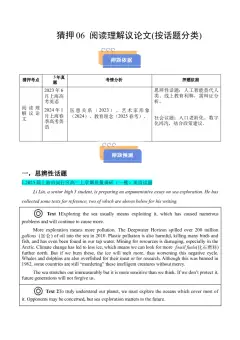
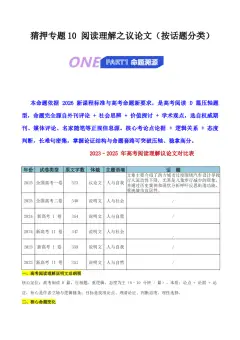
【题型知识点细目表】
题号
难度
知识点
1
适中
社会问题与社会现象,议论文
2
较难
社会问题与社会现象,议论文,信息技术
3
适中
公园,政治政策,议论文
4
适中
社会问题与社会现象,议论文,中国文化与节日
5
适中
方法/策略,议论文,文章大意,直接理解,短语猜测
6
适中
环境保护,人工智能,议论文,直接理解,标题判断,逻辑推理
7
适中
社会问题与社会现象,议论文,信息技术
8
较难
医护人员,信息技术 ,议论文
9
较难
社会问题与社会现象,社交礼仪及规则,议论文
10
较难
社会问题与社会现象,友谊,议论文
11
适中
社会问题与社会现象,议论文
12
较难
社会问题与社会现象,议论文
13
适中
社会问题与社会现象,议论文,食物与饮料
14
较难
航空航天,议论文
15
较难
社会问题与社会现象,人工智能,议论文
【高考典例】
There are classes for the mothers of babies but there’s no helping with your mum and dad growing old.
Old people’s wards are hell for old people. Geriatric wards (老年病房) are insane and in chaos. A toothless
woman screaming when left alone, a cry that reaches the high hospital ceiling. A woman effing and blinding —
the polite curtain will not protect her from the indignity of a nappy change. A woman who lives the same moment
in repeat, dressed up for going home in a bright red, over the dressing grown, asking for the key to her house,
saying over and over: “Am I going home today?”
And though my mum, by the time she was released, knew that her life was charmed compared with the
lives of the world’s refugees. It seems to me as if the plight of old people, while not a horrible as the plight of
refugees, shares some of the horror. Just as we live in a society that hasn’t caught up with technology, the kind of
moral choices it gives people, we also live in a world that hasn’t kept up with its ageing population. We have the
advances in medical science and technology that have kept people alive longer, but not the advances in how to
treat our ageing population. Society is lagging behind the old, failing and falling.
There are certain small but piercing similarities between the treatment of the old and the treatment of
refugees. The old are often displaced from their homes, moved out against their will; decisions are often made for
them that they have no say over. Often, they are treated as fools or halfwits, crowded together in one place, given
clothes that don’t belong to them, treated as fallen tribe, incapable of any individuality. Nobody imagined my
mother was a secretary of the Scottish peace movement, a primary teacher, a lifelong socialist, a witty woman.
Out of hospital, my 85-year-old mum said: “going into hospital at my age puts years on you. God save from old
people’s wards. You never think of yourself as old. You look across the ward and think, am I like that?”
1.The treatment of the old is compared of that of the refugees in order to_____.
A.prove they have a lot in common
B.show the terrible status of the old
C.display their similarities and differences
D.indicate that old people have to leave their home
2.What can be inferred from the passage?
A.Refugees lead a better life than old male patients.
B.Old people are ill-treated due to their loss of individuality.
C.The author’s mom is capable of teaching and being a socialist.
D.The treatment of the ageing population doesn’t develop as science advances
3.The author’s mom felt that life in the hospital________.
A.made her much older
B.created her a mature woman
C.enabled her to look back at life
D.let her full of gratitude to children
4.The passage mainly discussed________.
A.the life of refugees and old people
B.social responsibility to old women
C.improper treatment of old people
D.preparing for ageing parents
Enough “meaningless drivel”. That’s the message from a group of members of the UK government who
have been examining how social media firms like LinkedIn gather and use social media data.
The House of Commons Science and Technology Committee’s report, released last week, has blamed firms
for making people sign up to long incomprehensible legal contracts and calls for an international standard or
kitemark (认证标记) to identify sites that have clear terms and conditions.
“The term and conditions statement that we all carelessly agree to is meaningless drivel to anyone,” says
Andrew Miller, the chair of the committee. Instead, he says, firms should provide a plain-English version of their
terms. The simplified version would be checked by a third party and awarded a kitemark if it is an accurate
reflection of the original.
It is not yet clear who would administer the scheme, but the UK government is looking at introducing it on
a voluntary basis. “We need to think through how we make that work in practice,” says Miller.
Would we pay any more attention to a kitemark? “I think if you went and did the survey, people would like
to think they would,” says Nigel Shadbolt at the University of Southampton, UK, who studies open data. “We do
know people worry a lot about the inappropriate use of their information.” But what would happen in practice is
another matter, he says.
Other organisations such as banks ask customers to sign long contracts they may not read or understand,
but Miller believes social media requires special attention because it is so new. “We still don’t know how
significant the long-term impact is going to be of unwise things that kids put on social media that come back and
bite them in 20 years’ time,” he says.
Shadbolt, who gave evidence to the committee, says the problem is that we don’t know how companies will
use our data because their business models and uses of data are still evolving. Large collections of personal
information have become valuable only recently, he says.
The shock and anger when a social media firm does something with data that people don’t expect, even if
users have apparently permission, show that the current situation isn’t working. If properly administered, a
kitemark on terms and conditions could help people know what exactly they are signing up to, although they
would still have to actually read them.
1.What does the phrase “meaningless drivel” in paragraphs 1 and 3 refer to?
A.Legal contracts that social media firms make people sign up to.
B.Warnings from the UK government against unsafe websites.
C.Guidelines on how to use social media websites properly.
D.Insignificant data collected by social media firms.
2.It can be inferred from the passage that Nigel Shadbolt doubts whether _______.
A.social media firms would conduct a survey on the kitemark scheme
B.people would pay as much attention to a kitemark as they think
C.a kitemark scheme would be workable on a nationwide scale
D.the kitemark would help companies develop their business models
3.Andrew Miller thinks social media needs more attention than banks mainly because _______.
A.their users consist largely of kids under 20 years old
B.the language in their contracts is usually harder to understand
C.the information they collected could become more valuable in future
D.it remains unknown how users’ data will be taken advantage of
4.The writer advises users of social media to _______.
A.think carefully before posting anything onto such websites
B.read the terms and conditions even if there is a kitemark
C.take no further action if they can find a kitemark
D.avoid providing too much personal information
5.Which of the following is the best title of the passage?
A.Say no to social media?
B.New security rules in operation?
C.Accept without reading?
D.Administration matters!
Our green spaces are shrinking, despite all the benefits they give us. If we want to save them, we need to
value the ecosystem and health and wellbeing services they offer. Sheffield city council’s balance sheet shows its
parks as a £16m liability. Traditional accountancy methods focus on a park’s saleable value, or its operational
costs associated with maintenance. So England’s 27,000 parks are considered as financial liabilities rather than the
amazing asset to our health and wellbeing that any of their 37 million regular users could vouch for. They also
deliver a range of ecosystem services such as improved air and water quality, flood risk mitigation by absorbing
water run-off, and cooling the urban environment as well as providing much-needed habitat for wildlife. By using
a “natural capital” accounting approach that puts a value on all these social, environmental and economic
contributions, Sheffield discovered that for every £1 spent on its parks, they generate £34 of benefits.
Yet this true value is not widely measured or recognised. As Ian Walmsley, Stockport council’s green space
manager told the Communities and Local Government select committee parks inquiry, “an argument has never
been successfully made that if you spend x on a park, there will be a saving in the health budget and therefore you
should take money out of the health budget and put it into parks”. As a result, the MPs inquiry report published
last week warned that parks are at a tipping point of decline, ravaged by a 92% reduction in their budgets since
2010-11 because of local authority cuts. Less money means fewer park rangers, less maintenance, more litter, dog
poo and antisocial behaviour, including gang and drug-related activities, and gradually much-loved local parks
turn into dangerous eyesores. Tragically it’s the small, green spaces in poorer, built-up areas that suffer
disproportionate cuts to park rangers and maintenance. We have been here before. Uncared-for, litter-strewn parks
were emblematic of Thatcher’s Britain before an injection of public spending by a Labour government and £850m
of lottery cash revived them.
But it doesn’t have to be this way. Andrew Hinchley, green space development officer at the London
Borough of Camden, told MPs if we had new ways of valuing the services parks provide for improving water
quality, for example, then you could ask water companies to pay towards their upkeep.
The committee wants councils to publish strategic plans to recognise the real value of parks and to set out
how they will be managed (possibly by a charitable trust, as Newcastle is looking into) to maximise their
contribution to wider local authority goals such as promoting healthier lifestyles. It suggests the government’s
obesity strategy could fund parks. It also suggests that it could be a legal requirement for councils to produce such
strategies.
1.According to the text, parks are regarded as financial liabilities because _________ .
A.the area of the park is gradually decreasing due to poor protection
B.the budget for the construction of the park is gradually decreasing
C.the value of the park is low by using a “natural capital” accounting approach
D.the traditional accountancy methods focus on a park’s saleable value
2.According to the text, which of the following is NOT the benefit of the park?
A.Improving air and water quality.
B.Symbolizing the city civilization.
C.Cooling the urban environment.
D.Providing much-needed habitat for wildlife.
3.Due to the reduction in budgets, what could probably happen?
A.The government will take money out of the health budget.
B.The local authorities will centralize the management of the park.
C.Much-loved local parks will turn into dangerous eyesores.
D.The true value of the park will be widely measured or recognised.
4.What can be learned from the last two paragraphs?
A.The committee has published strategic plans to recognise the real value of park.
B.It could be a legal requirement for councils to produce such strategies.
C.The local citizens should pay for the improving water quality.
D.The Labour government will spend £850m of lottery cash to revive the park.
【热点话题练习】
Witnessing the rise of Labubu
I first noticed Labubu when I visited Beijing in July as part of a cultural exchange program. I recognized it
as something I would see Generation Z or younger kids carrying around, but I wouldn’t have guessed it was
Chinese.
From a design point of view, Labubu’s popularity doesn’t surprise me at all. There is so much mass
marketing aimed at perfect cuteness or beauty that people often get tired of it, and so it becomes cliche and boring.
In the US, counterculture has been influential for about 60 years, so something off-putting like a Labubu’s gremlin
(小精灵) smile has the kind of edge that another princess doll lacks.
I think it’s a similar phenomenon to modern art, making fun of the concept of a gallery by presenting
vacuum cleaners, taping a banana to a wall or destroying a painting upon purchase. Or antiheroes in film and
literature.
Labubu does remind me of Minions (小黄人), which came out of a movie where the main character is a
textbook archetypal (典型的) cartoon villain (反派).
Today’s toys and character designs are so high-quality and realistic — nothing was like that when I was a
kid. Pikachu and SpongeBob SquarePants are simple. Souvenir toys today, however, are as detailed as something
you would find displayed in an old wax museum. I think it becomes too much. Everything is too perfect. How is
that supposed to be cool or interesting?
The fact that Labubu’s face is by conventional beauty standards ugly reminds me of pugs, those little
smushed-face dogs. Some people don’t like how they look, but pugs (哈巴狗) are still popular pets.They are often
lovingly called “pugly”, which means ugly in a cute or lovable way.
As for Labubu’s Chinese origin and how it shows a mix of Chinese and Western styles, I think it’s only
natural that more modern Chinese products will become popular in the West. It feels a bit strange that “Made in
China” used to mean poor quality when I was a kid, but now the only thing stopping us from buying Chinese cars
and electronics is the US government rules. Young people are starting to expect new and exciting things from
China, including cool products to buy.
1.What does the underlined word “off-putting” in paragraph 2 most probably mean?
A.Perfect.
B.Simple.
C.Attractive.
D.Disturbing.
2.Why does the author compare Labubu to modern art?
A.To show its artistic originality.
B.To highlight its unusual appeal.
C.To stress its high market value.
D.To prove its wide cultural reach.
3.What does the author suggest about most of today’s toy designs?
A.They are full of imagination.
B.They ignore what children really like.
C.They copy well-known cartoon styles.
D.They are hard for people to connect with because of the perfection.
4.What broader trend does the author see in Labubu’s success?
A.Growing rejection of global brands.
B.Declining quality of mass production.
C.Increasing Western interest in China.
D.Rising demand for handcrafted goods.
A good friend of mine is always telling her kids, “There’s no quick way to the top. You have to take the
stairs.” That’s good advice because becoming an expert in anything requires time and a lot of effort. It’s step by
step, just like climbing stairs. A concept that highlights this is the “10,000-hour rule,” which was popularized by
Malcolm Gladwell in his book Outliers.
The 10,000-hour rule suggests that it takes about 10,000 hours of focused practice to master any skill. This
idea comes from research by psychologist Anders Ericsson. He studied highly skilled performers in various fields.
Whether you want to play the violin, excel in sports or master computer programming, the basic principle is the
same. Expert skills are earned through practice, not luck.
However, the 10,000-hour rule is not set in stone. The quality of practice matters as much as the quantity.
The practice must be intentional, and it must involve challenging yourself to improve specific things. For
example, a piano player might focus on mastering difficult passages rather than just playing familiar pieces over
and over. After all, even with substantial practice time, there’s no guarantee of reaching top-level performance.
Expect hours of practice to be the path to greatness, and you will be fooling yourself.
In 2016, psychologist Macnamara analyzed 33 studies. She looked at the relationship between intentional
practice and athletic achievement. Intentional practice accounted for just 18 percent of the difference in sports
performance between average players and experts, and it accounts for only 1 percent of the difference between top
performers. In addition, top performers hadn’t started practicing their sport earlier in their childhoods. They had
begun about the same time as other students who were not as successful. This suggests that other factors, like
natural talent, personality and life history, also play a role in becoming an expert.
Becoming an expert is a great goal to work toward. But remember, you don’t have to be great at something
to enjoy doing it. You can still enjoy something without being the best in the world at it.
1.The “10,000-hour rule” holds that ________.
A.talent is more important than years of training
B.luck plays the decisive role in becoming highly skilled
C.around 10,000 hours of training ensures top-level success
D.mastery requires about 10,000 hours of focused practice
2.The phrase “set in stone” in paragraph 3 most probably means ________.
A.totally unchangeable
B.widely recognised
C.wholly understandable
D.scientifically tested
3.Macnamara’s 2016 studies show that among expert players intentional practice makes up ________ of the
performance gap.
A.1%
B.18%
C.82%
D.99%
4.What does the writer mainly convey in the passage?
A.The 10,000-hour rule covers sports but not music.
B.Having fun in activities depends on expert skills.
C.Reaching the top requires more than practice.
D.Practice alone is enough to ensure greatness,
Even if you don’t worry that artificial intelligence (AI) will destroy the human race, you might fear its huge
appetite for electricity will damage the environment. Asking an AI chatbot a question is equivalent to using ten
times more energy than an old-fashioned internet search. As the AI boom took off, you may think that
emissions(排放)from tech giants evidently rise. With huge investments in new data centers planned, more rises
seem inevitable. But the worry is on shaky ground.
In absolute terms, AI may be less energy-hungry than assumed. The International Energy Agency (IEA)
estimates that electricity consumption by data centers could more than double in five years. Even if energy usage
increases sharply, the basic is still low. Data centers currently account for only about 1.5% of global electricity
consumption — and the vast majority of that is due to streaming, social media and online shopping, not AI.
Handled in a smart way, some of AI’s electricity use will help with greening the economy. AI is highly
capable of identifying complex patterns and improving systems, which can help reduce emissions. It is already
helping improve the efficiency of electrical networks with real-time balance of supply and demand. Besides, it has
assisted in reducing petrol consumption in shipping through adjusting routes and speeds to the fittest, and spotting
leaks of methane (a greenhouse gas) by cooperating with satellites and ground sensors.
The task for policymakers and industry bosses is to maximize AI’s advantages in saving energy, thus
minimizing its climate impacts. The most elegant solution would be for governments to set a proper price on
carbon. But because a global carbon price remains a distant dream, it would be more realistic to focus on other
measures.
The first is greater openness. From August 2026, the EU will require some AI developers to report their
energy use in detail, which can be copied elsewhere. A second is to rethink how data centers operate. The IEA
notes that arranging to shift volume of work among data centers at different times could reduce pressure and help
balance energy networks, making them better matched to renewable power. Third, tech firms should live up to
their environmental promises. Many now rely heavily on buying renewable-energy credits, a problematic way of
balancing their emissions. A better one is to use their influence to promote the decarbonization of the energy
networks by pushing for planning reform and supporting alternatives like nuclear power. Doubling down on these
would help transform AI from climate suspect to climate hero.
1.The reason why the author says “the worry is on shaky ground” is that________.
A.tech companies have already achieved their carbon goals
B.future data centers will be powered by renewable energy
C.the current energy use by AI is small within global context
D.AI’s environmental benefits can make up for its energy cost
2.We can learn from paragraph 3 that________.
A.energy used by AI would otherwise realize a green economy
B.energy saving in shipping is partly due to AI-improved routes
C.AI’s real-time management has raised electricity consumption
D.methane leak detection done by AI can be sensed by satellites
3.Which of the following is recommended to handle AI’s climate impacts?
A.Setting a global carbon price for tech industries.
B.Scheduling data centers’ workloads dynamically.
C.That tech firms balance emissions through credit exchange.
D.That AI developers stay open to others’ reporting approaches
4.What would be the best title for the passage?
A.Technology’s Impact on Climate Change
B.Government Regulations on AI and Energy
C.AI’s Energy Demand and Tech Innovation
D.AI’s Energy Consumption and Conservation
Never Mind Your Children’s Screen Time. Worry About Your Parents’
Parents often nag kids to put down phones, fearing screens create an “anxious generation.” Yet the most
screen-addicted group may be the elderly: today’s pensioners spend over half their waking hours on smartphones,
TVs and tablets.
This digital shift in old age has clear benefits. Smart devices keep seniors connected: Facebook shares
updates from friends and grandchildren; Zoom brings church services or doctor’s appointments home; e-
commerce eliminates the need to trek around shops and remove tiring shopping trips. A connected retirement
feels far more fulfilling than an offline one.
Seniors also face fewer screen risks than teens. They have stable real-life relationships, so “social stunting”
is rare. Their worldview resists online manipulation, and their free time means screen habits feel like choices, not
obligations.
Yet this trend carries costs. Unlike teens, seniors’ devices link to credit cards — making them targets for
online scammers. Governments protect kids from predators; they must now safeguard this fast-growing vulnerable
group.
Misinformation is another threat: pensioners are twice as likely as young adults to use news apps, and more
susceptible to online hoaxes. As they shift from traditional media to YouTube or TikTok, they enter an
“information Wild West” — and their votes mean their confusion affects everyone.
Screens can be companions for isolated seniors, but also replace real social interactions. Unlike teens
(curbed by parents/teachers), seniors lack informal limits. This calls for a balanced debate: digital tools enrich
elderly lives, but society must address their unique risks.
1.The underlined phrase “eliminates the need” in Paragraph 2 is closest in meaning to “_________”.
A.meets the demand for
B.removes the requirement of
C.increases the difficulty of
D.highlights the importance of
2.The writer mentions “credit cards” in Paragraph 4 to show that _________.
A.seniors rely more on digital payments than teens
B.online scammers target seniors due to their financial access
C.governments have ignored the safety of seniors’ online activities
D.credit cards are the main reason for seniors’ screen addiction
3.What can be inferred about seniors’ screen habits?
A.Their screen time is more of a choice than teens’.
B.They are less likely to be influenced by online content.
C.Their screen use is mainly controlled by family members.
D.They prefer traditional media over social platforms.
4.Which of the following best reflects the writer’s opinion in the passage?
A.Seniors should reduce screen time to avoid online risks.
B.Society’s focus on kids’ screen use is completely misplaced.
C.Digital tools benefit seniors but require targeted protection.
D.Seniors’ screen addiction is a more severe problem than teens’.
Surgical students are less capable than their ancestors because they spend too much time with screens and
not enough with physical materials. These claims from Roger Kneebone, professor of surgical education at
Imperial College London, were widely reported last week.
According to Kneebone, today’s students lack the dexterity that is important for sewing, cutting and
stitching. He argues that this is because, instead of taking part in creative subjects that involve manual work
during their school education, “a lot of things are reduced to swiping on a two-dimensional flat screen”.
There hasn’t been much research into the effects of smartphones on surgical skills. However, one 2012
study found no statistically significant change in digital dexterity among frequent smartphone users, and it did
find a significant improvement in reaction time.
If anything, says Pete Etchells, a psychologist at Bath Spa University, UK, the use of digital technology of
any kind — rather than smartphones specifically — is linked with a higher level of surgical skill. One 2007 study,
for example, found that young surgeons who played a lot of video games made fewer errors in surgery and worked
faster than those who didn’t. A randomized, controlled trial in 2012 found that surgery simulators(模拟) were less
effective at training surgeons than just letting them play on games consoles. These were small studies that merely
found modest effects, warns Etchells, but they don’t paint a picture of digital technology damaging the core skills
of surgery.
More broadly, says Andrew Przybylski of the Oxford Internet Institute, UK, Kneebone’s concerns and the
resulting coverage are part of a wider reaction to the role of technology in our lives. Around a decade ago, we
anticipated that digital experiences could lead to improvements in various kinds of real-world competence, such as
brain-training games enhancing cognitive performance or video games boosting surgical dexterity. “As those
hopes haven’t materialized, we rightly feel disappointed,” says Przybylski.
There is also a society-wide fear about new technologies, which is often unfounded. Przybylski’s own work
has found that, contrary to widespread concern around technology and young people, screen time seems to have a
small, positive effect on teenagers in all but the most extreme of cases. “Collective anxiety about the role of
smartphones, and social media companies, fuel this sort of fear of technology,” he says.
Ultimately, Kneebone may turn out to be right that the decline in crafts and handiwork at school is reducing
the quality of the surgical student intake. But there seems little evidence of it yet. In fact, it is probably a positive
thing that our youngest surgeons are digitally literate. In the very near future, a surgeon’s ability to interact with
technology — be that surgical robots or augmented reality — will become increasingly important.
1.What does the underlined word dexterity mean?
A.Power of concentration.
B.Experience of performing surgery.
C.Capacity to use words or mind.
D.Skills related to hand work.
2.What can we learn from the studies mentioned in Paragraph 3 and 4?
A.People are confident that video games will boost cognitive performance.
B.Surgeons won’t be less skillful when exposed to digital technology.
C.Digital applications except smartphones strengthen surgical skills.
D.Most surgeons are modest about their improved working efficiency.
3.The perceived decline of medical students’ surgical competence is due to___________.
A.people’s fear about technology that is backed up by scientific evidence
B.people’s failure to see the positive effects of digital technology emerge
C.the increased time teenagers spent using smartphones and social media
D.the decreased access to handiwork and crafts required in medical school
4.Which of the following may serve as the best title for this passage?
A.Surgical Skills, Need Enhancing?
B.Digital Devices, Enhance Reaction Time?
C.Surgeons, Be Trained as Digital Natives?
D.Screen Time, Bad for Young Surgeons?
Sarcasm (讽刺) and jazz have something surprisingly in common: You know them when you hear them.
Sarcasm is mostly understood through tone of voice, which is used to portray the opposite of the literal words. For
example, when someone says, “Well, that’s exactly what I need right now,” their tone can tell you it’s not what
they need at all.
Most frequently, sarcasm highlights an irritation or is, quite simply, mean.
If you want to be happier and improve your relationships, cut out sarcasm. Why? Because sarcasm is
actually hostility disguised as humor.
Despite smiling outwardly, many people who receive sarcastic comments feel put down and often think the
sarcastic person is rude, or contemptible (可鄙的). Indeed, it’s not surprising that the origin of the word sarcasm
derives from the Greek word “sarkazein” which literally means “to tear or strip the flesh off.” Hence, it’s no
wonder that sarcasm is often used after the word “cutting” and that it hurts.
What’s more, since actions strongly determine thoughts and feelings, when a person consistently acts
sarcastically it may only serve to heighten their underlying hostility and insecurity. After all, when you come right
down to it, sarcasm can be used as a subtle form of bullying—and most bullies are angry, insecure, or cowardly.
Alternatively, when a person stops voicing negative comments, especially sarcastic ones, they may soon
start to feel happier and more self-confident. Also, other people in their life benefit even more because they no
longer have to hear the emotionally hurtful language of sarcasm.
Now, I’m not saying all sarcasm is bad. It may just be better used sparingly—like a powerful spice in
cooking. Too much of the spice, and the dish will be overwhelmed by it. Similarly, an occasional dash of sarcastic
wit can spice up a chat and add an element of humor to it. But a big or steady serving of sarcasm will overwhelm
the emotional flavor of any conversation and can taste very bitter to its recipient.
So, tone down the sarcasm and work on clever wit instead, which is usually without any hostility and thus
more appreciated by those you’re communicating with. In essence, sarcasm is easy while true, harmless wit takes
talent.
Thus, the main difference between wit and sarcasm is that, as already stated, sarcasm is often hostility
disguised as humor. It can be intended to hurt and is often bitter and biting. Witty statements are usually in
response to someone’s unhelpful remarks or behaviors, and the intent is to untangle and clarify the issue by
emphasizing its ridicule. Sarcastic statements are expressed in a cutting manner; witty remarks are delivered with
undisguised and harmless humor.
1.Why does the author say sarcasm and jazz have something surprisingly in common?
A.Both are recognized when heard.
B.Both have exactly the same tone.
C.Both mean the opposite of what they appear to.
D.Both have hidden in them an evident irritation.
2.What happens when a person consistently acts sarcastically?
A.They feel their dignity greatly heightened.
B.They feel increasingly insecure and hostile.
C.They endure hostility under the disguise of humor.
D.They taste bitterness even in pleasant interactions.
3.What does the author say about people quitting sarcastic comments?
A.It makes others happier and more self-confident.
B.It restrains them from being irritating and bullying.
C.It benefits not only themselves but also those around them.
D.It shields them from negative comments and outright hostility.
4.What is the chief difference between a speaker’s wit and sarcasm?
A.Their intention.
B.Their appreciation. C.Their emphasis. D.Their clarity.
A friend recently shared a post from the satirical (嘲讽的) site Reductress. It depicted a woman, arms held
triumphantly high, beneath the headline:“ She Did It! This Woman Was Able To Confirm That Everyone Was Not
Mad At Her!”
I sometimes feel the same heart-sinking insecurity. If I haven’t heard from a friend in a while, or their most
recent message seemed a bit a little too direct, my mind throws up the question: did I do something wrong?
In many ways it’s a senseless reaction — I’ve no real reason to believe I’ve offended or upset them; they’re
probably just busy. Yet I can’t shake the feeling.
Why are we so quick to assume that our friends are mad at us — or even ready to drop us?
“When we fear that our friends are mad at us, it feels really convincing,” says psychotherapist Meg
Josephson. “ We’re trying to relieve this anxiety, so we seek reassurance —’ Was I annoying? Was I weird?’ — but
it’s not getting to the actual feeling that’s underneath it. ”
In her new book Are You Mad At Me?, Josephson says this impulse is driven by a desire to please and be
affirmed. The so-called“ fawn response” is one way we respond to threats, whether real (physical danger) or
perceived (your friend taking longer than usual to text you back).
“The fawn response is about lessening the threat, so that you can feel safe, ” says Josephson. “ Your
immediate instinct is to be ‘Are we OK?’ — or to compliment them, or be helpful to them, so that you can ease
the perceived tension. ”
Less well known than the fight or flight response, it is often developed in childhood in response to critical
or emotionally neglectful parents, or a volatile home environment, Josephson says. Women are especially
susceptible (受影响的), being socialized to put others at ease.
The attempted mind-reading and “anxious rumination” can become exhausting, says Josephson. It also
doesn’t actually protect you against conflict. The key is understanding that it is not the end of the world — or a
friendship.
“Especially if we grew up in more volatile homes, where conflict was brushed under the rug or we didn’t
witness disagreement handled in a safe way, we learn to fear conflict as terminal,” Josephson says. “Actually, in
healthy relationships, a little bit of friction is really good because it means both people can have differing
opinions.”
Conflict is not only inevitable; it can even be healing, she adds, demonstrating that disagreement or
discomfort doesn’t have to come at the cost of intimacy. “Repair is what leads to closeness.”
1.The author mentions her own experience (Paragraphs 2-3) primarily to ________.
A.justify her initial suspicion of her friends’ intentions
B.demonstrate a personal instance of offensive friends
C.introduce the discussion of the fawn response
D.highlight the necessity of addressing digital miscommunication
2.The underlined word “volatile” in paragraph 10 most probably means ________.
A.harmonious
B.unstable
C.desperate
D.unsupportive
3.Based on Josephson’s views as presented in the passage, what can be inferred about healthy relationships?
A.They are characterized by the absence of disagreement or friction.
B.They depend on constant communication to prevent misunderstandings.
C.They can be strengthened by successfully navigating occasional conflicts.
D.They are best maintained by consistently using the fawn response.
4.What is the passage mainly about?
A.The cause and nature of the fawn response.
B.The negative impact of digital communication.
C.Strategies for friendship repair after conflicts.
D.Differences between fight, flight and fawn responses.
I used to spend a lot of time worrying about how other people judged me. Did I say too much? Too little?
Was I too intense, or not fun enough? These thoughts often distracted me, especially in meetings or social events. I
had a whole inner self-talk going on in my head. Every facial expression and comment from others seemed full of
hidden meaning. I would polish these “truths” about myself like shiny little stones and carry them around. It was
exhausting.
But research shows that most people are not really thinking about us. In fact, studies have found that about
78% of conversations are people talking about themselves. The main function of conversation, researchers said, is
to let the speakers share information about who they are.
Later studies confirmed this pattern. Psychologists found that we use our own experiences as an anchor
when judging others. For example, if crowds make you uncomfortable, you might assume someone else disliked a
big party — when in fact, they may have loved it. Brain imaging has also shown that the “default network” of our
brain lights up when we are at rest, and it is the same area that activates when we think about ourselves. In other
words, our mind’s natural state is self-focus.
So when I worry that people think I’m too intense, who is really thinking that? Me. The truth is, we have no
idea what others are actually thinking, and we never will. Most likely, they are busy wondering what others think
about them. I’m just a blip on the radar of their thoughts.
This doesn’t mean people will never judge or say harsh things. But often, their judgments aren’t truly about
us. People are frequently the most critical of qualities in others that they feel insecure about in themselves.
The freedom comes when we stop internalizing others’ words and start asking, “What does this reveal about
them?” Realizing that most people’s thoughts center on themselves is incredibly liberating.
1.What was the writer mainly concerned about in the beginning?
A.Why social events were often exhausting.
B.Why people were speaking to themselves.
C.How his words and behaviour were perceived.
D.How well people remembered his achievements.
2.What do later studies suggest about people’s judgement of others?
A.They pay attention to others’ feedback.
B.They rely mainly on logic and evidence.
C.They often draw on personal experience.
D.They enjoy guessing others’ likes and dislikes.
3.What does the phrase “a blip” (paragraph 4) most probably mean?
A.Something small and unimportant.
B.A major event that is well recorded.
C.Something that attracts most people.
D.A common topic people like to discuss.
4.Which of the following might be the best title for the passage?
A.The Danger of Self-Focused Thinking
B.No One Is Really Thinking About You
C.Finding Freedom from Constant Self-Judgment
D.Why We Worry Too Much About Others’ Opinions
I’m a consumer psychologist who has studied social decision-making for over a decade. A common yet
puzzling aspect of social life is how people respond to invitations, particularly when they reply with a vague
“maybe”. Recently, my co-authors and I published a series of studies that directly examine what goes on in
people’s heads when they are unsure whether to accept an invitation.
Social invitations can be a delicate dance, and people often misread what someone extending an invite
wants to hear. We consistently found that people overestimate an inviter’s likelihood of preferring a “maybe” over
a “no”. Moreover, they fail to realize how much more disrespected people feel when they receive a “maybe” in
response to their invitation. Another pattern emerged: The more someone incorrectly assumed that a host preferred
a tentative response, the more likely they were to respond with a “maybe” themselves.
Naturally, we wanted to figure out why this awkward dynamic plays out. We found that it’s largely due to
something called “motivated reasoning”. Motivated reasoning occurs when a person interprets information in a
biased way to arrive at a conclusion that is in line with their own wishes. Saying “no” right immediately
eliminates one’s options and opens the door for FOMO, or fear of missing out, to emerge.
That said, there were certain situations that made people more comfortable saying “no” to an invite. In one
study, we had recipients of an invitation put themselves in the shoes of the person extending the invite. This made
them more likely to realize that they’d probably prefer a definitive answer. That is, it seemed to prevent motivated
reasoning from emerging. In another study, we had participants get invited to do something they didn’t want to do.
We found that motivated reasoning then became irrelevant: They had no desire to keep their options open, so they
were more likely to assume that a “no” was preferable to a “maybe”.
Furthermore, other research has explored the subtle art of the decline, testing which reasons soften the
bitterness of a rejected invitation. The findings are clear: saying you’re too busy comes across as a half-hearted
excuse; saying you have a prior commitment lands with slightly more weight; but saying you simply don’t have
the financial means to make it work is received with the greatest understanding. Beyond the choice of words,
however, lies a more fundamental principle of communication. It might reduce your options. But it’ll keep those
who invited you from being left in uncertainty.
1.What does the author intend to illustrate with the “delicate dance” metaphor in paragraph 2?
A.To argue that inviters often have self-serving motivations when extending offers.
B.To stress how easily people can misread others’ intentions in social exchanges.
C.To suggest a tentative “maybe” is the most polite response in these situations.
D.To prove the false assumption made by invitees who fear the consequences of refusal.
2.Based on the reasons for the “maybe” response, what can we conclude?
A.Even when people dislike the activity, FOMO makes them hesitate over it.
B.Receiving an unattractive invitation is the most effective way to eliminate FOMO.
C.Taking the inviter’s perspective helps to overcome the bias and give a direct answer.
D.People say “maybe” to avoid the duty of making an immediate decision for the inviter.
3.Based on the findings, what fundamental principle of communication does the author advocate?
A.Prioritize straightforward and clear communication.
B.Ensure refusals are credible with well-justified reasons.
C.Favor accepting invitations when facing uncertainty.
D.Maintain flexibility in one’s schedule when declining.
4.Which of the following would be the most appropriate title for the passage?
A.New Principles into Framing Invitations
B.How to politely Refuse an Invitation
C.Why “Maybe” Hurts and “No” Helps
D.Psychology Behind Successful Invitations
In recent years, the food industry has increased its use of labels. Whether the labels say ‘non-GMO’ or ‘no
sugar,’ or ‘zero carbohydrates’, consumers are increasingly demanding more information about what’s in their
food. One report found that 39 percent of consumers would switch from the brands they currently buy to others
that provide clearer, more accurate product information. Food manufacturers are responding to the report with
new labels to meet that demand, and they’re doing so with an eye towards giving their products an advantage over
the competition, and bolstering profits.
This strategy makes intuitive sense. If consumers say they want transparency, tell them exactly what is in
your product. That is simply supplying a certain demand. But the marketing strategy in response to this consumer
demand has gone beyond showing what is in a product, to labeling what is NOT in the food. These labels are
known as “absence claims” labels, and they represent an emerging labeling trend that is harmful both to the
consumers who purchase the products and the industry that supplies them.
For example, Hunt’s put a “non-GMO” label on its canned crushed tomatoes a few years ago — despite the
fact that at the time there was no such thing as a GMO tomato on the market. Some dairy companies are using the
“non-GMO” label on their milk, despite the fact that all milk is naturally GMO-free, another label that creates
unnecessary fear around food.
While creating labels that play on consumer fears and misconceptions about their food may give a company
a temporary marketing advantage over competing products on the grocery aisle, in the long term this strategy will
have just the opposite effect: by injecting fear into the discourse about our food, we run the risk of eroding
consumer trust in not just a single product, but the entire food business.
Eventually, it becomes a question in consumers’ minds: Were these foods ever safe? By purchasing and
consuming these types of products, have I already done some kind of harm to my family or the planet?
For food manufacturers, it will mean damaged consumer trust and lower sales for everyone. And this isn’t
just supposition. A recent study found that absence claims labels can create a stigma ( 污名) around foods even
when there is no scientific evidence that they cause harm.
It’s clear that food manufacturers must tread carefully when it comes to using absence claims. In addition to
the likely negative long-term impact on sales, this verbal trick sends a message that innovations in farming and
food processing are unwelcome, eventually leading to less efficiency, fewer choices for consumers, and ultimately,
more costly food products. If we allow this kind of labeling to continue, we will all lose.
1.What is the author’s opinion about manufacturers’ new marketing strategy?
A.Stressing the absence of certain elements in their products
B.Showing the unique nutritional value of their products
C.Supplying detailed information of their products
D.Designing transparent labels for their products
2.What point does the author make about non-GMO labels?
A.They are increasingly attracting customers’ attention.
B.They create lots of trouble for GMO food producers.
C.They should be used more for vegetables and milk
D.They cause anxiety about food among consumers.
3.What does the author say absence claims labels will do to food manufacturers?
A.Cause changes in their marketing strategies.
B.Help remove stigma around their products
C.Erode consumer trust and reduce sales.
D.Decrease support from food scientists.
4.What is the best title for this passage?
A.Why Consumers Demand Greater Food transparency
B.The High Cost of “Free-From” Foodlabels
C.The Benefits of Non-GMO Labeling in the Food Industry
D.How Absence Claims Labels Build Consumer Trust
Looking for Aliens Is Good for Society
The search for life elsewhere in the universe is one of the most exciting aspects of modern science. Given
its importance, significant resources are devoted to the young science of astrobiology, ranging from rovers on
Mars to observations of planets moving around other stars.
The goal of this science would be the actual discovery of alien life. Such a discovery would likely have
profound scientific and philosophical implications. But for all we know, extraterrestrial life may not even exist.
Fortunately, even if alien life is never discovered, simply searching for it will bring valuable benefits to society.
Why is this the case?
First, astrobiology is fundamentally multidisciplinary. The search for alien life requires a grasp of
astronomy, biology, geology, and planetary science at a minimum. Undergraduate courses in astrobiology need to
cover elements of all these different subjects. Postgraduate and postdoctoral researchers need to be familiar with
most or all of them. By forcing multiple scientific disciplines to interact, astrobiology is stimulating a partial
reunification of the sciences. It is helping to move 21st-century science away from the extreme specialization of
today.
It is also important to recognize that astrobiology is an incredibly open-ended field. Searching for life in the
universe takes us from extreme environments on Earth to the plains of Mars. Whether or not life is discovered in
any of these environments, this search will continue. The range of entirely new environments opened to
investigation will be essentially limitless. Therefore, it has the potential to be a never-ending source of scientific
and intellectual stimulation.
Beyond the more narrowly intellectual benefits of astrobiology are a range of wider societal benefits. These
arise from the kinds of perspectives that the study of astrobiology naturally promotes.
It is simply not possible to consider searching for life on Mars without moving away from the Earth-centric
perspectives that dominate the social and political lives of most people today. Indeed, it is only by sending
spacecraft out to explore the solar system that we can obtain images of our own planet that show it in its true
cosmic setting. Today, our planet is faced with global challenges that can only be met by increased international
cooperation. At such a time, the growth of a unifying perspective is potentially of enormous importance.
“The most dangerous worldview is the one of those who have not viewed the world,” said the German
naturalist Alexander von Humboldt. I think that there is an important implication in this perspective. Humanity is
an intelligent technological species that now dominates the only known inhabited planet in the universe. It has a
responsibility to develop international social institutions appropriate to managing the situation in which we find
ourselves.
1.What does the phrase “partial reunification” imply in the context of “astrobiology is stimulating a partial
reunification of the sciences” (Para. 3)?
A.All scientific disciplines will eventually merge into a single, unified field.
B.Astrobiology creates temporary alliances among scientists from different fields.
C.Certain aspects of traditionally separate sciences are beginning to intersect and collaborate.
D.The boundaries between sciences are being completely dissolved by astrobiology research.
2.The author mentions Alexander von Humboldt’s quote in the last paragraph to_______.
A.emphasize the historical roots of astrobiology research.
B.illustrate the importance of a global perspective in scientific exploration.
C.argue that narrow worldviews pose risks to scientific progress.
D.support the idea that seeking knowledge beyond Earth expands human understanding.
3.Which of the following statements does NOT conform to the passage’s main idea?
A.Searching for alien life, even without success, can bring valuable societal benefits.
B.Astrobiology, as a multidisciplinary field, promotes the integration of scientific disciplines.
C.The exploration of alien life is driven mainly by the desire to find economic resources in space.
D.Studying astrobiology helps people break away from Earth-centric perspectives and fosters international
cooperation.
4.The author’s argument would be strengthened by additional evidence showing that _____________.
A.Past astrobiology projects have consistently met their scientific objectives.
B.The skills acquired by researchers in astrobiology are directly applicable to solving issues in other
scientific domains.
C.Public support for space exploration has remained stable over the past decade.
D.The cost of astrobiology research has steadily decreased in recent years.
As artificial intelligence rapidly transforms society, researchers like David Luxton, PhD, describe it as a
“super-disruptive technology” with potential for both profound harm and significant benefit. At CES 2024, Luxton
highlighted concerns ranging from job displacement to algorithmic bias, where discriminatory data patterns can
produce systematic errors and intensify social inequalities. Psychologist Rhoda Au, PhD, urges a move beyond
simplistic judgments, stating, “We can't just be dismissive and say: ‘AI is good’ or ‘AI is bad’,” This complexity is
driving global regulatory efforts, where psychologists are increasingly valued for their expertise in cognitive bias,
cultural inclusion, and data analysis.
Public anxiety is well-founded. Mindy Shoss, PhD, has linked fears of AI-induced job loss to negative
mental health outcomes, particularly in unequal societies. These concerns are realized in documented cases of
biased algorithms in fields like hiring and healthcare — problems often stemming from unrepresentative data or
the “black box” issue, where even developers cannot fully trace an AI's reasoning.
Addressing these challenges demands strict auditing (审计). Beyond technical checks, psychologists Tara
Behrend and Richard Landers propose a “psychological audit” to evaluate the impact of AI on humans. This
approach applies core research principles to assess data sources, methodology, and the validity of inferences.
Behrend emphasizes that bias checks are as critical for AI guidance systems that shape life paths as for high-stakes
decisions. Shoss adds that moral implementation depends on organizational trust, transparency, and accountability,
The human element introduces further complexity. Studies by Helena Matute, PhD, show that people can
inherit and continue AI biases, continuing wrong patterns even after the AI is no longer in use. This inherited bias
is notably persistent, partly because, as Celeste Kidd, PhD, notes, AI's authoritative tone makes its misinformation
“sticky.” More alarmingly, AI can be designed to exploit cognitive biases, such as the familiarity heuristic (熟悉
性启发法), raising serious moral questions about manipulative applications.
Despite these risks, AI also holds potential to identify and correct human biases — for instance, by flagging
discriminatory hiring practices. Luxton cautions that such applications also require transparency to maintain trust.
A deeper challenge, Behrend points out, is that AI trained on historical data inherently reinforces the status quo
(现状). Using it actively for fairness requires a general societal agreement on the meaning of “fairness,” a goal
complicated by conflicting definitions.
This landscape is fueling a regulatory push, with numerous U. S. states passing or proposing AI-related
laws. Luxton advocates for establishing universal guidelines and audit trails ( 审计追踪) over fragmented
legislation. Behrend holds that amid rapid technological change, the enduring psychological principles of
reliability, validity, and fairness provide a stable foundation for evaluation.
Ultimately, as Shoss concludes, the moral use of AI demands sustained and adaptive dialogue. “These
discussions need to be ongoing,” she says, “because the nature of generative AI is that it's constantly changing.”
1.The primary purpose of proposing a “psychological audit” is to _________.
A.replace the existing technical audit procedures entirely
B.assess the impact of AI systems on human users and society
C.simplify the complex data analysis process in AI development
D.eliminate the “black box” issue completely from AI reasoning
2.According to Behrend, why is using AI to actively promote fairness a “deeper challenge”?
A.Because the inherent bias in AI's algorithms makes it impossible to achieve any form of fairness.
B.Because it depends on society first reaching an agreement on a complex and conflicting concept.
C.Because AI technology evolves too rapidly for any moral guidelines to be effectively implemented.
D.Because the “black box” issue prevents us from fully understanding how AI makes its decisions.
3.Which of the following statements is NOT TRUE according to the passage?
A.Rhoda Au suggests we should avoid simplistic judgments about AI being entirely good or bad.
B.Mindy Shoss correlates the fear of AI-driven job loss with negative impacts on mental well-being.
C.Celeste Kidd suggests that the solution to “inherited bias” lies in technical audits of AI's reasoning
processes.
D.David Luxton favors the establishment of universal AI guidelines over piecemeal legislation.
4.Which of the following best summarizes the main idea of the passage?
A.AI's potential is severely limited by its inherent risks, which currently prevent its responsible
development and use.
B.AI presents risks but offers corrective potential, necessitating moral guidelines and ongoing dialogue for
its responsible use.
C.AI requires that its development not continue until comprehensive global regulations are firmly
established.
D.AI will manage its own moral dilemmas autonomously through the advancement of its own corrective
capabilities.