时文阅读与高考模拟冲刺试卷06(话题综合)
题号
难度
知识点
阅读理解A 篇
容易
应用文,世界湿地日岳阳洞庭湖主场活动面向全国高校招募志愿
者。
阅读理解B 篇
适中
记叙文,秦岭护林员,向公众传播生态保护理念。
阅读理解C 篇
适中
说明文, 科研团队研发农田野花走廊技术,为传粉昆虫保护提供方
案。
阅读理解D 篇
较难
议论文, 围绕全球气候危机展开论证,驳斥 “个人气候行动无用
论”。
七选五
适中
四大维度简单易落地的低碳生活技巧。
完形填空
适中
讲述作者经历,践行环保理念并带动更多人守护海洋生态。
语法填空
适中
介绍中国风电产业的全球领先发展成果。
应用文写作
适中
“世界地球日” 环保主题活动。
第一部分 阅读理解(共两节,满分50 分)
第一节(共15 小题;每小题2.5 分,满分37.5 分)
A
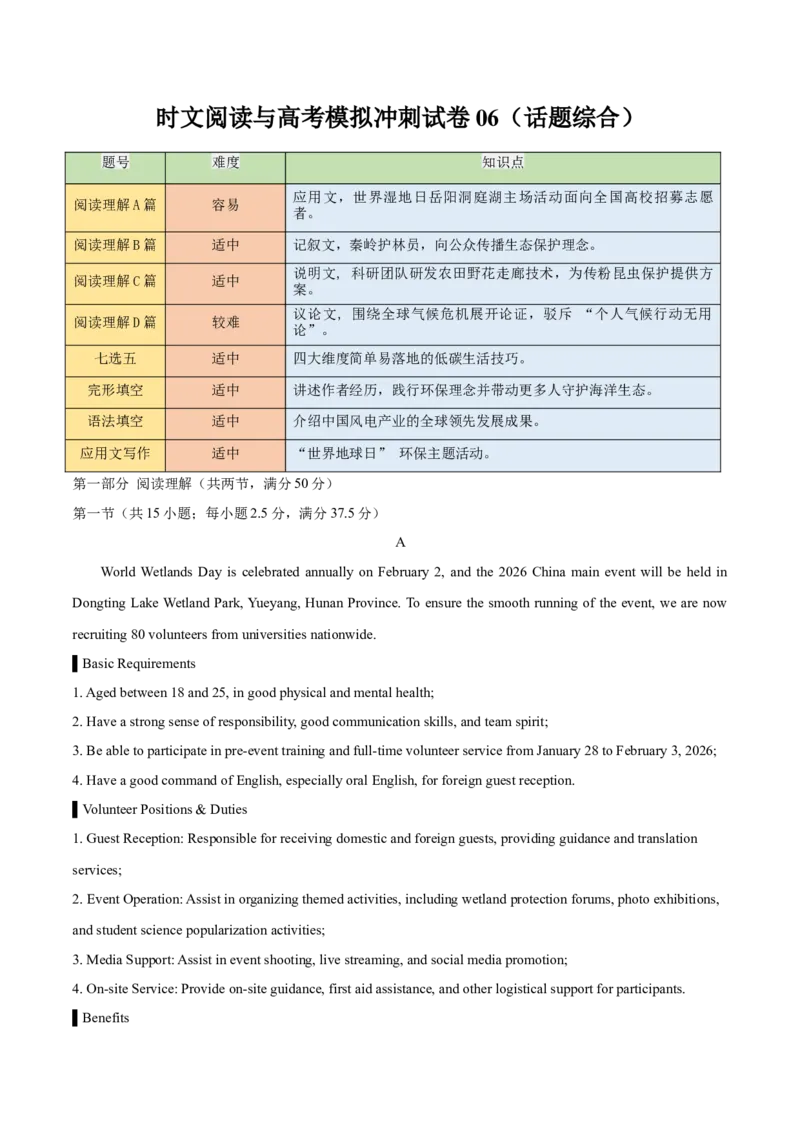
World Wetlands Day is celebrated annually on February 2, and the 2026 China main event will be held in
Dongting Lake Wetland Park, Yueyang, Hunan Province. To ensure the smooth running of the event, we are now
recruiting 80 volunteers from universities nationwide.
▌Basic Requirements
1. Aged between 18 and 25, in good physical and mental health;
2. Have a strong sense of responsibility, good communication skills, and team spirit;
3. Be able to participate in pre-event training and full-time volunteer service from January 28 to February 3, 2026;
4. Have a good command of English, especially oral English, for foreign guest reception.
▌Volunteer Positions & Duties
1. Guest Reception: Responsible for receiving domestic and foreign guests, providing guidance and translation
services;
2. Event Operation: Assist in organizing themed activities, including wetland protection forums, photo exhibitions,
and student science popularization activities;
3. Media Support: Assist in event shooting, live streaming, and social media promotion;
4. On-site Service: Provide on-site guidance, first aid assistance, and other logistical support for participants.
▌Benefits
1. Official volunteer certificate issued by the National Forestry and Grassland Administration;
2. Free accommodation, meals, and traffic subsidies during the service period;
3. Special training on wetland protection and volunteer service from professional experts;
4. Opportunities to communicate with renowned environmental scholars and industry experts.
▌Application
Please send your resume to wetlandvolunteer2026@163.com before January 10, 2026. The interview will be
conducted online from January 12 to 15. For more details, please follow the official WeChat account "Dongting
Wetland 2026".
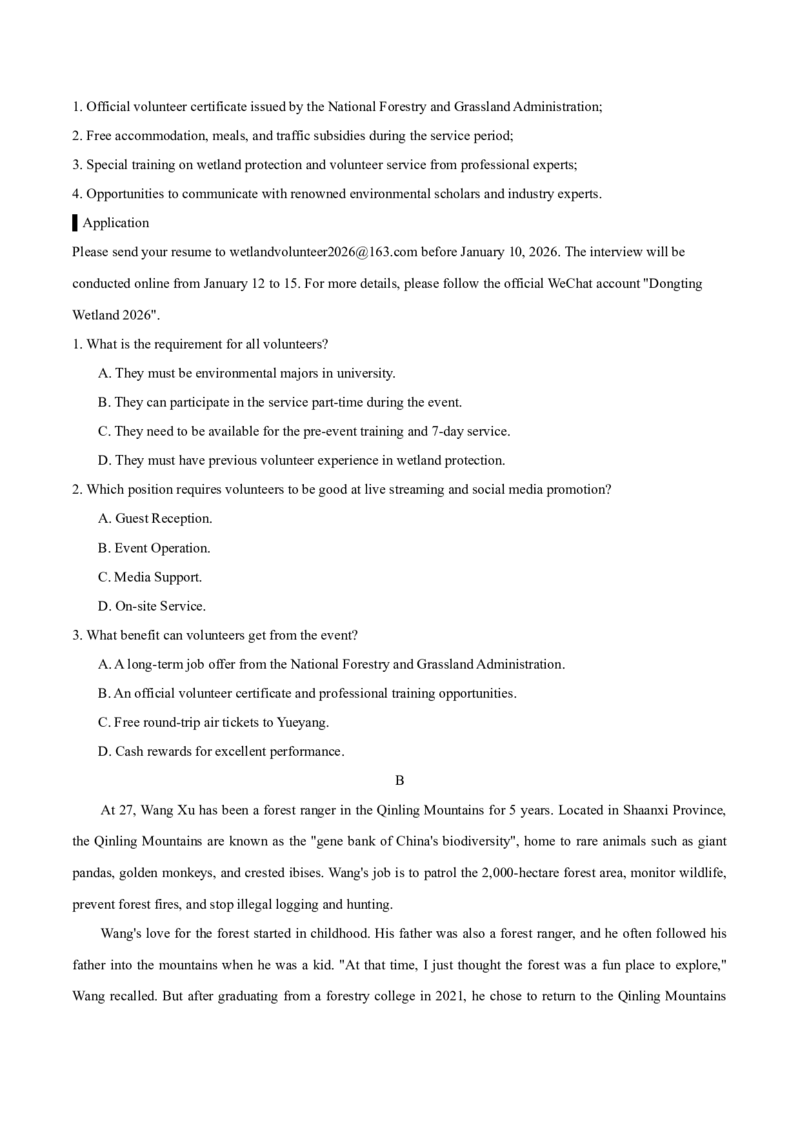
1. What is the requirement for all volunteers?
A. They must be environmental majors in university.
B. They can participate in the service part-time during the event.
C. They need to be available for the pre-event training and 7-day service.
D. They must have previous volunteer experience in wetland protection.
2. Which position requires volunteers to be good at live streaming and social media promotion?
A. Guest Reception.
B. Event Operation.
C. Media Support.
D. On-site Service.
3. What benefit can volunteers get from the event?
A. A long-term job offer from the National Forestry and Grassland Administration.
B. An official volunteer certificate and professional training opportunities.
C. Free round-trip air tickets to Yueyang.
D. Cash rewards for excellent performance.
B
At 27, Wang Xu has been a forest ranger in the Qinling Mountains for 5 years. Located in Shaanxi Province,
the Qinling Mountains are known as the "gene bank of China's biodiversity", home to rare animals such as giant
pandas, golden monkeys, and crested ibises. Wang's job is to patrol the 2,000-hectare forest area, monitor wildlife,
prevent forest fires, and stop illegal logging and hunting.
Wang's love for the forest started in childhood. His father was also a forest ranger, and he often followed his
father into the mountains when he was a kid. "At that time, I just thought the forest was a fun place to explore,"
Wang recalled. But after graduating from a forestry college in 2021, he chose to return to the Qinling Mountains
and take over his father's work.
The job is far from easy. Wang has to walk 15 to 20 kilometers every day on rugged mountain roads, often
facing bad weather such as heavy rain, snow, and strong winds. In summer, he has to fight against mosquitoes and
leeches; in winter, the temperature can drop to -15℃, and the mountain roads are covered with ice. Once, he
encountered a wild black bear while patrolling, and had to hide behind a tree for half an hour until the bear left.
Despite the hardships, Wang has never thought of giving up. Over the past 5 years, he has recorded more than
3,000 pieces of wildlife monitoring data, and helped rescue 12 injured wild animals, including a golden monkey
and a crested ibis. He has also set up a short video account to share his patrol stories, attracting over 300,000
followers.
"Many people think the forest ranger's job is boring and lonely, but I don't think so," Wang said. "Every time I
see a rare animal in the forest, or find that the trees we planted have grown tall, I feel a strong sense of pride. The
Qinling Mountains are my home, and I will guard this green land for as long as I can."
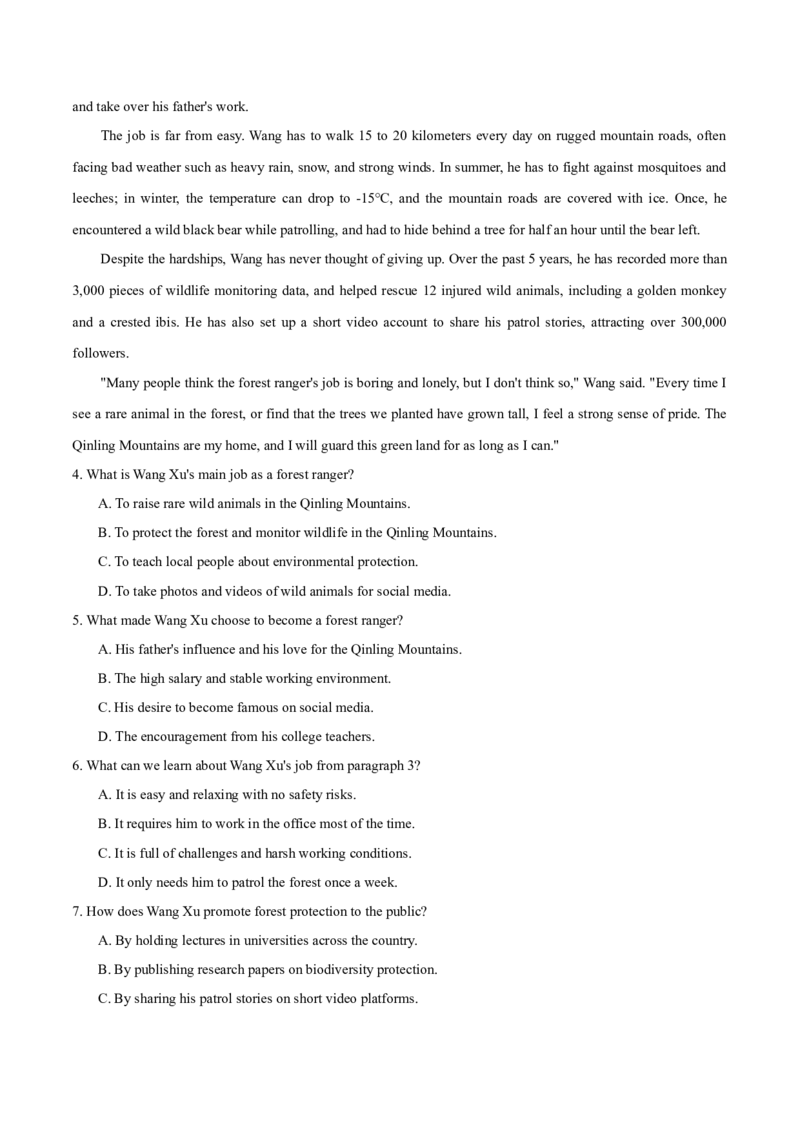
4. What is Wang Xu's main job as a forest ranger?
A. To raise rare wild animals in the Qinling Mountains.
B. To protect the forest and monitor wildlife in the Qinling Mountains.
C. To teach local people about environmental protection.
D. To take photos and videos of wild animals for social media.
5. What made Wang Xu choose to become a forest ranger?
A. His father's influence and his love for the Qinling Mountains.
B. The high salary and stable working environment.
C. His desire to become famous on social media.
D. The encouragement from his college teachers.
6. What can we learn about Wang Xu's job from paragraph 3?
A. It is easy and relaxing with no safety risks.
B. It requires him to work in the office most of the time.
C. It is full of challenges and harsh working conditions.
D. It only needs him to patrol the forest once a week.
7. How does Wang Xu promote forest protection to the public?
A. By holding lectures in universities across the country.
B. By publishing research papers on biodiversity protection.
C. By sharing his patrol stories on short video platforms.
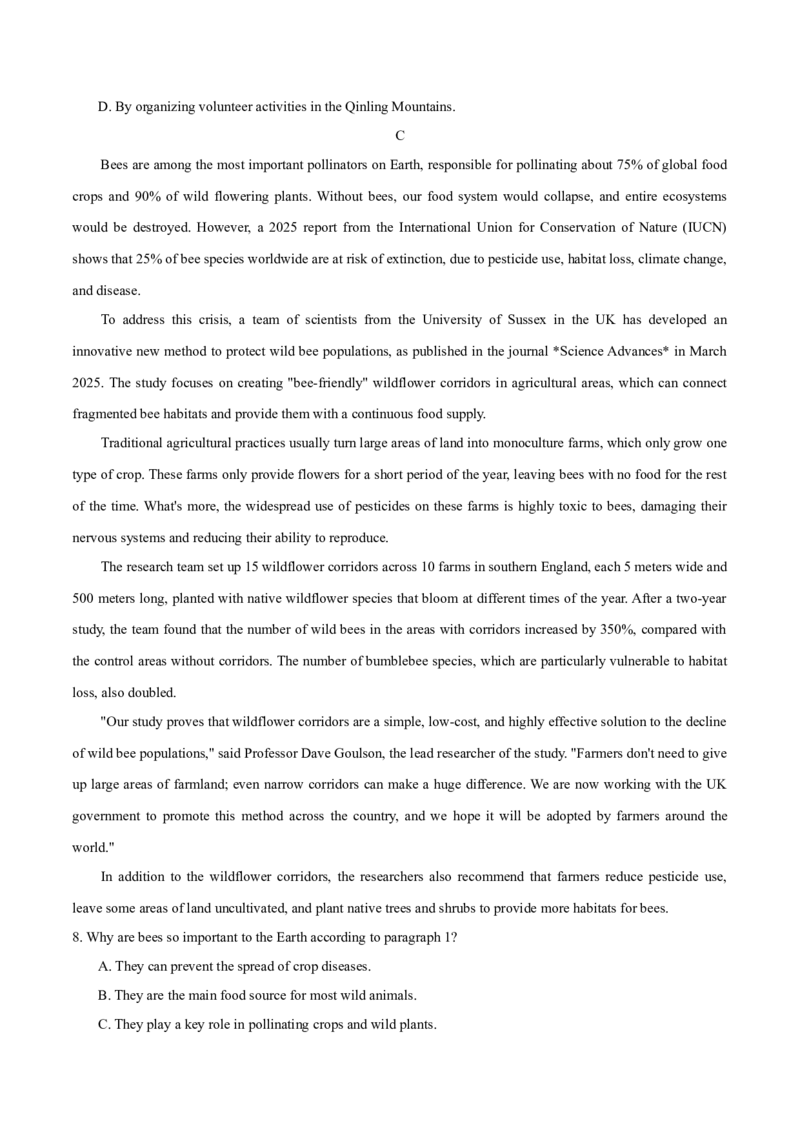
D. By organizing volunteer activities in the Qinling Mountains.
C
Bees are among the most important pollinators on Earth, responsible for pollinating about 75% of global food
crops and 90% of wild flowering plants. Without bees, our food system would collapse, and entire ecosystems
would be destroyed. However, a 2025 report from the International Union for Conservation of Nature (IUCN)
shows that 25% of bee species worldwide are at risk of extinction, due to pesticide use, habitat loss, climate change,
and disease.
To address this crisis, a team of scientists from the University of Sussex in the UK has developed an
innovative new method to protect wild bee populations, as published in the journal *Science Advances* in March
2025. The study focuses on creating "bee-friendly" wildflower corridors in agricultural areas, which can connect
fragmented bee habitats and provide them with a continuous food supply.
Traditional agricultural practices usually turn large areas of land into monoculture farms, which only grow one
type of crop. These farms only provide flowers for a short period of the year, leaving bees with no food for the rest
of the time. What's more, the widespread use of pesticides on these farms is highly toxic to bees, damaging their
nervous systems and reducing their ability to reproduce.
The research team set up 15 wildflower corridors across 10 farms in southern England, each 5 meters wide and
500 meters long, planted with native wildflower species that bloom at different times of the year. After a two-year
study, the team found that the number of wild bees in the areas with corridors increased by 350%, compared with
the control areas without corridors. The number of bumblebee species, which are particularly vulnerable to habitat
loss, also doubled.
"Our study proves that wildflower corridors are a simple, low-cost, and highly effective solution to the decline
of wild bee populations," said Professor Dave Goulson, the lead researcher of the study. "Farmers don't need to give
up large areas of farmland; even narrow corridors can make a huge difference. We are now working with the UK
government to promote this method across the country, and we hope it will be adopted by farmers around the
world."
In addition to the wildflower corridors, the researchers also recommend that farmers reduce pesticide use,
leave some areas of land uncultivated, and plant native trees and shrubs to provide more habitats for bees.
8. Why are bees so important to the Earth according to paragraph 1?
A. They can prevent the spread of crop diseases.
B. They are the main food source for most wild animals.
C. They play a key role in pollinating crops and wild plants.
D. They can help reduce the effects of climate change.
9. What is the main cause of the decline in bee populations?
A. The decrease in the number of monoculture farms.
B. Pesticide use, habitat loss, climate change and disease.
C. The lack of native wildflower species around the world.
D. The overgrowth of wild plants in agricultural areas.
10. What does the underlined word "monoculture" in paragraph 3 probably mean?
A. Growing a single type of crop on a large area of land.
B. Raising different kinds of animals on a farm.
C. Using organic methods to grow crops.
D. Planting wildflowers around farmland.
11. What did the research team find about the wildflower corridors?
A. They had no effect on the number of wild bees.
B. They required farmers to give up most of their farmland.
C. They significantly increased the number of wild bee populations.
D. They made the crop production of the farms decrease sharply.
D
In the face of the global climate crisis, many people feel helpless, believing that individual actions like
reducing plastic use or taking public transport make no difference compared to the huge carbon emissions from
large corporations and governments. However, a growing number of climate scientists and environmental activists
are arguing that individual climate action is not only meaningful, but also essential to solving the climate crisis.
Critics of individual action often point out that 100 companies are responsible for 71% of global greenhouse
gas emissions, according to a 2017 report. They argue that focusing on individual behavior distracts people from
demanding systemic change from governments and corporations. While it is true that systemic change is absolutely
necessary to address climate change, this argument ignores the powerful link between individual action and
systemic change.
First, individual actions add up to collective impact. If every person in the world reduced their carbon footprint
by just 10%, the total global emissions would drop by more than 7 billion tons per year, equivalent to taking 1.5
billion cars off the road. What's more, individual choices can drive market change. When more and more people
choose to buy electric vehicles, plant-based food, and renewable energy products, companies will respond by
increasing the production of these low-carbon products, and reducing their prices, making them accessible to more
people.
Second, individual climate action is a powerful driver of political change. People who adopt low-carbon
lifestyles are more likely to vote for climate-friendly politicians, join climate advocacy groups, and demand
stronger climate policies from their governments. A 2025 study from the University of California found that
communities with higher rates of individual climate action have a 40% higher chance of passing local climate laws,
compared with communities with lower rates.
Finally, individual action helps build a climate-positive culture. When you choose to cycle to work, bring a
reusable water bottle, or eat less meat, you set an example for your family, friends, and colleagues. This can create a
ripple effect, inspiring more people to take action, and making climate action a social norm.
"Climate change is not just a problem for governments and corporations; it's a problem for all of us," said
climate activist Greta Thunberg in a 2025 speech. "Every small action matters, because when millions of people act
together, they can change the world. We need both systemic change and individual action, and one cannot exist
without the other."
12. What is the main argument of the text?
A. Individual climate action is useless in the face of the global climate crisis.
B. Only systemic change from governments and corporations can solve climate change.
C. Individual climate action is meaningful and essential to addressing the climate crisis.
D. People should focus on individual action instead of demanding systemic change.
13. Why do critics think individual climate action is meaningless?
A. They believe individual actions have no impact on market change.
B. They think a small number of companies are responsible for most global emissions.
C. They find that individual action has no effect on building a climate culture.
D. They believe that individual actions will lead to higher carbon emissions.
14. What can we learn from the text about individual climate action?
A. It can drive both market change and political change.
B. It has no collective impact on global carbon emissions.
C. It prevents people from demanding systemic change.
D. It has been proven to have no effect on climate policy making.
15. What is the author's attitude towards individual climate action?
A. Critical
B. Neutral
C. Opposed
D. Supportive
第二节(共5 小题;每小题2.5 分,满分12.5 分)
根据短文内容,从短文后的选项中选出能填入空白处的最佳选项。选项中有两项为多余选项。
Living a low-carbon life at home is not only good for the environment, but also can help you save money on
your energy bills. Many people think that going low-carbon requires big changes and a lot of money, but the truth
is, small changes in your daily life can make a big difference. 16

 .
Switch to energy-efficient lighting.
Traditional incandescent bulbs waste a lot of energy, as 90% of the energy they use is turned into heat instead
of light. 17
  .

  LED bulbs use up to 85% less energy than incandescent bulbs, and can last 25 times
longer. They may cost a little more upfront, but they will save you a lot of money in the long run.
Reduce food waste.
About one-third of all food produced in the world is wasted every year, and food waste in landfills produces a
large amount of methane, a greenhouse gas 25 times more powerful than CO2. 18
  .

   You can plan your
meals in advance, make a shopping list, and store food properly to make it last longer. You can also compost
vegetable peels and food scraps instead of throwing them away.
19.


Heating and cooling your home uses a lot of energy. You can reduce your energy use by setting your
thermostat 1℃ lower in winter and 1℃ higher in summer. You can also install double-glazed windows, add
insulation to your walls and roof, and use curtains to keep heat in during winter and out during summer.
Use reusable products.
Single-use plastic products are a major source of pollution and carbon emissions. Instead of using plastic water
bottles, shopping bags, and food containers, switch to reusable alternatives. 20

 .

  These small changes
can reduce a huge amount of plastic waste and carbon emissions over time.
A. Save energy on heating and cooling.
B. Here are some simple and practical tips for low-carbon home living.
C. You can use a reusable water bottle, cloth shopping bags, and glass food containers.
D. It's important to teach your family members about the importance of low-carbon living.
E. The easiest way to solve this problem is to reduce the amount of food you waste at home.
F. Many people don't know how much energy they waste in their daily life.
G. By switching to LED bulbs, you can reduce your lighting energy use significantly.
第二部分 语言运用(共两节,满分30 分)
第一节(共15 小题;每小题1 分,满分15 分)
阅读下面短文,从短文后各题所给的A、B、C、D 四个选项中,选出可以填入空白处的最佳选项。
Last summer, I joined a beach cleanup volunteer program in Sanya, Hainan Province. I had always loved the
ocean, and I was 21

 .

   to see the beautiful beaches covered with plastic waste, which made me decide to do
something to help.
The program brought together 50 volunteers from across the country. On the first day, we were divided into 10
groups, and given gloves, garbage bags, and tongs. We were 22.

    to collect all kinds of waste, especially
plastic bottles, fishing nets, and single-use plastic products.
When we started cleaning, I was 23.

    by the amount of waste on the beach. Every step we took, we
found plastic bags, bottle caps, and tiny pieces of microplastic. It took us 4 hours to clean just 500 meters of beach,
and we 24.

    over 200 kilograms of waste that day.
The most 25.

    thing I found was a dead sea turtle, which had a plastic bag stuck in its throat. That
scene 26.
 me deeply, and made me realize how serious the ocean plastic pollution is. "Every piece of plastic we throw
away can 27.

    the lives of marine animals," our group leader told us.
During the 7-day program, we cleaned a total of 8 kilometers of beach, and collected more than 1,200
kilograms of waste. We also 28.

    a science popularization activity on the beach, telling tourists about the
harm of plastic pollution and how to reduce plastic use.
Many tourists were 29.

    by our action, and joined us in the cleanup. Some even promised to stop using
single-use plastic products. That made me feel that our 30.

    was not in vain.
When the program ended, I made a 31.

    to myself: I would reduce my plastic use as much as possible,
and encourage more people to protect the ocean. Now, I always bring a reusable water bottle and shopping bag, and
I never 32.

    litter when I go to the beach.
I also set up an environmental protection club at my university, to organize beach cleanup activities and spread
the idea of ocean protection. 33.

    many people still don't realize the seriousness of plastic pollution, I
believe that every small action can make a 34.

   .
The ocean is the heart of our planet, and it's our responsibility to 35.

    it. I will continue to do my part
to protect the ocean, and I hope more people will join us.
21. A. excited
B. shocked
C. relaxed
D. moved
22. A. trained
B. forced
C. warned
D. allowed
23. A. pleased
B. embarrassed
C. amazed
D. frightened
24. A. threw away
B. gave away
C. picked up
D. put away
25. A. heart-breaking
B. interesting
C. exciting
D. surprising
26. A. encouraged
B. touched
C. calmed
D. hurt
27. A. save
B. improve
C. end
D. change
28. A. missed
B. canceled
C. attended
D. held
29. A. inspired
B. annoyed
C. bored
D. confused
30. A. money
B. effort
C. time
D. plan
31. A. promise
B. joke
C. mistake
D. speech
32. A. clean up
B. pick up
C. leave behind
D. take away
33. A. If
B. Because
C. When
D. Although
34. A. decision
B. difference
C. promise
D. mistake
35. A. destroy
B. pollute
C. protect
D. explore
第二节(共10 小题;每小题1.5 分,满分15 分)
阅读下面短文,在空白处填入1 个适当的单词或括号内单词的正确形式。
China has become the global leader in wind power development, with the world's largest installed capacity of
wind power, according to a 2025 report released by the National Energy Administration.
By the end of September 2025, China's total installed capacity of wind power 36.

    (reach) 420 million
kilowatts, accounting for more than 40% of the global total. Of this, offshore wind power installed capacity
exceeded 35 million kilowatts, 37.

    (keep) China in first place worldwide for 5 consecutive years.
Wind power has become an important part of China's energy transition, 38.

    (help) the country reduce
its carbon emissions and achieve its "dual carbon" goals. In the first three quarters of 2025, China's wind power
generation reached 780 billion kilowatt-hours, 39.

    is equivalent to reducing carbon dioxide emissions by
620 million tons.
Thanks to the rapid development of China's wind power industry, the cost of wind power has dropped 40

 (significant) over the past decade. The onshore wind power cost has fallen by more than 50%, and offshore
wind power cost has dropped by over 40%, making wind power one of the 41.

    (cheap) sources of
electricity in many parts of China.
Chinese wind power companies have also expanded their business to the global market, 42.

    (provide)
advanced wind power equipment and solutions to more than 50 countries and regions around the world.
"Wind power will play 43.

    even more important role in China's future energy system," said an official
from the National Energy Administration. "We will continue to promote the high-quality development of wind
power, strengthen technological innovation, and work with other 44.

    (country) to address global climate
change and promote global energy transition. We believe that wind power will make 45.

    (great)
contributions to the world's carbon neutrality goals in the future."
 第三部分 写作(满分15 分)
假定你是李华,你校环保社团将举办“世界地球日”主题活动。请你给你校的外教Mr. Smith 写一封邮件,
邀请他参加活动,内容包括:
1. 活动的时间、地点;
2. 活动的主要内容;
3. 邀请他做一个关于环保的简短分享。
注意:
1. 词数80 左右;
2. 可以适当增加细节,以使行文连贯。
Dear Mr. Smith,


Yours,
Li Hua
参考答案
阅读理解
1-3: CCB
4-7: BACC
8-11: CBAC
12-15: CBAD
七选五
16-20: BGEAC
完形填空
21-25: BACCA 26-30: BCDAB 31-35: ACDBC
语法填空
36. had reached 37. keeping 38. helping 39. which 40. significantly 41. cheapest 42. providing 43. an 44. countries
45. greater
写作参考范文
Dear Mr. Smith,
I'm writing to invite you to the "World Earth Day" themed activity held by our school's environmental
protection club in the school lecture hall on April 22.
The activity will include a photo exhibition of environmental protection, a speech by a local environmental
expert, and a student debate on low-carbon living. We would be very grateful if you could give a short sharing
about environmental protection practices in your country.
We sincerely hope you can join us. Looking forward to your reply.
Yours,
Li Hua