专题07 人与社会(文化遗产)
目录
01 场景语料导入...................................................................................................................................1
02 核心词汇清单...................................................................................................................................2
03 题型融合训练...................................................................................................................................4
04 高考真题导航.................................................................................................................................10
05 高考模拟助力.................................................................................................................................15
整合世界文化遗产保护报告、《环球时报》2025 年12 月《文化遗产:在守护中焕发新
生》及国内外文化遗产活化典型案例。
 (难度:中     建议阅读时间:8 分钟)
In an era of rapid urbanization and globalization, cultural heritage sites around the world are facing
unprecedented challenges. Yet, 17-year-old Leo found his calling in safeguarding these precious legacies and
breathing new life into them. What started as a school field trip to a local ancient village soon evolved into a
dedicated mission of preservation, innovation, and cultural communication.
Leo’s first deep dive into cultural heritage came unexpectedly. His history teacher organized a visit to
Hongcun, a well-preserved ancient village in Anhui Province, renowned for its unique Huizhou-style
architecture and complex water system. Initially, Leo was merely curious about the old houses with white walls
and black tiles, but he was deeply touched when he learned that some buildings were at risk of collapsing due
to neglect and natural wear. Local elders shared stories of how their ancestors had built the village with great
wisdom, and Leo felt a strong urge to do something to protect this fading heritage. Unlike some of his classmates
who saw the village as a "backward relic," Leo was fascinated by the cultural values embedded in every corner—
from the carved wooden windows symbolizing good fortune to the ancient wells that had satisfied the thirst of
generations. He spent his weekends volunteering with local preservation teams, helping to document historical
details, clean cultural relics, and learn traditional craftsmanship from elderly artisans. He also researched
international cases of heritage, discovering how technology and creative design could help ancient sites
connect with young people.
01 场景语料导入
Later, Leo participated in a national youth competition themed "Heritage Reimagined." The task was to
propose innovative ways to promote and protect cultural heritage. His team, made up of students with
backgrounds in history, design, and technology, debated fiercely—some advocated for strict preservation
without any modifications, while others pushed for bold commercial development. Leo proposed a balanced
approach: creating a digital exhibition that combined 3D scans of Hongcun’s buildings with interactive stories,
allowing visitors to "walk through" the village virtually and learn about its history in an engaging way. He also
suggested organizing cultural workshops where young people could learn traditional skills like Huizhou ink
painting and wood carving, making heritage accessible and tangible. Leo took charge of the digital content
design, using his knowledge of multimedia tools to blend tradition with modern technology. Their proposal won
the first prize, and many of their ideas were later adopted by the local government to promote Hongcun.
Through his journey with cultural heritage, Leo has grown into a more responsible, creative, and culturally
confident young adult. He has realized that protecting cultural heritage is not about freezing the past, but about
passing it on in ways that resonate with the present. As a local preservation expert told him, "Cultural heritage
is a living treasure—when you safeguard it, you are preserving the roots of your culture and giving future
generations a chance to connect with their history." Today, Leo continues to advocate for heritage protection,
shares his experiences with peers online, and proves that cultural heritage can thrive in the modern
world, fostering a sense of identity, pride, and global understanding for all who engage with it.(526词)
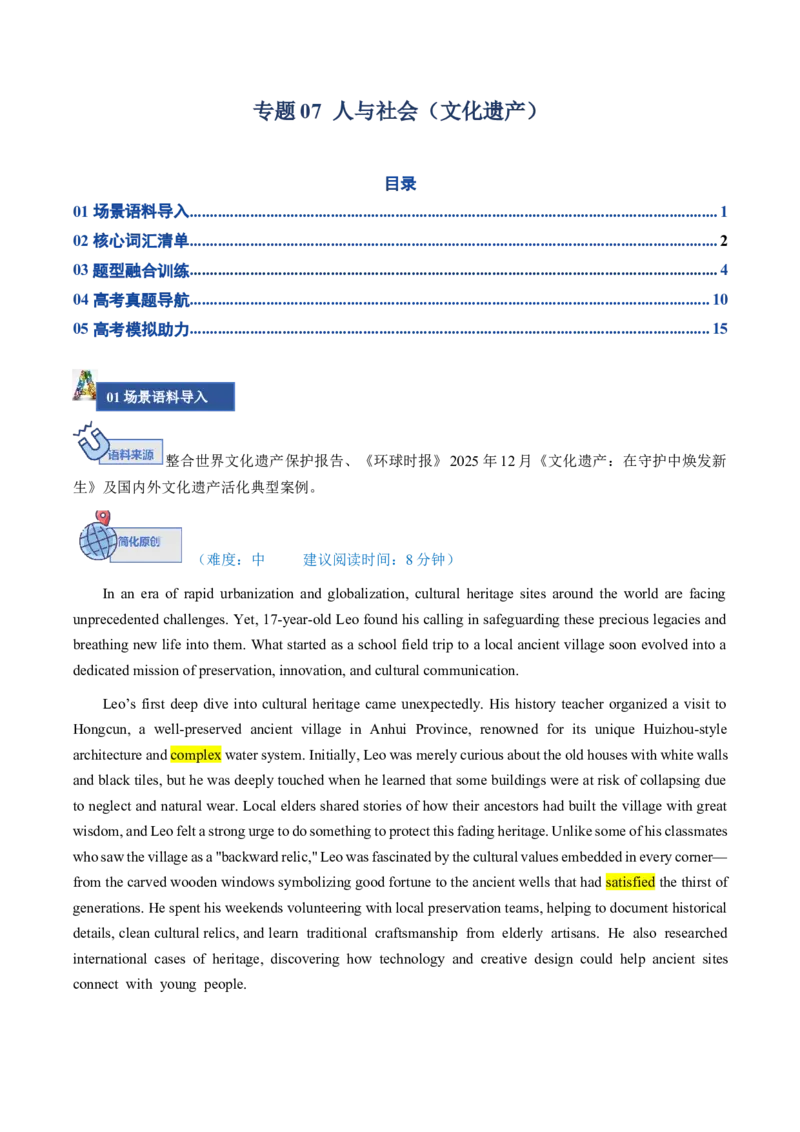
(一)核心概念类(文化遗产相关)
词汇/短语
词性
中文释义
语境原句摘录
教学重点(学生需掌握)
cultural
heritage site
名词
短语
文化遗产
地
cultural heritage sites
around the world are
facing unprecedented
challenges
1. 同义表达:heritage site(遗产地,简略表
达);2. 场景拓展:world cultural heritage
site(世界文化遗产地)、intangible cultural
heritage(非物质文化遗产)
ancient
architecture
名词
短语
古建筑
renowned for its
unique Huizhou-style
architecture and
intricate water system
1. 常见搭配:protect ancient architecture(保
护古建筑)、restore ancient architecture(修
复古建筑);2. 拓展:traditional architecture
(传统建筑)、architectural heritage(建筑遗
产)
heritage
preservation
名词
短语
遗产保护
He spent his
weekends
volunteering with
local preservation
teams
1. 核心搭配:strengthen heritage preservation
(加强遗产保护)、promote heritage
preservation(推动遗产保护);2. 拓展:
heritage conservation(同义,侧重“养护”)
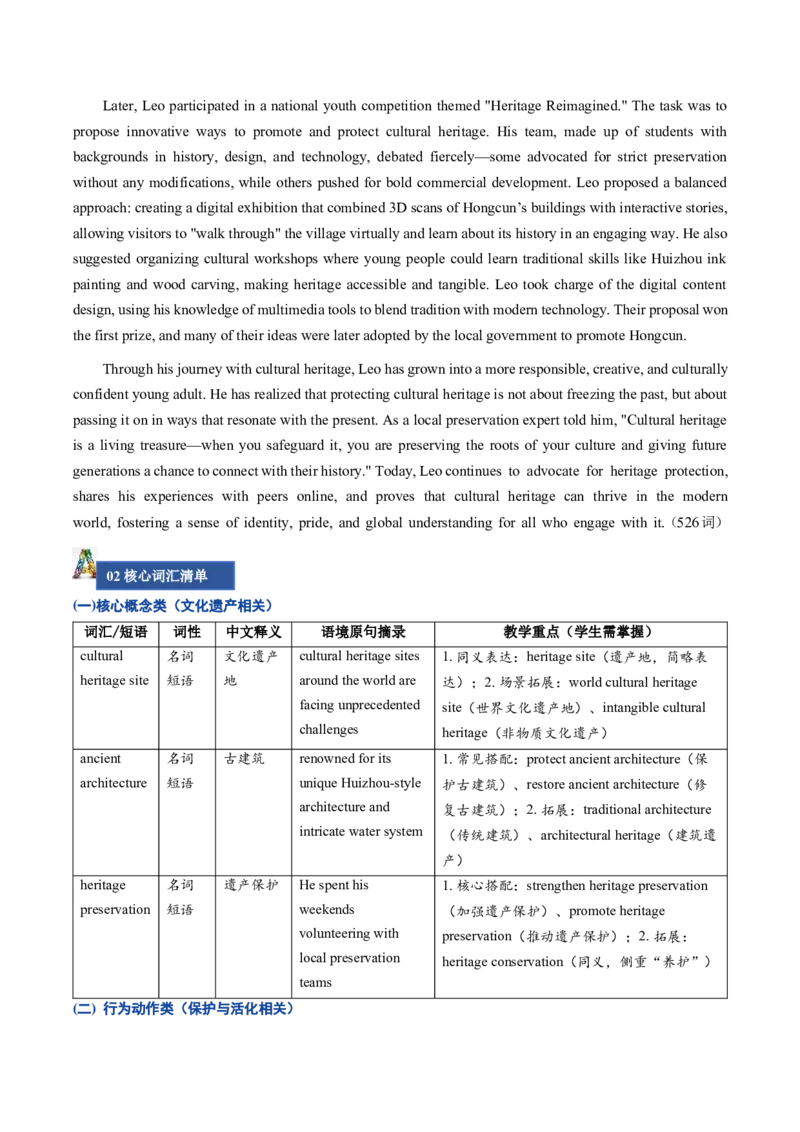
(二) 行为动作类(保护与活化相关)
02 核心词汇清单
词汇/短语
词性
中文释义
语境原句摘录
教学重点(语法+应用)
breathe new
life into
动词
短语
为……注
入新活力
breathing new life
into these precious
legacies
1. 同义替换:inject new vitality into、revitalize
(动词,使复兴);2. 场景应用:文化遗产活
化、传统产业升级等语境
blend...with..
.
动词
短语
使融合;
使结合
using his
knowledge of
multimedia tools to
blend tradition with
modern technology
1. 同义表达:combine...with...、
integrate...with...;2. 用法区分:blend 强调融合
后自然和谐,integrate 强调融入整体
pass on
动词
短语
传承;传
递
passing it on in
ways that resonate
with the present
1. 常见搭配:pass on cultural heritage(传承文化
遗产)、pass on traditions(传承传统);2. 拓
展:hand down(侧重“世代相传”)
document
historical
details
动词
短语
记录历史
细节
helping to
document historical
details, clean
cultural relics
1. 词形变化:document(动词,记录)→
documentation(名词,文献记录);2. 场景拓
展:document cultural practices(记录文化习俗)
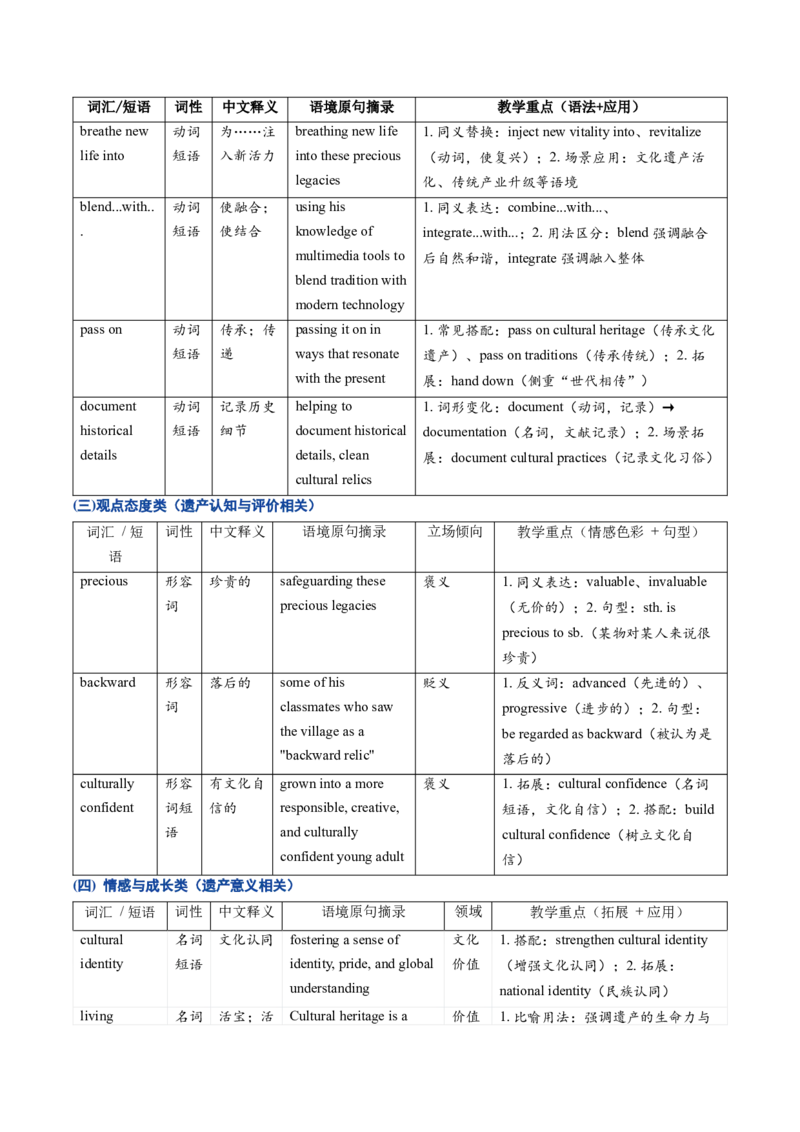
(三)观点态度类(遗产认知与评价相关)
词汇 / 短
语
词性
中文释义
语境原句摘录
立场倾向
教学重点(情感色彩 + 句型)
precious
形容
词
珍贵的
safeguarding these
precious legacies
褒义
1. 同义表达:valuable、invaluable
(无价的);2. 句型:sth. is
precious to sb.(某物对某人来说很
珍贵)
backward
形容
词
落后的
some of his
classmates who saw
the village as a
"backward relic"
贬义
1. 反义词:advanced(先进的)、
progressive(进步的);2. 句型:
be regarded as backward(被认为是
落后的)
culturally
confident
形容
词短
语
有文化自
信的
grown into a more
responsible, creative,
and culturally
confident young adult
褒义
1. 拓展:cultural confidence(名词
短语,文化自信);2. 搭配:build
cultural confidence(树立文化自
信)
(四) 情感与成长类(遗产意义相关)
词汇 / 短语
词性
中文释义
语境原句摘录
领域
教学重点(拓展 + 应用)
cultural
identity
名词
短语
文化认同
fostering a sense of
identity, pride, and global
understanding
文化
价值
1. 搭配:strengthen cultural identity
(增强文化认同);2. 拓展:
national identity(民族认同)
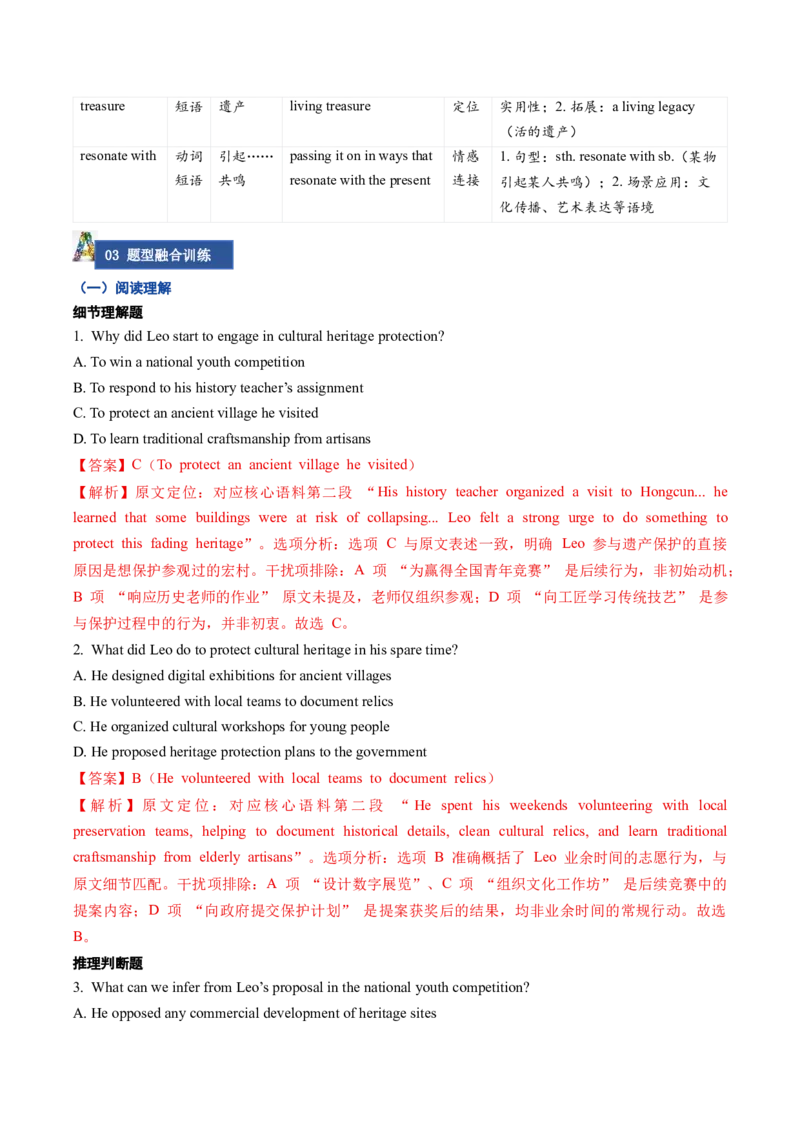
living
名词
活宝;活
Cultural heritage is a
价值
1. 比喻用法:强调遗产的生命力与
treasure
短语
遗产
living treasure
定位
实用性;2. 拓展:a living legacy
(活的遗产)
resonate with
动词
短语
引起……
共鸣
passing it on in ways that
resonate with the present
情感
连接
1. 句型:sth. resonate with sb.(某物
引起某人共鸣);2. 场景应用:文
化传播、艺术表达等语境
(一)阅读理解
细节理解题
1. Why did Leo start to engage in cultural heritage protection?
A. To win a national youth competition
B. To respond to his history teacher’s assignment
C. To protect an ancient village he visited
D. To learn traditional craftsmanship from artisans
【答案】C(To protect an ancient village he visited)
【解析】原文定位:对应核心语料第二段 “His history teacher organized a visit to Hongcun... he
learned that some buildings were at risk of collapsing... Leo felt a strong urge to do something to
protect this fading heritage”。选项分析:选项 C 与原文表述一致,明确 Leo 参与遗产保护的直接
原因是想保护参观过的宏村。干扰项排除:A 项 “为赢得全国青年竞赛” 是后续行为,非初始动机;
B 项 “响应历史老师的作业” 原文未提及,老师仅组织参观;D 项 “向工匠学习传统技艺” 是参
与保护过程中的行为,并非初衷。故选 C。
2. What did Leo do to protect cultural heritage in his spare time?
A. He designed digital exhibitions for ancient villages
B. He volunteered with local teams to document relics
C. He organized cultural workshops for young people
D. He proposed heritage protection plans to the government
【答案】B(He volunteered with local teams to document relics)
【解析】原文定位:对应核心语料第二段 “ He spent his weekends volunteering with local
preservation teams, helping to document historical details, clean cultural relics, and learn traditional
craftsmanship from elderly artisans”。选项分析:选项 B 准确概括了 Leo 业余时间的志愿行为,与
原文细节匹配。干扰项排除:A 项 “设计数字展览”、C 项 “组织文化工作坊” 是后续竞赛中的
提案内容;D 项 “向政府提交保护计划” 是提案获奖后的结果,均非业余时间的常规行动。故选
B。
推理判断题
3. What can we infer from Leo’s proposal in the national youth competition?
A. He opposed any commercial development of heritage sites
03 题型融合训练
B. He believed technology could help promote cultural heritage
C. He preferred strict preservation over innovation
D. He thought traditional skills were outdated for young people
【答案】B(He believed technology could help promote cultural heritage)
【解析】原文定位:对应核心语料第三段 “creating a digital exhibition that combined 3D scans of
Hongcun’ s buildings with interactive stories... using his knowledge of multimedia tools to blend
tradition with modern technology”。选项分析:从 Leo 提议制作数字展览、运用多媒体工具融合传
统与现代的行为,可推断他认为科技能助力文化遗产的推广,与选项 B 一致。干扰项排除:A 项
“反对任何商业开发” 与他主张“平衡方案”矛盾;C 项 “偏好严格保护而非创新” 与他的创新
提案不符;D 项 “认为传统技艺对年轻人来说过时” 与他提议组织传统技艺工作坊相悖。故选 B。
4. What does the local preservation expert want to convey?
A. Cultural heritage should be preserved without any changes
B. Protecting heritage helps people connect with their roots
C. Modern technology is harmful to cultural heritage
D. Only experts can safeguard cultural heritage
【答案】B(Protecting heritage helps people connect with their roots)
【解析】原文定位:对应核心语料第四段 “ Cultural heritage is a living treasure—when you
safeguard it, you are preserving the roots of your culture and giving future generations a chance to
connect with their history”。选项分析:选项 B 是对专家话语的同义转述,准确传达核心思想——
保护遗产能帮助人们连接文化根源。干扰项排除:A 项 “遗产应一成不变地保护” 与专家“活的遗
产”理念不符;C 项 “现代科技对遗产有害” 原文未提及,且 Leo 用科技活化遗产获得认可;D 项
“只有专家能保护遗产” 与 Leo 等年轻人参与保护的事实矛盾。故选 B。
词义猜测题
5. The underlined word "embedded" in Paragraph 2 probably means ______.
A. hidden B. ignored C. rooted D. forgotten
【答案】C(rooted)
【解析】语境线索:对应核心语料第二段 “Leo was fascinated by the cultural values embedded in
every corner—from the carved wooden windows symbolizing good fortune to the ancient wells”,结
合上下文,宏村的文化价值体现在各个角落的建筑和设施中,是深深植根于其中的。选项分析:选项
C “植根于” 符合语境逻辑,与 “embedded” 的核心含义“嵌入、蕴含”一致。干扰项排除:A
项 “隐藏”、B 项 “忽视”、D 项 “遗忘” 均与“文化价值体现在各处”的语义不符。故选 C。
主旨大意题
6. What is the main idea of the text?
A. The challenges faced by ancient villages in modern times
B. How Leo’s team won the national youth competition
C. Leo’s efforts in cultural heritage protection and activation
D. The differences between traditional and modern heritage protection
【答案】C(Leo’s efforts in cultural heritage protection and activation)
【解析】文章结构梳理:第一段介绍 Leo 接触文化遗产保护的契机;第二段讲述他参与宏村保护的具
体行动;第三段描述他在全国竞赛中提出遗产活化方案并获奖;第四段总结他的成长与文化遗产保护
的意义。全文围绕 “Leo 参与文化遗产保护与活化的经历” 展开。选项分析:选项 C 全面涵盖核
心内容,概括全文主旨。干扰项排除:A 项 “古村落面临的挑战” 仅为背景信息;B 项 “Leo 团
队如何获奖” 是局部情节;D 项 “传统与现代遗产保护的差异” 偏离主题,文章重点是两者的融
合。故选 C。(二)语法填空
Cultural heritage is the precious wealth of human civilization. __1__ (recognize) as the soul of a nation, it
carries the historical memory and cultural genes of a people. Many young people __2__  (begin) to realize what
they can do to protect heritage sites in recent years, and __3__  they value most is the lasting influence of these
legacies. A community organization __4__  (launch) a heritage protection project in 2024, which has attracted
hundreds of volunteers.
When participating in the project, volunteers often need __5__  (master) basic skills like documenting
cultural relics and communicating with local residents. Some __6__  (expert) in heritage preservation are invited
to give lectures __7__  the volunteers. Last month, a group of young volunteers __8__  (invite) to visit a world
cultural heritage site, where they saw the amazing ancient architecture.
They were deeply impressed by the site’s beauty and the efforts to protect it. To spread the importance of
heritage protection, they spent weeks __9__(create) creating short videos and shared them on social media.
This experience not only made them more aware of cultural heritage’s value but also aroused their sense of
responsibility to pass on __10__  legacy.
【答案】1. Recognized  2. have begun  3. what  4. launched  5. to master  6. experts  7. to  8.
were invited  9. creating 10.the
【解析】
1. Recognized  考查非谓语动词(ed 形式)。空格处为非谓语动词作状语,it(cultural heritage)与
recognize 之间是被动关系,故用过去分词Recognized,be recognized as 意为“被认为是”。
2. have begun  考查谓语动词(现在完成时)。根据时间状语“in recent years”可知,此处用现在完
成时,主语many young people 为复数,故填have begun。
3. what  考查主语从句引导词。空格处引导主语从句,且在从句中作value 的宾语,意为“他们最珍
视的东西”,故填what。
4. launched  考查谓语动词(一般过去时)。根据时间状语“in 2024”可知,此处用一般过去时,故
填launched。
5. to master  考查非谓语动词(to do 形式)。固定句型need to do sth.,意为“需要做某事”,故
填to master。
6. experts  考查名词复数。空格前有some 修饰,且谓语动词为are,故此处用expert 的复数形式
experts,意为“专家”。
7. to  考查介词。此处表示“给志愿者做讲座”,用介词to,表对象。
8. were invited  考查谓语动词(一般过去时被动语态)。根据时间状语“Last month”可知用一般过
去时,主语a group of young volunteers 与invite 之间是被动关系,故填were invited。
9. creating  考查非谓语动词(ing 形式)。固定搭配spend time (in) doing sth.,意为“花费时间做某
事”,in 可省略,故填creating。
10. the  考查冠词。空格后有名词,专门指要保护的遗产,需要用定冠词, 故填the。
(三)书面表达
假设你是李华,你校学生会正在举办“文化遗产,我守护”主题征文活动,邀请同学们分享自己参
与文化遗产保护的经历或想法。请你根据自己参与家乡古建筑保护志愿活动的经历,写一篇短文投稿,
内容包括:
1.
参与志愿活动的契机;
2.
活动中的具体工作;
3.
你的收获与感悟。
注意:1. 词数80-100;2. 可适当增加细节,以使行文连贯;3. 开头和结尾已给出,不计入总词
数。
Dear Editors,
I’m honored to share my experience of volunteering in the protection of ancient buildings in my
hometown.
________________________________________________________________________________________
________________________________________________________________________________________
________________________________________________________________________________________
________________________________________________________________________________________
Yours sincerely,
Li Hua
【参考范文】
Dear Editors,
I’m honored to share my experience of volunteering in the protection of ancient buildings in my
hometown.
I joined the volunteer team last summer, inspired by my father who is passionate about local history. During
the activity, we helped document the details of old temples and houses, took photos for archiving, and explained
the value of these buildings to visitors. At first, I struggled with recording accurate information, but with the
guidance of experts, I gradually improved.
This experience taught me the importance of cultural heritage protection. These ancient buildings are not
just old structures but carriers of our history. I’ve also learned teamwork and patience. I’ll continue to spread
the idea of protecting cultural heritage and encourage more people to join in, so that our precious legacies can
be passed on to future generations.
Yours sincerely,
Li Hua
【详解】
【导语】本次书面表达要求撰写“文化遗产,我守护”主题征文,需紧扣“参与契机 - 具体工作 - 收获感
悟”三大核心,符合征文“真实自然、情感真挚”的文体要求。范文以参与家乡古建筑保护志愿活动为核
心,贴合青少年社会实践场景,细节具体、逻辑清晰,既满足词数要求,又凸显了“文化遗产保护与青年
责任”的主题。以下从内容架构、词汇积累、句式拓展三个维度解析写作技巧:
一、 内容架构解析
• 参与契机(1 句):用 “inspired by my father” 明确参与志愿活动的起因,细节真实,贴近生活场景。
• 具体工作(2 句):列举“记录古建筑细节、拍照存档、向游客讲解”等具体任务,再补充“初期遇到
困难及后续进步”,使经历更完整可信。
• 收获感悟(2 句):从“文化遗产的重要性”切入,结合“个人品质提升”,最后升华到“呼吁他人参
与、传承遗产”,呼应征文主题。
二、词汇积累(场景适配型:文化遗产保护主题·志愿活动场景)
原文词汇
含义
替换表达
适用场景
passionate about
热衷于
enthusiastic about / devoted to
描述对文化、历史的热爱
document the
details
记录细节
record the details / note down
the details
文化遗产调查、档案整理场景
carriers of history
历史的载
体
embodiments of history /
symbols of history
强调文化遗产的历史价值
spread the idea
传播理念
promote the concept / advocate
the notion
文化传播、公益宣传场景
join in
参与
take part in / participate in
志愿活动、集体行动邀请
三、句式拓展(从简单到丰富:适配高考写作要求·文化遗产主题)
原句(简单句/并列句)
拓展句(复合句/升级结构)
拓展思路
I joined the volunteer
team. My father inspired
me.
I joined the volunteer team last summer,
which was inspired by my father—a history
lover who has studied local ancient buildings
for years.
用 “which” 定语从句、同
位语补充背景,丰富人物
形象,提升句式复杂度
We did many things. We
documented details and
explained to visitors.
During the volunteer activity, we undertook
various tasks such as documenting the
architectural details of old buildings, taking
photos for official archives, and introducing
their historical value to tourists.
用 “such as” 列举具体工
作,“architectural
details”“official archives” 等
词汇提升表达精准度
Ancient buildings are
important. We should
protect them.
These ancient buildings are not merely
outdated structures but priceless carriers of
our regional history, so it is our obligation to
safeguard them for future generations.
用 “not merely...but...” 强
调遗产价值,“it is our
obligation to...” 强化责任意
识,逻辑更严谨
三、高分句型解析(高考写作高频结构·文化遗产主题适配)
1. 同位语 + 定语从句结构
例文原句:His history teacher organized a visit to Hongcun, a well-preserved ancient village in Anhui
Province, renowned for its unique Huizhou-style architecture.(核心语料第二段)
解析:“a well-preserved ancient village in Anhui Province” 作同位语补充说明Hongcun 的属性,
“renowned for its unique Huizhou-style architecture” 作后置定语(等效于which is renowned...定语从
句)补充其特色,既丰富了文化遗产的背景信息,又避免简单句的单调堆砌,符合高考“语法结构丰富、
信息完整”的评分标准。
复用场景:介绍文化遗产相关地点时可套用 “visit/introduce sth., a + 修饰词 + 名词 + 地点状语,
renowned for...” ,如 “ We introduced the Forbidden City, a magnificent imperial palace in Beijing,
renowned for its grand architectural style and rich historical relics.”
2. “not only...but also...” 递进结构
例文原句:This experience not only made them more aware of cultural heritage’s value but also aroused
their sense of responsibility to pass it on.(语法填空改编句)
解析:通过递进结构清晰呈现参与遗产保护活动的双重收获——认知提升(了解价值)与责任觉醒(传承
遗产),比简单并列句更具逻辑层次感,能精准体现“经历-成长”的内在关联,符合高考“表达准确、逻
辑清晰”的要求。
复用场景:描述参与文化遗产相关活动的收获时可套用 “ this experience not only helps sb.
realize/understand sth. but also arouses/enhances sb.’s sense of...”,如 “Participating in the ancient
town renovation activity not only helped me understand the charm of traditional architecture but also
enhanced my sense of cultural identity.”
3. 主题句 + 结尾升华结构
例文原句:开头 “Through his journey with cultural heritage, Leo has grown into a more responsible,
creative, and culturally confident young adult.” + 结尾 “It’s a living treasure—when you safeguard it,
you are preserving the roots of your culture and giving future generations a chance to connect with their
history.”(核心语料第四段)
解析:开头主题句总述文化遗产相关经历给Leo 带来的个人成长,结尾从个人体验上升到“保护遗产即守
护文化根脉、惠及后代”的宏大意义,形成“个人成长-文化价值”的升华脉络,既呼应“文化遗产保护”
的主题,又提升文章立意深度,符合高考“主旨鲜明、内涵深刻”的评分标准。
复用场景:文化遗产主题写作结尾可套用 “sth. is not just a personal experience, but a way to safeguard
cultural roots and benefit future generations” ,如 “ Protecting local folk art is not just a personal
volunteer experience, but a way to safeguard our cultural roots and benefit future generations to inherit and
carry forward traditional culture.”
近3 年考查3 次,2024 年全国甲卷,语法填空,文章讲述了美国国家公园的由
来,即四个男人发现了一处非常美的自然风景区,决定好好保护它以供后人欣赏,并为此做出了许多
努力;2024 年新课标I 卷,阅读理解B 篇,文章讲述兽医威廉·法伯(William Farber)博士在从针灸中
受益后,将综合医疗应用于动物,并取得了初步成效;2023 全国乙卷,语法填空,文章介绍了北京
这座城市的古老建筑和现代化发展之间的独特结合,同时探讨了城市如何在不断发展的同时保护其丰
富的遗产。
1.(2024 全国甲卷,语法填空)
Although parks of all sizes and types exist at any level, the national parks, in particular, tend     41     (catch)
our attention because of their large size and variety. They are     42     (treasure) of American heritage (遗产). How
did the national park system come about? On a cool, starry night in mid-September 1870, four men relaxed before a
campfire along the Firehole River in     43     is now northwestern Wyoming. They     44    (be) part of a 15-member
exploring party that had spent almost five awesome weeks in witness of the natural beauties there.
What should     45    (do) with such a beautiful place? They wondered out loud. This area, with     46     (it)
unique and breathtaking natural beauty, must be well preserved     47     all people of the nation to enjoy — as a
national park. They all agreed and vowed (承诺) to promote the idea at the     48     (complete) of their journey. Their
promotional work paid off. Two years later, 18 years before Wyoming became a state, Yellowstone became the first
national park in the United States and the world. Yellowstone was the     49     (large) United States national park —
2.2 million acres — until Wrangell-Saint Elias in southern Alaska,      50      became a national monument in 1978,
took the honors as a national park in 1980 with 12.3 million acres.
【答案】41.to catch    42.treasures    43.what    44.were    45.be done    46.its    47.for
48.completion    49.largest    50.which
04 高考真题导航
【导语】本文是说明文。文章讲述了美国国家公园的由来,即四个男人发现了一处非常美的自然风景区,
决定好好保护它以供后人欣赏,并为此做出了许多努力。
41.考查非谓语动词。句意:尽管各级都有各种规模和类型的公园,但国家公园尤其吸引我们的注意,因
为它们体积大,种类繁多。固定搭配:tend to do sth.,表示“倾向于做某事”,不定式作宾语,故填to
catch。
42.考查名词。句意:它们是美国传统的瑰宝。treasure 表示“宝藏”,为可数名词,结合前文they are,
应用复数形式,故填treasures。
43.考查宾语从句。句意:1870 年9 月中旬,在一个凉爽、繁星点点的夜晚,四个男人在火洞河边的营火
前放松,这里现在是怀俄明州的西北部。后文为介词in 的宾语,is 前缺主语,指物,主语用what 引导宾语
从句,作介词in 的宾语,故填what。
44.考查时态。句意:他们是一个由15 人组成的探险队的一部分,他们花了近五个星期的时间来见证那里
的自然美景。本空前They 指代上文提及的四个男人,时间为1870 年,同时联系后文had spent 的过去完成
时可知,本空时态为过去式且为复数形式,故填were。
45.考查被动语态。句意:对于这样一个美丽的地方,我们应该做些什么呢?主语what 指物,与谓语动词
do 是被动关系,情态动词should 后接be done 构成被动语态,故填be done。
46.考查代词。句意:这个地区拥有独特的、令人惊叹的自然美景,必须作为国家公园保护好,为了所有
国家的人都能享受。修饰名词beauty 用形容词性物主代词its,故填its。
47.考查介词。句意同上。介词for 表目的,表示“为了所有国家的人都能享受”。 故填for。
48.考查名词。句意:他们都同意了,并发誓要在旅行结束后推广这个想法。冠词修饰名词,本空应填名
词作宾语,complete 名词形式为completion,不可数,故填completion。
49.考查形容词最高级。句意:黄石公园是美国最大的国家公园,占地220 万英亩,直到1978 年成为国家
纪念碑的阿拉斯加南部的弗兰格尔-圣伊莱亚斯在1980 年以1230 万英亩的面积作为国家公园获得这项荣誉。
本空前有the,为形容词最高级标志词,结合下文“1978 年成为国家纪念碑的阿拉斯加南部的弗兰格尔-圣
伊莱亚斯在1980 年以1230 万英亩的面积获得国家公园的荣誉”可知,用large 的最高级largest 作定语,故
填largest。
50.考查定语从句。句意同上。本空所在句子为定语从句,先行词为Wrangell-Saint Elias,从句中作主语,
指物,引导非限制性定语从句用which,故填which。
2.(2024 新课标I 卷,B)
“I am not crazy,” says Dr. William Farber, shortly after performing acupuncture (针灸) on a rabbit. “I am ahead
of my time.” If he seems a little defensive, it might be because even some of his coworkers occasionally laugh at his
unusual methods. But Farber is certain he’ll have the last laugh. He’s one of a small but growing number of American
veterinarians (兽医) now practicing “holistic” medicine-combining traditional Western treatments with acupuncture,
chiropractic (按摩疗法) and herbal medicine.
Farber, a graduate of Colorado State University, started out as a more conventional veterinarian. He became
interested in alternative treatments 20 years ago when he suffered from terrible back pain. He tried muscle-relaxing
drugs but found little relief. Then he tried acupuncture, an ancient Chinese practice, and was amazed that he improved
after two or three treatments. What worked on a veterinarian seemed likely to work on his patients. So, after studying
the techniques for a couple of years, he began offering them to pets.
Leigh Tindale’s dog Charlie had a serious heart condition. After Charlie had a heart attack, Tindale says, she
was prepared to put him to sleep, but Farber’s treatments eased her dog’s suffering so much that she was able to keep
him alive for an additional five months. And Priscilla Dewing reports that her horse, Nappy, “moves more easily and
rides more comfortably” after a chiropractic adjustment.
Farber is certain that the holistic approach will grow more popular with time, and if the past is any indication,
he may be right: Since 1982, membership in the American Holistic Veterinary Medical Association has grown from
30 to over 700. “Sometimes it surprises me that it works so well,” he says. “I will do anything to help an animal.
That’s my job.”
24.What do some of Farber’s coworkers think of him?
A.He’s odd.
B.He’s strict.
C.He’s brave.
D.He’s rude.
25.Why did Farber decide to try acupuncture on pets?
A.He was trained in it at university.
B.He was inspired by another veterinarian.
C.He benefited from it as a patient.
D.He wanted to save money for pet owners.
26.What does paragraph 3 mainly talk about?
A.Steps of a chiropractic treatment.
B.The complexity of veterinarians’ work.
C.Examples of rare animal diseases.
D.The effectiveness of holistic medicine.
27.Why does the author mention the American Holistic Veterinary Medical Association?
A.To prove Farber’s point.
B.To emphasize its importance.
C.To praise veterinarians.
D.To advocate animal protection.
【答案】24.A    25.C    26.D    27.A
【导语】本文是记叙文。文章讲述兽医威廉·法伯(William Farber)博士在从针灸中受益后,将综合医疗应用
于动物,并取得了初步成效。
24.细节理解题。根据第一段的“If he seems a little defensive, it might be because even some of his coworkers
occasionally laugh at his unusual methods.( 如果他看起来有点戒备的姿态,那可能是因为他的一些同事偶尔会
嘲笑他不寻常的方法。) ”可知,Farber 的同事们有时会嘲笑他不寻常的方法,他们认为他很奇怪。故选
A。
25.细节理解题。根据第二段的“Then he tried acupuncture, an ancient Chinese practice, and was amazed that
he improved after two or three treatments. What worked on a veterinarian seemed likely to work on his patients.
So, after studying the techniques for a couple of years, he began offering them to pets.(然后,他尝试了针灸,这
是一种古老的中国疗法,并惊讶地发现,经过两三次治疗,他的病情有所好转。对兽医有效的方法似乎对
他的病人也有效。因此,在研究了这些技术几年后,他开始把它们提供给宠物。)”可知,Farber 作为患者
从针灸中受益,这促使他决定尝试在宠物上使用针灸。故选C。
26.主旨大意题。根据第三段内容“Leigh Tindale’s dog Charlie had a serious heart condition. After Charlie had
a heart attack, Tindale says, she was prepared to put him to sleep, but Farber’s treatments eased her dog’s suffering
so much that she was able to keep him alive for an additional five months. And Priscilla Dewing reports that her
horse, Nappy, “moves more easily and rides more comfortably” after a chiropractic adjustment.(利·廷代尔的狗查
理患有严重的心脏病。廷代尔说,查理心脏病发作后,她准备让他进入睡眠状态,但法伯的治疗大大减轻
了她的狗的痛苦,她能够让它多活五个月。普里西拉·杜因(Priscilla Dewing)报告说,她的马纳皮(Nappy)经
过脊椎按摩调整后,“行动更容易,乘车更舒服”。) ”可知,本段主要讲述了两个例子,一个是Farber 通
过整体医学方法帮助了患有严重心脏病的狗Charlie,另一个是马Nappy 在接受脊椎按摩治疗后移动和骑行
更为舒适。这些例子都是为了说明整体医学的有效性。故选D。
27.推理判断题。根据最后一段的内容“Farber is certain that the holistic approach will grow more popular with
time, and if the past is any indication, he may be right: Since 1982, membership in the American Holistic Veterinary
Medical Association has grown from 30 to over 700. ( 法伯确信,随着时间的推移,综合疗法会越来越受欢迎,
如果过去有任何迹象的话,他可能是对的:自1982 年以来,美国综合兽医协会的会员已经从30 个增加到
700 多个。)”可知,法伯认为综合疗法会越来越受欢迎,随后作者列举了美国综合兽医协会的会员已经从
30 个增加到700 多个的例子,因此推断美国整体兽医协会是为证明法伯的观点。故选A。
3.(2023 全国乙卷,语法填空)
Beijing is a city bridging the ancient and the modern. From Buddhist temples to museums, narrow hutong
____61____ royal palaces, it is home to more than 3,000 years of glorious history even down to its layout, with the
city keeping its carefully ____62____ (build) system of ring roads.
But for all its ancient buildings, Beijing is also a place ____63____ welcomes the fast-paced development of
modern life, with 21st-century architectural ____64____ (wonder) standing side by side with historical buildings of
the past.
It is a distinct visual contrast (反差) that shouldn’t work, ____65____ somehow these two very different
worlds make a good combination. ____66____ (visit) several times over the last 10 years, I ____67____ (amaze)
by the co-existence of old and new, and how a city was able to keep such a rich heritage (遗产) while constantly
growing. As a photographer, I have spent the last two years ___68___  (record) everything I discovered.
The ____69____ (remark) development of this city, which is consciously designed to protect the past while
stepping into the modern world, ______70______ (mean) there is always something new to discover here, and I
could be photographing Beijing for the next 50 years.
【答案】61. to    62. built    63. Which/that    64. wonders    65. but
66. Having visited    67. was amazed    68. recording    69. remarkable    70. means
【解析】
【导语】本文是一篇说明文。文章介绍了北京这座城市的古老建筑和现代化发展之间的独特结合,同时探
讨了城市如何在不断发展的同时保护其丰富的遗产。作者作为一名摄影师,记录了这座城市的变化,并表
示将来还会继续拍摄北京的风貌。
【61 题详解】
考查介词。句意:从佛教寺庙到博物馆,从狭窄的胡同到皇家宫殿,它拥有3000 多年的辉煌历史,甚至从
它的布局来看,这座城市一直保持着精心建造的环城道路系统。根据上文的“From Buddhist temples to
museums”可知,空处和上文保持一致,表示“从……到……”,用介词to。故填to。
【62 题详解】
考查非谓语动词。句意:从佛教寺庙到博物馆,狭窄的胡同和皇家宫殿,它是3000 多年辉煌历史的家园,
即使是在它的布局上,这座城市也保持着精心建造的环城公路系统。这里为非谓语动词担当定语,表示
“精心建造的……”,和被修饰词“system of ring roads”之间为被动关系,用过去分词。故填built。
【63 题详解】
考查定语从句。句意:但是,除了古建筑,北京也是一个欢迎现代生活快节奏发展的地方,21 世纪的建筑
奇迹与过去的历史建筑并存。这里为定语从句的关系代词,先行词为“a place”,在定语从句中担当主语,
所以用关系代词which 或that 引导。故填which/that。
【64 题详解】
考查名词。句意:但是,除了古建筑,北京也是一个欢迎现代生活快节奏发展的地方,21 世纪的建筑奇迹
与过去的历史建筑并存。分析句子成分可知,空处为名词形式;根据下文的“historical buildings of the
past”可知,空处为名词的复数形式。故填wonders。
【65 题详解】
考查连词。句意:但不知何故,这两个截然不同的世界却很好地结合在了一起。空前“It is a distinct visual
contrast ( 反差) that shouldn’t work,” 和空后“ somehow these two very different worlds make a good
combination.”之间存在转折关系,用but。故填but。
【66 题详解】
考查非谓语动词。句意:在过去的10 年里,我多次访问北京,我惊讶于这里的新旧共存,惊讶于一个城市
如何在不断发展的同时保持如此丰富的文化遗产。这里为非谓语动词担当状语,和主句主语“ I”之间为主
动关系;根据时间状语“over the last 10 years”可知,用完成时态,由此推断,空处用现在分词的完成时态。
置于句首,首字母大写。故填Having visited。
【67 题详解】
考查时态和语态。句意:在过去的10 年里,我多次访问北京,我惊讶于这里的新旧共存,惊讶于一个城市
如何在不断发展的同时保持如此丰富的文化遗产。这里为本句谓语动词,根据下文“how a city was able to
keep such a rich heritage (遗产) while constantly growing.”可知,本句用一般过去时;主语I 和动词amaze 之间
为被动关系,所以用被动语态。故填was amazed。
【68 题详解】
考查非谓语动词。句意:作为一名摄影师,我花了两年时间记录我发现的一切。spend time (in) doing sth.花
费时间做某事。这里为非谓语动词担当宾语,用动名词形式。故填recording。
【69 题详解】
考查形容词。句意:这个城市的显著发展,是有意识地在保护过去的同时步入现代世界,这意味着这里总
是有新的东西可以发现,我可以在接下来的50 年里一直拍摄北京。分析句子成分可知,空处为形容词修饰
名词“development of this city”。故填remarkable。
【70 题详解】
考查时态。句意:这座城市的显著发展,在有意识地保护过去的同时步入现代世界,意味着这里总是有新
的东西等待发现,我可以在接下来的50 年里一直拍摄北京。这里为本句谓语动词,根据上下文可知,本句
时态为一般现在时;主语为“development”,单数,所以谓语动词用第三人称单数形式。故填means。
【点睛】
1.(2026 届广东省部分学校高三上学期1 月学科测试英语试题,完形填空)
In a quiet corner of a traditional village in Jinjiang, Fujian Province, ____21____ an old house known as
Canghaicuo, which literally means “the Hidden Sea Harbor.” Time has ____22____ its red bricks and curved eaves,
but stepping through its ____23____ doorway still feels like entering another world. Inside the century-old house, 21
colorful deity sculptures (神像) stand silently, with a divine mural. ____24____ common Buddhist icons, they have
earthly vitality, each telling a Quanzhou sea-linked creation myth.
Chen Zenghuang is the fifth-generation inheritor of Zhepingguo Buddha Sculpting. For decades, he has carved
traditional Buddha statues for temples across southern Fujian. However, the Canghaicuo sculptures, ____25____ a
turning point in his creative life. “It’s still wood, still lacquer, still the same tools,” Chen told the Global Times, “but
what I’m ____26____ now is a story of ____27____ we come from.”
Over a century ago, Chen’s ancestors migrated from Pingyang to a village in Quanzhou for work and set up a
workshop named “Zhepingguo” — a tribute to their hometown and a wish to combine skill with devotion. The
workshop became famous for zhuangfo. Lacquer-threading is the most ____28____ step: mixing lacquer (漆) , tung
oil (桐油) and natural fibers (天然纤维) into a paste, rolling it into hair-thin strands, and winding them on the
sculpture to create details. Chen once struggled with it, learning that a calm heart is ____29____ to avoid breaking
the threads.
Chen grew up ____30____ the sound of mallets and the scent of tung oil. His father, a craftsman with over 40
years of experience, taught him to avoid ____31____. Later, Chen studied sculpture at the Xiamen Academy of Arts
and Crafts, where he found clay forgiving but wood unforgiving, once cut, there’s no going back. Through blistered
hands and bleeding fingers, he learned ____32____ and realized carving is a dialogue between material and spirit. At
first, he thought his statues would only be for worship, ____33____ people with ancestors and the divine in southern
Fujian’s culture.
Chen believes ____34____ is the soul of inheriting tradition. His collaboration with contemporary artist Wen
Na on Canghaicuo blended craftsmanship with modern storytelling. Since Zhepingguo Buddha Sculpting became a
Jinjiang intangible cultural heritage in 2016, Chen and his father have taught apprentices. He sees carving as a record
of time, saying, “Our task is not to preserve tradition in a jar, but to keep it ____35____ .”
21. A. lies
B. stands
C. sits
D. lays
22. A. hardened
B. weakened
C. sharpened
D. softened
23. A. narrow
B. wide
C. tall
D. low
24. A. Like
B. As
C. Unlike
D. For
25. A. saw
B. marked
C. noticed
D. watched
26. A. making
B. building
C. creating
D. shaping
27. A. when
B. what
C. where
D. how
28. A. simple
B. easy
C. relaxing
D. demanding
29. A. essential
B. unimportant
C. useful
D. unnecessary
30. A. among
B. amid
C. between
D. within
05 高考模拟助力
31. A. efforts
B. advantages
C. shortcuts
D. challenges
32. A. patience
B. skill
C. courage
D. wisdom
33. A. connecting
B. bridging
C. linking
D. joining
34. A. creation
B. imagination
C. innovation
D. inspiration
35. A. flowing
B. stopping
C. still
D. quiet
【答案】21. B    22. D    23. A    24. C    25. B    26. D    27. C    28. D    29. A    30. B    31. C    32. A    33. B    34. C
35. A
【解析】
【导语】本文是一篇记叙文。 文章讲述了福建晋江“浙平国”佛像雕刻第五代传承人陈增煌并介绍了他的
祖屋“沧海厝”及其内部的神像,他从学习传统技艺到在创作中融入创新的历程,体现了非遗传承中“守
正创新”的精神。
【21 题详解】
考查动词词义辨析。句意:在福建晋江一个传统村落的静谧角落,矗立着一座名为“沧海厝”的老房子,
字面意思是“隐藏的海港”。A. lies 躺;B. stands 矗立;C. sits 坐;D. lays 放置。根据后文“an old house
known as Canghaicuo”可知,此处描述的是老房子的位置状态,用“矗立”更符合语境,表示房子静静地
立在那里。故选B。
【22 题详解】
考查动词词义辨析。句意:时间已经柔化了它的红砖和弯曲的屋檐,但踏过它狭窄的门廊,仍然感觉像是
进入了另一个世界。A. hardened 变硬;B. weakened 变弱;C. sharpened 变锋利;D. softened 使变软,柔化。
根据前文“Time”和常识可知,时间会使建筑物的外观变得柔和,不再那么崭新和锐利,因此“柔化”更
符合语境。故选D。
【23 题详解】
考查形容词词义辨析。句意同上。A. narrow 狭窄的;B. wide 宽的;C. tall 高的;D. low 低的。根据后文
“still feels like entering another world”可知,此处描述的是进入老房子的感觉,用“狭窄的”更能体现出一
种神秘和进入另一个世界的氛围。故选A。
【24 题详解】
考查介词词义辨析。句意:与常见的佛教偶像不同,它们具有世俗的活力,每一个都讲述着泉州与海洋相
关的创世神话。A. Like 像;B. As 作为;C. Unlike 不像;D. For 为了。根据后文“they have earthly vitality”
可知,这些神像与常见的佛教偶像不同,它们具有世俗的活力。故选C。
【25 题详解】
考查动词词义辨析。句意:然而,“沧海厝”的雕塑标志着陈增煌创作生涯的一个转折点。A. saw 看见;
B. marked 标志;C. noticed 注意到;D. watched 观看。根据后文“a turning point in his creative life”可知,这
些雕塑对陈增煌的创作生涯来说是一个重要的标志或转折点。故选B。
【26 题详解】
考查动词词义辨析。句意:“它仍然是木头,仍然是漆,仍然是同样的工具,”陈告诉《环球时报》,
“但我现在正在塑造的是一个关于我们来自哪里的故事。”A. making 制作;B. building 建造;C. creating 创
造;D. shaping 塑造。根据“a story”可知,此处描述的是陈增煌正在通过雕塑塑造一个故事,因此“塑
造”更符合语境。故选D。
【27 题详解】
考查宾语从句。句意同上。A. when 何时;B. what 什么;C. where 何地;D. how 如何。此处为宾语从句,
从句中缺少地点状语,因此用where 引导宾语从句,表示“我们来自哪里”。故选C。
【28 题详解】
考查形容词词义辨析。句意:漆线雕是最要求苛刻的步骤:将漆、桐油和天然纤维混合成糊状,将其滚成
细如发丝的线,然后缠绕在雕塑上以创建细节。A. simple 简单的;B. easy 容易的;C. relaxing 令人放松的;
D. demanding 要求苛刻的。根据后文“mixing lacquer (漆), tung oil (桐油) and natural fibers (天然纤维) into a
paste, rolling it into hair-thin strands, and winding them on the sculpture to create details”可知,漆线雕的制作
过程非常复杂和精细,因此“要求苛刻的”更符合语境。故选D。
【29 题详解】
考查形容词词义辨析。句意:陈曾经为此挣扎过,他了解到保持冷静的心对于避免折断线是至关重要的。
A. essential 至关重要的;B. unimportant 不重要的;C. useful 有用的;D. unnecessary 不必要的。根据后文
“to avoid breaking the threads”可知,保持冷静的心对于避免折断线是至关重要的。故选A。
【30 题详解】
考查介词词义辨析。句意:陈是在槌声和桐油的气味中长大的。A. among 在……之中(三者或三者以上);
B. amid 在……之中(用于抽象环境或氛围);C. between 在……之间(两者);D. within 在……内部。根
据后文“the sound of mallets and the scent of tung oil”可知,此处描述的是陈增煌成长的环境或氛围,用
amid 更符合语境。故选B。
【31 题详解】
考查名词词义辨析。句意:他的父亲是一位有40 多年经验的工匠,他教导他要避免走捷径。A. efforts 努力;
B. advantages 优势;C. shortcuts 捷径;D. challenges 挑战。根据后文“Later, Chen studied sculpture at the
Xiamen Academy of Arts and Crafts, where he found clay forgiving but wood unforgiving, once cut, there’s no going
back”可知,木雕一旦出错就无法挽回,因此需要避免走捷径。故选C。
【32 题详解】
考查名词词义辨析。句意:通过起泡的手和流血的手指,他学会了耐心,并意识到雕刻是材料与精神之间
的对话。A. patience 耐心;B. skill 技能;C. courage 勇气;D. wisdom 智慧。根据前文“Through blistered
hands and bleeding fingers”可知,木雕的过程非常艰难和痛苦,需要耐心和毅力才能完成。故选A。
【33 题详解】
考查动词词义辨析。句意:起初,他认为他的雕像只是为了供奉,在闽南文化中连接人们与祖先和神灵。
A. connecting 连接(直接接宾语);B. bridging 连接;消除(隔阂);C. linking 连接(常用于抽象事物之
间的联系);D. joining 加入。根据后文“people with ancestors and the divine”可知,此处描述的是雕像在
闽南文化中的作用,即连接人们与祖先和神灵之间的联系。bridge 更侧重“搭建原本存在隔阂或者距离的
两者之间的桥梁”,比link/connect 更强调“消除差距的联结”。故选B。
【34 题详解】
考查名词词义辨析。句意:陈认为创新是传承传统的灵魂。A. creation 创造;B. imagination 想象;C.
innovation 创新;D. inspiration 灵感。根据和后文“His collaboration with contemporary artist Wen Na on
Canghaicuo blended craftsmanship with modern storytelling”可知,陈增煌与当代艺术家的合作体现了他在传
承传统中的创新理念。故选C。
【35 题详解】
考查动词和形容词词义辨析。句意:我们的任务不是将传统保存在罐子里,而是让它保持流动。A. flowing
流动;B. stopping 停止;C. still 静止的;D. quiet 安静的。根据前文“not to preserve tradition in a jar”可知,
此处描述的是对传统的传承方式,即不是将传统静态地保存下来,而是让它保持动态和流动的状态。故选
A。
2.(2026 届吉林省长春市高三质量监测(一)英语试卷,语法填空)
Chinese grotto (石窟) art began in the Wei and Jin dynasties and flourished in the Sui and Tang dynasties.
It is a religious culture based ____36____ Buddhist stories, a combination of the traditional techniques and
aesthetic tastes of Chinese painting and sculpture. There are four notable grottoes in China.
The Mogao Grottoes are a system of 500 temples in the southeast of the center of Dunhuang, including other
Buddhist cave sites. The caves represent the ____37____ (fine) examples of Buddhist art spanning a period of 1,
000 years. The ____38____ (construct) began in the 4th century AD, but after the Tang Dynasty, the site
____39____ (gradual) declined. During the Ming Dynasty, there were few visitors and Dunhuang slowly became
forgotten by the outside world.
The Maijishan Grottoes are located in the hill of Maijishan in Tianshui, Gansu Province, ____40____
(contain) over 7, 200 Buddhist sculptures. Some caves are fairly simple, most of ____41____ follow the pattern of
a seated Buddha. Almost all sculptures at Maijishan are made of clay added with some sort of agent ____42____
(help) preserve them.
The Longmen Grottoes house tens of thousands of statues of Shakyamuni Buddha in the south of today’s
Luoyang in Henan Province. In 2000, the site ____43____ (include) in the World Cultural Heritage List by
UNESCO as ____44____ outstanding expression of human artistic creativity.
The Yungang Grottoes are ancient Chinese Buddhist temple grottoes next to the city of Datong in Shanxi.
They are excellent examples of rock-cut architecture and one of the three most famous ancient Buddhist sculptural
____45____ (site) in China.
【答案】36. on    37. finest    38. construction    39.  gradually    40. containing
41. which    42. to help    43. was included    44. an    45. sites
【解析】
【导语】本文是一篇说明文。文章主要讲述了中国四大著名石窟艺术的特点、历史及地位。
【36 题详解】
考查介词。句意:它是一种以佛教故事为基础的宗教文化,是中国绘画和雕塑传统技艺与审美情趣的结合。
be based on 意为“以……为基础”,应用介词on。故填on。
【37 题详解】
考查形容词最高级。句意:这些石窟代表了1000 年来佛教艺术的最佳范例。根据“spanning a period of 1,
000 years”可知,此处指“最佳范例”,应用形容词最高级finest。故填finest。
【38 题详解】
考查名词。句意:建设始于公元4 世纪,但在唐朝之后,该遗址逐渐衰落。根据空前“The”可知,空处
需用名词construction“建设”,作主语,此处特指莫高窟的建设,所以用单数。故填construction。
【39 题详解】
考查副词。句意:建设始于公元4 世纪,但在唐朝之后,该遗址逐渐衰落。根据空后“declined”可知,空
处需用副词gradually“逐渐地”修饰动词declined 作状语。故填gradually。
【40 题详解】
考查非谓语动词。句意:麦积山石窟位于甘肃省天水市麦积山,拥有7200 多尊佛教雕像。本句已有谓语动
词are located,所以空处需用非谓语动词作状语,contain 与其逻辑主语The Maijishan Grottoes 为主谓关系,
所以空处需用现在分词containing 作状语。故填containing。
【41 题详解】
考查定语从句。句意:有些石窟相当简单,其中大多数遵循坐佛的模式。空处需用关系词引导非限制性定
语从句,先行词是caves,指物,关系词在定语从句中作介词of 的宾语,所以空处需用关系代词which 引
导定语从句。故填which。
【42 题详解】
考查非谓语动词。句意:麦积山几乎所有的雕塑都是用粘土制成的,并添加了某种有助于保存的试剂。本
句已有谓语动词are made of,所以空处需用非谓语动词作状语,根据句意可知,空处需用动词不定式to
help 作目的状语。故填to help。
【43 题详解】
考查时态语态。句意:2000 年,该遗址被联合国教科文组织列入世界文化遗产名录,是人类艺术创造力的
杰出表现。根据时间状语In 2000 可知,空处谓语动词需用一般过去时,the site 与include 之间是被动关系,
所以空处谓语动词需用一般过去时的被动语态:was/were done,主语是单数site,所以be 动词需用was。
故填was included。
【44 题详解】
考查冠词。句意同上。根据空后“outstanding expression of human artistic creativity”可知,空处表示泛指,
指“一个杰出表现”,所以空处需用不定冠词an,因为outstanding 是以元音音素开头的单词。故填an。
【45 题详解】
考查名词复数。句意:它们是岩刻建筑的杰出范例,也是中国三大著名古代佛教雕塑遗址之一。one
of+the+形容词最高级+可数名词复数,表示“最……之一”,固定搭配,所以空处需用名词site“遗址”的
复数形式sites。故填sites。