专题06 知识运用之语法填空
主题01 人与社会——文旅融合;文化遗产;历史策略;文化传播
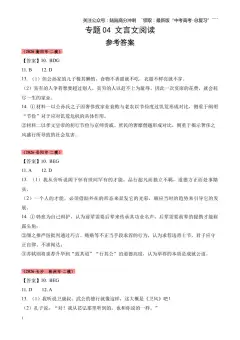
Passage 1
(2026·高三·湖南张家界·二模)
Tea is the national drink of China, with a history of over 5000 years. In recent years, tea-tourism integration
(茶旅融合)     1     (become) a new trend in rural China, combining tea culture with rural tourism to boost rural
revitalization.
Anxi County in Fujian Province, the hometown of Tieguanyin tea, is a good example. For hundreds of years,
local people     2     (grow) tea here. In the past, most farmers only sold fresh tea leaves or processed tea,     3
brought them limited income. Now, with the development of tea-tourism, the county has turned tea gardens into
tourist attractions.
Tourists can come here to pick tea leaves, learn     4     to process tea, taste different kinds of tea, and
listen to stories about tea culture. Local farmers have opened family hotels and tea-themed restaurants,     5

(provide) more jobs for villagers. “In the past, I only earned about 30,000 yuan a year from selling tea. Now, with
my family hotel, my income     6     (increase) to over 100,000 yuan a year,” said a local farmer.
Tea-tourism integration not only improves the income of local people,     7     also helps pass on traditional
tea culture. Many tea-producing areas have set up tea museums and tea culture experience centers,     8    , young
people can learn about the history and skills of tea making. Some schools even work with tea gardens to set up
research bases,     9     (teach) students about tea culture.
“Tea is not just a drink. It carries     10     (we) traditional Chinese culture and spirit,” said an expert.
“Tea-tourism integration gives a new life to the old tea culture, and helps build a better life for people in rural
areas.”
Passage 2
(2025-2026·高三·湖南长沙名校联盟·二模)
As the seasons turn, nature follows a rhythm that has shaped Chinese life for thousands of years. So     1
(fundamental) has Chinese civilization been guided by this rhythm that even time itself     2     (measure)
through the 24 solar terms. It was from this tradition that young composer Wen Ziyang created The Four Seasons of
China, a violin concerto (协奏曲) dedicated     3     the celebrated violinist Lyu Siqing.
Earlier this year, Lyu brought his work to Europe, including countries such as Hungary and Italy. Not only did
he present a new Chinese composition, but he also shared a musical vision rooted in China’s cultural heritage.     4
(structure) around spring, summer, autumn, and winter, the piece mirrors the agricultural wisdom     5     has
long connected Chinese people to the land. Beginning in spring and returning to it, the music reflects the renewal of
all living things —     6     theme central to the classical Chinese philosophy.
Inspired by Vivaldi yet determined     7     (move) beyond imitation, Wen crafted melodies of distinct
Chinese scenes: the quiet rain of Qingming, cicadas (蝉) singing in the summer heat, the glorious harvest moon,     8
the stillness of winter fields. What emerges is more than a     9     (describe) of nature; it is a cultural memory
shaped by harmony between humanity and the natural world.
Through this concerto, Chinese classical music steps confidently onto the global stage,     10     (carry)
forward both its ancient roots and its modern voice.
Passage 3
(2026·高三·湖南常德·二模)
“Besiege Wei to Rescue Zhao” is one of the ancient Chinese military strategies known as the Thirty-Six
Strategies. The name comes from a historical incident during the Warring States period of ancient China,     1
(involve) the states of Wei and Zhao. When Zhao     2     (face) an attack by Wei, the state of Qi employed this strategy
by launching an attack on Wei, thus forcing them to withdraw from Zhao to defend their own territory.
The core of this strategy means creating a situation     3     the opponent is forced to make a difficult
decision, often abandoning their offensive position     4     (address) a more pressing threat. It draws on the
element of surprise     5     the psychological impact of attacking an unexpected target. By shifting the
battleground     6     a weaker area, the strategy not only interrupts the enemy’s plans but also gains a tactical
(战略的) advantage without engaging in direct combat.
In contemporary settings, the principles of “Besiege Wei to Rescue Zhao”     7     (adapt) for use in
various non-military fields. In business, companies apply this strategy by launching attacks on a rival’s weaker
markets or products to force a strategic     8     (withdraw). Similarly, in sports, teams make full use of an
opponent’s defensive mistakes to gain a     9     (compete) advantage.
This strategy provides      10      valuable framework for addressing challenges in diverse contexts.
Passage 4
(2026·高三·湖南湘潭市一中·一模)
On December 4, 2024, thrilling news arrived from Asuncion, Paraguay. The 19th session of the UNESCO
Intergovernmental Committee for the Safeguarding of the Intangible Cultural Heritage    1    (announce) Spring
Festival - the social practice of Chinese people celebrating the traditional Chinese New Year was added    2    the
Representative List of the Intangible Cultural Heritage of Humanity.
The Spring Festival, with    3    history of over 3, 000 years, is filled with traditional customs. People
clean their homes, put up couplets, have family reunions, and give lucky money. It’s a time    4    family and
friends gather and celebrate.
The successful inscription (申遗) is of great significance. It promotes the spread of Chinese culture,    5
(strength) the cultural identity of Chinese people around the world, enriches    6    (globe) culture diversity, and
tightens the bond among Chinese people all over the world, inviting the world to this splendid cultural event.
With winter    7    (pass) by, spring is just around the corner. On the    8    (base) of the movement of the
sun and the moon, phenological (物候学的) changes and the cycle of agricultural production, the Chinese people
have developed their own calendar system. Spring Festival, falling on the first day of the first month of Chinese
calendar, marks the beginning of the Chinese New Year. From the 23rd of the    9    (twelve) month to the 15th
of the first month, a variety of activities are carried out     10     (bid) farewell to the old year, welcome the
spring, pray for good fortune and celebrate family reunion. This process of celebration is also called “guonian”.
主题02 人与自然——生态经济
Passage 1
(2026·高三·湖南长郡名校联盟·二模)
The multifunctionality of bamboo is recognized in China, where the giant woody grass has been widely
employed since the 11th century BC.

 1

  (bless) with a wealth of bamboo forests, China is the world’s
largest producer of bamboo products and this resource, comparable in scale and economic impact     2     that
of Ireland, secures its dominant position in the global market.
Evolving into an eco-friendly replacement, bamboo     3     (prize) for its superior green nature. Its edge lies
not only in toughness and strength but in rapid growth and renewability. As opposed to trees (such as oak or teak),       4


can take over a decade to mature, it reaches a harvest-ready stage in just four to six years, thus     5     (permit) repeated
harvests without replanting.
In Anji, a county in northwestern Zhejiang Province, bamboo has replaced plastic in various products. With
666 square kilometers of bamboo forests covering     6     area about 80 percent of the size of New York City     7
a long-standing history of bamboo use, Anji serves as a model in advancing bamboo as an alternative to plastic. On
the farm, bamboo-based film (薄膜) replaces plastic film in the     8     (preserve) of heat and water. The
industrial development of bamboo benefits local communities as well, rejuvenating rural areas through bamboo
harvesting.
Scenes of harmony between humankind and nature are emerging in Anji, where bamboo-driven development
is promoted     9     (initiate) dialogues with nature and champion a greener future. Transformation, innovation,
collaboration, and     10     (sustainable) grown natural treasures all form part of humanity’s shared heritage.
主题03 人与自然——动物保护
Passage 1
(2026·高三·湖南永州市·一模)
Moscow Zoo hosted a week-long celebration, starting on Sunday, to mark the second birthday of Katyusha,
the first giant panda born in Russia.
The zoo    1    (decorate) with traditional Chinese elements, including red lanterns and festive displays.
Celebrations featured lively dragon dances, tea ceremonies,    2    educational workshops on panda conservation.
The parade created a carnival atmosphere, with crowds cheering and laughing as the dragon wove through the
pathways. Visitors enjoyed interactive    3    (activity), such as handmade craft sessions and thematic tours
showcasing animals native to China.
Katyusha, the center of attention, received a specially crafted birthday cake made of bamboo, fruits, and ice
carved into the number “2”,    4    (mark) the panda's age in a display combining Chinese tradition with zoological
enrichment. Dedicated zookeepers went to great lengths    5    (refresh) her and keep both her mind and body
active and enriched Katyusha’s daily life by adding edible (可食用的) decorations and hiding food in new toys. She
enjoyed a bamboo playhouse filled with treats,    6    she enthusiastically unpacked to find the    7    (hide)
biscuits.
Moscow Zoo Director Svetlana Akulova shared updates on Katyusha’s growth, noting that Katyusha is    8
unique example of natural upbringing and a key part of Sino-Russian    9    (science) research on giant pandas.
Zhang Wei, minister counselor at China’s embassy in Russia, attended the event, saying: “Katyusha is not only a
special    10    (represent) of cultural exchange but also a beloved star on social media in both countries.”
主题01 人与社会——体育精神;古代艺术;经济开放
Passage 1
(2026·高三·湖南永州·二模)
You Haoran, a loyal supporter of the Yongzhou team, said he felt     1     (incredible) fortunate to witness
the team claim the 2025 Hunan Football League title after a tough four-month campaign     2     (feature) 98
matches between 14 cities.
Jokingly called “beggars” by fans due to their modest conditions, the team overcame three straight early     3
(defeat), charging into the final and beating Changde 1-0 to secure an amazing underdog comeback (逆袭). Coach
Huang Churu called the victory     4     wonder, noting it had strengthened the city’s unity,     5     residents and
students alike talking about the team and the league.
The first tournament     6     (draw) over 2.4 million on-site attendees, driving massive tourist visits and
consumer spending across host cities. A total of 262 student players joined the tournament, 73 of      7     scored
132 goals, accounting for 53.4% of the total goals. Huang emphasized the tournament’s profound impact on youth,
as many students now admire the players     8     dream of joining the team to honor their hometown.
In     9     (respond) to jokes about the “beggar stadium,” local authorities livestreamed its repair. When
fans joked about climbing trees for tickets, 18 official “tree-hanging tickets”      10      (introduce) with fun
rules. As You said, the title belongs to all Yongzhou people, which proves that efforts can surpass talent and ordinary
people can make history.
Passage 2
(2026·高三·湖南湘潭·二模)
Terra-cotta Warriors,     1     (create) during the Qin Dynasty, shows old China’s art skills. What makes
these soldiers so interesting is not just their different faces— each man     2     (think) to be copied from real
soldiers — but rather the philosophical implications underlying their construction.
Unlike Western works,     3     statues often praised human     4     (perfect), these clay men carried a
Chinese art rule: the balance between the person and the group. The question that comes up here is     5     making
so many art pieces lowers or raises their culture worth.
New dig finds have shown that the colors     6     (original) put on these men had rocks not found in
China back then, pointing to trade roads longer     7     recorded before. This find fights the old story of old
China as a land cut off from the outside world.
The building skill seen in the underground rooms is particularly     8     (amaze). The makers used a
drainage system so well that, even now, it would be considered     9     (innovation). Had this technology been
documented and disseminated ( 传播), it might have completely changed architectural practices across ancient
civilizations.
How we read these quiet guards— as signs of king power or as art wins— depends much on how we see today.
Maybe their biggest meaning lies not in what they were meant to show, but in what they have turned into:      10
(message) of Chinese life to today’s world.
Passage 3
(2026·高三·湖南娄底/衡阳/郴州·二模)
Imagine a huge, beautiful island that has just become     1     special “shopping and business park” for the
whole world. This is     2     happened to the Hainan Free Trade Port (FTP), the world’s largest FTP by area.
On December 18, 2025, island-wide special customs operations     3     (launch) officially. Don’t let the big
words confuse you — this doesn’t mean the island is closed. It actually means Hainan is now     4     (open) to the
world than ever before.
Think of it like this: the island is now a unique “world” with two “lines”. The “First Line” is between Hainan and
foreign     5     (country). Here, most goods from overseas can enter Hainan with zero tariffs ( 关税). The
“Second Line” is between Hainan and the Chinese mainland. This line     6     (make) sure that the special tax-free
goods stay in Hainan’s “world” and are managed properly.
This smart system,     7     (describe) as “freer access at the First Line and regulated access at the Second
Line”, allows goods, money, and people to move more freely. This helps businesses save a lot of money and grow
   8

(sustainable).
Why is this so important? At a time when some nations are creating more trade barriers, China is opening a huge
door wider. Hainan,     9     the full support of China’s vast market, aims to be a leading gateway for China’s
opening-up in the new era. It’s not just about doing shopping; it’s about establishing a stable, transparent and
predictable institutional system     10     (attract) high-end resources from around the world in the future.
主题02 人与自我——医药健康
Passage 1
(2026·高三·湖南岳阳·二模)
Nin Jiom Pei Pa Koa, a traditional Chinese cough syrup (糖浆) with a recipe unchanged since the 1600s, is
enjoying a renewed global surge in popularity. Its recipe has remained unchanged for over 400 years, sales     1
(hit) 635 million yuan in 2024, a nearly one-third increase compared with 2019. Sold in more than 20 countries across
the world, it is     2     (main) produced in Hong Kong and priced at around $5 a bottle in local pharmacies,
3     costs three times as much when sold by third parties on Amazon in America.
Young people have been particularly     4     (enthusiasm) about this effective herbal syrup. Worldwide
Google searches for the syrup rose     5     a quarter last year, and TikTok short videos on how to use it properly
have racked up millions of views online. Western     6     (celebrity), including famous singers, actors from
popular films and music groups, have praised its ability     7     (relieve) sore throats and soothe scratchy vocal cords
effectively.
This trend reflects the fast-growing Western interest in traditional Chinese medicine, driven by the social-
media craze for biohacking,     8     focuses on improving health through experimental ways in daily life. Other
ancient Chinese healing techniques, such as Gua Sha,     9     (be) also very popular among young Westerners
these days. It fully shows that ancient Chinese herbal remedies are still highly valued when     10     (introduce) to
the whole world.