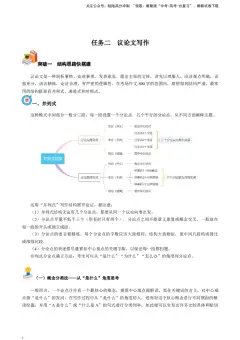
大题 阅读理解议论文
04
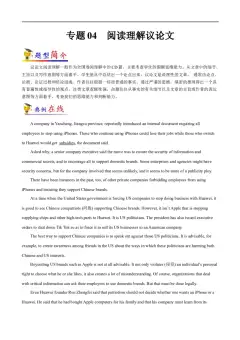
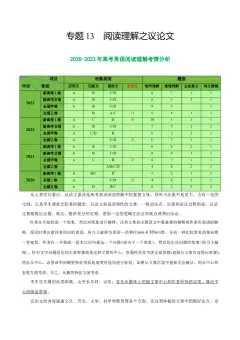
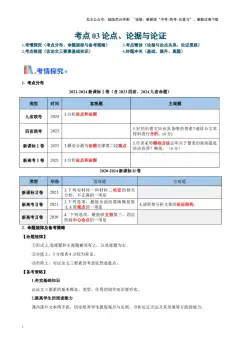
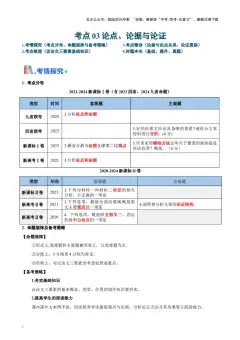
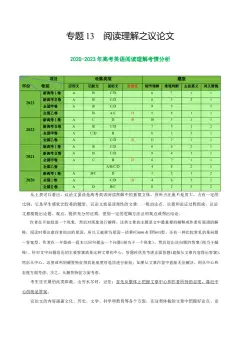
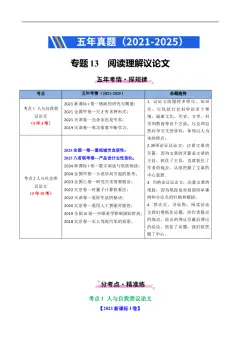
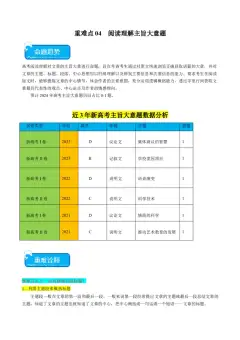
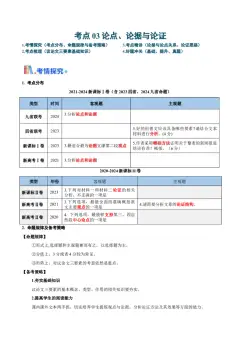
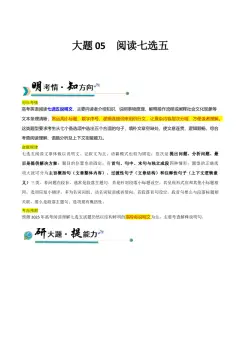
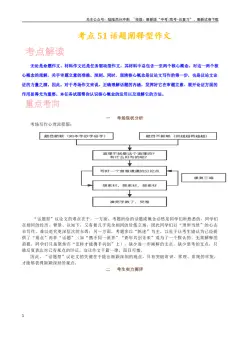
历年考情
高考英语阅读理解议论文,通常围绕某一观点、现象或问题展开论述,作者通过摆事实、讲道理,运用
逻辑推理来阐明自身看法,说服读者接受其观点。文章往往结构清晰,包含论点、论据与论证过程,选
材涉及社会热点、教育理念、科技发展争议、文化现象剖析等诸多领域,旨在考查学生对复杂文本的理
解、分析及批判性思维能力。
命题规律
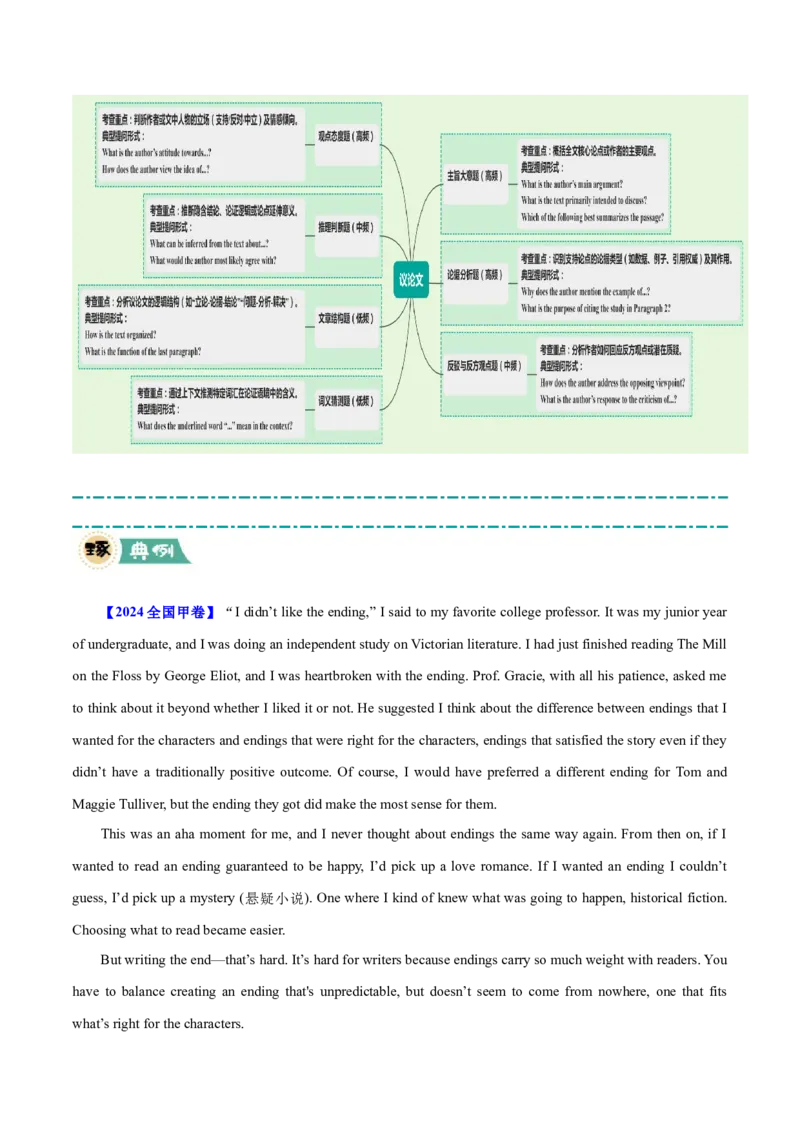
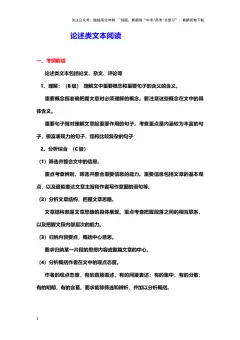
议论文涉及的论题具有生活化的特征,与社会生活密切相关。从命题上看,议论文阅读理解以考查细节理
解、推理判断和主旨大意题为主,但不排除对观点态度的考查。考生在平时的阅读训练中要阅读一定数量的
议论文,以了解和掌握议论文的结构和行文特征。
考向预测
预测2025年高考阅读理解议论文可能会出现且会继续考查考生快速而准确地获取和理解文中具体细节信息
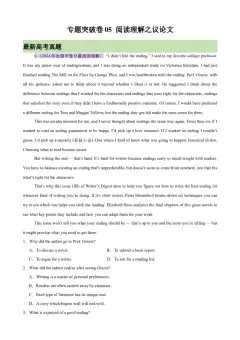
的能力, 对文章信息的判断能力以及对文章的整体感知能力。【2024全国甲卷】“I didn’t like the ending,” I said to my favorite college professor. It was my junior year
of undergraduate, and I was doing an independent study on Victorian literature. I had just finished reading The Mill
on the Floss by George Eliot, and I was heartbroken with the ending. Prof. Gracie, with all his patience, asked me
to think about it beyond whether I liked it or not. He suggested I think about the difference between endings that I
wanted for the characters and endings that were right for the characters, endings that satisfied the story even if they
didn’t have a traditionally positive outcome. Of course, I would have preferred a different ending for Tom and
Maggie Tulliver, but the ending they got did make the most sense for them.
This was an aha moment for me, and I never thought about endings the same way again. From then on, if I
wanted to read an ending guaranteed to be happy, I’d pick up a love romance. If I wanted an ending I couldn’t
guess, I’d pick up a mystery (悬疑小说). One where I kind of knew what was going to happen, historical fiction.
Choosing what to read became easier.
But writing the end—that’s hard. It’s hard for writers because endings carry so much weight with readers. You
have to balance creating an ending that's unpredictable, but doesn’t seem to come from nowhere, one that fits
what’s right for the characters.That’s why this issue (期) of Writer’s Digest aims to help you figure out how to write the best ending for
whatever kind of writing you’re doing. If it’s short stories, Peter Mountford breaks down six techniques you can try
to see which one helps you stick the landing. Elizabeth Sims analyzes the final chapters of five great novels to see
what key points they include and how you can adapt them for your work.
This issue won’t tell you what your ending should be—that’s up to you and the story you’re telling—bu it
might provide what you need to get there.
12. Why did the author go to Prof. Gracie?
A. To discuss a novel. B. To submit a book report.
C. To argue for a writer. D. To ask for a reading list.
13. What did the author realize after seeing Gracie?
A. Writing is a matter of personal preferences.
B. Readers are often carried away by character.
C. Each type of literature has its unique end.
D. A story which begins well will end well.
14. What is expected of a good ending?
.
A It satisfies readers’ taste. B. It fits with the story development.
C. It is usually positive. D. It is open for imagination.
15. Why does the author mention Peter Mountford and Elizabeth Sims?
A. To give examples of great novelists. B. To stress the theme of this issue.
C. To encourage writing for the magazine. D. To recommend their new books.
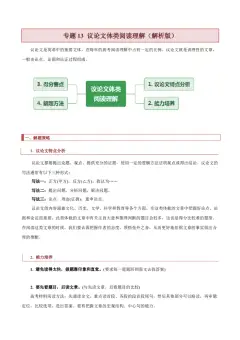
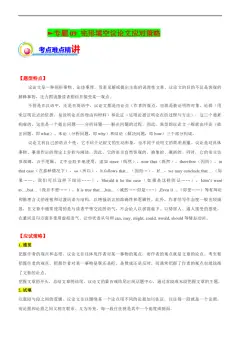
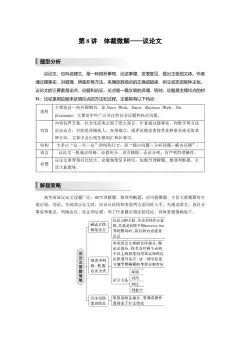
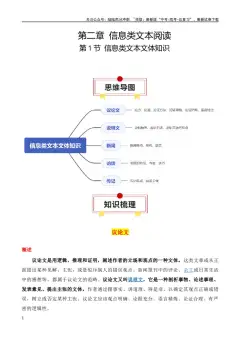
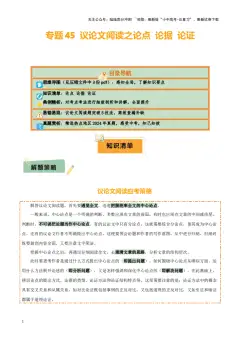
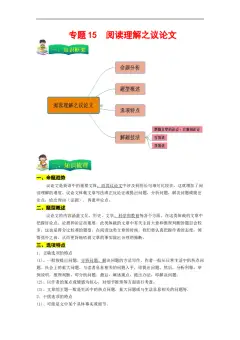
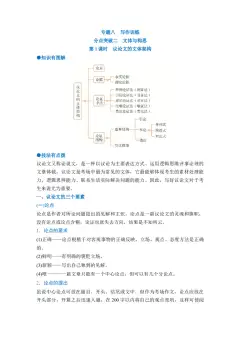
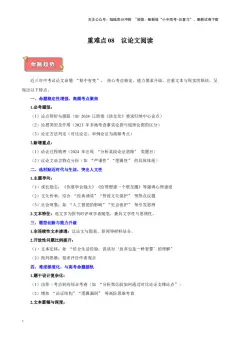
读题预判:快速浏览题目与选项,圈出关键信息,像主旨题中的 “main idea”、细节题里的专有名词等,
预判阅读重点,带着问题意识去读文章。
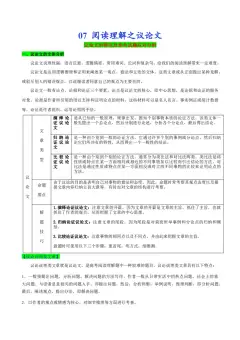
通读抓论点:首次通读,定位文章开头段,多数议论文在此点明主题、抛出论点;同时留意各段首句,
它们常起承上启下、引出分论点的作用,梳理出全文论述脉络。
定位找论据:碰上细节、词义类题目,依据题目关键词,精准回文定位,在定位段落中细读上下文,借
助因果、对比、举例等逻辑关系锁定答案,比如出现 “for example” 后的内容大概率是在解释前面论点,对理解词义、补充细节很关键。
推理重逻辑:面对推理题,紧扣文章已知观点、事实,杜绝过度臆想,分析作者用词褒贬、论证走向来
判断态度倾向;梳理段落、句子间的逻辑链条,像因果推导、让步转折后的语义走向,让推理有理有
据。
核查避陷阱:选完答案后,代入原文再次核查,看选项是否契合全文主旨、对应细节是否无误,警惕偷
换概念、无中生有、以偏概全这类常见陷阱选项。
When most parents of young children today were growing up, social media was not as hugely common as it
is today if it existed at all. A lot of us even remember the days of being pen pals, sending paper letters with actual
stamps. The fact remains that in the information age, these platforms are a huge part of daily life for everyone.
However, the question is, how young is too young for social media?
While most social media platforms require that members are of a certain age, that doesn’t always mean that
the child is really ready for what the world of social media has to offer. For example, Snapchat requires that users
be at least 13 years old, but are 13-year-olds ready for Snapchat?
A lot of research has been done to try to understand when the right time is for social media. It can be
compared to the debate of when to allow a child to have their first cell phone. The two are actually closely
connected with each other.
A recent study published in Computers in Human Behavior shows that for the 750 middle schoolers in the
Northeastern US, a majority of them who joined social media under the age of 10 had many problems. It showed
that students spent extended amounts of time visiting websites that were not approved for them to visit.
Similar to Snapchat, other social media giants require users to be at least 13 years old to join, but it is pretty
obvious to fake this information. The study’s lead author Linda Charmaraman shared, “Social media sites all
require a minimum age of 13 to register, but the reality is that many users are younger than that: One-third of our
sample had already started using social media at age 11 or 12 and another one-third had begun at age 10 or
younger.”
Dr. Charmaraman continued, “This study helps us understand the risks and benefits for kids, so that parents
and policymakers can make decisions that prioritize their well-being. These findings suggest that the industry-basedminimum age of 13 for social media users may potentially be a good standard, if it can be enforced.”
33.What do we know about most parents today when they were young?
A.They communicated by writing letters.
B.They were too young to use social media.
C.They were addicted to surfing the Internet.
D.They used to send emails to their pen friends.
34.What does Linda Charmaraman’s study show?
A.Social media giants are reliable enough for the young.
B.Kids use social media without their parents’ monitoring.
C.Social media may not practice 13 as minimum registering age.
D.Many social media users often visit websites not approved for them.
35.What does the underlined word “it” in the last paragraph refer to?
A.A good standard. B.The minimum age of 13.
C.Dr. Charmaraman’s study. D.Kids’ well-being.
36.Which of the following can be the best title for the text?
A.Why Shouldn’t Young Children Use Social Media?
B.Should Young Children Be Allowed on Social Media?
C.How Should Young Children Be Guided on Social Media?
D.What Is the Right Age to Allow a Child to Be on Social Media?
Passage(1)
【2025届贵州新高考高端精品模拟信息卷】The landline (座机) was an impressive presence in the house where
I grew up. On the rare and alarming occasions when it rang, there was an inflexible polite sentence for answering:
“Sittingbourne 981, who is speaking, please?”
The phone both was and wasn`t an instrument of communication. The occasions for its use were clearly
defined — and random chatting wasn’t one of them. Its situation in the front hail, from where every word could be
heard throughout the house, was an effective solution to the endless conversations that are (or were) the favouriteoccupation of teenagers.
Later mobile phones appeared. Now only 47 per cent of households have a home phone. Times are changing,
and the message from the advocates of digital technology is that we should change with them. In many ways this is
a reasonable proposition. My smartphone can tell me how to get from one place to another, answer questions about
unknown 19th-century artists or medical symptoms.
However, when it comes to that most basic function of a telephone — talking to people — my smartphone is
rubbish. On moving into my new house, in a village 50 miles from the capital, I was unsurprised to discover almost
no phone signal. In the ten days that it took for broadband (宽带) to be connected, I found myself in the bush — the
only place where there was a bar of signal, trying to talk about an urgency with a doctor. It was at once blackly
comic and severely frustrating. I began to understand why my son swerve (急转) phone calls in favour of
messaging, socials and voice notes.
Yet long before the appearance of telecommunications, printing, or even writing, speech was the most
fundamental of human interactions. Talking on the phone or in person is hard work, because it demands an ability
to listen. However, it almost certainly matters a lot. Now phone calls are dying. The art of conversation may not be
far behind. Smartphones are updating very quickly.
1.Why was the author’s landline improper for random chatting?
A.It was usually occupied by teenagers.
B.It was monitored by the grown-ups at home.
C.It couldn’t guarantee the privacy of the conversation.
D.It was only allowed to be used in alarming occasions.
2.What does the underlined word “proposition” in paragraph 3 probably mean?
A.Suggestion. B.Plan. C.Explanation. D.Solution.
3.What makes the author’s smartphone rubbish?
A.Occasional breakdowns. B.Frequent poor signals.
C.Wrong connected broadband. D.Incomplete functional system.
4.Which statement might the author agree with?
A.The landline no longer has its advantages.
B.The art of conversation is nowhere to be found.
C.The youth realize the importance of the landline.
D.The ability to have a phone conversation counts.Passage(2)
【重庆市拔尖强基联盟2024-2025学年高三下学期2月月考】Media literacy (素养) is finally getting
some late-arriving attention. Whether it’s the increasing awareness of political disinformation or the threat of AI,
discussions about media literacy are on the rise. The adoption of media literacy in the classroom, however,
stagnates.
The driving force for providing kids with media literacy skills often gets lost in the moral panic over
technology and kids. Fear has overrun reason, and people can’t decide whether to blame social media, mobile
devices, tech companies, or the Internet. They are concerned with claims that technology and social media are the
causes of teenage mental health issues despite the weak associations. In response, too many solutions are “ostrich
policies (鸵鸟政策)” that want to ban devices and shut down social media but don’t address more fundamental
issues.
Policies that set age limits on social media access and restrict devices during school to minimize disturbance
can be helpful but are incomplete solutions. Social media didn’t invent bullies (霸凌) or the enormous effect of peer
pressure. Social media platforms may be a new battleground, but they are not the source. Unfortunately, many
current policies ignore the need to teach kids how to manage these challenges. There is frighteningly little attention
paid to preparing kids to make good decisions when they will, unavoidably, get online.
On the bright side, the rapid development of AI and increasing attention to the amount of misinformation
online have helped normalize the acceptance of media literacy as a core skill. While suggestions to limit
inappropriate device use, increase face-to-face socialization, and engage in outdoor play are beneficial, they do not
build the core skills that will keep kids safe offline and are fundamental to well-being and life success: good
citizenship, self-awareness and self-control. Those things take teaching, whether you are online or outside.
Media literacy is an essential life skill that, once learned, can be applied to any content. While waiting for
public education to catch up, parents and educators can build media literacy skills at home with numerous
resources, ranging from family technology contracts and discussion guides to easy activities that can be done at
home with kids.
5.What does the underlined word “stagnates” in the first paragraph probably mean?
A.Advances significantly. B.Collapses abruptly.
C.Underperforms substantially. D.Initiates officially.
6.What factors contribute to people’s moral panic over technology and kids?
A.Widespread use of technology and social media.B.Inability to provide kids with media literacy skills effectively.
C.Concern about the lack of parental control over tech devices.
D.Fear of the impact of technology on teenage mental health.
7.What does paragraph 3 of the text focus on?
A.The importance of banning social media.B.The shortcomings of existing policies.
C.The limitations of social media platforms.D.The necessity of managing online challenges.
8.Which of the following belongs to media literacy?
A.Minimizing social media usage. B.Evaluating media content critically.
C.Increasing in-person interactions. D.Recognizing the risks of social media.
Passage(3)
【2025届广东省顺德区普通高中高三教学质量检测二】Nietzsche (尼采) was wrong: When you gaze long
enough into the abyss (深渊), the abyss does not gaze back into you. Instead, the cosmic void (黑洞) remains silent,
relentless and frightening in its vastness.
When looking at the vast emptiness of the universe, there is a temptation (诱惑) to look at our tiny world
with nihilism. To feel that our great achievements amount to nothing. That our history fails to leave a mark. That
our concerns and anxieties are pointless.
I’m a cosmologist, the kind of scientist who studies the origin, history and evolution of the universe. I have
spent years working to understand what cosmic voids teach us. And in the course of my studies, I have learned to
reject that temptation.
It’s true that Earth is neither large nor long-lived, but that is only one way of measuring significance.
Compared with the cosmic voids, there is something special happening on our planet. Earth is still the only known
place in the entire universe where conscious beings raise their curious eyes to the sky and wonder. Earth is the only
known place where humans can exist. It is the only known place where laughter, love, anger and joy exist. The only
known place where we can find dance, music, and art. Our disagreements and all the beautiful complexities that
make us human aren’t meaningless. The experiences in our lives are special because they will never happen in the
empty expanse of most of the universe
The same lessons that cosmic voids teach us are found in the voids we encounter in our own lives. The
presence of voids guarantees the opposite; they create contrast; they are full of potential. The pain we feel from loss
is the last reminder of the gift of a life deeply loved. The silence before a performance is full of electric expectation.
Our choice to ignore stressful news is necessary to allow us to focus on what truly matters.Artists have long understood the power of the void. The 12th-century poet Saigyo noted that the pauses
between raindrops were as important as the drops themselves. The famed architect Rem celebrated the utility of
negative spaces, proclaiming, “Where there is nothing, everything is possible.”
The universe won’t do anything for us except give us the freedom to exist. It is our job to fill the universe
with meaning and purpose.
9.What does the underlined word “nihilism” in paragraph 2 mean?
A.Hope. B.Admiration. C.Meaninglessness. D.Purpose
10.Why does the author reject the temptation?
A.He is a cosmologist who believes science.
B.Earth is the only place for human experiences.
C.Human experiences differ from those in voids.
D.Earth is special because it is small and short-lived
11.What is the author doing in paragraph 5?
A.Explaining how voids in life offer meaning.
B.Stating that voids in life should be avoided.
C.Criticizing the role of voids in universe and life.
D.Arguing voids should be filed for more meaning.
12.What is the author’s purpose in writing the text?
A.To clarify Nietzsche’s philosophy.
B.To explore the unique significance of voids.
C.To report a scientific study of cosmic voids.
D.To criticize passive views on human achievements.
Passage(4)
【北京市中国人民大学附属中学 2024-2025 学年高三下学期 2 月统练】In 1979, Archie Cochrane
published an essay criticizing his fellow doctors. “It is surely a great criticism of our profession,” he wrote, “that we
have not organized a critical summary, by specialty or subspecialty, adapted periodically, of all relevant randomized
controlled trials. ” The idea of “organizing a critical summary” may not seem a groundbreaking concept, yet
Cochrane had struck at the heart of the matter.
The basic building block of evidence in medicine is the randomized trial, as Cochrane understood. But some
trials are flawed, others may have vanished from the academic record, unpublished because they didn’t yield the
hoped-for results. Even when trials are reported, the most robust evidence comes from synthesizing them. Propersynthesis can turn inconclusive trials into a conclusive result, yet to turn those trials into a structured body of
knowledge takes work.
In 1993, Sir Iain Chalmers founded Cochrane, a non-profit now listing over 9, 000 systematic reviews. But
in fields like education or policing, the picture is less rosy. Education is arguably of comparable importance to
health for any government. Yet, the UK government spends 18 times as much on research into health than it does
on research into education - or, to put it another way, education research is underfunded by 10 percent.
If anything, that paints too optimistic a picture of research into social policy, because other countries spend
even less. And, perhaps, education research is probably the best of the rest when it comes to research funding. The
Campbell Collaboration, which aims to do for social policy what Cochrane does for medicine, boasts just 231
systematic reviews - reflecting that social policy research enjoys a fraction of the money and attention lavished on
medicine.
More than a lack of spending, there’s a reluctance to support the infrastructure of systematic reviews, or to
fund their updates into “living evidence reviews”. Take the 3ie (International Initiative for Impact Evaluation),
admired for its Development Evidence Portal, which struggles for steady funding. The portal could run for a year at
less cost than a typical study evaluating its effectiveness, yet “public goods tend by their nature to be underfunded.”
On the bright side, more than f50mn of funding for evidence synthesis was recently announced. This modest
funding could significantly contribute to building an “evidence bank” for policymakers.
Systematic reviews bridge the gap between researchers and policymakers. Researchers focus on specific
interventions, while policymakers address broader problems. By synthesizing relevant research, systematic reviews
can answer policymaker questions. Furthermore, evidence synthesis highlights “ known unknowns” - gaps in
research that can be filled through targeted funding, rather than more studies of familiar topics.
As Eleanor Chelimsky, one of the 20th century’s great policy evaluators explained, “I hoped that synthesis
could dramatize, for our legislative users, not only what was, in fact, known, but also what was not known.”
Dramatizing our ignorance is one of the most valuable things an evidence review can do.
13.What was Archie Cochrane’s major concern?
A.Organizing medical summaries was seen as unworthy.
B.Doctors failed to put medical trials into summaries.
C.The medical profession received widespread criticism.
D.Medical trials were too flawed to be published.
14.What be inferred from the passage?A.Education should be the top priority in research funding.
B.Social policy research funding has increased significantly.
C.Systematic reviews help make research funding more focused.
D.The 3ie portal was underfunded due to poor effectiveness evaluation.
15.What’s the author’s attitude towards “synthesis dramatizing the unknown”?
A.Torn between. B.Radically oppose.
C.Cautious optimism. D.Enthusiastic approval.
16.Which of the following would be the best title for the article?
A.The Downfall of Systematic Reviews: Why They’re Outdated
B.Rethinking Systematic Reviews: A Call for Broader Application
C.Uncovering the Untold Story: The Importance of Evidence Synthesis
D.From Criticism to Collaboration: The Evolution of Evidence Synthesis
Passage(5)
【江苏省常州高级中学2024-2025学年高三下学期期初质量调研】A recent survey found children would
rather be online influencers (网红) than astronauts. It made headlines and led to plenty of complaints about “kids
these days”. Is influencing a promising career path? The lifestyles we see advertised on social media are enticing,
but under the shining appearance lie uncertain income, pay inequality, disability and mental health issues.
Successful influencers will be the first to claim that anyone can make it in the industry. However, social
media economy experts uncovered a huge income gap between successful influencers and everyone else. For most
people trying to become an influencer, their passion projects of content creation often become free work for brands.
Most influencers are self-employed, often experiencing inconsistent income and a lack of protection that
comes with long-term employment. The risks of self-employment are increased in the influencer industry by an
absence of industry standards and little pay transparency. Influencers are often forced to assess their own value and
determine fees for their work. As a result, content creators often undervalue their own creative labour, and many
end up working for free.
Influencers are also often at the mercy of algorithms — the behind-the-scenes computer programs that
determine which posts are shown, in which order, to users. Platforms share little detail about their algorithms, yet
they finally determine who and what gains visibility and influence on social media. The threat of invisibility is a
constant source of insecurity for influencers, who are under constant pressure to feed platforms with content. If they
don’t, they may be “punished” by the algorithm — having posts hidden or displayed lower down on search results.Constant online presence leads to one of the most common issues in the influencer industry: mental health
concerns. Influencers can connect to their platform workspaces and audience at any time of day or night, which can
lead to them overworking. Coupled with the fear of online criticism, it contributes to mental and physical health
issues.
Although becoming an influencer may look appealing to more and more people, the industry’s dark
underside needs to be made visible and improved through enhanced employment regulation and industry-led
cultural change.
17.Which of the following words cans replace “enticing” in Paragraph 1?
A.Imaginative. B.Similar. C.Attractive. D.Traditional
18.What’s one of the reasons for influencers’ undervaluing their creative work?
A.Standardized protection. B.Invisibility of payment.
C.Assessment of own work. D.Passion for content creation.
19.What may cause the influencers’ stress according to Paragraph 4?
A.Having to work out the order of posts to be displayed.
B.Finding it difficult to create new content constantly.
C.Having little knowledge of platform algorithms.
D.Being unequally punished by platforms.
20.Why does the author write this text?
A.To show the dark side of working as an online content creator.
B.To reveal relationships between platforms and influencers.
C.To stress the importance of visibility in the online world.
D.To describe the life of self-employed content creators.
Passage(6)
【山东省青岛市四区联考2024-2025学年高三上学期期末】For too long, we’ve been living on the edge of
burnout, with to-do lists growing longer, calendars full, and deadlines that seem never-ending. It’s not a secret that
busyness has been worn like a mark of honor, while moments of down time are seen as unproductive. But if there’s
no time to breathe or room to think, how are we able to come up with new ideas, let alone carry them out?
I didn’t realize how deep-rooted this lifestyle had become for me until I stepped into self-employment in
2023. Balancing busy periods with quieter ones unexpectedly brought anxiety and self-judgment instead of the
anticipated relief to pause and reflect. However, the tide is turning in the world of work: there’s a growing pushbackagainst non-stop demands, and increased awareness about the benefits — including improved concentration,
creativity and job satisfaction-of doing one thing at a time.
According to Marc Zao-Sanders, author of Timeboxing, multitasking is the attempt to attend to two things at
once, for example firing off a few emails while sitting in a meeting. The pity here is that you may end up doing a
poor job of both, and enjoy neither. But it’s actually a little more complex than this. If one of the tasks is familiar to
you and doesn’t demand too much of you cognitively (认知地), it may well be that you can take on a second task at
the same time. The main issue is thinking you can do both at once for those tasks where you can’t. This is both
unproductive and can easily feel frustrated.
The phrase “multitasking” has been adopted by all sorts of typically high-achieving people and a mark of
status. But our brains cannot complete tasks at the same time. They are completed in a sequence. Multitasking is
tiring us out more quickly and making us less efficient. So, let’s bid farewell to the era of handling a hundred things
at once.
21.What’s people’s common view to busyness?
A.It is a way to generate new ideas.
B.It shows that people are less productive.
C.It reflects people’s poor time-management.
D.It is a symbol of efficiency and excellence.
22.How does the author feel after she became self-employed?
A.Relaxed. B.Panicked. C.Uneasy. D.Stress-free.
23.What can we learn about multitasking from paragraph 3?
A.It can reduce our productivity. B.It can weaken our cognitive ability.
C.It makes us creative and concentrated. D.It is essential in today’s fast-pace world.
24.What does the author suggest in the passage?
A.Following high-achieving people. B.Working one task at a time.
C.Raising the efficiency of multitasking. D.Challenging our brain capacity.
Passage(7)
【广西邕衡教育名校联盟2024-2025学年高三下学期开学考试】Some films shine brighter than others. RaMell
Ross’ “Nickel Boys,” a stirring cinematic adaptation of Colson Whitehead’s Pulitzer Prize-winning novel, is
polished to a remarkable brilliance. Its confidence comes on like a stiff breeze on a sticky Southern summer day, as
it tells a boldly designed story of two Black kids named Elwood and Turner, living during the height of segregation(种族隔离) in Florida. Elwood is a smart, idealistic kid who is wrongly sent to the abusive walls of Nickel
Academy, a reform school for boys, while Turner is the bright friend he makes in the dark passages of those days.
Your immersion into the film’s world begins early on. From its opening scene with closeups of fruit hanging
high up in a tree, cigarette smoke floating through the air and hands shuffling cards, “Nickel Boys” makes you feel
like you’re taking a glance into someone’s life. You’re getting a kid’s perspective of Christmas trees and
decorations from below; sheets being put onto beds and laughter ringing in the air. The simple, joyful human
moments at the beginning of the film are in sharp contrast to the inhumane treatment shown later on.
Ross achieves something brilliant when he shows this first-person point of view from Elwood’s perspective.
It’s as if you see through his eyes, moving along with him, but you also hear his voice in conversations. This soon
shifts when Turner makes his first appearance, and his perspective is also shown throughout the rest of the film.
This choice is effective in making the viewer feel every conversation, every loss, every little moment. It also shows
both the boys’ very different attitudes toward whether the truth would win out.
Shot with frequent shifts in perspective, “Nickel Boys” challenges the audience to see and feel the world
through Black eyes, demanding effort and empathy. This isn’t a film that holds your hand, but rather one that
expects you to meet it on its own terms. Yet, as a clear masterpiece held together by visual splendor and distinctive
performances, it proves that this brave, honest storytelling strategy is well worth the reward.
25.What can we learn about the film “Nickle Boys” from the first paragraph?
A.It has been awarded the Pulitzer Prize.
B.Its setting reflects the reality of racism.
C.The story happened during a hot summer.
D.Both main characters were wrongly punished.
26.Why does RaMell Ross adopt shifting perspectives?
A.To highlight both boys’ very different viewpoints.
B.To avoid focusing too much on one character’s story.
C.To confuse the audience and challenge their understanding.
D.To showcase the reform school’s effect on different students.
27.Which of the following best describes the film?
A.Cheerful and realistic. B.Daring and immersive.
C.Heavy but inspiring. D.Heartwarming but challenging.
28.Where is the text most probably taken from?A.A film review. B.A book introduction.
C.A historical analysis. D.An online advertisement.
Passage(8)
【湖北省云学名校联盟2024-2025学年高三下学期2月联考】The next time you’re feeling depressed or angry
at the world, ask yourself if you’ve really been dealt a poor hand — or if, just maybe, you were expecting too
much. That’s one message that can be drawn from a recent study on entitlement, a personality trait characterized by
exaggerated feelings of deservingness and superiority. Entitlement may lead to constant disappointment, say
researchers from Case Western Reserve University.
The authors reached these conclusions after analyzing more than 170 academic papers. They found that
people who possess high levels. of entitlement consistently fall victim to a three-part cycle: First, they don’t always
get everything they think they deserve, leaving them constantly vulnerable to unmet expectations. Those unmet
expectations are then perceived as injustices, leading to emotions like anger and sadness. Finally, to justify those
emotions, entitled people reassure themselves of their own specialness. This helps them feel better temporarily, but
ultimately starts the process all over again.
At extreme levels, entitled people repeatedly expose themselves to the risk of feeling frustrated and
disappointed with life. They also tend to suffer from poor relationships, interpersonal conflicts, and depression, says
co-author Julie Exline, PhD, a professor of psychological sciences at Case Western Reserve. “So much of
entitlement is about competition — being better or more deserving than other people, ”she told Health. com. “It
really sets in opposition to society, and it can be very isolating. ”
“It’s not easy for true narcissists (自恋者) to see themselves for what they are, or to change their way of
thinking.” Exline says. But she does believe that, for many well-intentioned people, feelings of entitlement can be
controlled. “Conditioning yourself to think about other people and what they deserve — and also being willing to
admit your own faults and weaknesses — can help you feel more connected to others, ” she says.
We should be also aware that not all feelings of entitlement are wrong or bad: We shouldn’t just lower our
standards or stop expecting things we truly do deserve, just so we can be happier. But if you do notice that you’ve
developed an overblown sense of self — and it’s causing you to be annoyed or not get along with others — you can
definitely try to do something about it.
29.What causes entitled people to be trapped in a three-part cycle?
A.Consistent negative emotions. B.A strong sense of self-awareness.
C.Constant self-pity and helplessness. D.Unrealistic expectations and frustration.30.What does paragraph 3 mainly talk about?
A.The reason for entitlement. B.The benefits of competition.
C.The negative effects of entitlement. D.The importance of connecting with others.
31.What might be Exline’s suggestion for entitled people?
A.Change your mindset to one of competitiveness.
B.Focus on your own achievements and superiority.
C.Prioritize personal goals over considering others’ needs.
D.Place yourself into others’ position and reflect on yourself.
32.Which word best describes the author’s attitude to entitlement?
A.Balanced. B.Critical. C.Supportive. D.Tolerant.
Passage(9)
【2025届河南省安阳市高三上学期一模】Think about the illegal screen (掩护) that was called against UConn in
the last seconds of the NCAA women’s semifinal game. But remember to approach it without an unreasonable
dislike of or preference for the team, gender considerations, or the overall skill level of the players involved.
American basketball fans have come to believe that at the end of close games, we should “let the players decide the
outcome”.
Do the referees (裁判) actually stop themselves from blowing their whistles at the end of close games, or is it
all just a misconception? While I would like to believe that it is a misconception, during my 31 years of coaching
high school basketball, I have met quite a few game officials who practice that philosophy. To “let the players
decide the outcome” means that the game won’t be called as strictly as it is during other parts of the match. Is that
really what we want? I have a very close knowledge of NFHS basketball rules, and have read NCAA basketball
regulations. But I have never seen any reference to calling the game differently in the closing seconds of a tight
contest. Oftentimes, the game ends with the result that would happen no matter what. But if not, who gets
punished? Most often, it’s the team that continues to play within the rules.
We need to abandon the belief that we should “let the players decide the outcome”. A foul (犯规) should be
recognized as a foul no matter what time in the game it occurs — the first minute, the middle of the third quarter, or
the final 10 seconds of a close game. But again, it’s up to the referees to make sure that happens.
Officials are human, and they sometimes miss a call, such as a close contact that could be interpreted as a
block or a charge. We have to remove the idea that what is a foul committed in the third quarter is not a foul in the
last 10 seconds of a close game. And we coaches and spectators have to accept and expect that!37.Why is the scene in a basketball game described in paragraph 1?
A.To lead in the topic. B.To add background information.
C.To honor the competitive players. D.To stress the importance of referees.
38.What is the common misconception among basketball fans?
A.Referees have preferences for certain teams.
B.Referees stop using their whistles in close games.
C.The team playing within the rules will be the winner.
D.The coaches have too much influence on the officials’ decisions.
39.The author mentions his experience as a high school basketball coach to ______.
A.prove his expertise in basketball rules
B.illustrate the popularity of a certain referee philosophy
C.criticize the poor performance of officials in high school games
D.show how difficult it is to coach a high school basketball team
40.What is the author’s suggestion for improving the fairness of basketball games?
A.Increasing the number of officials.
B.Allowing coaches to challenge referees’ decisions.
C.Observing the rules consistently throughout the game.
D.Carrying out stricter punishment for fouls in close games.
Passage(1)
【2024新课标Ⅰ卷】Is comprehension the same whether a person reads a text onscreen or on paper? And are
listening to and viewing content as effective as reading the written word when covering the same material? The
answers to both questions are often “no”. The reasons relate to a variety of factors, including reduced concentration,
an entertainment mindset (心态) and a tendency to multitask while consuming digital content.
When reading texts of several hundred words or more, learning is generally more successful when it’s on
paper than onscreen. A large amount of research confirms this finding. The benefits of print reading particularly
shine through when experimenters move from posing simple tasks — like identifying the main idea in a reading
passage — to ones that require mental abstraction — such as drawing inferences from a text.
The differences between print and digital reading results are partly related to paper’s physical properties. With
paper, there is a literal laying on of hands, along with the visual geography of distinct pages. People often link their
memory of what they’ve read to how far into the book it was or where it was on the page.But equally important is the mental aspect. Reading researchers have proposed a theory called “shallowing
hypothesis (假说)”. According to this theory, people approach digital texts with a mindset suited to social media,
which are often not so serious, and devote less mental effort than when they are reading print.
Audio (音频) and video can feel more engaging than text, and so university teachers increasingly turn to these
technologies — say, assigning an online talk instead of an article by the same person. However, psychologists have
demonstrated that when adults read news stories, they remember more of the content than if they listen to or view
identical pieces.
Digital texts, audio and video all have educational roles, especially when providing resources not available in
print. However, for maximizing learning where mental focus and reflection are called for, educators shouldn’t
assume all media are the same, even when they contain identical words.
28. What does the underlined phrase “shine through” in paragraph 2 mean?
.
A Seem unlikely to last. B. Seem hard to explain.
C. Become ready to use. D. Become easy to notice.
29. What does the shallowing hypothesis assume?
A. Readers treat digital texts lightly. B. Digital texts are simpler to understand.
C. People select digital texts randomly. D. Digital texts are suitable for social media.
30. Why are audio and video increasingly used by university teachers?
A. They can hold students' attention. B. They are more convenient to prepare.
C. They help develop advanced skills. D. They are more informative than text.
31. What does the author imply in the last paragraph?
A. Students should apply multiple learning techniques.
B. Teachers should produce their own teaching material.
C. Print texts cannot be entirely replaced in education.
D. Education outside the classroom cannot be ignored.
Passage(2)
【2024北京卷】The notion that we live in someone else’s video game is irresistible to many. Searching the
term “simulation hypothesis” (模拟假说) returns numerous results that debate whether the universe is a computer
simulation —— a concept that some scientists actually take seriously. Unfortunately, this is not a scientific
question. We will probably never know whether it’s true. We can, instead, use this idea to advance scientific
knowledge.The 18th-century philosopher Kant argued that the universe ultimately consists of things-in-themselves that
are unknowable. While he held the notion that objective reality exists, he said our mind plays a necessary role in
structuring and shaping our perceptions. Modern sciences have revealed that our perceptual experience of the world
is the result of many stages of processing by sensory systems and cognitive (认知的) functions in the brain. No one
knows exactly what happens within this black box. If empirical (实证的) experience fails to reveal reality,
reasoning won’t reveal reality either since it relies on concepts and words that are contingent on our social,
cultural and psychological histories. Again, a black box.
So, if we accept that the universe is unknowable, we also accept we will never know if we live in a computer
simulation. And then, we can shift our inquiry from “Is the universe a computer simulation?” to “Can we model the
universe as a computer simulation? ” Modelling reality is what we do. To facilitate our comprehension of the world,
we build models based on conceptual metaphors (隐喻) that are familiar to us. In Newton’s era, we imagined the
universe as a clock. In Einstein’s, we uncovered the standard model of particle (粒子) physics.
Now that we are in the information age, we have new concepts such as the computer, information processing,
virtual reality, and simulation. Unsurprisingly, these new concepts inspire us to build new models of the universe.
Models are not the reality, however. There is no point in arguing if the universe is a clock, a set of particles or an
output of computation. All these models are tools to deal with the unknown and to make discoveries. And the more
tools we have, the more effective and insightful we can become.
It can be imagined that comparable to the process of building previous scientific models, developing the
“computer simulation” metaphor-based model will also be a hugely rewarding exercise.
28. What does the author intend to do by challenging a hypothesis?
A. Make an assumption. B. Illustrate an argument.
C. Give a suggestion. D. Justify a comparison.
29. What does the phrase “contingent on” underlined in Paragraph 2 probably mean?
A. Accepted by. B. Determined by. C. Awakened by. D. Discovered by.
30. As for Kant’s argument, the author is _________.
A. appreciative B. doubtful C. unconcerned D. disapproving
31. It is implied in this passage that we should _________.
A. compare the current models with the previous ones
B. continue exploring the classical models in history
C. stop arguing whether the universe is a simulationD. turn simulations of the universe into realities up.
Passage(3)
【2024新课标ⅠⅠ卷】 Do you ever get to the train station and realize you forgot to bring something to
read? Yes, we all have our phones, but many of us still like to go old school and read something printed.
Well, there’s a kiosk (小亭) for that. In the San Francisco Bay Area, at least.
“You enter the fare gates (检票口) and you’ll see a kiosk that is lit up and it tells you can get a one-minute, a
three-minute, or a five-minute story,” says Alicia Trost, the chief communications officer for the San Francisco Bay
Area Rapid Transit — known as BART. “You choose which length you want and it gives you a receipt-like short
story.”
It’s that simple. Riders have printed nearly 20,000 short stories and poems since the program was launched last
March. Some are classic short stories, and some are new original works.
Trost also wants to introduce local writers to local riders. “We wanted to do something where we do a call to
artists in the Bay Area to submit stories for a contest,” Trost says. “And as of right now, we’ve received about 120
submissions. The winning stories would go into our kiosk and then you would be a published artist.”
Ridership on transit (交通) systems across the country has been down the past half century, so could short
stories save transit?
Trost thinks so.
“At the end of the day all transit agencies right now are doing everything they can to improve the rider
experience. So I absolutely think we will get more riders just because of short stories,” she says.
And you’ll never be without something to read.
4. Why did BART start the kiosk program?
A. To promote the local culture. B. To discourage phone use.
C. To meet passengers’ needs. D. To reduce its running costs.
5. How are the stories categorized in the kiosk?
A. By popularity. B. By length.
C. By theme. D. By language.
6. What has Trost been doing recently?
A. Organizing a story contest. B. Doing a survey of customers.
C. Choosing a print publisher. D. Conducting interviews with artists.
7. What is Trost’s opinion about BART’s future?
A. It will close down. B. Its profits will decline.C. It will expand nationwide. D. Its ridership will increase.
Passage(4)
【2024新课标ⅠⅠ卷】Given the astonishing potential of AI to transform our lives, we all need to take
action to deal with our AI-powered future, and this is where AI by Design: A Plan for Living with Artificial
Intelligence comes in. This absorbing new book by Catriona Campbell is a practical roadmap addressing the
challenges posed by the forthcoming AI revolution (变革).
In the wrong hands, such a book could prove as complicated to process as the computer code (代码) that
powers AI but, thankfully, Campbell has more than two decades’ professional experience translating the heady into
the understandable. She writes from the practical angle of a business person rather than as an academic, making for
a guide which is highly accessible and informative and which, by the close, will make you feel almost as smart as
AI.
As we soon come to learn from AI by Design, AI is already super-smart and will become more capable,
moving from the current generation of “narrow-AI” to Artificial General Intelligence. From there, Campbell says,
will come Artificial Dominant Intelligence. This is why Campbell has set out to raise awareness of AI and its future
now-several decades before these developments are expected to take place. She says it is essential that we keep
control of artificial intelligence, or risk being sidelined and perhaps even worse.
Campbell’s point is to wake up those responsible for AI-the technology companies and world leaders-so they
are on the same page as all the experts currently developing it. She explains we are at a “tipping point” in history
and must act now to prevent an extinction-level event for humanity. We need to consider how we want our future
with Al to pan out. Such structured thinking, followed by global regulation, will enable us to achieve greatness
rather than our downfall.
AI will affect us all, and if you only read one book on the subject, this is it.
12. What does the phrase “In the wrong hands” in paragraph 2 probably mean?
A. If read by someone poorly educated. B. If reviewed by someone ill-intentioned.
C. If written by someone less competent. D. If translated by someone unacademic.
13. What is a feature of AI by Design according to the text?
A. It is packed with complex codes. B. It adopts a down-to-earth writing style.
C. It provides step-by-step instructions. D. It is intended for AI professionals.
14. What does Campbell urge people to do regarding AI development?
A. Observe existing regulations on it.B. Reconsider expert opinions about it.
C. Make joint efforts to keep it under control.
D. Learn from prior experience to slow it down.
15. What is the author’s purpose in writing the text?
A. To recommend a book on AI. B. To give a brief account of AI history.
C. To clarify the definition of AI. D. To honor an outstanding AI expert.
Passage(5)
【2023年全国甲卷】 I was about 13 when an uncle gave me a copy of Jostein Gaarder’s Sophie’s World. It
was full of ideas that were new to me, so I spent the summer with my head in and out of that book. It spoke to me
and brought me into a world of philosophy (哲学).
That love for philosophy lasted until I got to college. Nothing kills the love for philosophy faster than people
who think they understand Foucault, Baudrillard, or Confucius better than you — and then try to explain them.
Eric Weiner’s The Socrates Express: In Search of Life Lessons from Dead Philosophers reawakened my love
for philosophy. It is not an explanation, but an invitation to think and experience philosophy.
Weiner starts each chapter with a scene on a train ride between cities and then frames each philosopher’s work
in the context (背景) of one thing they can help us do better. The end result is a read in which we learn to wonder
like Socrates, see like Thoreau, listen like Schopenhauer, and have no regrets like Nietzsche. This, more than a
book about understanding philosophy, is a book abour learning to use philosophy to improve a life.
He makes philosophical thought an appealing exercise that improves the quality of our experiences, and he
does so with plenty of humor. Weiner enters into conversation with some of the most important philosophers in
history, and he becomes part of that crowd in the process by decoding (解读) their messages and adding his own
interpretation.
The Socrates Express is a fun, sharp book that draws readers in with its apparent simplicity and gradually
pulls them in deeper thoughts on desire, loneliness, and aging. The invitation is clear: Weiner wants you to pick up
a coffee or tea and sit down with this book. I encourage you to take his offer. It’s worth your time, even if time is
something we don’t have a lot of.
28. Who opened the door to philosophy for the author?
A. Foucault. B. Eric Weiner.
C. Jostein Gaarder. D. A college teacher.
29. Why does the author list great philosophers in paragraph 4?A. To compare Weiner with them.
B. To give examples of great works.
C. To praise their writing skills.
D. To help readers understand Weiner’s book.
30. What does the author like about The Socrates Express?
A. Its views on history are well-presented.
B. Its ideas can be applied to daily life.
C. It includes comments from readers.
D. It leaves an open ending.
31. What does the author think of Weiner’s book?
A. Objective and plain.
B. Daring and ambitious.
C. Serious and hard to follow.
D. Humorous and straightforward.
D. Humorous and straightforward.