专题突破卷 05 阅读理解之议论文
最新高考真题
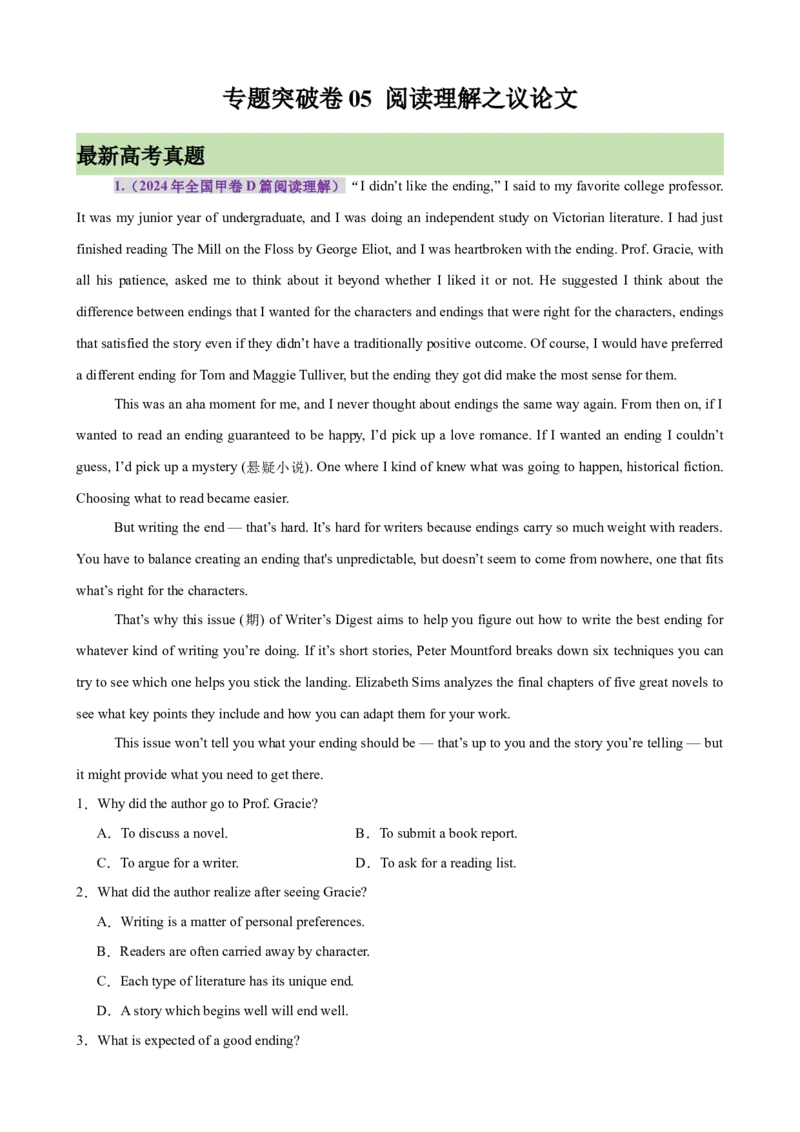
1.(2024年全国甲卷D篇阅读理解)“I didn’t like the ending,” I said to my favorite college professor.
It was my junior year of undergraduate, and I was doing an independent study on Victorian literature. I had just
finished reading The Mill on the Floss by George Eliot, and I was heartbroken with the ending. Prof. Gracie, with
all his patience, asked me to think about it beyond whether I liked it or not. He suggested I think about the
difference between endings that I wanted for the characters and endings that were right for the characters, endings
that satisfied the story even if they didn’t have a traditionally positive outcome. Of course, I would have preferred
a different ending for Tom and Maggie Tulliver, but the ending they got did make the most sense for them.
This was an aha moment for me, and I never thought about endings the same way again. From then on, if I
wanted to read an ending guaranteed to be happy, I’d pick up a love romance. If I wanted an ending I couldn’t
guess, I’d pick up a mystery (悬疑小说). One where I kind of knew what was going to happen, historical fiction.
Choosing what to read became easier.
But writing the end — that’s hard. It’s hard for writers because endings carry so much weight with readers.
You have to balance creating an ending that's unpredictable, but doesn’t seem to come from nowhere, one that fits
what’s right for the characters.
That’s why this issue (期) of Writer’s Digest aims to help you figure out how to write the best ending for
whatever kind of writing you’re doing. If it’s short stories, Peter Mountford breaks down six techniques you can
try to see which one helps you stick the landing. Elizabeth Sims analyzes the final chapters of five great novels to
see what key points they include and how you can adapt them for your work.
This issue won’t tell you what your ending should be — that’s up to you and the story you’re telling — but
it might provide what you need to get there.
1.Why did the author go to Prof. Gracie?
A.To discuss a novel. B.To submit a book report.
C.To argue for a writer. D.To ask for a reading list.
2.What did the author realize after seeing Gracie?
A.Writing is a matter of personal preferences.
B.Readers are often carried away by character.
C.Each type of literature has its unique end.
D.A story which begins well will end well.
3.What is expected of a good ending?A.It satisfies readers’ taste. B.It fits with the story development.
C.It is usually positive. D.It is open for imagination.
4.Why does the author mention Peter Mountford and Elizabeth Sims?
A.To give examples of great novelists. B.To stress the theme of this issue.
C.To encourage writing for the magazine. D.To recommend their new books.
2.(2024 年新高考 I 卷 C 篇阅读理解) Is comprehension the same whether a person reads a text
onscreen or on paper? And are listening to and viewing content as effective as reading the written word when
covering the same material? The answers to both questions are often “no”. The reasons relate to a variety of
factors, including reduced concentration, an entertainment mindset (心态) and a tendency to multitask while
consuming digital content.
When reading texts of several hundred words or more, learning is generally more successful when it’s on
paper than onscreen. A large amount of research confirms this finding. The benefits of print reading particularly
shine through when experimenters move from posing simple tasks — like identifying the main idea in a reading
passage — to ones that require mental abstraction — such as drawing inferences from a text.
The differences between print and digital reading results are partly related to paper’s physical properties.
With paper, there is a literal laying on of hands, along with the visual geography of distinct pages. People often
link their memory of what they’ve read to how far into the book it was or where it was on the page.
But equally important is the mental aspect. Reading researchers have proposed a theory called “shallowing
hypothesis (假说)”. According to this theory, people approach digital texts with a mindset suited to social media,
which are often not so serious, and devote less mental effort than when they are reading print.
Audio (音频) and video can feel more engaging than text, and so university teachers increasingly turn to
these technologies — say, assigning an online talk instead of an article by the same person. However,
psychologists have demonstrated that when adults read news stories, they remember more of the content than if
they listen to or view identical pieces.
Digital texts, audio and video all have educational roles, especially when providing resources not available
in print. However, for maximizing learning where mental focus and reflection are called for, educators shouldn’t
assume all media are the same, even when they contain identical words.
5.What does the underlined phrase “shine through” in paragraph 2 mean?
A.Seem unlikely to last. B.Seem hard to explain.
答案第2页,共2页C.Become ready to use. D.Become easy to notice.
6.What does the shallowing hypothesis assume?
A.Readers treat digital texts lightly. B.Digital texts are simpler to understand.
C.People select digital texts randomly. D.Digital texts are suitable for social media.
7.Why are audio and video increasingly used by university teachers?
A.They can hold students' attention. B.They are more convenient to prepare.
C.They help develop advanced skills. D.They are more informative than text.
8.What does the author imply in the last paragraph?
A.Students should apply multiple learning techniques.
B.Teachers should produce their own teaching material.
C.Print texts cannot be entirely replaced in education.
D.Education outside the classroom cannot be ignored.
3.(2023年全国乙卷D篇阅读理解)If you want to tell the history of the whole world, a history that does
not privilege one part of humanity, you cannot do it through texts alone, because only some of the world has ever
had texts, while most of the world, for most of the time, has not. Writing is one of humanity’s later achievements,
and until fairly recently even many literate (有文字的) societies recorded their concerns not only in writing but in
things.
Ideally a history would bring together texts and objects, and some chapters of this book are able to do just
that, but in many cases we simply can’t. The clearest example of this between literate and non-literate history is
perhaps the first conflict, at Botany Bay, between Captain Cook’s voyage and the Australian Aboriginals. From
the English side, we have scientific reports and the captain’s record of that terrible day. From the Australian side,
we have only a wooden shield (盾) dropped by a man in flight after his first experience of gunshot. If we want to
reconstruct what was actually going on that day, the shield must be questioned and interpreted as deeply and
strictly as the written reports.
In addition to the problem of miscomprehension from both sides, there are victories accidentally or
deliberately twisted, especially when only the victors know how to write. Those who are on the losing side often
have only their things to tell their stories. The Caribbean Taino, the Australian Aboriginals, the African people of
Benin and the Incas, all of whom appear in this book, can speak to us now of their past achievements most
powerfully through the objects they made: a history told through things gives them back a voice. When we
consider contact (联系) between literate and non-literate societies such as these, all our first-hand accounts are
necessarily twisted, only one half of a dialogue. If we are to find the other half of that conversation, we have toread not just the texts, but the objects.
9.What is the first paragraph mainly about?
A.How past events should be presented. B.What humanity is concerned about.
C.Whether facts speak louder than words. D.Why written language is reliable.
10.What does the author indicate by mentioning Captain Cook in paragraph 2?
A.His report was scientific. B.He represented the local people.
C.He ruled over Botany Bay. D.His record was one-sided.
11.What does the underlined word “conversation” in paragraph 3 refer to?
A.Problem. B.History. C.Voice. D.Society.
12.Which of the following books is the text most likely selected from?
A. How Maps Tell Stories of the World B. A Short History of Australia
C. A History of the World in 100 Objects D. How Art Works Tell Stories
2024 年高考模拟真题
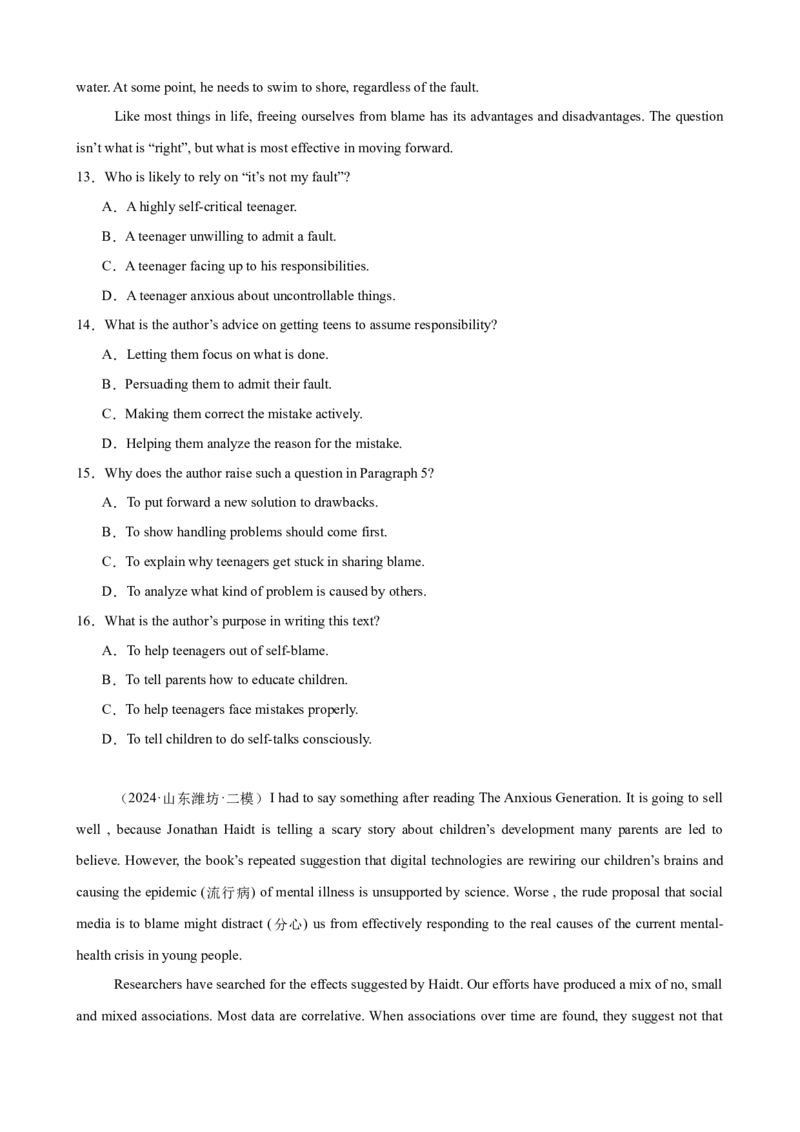
(2024·四川达州·二模)“I spilled soup all over the table, but it wasn’t my fault”. “I got into trouble at
school, but it wasn’t my fault.” Such statements are often heard. “It’s not my fault” is actually a common response
for so many people and especially teenagers. Parents complain that they’re tired of the “excuses”.
The reason why variations of “it’s not my fault” are so popular is that they get us out of guilt, blame and
anger. Those emotions may come from others’ reactions or our own self-talks. In the case of adolescents, they are
often trying to escape responsibility and punishment for mistakes.
Some teens would benefit from decreasing their self-blame. Those who blame themselves for things that
they can’t control tend to be highly self-critical and are more likely to be anxious.
Many teens overly rely on “it’s not my fault”. However, overuse of the phrase can result in feelings of
helplessness to control their own lives. Besides, “it’s not my fault” focuses a teen’s attention on what is done as
opposed to what needs to be done. In trying to get them to assume responsibility, many parents attempt to
convince their children that something is their fault, but the approach tends to be ineffective. A more effective
approach is to face up to drawbacks to find solutions to the drawbacks actively.
People may not have caused all their problems, but they have to solve them anyway. Getting stuck in
sharing blame often keeps people from moving forward effectively. What does one do if he is pushed into a deep
lake? One could certainly stay in water, yelling, “It’s not my fault.” However, that is not going to get him out of
答案第4页,共2页water. At some point, he needs to swim to shore, regardless of the fault.
Like most things in life, freeing ourselves from blame has its advantages and disadvantages. The question
isn’t what is “right”, but what is most effective in moving forward.
13.Who is likely to rely on “it’s not my fault”?
A.A highly self-critical teenager.
B.A teenager unwilling to admit a fault.
C.A teenager facing up to his responsibilities.
D.A teenager anxious about uncontrollable things.
14.What is the author’s advice on getting teens to assume responsibility?
A.Letting them focus on what is done.
B.Persuading them to admit their fault.
C.Making them correct the mistake actively.
D.Helping them analyze the reason for the mistake.
15.Why does the author raise such a question in Paragraph 5?
A.To put forward a new solution to drawbacks.
B.To show handling problems should come first.
C.To explain why teenagers get stuck in sharing blame.
D.To analyze what kind of problem is caused by others.
16.What is the author’s purpose in writing this text?
A.To help teenagers out of self-blame.
B.To tell parents how to educate children.
C.To help teenagers face mistakes properly.
D.To tell children to do self-talks consciously.
(2024·山东潍坊·二模)I had to say something after reading The Anxious Generation. It is going to sell
well , because Jonathan Haidt is telling a scary story about children’s development many parents are led to
believe. However, the book’s repeated suggestion that digital technologies are rewiring our children’s brains and
causing the epidemic (流行病) of mental illness is unsupported by science. Worse , the rude proposal that social
media is to blame might distract (分心) us from effectively responding to the real causes of the current mental-
health crisis in young people.
Researchers have searched for the effects suggested by Haidt. Our efforts have produced a mix of no, small
and mixed associations. Most data are correlative. When associations over time are found, they suggest not thatsocial-media use predicts or causes depression, but that young people who already have mental-health problems
use such platforms more often or in different ways from their healthy peers.
We are not alone here. Several analyses and systematic reviews centralize on the same message. An
analysis done in 72 countries shows no consistent or measurable associations between well-being and social
media globally. Moreover, studies from some authorities finds no evidence of intense changes associated with
digital-technology use.
As a psychologist studying children’s and adolescents’ mental health, I appreciate parents’ frustration (沮
丧) and desire for simple answers. As a parent of adolescents, I would also like to identify a simple source for the
pain this generation is reporting. There are, however, no simple answers. The beginning and development of
mental disorders are driven by a complex set of genetic and environmental factors.
More young people are talking openly about their mental-health struggles than ever before. But insufficient
services are available to address their needs. In the United States, there is, on average, one school psychologist for
every 1,119 students. We have a generation in crisis and in desperate need of the best of what science and
evidence-based solutions can offer. Unfortunately, our time is being spent telling stories that are unsupported by
research and that do little to support young people who need, and deserve, more.
17.What is presented in The Anxious Generation?
A.Scary stories affect children’s brains.
B.Parents are responsible for children’s health.
C.Teen’s mental illness results from screen time.
D.The epidemic of mental illness is unavoidable.
18.What does “the same message ” underlined in paragraph 3 refer to?
A.Many countries do research in mental health.
B.Well-being and social media are closely related.
C.The young are trapped in the mental-health crisis,
D.Social media don’t necessarily cause mental illness.
19.What is implied in the last paragraph?
A.Effective actions need to be taken. B.Positive stories should be shared.
C.Financial support needs to be provided. D.Broader research should be done.
20.What is the author’s purpose in writing the text?
A.To suggest ways to help those in need.
答案第6页,共2页B.To encourage parents to brave the crisis.
C.To recommend a newly-published book.
D.To give a voice to children’s mental issues.
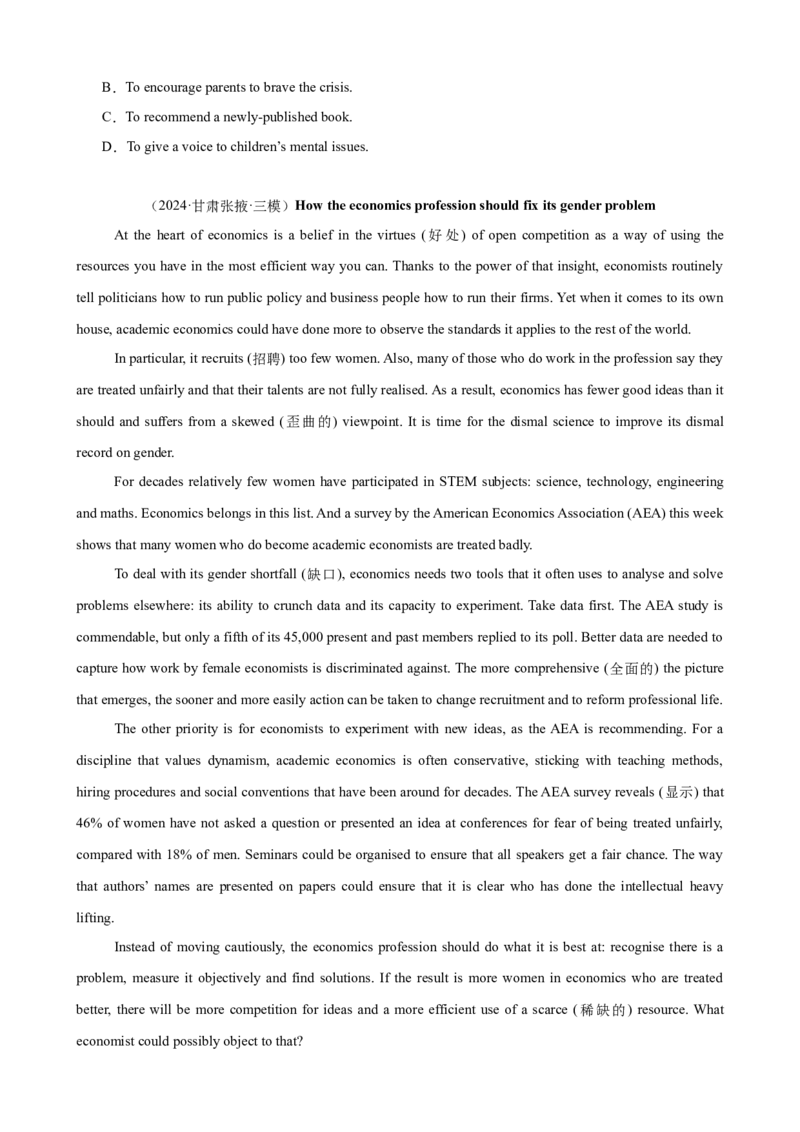
(2024·甘肃张掖·三模)How the economics profession should fix its gender problem
At the heart of economics is a belief in the virtues (好处) of open competition as a way of using the
resources you have in the most efficient way you can. Thanks to the power of that insight, economists routinely
tell politicians how to run public policy and business people how to run their firms. Yet when it comes to its own
house, academic economics could have done more to observe the standards it applies to the rest of the world.
In particular, it recruits (招聘) too few women. Also, many of those who do work in the profession say they
are treated unfairly and that their talents are not fully realised. As a result, economics has fewer good ideas than it
should and suffers from a skewed (歪曲的) viewpoint. It is time for the dismal science to improve its dismal
record on gender.
For decades relatively few women have participated in STEM subjects: science, technology, engineering
and maths. Economics belongs in this list. And a survey by the American Economics Association (AEA) this week
shows that many women who do become academic economists are treated badly.
To deal with its gender shortfall (缺口), economics needs two tools that it often uses to analyse and solve
problems elsewhere: its ability to crunch data and its capacity to experiment. Take data first. The AEA study is
commendable, but only a fifth of its 45,000 present and past members replied to its poll. Better data are needed to
capture how work by female economists is discriminated against. The more comprehensive (全面的) the picture
that emerges, the sooner and more easily action can be taken to change recruitment and to reform professional life.
The other priority is for economists to experiment with new ideas, as the AEA is recommending. For a
discipline that values dynamism, academic economics is often conservative, sticking with teaching methods,
hiring procedures and social conventions that have been around for decades. The AEA survey reveals (显示) that
46% of women have not asked a question or presented an idea at conferences for fear of being treated unfairly,
compared with 18% of men. Seminars could be organised to ensure that all speakers get a fair chance. The way
that authors’ names are presented on papers could ensure that it is clear who has done the intellectual heavy
lifting.
Instead of moving cautiously, the economics profession should do what it is best at: recognise there is a
problem, measure it objectively and find solutions. If the result is more women in economics who are treated
better, there will be more competition for ideas and a more efficient use of a scarce (稀缺的) resource. What
economist could possibly object to that?21.Why does economics have fewer excellent ideas than it should?
A.Economical environment isn’t good enough.
B.Professionals in this field are treated unjustly and their gifts are not fully recognized.
C.Too many women are employed.
D.Women do worse in economics than men.
22.What does economics need to handle its gender gap?
A.Data to capture how work by female economists is discriminated against.
B.Its ability to process data quickly and its capacity to experiment.
C.Action to change recruitment and professional life of female economists.
D.Seminars organised to ensure that all speakers get a fair chance.
23.What can we know from the last paragraph?
A.The result of the AEA survey is that there is better treatment to women.
B.More women in economics will bring more competition of scarce resource.
C.A balanced sex ratio will do good to the development of economics.
D.Men in economics can’t make this discipline better.
24.What can we infer about the author’s attitude towards the economics and its recruitment now?
A.Opposed. B.Positive. C.Objective. D.Indifferent.
(2024·广东广州·三模)“Sating from now on, to be healthy, I will NOT eat any snacks besides granola
bars (燕麦棒),” is what I told myself yesterday, and yet here I am today chewing a Chocopie. I’m aware that I’m
breaking my own promise to myself. Instead of eating this, I should be working out or something. But the thing is,
chocolate is too good at this moment for me to refuse it!
As I type this, I’m experiencing what’s called instant gratification — the desire to experience pleasure or
fulfillment without delaying it for a future benefit. Essentially, when you want it, you get it.
Instant gratification is also the exact opposite of what we’re taught to do-delayed gratification: deciding to
put off satisfying our current want to gain something better in the future. We’ve all encountered instant
gratification before. Should I sleep in or wake up early to work out? When I get home, should I rest and watch TV
first or get started on my homework?
All humans have the tendency to seek pleasure and avoid pain, which is a basic but fundamental concept
known as the pleasure principle. Originally coined by Sigmund Freud, it clearly states that all humans are driven,
答案第8页,共2页to some extent, by pleasure.
Constantly seeking quick pleasure may bring subsequent troubles. However pleasant not doing your
homework may seem pleasant right now, it only results in pleasure plagued by guilt and last-minute panicking
late at night. An inability to resist instant gratification may result in underachieving in the long term and failure to
meet certain goals.
Instant gratification, however, is not necessarily a bad thing. You don’t always have to say no to things you
want at that moment, and it’s good to treat yourself when you need it. In other words, times where you “treat
yourself” are only valuable in combination with delayed gratification. While my Chocopie may taste good now,
it’ll taste even better if I only eat it after I’ve worked out or done something healthy.
25.How does the author introduce the topic?
A.By making a contrast. B.By giving a definition.
C.By citing a personal case. D.By listing detailed problems.
26.Which of the following is an example of instant gratification?
A.Purchasing items regardless of budgets. B.Exercising regularly for long-term health.
C.Limiting time on social media platforms.D.Finishing homework before watching TV.
27.What does the underlined word “plagued” in paragraph 5 probably mean?
A.Reminded. B.Highlighted. C.Introduced. D.Bothered.
28.What may the author agree with?
A.Delayed gratification is pointless.
B.Instant gratification should be prioritized.
C.Enjoying the moment brings in endless pleasure.
D.Instant treats paired with delayed gratification are sweeter.
(2024·河北秦皇岛·三模)The recent spread of “fake news” may make it seem like misinformation is a
relatively modern invention. But falsehoods (假话) and wild claims have been part of human culture for about as
long as it’s existed. This is because misinformation originates with, and is spread by, fellow humans.
When you’ve ever had to communicate an important, but complex, issue to a general audience, you may
have a sea of the most reliable data, the most elegant PowerPoint slides and the full backing of every famous
expert in the relevant field. And yet, you can still be less persuasive than someone whose entire argument is: “A
guy I met down the pub told me something different.”
In a perfectly sensible, logical world, someone who is loosely connected with a certain field or industry
wouldn’t have the same influence as actual data, or the leading experts in the field. But humans aren’t perfectlysensible, logical creatures and neither is the world we live in.
The ability to think rationally and analytically is a relatively recent addition to our mental abilities (in the
evolutionary sense). And it costs our brains a lot of energy and effort, The more established, fundamental systems
in our brain, which shape memory and learning, are heavily reliant on emotion. The more emotionally stimulating
something is, the easier it is to remember. That’s why we can spend months revising the material for a crucial
school exam, but struggle to remember any of it once we’ve passed. Meanwhile, the embarrassing tine we slipped
and landed on our backside in the school canteen. that memory will last until our dying day.
The most determined sceptics (无神论者) will often say, “Facts don’t care about your feelings,” which is
correct. But feelings don’t necessarily care about facts either. And ultimately, feelings have more of a say in what
we think and do. And that’s why your mate down the pub can seem more believable than a pile of published
research.
29.What contributes to the spread of “fake news”?
A.People factor. B.Human culture.
C.Modern invention. D.Information accuracy.
30.Why did the general audiences think actual data less persuasive?
A.They prefer making sensible analyses. B.They ae more likely to be emotional.
C.They have more trust in authority. D.They overestimate themselves.
31.How does the author illustrate his idea in paragraph 4?
A.By listing figures. B.By giving examples.
C.By explaining a concept. D.By citing experts’ words.
32.What is the author’s purpose of writing the passage?
A.To reveal secrets. B.To share emotions.
C.To criticize a decision. D.To describe a phenomenon.
(2024·浙江杭州·二模)Is forgiveness against our human nature? To answer our question, we need to ask
a further question: What is the essence of our humanity? For the sake of simplicity, people consider two distinctly
different views of humanity.
The first view involves dominance and power. In an early paper on the psychology of forgiveness, Droll
(1984) made the interesting claim that humans’ essential nature is more aggressive than forgiving allows. Those
who forgive are against their basic nature, much to their harm. In his opinion, forgivers are compromising their
答案第10页,共2页well-being as they offer mercy to others, who might then take advantage of them.
The second view involves the theme of cooperation, mutual respect, and even love as the basis of who we
are as humans. Researchers find that to fully grow as human beings, we need both to receive love from and offer
love to others. Without love, our connections with a wide range of individuals in our lives can fall apart. Even
common sense strongly suggests that the will to power over others does not make for harmonious interactions. For
example, how well has slavery worked as a mode of social harmony?
From this second viewpoint of who we are as humans, forgiveness plays a key role in the biological and
psychological integrity of both individuals and communities because one of the outcomes of forgiveness, shown
through scientific studies, is the decreasing of hate and the restoration of harmony. Forgiveness can break the
cycle of anger. At least to the extent the people from whom you are estranged (不和的) accept your love and
forgiveness and are prepared to make the required adjustments. Forgiveness can heal relationships and reconnect
people.
As an important note, when we take a classical philosophical perspective, we see the distinction between
potentiality and actuality. We are not necessarily born with the capacity to forgive, but instead with the potential to
learn about it and to grow in our ability to forgive. The actuality of forgiving, in real situations, develops with
practice.
33.What is Droll’s idea about forgiveness?
A.People should offer mercy to others.
B.Aggressive people should learn to forgive.
C.Forgiveness depends on the nature of humanity.
D.People who forgive can have their own welfare affected.
34.What does the example in Paragraph 3 illustrate?
A.To fight is to grow. B.To give is to receive.
C.To forgive is to abuse. D.To dominate is to harm.
35.What is the writer’s attitude toward forgiveness?
A.Favorable. B.Reserved. C.Objective. D.Skeptical.
36.What message does the last paragraph convey?
A.Forgiveness is in our nature. B.Forgiveness grows with time.
C.It takes practice to forgive. D.Actuality is based on potentiality.
(2024·陕西榆林·三模)People have speculated (思索) for centuries about a future without work. Some
imagine that the coming work-free world will be defined by inequality: A few wealthy people will own all thewealth, and the masses will struggle in a wasteland. A different prediction holds that without jobs to give their
lives meaning, future people will simply become lazy and depressed.
But it doesn’t necessarily follow from these findings that a world without work would be filled with
dissatisfaction. Such visions are based on the downsides of being unemployed in a society built on the concept of
employment. In the absence of work, a society designed with other ends in mind could provide strikingly different
circumstances for the future of labor and leisure.
These days, spare time is relatively rare for most workers. “When I come home from a hard day’s work, I
often feel tired,” says John Danaher, a lecturer at the National University of Ireland, adding, “In a world in which I
don’t have to work, I might feel rather different—perhaps different enough to throw myself into a hobby with the
enthusiasm usually reserved for professional matters.”
Daniel Everett, an anthropologist (人类学家) at Bentley University studied a group of hunter-gatherers in
the Amazon called the Piraha for years. According to Everett, while some might consider hunting and gathering as
work, hunter-gatherers don’t. “They think of it as fun,” he says. “They don’t have a concept of work the way we
do.”
Everett described a typical day for the Piraha: A man might get up, spend a few hours fishing, have a
barbecue, and play until the evening. Does this relaxing life lead to the depression and purposelessness seen
among so many of today’s unemployed? “I’ve never seen anything like depression there, except people who are
physically ill,” Everett says. While many may consider work necessary for human life, work as it exists today is a
relatively new invention in the course of human culture. “We don’t think it’s desirable to just sit around with
nothing to do,” says Everett. “For the Piraha, it’s quite a pleasant state.”
37.What does the author think of a redesigned work-free society?
A.It may offer distinct leisure and labor situations.
B.It may widen the gap between rich and poor.
C.It will certainly lead to social dissatisfaction.
D.It will allow laborers enough leisure time.
38.Why are the hunter-gatherers mentioned in paragraph 4?
A.To inspire us to learn from them.
B.To show a work-free life in the future.
C.To justify the previous views on work.
D.To show a different viewpoint on work.
答案第12页,共2页39.What’s the author’s attitude towards the coming work-free world?
A.Objective. B.Optimistic. C.Negative. D.Concerned.
40.What can we conclude from the text?
A.Daniel Everett prefers to sit around doing nothing.
B.The work-free life makes the Piraha purposeless.
C.Physical sickness is seldom seen among the Piraha.
D.A work-free life may contribute to depression.
(2024·江西·三模)If you’re a white-collar worker working at an office, it’s unlikely that anyone can
guess exactly what you do from your clothes. That’s not true for lots of the people you interact with. The bus
driver who gets you to your destination, and the people on reception as you enter the building — they’re likely to
be wearing some kind of corporate uniform. A poll of American workers conducted last summer by Gallup found
that although most employees wear casual clothes, almost a quarter wear a uniform.
Some employers require uniforms, since they help ensure a level of professionalism in appearance, project
a brand identity with useful job-specific features, and send a clear signal to customers about whom they should
approach with questions.
Those customers draw different conclusions if staff are in uniform. A study by Robert Smith of Tilburg
University and his colleagues asked people to imagine being on the receiving end of poor service when picking up
a pizza. They were then shown pictures of uniformed or non-uniformed employees. Participants were more likely
to blame the company than the individual for a bad experience when a uniform was involved. If corporate clothing
makes each worker seem more representative of their employers, the authors suggest that it may be a good idea
not to give it to inexperienced workers.
Uniforms can also affect the psychology of employees. In 2012, Hajo Adam and Adam Galinsky coined the
term “unclothed cognition” to describe the effect that specific clothes have on the way people think and feel. In
one study, Emilie Caspar of Ghent University gave participants the option to apply minor electric shocks to other
people in return for money; those dressed in Red Cross uniforms showed more empathy than those in normal
outfits.
The effects uniforms have on workers will obviously vary. The obvious objection to uniforms is that they
lack individuality. But employees who don’t have to wear a formal uniform tend to have their own pattern of
dressing, thus forming another informal uniform.
41.What do we know about white-collar office workers?
A.They must follow strict rules about uniforms.B.Their way of dressing reveals their job duties.
C.Their clothes may not be relevant to their work.
D.They wear uniforms to inspire customers’ interest.
42.What did the participants do in the study in Para. 3?
A.They imagined being served in a shop.
B.They dressed up in employees’ uniform.
C.They were asked to work in a pizza shop.
D.They ordered pizza from uniformed employees.
43.Why are workplace uniforms disliked by some people?
A.They block customers’ en-clothed cognition.
B.They re an expression of being inexperienced.
C.They are inferior to their own pattern of dressing.
D.They lack an express on of wearers’ individuality.
44.Where is the text most probably taken from?
A.An essay on fashion trend.
B.A review of workplace culture
C.A guidebook about making clothes.
D.An introduction about social customs.
(2024·湖北襄阳·三模)Studies have shown the mere exposure effect, also referred to as the familiarity
principle: inspires our decisions. It is a helpful psychological mechanism that helps us sustain our energy and
focus our attention on other things. Getting used to new things takes effort and it can be exhausting. So unless we
have a terrible experience, we are likely to buy from companies we’ve got used to. That is why companies spend
so much money on advertising and marketing and why insurance companies openly charge existing customers
more than new ones.
It’s not the case that we only desire things we already know. Some studies suggest when invited to share
our preferences, we sometimes see less familiar options as more desirable. But when acting on that preference, we
fall back to what we know. This might explain why sometimes the things we want and the things we do don’t
quite batch on. We might even return to companies that treated us poorly in the past or stay in bad relationships.
It’s easy to paint the familiarity principle as an enemy or something to battle as if it is something that holds
答案第14页,共2页us back from living our dreams. But this attitude might be overwhelming because it tends to encourage us toward
big-picture thinking, where we imagine that change requires a substantial dramatic swing that we don’t feel ready
for. Some articles suggest the solution to familiarity frustration is complete exposure to novelty. While this can
appear effective in the short run, we may only end up replacing one problem with another. It also risks overwhelm
and burnout.
So what if we can work with the familiarity principle instead? Familiarity is something we can learn to play
with and enjoy. It is a setting for creativity and a pathway to expansion. We can push back the zone of familiarity
bit by bit. If we think of familiarity as something that can expand, we can consider changing the conditions in and
around our lives to make more space for our preferences to take root and grow gently. From here, we will start to
make decisions, drawing from an ever-deepening pool at valuable options.
45.What allows insurance companies to charge old customers more?
A.The improved service. B.The advertising cost.
C.The familiarity principle. D.The law of the market.
46.What can be learned from paragraph 2?
A.Our preferences affect our decisions.
B.Familiarity tends to generate disrespect.
C.The familiarity principle is a double-edged sword.
D.There can be an inconsistency between desires and actions
47.What is the author’s attitude towards the solution in some arises?
A.Disapproving. B.Tolerant. C.Objective. D.Reserved.
48.How should we perceive familiarity principle according to the passage?
A.To treat it as an enemy.
B.To give top priority to it.
C.To replace it with exposure to novelty.
D.To gently use it to broaden familiarity zone.