专题06 议论文-十年(2015-2024)高考真题英语试题研究
专题 06 阅读理解(议论文阅读理解研究)
目录
01 命题分析-------------------------------------------------------------------------------------2页
02 题型解读-------------------------------------------------------------------------------------2页
03应试技巧-------------------------------------------------------------------------------------3页
04 真题回顾(10年高考议论文真题训练)--------------------------------------------3页
专题 06 阅读理解(议论文阅读研究)
01命题分析
议论文是英语中的重要文体,在阅读理解中占有一定的比例。相对于其它文体,议论文阅读要难一些,因此
要多加重视。议论文就是说理性的文章,一般由论点、论据和论证过程组成。议论文都要提出论题、观点、提供充分的证
据,使用一定的逻辑方法证明观点或得出结论。
英语文章讲究使用主题段或主题句。主题段通常在文章开头,简要概括文章的中心思想,主题句可能在一段
的开头交待该段的中心意思,再由全段展开或讨论这个意思。主题句也可能在中间或末尾,由全段展开讨论后归
纳总结出来。段与段之间常用词语连接,承上启下,使文章行文连贯,为了深化主题,作者可能用许多方法来写。
02题型解读
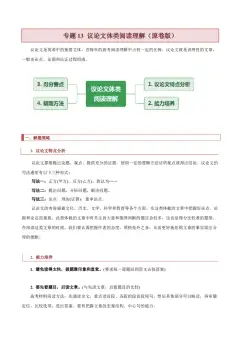
想读懂议论文、理解作者的写作意图,关键在于是否能够把握议论文的三要素。首先,论点是作者对所论
述事件的基本看法和立场,找准论点有助于把握文章的整体方向和理解文章主题的深层内涵;理清论据材料的内
容能够帮助读者更深层次地理解论点的含义;论据是作者组织、运用论据的手法。论证方法多种多样,常见的有:
▲归纳法,即从分析个别事例入手,找出事物的共同特点,从而得出结论。
▲演绎法,即从一般原理出发,对个别事物进行说明、分析后得出结论。
▲比较对照法,即对所有事实、方面进行对照,找出异同之处,然后加以分析,得出结论。
▲驳论法,即先列出错误的观点,然后加以逐条批驳,反证自己观点的正确性。
英语议论文在表达上多使用有辩论、推理等含义的连接词和过渡词等的结构,如 since, now that(既然),
therefore(因而),consequently(因此),accordingly(因此),hence(因而),in that case(在那种情况下)。还有些常用句型
比如 It follows that…(因而……),If…,we may conclude that…(如果……,我们可以这样下结论……),It is true
that…,but…(诚然……,但是……),Even if…(即使……)等。同学们在阅读的时候可以通过寻找关键词语表达来
快速搜索需要的信息。
议论文,有论点,有事实。作者往往根据一些很普通的事实,通过严谨的思维,缜密的推理得出一个具有普
遍性或指导性的观点。该类文章逻辑性强,命题往往从事实的有关细节以及文章的主旨或作者想表达的意图等方
面着手,考查思维能力和判定能力。
①主旨大意题
这种题型考查对议论文基本观点的理解,是主旨题设题的目的。做这种类型的题目要弄清作者想说什么,即作者
写此文章的目的。
②推理判断题
这种题型的特点是以事实为依据,但其结果又绝不是事实本身。它主要测试逻辑思维能力,侧重于推理。
③细节理解题
这种题型也是议论文试题的主要题型,要求考生理解文中的具体观点和具体事实。
03应试技巧
①抓论点、找论据。
阅读议论文我们要抓住论题,即作者提出的观点、给出的例证及最后得出的结论。抓住了论题,我们就把握
了中心。
②注重文章结构,理清文章脉络。
把握文章结构,有利于对文章大意的理解。从论证方法上讲,常见的议论文结构有以下两类:
(1)Put forward a question→Analyze the question→Solve the question 这就是“提出问题、分析问题、解决问题”
的过程。
(2) Argument/ Idea→Evidence→Conclusion/ Restating the idea 这就是“由论点到论据到结论或者强调论点”的
过程。
③体会文章语言特点,把握作者写作态度,准确进行推理判断。能否正确把握作者的观点和态度是体现阅读能力的重要方面。一般来说,对作者的总的态度和倾向,必须在
通读全文,掌握了论点和论据后,方能做出判断。在判断作者观点态度时,我们应注意,有时候作者的观点和态
度并不是明确地表达出来的,需要我们认真体察。做推理判断时,一定要遵循逻辑规律,以事实为依据进行合理
的推理。
04 真题回顾(10年高考议论文真题训练) )
2.(2024新高考Ⅰ卷)C
Is comprehension the same whether a person reads a text onscreen or on paper? And are listening to and viewing
content as effective as reading the written word when covering the same material? The answers to both questions are often
“no.” The reasons relate to a variety of factors, including reduced concentration, an entertainment mindset (心态) and a
tendency to multitask while consuming digital content.
When reading texts of several hundred words or more, learning is generally more successful when it’s on paper than
onscreen. A large amount of research confirms this finding. The benefits of print reading particularly shine through when
experimenters move from posing simple tasks – like identifying the main idea in a reading passage – to ones that require
mental abstraction – such as drawing inferences from a text.
The differences between print and digital reading results are partly related to paper’s physical properties. With paper,
there is a literal laying on of hands, along with the visual geography of distinct pages. People often link their memory of
what they’ve read to how far into the book it was or where it was on the page.
But equally important is the mental aspect. Reading researchers have proposed a theory called “shallowing hypothesis
(假说).” According to this theory, people approach digital texts with a mindset suited to social media, which are often not so
serious, and devote less mental effort than when they are reading print.
Audio (音频) and video can feel more engaging than text, and so university teachers increasingly turn to these
technologies – say, assigning an online talk instead of an article by the same person. However, psychologists have
demonstrated that when adults read news stories, they remember more of the content than if they listen to or view identical
pieces.
Digital texts, audio and video all have educational roles, especially when providing resources not available in print.
However, for maximizing learning where mental focus and reflection are called for, educators shouldn’t assume all media
are the same, even when they contain identical words.
28. What does the underlined phrase “shine through” in paragraph 2 mean?
A. Seem unlikely to last. B. Seem hard to explain.
C. Become ready to use. D. Become easy to notice.
29. What does the shallowing hypothesis assume?
A. Readers treat digital texts lightly.
B. Digital texts are simpler to understand.
C. People select digital texts randomly.
D. Digital texts are suitable for social media.
30. Why are audio and video increasingly used by university teachers?
A. They can hold students’ attention.
B. They are more convenient to prepare.
C. They help develop advanced skills.
D. They are more informative than text.
31. What does the author imply in the last paragraph?A. Students should apply multiple learning techniques.
B. Teachers should produce their own teaching material.
C. Print texts cannot be entirely replaced in education.
D. Education outside the classroom cannot be ignored.
2.(2024·全国甲卷)D
"I didn't like the ending," I said to my favorite college professor. It was my junior year of undergraduate, and I was
doing an independent study on Victorian literature. I had just finished reading The Mill on the Floss by George Eliot, and I
was heartbroken with the ending. Prof. Gracie, with all his patience, asked me to think about it beyond whether I liked it
or not. He suggested I think about the difference between endings that I wanted for the characters and endings that were
right for the characters, endings that satisfied the story even if they didn't have a traditionally positive outcome. Of course,
I would have preferred a different ending for Tom and Maggie Tulliver, but the ending they got did make the most sense for
them.
This was an aha moment for me, and I never thought about endings the same way again. From then on, if I wanted to
read an ending guaranteed to be happy, I'd pick up a love romance. If I wanted an ending I couldn't guess, I'd pick up a
mystery(悬疑小说). One where I kind of knew what was going to happen, historical fiction. Choosing what to read
became easier.
But writing the end—that's hard. It's hard for writers because endings carry so much weight with readers. You have to
balance creating an ending that's unpredictable, but doesn't seem to come from nowhere, one that fits what's right for the
characters.
That's why this issue(期)of Writer's Digest aims to help you figure out how to write the best ending for whatever
kind of writing you're doing. If it's short stories, Peter Mountford breaks down six techniques you can try to see which one
helps you stick the landing. Elizabeth Sims analyzes the final chapters of five great novels to see what key points they
include and how you can adapt them for your work.
This issue won't tell you what your ending should be—that's up to you and the story you're telling—bu it might
provide what you need to get there.
32. Why did the author go to Prof. Gracie?
A. To discuss a novel. B. To submit a book report.
C. To argue for a writer. D. To ask for a reading list.
33. What did the author realize after seeing Gracie?
A. Writing is a matter of personal preferences
B. Readers are often carried away by character
C. Each type of literature has its unique ending
D. A story which begins well will end well
34. What is expected of a good ending?
A. It satisfies readers' taste. B. It fits with the story development.
C. It is usually positive. D. It is open for imagination.
35. Why does the author mention Peter Mountford and Elizabeth Sims?
A. To give examples of great novelists. B. To stress the theme of this issue.
C. To encourage writing for the magazine. D. To recommend their new books.
3.2021年全国甲卷之D篇Who is a genius? This question has greatly interested humankind for centuries.
Let's state clearly: Einstein was a genius. His face is almost the international symbol for genius. But we want to go
beyond one man and explore the nature of genius itself. Why is it that some people are so much more intelligent or creative
than the rest of us? And who are they?
In the sciences and arts, those praised as geniuses were most often white men, of European origin. Perhaps this is not a
surprise. It's said that history is written by the victors, and those victors set the standards for admission to the genius club.
When contributions were made by geniuses outside the club—women, or people of a different color or belief—they were
unacknowledged and rejected by others.
A study recently published by Science found that as young as age six, girls are less likely than boys to say that
members of their gender(性别)are “really, really smart.” Even worse, the study found that girls act on that belief: Around
age six they start to avoid activities said to be for children who are “really, really smart.” Can our planet afford to have any
great thinkers become discouraged and give up? It doesn't take a genius to know the answer: absolutely not.
Here's the good news. In a wired world with constant global communication, we're all positioned to see flashes of
genius wherever they appear. And the more we look, the more we will see that social factors(因素)like gender, race, and
class do not determine the appearance of genius. As a writer says, future geniuses come from those with “intelligence,
creativity, perseverance(毅力), and simple good fortune, who are able to change the world.”
12. What does the author think of victors' standards for joining the genius club?
A. They're unfair. B. They're conservative.
C. They're objective. D. They're strict.
13. What can we infer about girls from the study in Science?
A. They think themselves smart.
B. They look up to great thinkers.
C. They see gender differences earlier than boys.
D. They are likely to be influenced by social beliefs
14. Why are more geniuses known to the public?
A. Improved global communication.
B. Less discrimination against women.
C. Acceptance of victors' concepts.
D. Changes in people's social positions.
15. What is the best title for the text?
A. Geniuses Think Alike B. Genius Takes Many Forms
C. Genius and Intelligence D. Genius and Luck
4.2021年3月天津卷之D篇
There is something to be said for being a generalist, even if you are a specialist. Knowing a little about a lot of things
that interest you can add to the richness of a whole, well-lived life.
Society pushes us to specialize, to become experts. This requires commitment to a particular occupation, branch of
study or research. The drawback to being specialists is we often come to know more and more about less and less. There is a
great deal of pressure to master one's field. You may pursue training, degrees, or increasing levels of responsibility at work.
Then you discover the pressure of having to keep up.
Some people seem willing to work around the clock in their narrow specialty. But such commitment can also weaken a
sense of freedom. These specialists could work at the office until ten each night, then look back and realize they would have
loved to have gone home and enjoyed the sweetness of their family and friends, or traveled to exciting places, meetinginteresting people. Mastering one thing to the exclusion (排 除)of others can hold back your true spirit.
Generalists, on the other hand, know a lot about a wide range of subjects and view the whole with all its connections.
They are people of ability, talent, and enthusiasm who can bring their broad perspective (视角)into specific fields of
expertise (专长).The doctor who is also a poet and philosopher is a superior doctor, one who can give so much more to
his patients than just good medical skills.
Things are connected. Let your expertise in one field fuel your passions in all related areas. Some of your interests may
not appear to be connected but, once you explore their depths, you discover that they are. My editor Toni, who is also a
writer, has edited several history books. She has decided to study Chinese history. Fascinated by the structural beauty of the
Forbidden City as a painter, she is equally interested to learn more about Chinese philosophy. "I don't know where it will
lead, but I'm excited I'm on this pursuit."
These expansions into new worlds help us by giving us new perspectives. We begin to see the interconnectedness of
one thing to another in all aspects of our life, of ourselves and the universe. Develop broad, general knowledge and
experience. The universe is all yours to explore and enjoy.
51. To become a specialist, one may have to_____.
A. narrow his range of knowledge
B. avoid responsibilities at work
C. know more about the society
D. broaden his perspective on life
52. The specialists mentioned in Paragraph 3 tend to______.
A. treasure their freedom
B. travel around the world
C. spend most time working
D. enjoy meeting funny people
53. According to the author, a superior doctor is one who_____.
A. is fully aware of his talent and ability
B. is a pure specialist in medicine
C. should love poetry and philosophy
D. brings knowledge of other fields to work
54. What does the author intend to show with the example of Toni?
A. Passion alone does not ensure a person's success.
B. In-depth exploration makes discoveries possible.
C. Everyone has a chance to succeed in their pursuit.
D. Seemingly unrelated interests are in a way connected.
55. What could be the best title for the passage?
A. Be More a Generalist Than a Specialist
B. Specialist or Generalist: Hard to Decide
C. Turn a Generalist into a Specialist
D. Ways to Become a Generalist
5.2020年天津卷之D篇
After years of observing human nature, I have decided that two qualities make the difference between men of great
achievement and men of average performance curiosity and discontent. I have never known an outstanding man who lacked
either. And I have never known an average man who had both. The two belong together.Together, these deep human urges (驱策力) count for much more that ambition. Galileo was not merely ambitious
when he dropped objects of varying weights from the Leaning Tower at Pisa and timed their fall to the ground. Like Galileo,
all the great names in history were curious and asked in discontent, “Why? Why? Why?”
Fortunately, curiosity and discontent don’t have to be learned. We are born with them and need only recapture them.
“The great man,” said Mencius (孟子), “is he who does not lose his child’s heart.” Yet most of us do lose it. We stop
asking questions. We stop challenging custom. We just follow the crowd. And the crowd desires restful average. It
encourages us to occupy our own little corner, to avoid foolish leaps into the dark, to be satisfied.
Most of us meet new people, and new ideas, with hesitation. But once having met and liked them, we think how
terrible it would have been, had we missed the chance. We will probably have to force ourselves to waken our curiosity and
discontent and keep them awake.
How should you start? Modestly, so as not to become discouraged. I think of one friend who couldn’t arrange flowers
to satisfy herself. She was curious about how the experts did it. How she is one of the experts, writing books on flower
arrangement.
One way to begin is to answer your own excuses. You haven’t any special ability? Most people don’t; there are only a
few geniuses. You haven’t any time? That’s good, because it’s always the people with no time who get things done. Harriet
Stowe, mother of six, wrote parts of Uncle Tom’s Cabin while cooking. You’re too old? Remember that Thomas Costain
was 57 when he published his first novel, and that Grandma Moses showed her first pictures when she was 78.
However you start, remember there is no better time to start than right now, for you’ll never be more alive than you are
at this moment.
51. In writing Paragraph 1, the author aims to ________.
A. propose a definition
B. make a comparison
C. reach a conclusion
D. present an argument
52. What does the example of Galileo tell us?
A. Trial and error leads to the finding of truth.
B. Scientists tend to be curious and ambitious.
C. Creativity results from challenging authority.
D. Greatness comes from a lasting desire to explore.
53. What can you do to recapture curiosity and discontent?
A. Observe the unknown around you.
B. Develop a questioning mind.
C. Lead a life of adventure.
D. Follow the fashion.
54. What can we learn from Paragraphs 6 and 7?
A. Gaining success helps you become an expert.
B. The genius tends to get things done creatively.
C. Lack of talent and time is no reason for taking no action.
D. You should remain modest when approaching perfection.
55. What could be the best tile or the passage?
A. Curious Minds Never Feel Contented
B. Reflections on Human NatureC. The Keys to Achievement
D. Never Too Late to Learn
6.2019年全国卷III之B篇
For Western designers, China and its rich culture have long been an inspiration for Western creative.
"It's no secret that China has always been a source(来源)of inspiration for designers," says Amanda Hill, chief creative
officer at A+E Networks, a global media company and home to some of the biggest fashion(时尚)shows.
Earlier this year, the China Through A Looking Glass exhibition in New York exhibited 140 pieces of China-inspired
fashionable clothing alongside Chinese works of art, with the aim of exploring the influence of Chinese aesthetics(美学)on
Western fashion and how China has fueled the fashionable imagination for centuries. The exhibition had record attendance,
showing that there is huge interest in Chinese influences.
"China is impossible to overlook," says Hill. "Chinese models are the faces of beauty and fashion campaigns that sell
dreams to women all over the world, which means Chinese women are not just consumers of fashion — they are central to
its movement. "Of course, only are today's top Western designers being influenced by China-some of the best designers of
contemporary fashion are themselves Chinese." Vera Wang, Alexander Wang, Jason Wu are taking on Galiano, Albaz, Marc
Jacobs-and beating them hands down in design and sales," adds Hil.
For Hill, it is impossible not to talk about China as the leading player when discussing fashion. "The most famous
designers are Chinese, so are the models, and so are the consumers," she says. "China is no longer just another market; in
many senses it has become the market. If you talk about fashion today, you are talking about China-its influences, its
direction, its breathtaking clothes, and how young designers and models are finally acknowledging that in many ways."
24. What can we learn about the exhibition in New York?
A. It promoted the sales of artworks.
B. It attracted a large number of visitors.
C. It showed ancient Chinese clothes.
D. It aimed to introduce Chinese models.
25. What does Hill say about Chinese women?
A. They are setting the fashion. B. They start many fashion campaigns.
C. They admire super models. D. They do business all over the world.
26. What do the underlined words "taking on" in paragraph 4 mean?
A. learning from B. looking down on
C. working with D. competing against
27. What can be a suitable title for the text?
A. Young Models Selling Dreams to the World
B. A Chinese Art Exhibition Held in New York
C. Differences Between Eastern and Western Aesthetics
D. Chinese Culture Fueling International Fashion Trends
7.2019年天津卷之D篇
Would you BET on the future of this man?He is 53 years old. Most of his adult life has been a losing struggle against
debt and misfortune. A war injury has made his left hand stop functioning,and he has often been in prison. Driven by
heaven-knows-what motives,he determines to write a book.
The book turns out to be one that has appealed to the world for more than 350 years. That former prisoner was
Cervantes,and the book was Don Quixote(《堂吉诃德》). And the story poses an interesting question: why do somepeople discover new vitality and creativity to the end of their days,while others go to seed long before?
We've all known people who run out of steam before they reach life's halfway mark. I'm not talking about those who
fail to get to the top. We can't all get there. I'm talking about people who have stopped learning on growing because they
have adopted the fixed attitudes and opinions that all too often come with passing years.
Most of us,in fact,progressively narrow the variety of our lives. We succeed in our field of specialization and then
become trapped in it. Nothing surprises us. We lose our sense of wonder. But,if we are willing to lean,the opportunities
are everywhere.
The things we learn in maturity seldom involve information and skills. We learn to bear with the things we can't
change. We learn to avoid self-pity. We learn that however much we try to please,some people are never going to love us-
an idea that troubles at first but is eventually relaxing.
With high motivation and enthusiasm,we can keep on learning. Then we will know how important it is to have
meaning in our life. However,we can achieve meaning only if we have made a commitment to something larger than our
own little egos(自我),whether to loved ones,to fellow humans,to work,or to some moral concept.
Many of us equate(视……等同于)“commitment” with such “caring” occupations as teaching and nursing. But
doing any ordinary job as well as one can is in itself an admirable commitment. People who work toward such excellence
whether they are driving a truck,or running a store-make the world better just by being the kind of people they are.
They've learned life's most valuable lesson.
51. The passage starts with the story of Cervantes to show that_________.
A. loss of freedom stimulates one's creativity
B. age is not a barrier to achieving one's goal
C. misery inspires a man to fight against his fate
D. disability cannot stop a man's pursuit of success
52. What does the underlined part in Paragraph 3 probably mean?
A. End one's struggle for liberty.
B. Waste one's energy taking risks.
C. Miss the opportunity to succeed.
D. Lose the interest to continue learning.
53. What could be inferred from Paragraph 4?
A. Those who dare to try often get themselves trapped.
B. Those who tend to think back can hardly go ahead.
C. Opportunity favors those with a curious mind.
D. Opportunity awaits those with a cautious mind.
54. What does the author intend to tell us in Paragraph 5?
A. A tough man can tolerate suffering.
B. A wise man can live without self-pity
C. A man should try to satisfy people around him.
D. A man should learn suitable ways to deal with life
55. What is the author's purpose in writing the passage?
A. To provide guidance on leading a meaningful adult life.
B. To stress the need of shouldering responsibilities at work.
C. To state the importance of generating motivation for learning.D. To suggest a way of pursuing excellence in our lifelong career.
8.2019年江苏卷之C篇
Who cares if people think wrongly that the Internet has had more important influences than the washing machine?
Why does it matter that people are more impressed by the most recent changes?
It would not matter if these misjudgments were just a matter of people's opinions. However, they have real impacts, as
they result in misguided use of scarce resources.
The fascination with the ICT(Information and Communication Technology) revolution, represented by the Internet, has
made some rich countries wrongly conclude that making things is so "yesterday" that they should try to live on ideas. This
belief in "post-industrial society" has led those countries to neglect their manufacturing sector(制造业) with negative
consequences for their economies.
Even more worryingly, the fascination with the Internet by people in rich countries has moved the international
community to worry about the "digital divide" between the rich countries and the poor countries. This has led companies
and individuals to donate money to developing countries to buy computer equipment and Internet facilities. The question,
however, is whether this is what the developing countries need the most. Perhaps giving money for those less fashionable
things such as digging wells, extending electricity networks and making more affordable washing machines would have
improved people's lives more than giving every child a laptop computer or setting up Internet centres in rural villages, I am
not saying that those things are necessarily more important, but many donators have rushed into fancy programmes without
carefully assessing the relative long-term costs and benefits of alternative uses of their money.
In yet another example, a fascination with the new has led people to believe that the recent changes in the technologies
of communications and transportation are so revolutionary that now we live in a "borderless world". As a result, in the last
twenty years or so, many people have come to believe that whatever change is happening today is the result of great
technological progress, going against which will be like trying to turn the clock back. Believing in such a world, many
governments have put an end to some of the very necessary regulations on cross-border flows of capital, labour and goods,
with poor results.
Understanding technological trends is very important for correctly designing economic policies, both at the national
and the international levels, and for making the right career choices at the individual level. However, our fascination with
the latest, and our under valuation of what has already become common, can, and has, led us in all sorts of wrong directions.
61. Misjudgments on the influences of new technology can lead to __________.
A. a lack of confidence in technology
B. a slow progress in technology
C. a conflict of public opinions
D. a waste of limited resources
62. The example in Paragraph 4 suggests that donators should __________.
A. take people's essential needs into account
B. make their programmes attractive to people
C. ensure that each child gets financial support
D. provide more affordable internet facilities
63. What has led many governments to remove necessary regulations?
A. Neglecting the impacts of technological advances.
B. Believing that the world has become borderless.
C. Ignoring the power of economic development.
D. Over-emphasizing the role of international communication.64. What can we learn from the passage?
A. People should be encouraged to make more donations.
B. Traditional technology still has a place nowadays.
C. Making right career choices is crucial to personal success.
D. Economic policies should follow technological trends.
9.2018年全国I卷之C篇
Languages have been coming and going for thousands of years, but in recent times there has been less coming and a lot
more going. When the world was still populated by hunter-gatherers, small, tightly knit (联系)groups developed their own
patterns of speech independent of each other. Some language experts believe that 10,000 years ago, when the world had just
five to ten million people, they spoke perhaps 12,000 languages between them.
Soon afterwards, many of those people started settling down to become farmers, and their languages too became more
settled and fewer in number. In recent centuries, trade, industrialization, the development of the nation-state and the spread
of universal compulsory education, especially globalisation and better communications in the past few decades, all have
caused many languages to disappear, and dominant languages such as English, Spanish and Chinese are increasingly taking
over.
At present, the world has about 6,800 languages. The distribution of these languages is hugely uneven. The general
rule is that mild zones have relatively few languages, often spoken by many people, while hot, wet zones have lots, often
spoken by small numbers. Europe has only around 200 languages; the Americas about 1,000; Africa 2 400; and Asia and the
Pacific perhaps 3,200, of which Papua New Guinea alone accounts for well over 800. The median number (中位数)of
speakers is a mere 6,000, which means that half the world’s languages are spoken by fewer people than that.
Already well over 400 of the total of, 6,800 languages are close to extinction(消亡), with only a few elderly speakers
left. Pick, at random, Busuu in Cameroon (eight remaining speakers),Chiapaneco in Mexico(150), Lipan Apache in the
United States(two or three)or Wadjigu in Australia (one, with a question-mark): none of these seems to have much chance of
survival.
28. What can we infer about languages in hunter-gatherer times?
A. They developed very fast. B. They were large in number.
C. They had similar patterns. D. They were closely connected.
29. Which of the following best explains "dominant " underlined in paragraph 2?
A. Complex. B. Advanced.
C. Powerful. D. Modern.
30. How many languages are spoken by less than 6, 000 people at present?
A. About 6,800 B. About 3,400
C. About 2,400 D. About 1,200
31. What is the main idea of the text?
A. New languages will be created.
B. People’s lifestyles are reflected in languages.
C. Human development results in fewer languages.
D. Geography determines language evolution.
10.2018年全国II卷之D篇
We’ve all been there: in a lift, in line at the bank or on an airplane, surrounded by people who are, like us, deeply
focused on their smartphones or, worse, struggling with the uncomfortable silence.What’s the problem? It’s possible that we all have compromised conversational intelligence. It’s more likely that none
of us start a conversation because it’s awkward and challenging, or we think it’s annoying and unnecessary. But the next
time you find yourself among strangers, consider that small talk is worth the trouble. Experts say it’s an invaluable social
practice that results in big benefits.
Dismissing small talk as unimportant is easy, but we can’t forget that deep relationships wouldn’t
even exist if it weren’t for casual conversation. Small talk is the grease(润滑剂) for social communication, says
Bernardo Carducci, director of the Shyness Research Institute at Indiana University Southeast. "Almost every great love
story and each big business deal begins with small talk," he explains. "The key to successful small talk is learning how
to connect with others, not just communicate with them."
In a 2014 study, Elizabeth Dunn, associate professor of psychology at UBC, invited people on their way into a coffee
shop. One group was asked to seek out an interaction(互动) with its waiter; the other, to speak only when necessary. The
results showed that those who chatted with their server reported significantly higher positive feelings and a better coffee
shop experience. "It’s not that talking to the waiter is better than talking to your husband," says Dunn. "But
interactions with peripheral(边缘的) members of our social network matter for our well-being also."
Dunn believes that people who reach out to strangers feel a significantly greater sense of belonging, a bond with
others. Carducci believes developing such a sense of belonging starts with small talk. "Small talk is the basis of good
manners," he says.
32. What phenomenon is described in the first paragraph?
A. Addiction to smartphones.
B. Inappropriate behaviours in public places.
C. Absence of communication between strangers.
D. Impatience with slow service.
33. What is important for successful small talk according to Carducci?
A. Showing good manners. B. Relating to other people.
C. Focusing on a topic. D. Making business deals.
34. What does the coffee-shop study suggest about small talk?
A. It improves family relationships. B. It raises people’s confidence.
C. It matters as much as a formal talk. D. It makes people feel good.
35. What is the best title for the text?
A. Conversation Counts B. Ways of Making Small Talk
C. Benefits of Small Talk D. Uncomfortable Silence
11.2018年全国III卷之D篇
Adults understand what it feels like to be flooded with objects. Why do we often assume that more is more when it
comes to kids and their belongings? The good news is that I can help my own kids learn earlier than I did how to live more
with less.
I found the pre-holidays a good time to encourage young children to donate less-used things, and it worked. Because of
our efforts, our daughter Georgia did decide to donate a large bag of toys to a little girl whose mother was unable to pay for
her holiday due to illness. She chose to sell a few larger objects that were less often used when we promised to put the
money into her school fund(基金)(our kindergarten daughter is serious about becoming a doctor).
For weeks, I've been thinking of bigger, deeper questions: How do we make it a habit for them? And how do we train
ourselves to help them live with, need, and use less? Yesterday, I sat with my son, Shepherd, determined to test my owntheory on this. I decided to play with him with only one toy for as long as it would keep his interest. I expected that one toy
would keep his attention for about five minutes, ten minutes, max. I chose a red rubber ball-simple, universally available.
We passed it, he tried to put it in his mouth, he tried bouncing it, rolling it, sitting on it, throwing it. It was totally,
completely enough for him. Before I knew it an hour had passed and it was time to move on to lunch.
We both became absorbed in the simplicity of playing together. He had my full attention and I had his. My little
experiment to find joy in a single object worked for both of us.
32. What do the words “more is more” in paragraph 1 probably mean?
A. The more, the better. B. Enough is enough.
C. More money, more worries. D. Earn more and spend more.
33. What made Georgia agree to sell some of her objects?
A. Saving up for her holiday B. Raising money for a poor girl
C. Adding the money to her fund D. Giving the money to a sick mother
34. Why did the author play the ball with Shepherd?
A. To try out an idea
B. To show a parent's love
C. To train his attention
D. To help him start a hobby
35. What can be a suitable title for the text?
A. Take It or Leave It B. A Lesson from Kids
C. Live More with Less D. The Pleasure of Giving
12.2018年北京卷之D篇
Preparing Cities for Robot Cars
The possibility of self-driving robot cars has often seemed like a futurist’s dream, years away from materializing in the
real world. Well, the future is apparently now. The California Department of Motor Vehicles began giving permits in April
for companies to test truly self-driving cars on public roads. The state also cleared the way for companies to sell or rent out
self-driving cars, and for companies to operate driverless taxi services. California, it should be noted, isn’t leading the way
here. Companies have been testing their vehicles in cities across the country. It’s hard to predict when driverless cars will be
everywhere on our roads. But however long it takes, the technology has the potential to change our transportation systems
and our cities, for better or for worse, depending on how the transformation is regulated.
While much of the debate so far has been focused on the safety of driverless cars(and rightfully so), policymakers also
should be talking about how self-driving vehicles can help reduce traffic jams, cut emissions(排放) and offer more
convenient, affordable mobility options. The arrival of driverless vehicles is a chance to make sure that those vehicles are
environmentally friendly and more shared.
Do we want to copy — or even worsen — the traffic of today with driverless cars? Imagine a future where most adults
own individual self-driving vehicles. They tolerate long, slow journeys to and from work on packed highways because they
can work, entertain themselves or sleep on the ride, which encourages urban spread. They take their driverless car to an
appointment and set the empty vehicle to circle the building to avoid paying for parking. Instead of walking a few blocks to
pick up a child or the dry cleaning, they send the self-driving minibus. The convenience even leads fewer people to take
public transport — an unwelcome side effect researchers have already found in ride-hailing(叫车) services.
A study from the University of California at Davis suggested that replacing petrol-powered private cars worldwide
with electric, self-driving and shared systems could reduce carbon emissions from transportation 80% and cut the cost oftransportation infrastructure(基础设施) and operations 40% by 2050. Fewer emissions and cheaper travel sound pretty
appealing. The first commercially available driverless cars will almost certainly be fielded by ride-hailing services,
considering the cost of self-driving technology as well as liability and maintenance issues(责任与维护问题). But driverless
car ownership could increase as the prices drop and more people become comfortable with the technology.
Policymakers should start thinking now about how to make sure the appearance of driverless vehicles doesn’t extend
the worst aspects of the car-controlled transportation system we have today. The coming technological advancement
presents a chance for cities and states to develop transportation systems designed to move more people, and more
affordably. The car of the future is coming. We just have to plan for it.
47. According to the author, attention should be paid to how driverless cars can __________.
A. help deal with transportation-related problems
B. provide better services to customers
C. cause damage to our environment
D. make some people lose jobs
48. As for driverless cars, what is the author’s major concern?
A. Safety. B. Side effects.
C. Affordability. D. Management.
49. What does the underlined word "fielded" in Paragraph 4 probably mean?
A. Employed. B. Replaced.
C. Shared. D. Reduced.
50. What is the author’s attitude to the future of self-driving cars?
A. Doubtful. B. Positive.
C. Disapproving. D. Sympathetic.
13.【2017 年浙江卷】Getting less sleep has become a bad habit for most American kids. According to a new
survey(调查)by the National Sleep Foundation, 51% of kids aged 10 to 18 go to bed at 10 pm or later on school nights, even
though they have to get up early. Last year the Foundation reported that nearly 60% of 7- to 12-year-olds said they felt tired
during the day, and 15% said they had fallen asleep at school.
How much sleep you need depends a lot on your age. Babies need a lot of rest; most of them sleep about 18 hours a
day! Adults need about eight hours. For most school-age children, ten hours is ideal(理想的). But the new National Sleep
Foundation survey found that 35% of 10- to 12-year-olds get only seven or eight hours. And guess what almost half of the
surveyed kids said they do before bedtime? Watch TV.
"More children are going to bed with TVs on, and there are more opportunities(机会)to stay awake, with more
homework, the Internet and the phone," says Dr. Mary Carskadon, a sleep researcher at Brown University Medical School.
She says these activities at bedtime can get kids all excited and make it hard for them to calm down and sleep. Other experts
say part of the problem is chemical. Changing levels of body chemicals called hormones not only make teenagers’ bodies
develop adult characteristics, but also make it hard for teenagers to fall asleep before 11 pm.
Because sleepiness is such a problem for teenagers, some school districts have decided to start high school classes later
than they used to. Three years ago, schools in Edina, Minnesota, changed the start time from 7:25 am to 8:30 am. Students,
parents and teachers are pleased with the results.
25.What is the new National Sleep Foundation survey on?
A. American kids’ sleeping habits. B. Teenagers’ sleep-related diseases.
C. Activities to prevent sleeplessness. D. Learning problems and lack of sleep.26.How many hours of sleep do 11-year-olds need every day?
A.7 hours. B.8 hours. C.10 hours. D.18 hours.
27.Why do teenagers go to sleep late according to Carskadon?
A. They are affected by certain body chemicals.
B. They tend to do things that excite them.
C. They follow their parents’ examples.
D. They don’t need to go to school early.
14.【2017年浙江卷】FLORENCE, Italy — Svetlana Cojochru feels hurt. The Moldovan has lived here seven years
as a caregiver to Italian kids and the elderly, but in order to stay she’s had to prove her language skills by taking a test which
requires her to write a postcard to an imaginary friend and answer a fictional job ad.
Italy is the latest Western European country trying to control a growing immigrant(移民)population by demanding
language skills in exchange for work permits, or in some cases, citizenship.
Some immigrant advocates worry that as hard financial times make it more difficult for natives to keep jobs, such
measures will become more a vehicle for intolerance than integration(融合).Others say it’s only natural that newcomers
learn the language of their host nation, seeing it as a condition to ensure they can contribute to society.
Other European countries laid down a similar requirement for immigrants, and some terms are even tougher. The
governments argue that this will help foreigners better join the society and promote understanding across cultures.
Italy, which has a much weaker tradition of immigration, has witnessed a sharp increase in immigration in recent years.
In 1990, immigrants numbered some 1.14 million out of Italy’s then 56.7 million people, or about 2 percent. At the start of
this year, foreigners living in Italy amounted to 4.56 million of a total population of 60.6 million, or 7.5 percent, with
immigrants’ children accounting for an ever larger percentage of births in Italy.
Cojochru, the Moldovan caregiver, hoped obtaining permanent residence (居住权) would help her bring her two
children to Italy; they live with her sister in Moldova, where salaries are among the lowest in Europe. She was skeptical that
the language requirement would encourage integration.
Italians always "see me as a foreigner," an outsider, even though she’s stayed in the country for years and can speak the
local language fluently, she said.
28.Why does Cojochru have to take a language test?
A. To continue to stay in Italy. B. To teach her children Italian.
C. To find a better job in Italy. D. To better mix with the Italians.
29.Some people worry that the new language requirement may .
A. reduce Italy’s population quickly B. cause conflicts among people
C. lead to financial difficulties D. put pressure on schools
30.What do we know about Cojochru?
A. She lives with her sister now in Italy.
B. She enjoys learning the Italian language.
C. She speaks Italian well enough for her job.
D. She wishes to go back to her home country.
15.【2017年天津卷】I read somewhere that we spend a full third of our lives waiting. But where are we doing all of
this waiting, and what does it mean to an impatient society like ours? To understand the issue, let’s take a look at three types
of “waits”.
The very purest form of waiting is the Watched-Pot Wait. It is without doubt the most annoying of all. Take filling up thekitchen sink(洗碗池) as an example. There is absolutely nothing you can do while this is going on but keep both eyes fixed
on the sink until it’s full. During these waits, the brain slips away from the body and wanders about until the water runs over
the edge of the counter and onto your socks. This kind of wait makes the waiter helpless and mindless.
A cousin to the Watched-Pot Wait is the Forced Wait. This one requires a bit of discipline. Properly preparing packaged
noodle soup requires a Forced Wait. Directions are very specific. “Bring three cups of water to boil, add mix, simmer three
minutes, remove from heat, let stand five minutes.” I have my doubts that anyone has actually followed the procedures
strictly. After all, Forced Waiting requires patience.
Perhaps the most powerful type of waiting is the Lucky-Break Wait. This type of wait is unusual in that it is for the
most part voluntary. Unlike the Forced Wait, which is also voluntary, waiting for your lucky break does not necessarily
mean that it will happen.
Turning one’s life into a waiting game requires faith and hope, and is strictly for the optimists among us. On the
surface it seems as ridiculous as following the directions on soup mixes, but the Lucky-Break Wait well serves those who
are willing to do it. As long as one doesn’t come to rely on it, wishing for a few good things to happen never hurts anybody.
We certainly do spend a good deal of our time waiting. The next time you’re standing at the sink waiting for it to fill
while cooking noodle soup that you’ll have to eat until a large bag of cash falls out of the sky, don’t be desperate. You’re
probably just as busy as the next guy.
51. While doing a Watched-Pot Wait, we tend to ___________.
A. keep ourselves busy
B. get absent-minded
C. grow anxious
D. stay focused
52. What is the difference between the Forced Wait and the Watched-Pot Wait?
A. The Forced Wait requires some self-control.
B. The Forced Wait makes people passive.
C. The Watched-Pot Wait needs directions.
D. The Watched-Pot Wait engages body and brain.
53. What can we learn about the Lucky-Break Wait?
A. It is less voluntary than the Forced Wait.
B. It doesn’t always bring the desired result.
C. It is more fruitful than the Forced Wait.
D. It doesn’t give people faith and hope.
54. What does the author advise us to do the next time we are waiting?
A. Take it seriously.
B. Don’t rely on others.
C. Do something else.
D. Don’t lose heart.
55. The author supports his view by ____________.
A. exploring various causes of “waits”
B. describing detailed processes of “waits”
C. analyzing different categories of “waits”
D. revealing frustrating consequences of “waits”
16.【2016年浙江卷】"Did you hear what happened to Adam last Friday?" Lindsey whispers to Tori.With her eyes shining, Tori brags, "You bet I did. Sean told me two days ago."
Who are Lindsey and Tori talking about? It just happens to be yours truly, Adam Freedman. I can tell you that what
they are saying is (a) not nice and (b) not even true. Still, Lindsey and Tori aren’t very different from most students here at
Linton High School, including me. Many of our conversations are gossip(闲话). I have noticed three effects of gossip: it can
hurt people, it can give gossipers a strange kind of satisfaction, and it can cause social pressures in a group.
An important negative effect of gossip is that it can hurt the person being talked about. Usually, gossip spreads
information about a topic — breakups, trouble at home, even dropping out — that a person would rather keep secret. The
more embarrassing or shameful the secret is, the juicier the gossip it makes. Probably the worst type of gossip is the
absolute lie. People often think of gossipers as harmless, but cruel lies can cause pain.
If we know that gossip can be harmful, then why do so many of us do it? The answer lies in another effect of gossip:
the satisfaction it gives us. Sharing the latest rumor(传言) can make a person feel important because he or she knows
something that others don’t. Similarly, hearing the latest rumor can make a person feel like part of the "in group." In other
words, gossip is satisfying because it gives people a sense of belonging or even superiority(优越感).
Gossip also can have a third effect: it strengthens unwritten, unspoken rules about how people should act. Professor
David Wilson explains that gossip is important in policing behaviors in a group. Translated into high school terms, this
means that if everybody you hang around with is laughing at what John wore or what Jane said, then you can bet that
wearing or saying something similar will get you the same kind of negative attention. The do’s and don’ts conveyed through
gossip will never show up in any student handbook.
The effects of gossip vary depending on the situation. The next time you feel the urge to spread the latest news, think
about why you want to gossip and what effects your "juicy story" might have.
41.The author uses a conversation at the beginning of the passage to ___________.
A. introduce a topic B. present an argument
C. describe the characters D. clarify his writing purpose
42.An important negative effect of gossip is that it ___________.
A. breaks up relationships B. embarrasses the listener
C. spreads information around D. causes unpleasant experiences
43.In the author’s opinion, many people like to gossip because it ___________.
A. gives them a feeling of pleasure
B. helps them to make more friends
C. makes them better at telling stories
D. enables them to meet important people
44.Professor David Wilson thinks that gossip can ___________.
A. provide students with written rules
B. help people watch their own behaviors
C. force schools to improve student handbooks
D. attract the police’s attention to group behaviors
45.What advice does the author give in the passage?
A. Never become a gossiper. B. Stay away from gossipers.
C. Don’t let gossip turn into lies. D. Think twice before you gossip.
17.【2016年北京卷】Why College Is Not Home
The college years are supposed to be a time for important growth in autonomy(自主性) and the development of adultidentity. However, now they are becoming an extended period of adolescence, during which many of today’s students and
are not shouldered with adult responsibilities.
For previous generations, college was a decisive break from parental control; guidance and support needed to come from
people of the same age and from within. In the past two decades, however, continued connection with and dependence on
family, thanks to cell phones, email and social media, have increased significantly. Some parents go so far as to help with
coursework. Instead of promoting the idea of college as a passage from the shelter of the family to autonomy and adult
responsibility, universities have given in to the idea that they should provide the same environment as that of the home.
To prepare for increased autonomy and responsibility, college needs to be a time of exploration and experimentation. This
process involves "trying on " new ways of thinking about oneself bother intellectually(在思维方面) and personally.
While we should provide "safe spaces" within colleges, we must also make it safe to express opinions and challenge
majority views. Intellectual growth and flexibility are fostered by strict debate and questioning.
Learning to deal with the social world is equally important. Because a college community(群体) differs from the
family, many students will struggle to find a sense of belonging. If students rely on administrators to regulate their social
behavior and thinking pattern, they are not facing the challenge of finding an identity within a larger and complex
community.
Moreover, the tendency for universities to monitor and shape student behavior runs up against another characteristic of
young adults: the response to being controlled by their elders. If acceptable social behavior is too strictly defined(规定) and
controlled, the insensitive or aggressive behavior that administrators are seeking to minimize may actually be encouraged.
It is not surprising that young people are likely to burst out, particularly when there are reasons to do so. Our generation
once joined hands and stood firm at times of national emergency. What is lacking today is the conflict between adolescent’s
desire for autonomy and their understanding of an unsafe world. Therefore, there is the desire for their dorms to be
replacement homes and not places to experience intellectual growth.
Every college discussion about community values, social climate and behavior should include recognition of the
developmental importance of student autonomy and self-regulation, of the necessary tension between safety and self-
discovery.
67. What’s the author’s attitude toward continued parental guidance to college students?
A. Sympathetic. B. Disapproving.
C. Supportive. D. Neutral.
68. The underlined word "passage" in Paragraph 2 means _________.
A. change B. choice
C. text D. extension
69. According to the author, what role should college play?
A. To develop a shared identity among students.
B. To define and regulate students’ social behavior.
C. To provide a safe world without tension for students.
D. To foster students’ intellectual and personal development.
70. Which of the following shows the development of ideas in the passage?I: Introduction P:Point Sp:Sub-point(次要点) C:Conclusion
18.【2016年四川卷】If you could have one superpower, what would it be?
Dreaming about whether you would want to read minds, see through walls, or have superhuman strength may sound
silly, but it actually gets to the heart of what really matters in your life .
Every day in our work, we are inspired by the people we meet doing extraordinary things to improve the world.
They have a different kind of superpower that all of us possess: the power to make a difference in the lives of others.
We’re not saying that everyone needs to contribute their lives to the poor. Your lives are busy enough doing homework,
playing sports, making friends, seeking after your dreams. But we do think that you can live a more powerful life when you
devote some of your time and energy to something much larger than yourself. Find an issue you are interested in and learn
more. Volunteer or, if you can, contribute a little money to a cause. Whatever you do, don’t be a bystander. Get involved.
You may have the opportunity to make your biggest difference when you’re older. But why not start now?
Our own experience working together on health, development, and energy the last twenty years has been one of the
most rewarding parts of our lives. It has changed who we are and continues to fuel our optimism about how much the lives
of the poorest people will improve in the years ahead.
24.What does the underlined part in Paragraph 2 refer to?
A. Your life style. B. Your life value.
C. Your trouble in life. D. Your life experience.
25.Why does the author say they are inspired every day?
A. They possess different kinds of superpowers.
B. They have got the power to change the world.
C. Some people around them are making the world better.
D. There are many powerful people in their life and work.
26.What does the author stress in Paragraph 5?
A. Learning more and contributing more to a cause.
B. Rising above self and acting to help others.
C. Working hard to get a bigger opportunity.
D. Trying your best to help the poor.
27.What can be inferred from the last paragraph?
A. The author believes the lives of the poorest will get better.
B. Much more progress will be made in the near future.
C. The work on health is the most valuable experience.D. People’s efforts have been materially rewarded.
19.【2015年新课标Ⅱ卷】More students than ever before are taking a gap year(间隔年) before going to university. It
used to be the “year off” between school and university. The gap-year phenomenon originated(起源) with the months left
over to Oxbridge applicants between entrance exams in November and the start of the next academic year.
This year, 25,310 students who have accepted places in higher education institutions have put off their entry until next
year, according to statistics on university entrance provided by the University and College Admissions Service (UCAS).
That is a record 14.7% increase in the number of students taking a gap year. Tony Higgins from UCAS said that the
statistics are good news for everyone in higher education. “Students who take a well-planned year out are more likely to be
satisfied with, and complete, their chosen course. Students who take a gap year are often more mature and responsible,” he
said.
But not everyone is happy. Owain James, the president of the National Union of Students (NUS), argued that the
increase is evidence of student hardship – young people are being forced into earning money before finishing their
education. “New students are now aware that they are likely to leave university up to£15,000 in debt. It is not surprising
that more and more students are taking a gap year to earn money to support their study for the degree. NUS statistics show
that over 40% of students are forced to work during term time and the figure increases to 90% during vacating periods,” he
said.
29. What do we learn about the gap year from the text?
A. It is flexible in length.
B. It is a time for relaxation
C. It is increasingly popular
D. It is required by universities
30. According to Tony Higgins. students taking a gap year ____.
A. are better prepared for college studies
B. know a lot more about their future job
C. are more likely to leave university in debt
D. have a better chance to enter top universities
31. How does Owain James feel about the gap-year phenomenon?
A. He’s puzzled
B. He’s worried
C. He’s surprised
D. He’s annoyed
32. What would most students do on their vacation according to NUS statistics?
A. Attend additional courses.
B. Make plans for the new term
C. Earn money for their education
D. Prepare for their graduate studies
20.【2015 年北京卷】 Technological change is everywhere and affects every aspect of life, mostly for the better.
However, social changes are brought about by new technology are often mistaken for a change in attitudes.
An example at hand is the involvement of parents in the lives of their children who are attending college. Surveys (调
查) on this topic suggests that parents today continue to be "very"or "somewhat"overly-protective even
after their children move into college dormitories. The same surveys also indicate that the rate of parental involvement isgreater today than it was a generation ago. This is usually interpreted as a sign that today’s parents are trying to manage
their children’s lives past the point where this behavior is appropriate.
However, greater parental involvement does not necessarily indicate that parents are failing to let go of their "adult"
children.
In the context (背景) of this discussion, it seems valuable to first find out the cause of change in the case of parents’
involvement with their grown children. If parents of earlier generations had wanted to be in touch with their college-age
children frequently, would this have been possible? Probably not. On the other hand, does the possibility of frequent
communication today mean that the urge to do so wasn’t present a generation ago? Many studies show that older parents —
today’s grandparents — would have called their children more often if the means and cost of doing so had not been a
barrier.
Furthermore, studies show that finances are the most frequent subject of communication between parents and their college
children. The fact that college students are financially dependent on their parents is nothing new; nor are requests for more
money to be sent from home. This phenomenon is neither good nor bad; it is a fact of college life, today and in the past.
Thanks to the advanced technology, we live in an age of bettered communication. This has many implications well
beyond the role that parents seem to play in the lives of their children who have left for college. But it is useful to bear in
mind that all such changes come from the technology and not some imagined desire by parents to keep their children under
their wings.
67. The surveys inform us of __________.
A. the development of technology
B. the changes of adult children’s behavior
C. the parents’ over-protection of their college children
D. the means and expenses of students’ communication
68. The writer believes that __________.
A. parents today are more protective than those in the past
B. the disadvantages of new technology outweigh its advantages
[来源:Z,xx,k.Com]
C. technology explains greater involvement with their children
D. parents’ changed attitudes lead to college children’s delayed independence
69. What is the best title for the passage?
A. Technology or Attitude
[来源:学科网ZXXK]
B. Dependence or Independence
C. Family Influences or Social Changes
D. College Management or Communication Advancement
70. Which of the following shows the development of ideas in this passage?Passage 5
21.【2015 年广东卷】Daniel Anderson, a famous psychologist, believes it’s important to distinguish television’s
influences on children from those of the family. We tend to blame TV, he says, for problems it doesn’t really cause,
overlooking our own roles in shaping children’s minds.
One traditional belief about television is that it reduces a child’s ability to think and to understand the world. While
watching TV, children do not merely absorb words and images(影像). Instead, they learn both explicit and hidden meanings
from what they see. Actually, children learn early the psychology of characters in TV shows. Furthermore, as many teachers
agree, children understand far more when parents watch TV with them, explaining new words and ideas. Yet, most parents
use an educational program as a chance to park their kids in front of the set and do something in another room.
Another argument against television is that it replaces reading as a form of entertainment. But according to Anderson,
the amount of time spent watching television is not related to reading ability. TV doesn’t take the place of reading for most
children; it takes the place of similar sorts of recreation, such as listening to the radio and playing sports. Things like
parents’ educational background have a stronger influence on a child’s reading. "A child’s reading ability is best predicted
by how much a parent reads," Anderson says.
Traditional wisdom also has it that heavy television-watching lowers IQ(智商)scores and affects school performance.
But here, too, Anderson notes that no studies have proved it. In fact, research suggests that it’s the other way around. "If
you’re smart young, you’ll watch less TV when you’re older," Anderson says. Yet, people of lower IQ tend to be lifelong
television viewers.
For years researchers have attempted to show that television is dangerous to children. However, by showing that
television promotes none of the dangerous effects as conventionally believed, Anderson suggests that television cannot be
condemned without considering other influences.
36.By watching TV, children learn __________.
A. images through words B. more than explicit meanings
C. more about images than words D. little about people’s psychology
37.An educational program is best watched by a child___________.
A. on his own B. with other kids
C. with his parents D. with his teachers
38.Which of the following is most related to children’s reading ability?
A. Radio-listening. B. Television-watching.C. Parents’ reading list. D. Parents’ educational background.
39.Anderson believes that .
A. the more a child watches TV, the smarter he is
B. the younger a child is, the more he watches TV
C. the smarter a child is, the less likely he gets addicted to TV
[来源:Zxxk.Com]
D. the less a child watches TV, the better he performs at school
40.What is the main purpose of the passage?
A. To advise on the educational use of TV.
B. To describe TV’s harmful effects on children.
C. To explain traditional views on TV influences.
D. To present Anderson’s unconventional ideas.
22.【2015年湖北卷】Science has a lot of uses. It can uncover laws of nature, cure diseseases, make bombs, and help
bridges to stand up. Indeed science is so good at what it does that there’s always a temptation(诱惑) to drag it into problems
where it may not be helpful. David Brooks, author of The Social Animal: The Hidden Sources of Love, Character, and
Achievement, appears to be the latest in a long line of writers who have failed to resist the temptation.
Brooks gained fame for several books. His latest book The Social Animal, however, is more ambitious and serious
than his earlier books. It is an attempt to deal with a set of weighty topics. The book focuses on big questions: What has
science revealed about human nature? What are the sources of character? And why are some people happy and successful
while others aren’t?
To answer these questions, Brooks surveys a wide range of disciplines(学科). Considering this, you might expect
the book to be a dry recitation of facts. But Brooks has structured his book in an unorthodox(非常规的), and perhaps
unfortunate, way. Instead of introducing scientific theories, he tells a story, within which he tries to make his points, perhaps
in order to keep the reader’s attention. So as Harold and Erica, the hero and heroine in his story, live through childhood, we
hear about the science of child development, and as they begin to date we hear about the theory of sexual attraction. Brooks
carries this through to the death of one of his characters.
[来源:学+科+网]
On the whole,Brooks’s story is acceptable if uninspired. As one would expect, his writing is mostly clear and, to be
fair, some chapters stand out above the rest. I enjoyed, for instance, the chapter in which Harold discovers how to think on
his own. While Harold and Erica are certainly not strong or memorable characters, the more serious problems with The
Social Animal lie elsewhere. These problems partly involve Brooks’s attempt to translate his tale into science.
67. The author mentions the functions of science at the beginning of the passage to__________.
A. illustrate where science can be applied
B. demonstrate the value of Brooks’s new book
C. remind the reader of the importance of science
D. explain why many writers use science in their works
68. According to the author, which of the following could be a strength of the book?
A. Its strong basis.
B. Its convincing points.
C. Its clear writing.
D. Its memorable characters.
69. What is the author’s general attitude towards the book?
A. Contradictory.
B. Supportive.C . Cautious.
D. Critical.
70. What is the author likely to write about after the last paragraph?
A. Problems with the book.
B. Brooks’s life experiences.
C. Death of the characters.
D. Brooks’s translation skills.
23.【2015 年江苏卷】Suppose you become a leader in an organization. It’s very likely that you’ll want to have
volunteers to help with the organization’s activities. To do so, it should help to understand why people undertake volunteer
work and what keeps their interest in the work.
Let’s begin with the question of why people volunteer. Researchers have identified several factors that motivate people
to get involved. For example, people volunteer to express personal values related to unselfishness, to expand their range of
experiences, and to strengthen social relationships. If volunteer positions do not meet these needs, people may not wish to
participate. To select volunteers, you may need to understand the motivations of the people you wish to attract.
People also volunteer because they are required to do so. To increase levels of community service, some schools have
launched compulsory volunteer programs. Unfortunately, these programs can shift people’s wish of participation from an
internal factor (e.g., "I volunteer because it’s important to me") to an external factor (e.g., "I volunteer because I’m required
to do so"). When that happens, people become less likely to volunteer in the future. People must be sensitive to this
possibility when they make volunteer activities a must.
Once people begin to volunteer, what leads them to remain in their positions over time? To answer this question,
researchers have conducted follow-up studies in which they track volunteers over time. For instance, one study followed
238 volunteers in Florida over a year. One of the most important factors that influenced their satisfaction as volunteers was
the amount of suffering they experienced in their volunteer positions. Although this result may not surprise you, it leads to
important practical advice. The researchers note that attention should be given to "training methods that would prepare
volunteers for troublesome situations or provide them with strategies for coping with the problem they do experience".
Another study of 302 volunteers at hospitals in Chicago focused on individual differences in the degree to which
people view "volunteer" as an important social role. It was assumed that those people for whom the role of volunteer was
most part of their personal identity would also be most likely to continue volunteer work. Participants indicated the degree
to which the social role mattered by responding to statements such as "Volunteering in Hospital is an important part of who
I am. "Consistent with the researchers’ expectations, they found a positive correlation(正相关) between the strength of role
identity and the length of time people continued to volunteer. These results, once again, lead to concrete advice: "Once an
individual begins volunteering, continued efforts might focus on developing a volunteer role identity... Items like T-shirts
that allow volunteers to be recognized publicly for their contributions can help strengthen role identity".
61.People volunteer mainly out of_________.
A. academic requirements B. social expectations
C. financial rewards D. internal needs
62.What can we learn from the Florida study?
A. Follow-up studies should last for one year.
B. Volunteers should get mentally prepared.
C. Strategy training is a must in research.
D. Volunteers are provided with concrete advice.
63.What is most likely to motivate volunteers to continue their work?A. Individual differences in role identity. B. Publicly identifiable volunteer T-shirts.
C. Role identity as a volunteer. D. Practical advice from researchers.
64.What is the best title of the passage?
A. How to Get People to Volunteer B. How to Study Volunteer Behaviors
C. How to Keep Volunteers’ Interest D. How to Organize Volunteer Activities
24.【2015年天津卷】Once when I was facing a decision that involved high risk, I went to a friend. He looked at me
for a moment, and then wrote a sentence containing the best advice I’ve ever had: Be bold and brave — and mighty (强大
的) forces will come to your aid.
Those words made me see clearly that when I had fallen short in the past, it was seldom because I had tried and failed.
It was usually because I had let fear of failure stop me from trying at all. On the other hand, whenever I had plunged into
deep water, forced by courage or circumstance, I had always been able to swim until I got my feet on the ground again.
Boldness means a decision to bite off more than you are sure you can eat. And there is nothing mysterious about the
mighty forces. They are potential powers we possess: energy, skill, sound judgment, creative ideas — even physical strength
greater than most of us realize.
Admittedly, those mighty forces are spiritual ones. But they are more important than physical ones. A college classmate
of mine, Tim, was an excellent football player, even though he weighed much less than the average player. “In one game I
suddenly found myself confronting a huge player, who had nothing but me between him and our goal line,” said Tim. “I was
so frightened that I closed my eyes and desperately threw myself at that guy like a bullet(子弹) — and stopped him cold.”
Boldness — a willingness to extend yourself to the extreme — is not one that can be acquired overnight. But it can be
taught to children and developed in adults. Confidence builds up. Surely, there will be setbacks (挫折) and disappointments
in life; boldness in itself is no guarantee of success. But the person who tries to do something and fails is a lot better off than
the person who tries to do nothing and succeeds.
So, always try to live a little bit beyond your abilities — and you’ll find your abilities are greater than you ever
dreamed.
51. Why was the author sometimes unable to reach his goal in the past?
A. He faced huge risks.
B. He lacked mighty forces.
C. Fear prevented him from trying.
D. Failure blocked his way to success.
52. What is the implied meaning of the underlined part?
A. Swallow more than you can digest.
B. Act slightly above your abilities.
C. Develop more mysterious powers.
D. Learn to make creative decisions.
53. What was especially important for Tim’s successful defense in the football game?
A. His physical strength. B. His basic skill.
C. His real fear. D. His spiritual force.
54. What can be learned from Paragraph 5?
A. Confidence grows more rapidly in adults.
B. Trying without success is meaningless.
C. Repeated failure creates a better life.D. Boldness can be gained little by little.
55. What is the author’s purpose in writing this passage?
A. To encourage people to be courageous.
B. To advise people to build up physical power.
C. To tell people the ways to guarantee success.
D. To recommend people to develop more abilities.