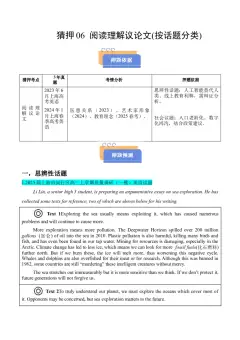
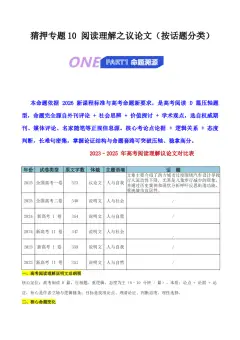
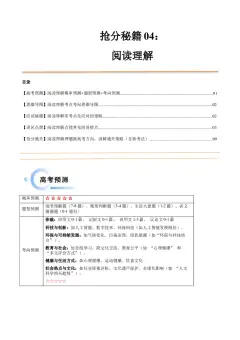
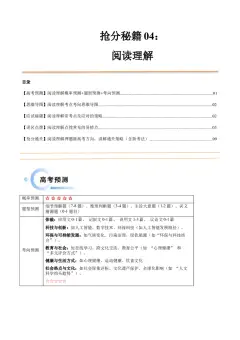
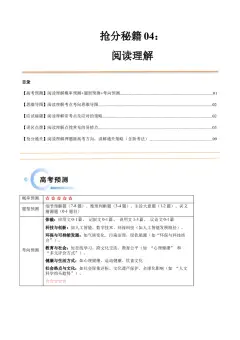
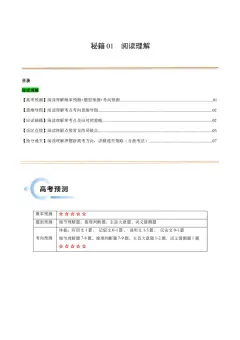
猜押 阅读理解议论文
猜
押
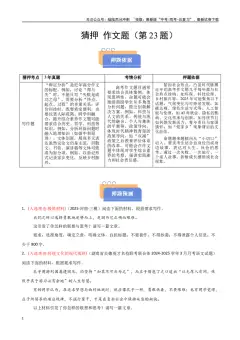
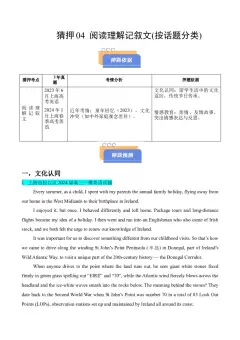
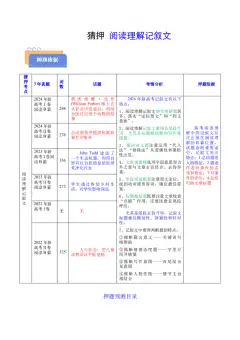
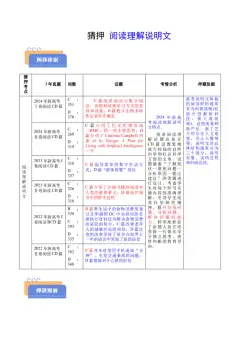
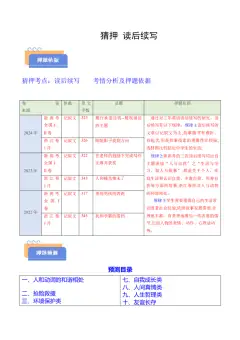
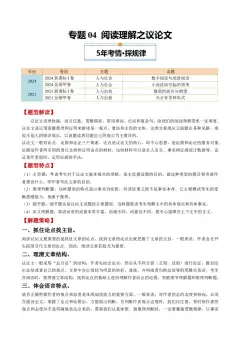
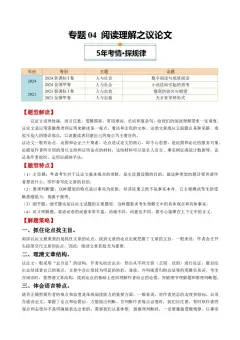
3年真题 词数和体裁 话题 考情分析 押题依据
考
点
议论文是英 高考英语阅读理
2024年新高考 讨论了纸质阅
语 中 的 重 要 文 解中的议论文通
Ⅰ卷阅读C篇 读与数字阅读、音
343议论文 体,在阅读理解 常涉及社会、文
频和视频学习方式
中占有一定的比 化 、 教 育 、 科
的差异和效果
例。 技、环境等领域
的争议性或热点
阅 通过作者与教 议论文就是
话题。这类文章
读 2024年全国甲 授关于小说结局的 说理性的文章,
旨在考查学生的
理 卷阅读D篇 343议论文 讨论引发了对结局 一般由论点、论 阅读理解能力、
解 的思考,接着阐述 据和论证过程组
逻辑思维能力以
议 了不同类型的文学 成。议论文都要
及对作者观点和
论 作品结局的特点 提 出 论 题 、 观
态度的把握。
文 点、提供充分的
证据,使用一定
2023年全国乙
的逻辑方法证明
卷D篇 论述了世人对
289议论文 观 点 或 得 出 结
天才的狭隘定义
论。
押题预测目录
一、思想哲理类 五、文化与艺术类
二、人工智能类 (批判性思维) 六、社会生活类
三、心理学类 七、思辨类
四、科学研究类 八、教育类
一、思想哲理类
押题1
词
话题 体裁 考点 押题理由
数
347 失败的心理痛苦 议论 细节理 思想哲理类议论文是高考英语阅读理解中的重要题型之
如何能够激励个 解、主旨 一,通常涉及人生哲理、价值观、道德观、成功与失败等人在缺乏熟练度 文 要义。 深层次的主题。这类文章不仅考查学生的语言理解能力,
的活动中变得更 还要求考生具备一定的思辨能力和对抽象概念的理解能
好 力。
The mental pain of failure can stimulate you to become better at the activity in which you lack proficiency-if
you can consider the unpleasant experience as an indicator of personal growth. This is what researchers found when
they conducted a field experiment at an improvisation (即兴表演) club. One group of amateur improvisers was
instructed to actively seek the feeling of awkwardness. The scholars found that, compared with improvisers who
were not given this instruction, the first group was more engaged in the exercise. Instead of seeing the discomfort
as something to avoid, they saw it as central to the process and leaned into it.
This has effects on how to improve ordinary life. You can put failure to good use in many other areas of life.
If you’re a student, take a class far outside your area of skills and interests, knowing that the struggle to cope with a
very novel challenge may improve studying what you do like. Enjoy the difficulty of it and analyze the mistakes
you make—and you will almost certainly find that you're doing even better at your preferred subject.
Employers can apply these principles as well. I like the “75/25 rule,” according to which employees spend
three-quarters of their time on their assigned task and one quarter helping others outside their area. The short-term
cost of this is friction as people struggle with novelty and difficulty-and bosses should take care not to make this
worse by being punitive or overly critical. But I have seen the long-term benefit of better motivation in the core
assignment, as well as a better flow of information and distribution of new skills across different activities within
an enterprise.
The embrace-failure principle can even be applied to happiness itself. None of us wants to be unhappy. But
inviting sources of unhappiness into life can be extremely beneficial. Resolve not to be afraid of fear, anger, or
sadness. They are normal and natural parts of life, after all. And if you let them, they will help you savor (享受) the
joys of life all the more.
1.What did the experiment at the improvisation club find?
A.Avoiding awkwardness improved improvisers’ creativity.
B.Actively embracing awkwardness increased engagement.
C.Professional improvisers performed better than amateurs.
D.Discomfort negatively impacted participants’ motivation.
2.Why does the author advise students to take unfamiliar classes?
A.To reduce their academic pressure.
B.To increase their studying interests.C.To avoid errors in their preferred field.
D.To indirectly strengthen their major subjects.
3.What is the long-term effect of the “75/25 rule”?
A.Employees are more motivated and multi-skilled.
B.Competitions among colleagues get more intense.
C.New and difficult assignments become effortless.
D.Conflicts in workplace disappear completely.
4.Which is the best title of the text?
A.The Different Ways to Avoid Failure.
B.The Advice on How to Seek Happiness.
C.The Benefits of Doing Things You’re Bad at.
D.The Reasons Why You’re in Negative Moods.
押题2
词
话题 体裁 考点 押题理由
数
339 培养成长型思维 议论 推理判 思想哲理类议论文是高考英语阅读理解中的重要题型之
模式更有益,要 文 断、主旨 一,通常涉及人生哲理、价值观、道德观、成功与失败等
正视事情带来的 要义。 深层次的主题。这类文章不仅考查学生的语言理解能力,
感受,认识到无 还要求考生具备一定的思辨能力和对抽象概念的理解能
法掌控一切,努 力。
力提升应对意外
挑战的能力
What if everything happens for a reason? Burnt toast theory, a modern view on this classic idea, suggests that
every little inconvenience we experience in our day-to-day lives happens for a bigger reason.
Imagine you accidentally burn your toast before leaving for work. According to burnt toast theory, this tiny
inconvenience can cause a domino effect (多米诺效应). Your morning gets delayed by three to five minutes—just
enough time to leave the house later than usual and avoid a potential car accident. Or perhaps you catch a later
train, missing an awkward encounter with someone you don’t intend to see. You might even meet someone new
whom you wouldn’t have otherwise met, leading to a friendship or romantic connection.
When we feel like things are outside our control, that can be scary. The burnt toast theory can help some
people let go of their need for control and take negative situations more positively.
However, while maintaining a positive mindset can be beneficial, over-optimism can lead to “poisonous
positivity”. When we only allow ourselves to focus on positive thoughts, we are denying ourselves the chance to
properly deal with challenges and difficult situations to better ourselves, focusing on creating a false positive façade(假象) instead. By constantly avoiding negative experiences, we might ignore their real impact on us and fail to
acknowledge when we’re struggling. It can make us feel worse about ourselves, and may lead to pushing down
negative feelings or experiences, and refusing to acknowledge or deal with them fully.
Instead of focusing purely on positive thinking, working towards developing a growth mindset may be more
helpful. You don’t always have to look for life’s silver linings, or even the meaning behind a little burnt toast.
Sometimes things happen, and they suck. But as long as we take time to acknowledge how these things make us
feel, and recognize that we can’t always control everything around us, we can still work towards improving
ourselves, and how we handle life’s unexpected challenges—and that’s what really matters.
1.What can be inferred from the burnt toast theory?
A.Life is a process, not destination. B.Lost in the east, gained in the west.
C.Life is full of endless challenges. D.Lost time will never be found again.
2.Which can be an outcome from “poisonous positivity”?
A.Loss of chances to grow. B.Failure to acknowledge others.
C.Inability to control emotions. D.Decline in physical health.
3.Which can be seen as a growth mindset mentioned in the last paragraph?
A.Finding reasons for failure.
B.Avoiding pushing others too hard.
C.Accepting life and making it better.
D.Keeping a positive mindset and working hard.
4.Which is the best possible title for the text?
A.Bum Toast Theory: Find a True Self
B.Bum Toast Theory: Lead a Positive Life
C.Burn Toast Theory: More than Positivity
D.Burn Toast Theory: How to Live Actively
押题3
词
话题 体裁 考点 押题理由
数
362 反思性思考在追 议论 细节理 思想哲理类议论文是高考英语阅读理解中的重要题型之
求个人幸福和成 文 解、主旨 一,通常涉及人生哲理、价值观、道德观、成功与失败等
功方面的作用及 要义、词 深层次的主题。这类文章不仅考查学生的语言理解能力,
其局限性 句猜测、 还要求考生具备一定的思辨能力和对抽象概念的理解能
推理判 力。
断。
Socrates declared that the unexamined life wasn’t worth living for a human being, implying that we shouldattempt to know ourselves, to think through our actions, choices, prejudices and attitudes. But when it comes to
thinking about our own happiness and what makes our lives go well, it really does seem that this reflective attitude
can ruin our chances of finding what we seek.
Perhaps it’s not surprising that we are better designed for engaging in other activities than reflecting on how
best to achieve our own happiness and well-being. Doing things that enhance our growth in physical, social and
intellectual areas tends to bring the reward of feeling good, and so stimulates us further to pursue those activities.
Sitting around reflecting on what will make us happy is a lot less efficient than chasing the things that make us
happy, and if we think too much, there is an opportunity cost - time that we could have spent in a worthwhile
activity has gone while we were thinking deeply about the best way to develop.
The philosopher David has written about the role of reflective thinking in sports. One of his observations is
that while sports people need to think about the basic actions they are performing, it can be counterproductive to
start thinking about the elements making up those actions. A footballer needs to think about kicking the ball low
and hard to the left of the goalkeeper, but not to overthink the mechanics of the precise small movements of legs
and feet that produce that outcome. If he or she does start this sort of thought process, it very often leads to a poorer
shot. What’s needed is a kind of automatic response to the situation.
Perhaps something similar is going on in our life. Those people who start detailed programs of self-
development in various dimensions, focusing on diet, habits, exercise, mental activity, work output, and so on, are
like the footballer thinking through the small muscle movements. Perhaps their well-meaning self-reflection on
their own development and how they want to achieve it, is the very thing that will make a high level of
development forever unobtainable for them.
1.What may cause an opportunity cost?
A.Spending time on worthy activities.
B.Joining in social meetings actively.
C.Getting stuck in much self-reflection.
D.Doing physical exercises efficiently.
2.What does the underlined word “counterproductive” in Paragraph 3 probably mean?
A.Ineffective. B.Meaningless. C.Constructive. D.Profitable.
3.What does the author suggest readers do to achieve their goals?
A.Make a comprehensive plan. B.Adopt a direct approach.
C.Think carefully before action. D.Attach importance to details.
4.What is a suitable title for this text?A.The Risk of Overthinking B.The Key to Well-being
C.The Way to Think Reflectively D.The Method to Develop Yourself
二、人工智能类 (批判性思维)
押题1
词
话题 体裁 考点 押题理由
数
345 AI 使人类认知 议论 推理判断 人工智能是当前科技领域的热门话题,也是高考英语阅读
面临过时风险, 文 理解中的高频主题之一。这类文章通常涉及人工智能的发
引发对人类地位 展、应用、影响及其引发的伦理和社会问题。
和未来的担忧
Since the dawn of human history, innovation has been a balancing act of wonder and fear. From the
discovery of fire to the first flights of airplanes, each technological breakthrough has promised to enhance human
abilities while simultaneously (同时) causing risks. Fire could warm us or destroy us; airplanes could connect us or
be turned into tools of war. Yet through all these advancements, one constant has remained: human cognition (认知)
, the unique spark of thought and creativity that has shaped our progress.
But today, something is different. For the first time in history, human cognition itself is at risk of being out-
of-date. With the rise of artificial intelligence (AI), we are no longer just building tools to enhance our abilities; we
are building systems that may be superior to our very capacity to think, create, and innovate. This shift doesn’t just
completely change industries, but it also challenges the core of what makes us human.
In past innovations, technologies functioned as extensions of human abilities. The airplanes enlarged our
physical reach, the Internet expanded our access to information, and computers increased our ability to compute.
These tools were clearly under human control, operating within the boundaries we set.
However, AI is fundamentally different. It operates in the range of cognition, not merely conducting tasks,
but also learning, reasoning, and even generating creative content. From writing news articles to diagnosing
diseases, AI systems are performing tasks once thought to require uniquely human judgment. What happens when
machines can think better than we can? And, more importantly, what does it mean to be human in an age when our
intellectual strength is no longer guaranteed?
Historically, we’ve accepted obsolescence (过时) as part of the cycle of innovation and, in most situations,
embraced it. Outdated tools should be abandoned, and new ones take their place. But when the “tool” at risk of
obsolescence is human cognition itself, we enter unknown area. AI’s capacity to potentially outdo our intellectual
talents puts humanity in a weak position, one where we must confront our own limitations.1.What can we infer from the first paragraph?
A.One good turn deserves another. B.Take things as they come.
C.Don’t put the cart before the horse. D.Every coin has two sides.
2.What does the author mean by saying “But today, something is different” in paragraph 2?
A.Human cognition starts to be outdated. B.Wonder and fear have lost balance.
C.Human cognition has reached a ceiling. D.Creativity has shaped our progress.
3.How is the main idea presented in the text?
A.By telling stories. B.By analyzing causes.
C.By giving examples. D.By applying inferences.
4.What is the author’s attitude towards the rise of artificial intelligence?
A.Concerned. B.Skeptical. C.Positive. D.Unclear.
押题2
词
话题 体裁 考点 押题理由
数
290 文章提出企业应 议论 推理判 人工智能是当前科技领域的热门话题,也是高考英语阅读
通过战略性设 文 断、词句 理解中的高频主题之一。这类文章通常涉及人工智能的发
计,利用AI增 猜测、主 展、应用、影响及其引发的伦理和社会问题。
强和升级工作任 旨大意
务,推动工作转
型
The potential for AI like ChatGPT to affect how humans interact with computers and transform jobs has left
many company leaders head-scratching. As with other breakthroughs in AI, ChatGPT raises big questions about
how AI would impact jobs.
We believe that leading companies should neither attempt to automate human jobs nor wait on the sidelines
until the shortcomings of AI are ironed out. Instead, companies should take a more strategic approach to make AI
positively influence jobs.
Customer service provides an instructive case in point of the ways AI will transform — not wipe out — jobs.
For example, we found that the work for customer service representatives could be broken down into 13 existing
tasks. We then analyzed how AI might affect each of those tasks. Four of the tasks like directing organizational
activities remained unchanged and could be performed entirely by humans. Four repetitive tasks, including fixing
the prices of goods and services and collecting payments, could be fully automated. Five tasks could be upgraded to
help humans work more effectively. And five new, high-value tasks emerge. Human, automated, updated, and
emergent tasks — these are the elements of a new mix of tasks around which companies should redesign humanjobs to get the greatest advantage from AI.
Instead of being dominated by AI, people are guiding them by human experience and knowledge. In fact, the
developers of ChatGPT are continuing to refine it based on how people are using it online. As one of ChatGPT's
developers pointed out, “This is ChatGPT's secret sauce. The basic idea is to take a large language model with a
tendency to pour out anything it wants ... and tune it by teaching it what kinds of responses human users actually
prefer.”
1.What does the underlined word “head-scratching” mean in paragraph 1?
A.Excited. B.Confused. C.Relieved. D.Frightened.
2.What change will AI bring to the customer service department?
A.The department aims to replace human workers with AI.
B.Most tasks in the department will remain untouched by AI.
C.Staff in the department are expected to determine product prices.
D.AI can lead to novel roles for human employees.
3.Why does the author mention the words of a developer of ChatGPT in paragraph 4?
A.To prove that a large language model is the key to ChatGPT's success.
B.To show that ChatGPT will be capable of speaking anything.
C.To support that AI should remain under human control and guidance.
D.To support that AI will be smarter than humans in communication.
4.What can be a suitable title for the text?
A.AI: Beauty or Beast? B.ChatGPT’s Secret to Success
C.AI Will Enrich — Not Erase — Human JobsD.Clear Divisions of Tasks in Customer Service
押题3
词
话题 体裁 考点 押题理由
数
332 引用学者的观点 议论 推理判 人工智能是当前科技领域的热门话题,也是高考英语阅读
和对比人类思维 文 断、细节 理解中的高频主题之一。这类文章通常涉及人工智能的发
与人工智能的不 理解、主 展、应用、影响及其引发的伦理和社会问题。
同 旨大意、
推理判断
A lot of my friends are deeply worried about artificial intelligence, while acknowledging the possible
benefits. Many fears about AI are based on an underestimation of the human mind. Some people seem to believe
that the mind is like a computer. It’s all just information processing, algorithms (算法) all the way down, so of
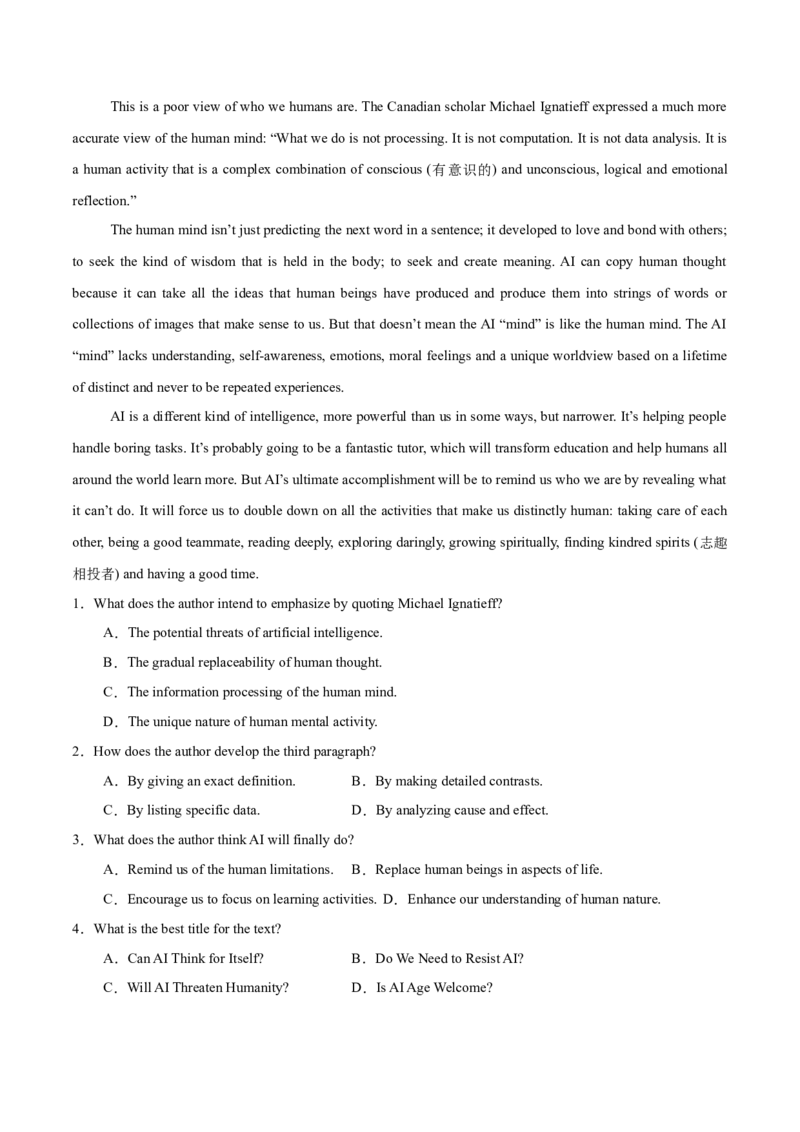
course machines are going to eventually overtake us.This is a poor view of who we humans are. The Canadian scholar Michael Ignatieff expressed a much more
accurate view of the human mind: “What we do is not processing. It is not computation. It is not data analysis. It is
a human activity that is a complex combination of conscious (有意识的) and unconscious, logical and emotional
reflection.”
The human mind isn’t just predicting the next word in a sentence; it developed to love and bond with others;
to seek the kind of wisdom that is held in the body; to seek and create meaning. AI can copy human thought
because it can take all the ideas that human beings have produced and produce them into strings of words or
collections of images that make sense to us. But that doesn’t mean the AI “mind” is like the human mind. The AI
“mind” lacks understanding, self-awareness, emotions, moral feelings and a unique worldview based on a lifetime
of distinct and never to be repeated experiences.
AI is a different kind of intelligence, more powerful than us in some ways, but narrower. It’s helping people
handle boring tasks. It’s probably going to be a fantastic tutor, which will transform education and help humans all
around the world learn more. But AI’s ultimate accomplishment will be to remind us who we are by revealing what
it can’t do. It will force us to double down on all the activities that make us distinctly human: taking care of each
other, being a good teammate, reading deeply, exploring daringly, growing spiritually, finding kindred spirits (志趣
相投者) and having a good time.
1.What does the author intend to emphasize by quoting Michael Ignatieff?
A.The potential threats of artificial intelligence.
B.The gradual replaceability of human thought.
C.The information processing of the human mind.
D.The unique nature of human mental activity.
2.How does the author develop the third paragraph?
A.By giving an exact definition. B.By making detailed contrasts.
C.By listing specific data. D.By analyzing cause and effect.
3.What does the author think AI will finally do?
A.Remind us of the human limitations. B.Replace human beings in aspects of life.
C.Encourage us to focus on learning activities. D.Enhance our understanding of human nature.
4.What is the best title for the text?
A.Can AI Think for Itself? B.Do We Need to Resist AI?
C.Will AI Threaten Humanity? D.Is AI Age Welcome?三、心理学类
押题1
词
话题 体裁 考点 押题理由
数
353 心理学家弗洛姆关于 议论 推理判 心理学类阅读理解是高考英语中的重要题型之一,通常
“拥有”和“存在” 文 断、词句 涉及人类行为、情绪、认知、心理健康等主题。这类文
两种心态的观点,指 猜测、细 章不仅考查学生的语言理解能力,还要求考生具备一定
出“拥有”心态的问 节理解 的逻辑思维能力和对心理学概念的理解能力。
题并建议人们做出改
变
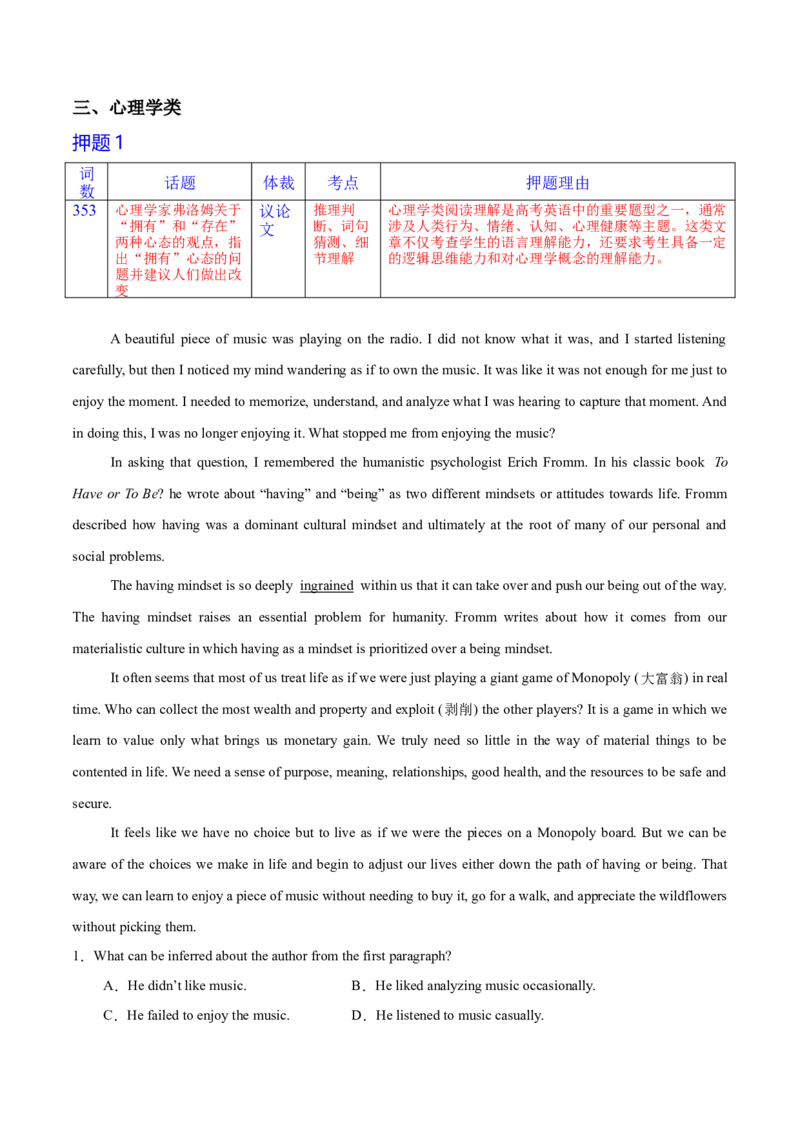
A beautiful piece of music was playing on the radio. I did not know what it was, and I started listening
carefully, but then I noticed my mind wandering as if to own the music. It was like it was not enough for me just to
enjoy the moment. I needed to memorize, understand, and analyze what I was hearing to capture that moment. And
in doing this, I was no longer enjoying it. What stopped me from enjoying the music?
In asking that question, I remembered the humanistic psychologist Erich Fromm. In his classic book To
Have or To Be? he wrote about “having” and “being” as two different mindsets or attitudes towards life. Fromm
described how having was a dominant cultural mindset and ultimately at the root of many of our personal and
social problems.
The having mindset is so deeply ingrained within us that it can take over and push our being out of the way.
The having mindset raises an essential problem for humanity. Fromm writes about how it comes from our
materialistic culture in which having as a mindset is prioritized over a being mindset.
It often seems that most of us treat life as if we were just playing a giant game of Monopoly (大富翁) in real
time. Who can collect the most wealth and property and exploit (剥削) the other players? It is a game in which we
learn to value only what brings us monetary gain. We truly need so little in the way of material things to be
contented in life. We need a sense of purpose, meaning, relationships, good health, and the resources to be safe and
secure.
It feels like we have no choice but to live as if we were the pieces on a Monopoly board. But we can be
aware of the choices we make in life and begin to adjust our lives either down the path of having or being. That
way, we can learn to enjoy a piece of music without needing to buy it, go for a walk, and appreciate the wildflowers
without picking them.
1.What can be inferred about the author from the first paragraph?
A.He didn’t like music. B.He liked analyzing music occasionally.
C.He failed to enjoy the music. D.He listened to music casually.2.What does the underlined word “ingrained” in Paragraph 3 mean?
A.Rooted. B.Affected. C.Imagined. D.Discovered.
3.What’s the author’s attitude towards “having” mindset?
A.Interested. B.Opposed. C.Positive. D.Unconcerned.
4.What does the author advise us to do?
A.Play the game of Monopoly. B.Change our mindsets in life.
C.Aim high and seek your fortune. D.Find life purpose and help others.
押题2
词
话题 体裁 考点 押题理由
数
350 心理学家马斯洛的需 议论 推理判 心理学类阅读理解是高考英语中的重要题型之一,通常
求层次理论,以及金 文 断、词句 涉及人类行为、情绪、认知、心理健康等主题。这类文
钱在满足人类需求中 猜测、细 章不仅考查学生的语言理解能力,还要求考生具备一定
的作用 节理解 的逻辑思维能力和对心理学概念的理解能力。
Consider the hierarchy (层次) of needs proposed in 1943 by the psychologist Abraham Maslow. Maslow
believed that people tend to focus on meeting their needs in a particular order of urgency. We start with survival
needs such as food, shelter, and safety. Once these have been met, we turn our attention to social and emotional
needs, such as love and belonging. Finally, we focus on higher-order needs such as self-actualization — in other
words, looking for life’s meaning.
Of these three levels, money is only truly helpful for the first. This is why economists often find that well-
being doesn’t improve much once a person reaches the relatively humble financial means that meet those needs.
The “middle needs” of love and belonging — family, friends, romance — can’t be met with money, and pursuing
money with too much gusto can even result in unexpected consequences.
Focusing too much on money is actively opposed to Maslow’s highest-level needs, because doing so can
lead people into a trap that researchers call “financial contingency of self-worth,” which happens when a person’s
self-esteem is conditional on his or her financial success.
This might explain why stress levels are high both when money is tight and when people reach higher
income levels. A 2018 survey conducted by LinkedIn found that stress at work falls when people earn more than
$50,000, but then starts to rise significantly when people earn above $200,000. One reason for the stress among
high earners is their neglect (忽略) of relationships, according to some researchers.
Perhaps your parents always put a lot of pressure on you to succeed financially, or you tend to be insecure
about your self-worth and rely a lot on social comparison. One way or another, you might be measuring yourself inmoney, and without realizing it, hoping that at some point you will be “expensive” enough to earn others’ love and
respect. Your instincts (直觉) might be telling you to earn more, more, more in order to find peace and satisfaction.
Your instincts are lying, and you could get much happier by reassessing your priorities.
1.What is the primary role of money according to Maslow’s hierarchy of needs?
A.It ensures a sense of safety. B.It satisfies all levels of needs.
C.It is crucial for self-actualization. D.It is most effective for basic survival needs.
2.What does “gusto” mean in paragraph 2?
A.Resistance. B.Enthusiasm. C.Indifference. D.Hesitation.
3.Why might pursuing money excessively lead to stress even at higher income levels?
A.It leads to a constant need for financial growth.
B.It complicates financial choices for the wealthy.
C.It may overshadow social and emotional bonds.
D.It increases the pressure to maintain high income.
4.What is the author’s view on using money as a measure of self-worth?
A.It’s a natural response. B.It’s a reasonable pursuit.
C.It’s a notable misconception. D.It’s a temporary phase in personal growth.
押题3
词
话题 体裁 考点 押题理由
数
311 人格测试的局限性以 议论 推理判 心理学类阅读理解是高考英语中的重要题型之一,通常
及人格并非固定不变 文 断、词句 涉及人类行为、情绪、认知、心理健康等主题。这类文
的观点 猜测、细 章不仅考查学生的语言理解能力,还要求考生具备一定
节理解、 的逻辑思维能力和对心理学概念的理解能力。
主旨大意
Many seemingly serious personality tests are not supported by research. Despite being a billion-dollar
industry, commercial personality testing does not predict success. That’s because most tests assume one’s characters
are static.
Researches confirm that people can intentionally shape their characters. That’s contrary to their assumption
that your personality type places you in a box, directing how you choose partners, activities and careers.
You can think of personality as labels that summarize your responses to questions as follows. Do you think
about situations more pessimistically, or are you a glass-half-full kind of person? Do you wait until the last minute
to complete tasks, or do you plan ahead? Depending on your answers, you might be labeled as a certain personality.
However, people often view personality as the core of who they are. According to scientific definitions, personalityis not one’s likes, dislikes or preferences. It’s not your values or what you think is important. Shifting characters
does not change the core of who you are. It simply means responding to situations with different thoughts and
behaviors.
Here is a common example. Suppose you’re not super reliable. If you start to think “being on time shows
others that you respect them”, to feel pride when you arrive to a dinner party before friends, and to engage in new
behaviors that increase your timeliness (守时) — such as getting up with an alarm and setting appointment
reminders — you are demonstrating the features of a reliable person. If you maintain these changes to your
thoughts and behaviors over time — ta-da! — you are reliable.
Besides, personality changes across a person’s lifetime. As people grow older, they tend to experience fewer
negative emotions, become more considerate, place greater emphasis on harmonious relationships and are less
critical of others. Slow yet steady changes in thoughts and behaviors can eventually develop the personality people
desire.
1.What does the underlined word “static” in paragraph 1 mean?
A.Flexible. B.Constant. C.Complex. D.Predictable.
2.What is the main idea of paragraph 3?
A.Questions help people understand labels. B.Planning ahead leads to completing tasks.
C.Negative beliefs tend to worsen situations. D.Personality is how one thinks and behaves.
3.What does the common example show?
A.How to manage the time. B.How to maintain changes.
C.How to change personality. D.How to increase timeliness.
4.How might people become as they age?
A.Critical. B.Positive. C.Selfless. D.Reliable.
四、科学研究类
押题1
词
话题 体裁 考点 押题理由
数
368 论述了科学的本质 议论 推理判 科学研究类说明文是高考英语阅读理解中的重要题型之
文 断、主旨 一,通常涉及科学发现、实验研究、技术应用、科学原
大意、细 理等主题。这类文章不仅考查学生的语言理解能力,还
节理解 要求考生具备一定的科学素养和逻辑思维能力。
Some scientists insist that once we discover the truth about the world, we are done. Anyone who denies such
truths, they suggest, is stupid or ignorant (无知的). Well, no. In science, what we do is both hard and, often, hard toexplain. The history of science offers many examples of matters that scientists thought they had resolved, only to
discover that these matters needed to be reconsidered. Familiar examples include Earth as the center of the universe
and the stability of continents.
Science is a process of learning and discovery, and sometimes we learn that what we thought was right is
wrong. To say that science is “true” or “permanent” is like saying that “beauty is absolute”. At best, it’s a bit off-key
(不恰当的). The concept of beauty today is very different from what it was in ancient Greece or the Middle Ages,
and so are most of our “laws” of nature.
Other scientists may say scientific findings are true because they use “the scientific method”. But we can
never actually agree on what that method is. Some will say it is observation and description of the world. Others
will say it is the use of experience and experiment. Recently a leading scientist said the scientific method was to
avoid fooling oneself into thinking something is true that is not.
Each of these views has its value, but if the claim is that any one of these is the scientific method, then they
all fail. History and philosophy have shown that the idea of a singular (唯一的) scientific method is unscientific. In
fact, the methods of science have varied between disciplines and across time. Scientists have bitterly argued about
which methods are the best, and, as we all know, bitter arguments rarely get resolved.
In my view, science is not simple, and neither is the natural world. Our efforts to understand and explain the
natural world are just that: efforts.
Because we’re human, we often fall flat. The good news is that when that happens, we pick ourselves up,
brush ourselves off, and get back to work. Understanding the world we live in, and using that knowledge to do
useful things, is its own reward.
1.According to paragraph 1, what is considered as truth in science________.
A.may have lasting value B.may need re-examining
C.should be known to all D.should not be rejected
2.Why does the author mention “beauty” in paragraph 2?
A.To raise a question. B.To make a prediction.
C.To illustrate an idea. D.To propose a solution.
3.What does the author think of the methods of science?
A.They shouldn’t be used to fool the public.
B.They rely heavily on observation and description.
C.They seldom cause arguments among scientists.
D.They shouldn’t be limited to a single method.4.What could be the best title for the passage?
A.Efforts in Science: Dreaming Big. B.Science: Endless Journey to Truth.
C.Scientists: Defenders of Science. D.Scientific Method: Simple Choice.
押题2
词
话题 体裁 考点 押题理由
数
354 发明创造不是一蹴而 议论 推理判断 科学研究类说明文是高考英语阅读理解中的重要题型之
就的,而往往来自不 文 一,通常涉及科学发现、实验研究、技术应用、科学原
断的试错过程 理等主题。这类文章不仅考查学生的语言理解能力,还
要求考生具备一定的科学素养和逻辑思维能力。
People often think that scientific discoveries come from the geniuses like Charles Darwin and Albert
Einstein. Such a view overlooks the efforts of lesser-known pioneers. Also, popular belief holds that the sudden
idea is the key to making scientific breakthroughs, as if it just appears in someone’s mind.
This opinion might be partially true. It doesn’t accurately represent the true nature of scientific
breakthroughs. Apart from, the great figures such as Darwin and Einstein, whose contributions are rightly
recognized — we believe innovation is largely a trial-and-error process, where two steps forward may sometimes
come with one step back or even more steps to the right or left.
Take John Nicholson, a lesser-known scientist from the 1910s. He was a mathematical physicist who
suggested the idea of ‘proto-elements’ in space. By mixing different weights of these atoms, he could recover the
weights of the elements in the periodic table. Though proto-elements don’t actually exist, Nicholson’s wild ideas
led him to propose a new theory about atomic structure. Niels Bohr, the Nobel prize-winning father of modern
atomic theory, later built on this idea to develop his famous model of the atom.
What can we learn from this story? Science is always evolving, similar to the evolution of animal species.
Just random or unexpected changes of ideas may open the door for advances in science. Support for this idea can be
seen in many areas. For example, in US horse racing, the ‘acey-deucy’ stirrup placement, where the rider’ s left foot
is placed lower than the right foot, provides a speed advantage on oval tracks. It was created by a little-known rider
named Jackie Westrope. Had Westrope done careful research to develop this technique? No. He had a leg injury
that prevented him from fully bending his left knee. This change just happened to improve his left-hand turning
performance. As a result, many riders quickly adopted the acey-deucy style, which is still used in racing today.
Many other examples show science progress often comes from mistakes, accidents, or pure luck. It’s time to
abandon the naive beliefs of genius and explore the true causes of creativity.
1.What is the purpose of paragraph 1?A.To support specific ideas.
B.To describe a common belief.
C.To compare certain beliefs.
D.To challenge a popular view.
2.What does the writer imply about Darwin and Einstein in paragraph 2?
A.They set an example for others to follow.
B.Their way of working has been misunderstood.
C.They are exceptions to the usual rule.
D.Their achievements deserve greater recognition.
3.What do we know about the idea of Nicholson?
A.It made him famous as an important scientist.
B.People only fully understood it later in history.
C.Other scientists were initially doubtful about it.
D.It paved the way for someone else’ s breakthrough.
4.What is most interesting about the ‘acey-deucy’ stirrup adjustment?
A.Why it was made.
B.How quickly people used it.
C.The research work behind it.
D.The cleverness of its first user.
押题3
词
话题 体裁 考点 押题理由
数
360 科学的本质是集体、 议论 推理判 科学研究类说明文是高考英语阅读理解中的重要题型之
不完美且多面的过程 文 断、主旨 一,通常涉及科学发现、实验研究、技术应用、科学原
大意 理等主题。这类文章不仅考查学生的语言理解能力,还
要求考生具备一定的科学素养和逻辑思维能力。
A man in a lab coat bends under a dim light with tight eyes looking at a microscope. Time is short, the pays-
off are high, and only this scientist can save everyone. That kind of romanticized picture of science was standard
for a long time. But it’s far from the truth.
Some scientists search for the causes of some observable effects, such as the link between destroyed forests
and Earth’s temperature increase. Others may investigate the “what” rather than the “why” of things. For example,
ecologists build models to estimate gray wolf abundance in Montana, US. It’s impractical to spot them all and countthem, Abundance models are not 100 percent accurate, but they offer estimates that seem good enough to set
harvesting quotas (限额) and maintain the ecosystem.
Beyond the “what” and the “why”, scientists may focus on the “how”. For instance, the lives of people living
with illnesses can be improved by research on how to relieve symptoms, even if the true causes of their disorders
are largely unknown to current medicine.
People often think “real science” should provide definite, complete and perfect answers to their questions.
However, given various limitations and the world’s complexity, keeping multiple perspectives in play is often the
best way for scientists to reach their goals and solve the problems at hand.
In the world of science, disagreement is a feature, not a bug. Science is a social process in which the
community’s scrutiny (审查) ensures we have the best available knowledge. “Best available” does not mean
“definitive”, but the best we have until we find out how to improve it.
The long history of atomism (原子论) shows how science is a process rather than a fast delivery of results
set in stone. As scientist Jean Baptiste Perrin conducted his 1908 experiments that seemingly settled all discussion
regarding atoms, questions about the atom’s properties were about to spark decades of controversy with the birth of
quantum (量子) physics. Similar discussions continue to the present day.
So, real science is a collective, imperfect and many-sided process in which scientists contribute multiple and
often partial solutions to complex and diverse problems.
1.How does the author introduce the topic of the article?
A.By presenting a typical misconception. B.By giving an example of scientific failure.
C.By describing a scientific research process. D.By telling a scientist’s personal experience.
2.What do Paragraph 2 and 3 mainly talk about?
A.The history of scientific research.
B.The challenges faced by scientists.
C.The methods scientists use to share results.
D.The specific attention of scientists on their research.
3.What is the author’s view on disagreement in science?
A.It inspires critical thinking.
B.It seeks universal standards.
C.It creates confusion and delays conclusions.
D.It indicates imperfection in research approaches.
4.What does the real scientific process emphasize?A.Complete and immediate solutions. B.Individual achievements and final results.
C.Diverse contributions and ongoing revisions.D.Definitive answers and complete certainty.
五、文化与艺术类
押题1
词
话题 体裁 考点 押题理由
数
369 在全球化时代,理解 议论 推理判 文化与艺术类议论文是高考英语阅读理解中的重要题型
并适应文化差异是促 文 断、词句 之一,通常涉及文化传承、艺术价值、文化多样性、艺
进国际合作与社会和 猜测、细 术与社会的关系等主题。这类文章不仅考查学生的语言
谐的关键 节理解 理解能力,还要求考生具备一定的文化素养和对艺术话
题的思辨能力。
In today’s interconnected world, cross-cultural communication has emerged as a vital skill for fostering
international cooperation and social harmony. Britain, with its centuries-old history of absorbing diverse influences
and its current multicultural landscape, serves as an ideal example of how tradition and modernity can coexist to
bridge cultural gaps.
The roots of British cultural adaptability trace back to ancient times. When the Romans invaded Britain in 55
BC, they not only established management systems but also constructed public facilities such as roads and
Hadrian’s Wall — a massive defensive structure marking the northern border of their empire. These innovations not
only managed conflicts with Celtic tribe’s but also laid the foundation for future cultural exchanges. Today, this
legacy of blending old and new remains evident. For instance, the British Parliament maintains strict dress codes
requiring formal suits and robed (长袍) during sessions, symbolizing respect for tradition. Meanwhile, modern
Britain embraced literary festivals and experimental theater productions, reflecting its dynamic engagement with
contemporary artistic expression.
However, navigating cultural differences remains challenging. In international business settings, British
professionals often prioritize building trust through indirect communication and tea-break small talk, while their
American counterparts favor straightforward discussions to get straight to the point. Research by the London
Business School (2022) reveals that 68 % of cross-Atlantic negotiations face delays due to these contrasting styled.
Americans may interpret British politeness as in decision, whereas Britons perceive American directness as
impersonal and overlay focused only on business deals.
Language differences further test cultural sensitivity. A simple phrase like “I’ll consider it” in British English
often means a polite refusal, whereas Americans might take it literally as openness to further discussion. Even
gestured differ: maintaining eye contact is seen as confident in the U. S. But may be viewed as aggressive in some
British contexts.To address these challenged, educational institutions play a key role. Universities like Oxford and Cambridge
now offer courses such as “Global Communication Strategies,” where students role-play negotiation scene’s and
analyze case studies of multinational corporations. Such training emphasized empathy, active listening, and
adapting communication styled to diverse audiences. As globalization continued to erase borders, mastering these
skills becomes not just beneficial but essential for building a more inclusive world.
1.What can be known about the purpose of the Romans building Hadrian’s Wall?
A.To establish trade routed with Celtic tribes. B.To mark the southern border of the Roman Empire.
C.To showcase advanced architectural skills. D.To manage conflicts and control territory.
2.What can be inferred about British and American negotiation style from Paragraph 3?
A.Their differences may lead to misunderstandings. B.They both value long-term relationships equally.
C.Americans prefer indirect communication. D.British negotiators focus on short-term gains.
3.What does the word “impersonal” mean in the context of American negotiators?
A.Friendly and emotional. B.Aggressive and rude.
C.Emotionally distant and formal. D.Humorous and casual.
4.What might the author discuss next regarding cross-cultural communication training?
A.The history of Roman education systems. B.Specific methods used in university coursed.
C.How technology replaces traditional teaching.D.Economic costs of cultural misunderstandings.
押题2
词
话题 体裁 考点 押题理由
数
308 作者对艺术在生活中 议论 推理判 文化与艺术类议论文是高考英语阅读理解中的重要题型
的重要性的看法 文 断、细节 之一,通常涉及文化传承、艺术价值、文化多样性、艺
理解 术与社会的关系等主题。这类文章不仅考查学生的语言
理解能力,还要求考生具备一定的文化素养和对艺术话
题的思辨能力。
I'm an artist, always considering art and beauty as essential to life as daily bread. However, I didn't initially
think much about how others perceived art. Over time, I noticed that many, even most people, regarded art as a
luxury rather than a necessity.
My rudest awakening on this subject came during a visit to Britain. While exploring the countryside, I
stopped at a small store that made its own cheese daily. The salesperson, a young woman with an air of expertise,
was astonished by my ignorance of milk products. When I asked if they sold the cheese made that morning, she
said with annoyance, “Don't you know nothing about cheese?” Suddenly and without thinking, I said, “No. Do you
know anything about art?” Her reply “No. But that's not something you have to do with every day, and cheese is!”made me realize that for most people, art isn't a daily essential.
Despite this common view, I firmly believe art is as crucial as food. It's the expression of our individuality.
We all share basic human qualities, feelings, and longings, but it's how we express them uniquely that defines art.
Throughout art history, while the subject matter of paintings may be similar, the true essence lies in the
artist's unique style. Museums, which I once saw as the preserve of a few great artists, now seem to spotlight the
universal truth of individual uniqueness. They remind us that expressing our originality is the core of art and life.
Art is everywhere in our daily lives. Whether we're cooking, arranging flowers, or conducting business, art is
our unique voice, helping us resist the pressure to follow and preserve our individual beauty. As John Muir said,
“Everybody needs beauty as well as bread.” Art is indeed a universal, individual, and fundamental truth, an
essential part of our daily existence.
1.How did the author originally react to others' views on art?
A.He felt curious. B.He paid little attention.
C.He was concerned. D.He was opposed to them.
2.What did the author learn during his visit to the British store?
A.The beauty in cheese. B.The necessities in life.
C.Common opinion on art. D.The value of art in life.
3.Why does the author think art is crucial?
A.It shapes one's personality. B.It's as common as daily bread.
C.It enriches people's lives. D.It's a way to show off oneself.
4.What does the text mainly convey to us?
A.The significance of art in everyday life.
B.The author's long-term passion for art.
C.The difference between art and daily needs.
D.The history of art and the role of museums.
押题3
词
话题 体裁 考点 押题理由
数
388 人工智能(AI)和机器 议论 推理判 文化与艺术类议论文是高考英语阅读理解中的重要题型
人如Ai-Da对艺术定 文 断、词义 之一,通常涉及文化传承、艺术价值、文化多样性、艺
义和人类创造力的影 猜测、细 术与社会的关系等主题。这类文章不仅考查学生的语言
响,以及AI在艺术 节理解 理解能力,还要求考生具备一定的文化素养和对艺术话
题的思辨能力。
领域的潜在作用和未
来发展方向In a drawing room in rural Oxfordshire, an artist slowly and deliberately puts pen to paper. Her arm moves
across the canvas, the marks gradually integrating into a portrait of herself. It seems like a moment of creative
expression. But this is no ordinary artist—she is the world’s first humanoid robot artist, Ai-Da. By design, her very
existence brings into question how we define art, and who, or in this case, what, can create it.
Will AI algorithms (算法) and robots like Ai-Da mean the end of human creativity and artistry,or can they
strengthen our own creative potential? When Marcel Duchamp proposed that a urinal (小便池) be considered art,
he flipped the art world on its head. In much the same way, AI-created artworks are changing the standards of the
art world, because both were controversial and contain objects that haven’t technically been created by an “artist’s”
hand.
Someone argues that a humanoid artist like Ai-Da represents society’s current fears — the rise of job-stealing
AI algorithms and potential robot domination. But technological revolutions like artificial intelligence don’t
necessarily mean the “end of art” as many fear. Instead, they can help to kickstart an artistic transformation and
move us towards different ways of seeing and creating. “AI might kick us into being creative again as humans,”
says mathematician du Sautoy, who sees it as a powerful partner in the pursuit of human creativity.
However, questions of authorship haunt the artificial intelligence story. Artists Holly Herndon and Mat
Dryhurst co-founded Spawning AI, which aimed at empowering human creators to prohibit AI from using their
works. But there are also artists who see AI as a new outlet for their own creativity. Some artists are now even
training algorithms in an attempt to push their own creative boundaries.
It’s clear that AI algorithms and machines like Ai-Da are having an impact on the art world. Their works are
exhibited alongside more traditional forms of art worldwide. Next year we’ll see the world’s first AI art gallery
open its doors in LA.Eva Jäger, the creative AI lead, is also helping to bring AI art to the masses, with a
programme of exhibitions leading to critical discussion about the impact of technology on art. She sees the
cooperation between human and machine as a space for real creative potential.
1.What does the phrase “flipped the art world on its head” in paragraph 2 probably mean?
A.Overturned the art standards. B.Dominated the art world.
C.Broadened artists’ horizons. D.Recognized artists’ wisdom.
2.What influence will Ai-Da generate on the art world?
A.It will increase the commercial value. B.It will replace human artists soon.
C.It may boost human creativity. D.It may help artists protect their works.
3.What can be inferred from the last two paragraphs?
A.Spawning AI helps produce better art works.B.Some artists trained AI to work for them.C.AI art gallery will win over more visitors. D.Eva looks favorably to the future of AI.
4.What’s the author’s purpose in writing the text?
A.To argue that AI will eventually outperform human artists.
B.To explore the impact of AI on art definition and creativity.
C.To promote the idea that artworks created by AI lacks value.
D.To record the history of art movements and their significance.
六、社会生活类
押题1
词
话题 体裁 考点 押题理由
数
324 梭罗的简单生活理念 议论 推理判 社会生活类议论文是高考英语阅读理解中的常见题型之
及其对现代生活的启 文 断、主旨 一,通常涉及社会现象、生活方式、人际关系、社会问
示 大意、细 题等主题。这类文章不仅考查学生的语言理解能力,还
节理解 要求考生具备一定的社会观察能力和逻辑思维能力。
Most have probably heard of Henry David Thoreau and his book Walden, even though his message of
simplicity may sound outdated. Nowadays, smartphones flood us with text messages. Many consumers are buying
the latest digital devices, from tablets and fitness trackers to commercial drones. Simple living seems to be a thing
of the past.
Thoreau would beg to differ. As a writer who advocated the value of simplicity almost two centuries ago, he
was a contrarian (叛逆者) for his time. He lived during the height of the Industrial Age, distinguished by the rise of
large factories, expanding urban developments, and powerful machines.
Turned off by the constant busyness of this time, Thoreau withdrew from city life to live alone in the woods.
He brought with him only the necessities of life and wrote about this adventure in his book Walden. In the book,
Thoreau is basically making a philosophical statement. We are not living meaningful lives due to modern
technology. We created powerful machines to make life more convenient. Unfortunately, these machines have done
the opposite. In his words, “men have become the tools of their tools”.
That is to say, we are not the ones controlling technology. Technology is controlling us. Every few minutes,
smartphones may distract us with messages. At least half of Americans check their phones several times an hour.
Meanwhile, information overload from social media can weaken our concentration and heighten confusion.
When technology causes that much distraction and confusion, it may be healthy to simplify life by reducing
technology overuse. Personally, I’ve done so in two ways. First, I use very little data on my phone and keep theapps on it to a minimum. Most time, I only use my phone to call or text. Second, I quit most social media. Sure,
those two things aren’t as extreme as Thoreau withdrawing into the woods. Nevertheless, they’re realistic moves I
can make toward living a more meaningful life.
1.Why does the author refer to Thoreau’s book Walden in Paragraph1?
A.To tell the characters of Thoreau. B.To attract more consumers.
C.To bring in the concept of simple life. D.To discuss the advantage of smartphones.
2.What might drive Thoreau to live in the woods?
A.The purpose to keep fit. B.His plan of writing a book.
C.The pace of his time. D.His worry about technology.
3.What is the author’s attitude to Thoreau’s words “men have become the tools of their tools”?
A.Tolerant. B.Doubtful. C.Approving. D.Critical.
4.What is the author’s main argument in this text?
A.Modern technology improves our lives.B.Simplicity in a way helps live a meaningful life.
C.We should withdraw from modern society. D.Powerful machines are necessary for progress.
押题2
词 体
话题 考点 押题理由
数 裁
325 现代社会中人们普遍存 议 推理判 社会生活类议论文是高考英语阅读理解中的常见题型之
在的过度忙碌和“多任 论 断、细节 一,通常涉及社会现象、生活方式、人际关系、社会问
务处理”现象,以及这 理解 题等主题。这类文章不仅考查学生的语言理解能力,还
文
种生活方式对个人创造 要求考生具备一定的社会观察能力和逻辑思维能力。
力和工作效率的负面影
响
For too long, we’ve been living on the edge of burnout, with to-do lists growing longer, calendars full, and
deadlines that seem never-ending. It’s not a secret that busyness has been worn like a mark of honor, while
moments of down time are seen as unproductive. But if there’s no time to breathe or room to think, how are we able
to come up with new ideas, let alone carry them out?
I didn’t realize how deep-rooted this lifestyle had become for me until I stepped into self-employment in
2023. Balancing busy periods with quieter ones unexpectedly brought anxiety and self-judgment instead of the
anticipated relief to pause and reflect. However, the tide is turning in the world of work: there’s a growing pushback
against non-stop demands, and increased awareness about the benefits — including improved concentration,
creativity and job satisfaction-of doing one thing at a time.
According to Marc Zao-Sanders, author of Timeboxing, multitasking is the attempt to attend to two things atonce, for example firing off a few emails while sitting in a meeting. The pity here is that you may end up doing a
poor job of both, and enjoy neither. But it’s actually a little more complex than this. If one of the tasks is familiar to
you and doesn’t demand too much of you cognitively (认知地), it may well be that you can take on a second task at
the same time. The main issue is thinking you can do both at once for those tasks where you can’t. This is both
unproductive and can easily feel frustrated.
The phrase “multitasking” has been adopted by all sorts of typically high-achieving people and a mark of
status. But our brains cannot complete tasks at the same time. They are completed in a sequence. Multitasking is
tiring us out more quickly and making us less efficient. So, let’s bid farewell to the era of handling a hundred things
at once.
1.What’s people’s common view to busyness?
A.It is a way to generate new ideas.
B.It shows that people are less productive.
C.It reflects people’s poor time-management.
D.It is a symbol of efficiency and excellence.
2.How does the author feel after she became self-employed?
A.Relaxed. B.Panicked. C.Uneasy. D.Stress-free.
3.What can we learn about multitasking from paragraph 3?
A.It can reduce our productivity. B.It can weaken our cognitive ability.
C.It makes us creative and concentrated. D.It is essential in today’s fast-pace world.
4.What does the author suggest in the passage?
A.Following high-achieving people. B.Working one task at a time.
C.Raising the efficiency of multitasking. D.Challenging our brain capacity.
押题3
词 体
话题 考点 押题理由
数 裁
366 赞美他人的重要性、有 议 推理判 社会生活类议论文是高考英语阅读理解中的常见题型之
效赞美的标准及方式 论 断、主旨 一,通常涉及社会现象、生活方式、人际关系、社会问
大意 题等主题。这类文章不仅考查学生的语言理解能力,还
文
要求考生具备一定的社会观察能力和逻辑思维能力。
Important as giving and taking criticism is for getting along with others, one skill does outperform it: the
ability to give compliments (赞美). However, giving compliments is no straightforward matter and requires skills
and knowledge. Done well, words of praise can be a comforting balm for human relations. But done poorly;
compliments can be ineffective. even destructive.Whether the compliment is effective in uplifting the other person depends on whether it is
believable,appropriate, and qualified. If you tell me my hair looks good, I will dismiss it and suspect your
motives,because I am hairless. Even if a compliment agrees with one’s self-conception, it must meet three criteria
to be accepted by its object. The praise must come from a person with credibility to give it, it must be sincere and
unscripted, and it must occur in the appropriate context.
Consider, for example, how you’d respond to a flattering compliment from a salesperson you’d never met
about how smart and discriminating you are when you’re leaning toward a particular purchase. You’d probably find
that kind of compliment off-putting, because the person doesn’t know you well enough to judge your true qualities
and is simply buttering you up to make a sale. The compliment fails on all three counts: the praiser lacks credibility,
their sincerity is suspicious, and your willingness to spend money in a store is not a meaningful context for grading
your intelligence.
Given all of this, it might sound as though giving a compliment that can be accepted and beneficial is
difficult and fraught. My idea is: Moving beyond other people’s appearance and performance. One quality people
rarely compliment — but should — is what the psychologist Rhett Diessner calls“moral beauty,” a characteristic
that is reflected in acts of charity, kindness, sympathy, forgiveness, courage, or self-sacrifice.Diessner finds that
witnessing such beauty brings moral elevation, which is experienced as“pleasant feelings of warmth in the chest,
feeling uplifted, moved,” which in turns leads to being more “optimistic about humanity.” In a complicated and
conflict-filled world, saying“Nice tie!” or“Good job!” is fine. But making a habit of recognizing and
complimenting true acts of love and kindness can help us all get more of the uplift we need.
1.What can we learn from the first paragraph?
A.Giving compliments is not as important as giving and taking criticism.
B.The impact of giving compliments is often straightforward and fixed.
C.Compliments can be ineffective or even destructive when you are poor.
D.The importance of giving compliments can never be overemphasized.
2.According to Paragraph 2, what will the author agree with about compliments?
A.It is always challenging to deliver sincere compliments.
B.Dishonest people are unqualified te give compliments.
C.Various factors impact the effectiveness of compliments.
D.Credible compliments should be well prepared beforehand.
3.What point does the author illustrate by mentioning a salesperson’s compliment?
A.Salespeople are not good at giving sincere compliments.B.Compliments given in a sales context are always believable.
C.A compliment must meet certain criteria to be accepted.
D.People should avoid believing compliments from a salesperson.
4.What might be the best title for the passage?
A.The Art and Science of Giving Effective Compliments
B.The Psychology behind Receiving Compliments Positively
C.The Effect of Compliments on Human Relationships
D.The Challenges and Rewards of Recognizing Moral Beauty
七、思辨类
押题1
词
话题 体裁 考点 押题理由
数
346 文章对“失败是成功 议论 推理判 思辨类议论文是高考英语阅读理解中的高难度题型之
之母”这一常见观点 文 断、词句 一,通常涉及哲学、伦理、社会争议等深层次主题。这
提出了质疑 猜测、主 类文章不仅考查学生的语言理解能力,还要求考生具备
旨大意 较强的逻辑思维能力、批判性思维能力和对抽象概念的
理解能力。
Winston Churchill once said, “Success consists of going from failure to failure without loss of enthusiasm.”
It’s one of countless platitudes claiming that failure leads to success. But there’s strong evidence that such a
concept is wrongheaded and can lead to terrible real-world consequences, researchers said in a new report.
In fact, many people do not learn from their failures, and it’s stupid to expect otherwise, according to
findings published June 10 in the Journal of Experimental Psychology: General.
“People often confuse what is with what ought to be,” lead researcher Lauren Eskreis-Winkler, an assistant
professor of management and organizations at Northwestern University, said in a news release. “People ought to
pay attention and learn from failure, but often they don’t because failure is demotivating and self-threatening.”
A series of 11 experiments involving more than 1,800 participants found that people often don’t gain wisdom
from failure, and that expecting them to do so can have potentially terrible consequences: People vastly
overestimated the percentage of prospective nurses, lawyers and teachers who pass licensing exams after previously
failing them. Nurses tended to overestimate how much colleagues would learn from a past error. People assumed
that heart patients would embrace a healthier lifestyle, when many don’t.
“People expect success to follow failure much more often than it actually does,” Eskreis-Winkler said.
“People usually assume that past behavior predicts future behavior, so it’s surprising that we often believe the
opposite when it comes to succeeding after failure.”Telling people they will succeed after failure might reduce the pain of a failure, but that way of thinking
won’t naturally turn into people learning a lesson, researchers said. On the other hand, people can adjust their
expectations of others when given more information about how little failure actually brings good results.
Experiments found people were more in favor of taxpayer money being used for recovery and drug treatment
programs when they learned about the low rates of success for people using those programs.
“Correcting our wrong beliefs about failure could help move taxpayer dollars from punishment to recovery
and improvement,” Eskreis-Winkler said.
1.What does the underlined word “platitudes” in Paragrah1 probably mean?
A.Worn-out sayings. B.Confirmed principles.
C.Convincing examples. D.Common statements.
2.What will assuming success after failure bring about?
A.Higher success rate. B.No repetition of mistakes.
C.Varied negative emotions. D.Overoptimism about results.
3.Which of the following cases will the author approve of?
A.Being passive about an intense relationship.
B.Lowering expectations of smokers after quit-failures.
C.Convincing the students a test failure is unimportant.
D.Expecting employees to learn more from work failure.
4.What would be the best title of the text?
A.Braving Failures For Success B.Tracking Failure-Success Interplay
C.Failures’ Benefits Might Be Overrated D.Success Goes Hand In Hand With Failure
押题2
词
话题 体裁 考点 押题理由
数
362 通过比较历史和现代 议论 推理判 思辨类议论文是高考英语阅读理解中的高难度题型之
的工作观念,探讨了 文 断、词句 一,通常涉及哲学、伦理、社会争议等深层次主题。这
为何现代人尽管有各 猜测、细 类文章不仅考查学生的语言理解能力,还要求考生具备
种劳动力节省设备, 节理解 较强的逻辑思维能力、批判性思维能力和对抽象概念的
但依然感觉非常忙碌 理解能力。
It’s no secret that people feel like they are getting busier.
Yet, are we really crazy busy? Work undertaken at the University College London’s Centre for Time Use
Research boldly claims that we are less, not more, busy over the past half century. How can that be?
Consider this: Modern inventions like the dishwasher, the washer and dryer, the microwave and any numberof other labor-saving devices, have fundamentally diminished the time needed for household chores. And “work
hours per week declined for a century,” writes Kyle Kowalski, a best-selling author, who investigates in his book
the reason we feel busy in such a convenient society.
It isn’t just the reality of how we spend our time that has shifted, either. Culturally, how we define “busy” has
also changed considerably.
Historically, working long hours didn’t generate admiration. In ancient Rome, otium, the Latin word
signifying freedom from work and leisure time, was a dear activity to the wealthy who could happily afford not to
work for a living.
What a difference a few decades makes! Elon Musk, the wealthiest person on the planet, portrays himself as
a workaholic, working 80 to 100 hours per week. Celebrities brag about their busyness and crazy work schedules
on social media. Recent data from the U. S Census Bureau also suggests that the highest earners work the longest
hours.
Part of this monumental shift is down to the gradual rise of knowledge-intensive economies. Labor markets
are increasingly highly structured and competitive, where human capital is one of the most prized economic assets.
On the supply side, workers invest heavily in their education and skill development, recognizing that their human
capital is their most marketable resource. On the demand side, companies, institutions, and headhunters compete to
attract top talent and the best brains. All of this has helped usher in an environment where long work hours have
become a status symbol; a way for individuals to demonstrate their worth.
As Generative Artificial Intelligence enhances our productivity and efficiency at work, will we use the extra
time to enjoy our lives, or will we simply push more tasks into an already overloaded schedule, seeking a sense of
importance?
1.Which of the following could be Kyle Kowalski’s work?
A.Why Do We Feel So Busy When Research Says We’re Not?
B.What Do Modern Inventions Bring To Us Nowadays?
C.How Does Modern Technology Weaken Our Busyness?
D.When Will Household Chores Be Totally Done By AI?
2.Why is Elon Musk mentioned in paragraph 6?
A.To introduce a topic. B.To support an idea.
C.To make a prediction. D.To clarify a definition.
3.Which of the following best explains “monumental” underlined in paragraph 7?
A.Major. B.Positive. C.Abrupt. D.Slight.4.Why does the author raise the questions in the last paragraph?
A.To urge readers to seek self-importance.
B.To advocate leading a busy and admirable life.
C.To inspire readers to reflect on the busy lifestyle.
D.To suggest fighting against the overloaded schedule.
八、教育类
押题1
词
话题 体裁 考点 押题理由
数
339 论述了学习过程中的 议论 推理判断 教育类议论文是高考英语阅读理解中的高频题型之一,
挣扎、错误与成长之 文 通常涉及教育理念、教育制度、学习方法、教育改革等
间的关系,以及这些 主题。这类文章不仅考查学生的语言理解能力,还要求
经历对个人成长的重 考生具备一定的教育背景知识和对教育问题的思辨能
要性 力。
I have been studying the French language for three years. This field of study has been the hardest but most
precious of my life. I would put it above the study of writing simply because I started writing as a 6-year-old boy
under my mother’s guidance. I always “felt” I could write. I did not always “feel” I could study a foreign language
effectively.
But here I am, right now, in a French hotel. I spoke French at the border, when I checked in and when I went
to get lunch. I fail to speak with fluency. I mishear words. I can’t really use complicated grammar. But my words
are perfectly understandable and serve their purpose. I feel, as I always do, like I am lost in the dark, but with each
misstep, I find my way more clearly. I didn’t feel it when reading French novels; I didn’t feel it at school. I just felt
it when I first arrived Paris.
I’m emphasizing feelings because, when studying, they are as important as any reality. The fear of making
mistakes feeds the hopeless and makes learners quit. It is not the study of language that is hard. It is the feelings of
who you are at the present level and pessimistic belief of who you will always be that make it hard. The
transformation to turn struggles into growth is what truly makes learning a life-changing journey.
Maybe one day, someone will say something to me that I do not understand, and in that moment. I may feel a
bit discouraged. But now, I feel a sense of being high. These moments of confidence and motivation are precious,
for they remind me of how far I’ve come. They are not the norm (常态), though. The truth is, the lows are what I
encounter more often. They are part of the learning process, part of the transformation that shapes us into better
versions of ourselves. And yet, it is through these lows that I am constantly learning and growing.1.How does the author feel about making mistakes in French?
A.Awkward. B.Hopeless. C.Competent. D.Rewarding.
2.Why does the author emphasize feelings?
A.To highlight his struggles in learning French.
B.To show that positive thinking can drive growth.
C.To illustrate that people should follow their hearts.
D.To clarify his experience in mindset transformation.
2.What can we infer from the last paragraph?
A.The lows are always followed by highs.
B.Feeling confident should be made a norm.
C.Struggles are an essential part of learning.
D.The ups are the real times when learning occurs.
4.Which statement might the author probably agree with?
A.Fail again, fail better. B.Stay grounded, work for greatness.
C.Accept the lows, wait for the chance. D.Be courageous, explore the unknown.
押题2
词
话题 体裁 考点 押题理由
数
357 论述了教师自我同情 议论 推理判 教育类议论文是高考英语阅读理解中的高频题型之一,
的重要性 文 断、词句 通常涉及教育理念、教育制度、学习方法、教育改革等
猜测、主 主题。这类文章不仅考查学生的语言理解能力,还要求
旨大意 考生具备一定的教育背景知识和对教育问题的思辨能
力。
Teaching is a caregiving profession. We all have that one teacher who inspired us to aim higher, choose a
certain career path, or simply discover our passions. This role comes with not only many satisfactions, but lots of
pressure to hold yourselves to a higher standard. The responsibilities of teachers only increased during the
pandemic, so teachers had to show compassion for students and parents — often without expecting the same
treatment. That’s why it’s so easy to think of teachers as selfless people that give it all for future generations.
However, where does that leave teachers? Educators are taught to do many things, but their education is
usually lacking in addressing the emotional problems of being a teacher. During the pandemic, I failed to make my
online classes as enjoyable as possible for my students. Later, it turned out that other teachers were having
problems as well. I had zero reasons to feel so isolated in my experience. What I needed was self-compassion.
According to Dr. Kristin Neff, a lead researcher in this field, “Self-compassion is simply compassion directedinwards.” In other words, it’s about showing yourself the same care and understanding that you typically show
students or other people in your life. Some people have more self-compassion than others, and working towards
achieving more of it can help you in all aspects of your life.
Being a teacher comes with so many expectations and responsibilities. In theory, nobody’s perfect, but
there’s great pressure to be a good role model, educator, mentor, etc. The inner critic has so much more “material”
to work with when you’ re in front of a class. It’s no wonder that in stressful situations, it’s harder to control your
self-talk. For example, if you fail to upload a lesson on time, your inner critic will jump at the chance to say, “You’
re so forgetful, and I can’t believe you did this.”
It’s no secret that teachers are usually under a lot of stress. A part of the solution can be incorporating self-
compassion into teaching, which can not only enhance a satisfactory job but also have a good effect on students.
1.What does the underlined word “that” in paragraph 2 refer to?
A.Teachers’ dedicating themselves to the cause of teaching.
B.Teachers’ showing great compassion for themselves.
C.Teachers’ suffering from unknown mental pressure.
D.Teachers’ failing to learn something in their careers.
2.Which of the following fits with Dr. Kristin Neff’s view on self-compassion?
A.Self-compassion is hard for teachers to learn.
B.Self-compassion helps teachers understand students well.
C.The more self-compassion you have, the more benefits you’ll get.
D.The more you understand others, the more self-compassion you’ll have.
3.What can be inferred from the example given in paragraph 3?
A.Teachers’ responsibilities matter. B.Teachers have a lot of work pressure.
C.Teachers play a big role in students’ life. D.It’s normal for teachers to do wrong things.
4.What is mainly talked about in the text?
A.The importance of teachers’ self-compassion.
B.The suggestions on raising future generations.
C.The necessity of reducing the burden on teachers.
D.The approaches to teachers’ growth and development.
押题3
词
话题 体裁 考点 押题理由
数
289 作者认为人工智能不 议论 推理判 教育类议论文是高考英语阅读理解中的高频题型之一,但不会威胁到教师这 文 断、细节 通常涉及教育理念、教育制度、学习方法、教育改革等
份职业 理解、主 主题。这类文章不仅考查学生的语言理解能力,还要求
旨大意 考生具备一定的教育背景知识和对教育问题的思辨能
力。
Some futurists have gone so far as to say that, intelligent machines will replace teachers within10 years. Not
surprisingly, this causes concern among educators. As artificial intelligence (AI) develops, it is playing an
increasingly important role in education. But should teachers really be worried?
I have been involved in AI in education throughout my career, developed award-winning AI-based products.
While I am more excited than ever about the potential of AI to improve the quality and economies of learning, I
don’t think educators should worry about being replaced by machines. Instead, AI is more likely to empower
teachers: reduce overwork, and make their jobs more rewarding.
Studies show that teachers have more impact on students’ achievement than any other aspect of schooling,
and effective teachers have a lasting impact on students’ success. Yet many teachers report that their workload is
unmanageable, and much of their time is devoted to activities other than teaching. This is an area where AI can
help. For example, by automating the scoring of student work teachers spend less time on grading assignments and
data input and management and focus instead on responding to students’ needs.
Teachers with large classes find it stressful to meet the needs of individual students. AI can give these the
practice opportunities and individualized feedback that they otherwise might not receive. Teachers have few
opportunities to interact with students outside of the classroom. AI-based learning environments can be made
available to students anywhere and anytime. Learning can continue outside of the classroom. This helps every
learner to make rapid progress toward mastery of their subjects.
Thus, the question should not be whether AI will replace teachers, but how it can support teacher and
learners both inside and outside the classroom.
1.According to what futurists say in the first paragraph, we can learn ________.
A.AI might be a threat to educators
B.teachers are irreplaceable in school
C.intelligent machines are developing fast
D.the teacher is playing an important role in education
2.What is the author’s opinion about AI in education?
A.AI can replace teachers.
B.AI is less useful than educators.
C.AI can make education very profitable.
D.AI has the potential to replace teachers.3.According to the author, AI can support teachers by ________.
A.interacting with students
B.helping teachers organize class activities
C.reducing the time teachers spend on activities other than teaching
D.helping teachers check how students are mastering what they have learnt
4.What is the author mainly talking about?
A.The development of AI.
B.The ways that AI can help educators.
C.The importance of educators in education.
D.The impacts that teachers have had on education.