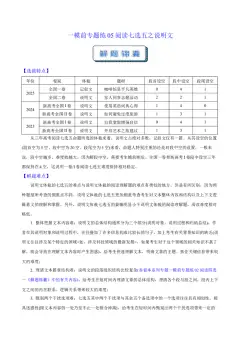
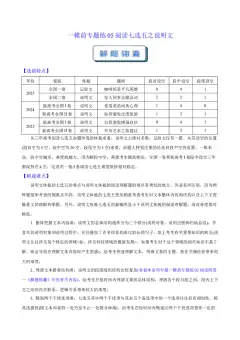
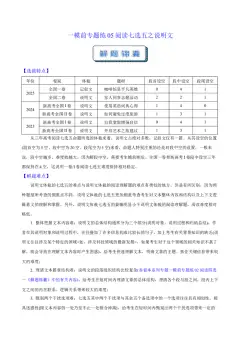
猜押 05 阅读理解说明文(按话题分类)
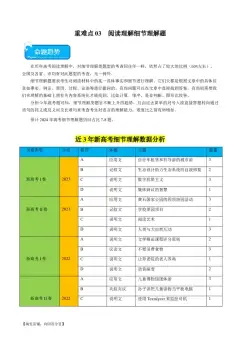
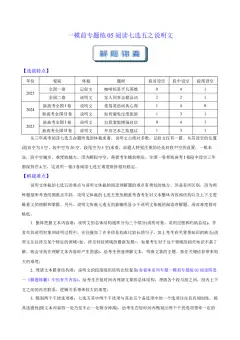
3年真
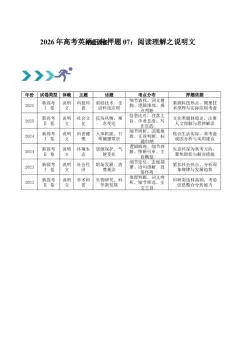
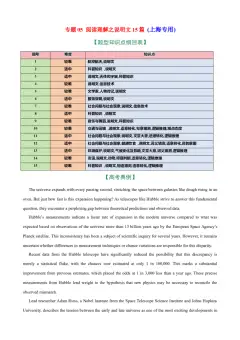
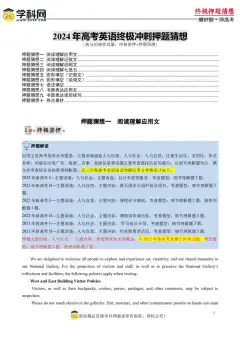
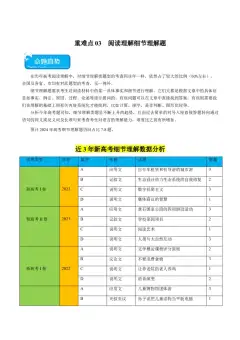
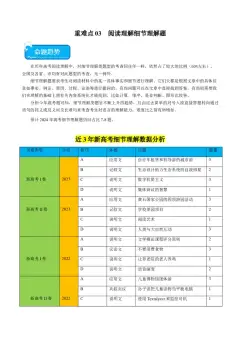
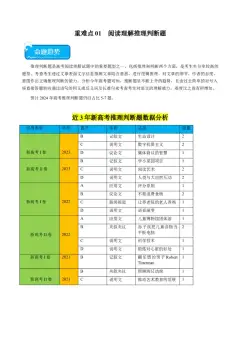
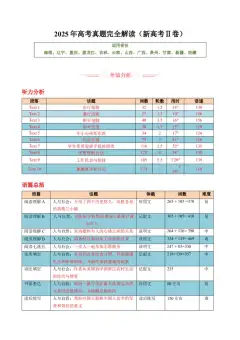
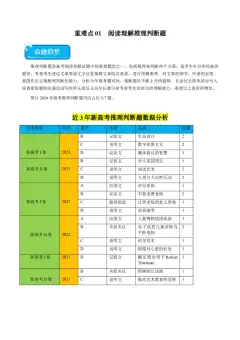
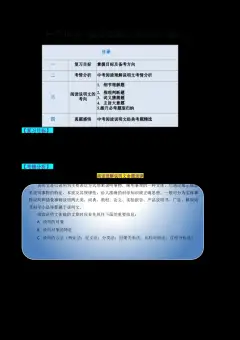
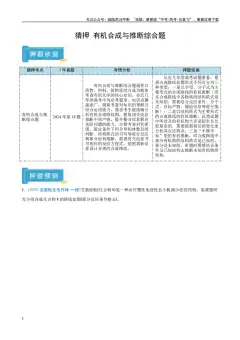
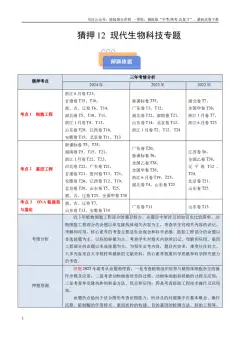
猜押考点 考情分析 押题依据
题
2023年6 科技前沿:如元宇宙、基因编
月上海高 辑,需关注多模态文本(图表
考英语 +文字)。
阅 读 理 近年考情:运动损伤预防(2021)、
2024年1 健康科学:饮食与认知、睡眠
解 说 明 无人驾驶技术(2021)、大脑发展
月上海春 研究,强调科学研究方法。
文 (2024)。
季高考英
语
一,科技前沿
1.学易金卷:2025年高考第一次模拟考试
It’s 2076 and the skies are looking decidedly milky. On windy plains and in parts of the seas
that have been turned over to wind farms, a different kind of tower has been built alongside the
turbines (涡轮). They take in CO out of the atmosphere. Vast parcels of land have been given over
2
to forest. Trees are grown, harvested and burned for energy in power plants that don’t let CO escape
2
to the atmosphere. Instead, emissions are captured and driven underground. Powdered minerals are
put into the water to absorb CO and reduce ocean acidification.
2
All these technologies are a desperate action to reverse more than two centuries of greenhouse
gas emissions. But they are not entirely up to the task and, anyway, we are still releasing greenhouse
gases. “I think it’s very likely that in 60 years we’ll be using both technologies,” says John Shepherd
of the University of Southampton, UK. He is referring to the two flavors of geoengineering:
absorbing CO out of the air and using a sunshade to reflect some of the sun’s rays back out into
2
space.
There is no denying that climate talks are going too slowly and not so smoothly. Even ifindustrial emissions were to drop rapidly — a big if — some sections pose an intractable problem.
We have no real replacement for aeroplane fuel and feeding people demands intensive agriculture,
which accounts for a quarter of global emissions.
Computer models suggest there will be winners and losers. While a sunshade could lower
global average temperatures to pre-industrial levels, there would be regional differences. Northern
Europe, Canada, Siberia and the poles would remain warmer than they were, and temperatures over
the oceans would be cooler. Global warming is predicted to make wet regions wetter and dry ones
drier. Models suggest a sunshade would correct this, but, again, not in a uniform way.
Shepherd fears all this will feed into international arguments. He imagines some kind of global
council where governments seek a climate that meets their needs. Some might prefer a slightly
warmer temperature, for tourism or agriculture. But nations whose coral reefs (珊瑚礁) draw in
visitors will probably want more CO absorbing technologies.
2
In spite of all these concerns, most scientists hold that revolutionary technology and people’s
awakening can shine a light on solutions in ways that are impossible now. There is undoubtedly a
long way to go when we address problems facing mankind, but we can always anticipate something.
1.What is described in the first paragraph?
A.Future scenery and farming methods.
B.The development of transport technology.
C.The serious pollution problem in the very near future.
D.Future technologies to reduce greenhouse gas emissions.
2.The word “intractable” in paragraph 4 most probably means “______”.
A.solvable B.untypical
C.tricky D.existing
3.It can be inferred from the passage that ______.
A.climate talks haven’t achieved the expected results
B.industrial emissions will decrease greatly in 60 years
C.technologies to reduce CO emission aren’t used properly for now
2
D.sunshades outshine intensive agriculture at capturing CO emissions
2
4.What is the main idea of the passage?
A.Effective CO absorbing technologies have come into wide use.
2B.With greenhouse gas reduced, global warming can be addressed.
C.Future climate will improve with human efforts but threats still remain.
D.Future climate will restore to a normal state with advanced technology.
2.2025届上海市高三下学期2月联考调研英语试题
Attempts to genetically engineer the American chestnut tree (Darling 58) have failed, exposing
the risks of rushed solutions to complex problems. In December 2023, the American Chestnut
Foundation (TACF) announced it was ending its years-long effort to create a blight-resistant
chestnut. These trees grew poorly, failed to resist disease, and often died.
The American chestnut, once abundant in Eastern U.S. forests, was destroyed by blight in the
early 1900s. Some surviving trees sprouted from stumps or resisted the disease naturally. Efforts to
restore the species have divided scientists into two camps: one advocating for natural restoration and
the other for genetic engineering (GE). The GE approach started in 1989, led by researchers at
SUNY-ESF with backing from industry players like Duke Energy, and Monsanto.
In 2020, researchers sought USDA approval to deregulate Darling 58. The tree was engineered
with a wheat gene to combat the acid produced by chestnut blight. However, critics argued the
testing period was too short to predict the tree’s long-term impact. The proposed plan to spread GE
traits through wild forests sparked fears of ecological harm.
By 2023, it was revealed that years of research had mistakenly used the wrong tree variety
(Darling 54). TACF withdrew support, citing poor results, reduced survival rates, and commercial
conflicts involving a for-profit company. Despite setbacks, SUNY-ESF continues to push for USDA
approval, claiming the trees are safe.
Meanwhile, organizations like the American Chestnut Cooperators Foundation focus on natural
methods, breeding pure chestnuts with blight resistance. Hybridization with Chinese chestnuts is
another method under development.
The Darling 58 debacle highlights the risks of genetic engineering and commercial motives
behind GE trees. Critics argue that GE is less about forest health and more about profits from faster-
growing or industrially modified trees. As the debate continues, the lesson remains clear: science
must proceed cautiously, especially when dealing with long-living species like trees.5.The primary purpose of this passage is to ________.
A.criticize the use of genetic engineering on chestnut trees in forest restoration.
B.describe the main history of the American chestnut tree’s decline since the 1900s.
C.explain the controversy surrounding the restoration of the American chestnut tree.
D.promote natural breeding as the best solution for chestnut tree restoration.
6.Why did the USDA petition for Darling 58 face criticism?
A.The testing period was not long enough to predict long-term effects.
B.The genetically engineered trees were not resistant to blight.
C.The USDA was accused of favoring genetic engineering companies.
D.The petition did not include input from environmental scientists.
7.According to the passage, which of the following statements is TRUE?
A.Darling 58 chestnut trees were approved for widespread planting in 2023.
B.Natural methods of restoring the American chestnut show no promise.
C.Critics believe the genetic engineering is profit-driven rather than ecological.
D.TACF fully supports SUNY-ESF’s efforts with Darling 58 chestnut trees.
8.What can be inferred about releasing genetically engineered trees into the wild?
A.It may lead to deregulation and commercialization of GE trees.
B.It will rapidly restore ecosystems with minimal risks.
C.It proves corporate interests align with environmental goals.
D.It shows GE is more reliable than natural restoration.
3.2025届上海市闵行区高三上学期质量调研(一模)英语试题
The conversational tone of an AI chatbot or voice-based assistant is a good way to learn new
concepts, but it may actually make us more willing to believe inaccuracies, compared with
information presented in a static (静态的) article.
To investigate this issue, Sonja Utz from Germany asked 1,200 participants to engage with one
of three formats. The first involved text appearing letter by letter in the style of a large model, similar
to ChatGPT; the second provided information through a voice-based device; and the third was a
static, text-based copy of content.
Participants couldn’t interact with the systems as they might with the real versions, in order tokeep the experience consistent across the study. In some cases, participants were given accurate
information, while in others, they saw factual errors. Some of these errors were plain wrong, such as
naming Sofia as the capital of France, but others involved certain statements that were contradicted
elsewhere in the same response.
Participants were asked to rate the accuracy of the information on a seven-point scale, where7
is entirely accurate. In the answers where errors were introduced, the information presented in a
static format was rated as 4.24 on average. The ChatGPT-like system managed 4.76, while the voice
assistant scored 5.29. Participants rated all of the systems higher for answers where no errors were
introduced, but the differences were smaller for the voice assistant and chatbot.
“People find conversational chat agents more convincing because humans seem to be
hardwired to assign credibility to things that seem lifelike,” says Mike Katell from UK. “The way the
chatbots and voice agents are programmed to use a friendly and helpful conversational tone also
confuses people. Chatbot makers are trying to put users at ease, which is achieved through believable
content and inoffensive delivery.”
People have learned that these models generate false information sometimes. “But people don’t
realize that this interaction mode makes us tend to believe whatever is written there.” Utz says. “That
should be in media literacy training.”
9.What was the main focus of Sonja Utz’s study?
A.Features of AI chatbots or voice-based assistants.
B.People’s preference for information sources.
C.Why static articles differ from conversational content.
D.How text formats influence information trustworthiness.
10.In paragraph 3, text errors in the study can be summarized as________
A.inevitable and conflicting
B.minor and common
C.obvious and internally inconsistent
D.repetitive and randomly selected
11.According to Mike Katell, which of the following is NOT a reason why people find
conversational chat agents more convincing?
A.People’s inborn trust in lifelike things.B.Inoffensive delivery of personalized content.
C.The chatbot’s use of a gentle conversational tone.
D.The makers’ intention to make users feel relaxed.
12.Which of the following can be inferred from the passage?
A.Utz suggests people improve media awareness and competence.
B.People’s preference for lifelike things may be overstated.
C.How information is presented doesn’t affect how much we believe it.
D.The research results are uncertain due to the lack of man-system interaction.
二,健康科学
4.2025届上海市嘉定区高三上学期一模英语试题
Some dishes give off an unmistakable air of elegance. Take a flawlessly clear consommé (清炖
肉汤) for instance. Others are less so, like a pizza with a dense crust. And then there are dishes that
seem to bridge the gap, appearing on menus across the range of taste and class. The chocolate
fondant is one such dessert, loved for its simple, rich pleasure and luxury.
The origins of the chocolate fondant are somewhat disputed, with two significant French chéfs
laying claim to its invention. The first is Michel Bras, a Michelin-starred chef who, in 1981, crafted
the coulant au chocolate-a dessert with a warm, sticky center inspired by memories of a hot cup of
chocolate after a cold day in the mountains. The second is Jean-Georges Vongerichten, another
influential chef who, in 1987, created the fondant while experimenting in New York. His version
featured small chocolate cakes with a molten (融化的) center due to a happy accident: he had
removed them from the oven too early. Despite the small accident, diners were delighted, and
Vongerichten perfected the recipe that would become his signature dish.
Though different in technique, both chéfs shared a vision of the fondant as a fancy, rich treat, a
dessert designed to satisfy both the taste buds (味蕾) and a desire for elegance. Initially, it was a
delicacy reserved for high-end dining rooms and the most exclusive restaurants. In America, it
became a symbol of refined dessert culture, representing a particular kind of elegance.
The simplicity of the fondant - a single-serving dessert with a molten core - belies its
complexity. Achieving the perfect texture and ensuring the center flows at the exact moment ofcutting are the challenges that only a skilled chef can consistently conquer. There's an element of
anticipation built into the experience: will the warm chocolate flow or remain disappointingly solid?
By the 1990s, Alain Ducasse, another highly regarded chéf, observed that the fondant had
become so popular that restaurants felt nearly forced to include it on their menus. It became the
defining dessert of the era, with chains and takeaway joints adopting their own versions. Over time,
the fondant evolved into what many now known as the “molten chocolate cake” or “chocolate lava
cake.” The dessert began to appear in grocery stores and at Valentine's Day promotions, as brands
like Costco, Aldi, and Walmart capitalized on its widespread appeal.
13.What can be learned about the origin of the chocolate fondant from the passage?
A.The dish was first introduced in grocery stores.
B.The true inventor of the dish remains uncertain.
C.Both inventors drew inspiration from their cooking experiences.
D.The creation of the dish was more intentional than accidental.
14.What does the word “belies” (paragraph 4) most probably mean?
A.Reveals. B.Defines. C.Masks. D.Explains.
15.According to the last paragraph, what contributed to the further development of the chocolate
fondant?
A.The cooperation between grocery stores and restaurants to promote the dessert.
B.Chefs simplified the recipe to make it easier for home cooks to prepare.
C.The decision to market the dessert for Valentine's Day promotions.
D.Restaurants felt pressured to offer the dessert due to its popularity.
16.What is the main idea of the passage?
A.The chocolate fondant's simplicity makes it easy for chefs to prepare.
B.The chocolate fondant has gone from a high-end dessert to a common treat.
C.The chocolate fondant originates in France and then spread to the whole world.
D.The chocolate fondant is superior to other desserts because of its molten center.
5.2024届上海市松江区高三下学期模拟考质量监控英语试卷
Precognitive dreams are dreams that seemingly predict the future which cannot be inferred
from actually available information. Former US President Abraham Lincoln once revealed thefrightening dream to his law partner and friend Ward Hill Lamon, “…Then I heard people weep…
‘Who is dead in the White House?’ I demanded. ‘The President,’ ‘he was killed!’…” The killing did
happen later.
Christopher French, Professor in the Department of Psychology at Goldsmiths, stated the most
likely explanation for such a phenomenon was coincidence ( 巧 合 ). “In addition to pure
coincidences we must also consider the unreliability of memory”, he added. Asked what criteria
would have to be met for him to accept that precognitive dreams were a reality, he said, “The
primary problem with tests of the claim is that the subjects are unable to tell when the
event(s)they’ve dreamed about will happen.”
However, some claimed to make such tests practicable. Professor Caroline Watt at the
University of Edinburgh, has conducted studies into precognitive dreaming. She stated that knowing
future through dreams challenged the basic assumption of science — causality (relationship of cause
and effect).
Dick Bierman, a retired physicist and psychologist, who has worked at the Universities of
Amsterdam, Utrecht and Groningen, has put forward a theory that may explain precognitive dreams.
It is based on the fact that when scientists use certain mathematical descriptions to talk about things
like electromagnetism (电磁学), these descriptions favour the belief that time only moves in one
direction. However, in practice the wave that is running backwards in time does exist. This concept is
called the time symmetry, meaning that the laws of physics look the same when time runs forward or
backward. But he believes that time symmetry breaks down due to external conditions. “The key of
the theory is that it assumes that there is a special context that restores the broken time-symmetry, if
the waves running backwards are ‘absorbed’ by a consistent multi-particle (多粒子) system. The
brain under a dream state may be such a system where broken time-symmetry is partially restored.
This is still not a full explanation for precognitive dreams but it shows where physics might be
adjusted to accommodate the phenomenon,” he explains.
Although Bierman’s explanation is still based on guesses and has not accepted by mainstream
science, Watt does think it is worth considering. For now, believing that it’s possible to predict future
with dreams remains an act of faith. Yet, it’s possible that one day we’ll wake up to a true
understanding of this fascinating phenomenon.
17.According to French, what makes it difficult to test precognitive dreams?A.Unavailability of people’s dreams.
B.That coincidences happen a lot in reality.
C.That criteria for dream reliability are not trustworthy.
D.People’s inability to tell when dreamt events will happen.
18.Believers in precognitive dreams may question the truth of ________.
A.the assumption of causality B.the time symmetry
C.memories of ordinary people D.modern scientific tests
19.We can infer from the passage that ________.
A.Lincoln was warned of the killing by his friend
B.Watt carried out several experiments on causality
C.researches on electromagnetism are based on the time symmetry
D.time’s moving in two directions may justify precognitive dreams
20.Which might be the best title of the passage?
A.Should Dreams Be Assessed?
B.Can Dreams Predict the Future?
C.How Can Physics Be Changed to Explain Dreams?
D.Why Should Scientists Study Precognitive Dreams?