Lesson 3 Table Manners餐桌礼仪
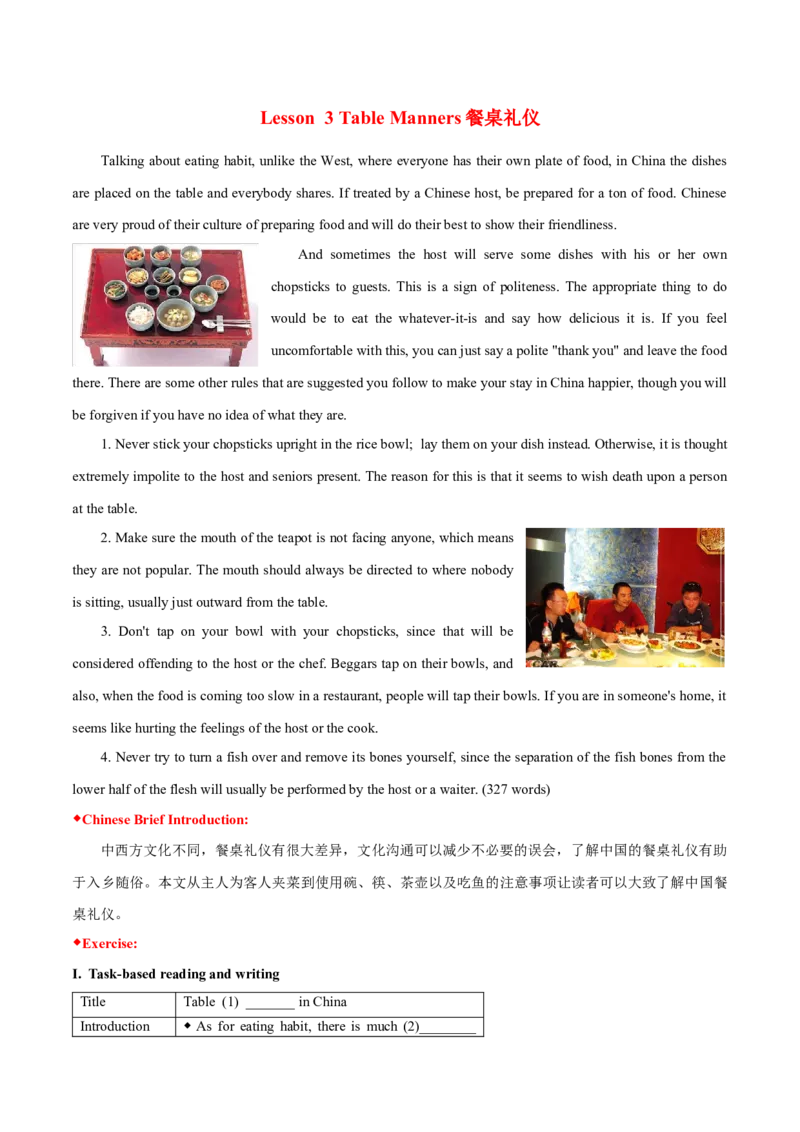
Talking about eating habit, unlike the West, where everyone has their own plate of food, in China the dishes
are placed on the table and everybody shares. If treated by a Chinese host, be prepared for a ton of food. Chinese
are very proud of their culture of preparing food and will do their best to show their friendliness.
And sometimes the host will serve some dishes with his or her own
chopsticks to guests. This is a sign of politeness. The appropriate thing to do
would be to eat the whatever-it-is and say how delicious it is. If you feel
uncomfortable with this, you can just say a polite "thank you" and leave the food
there. There are some other rules that are suggested you follow to make your stay in China happier, though you will
be forgiven if you have no idea of what they are.
1. Never stick your chopsticks upright in the rice bowl; lay them on your dish instead. Otherwise, it is thought
extremely impolite to the host and seniors present. The reason for this is that it seems to wish death upon a person
at the table.
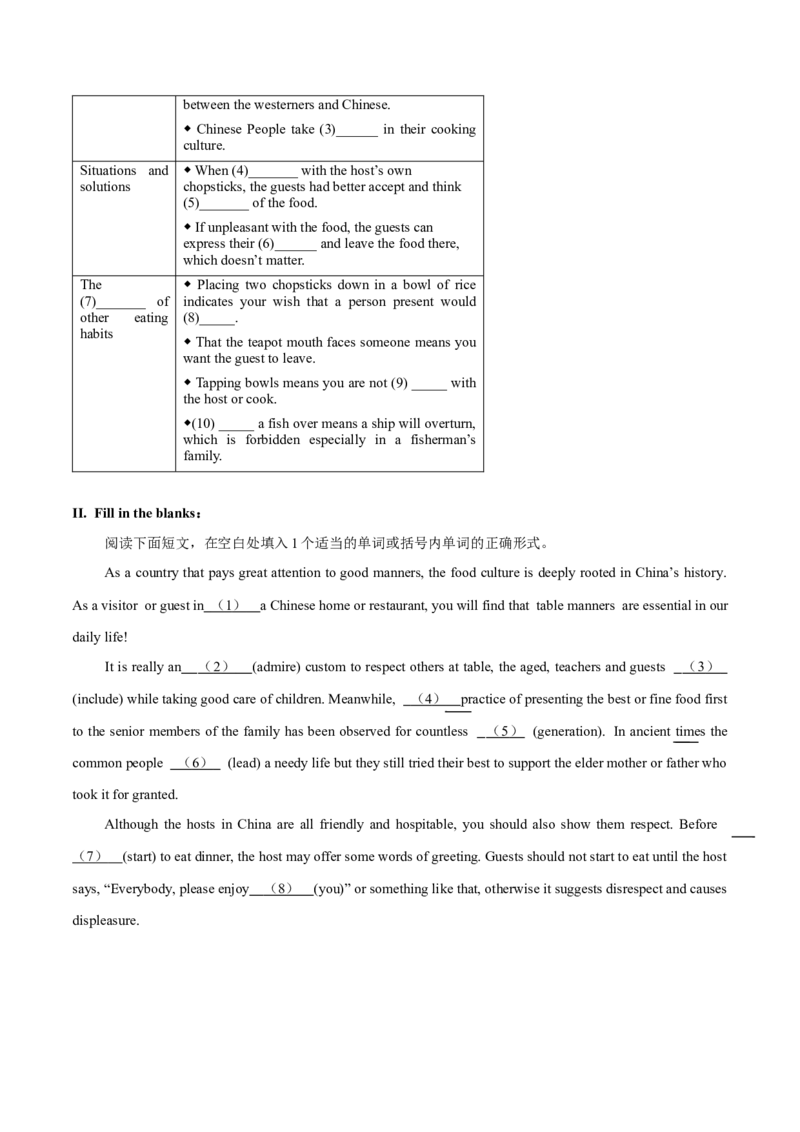
2. Make sure the mouth of the teapot is not facing anyone, which means
they are not popular. The mouth should always be directed to where nobody
is sitting, usually just outward from the table.
3. Don't tap on your bowl with your chopsticks, since that will be
considered offending to the host or the chef. Beggars tap on their bowls, and
also, when the food is coming too slow in a restaurant, people will tap their bowls. If you are in someone's home, it
seems like hurting the feelings of the host or the cook.
4. Never try to turn a fish over and remove its bones yourself, since the separation of the fish bones from the
lower half of the flesh will usually be performed by the host or a waiter. (327 words)
◆Chinese Brief Introduction:
中西方文化不同,餐桌礼仪有很大差异,文化沟通可以减少不必要的误会,了解中国的餐桌礼仪有助
于入乡随俗。本文从主人为客人夹菜到使用碗、筷、茶壶以及吃鱼的注意事项让读者可以大致了解中国餐
桌礼仪。
◆Exercise:
I. Task-based reading and writing
Title Table (1) _______ in China
Introduction ◆ As for eating habit, there is much (2)________between the westerners and Chinese.
◆ Chinese People take (3)______ in their cooking
culture.
Situations and ◆ When (4)_______ with the host’s own
solutions chopsticks, the guests had better accept and think
(5)_______ of the food.
◆ If unpleasant with the food, the guests can
express their (6)______ and leave the food there,
which doesn’t matter.
The ◆ Placing two chopsticks down in a bowl of rice
(7)_______ of indicates your wish that a person present would
other eating (8)_____.
habits
◆ That the teapot mouth faces someone means you
want the guest to leave.
◆ Tapping bowls means you are not (9) _____ with
the host or cook.
◆(10) _____ a fish over means a ship will overturn,
which is forbidden especially in a fisherman’s
family.
II. Fill in the blanks:
阅读下面短文,在空白处填入1个适当的单词或括号内单词的正确形式。
As a country that pays great attention to good manners, the food culture is deeply rooted in China’s history.
As a visitor or guest in ( 1 ) a Chinese home or restaurant, you will find that table manners are essential in our
daily life!
It is really an ( 2 ) (admire) custom to respect others at table, the aged, teachers and guests ( 3 )
(include) while taking good care of children. Meanwhile, ( 4 ) practice of presenting the best or fine food first
to the senior members of the family has been observed for countless ( 5 ) (generation). In ancient times the
common people ( 6 ) (lead) a needy life but they still tried their best to support the elder mother or father who
took it for granted.
Although the hosts in China are all friendly and hospitable, you should also show them respect. Before
( 7 ) (start) to eat dinner, the host may offer some words of greeting. Guests should not start to eat until the host
says, “Everybody, please enjoy ( 8 ) (you)” or something like that, otherwise it suggests disrespect and causes
displeasure.3. Table Manners
I. Task-based Reading and Writing
(1)Manners (2) difference (3)pride (4)served (5)highly (6)hanks (7)significance/
meaning(s)/ implication(s) (8)die (9)pleased/satisfied/content(10)Turning
II.Fill in the blanks:
(1)either (2)admirable (3)included (4) the (5)generation 6)led (7)starting (8)
yourself (9)are prepared (10)which
中国食物的象征意义
In China, foods are given particular meanings, so that a type of food can only be eaten by some specific
individuals in certain occasion, or must be eaten in specific occasion.
Usually, an honored guest will be served a snapper's head or shell to greet him and show warm welcome in
some districts.
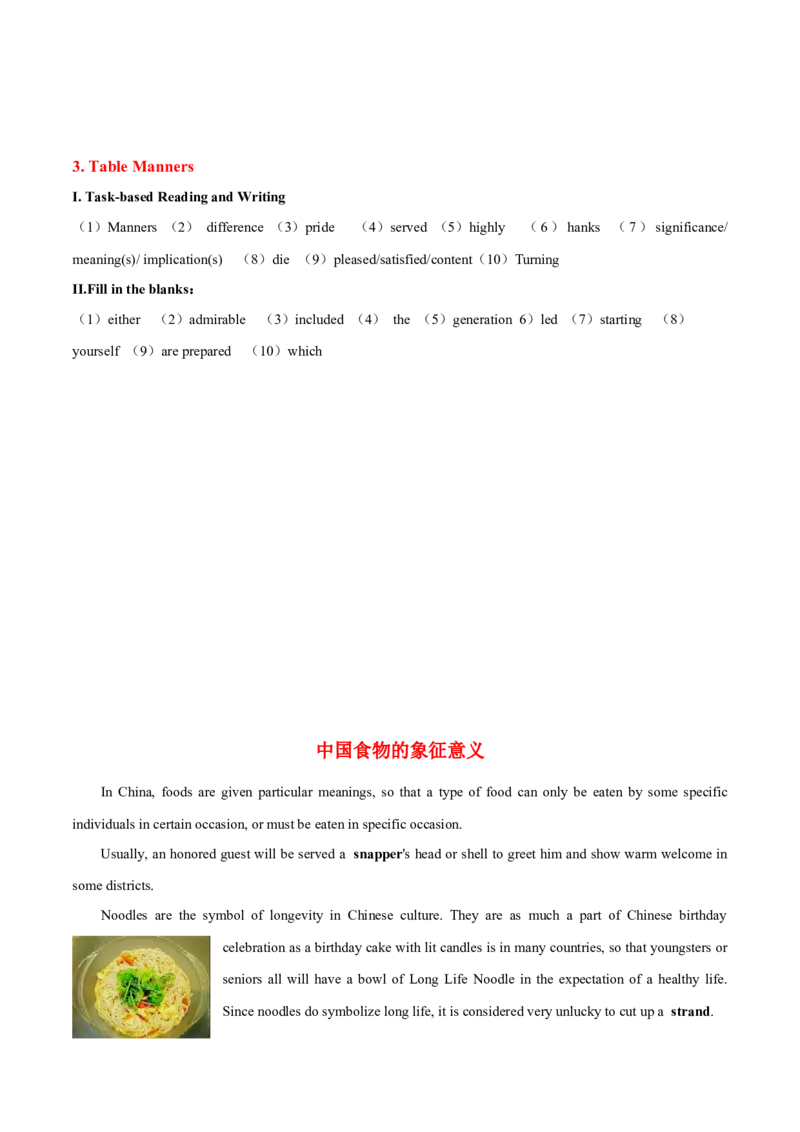
Noodles are the symbol of longevity in Chinese culture. They are as much a part of Chinese birthday
celebration as a birthday cake with lit candles is in many countries, so that youngsters or
seniors all will have a bowl of Long Life Noodle in the expectation of a healthy life.
Since noodles do symbolize long life, it is considered very unlucky to cut up a strand.Eggs hold a special symbolic significance in many cultures, and China is no exception. The Chinese believe
eggs symbolize fertility. After a baby is born, parents may hold a "red egg and ginger party", where they serve
round hard-boiled eggs to announce the birth. (In Central China, the
number of eggs presented depends on the sex of the child: An even
number, usually six or eight Red Boiled Eggs with a black point dotted
on one end will be delivered for a boy and an odd number, usually five
or seven without black point for a girl). Egg rolls or spring rolls
resemble the shape of a gold bar, and thus are often served on the New Year as a symbol of wealth and prosperity
in the coming year.
Fish also play a large role in festive celebrations. The Chinese word for fish "Yu" sounds like the
homophonic words both for wish and abundance. As a result, on New
Year's Eve it is customary to serve a fish for dinner, symbolizing the wish
for accumulations of prosperity and wealth in the coming year. In addition,
the fish is served whole, with head and tail attached, symbolizing a good
beginning and ending for the coming year.
Ducks represent fidelity in Chinese culture. If you are ever invited to a Chinese
wedding banquet, don't be surprised to spot a mouthwatering platter of Peking duck
on the banquet table. Also, red dishes are featured at weddings as red is the color of
happiness. (You may find them served at New Year's banquets for the same reason.)
Chicken forms part of the symbolism of the dragon and phoenix in Chinese culture. At a Chinese wedding,
chicken's feet, referred to as phoenix feet, are often served with dragon foods such as lobster. Chicken is also
popular at Chinese New Year, symbolizing a good marriage and the coming together of families, and serving the
bird whole emphasizes family unity.
Seeds -- lotus seeds, watermelon seeds, etc -- represent bearing many children in Chinese culture. Visit an
Asian bakery during the Chinese New Year, and you're likely to find a wide assortment of snacks with different
types of seeds in them.
There are other foods, snacks and fruits which symbolize good wishes under special circumstances. (498
words)
◆Helper:
snapper ['snæpə(r)] 甲鱼 strand [strænd] (绳子、线等的)股, 缕 fertility [fəˈtɪləti] (土地的)肥沃,肥力, 丰产homophonic [ˌhɒmə'fɒnɪk] 同音的 abundance [əˈbʌndəns] 丰富,充裕 fidelity [fɪ'delətɪ] 忠诚 platter ['plætə(r)] <美>大浅
盘 lobster ['lɒbstə(r)] 龙虾 assortment [əˈsɔ:tmənt] 花色品种 snack[snæk] 快餐,点心
◆Chinese Brief Introduction:
象征性是中国饮食文化的重要特征之一。食物和饮食行为被赋予了特定的意义,表达一种特定的文化
意蕴。长寿面是中国人每逢生辰设于宴会最后必吃食品,因面条长长的,寓意长命百岁。吃面时要将一整
条面一次吞下,既不可以筷子夹断,亦不可以口咬断之。红鸡蛋在中国民间是祥瑞之物,有赐福送子喜庆
安乐之意。 “鱼”是一个吉祥并且生动的素材,特别在中国民间取之谐音有“游刃有余”、“年年有
余”之吉意。象征幸福。花生、栗子、枣子、瓜子等寓意子孙绵延,俗称“子孙果”。旧时新娘入洞房后
的“撒帐”习俗,就是将这些果子取出放在床上,由儿童们争先抢夺,并认为抢得越多越好。
◆Exercise:
I. Questions:
1. Who will be served a snapper's head or shell? Why?
2. What do noodles symbolize in Chinese culture?
3. What do eggs symbolize in Chinese culture?
4. What do fishes and chickens symbolize in Chinese culture?
5. What do seeds symbolize in Chinese culture?
II. Written work
假设你们学校英语爱好者俱乐部将对“良好饮食习惯”这一话题进行讨论。请根据下列提示,用英语写
一篇发言稿。内容要点应包括:
部分同学的饮食习惯 良好的饮食习惯 个人看法
不吃早餐 饮食多样化 重要性
爱吃零食 饮食定时定量 有助于身体健康
偏食
饮食过量
1. Chinese Food Symbolism
II. Written work
Dear friends,
As we all know, we are what we eat. Therefore, it’s very important for us to from healthy eating habits. Butunfortunately, many of us have very bad eating habits. For instance, most students don’t eat breakfast. They eat
snacks when feeling hungry. Other students are quite choosy about food. They eat too much the food they like.
I suppose it’s important for each of us to from healthy eating habits and balanced diets.
First, we should remember to eat a variety of food, because the nutrition that we need cannot be attained from a
single kind of food. Second, we should eat appropriate portions of food at fixed times every day.
I hope everyone can form healthy eating habits, which will help us maintain healthy bodies. Then, we will be
energetic enough to devote ourselves to learning.
That’s all. Thank you!