专题 25 语法填空中国元素专练(1)
Passage 1
阅读下边短文, 在空白处填入1个适当的单词或括号内单词的适当形式。
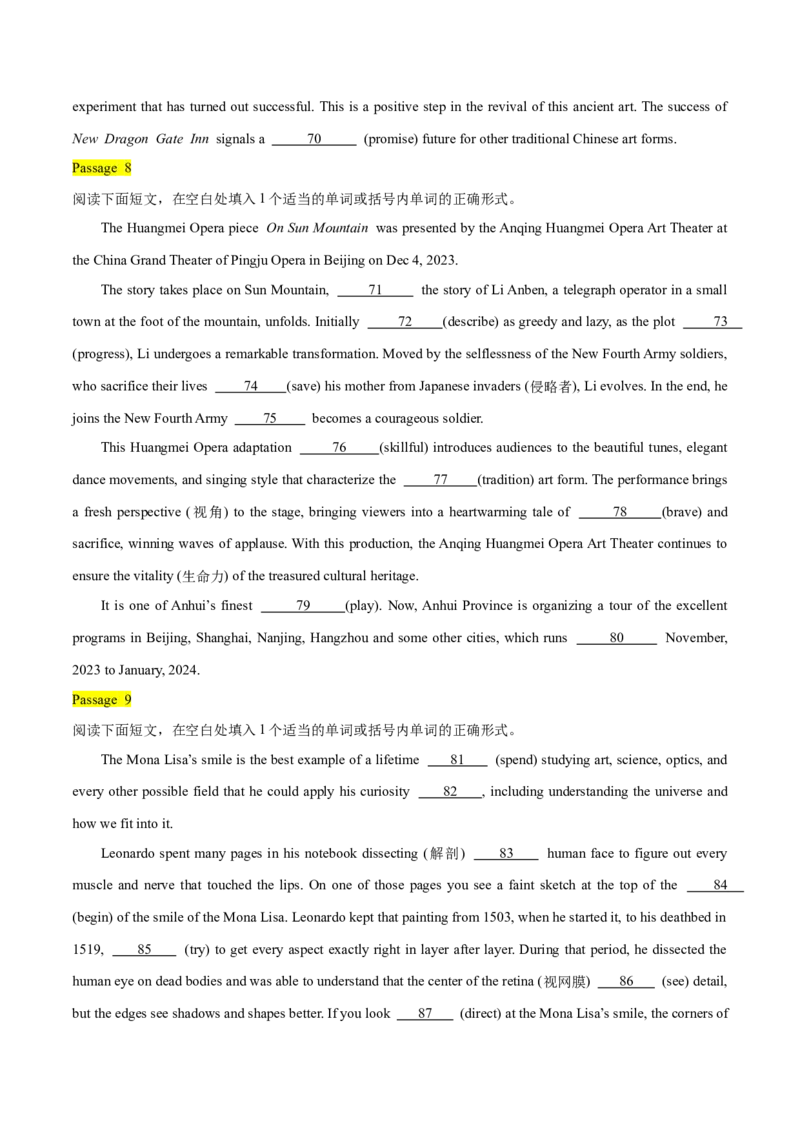
2024 is “The Year of the Dragon” on the Chinese lunar calendar. But 1 that’s the proper translation
of the iconic mythical symbol of China or not has aroused 2 (heat)debate.
The Western concept of dragon is not consistent with 3 of the Chinese dragon. Influenced by Greek
mythology, the dragon is often the keeper of treasure. For Europeans, dragon is usually a monster 4
(keep) distances away from people. With four legs and two huge black wings, they can spit fire or even poison gas
out of their mouth. Contrary 5 the evil image of European dragons, Chinese dragons symbolize 6
(strong) and goodluck. In Chinese legends, dragons were appointed head of the four seas, rulers of weather and
water. Those born in the year of the Loong are believed 7 (be)interested in the world and willing to give a
helping hand.
The differences in perception of the mythical creatures in China and the West 8 (root)in their different
cultural values. What is important is that as we enter 9 new lunar year, people 10
(global)appreciate the cultural values embodied in such Chinese symbols as Loong.
Passage 2
阅读下面短文,在空白处填入1个适当的单词或括号内单词的正确形式。
Peking Opera actress Dong Yuanyuan proposed integrating the art of Peking Opera with digital technology to
compete for more young audiences. 11 a national treasure in China, the art form is becoming more and more
alienated, especially by younger generations. Her 12 (propose) might be one of the most effective ways to
help resolve the problem.
In November 2021, the “Digital Mei Lanfang” project 13 (launch) in Beijing. The late Mei Lanfang
(1894-1961) now, is once again able to “appear” in front of audiences thanks to digital technology. Dong got very
excited and emotional 14 she saw that Master Mei was “really talking” on stage.
Since then, she 15 (work) hard to deeply integrate the traditional Chinese art with modern technology.
In addition, Dong has adopted more flexible means 16 (promote) Peking Opera and suggests that traditional
artistic elements, such as tunes from Peking Opera, could also be used in pop songs in an ancient Chinese style. So
far, a dozen such songs have been very well-received by audiences, 17 (include) young people. However,
there are many obstacles to overcome.A tech expert mentioned it was very difficult to imitate Master Mei’s facial expressions and voice as well as
the materials of his costumes. This project was not only a process of technological implementation, but also one
18 integrated technology with traditional culture. So there is a 19 (true) long way to go before a digital
Peking Opera human with real-time interaction capability is created.
A digital Mei Lanfang is a good beginning, a breakthrough in promoting Peking Opera 20 other
traditional art forms. Therefore, all levels of society should pay attention and lend their support to this endeavor.
Passage 3
阅读下面短文,在空白处填入1个适当的单词或括号内单词的正确形式。
China is known as Xia for its grand etiquette (礼仪) culture, and known as Hua for its beautiful attire (衣裳).
With the 21 (change) in society, economic development, and cultural development, clothing has evolved
over thousands of years. However, while the forms may have been changed, the essence ( 本质) 22
(remain) constant.
“In ancient China, emperors like Huangdi. Yao, and Shun brought peace to the world through their clothing.”
Clothing holds 23 significant place in Chinese culture. It is not only used for daily wear, 24
(cover) the body and protect it from cold but also as an instrument of management. In ancient Chinese society, there
were strict rules and dress codes about clothing. The presence of clothing distinguished civilization 25
barbarism (野蛮), while changes in color and style 26 (gradual) developed into a form of etiquette. Their
design conveyed behavioral norms and 27 (they) patterns were rich in cultural significance. Moreover,
ancient attire were also an important carrier of morality. China has always been known as a nation 28
values formal attire and etiquette.
What is the Chinese style? It is something that makes people think of China as soon as they see it. For
example, the horse-face skirt, which 29 (favor) by international brands and Chinese people for many
years, will continue to be attractive. Chinese clothing, as a classical style. has been known to the world overnight
with good opportunities. It’s not just a traditional costume style but also a source of 30 (admire).
Passage 4
阅读下面短文,在空白处填入1个适当的单词或括号内单词的正确形式。
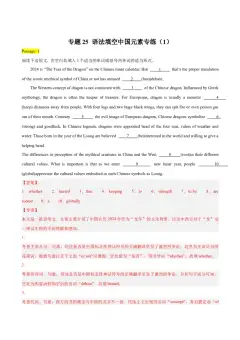
Chinese pastries (糕点) have a rich and divers history that spans thousands of years. Traditional Chinese
pastries are popular 31 their beautiful shapes, delicate flavors and cultural symbolism.
The origins of Chinese pastries can be traced back to ancient times when they were primarily made for 32
(religion) ceremonies and special occasions. Over centuries of evolution, Chinese pastries 33 (develop),combining various regional flavors and techniques.
During the Tang dynasty, Chinese pastries experienced a significant 34 (grow) in popularity. The Tang
dynasty emperors were known for their love of desserts and pastries, 35 led to the development of
numerous delicate and complicated pastry recipes.
It was during this time 36 many symbolic pastries were created, and the art of pastry-making reached
new heights.
Mooncakes, closely 37 (associate) with the Mid-autumn Festival, are among the most famous Chinese
pastries. Mooncakes have a history 38 (date) back over 1,000 years. They were 39 (original) used as
an offering 40 (honour) the moon goddess during the harvest season. Mooncakes are often imprinted
with amazing designs and symbols that represent good luck and prosperity.
Each region in China has its own pastries with distinct flavors, ingredients and making methods. Chinese
pastries are an essential part of Chinese cuisine and cultural traditions.
Passage 5
阅读下面短文,在空白处填入1个适当的单词或括号内单词的正确形式。
There is a Chinese story of an old man in his 90s working with his family to remove mountains to connect the
outside world 41 others’ doubts. The story has inspired the Chinese to unite and overcome difficulty with
42 (determine) and hard work.
The story became a reality in Lin County, Henan Province in the 1960s. A 1,500-kilometer-long waterway
along the cliffs (悬崖) of the Taihang Mountains 43 (build) by the local people within 10 years, bringing
precious water from the Zhanghe River in the bordering Shanxi Province to the drought-hit area.
Initially, finding drinking water was 44 headache for residents: People had to fetch water from five
kilometers away every day. 45 (ease) this area’s water shortages, the local government decided to construct
a canal across the mountains, 46 construction was a remarkable engineering achievement.
People tied ropes around their waists and 47 (hang) off cliffs, drilling holes in rock, and then dug
canals with simple tools. From February 1960 to July 1969,they leveled 1,250 mountain tops and dug 211 tunnels
(隧道), 48 (remove) 22.25 million cubic meters of earth and rocks.
Their efforts gained multiple 49 (benefit). It was the canal that 50 (dramatic) changed the
life of the local people, irrigating (灌溉) 36,000 hectares of land and solving water supply difficulties to some
567,000 people. Their deeds have been hailed (称颂) as the “spirit of the Red Flag Canal.”
Passage 6阅读下面短文,在空白处填入1个适当的单词或括号内单词的正确形式。
The Qingming Festival by the Riverside, which 51 (measure) 24.8 by 528 cm, is now in the
collection of the Palace Museum in Beijing. It portrays street scenes of Bianjing, the capital of the Northern Song
Dynasty (960—1127). The work was created by Zhang Zeduan, a native of Shandong Province, 52
studied painting in his early years. Later, Zhang became a painter for the Imperial Painting Academy of the
Northern Song Dynasty. 53 the fact that there aren’t many historical records about Zhang, his name is
remembered 54 (simple) due to this masterpiece.
The painting features magnificent and complex scenes with a rigorous structure, which can 55
(divide) into three parts: scenes of the suburbs, Bian River and city streets. Some interesting scenes are presented
56 great detail. In the suburban scene, farmers are working in the fields and 57 (wealth) people are
returning home. The street is crowded with people on horseback, wheel carts and sedan chairs. The scene of the
Bian River is the most magnificent: The arched bridge stands like a rainbow over the river with streams of people
58 (move) about. Under the bridge are many boats competing for the right of way. All such elements reveal the
59 (painter) supreme painting skills and his careful 60 (observe) of life.
Passage 7
阅读下面短文,在空白处填入1个适当的单词或括号内单词的正确形式。
In a specially designed studio theater in Hangzhou, a latest Yueju Opera production, New Dragon Gate Inn
performed by Xiao Bai Hua Opera troupes (剧团), has emerged 61 an immediate hit. It not only
showcases a traditional art form that definitely 62 (deserve) more attention, but also wins younger
audiences who are usually not opera-goers.
The name of the adapted work is the same as that of the 1992 classic martial arts film. 63 (wise), the
Shaoxing Opera captures the interest of a younger audience by combining traditional Chinese opera with modern
theater models and dramatic concepts. The audience sits very close to the performers, engaging with them and
immersing themselves in 64 unique and fascinating viewing experience.
Through her cross-dressed role Jia Ting, 31-year-old female performer Chen Lijun has suddenly risen to
fame due to her gorgeous appearance, elegant air 65 skillful performance. A livestream of the opera in
August attracted millions of viewers and sparked heated discussions online, 66 (earn) over 14,000
comments. Clips of her performances, such as a scene 67 she effortlessly spins the landlady around with
just one arm, went viral on various social media 68 (platform).
In addition to the bold and innovative 69 (adapt), the marketing approach has also been a newexperiment that has turned out successful. This is a positive step in the revival of this ancient art. The success of
New Dragon Gate Inn signals a 70 (promise) future for other traditional Chinese art forms.
Passage 8
阅读下面短文,在空白处填入1个适当的单词或括号内单词的正确形式。
The Huangmei Opera piece On Sun Mountain was presented by the Anqing Huangmei Opera Art Theater at
the China Grand Theater of Pingju Opera in Beijing on Dec 4, 2023.
The story takes place on Sun Mountain, 71 the story of Li Anben, a telegraph operator in a small
town at the foot of the mountain, unfolds. Initially 72 (describe) as greedy and lazy, as the plot 73
(progress), Li undergoes a remarkable transformation. Moved by the selflessness of the New Fourth Army soldiers,
who sacrifice their lives 74 (save) his mother from Japanese invaders (侵略者), Li evolves. In the end, he
joins the New Fourth Army 75 becomes a courageous soldier.
This Huangmei Opera adaptation 76 (skillful) introduces audiences to the beautiful tunes, elegant
dance movements, and singing style that characterize the 77 (tradition) art form. The performance brings
a fresh perspective (视角) to the stage, bringing viewers into a heartwarming tale of 78 (brave) and
sacrifice, winning waves of applause. With this production, the Anqing Huangmei Opera Art Theater continues to
ensure the vitality (生命力) of the treasured cultural heritage.
It is one of Anhui’s finest 79 (play). Now, Anhui Province is organizing a tour of the excellent
programs in Beijing, Shanghai, Nanjing, Hangzhou and some other cities, which runs 80 November,
2023 to January, 2024.
Passage 9
阅读下面短文,在空白处填入1个适当的单词或括号内单词的正确形式。
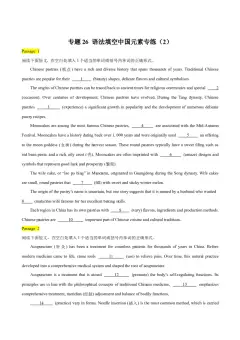
The Mona Lisa’s smile is the best example of a lifetime 81 (spend) studying art, science, optics, and
every other possible field that he could apply his curiosity 82 , including understanding the universe and
how we fit into it.
Leonardo spent many pages in his notebook dissecting (解剖) 83 human face to figure out every
muscle and nerve that touched the lips. On one of those pages you see a faint sketch at the top of the 84
(begin) of the smile of the Mona Lisa. Leonardo kept that painting from 1503, when he started it, to his deathbed in
1519, 85 (try) to get every aspect exactly right in layer after layer. During that period, he dissected the
human eye on dead bodies and was able to understand that the center of the retina (视网膜) 86 (see) detail,
but the edges see shadows and shapes better. If you look 87 (direct) at the Mona Lisa’s smile, the corners ofthe lips turn downward slightly, 88 shadows and light make it seem like it’s turning upwards. As you move
your eyes across her face, the smile flickers on and off.
Being curiosity about everything just for 89 (curiosity) sake, not simply because it’s useful, is the
90 (decision) trait of Leonardo.
Passage 10
阅读下面短文,在空白处填入1个适当的单词或括号内单词的正确形式。
As an epic (史诗) 91 brings back to life some of the most famous poets from the Tang Dynasty
(618-907), the highly 92 (expect) animated movie Chang’an held its premiere (首映) in 93
was once its namesake city, now known as Xi’an, 94 provincial capital of Shaanxi province on July 2.
Produced by Light Chaser Animation, a Beijing-based animated studio known for its focus on tales inspired by
traditional culture and mythology, the film 95 (release) nationwide this past summer.
96 a runtime of 168 minutes, the longest of any Chinese animated movie to date, Chang’an
describes the decades-long friendship of Li Bai, arguably the country’s most beloved poet, and Gao Shi, his close
friend and a noted poet as well, and also 97 (reveal) the dynasty’s transition from peak prosperity to
decline due to the unrest caused by An Lushan, who was once one of Emperor Xuanzong’s most favored 98
(general).
Xie Junwei, who co-directs the movie with Zou Jing, says that he made multiple trips to Xi’an in search of
inspiration during the production, 99 (add) that the small statues and ancient paintings exhibited at the
Shaanxi History Museum provided them with 100 (value) ideas for the film.
Passage 11
阅读下面短文,在空白处填入1个适当的单词或括号内单词的正确形式。
The Golden Panda Awards, 101 (host) by the China Federation of Literary and Art Circles and the
Sichuan provincial government, will be held in Chengdu, Sichuan province on Sept. 19 and20, according to a news
conference on Saturday.
It is an international communication award that demonstrates the concept of community with a shared future,
rather than a 102 (profession ) film and television award. In terms of the composition of the judges, the
number of foreign judges will account 103 at least 40% of the judging panel, 104 also demonstrates
the internationality and openness of the Golden Panda Awards.
Aiming 105 (be) an international grand event to deepen cultural exchanges, the Golden Panda Awards
opens to excellent film and television works. Through the event, the world can get closer to China, let Chinaembrace the world and 106 (well) carry out cultural exchanges and learning.
The First Golden Panda Awards has four 107 (category):film, TV series, documentary and animation
with three main activities, as well as three supporting events: visiting events, public film screening 108 new
exhibitions. So far, a total of 90 films and TV series from 7,024 submission s by artists of 104 countries and regions
like the US, India and Iran 109 (select) for the next stage.
With the panda a cultural symbol and films and TV series as a carrier, the Golden Panda Awards builds a
platform for mutual learning and cultural exchange among civilizations, 110 (present) the diversity of
world's civilizations.
Passage 12
阅读下面短文,在空白处填入1个适当的单词或括号内单词的正确形式。
What is painting? Painting is a centuries-old form of fine art that involves 111 (careful) spreading paint
on a canvas (画布) to create a picture. As mentioned above, a painter applies paint to a canvas to create a scene.
However, painting is often much more than simply 112 (create) pictures. Artists often use their paintings
113 a means of self- expression, for example. Nearly every painting they create is meant 114 (show)
certain feelings or emotions.
People who are interested in becoming a painter should earn a college degree in fine arts. During 115
course of their schooling, these people usually take a number of painting and art 116 (lesson) to develop
their talent and to learn about different painting styles and techniques. Some art-learning students aim to be artists
specializing in fixing 117 (damage) old paintings. Before they are trusted with very 118 (value)
paintings, they must usually complete an apprenticeship (学徒期), in 119 they will learn how to fix old
paintings from an experienced artist. If these art-learning students can gain enough skills in their apprenticeship,
possibly they 120 (get) a job in the museums or galleries to help protect masterpieces (杰作) by other
artists.
Passage 13
阅读下面短文,在空白处填入1个适当单词或括号内单词的正确形式。
Post-00s is a documentary about growing up, 121 covers almost every aspect of Millennials’ (千禧
一代的) experiences on their path toward adolescence. But this five-episode series is 122 (basic)
different from any other TV program with a similar theme. Post-00s was filmed over 10 years, during which it
followed several kids from their infancy to adolescence. In 123 words, the show’s characters and their
stories are all real.“Coming-of-age” stories, as we know, have a special appeal. They satisfy our 124 (curious) of
looking at others’ life, and we become 125 (attach) to the characters as if we truly knew them.
This realness can also be seen in Boyhood, a 2014 film winning the Silver Bear award for best director.
During a period of 12 years, the film 126 (follow) the life of Mason Jr. — played by US actor Ellar
Coltrane—from when he was 6 years old 127 when he finished high school.
One of Boyhood’s attractions comes from its “ordinariness”. Mason Jr. isn’t some child genius, 128
rather a fairly typical American boy who grows up in the Texas suburbs.
Ordinary 129 coming-of-age stories may look on the outside, they often allow us to look underneath
the surface and see the power of life 130 (it).
Passage 14
阅读下面短文,在空白处填入1个适当的单词或括号内单词的正确形式。
As the sun rises over his tea farm in Ning’ er county in Pu’ er, Yunnan province, Li Xingchang walks around,
131 (examine) the leaves of the plants.
Last November, China’s traditional tea-processing techniques and their associated social practices were listed
on the UNESCO’s Representative List of the Intangible Cultural Heritage of Humanity. Pu’er tea 132
(include) on the list.
Li’s family began making Pu’ er tea during the Emperor Yongzheng period(1723–35). He is now the 133
(eight) generation with expert skills in the process.
When Li was a child, he would go to the plantation with his parents 134 (help) them pick leaves at
harvest time. 135 a history of several hundred years, the ancient plantation was his playground. Most of his
childhood 136 (memory) are associated with it, such as climbing tea trees and playing games with his
friends.
In 1987, Li started learning 137 to make Pu’er tribute tea from his mother, 138 he said was
very strict. From planting to the complicated processes of tea making, it took him 10 years to win his mother’s
139 (approve).
“If I didn’t do well, she would throw away the leaves or refuse to drink the tea I made. When one day, she
smiled after taking a sip, I knew I 140 (make) it,” recalls Li.
Passage 15
阅读下面短文,在空白处填入1个适当的单词或括号内单词的正确形式。
The term Xuan paper first appeared in On Famous Paintings through the Ages, a book written by TangDynasty (618-907) scholar Zhang Yanyuan, 141 he described Xuan paper as an ideal carrier for
calligraphy and painting. Handmade Xuan paper from Jingxian county, East China’s Anhui province, was listed
142 a tribute (贡品) to the imperial court for its supreme quality during the period.
The traditional craft of making Xuan paper is 143 (extreme) demanding. Sandalwood bark, a plant
native to southern China, 144 (go) through 108 procedures together with rice straw over the course of
three years before it can transform fine Xuan paper. 145 entire procedure is so complex that even the
most skilled craftsman can only master limited number of 146 (step).
The flow of ink, both guided and resisted by water, determines the output of Chinese art, and Xuan paper
outshines others with its excellent ability 147 (give) full play to ink. Xuan paper 148
(accompany) the passionate brushstrokes (笔画) of the Chinese literati (文人) for thousands of years. Unlike other
forms of paper, it is very resistant to damage 149 (bring) by time. It is this durability that has made the
preservation of many 150 (value) works from ancient China possible.