专题 23 语法填空专练(有提示词)
知考法 明考向:
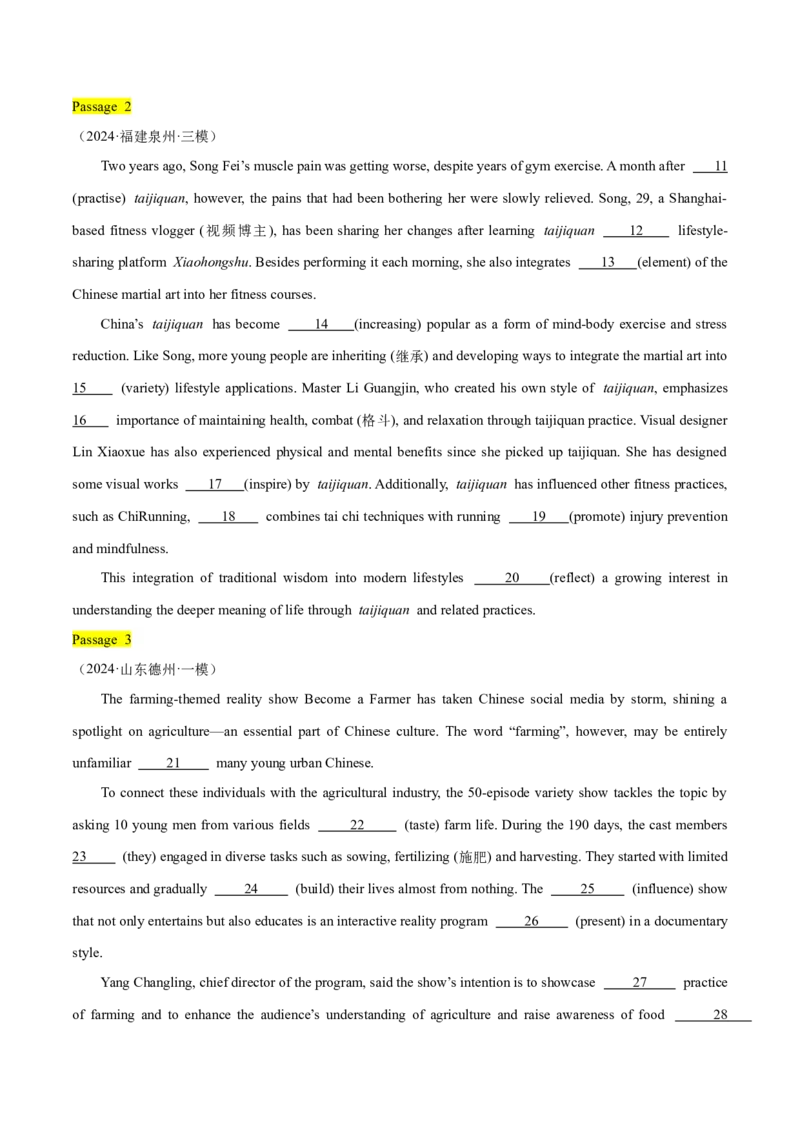
语法填空考查形式分为有提示词和无提示词两种,有提示词设空一般为7个,提示词多为实词(动词、名词、
形容词、副词、代词等),主要考查实词的词性转换或基本用法,如动词的时态、语态、非谓语动词、主谓一
致;名词的单复数;形容词和副词的比较等级等。语法填空命题规律主要体现在:
1.从句子结构及语法形式入手考查句子常识和基础语法,语篇中的句子结构和常见的语法形式是命题重点;
2.从词汇的本义、转义和前后缀的变化入手考查词性转换,词性转换以实词中的名词、动词、形容词以及副
词为主。
做 真 题 悟技法
(2023·新课标 I)Xiao long bao (soup dumplings), those amazing constructions of delicate dumpling
wrappers, encasing hot, 1 (taste) soup and sweet, fresh meat, are far and away my favorite Chinese street
food. The dumplings arrive steaming and dangerously hot. To eat one, you have to decide whether 2
(bite) a small hole in it first, releasing the stream and risking a spill (溢出), 3 to put the whole dumpling
in your mouth, letting the hot soup explode on your tongue. Shanghai may be the 4 (recognize) home of
the soup dumplings but food historians will actually point you to the neighboring canal town of Nanxiang as Xiao
long Bao’s birthplace. There you will find them prepared differently — more dumpling and less soup, and the
wrappers are pressed 5 hand rather than rolled. Nanxiang aside, the best Xiao long bao have a fine skin,
allowing them 6 (lift) out of the steamer basket without tearing or spilling any of 7 (they)
contents. The meat should be fresh with 8 touch of sweetness and the soup hot, clear and delicious.
No matter where I buy them, one steamer is 9 (rare) enough, yet two seems greedy, so I am always
left 10 (want) more next time.
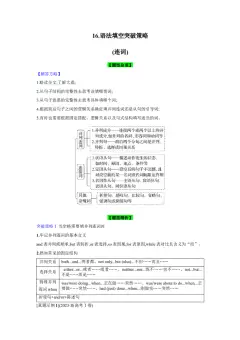
技法点拨: “一看二思”解题法
先看给的什么词,再思考转换和用法。练模拟 提能力
Passage 1
(2024·江苏泰州·一模)
The traditional Chinese painting is 1 (fundamental) an abstract art form. Objects in Chinese
paintings are a less direct copy of the natural world, 2 comparison to Western paintings. Actually, the
Chinese painting aims to demonstrate a 3 (harmony) relation between the natural world and human
emotion.
What Chinese painters would like to produce in their paintings is not a visual effect of colors and patterns that
Western painters tend 4 (achieve). The description of objects in Chinese paintings is by no means
accurate because few painters 5 (concern) about their exact size or shape. What they want to seek is a
spiritual world in their mind 6 nature provides exactly basic elements. This is how Chinese painters view
nature. Remote mountains and running streams 7 (be) the primary materials of their thinking and
creating since ancient times. Chinese artists often say that the artists first need to have a thorough and deep
understanding of the natural 8 (exist) before drawing.
With a long history of China, generations of Chinese painters express thoughts on the material world through
this unique art form and leave a valuable treasure to the Chinese. Nowadays, the Chinese painting, as 9
important part of global culture, has become increasingly attractive across the world, 10 (enjoy) great
popularity at home and abroad.Passage 2
(2024·福建泉州·三模)
Two years ago, Song Fei’s muscle pain was getting worse, despite years of gym exercise. A month after 11
(practise) taijiquan, however, the pains that had been bothering her were slowly relieved. Song, 29, a Shanghai-
based fitness vlogger (视频博主), has been sharing her changes after learning taijiquan 12 lifestyle-
sharing platform Xiaohongshu. Besides performing it each morning, she also integrates 13 (element) of the
Chinese martial art into her fitness courses.
China’s taijiquan has become 14 (increasing) popular as a form of mind-body exercise and stress
reduction. Like Song, more young people are inheriting (继承) and developing ways to integrate the martial art into
15 (variety) lifestyle applications. Master Li Guangjin, who created his own style of taijiquan, emphasizes
16 importance of maintaining health, combat (格斗), and relaxation through taijiquan practice. Visual designer
Lin Xiaoxue has also experienced physical and mental benefits since she picked up taijiquan. She has designed
some visual works 17 (inspire) by taijiquan. Additionally, taijiquan has influenced other fitness practices,
such as ChiRunning, 18 combines tai chi techniques with running 19 (promote) injury prevention
and mindfulness.
This integration of traditional wisdom into modern lifestyles 20 (reflect) a growing interest in
understanding the deeper meaning of life through taijiquan and related practices.
Passage 3
(2024·山东德州·一模)
The farming-themed reality show Become a Farmer has taken Chinese social media by storm, shining a
spotlight on agriculture—an essential part of Chinese culture. The word “farming”, however, may be entirely
unfamiliar 21 many young urban Chinese.
To connect these individuals with the agricultural industry, the 50-episode variety show tackles the topic by
asking 10 young men from various fields 22 (taste) farm life. During the 190 days, the cast members
23 (they) engaged in diverse tasks such as sowing, fertilizing (施肥) and harvesting. They started with limited
resources and gradually 24 (build) their lives almost from nothing. The 25 (influence) show
that not only entertains but also educates is an interactive reality program 26 (present) in a documentary
style.
Yang Changling, chief director of the program, said the show’s intention is to showcase 27 practice
of farming and to enhance the audience’s understanding of agriculture and raise awareness of food 28(secure) by sharing these young people’s experiences and stories of personal growth.
One view er said, “The distinctive program has enlightened me on the process of cultivating a grain of rice.
29 watches the program will realize what it takes to grow grain. I won’t waste food anymore.” Another said, “I
don’t deny 30 (amaze) by the advanced modern agricultural technology and I feel sorry for the back-
breaking work of farmers who establish deep roots in the land but only rely on the weather for their harvest.”
Passage 4
(2024·山东菏泽·一模)
The dragon, or loong in Chinese, is the only imaginary creature among the 12 Chinese zodiac signs (生肖). It
has been present in legends for thousands of years, and 31 (recognize) as a national totem (图腾) and has
a long-held spiritual importance in Chinese culture.
According to the legends, the dragon is capable of changing 32 (it) size and visibility at will. It can
be found flying through the clouds on the spring equinox (chunfen), or 33 (hide) in water on the autumn
equinox (qiufen). Its 34 (mystery) powers—particularly its control over rain— 35 (be) central
to agricultural society. The lucky creature was historically associated with the East, 36 used as a symbol to
represent imperial power, explaining the significance of the dragon in Chinese culture.
Dragons can be found throughout ancient Chinese art. The jade Jue dragon from the Liaoning Provincial
Institute of Cultural Relics and Archaeology 37 (date) back around 7,000 years to the Neolithic period
between 5,500 BC to 5,000 BC. It is 38 object from the late Hongshan culture period. It has a large
head, with pointed ears and protruding (突出的) jaws. Jue objects are widely believed to be the earliest 39
(image) of the dragon, and archaeologists have supposed that the image could 40 (original) have been
based on a pig, bear or even a silkworm.
Passage 5
(2024·山东临沂·一模)阅读下面短文,在空白处填入1个适当的单词或括号内单词的正确形式。
Playing an instrument or singing in a choir may boost your brain. For generations, parents 41
(encourage) their children to practice playing musical instruments. Parents have good reason to prioritize their
children’s musical education. Learning an instrument is not only associated with 42 (good) educational
attainment but also with improved cognitive (认知的) abilities and intelligence (智力) scores in children.
The results of a recent study 43 (investigate) this question showed that musical people had better
memory and the ability to stay 44 (focus) on tasks than those with less or no musicality.
However, 45 made a difference among those who played an instrument was whether they continuedto play 46 had only played in the past. Current amateur musicians exhibited the highest cognitive
performance among participants.
Continued engagement 47 cognitively stimulating activities, like playing an instrument, is likely
48 (lead) to sustained brain health. In contrast, playing the recorder for only three years in primary school may
not 49 (significant) impact our cognitive performance later in life.
Given the overall benefits of learning an instrument or participating in a choir, engaging in such a cognitive
50 (stimulate) as we age could be beneficial.
Passage 6
(2024·山东淄博·一模)
As social media has skyrocketed in popularity in the past years, 51 (it) lightning-fast development
has caused public concern. Overusing may lead to many serious problems, such as mental health problems, 52
(reduce) learning time and poor interpersonal quality. More and more kids of all ages are experiencing unease,
anxiety and even depression if they’re separated from their phones. YouTube boasts (吹嘘) many “funny” videos of
kids losing their temper when screens 53 (take) away. So it’s important to keep a balance between our
life on the screen 54 that in the real world.
Trying these unplugged Dos may help. First, set a schedule to put adults, teens and kids back together with
family, friends and neighbors 55 person. You can try board games instead of video games. Second, get
outside 56 (regular) to do hide-and-seek, plant a garden, or just sit and watch the birds. 57
(build) our relationship with nature increases our peace, positivity and well-being, 58 brings much
benefit. Third, get off the chair or so fa to walk, bike, stretch and dance! Remind your body it can move into other
59 (position) besides “Looking at Screen”. Last, practice mindfulness and acceptance. Mindfulness is the act
of paying attention to the present moment, without judgment. Acceptance increases peace within us, unlike social
media interaction, which 60 (promote) self-judgment and other-judgment.
Passage 7
(2024·山东青岛·一模)
Chinese Loong is the fifth animal of the 12-year Chinese zodiac cycle, 61 (consider)to be mythical and
symbolic of fortune.Recently, sales of things with dragon elements have witnessed explosive growth on e-
commerce platforms.
Data from an e-commerce platform show that searches 62 dragon-related goods via its online
marketplace have reached 23 million. 63 is said that since January, goods with dragon-themed elements,such as daily necessities, alcohol and gold jewelry, 64 (prefer)by consumers.The purchasing excitement is
expected to 65 (huge)boost consumer confidence and improve the recovery of consumption.
Purchases by the post-1990s and post-2000s generations accounted for nearly 55%, while consumers in
Guangdong province, Beijing, Jiangsu province in that order, 66 (be)the top three spenders on dragon-
featured items.Because the dragon is an important symbol of Chinese traditional culture 67 good luck,
Chinese consumers are expressing their hopes for 68 better life in the new year.
“Brands should capitalize on traditional Chinese culture to launch more innovative 69 (product),” a
research fellow said, 70 (stress)that Spring Festival is the traditional festival Chinese people attach the
most importance to, and it’s also a peak season for consumption.
Passage 8
(2024·湖北·二模)
Walking along the Great Wall is a once-in-a-lifetime dream for many, but Jim Spear has taken it one step 71
(far), spending the last 18 years living in a village beneath the ancient wonder.
72 68-year-old, a self-taught architect from the US, made the most important decision of his life to
move to China in 1986, a year before the Great Wall 73 (list) as a UNESCO World Heritage Site. Today,
Spear calls Mutianyu village home. In this quiet place, 74 (locate) at the foot of the Mutianyu section of
the Great Wall, he lives with his dog in a home with a courtyard garden he tended 75 (he).
As an architect, not only did Spear renovate (翻新) his own dream house, 76 comes with multiple
views of the Great Wall, but he also explored ways to boost the local business and support rural residents. Over the
years, the architect 77 (help) renovate around 20 households in Mutianyu, most of which now operate
78 hotels or restaurants, while 79 (do) his best to preserve the original structures as much as
possible.
In 80 (recognize) of his contributions, Spear was given the Great Wall Friendship Award in 2014.
Passage 9
(2024·湖南·二模)
Chinese ancient civilisation has continued all the way through into modern times, despite the many ups and
downs in 81 (it) history. There are many reasons why this has been possible. but one of the main factors
has been the Chinese writing system.
At the 82 (begin), written Chinese was a picture-based language. It dates back several thousand
years to the use of longgu animal bones and shells on which symbols 83 (carve) by ancient Chinesepeople.
By the Shang Dynasty, these symbols 84 (become) a well-developed writing system. Over the years.
the system developed into different forms, as it was a time when people were divided 85 (geographical),
leading to many varieties of dialects and characters. This, however, changed under Emperor Qinshihuang of 86
Qin Dynasty.
Emperor Qinshihuang unified the seven major states into one 87 (unite) country where the Chinese
writing system began to develop in one direction. Today, no matter where Chinese people live or 88
dialect they speak, they can all still communicate in writing.
Written Chinese has also become an important means 89 which China’s present is connected with
its past. The high regard for the Chinese writing system can be seen as an art form. 90 (know) as
Chinese calligraphy, which has become an important part of Chinese culture.
Passage 10
(2024·湖南长沙·一模)
A total of 12 areas across China have been required to innovate, protect and develop the copyright of Chinese
folk cultures as a national pilot program. The pilot consists 91 four provinces, including Jiangsu and
Sichuan, as well as eight cities, including Weifang and Huangshan. The program 92 (carry)out during last
year’s International Copyright Forum, 93 was held in Jingdezhen, Jiangxi province.
Folklore is an important treasure of Chinese civilization, so it is essential 94 (strengthen)the
protection, promotion and spread of folk cultures. The move is not only a requirement for promoting the 95
(create)transformation of traditional cultures, but also a key way to enhance the country’s cultural soft power and
improve 96 (it)cultural self-confidence and self-growth.
While giving full play to advantages of local folk resources and 97 (clarify)the current situation of the
country’s folk customs, the pilot areas will enhance public awareness of protecting the copyright of folk cultures
and promote copyright innovation, 98 (apply), management and services.
At the opening ceremony, Zhang Jianchun, vice-minister of the Publicity Department of the Communist Party
of China Central Committee, called for greater efforts to 99 (full)advance high-quality development and
actively encourage creation through copyright. ”Copyright protection is 100 guarantee, so we’d like to
increase exchanges and cooperation with the world,“ he said.