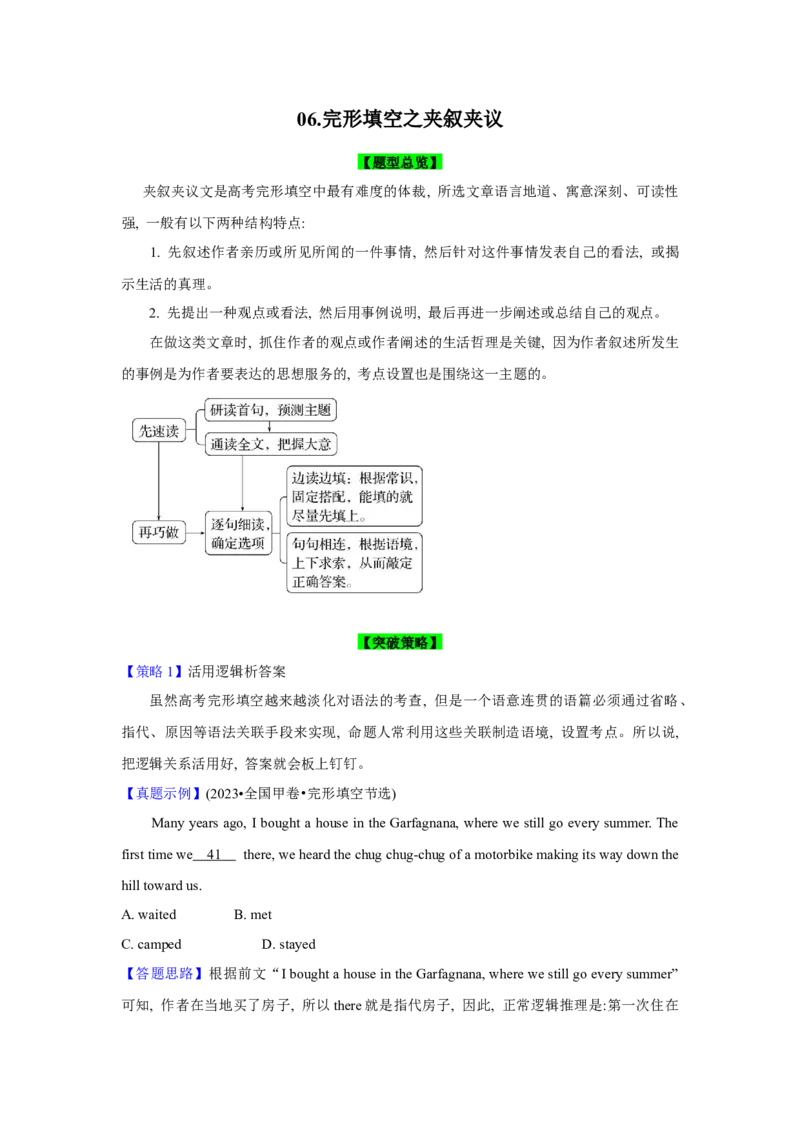
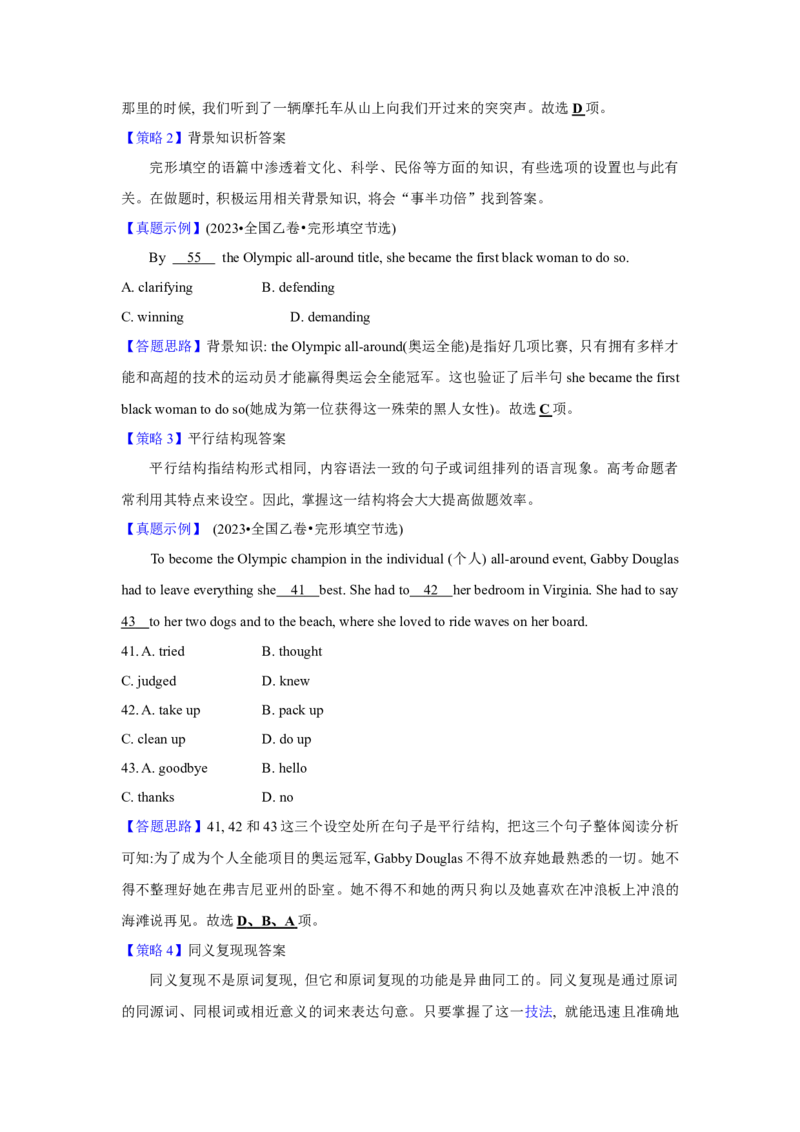
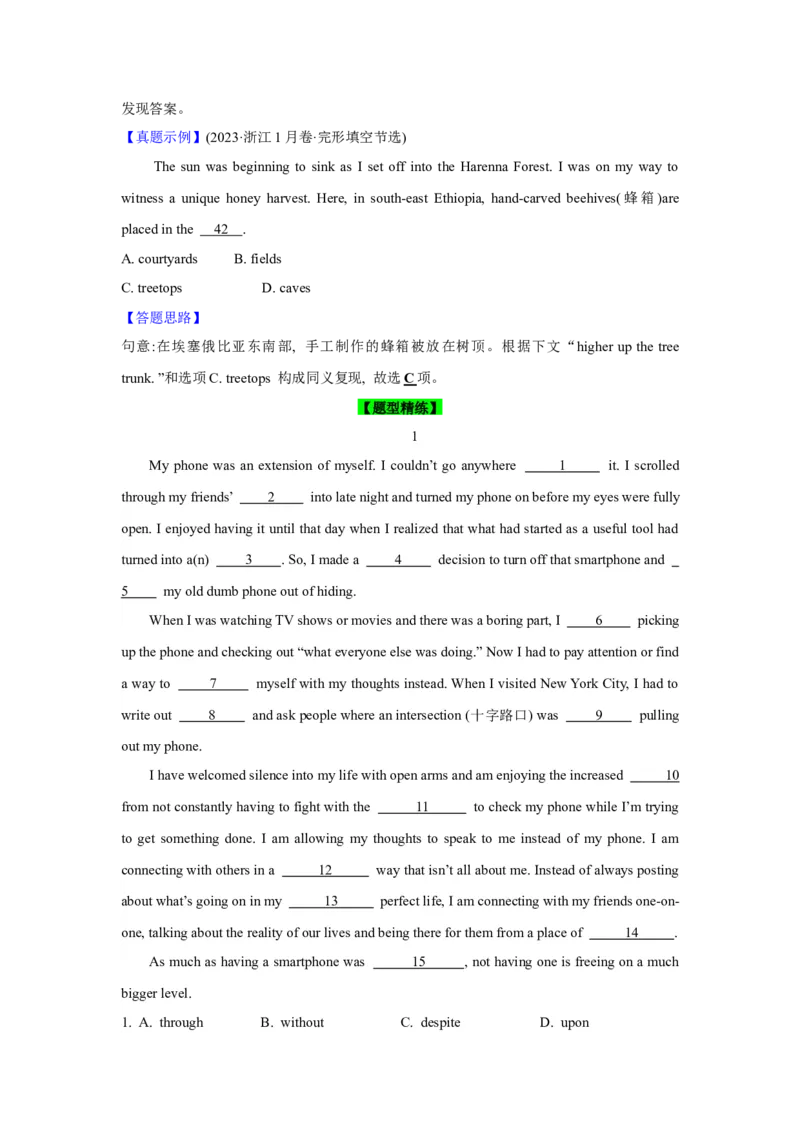
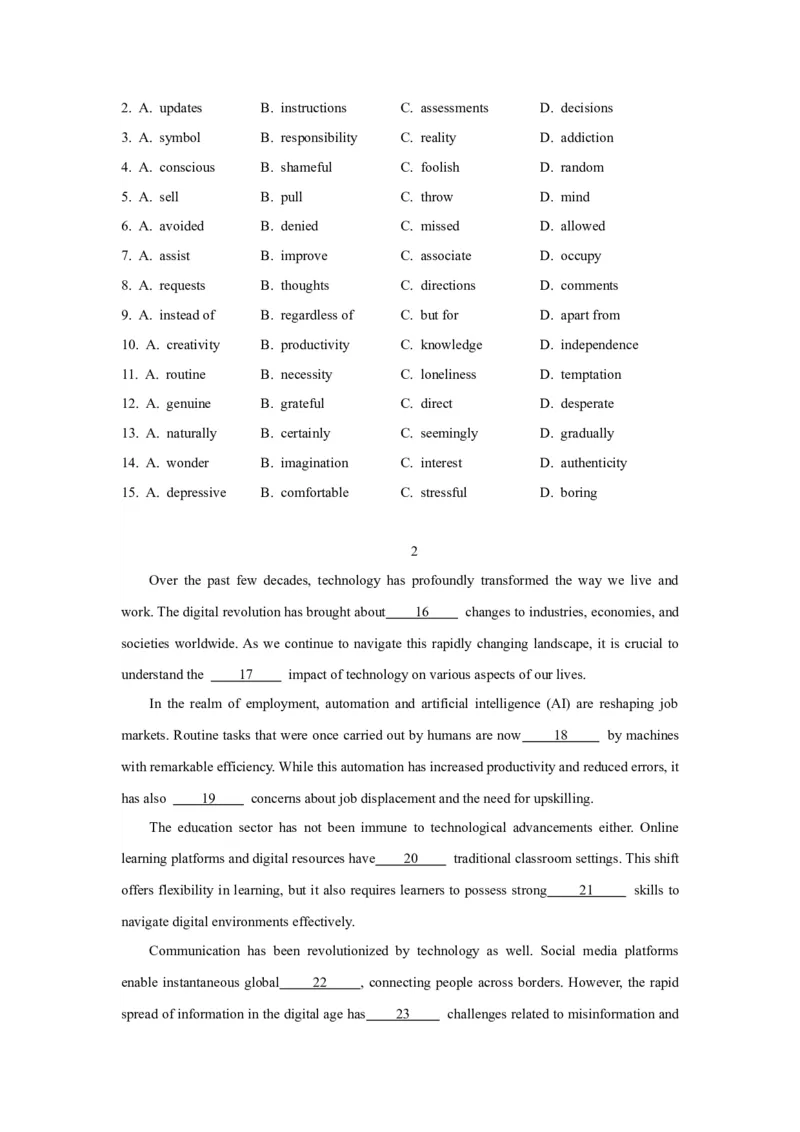
06.完形填空之夹叙夹议
【题型总览】
夹叙夹议文是高考完形填空中最有难度的体裁, 所选文章语言地道、寓意深刻、可读性
强, 一般有以下两种结构特点:
1. 先叙述作者亲历或所见所闻的一件事情, 然后针对这件事情发表自己的看法, 或揭
示生活的真理。
2. 先提出一种观点或看法, 然后用事例说明, 最后再进一步阐述或总结自己的观点。
在做这类文章时, 抓住作者的观点或作者阐述的生活哲理是关键, 因为作者叙述所发生
的事例是为作者要表达的思想服务的, 考点设置也是围绕这一主题的。
【突破策略】
【策略1】活用逻辑析答案
虽然高考完形填空越来越淡化对语法的考查, 但是一个语意连贯的语篇必须通过省略、
指代、原因等语法关联手段来实现, 命题人常利用这些关联制造语境, 设置考点。所以说,
把逻辑关系活用好, 答案就会板上钉钉。
【真题示例】(2023•全国甲卷•完形填空节选)
Many years ago, I bought a house in the Garfagnana, where we still go every summer. The
first time we 41 there, we heard the chug chug-chug of a motorbike making its way down the
hill toward us.
A. waited B. met
C. camped D. stayed
【答题思路】根据前文“I bought a house in the Garfagnana, where we still go every summer”
可知, 作者在当地买了房子, 所以there就是指代房子, 因此, 正常逻辑推理是:第一次住在那里的时候, 我们听到了一辆摩托车从山上向我们开过来的突突声。故选D 项。
【策略2】背景知识析答案
完形填空的语篇中渗透着文化、科学、民俗等方面的知识, 有些选项的设置也与此有
关。在做题时, 积极运用相关背景知识, 将会“事半功倍”找到答案。
【真题示例】(2023•全国乙卷•完形填空节选)
By 5 5 the Olympic all-around title, she became the first black woman to do so.
A. clarifying B. defending
C. winning D. demanding
【答题思路】背景知识: the Olympic all-around(奥运全能)是指好几项比赛, 只有拥有多样才
能和高超的技术的运动员才能赢得奥运会全能冠军。这也验证了后半句she became the first
black woman to do so(她成为第一位获得这一殊荣的黑人女性)。故选C 项。
【策略3】平行结构现答案
平行结构指结构形式相同, 内容语法一致的句子或词组排列的语言现象。高考命题者
常利用其特点来设空。因此, 掌握这一结构将会大大提高做题效率。
【真题示例】 (2023•全国乙卷•完形填空节选)
To become the Olympic champion in the individual (个人) all-around event, Gabby Douglas
had to leave everything she 41 best. She had to 42 her bedroom in Virginia. She had to say
43 to her two dogs and to the beach, where she loved to ride waves on her board.
41. A. tried B. thought
C. judged D. knew
42. A. take up B. pack up
C. clean up D. do up
43. A. goodbye B. hello
C. thanks D. no
【答题思路】41, 42和43这三个设空处所在句子是平行结构, 把这三个句子整体阅读分析
可知:为了成为个人全能项目的奥运冠军, Gabby Douglas不得不放弃她最熟悉的一切。她不
得不整理好她在弗吉尼亚州的卧室。她不得不和她的两只狗以及她喜欢在冲浪板上冲浪的
海滩说再见。故选 D 、 B 、 A 项。
【策略4】同义复现现答案
同义复现不是原词复现, 但它和原词复现的功能是异曲同工的。同义复现是通过原词
的同源词、同根词或相近意义的词来表达句意。只要掌握了这一技法, 就能迅速且准确地发现答案。
【真题示例】(2023·浙江1月卷·完形填空节选)
The sun was beginning to sink as I set off into the Harenna Forest. I was on my way to
witness a unique honey harvest. Here, in south-east Ethiopia, hand-carved beehives(蜂箱)are
placed in the 4 2 .
A. courtyards B. fields
C. treetops D. caves
【答题思路】
句意:在埃塞俄比亚东南部, 手工制作的蜂箱被放在树顶。根据下文“higher up the tree
trunk. ”和选项C. treetops 构成同义复现, 故选C 项。
【题型精练】
1
My phone was an extension of myself. I couldn’t go anywhere 1 it. I scrolled
through my friends’ 2 into late night and turned my phone on before my eyes were fully
open. I enjoyed having it until that day when I realized that what had started as a useful tool had
turned into a(n) 3 . So, I made a 4 decision to turn off that smartphone and
5 my old dumb phone out of hiding.
When I was watching TV shows or movies and there was a boring part, I 6 picking
up the phone and checking out “what everyone else was doing.” Now I had to pay attention or find
a way to 7 myself with my thoughts instead. When I visited New York City, I had to
write out 8 and ask people where an intersection (十字路口) was 9 pulling
out my phone.
I have welcomed silence into my life with open arms and am enjoying the increased 10
from not constantly having to fight with the 11 to check my phone while I’m trying
to get something done. I am allowing my thoughts to speak to me instead of my phone. I am
connecting with others in a 12 way that isn’t all about me. Instead of always posting
about what’s going on in my 13 perfect life, I am connecting with my friends one-on-
one, talking about the reality of our lives and being there for them from a place of 14 .
As much as having a smartphone was 15 , not having one is freeing on a much
bigger level.
1. A. through B. without C. despite D. upon2. A. updates B. instructions C. assessments D. decisions
3. A. symbol B. responsibility C. reality D. addiction
4. A. conscious B. shameful C. foolish D. random
5. A. sell B. pull C. throw D. mind
6. A. avoided B. denied C. missed D. allowed
7. A. assist B. improve C. associate D. occupy
8. A. requests B. thoughts C. directions D. comments
9. A. instead of B. regardless of C. but for D. apart from
10. A. creativity B. productivity C. knowledge D. independence
11. A. routine B. necessity C. loneliness D. temptation
12. A. genuine B. grateful C. direct D. desperate
13. A. naturally B. certainly C. seemingly D. gradually
14. A. wonder B. imagination C. interest D. authenticity
15. A. depressive B. comfortable C. stressful D. boring
2
Over the past few decades, technology has profoundly transformed the way we live and
work. The digital revolution has brought about 16 changes to industries, economies, and
societies worldwide. As we continue to navigate this rapidly changing landscape, it is crucial to
understand the 17 impact of technology on various aspects of our lives.
In the realm of employment, automation and artificial intelligence (AI) are reshaping job
markets. Routine tasks that were once carried out by humans are now 18 by machines
with remarkable efficiency. While this automation has increased productivity and reduced errors, it
has also 19 concerns about job displacement and the need for upskilling.
The education sector has not been immune to technological advancements either. Online
learning platforms and digital resources have 20 traditional classroom settings. This shift
offers flexibility in learning, but it also requires learners to possess strong 21 skills to
navigate digital environments effectively.
Communication has been revolutionized by technology as well. Social media platforms
enable instantaneous global 22 , connecting people across borders. However, the rapid
spread of information in the digital age has 23 challenges related to misinformation andprivacy breaches.
Healthcare has witnessed the integration of technology through telemedicine and remote
monitoring. While these innovations improve access to medical services, they also raise questions
about the 24 of personal health data and the potential loss of the human touch in patient
care.
In the realm of creativity, technology has opened new avenues for artistic expression. Digital
art, virtual reality experiences, and interactive storytelling have 25 boundaries in the
creative world. However, concerns linger about the 26 of originality and the potential
loss of tangible artistic experiences.
The environment benefits from technology through innovations in renewable energy and
resource management. Yet, the 27 footprint of electronic devices and the challenge of
electronic waste management underscore the 28 implications of the digital revolution.
In conclusion, technology’s far-reaching influence touches every aspect of our lives. Its 29
can be both empowering and concerning. To navigate this complex landscape, individuals,
businesses, and policymakers must work together to harness the potential of technology while
addressing its 30 challenges.
16. A. incremental B. revolutionary C. gradual D. minimal
17. A. profound B. superficial C. theoretical D. casual
18. A. substituted B. enhanced C. abandoned D. detected
19. A. suppressed B. triggered C. alleviated D. sparked
20. A. surpassed B. preserved C. substituted D. revived
21. A. digital B. analytical C. cognitive D. interpersonal
22. A. correspondence B. connectivity C. isolation D. suspension
23. A. solved B. raised C. suppressed D. established
24. A. protection B. vulnerability C. anticipation D. interpretation
25. A. extended B. imposed C. enforced D. dissolved
26. A. preservation B. authenticity C. distortion D. manipulation
27. A. insignificant B. extensive C. marginal D. deliberate
28. A. beneficial B. detrimental C. ambiguous D. prevalent
29. A. implications B. consequences C. limitations D. requirements
30. A. promising B. potential C. evident D. underlying3
The days that make us happy make us wise.
--- John Masefield
When I first read this line by England's Poet Laureate, it 31 me. What did
Masefield mean? Without thinking about it much, I had always assumed that the 32 was
true. But his serious assurance was 33 . I was deeply attracted by it.
Slowly, I seemed to 34 his meaning and realized the wisdom that happiness makes
possible lies in clear perception(洞察力), not 35 by anxiety nor dimmed by despair and
boredom, and without the blind 36 caused by fear.
Active happiness---not mere satisfaction or 37 ---often comes suddenly, like an April
shower or the unfolding of a bud. Then you discover what kind of wisdom has 38
it. Amazingly, in your eyes, the grass is greener; bird songs are sweeter; the 39 of your
friends are more understandable, and more forgivable. Happiness is like a pair of eyeglasses
correcting your 40 vision.
Nor are the 41 of happiness limited to what is near around you. Unhappy, with
your thoughts focused on your emotional woes (痛苦) , your vision is cut short as though blocked
by a wall. Happy, the wall 42 .
Consequently, the long vision is there for the seeing. The ground at your feet, the world about
you---people, thoughts, emotions, pressures---are now 43 a larger scene.
Everything covers a fairer 44 . Everything around you, whether it is encouraging or
frustrating, no longer seems such a big deal. And here is the beginning of 45 .
31. A. terrified B. satisfied C. surprised D. upset
32. A. other B. opposite C. view D. contrast
33. A. arresting B. amazing C. interesting D. disturbing
34. A. handle B. observe C. appreciate D. seize
35. A. iced B. clouded C. rained D. snowed
36. A. roads B. paths C. spots D. places
37. A. fulfillment B. sorrow C. disappointment D. entertainment
38. A. embraced B. interrupted C. responded D. accompanied
39. A. brightness B. stupidity C. shortcomings D. memories40. A. physical B. sharp C. spiritual D. solid
41. A. insights B. impressions C. attentions D. expectations
42. A. extended B. collapsed C. witnessed D. withdrew
43. A. got out B. stayed on C. kept off D. fitted into
44. A. proportion B. position C. explanations D. duty
45. A. happiness B. wisdom C. ability D. life
4
Why Some Brilliant Ideas Get Overlooked?
In 1928, Karl Jansky, a young radio engineer at Bell Telephone Laboratories, began
researching static interference. Five years later, after investigating every possibility, he published
his remarkable 46 : some of the static was coming from the Milky Way.
Jansky’s theory was eye-catching enough to be published in The New York Times but
scientists were 47 . Radio signals from outer space? Surely they were too weak to detect.
Jansky’s ideas were largely 48 for about a decade. Thankfully, he lived long enough to see
his ideas blossom into field of radio astronomy.
Jansky’s story resonates with us: we all like the idea of the researcher who is so far ahead of
their 49 that it takes years for the rest of the world to catch up. Gregor Mendel’s research
into plant genetics is a famous example — published in 1866. It wasn’t taken seriously until 1900.
The stories of Jansky and Mendel hold out some hope to anyone who feels that the world has
not quite 50 their brilliance. There is even a name for such cases by Anthony van Raan of
Leiden University: “Sleeping Beauties”, scientific papers that are not referred to later for years,
before finding wide 51 . (Some scholars argue that the term is sexist and prefer “delayed
recognition”.)
So what is it about an idea that delays recognition? One view is that brilliant ideas are
overlooked when delivered by unclearly expressed messengers. Jansky and Mendel were
somewhat off the scientific 52 . In 1970, the sociologist Stephen Cole published an
analysis arguing that the obstacle tended to lie in the 53 of the idea itself, rather than the
reputation of the scientist behind it. Ideas fell asleep for a hundred years because they were
confusing.
Two scholars of the field, Eugene Garfield and Wolfgand Glanzel, have argued that such54 of delayed recognition are so rare as to be hard to analyse. Studying papers published in
1980, they looked for articles that were barely cited (引用) for five years and found just 60
examples cited later in 450,000 cases. Unfortunately, they 55 their work in 2004.
Why, then, is this myth such an appealing one? One explanation is that we all love a story of
the underdog (黑马) who succeeds against 56 . Immediate and sustained success is as
boring as immediate and sustained failure.
Another is that scientists themselves are fond of the thought that their ideas are 57 .
In an essay on delayed recognition, Garfield notes mildly that one historian of science, Derek
Price, believed one of his own papers was suffering delayed recognition.
Delayed recognition is rare. Much more 58 is for people simply to reach their
prime late in life. David Galenson is an economist who studies the creative output of musicians,
artists, directors and others. Galenson has found that while it is quite possible to 59 as a
radical young artist, there are many examples of “old masters” whose later works are more
admired than their youthful ones.
We all need to be able to hold on to the idea that the best is yet to come. But we can’t just
hope what we have already produced will, one day, be recognized for its brilliance. Good things
do not come to those who wait, if 60 is all they do. It is wiser to get back to work and
make something better.
46. A. conclusion B. device C. invention D. paper
47. A. unreliable B. uncomfortable C. unimpressed D. unsatisfactory
48. A. criticized B. kept C. ignored D. inspected
49. A. mission B. goal C. schedule D. time
50. A. lost touch with B. had a good knowledge of
C. made good use of D. taken advantage of
51. A. attention B. platform C. space D. vision
52. A. data B. kingdom C. mainstream D. proof
53. A. content B. origin C. popularity D. presence
54. A. examples B. letters C. reports D. supporters
55. A. broke off B. paid off C. switched off D. took off
56. A. the authorities B. the odds C. the opposite D. the wrong
57. A. underappreciated B. underdeveloped C. underequipped D.underperformed
58. A. challenging B. common C. complicated D. difficult
59. A. break through B. get through C. make ends meet D. make sense
60. A. complaining B. socializing C. thinking D. waiting
5
My son “graduated” from elementary school this week. I put the word in quotations(引
语)because as a rising 6th grader, he wasn’t receiving a 61 —and because the school used
a 62 term to describe the milestone. On reflection, the school’s term felt even more 63
than the traditional name of the 64 of one stage of a person’s education: they called it
Moving On.
At the Moving On Ceremony, each member of the 5th grade class 65 one sentence of
reflection on what they were thankful for or would 66 about their primary school years.
One 67 words caught my attention — he said he was 68 for what he called “a step
on the ladder”. I was really 69 by this 11-year-old’s ability to summarize the emotional
heart of the “moving on” moment. That was totally beyond my imagination.
Growing up is the work of a 70 — a ladder that has no top. And the gift of a
“moving on” moment is that we get to celebrate the firm foothold (立足点)we’ve gained on our
71 step, even as we reach upward toward the next. We get to 72 —not beyond
what we’ve learned and accomplished so far, 73 because we are able to build on today’s
experiences to move ahead toward tomorrow.
We look forward to our son 74 more graduations in his lifetime. But perhaps more
than that, we pray that he will have the ability to recognize many “moving on” moments to
celebrate and enjoy with 75 .
61. A. prize B. letter C. degree D. gift
62. A. normal B. different C. traditional D. popular
63. A. interesting B. successful C. creative D. meaningful
64. A. end B. goal C. process D. task
65. A. translated B. learned C. shared D. completed
66. A. complain B. miss C. worry D. imagine
67. A. teacher’s B. parent’s C. cleaner’s D. student’s68. A. responsible B. grateful C. concerned D. famous
69. A. struck B. confused C. inspired D. disappointed
70. A. moment B. month C. year D. lifetime
71. A. current B. previous C. future D. upward
72. A. work out B. calm down C. think over D. move forward
73. A. but B. though C. and D. also
74. A. holding B. preparing C. discovering D. experiencing
75. A. kindness B. gratitude C. bravery D. patience
6
Before I started high school my parents gave me the greatest gift any teenage boy could ask
for: a cell phone. I 76 that phone all summer. To me, being connected was more important
than being present. So, you can imagine my 77 when I learned what my dad had 78
for my family vacation that year. “This year,” my dad said, “We are going camping!” His
excitement was met with a disappointing sigh(叹气). 79 , he wasn’t upset.
The views during the trip were amazing, but none of those mattered to me. My mind was on
my phone. I remembered the first time I looked up was for something shocking—my phone had
no service. My dad said that it would be 80 until we returned home. I would be 81
in the forest for four days with no way to contact the outside world. I went to bed angry that night.
But something 82 when I awoke in the morning. 83 immediately burying my
head in my phone, I 84 something else: my surroundings. As my dad and I walked the
trails(小路),I felt the weight of tons of stress off my shoulders.
I realized being 85 to nature made me focus more on myself. I let my mind speak to
me and listened to my feelings. I had been so focused on staying connected that I hadn’t been
hearing my own 86 . That was 15 years ago, and I carry that 87 to this day. When I
received my first work email. I 88 the reason why my dad chose a campsite with no access
to technology. In a world that asks for more connectivity, the need to check up your cell phone
becomes stronger. Having my own time is nearly 89 when I can be 90 at any time
of day or night. So, I need to work harder.
Whenever I feel my inner self is slipping away, I follow my dad’s guidance. I pack up the tent
and drive until my phone shows those two magic words: “no service”.76. A. wished for B. applied for C. lived on D. learned from
77. A. impression B. displeasure C. impoliteness D. embarrassment
78. A. revised B. rented C. mistaken D. planned
79. A. However B. Besides C. Therefore D. Otherwise
80. A. mobile B. private C. missing D. useless
81. A. trapped B. punished C. trained D. attended
82. A. appeared B. ended C. changed D. formed
83. A. Because of B. Apart from C. Along with D. Instead of
84. A. cleaned up B. focused on C. contributed to D. showed off
85. A. close B. blind C. similar D. new
86. A. contacts B. parents C. thoughts D. sighs
87. A. dream B. lesson C. stressor D. trial
88. A. understood B. wondered C. recorded D. preferred
89. A. painful B. impossible C. unreasonable D. obvious
90. A. appreciated B. convinced C. recognized D. connected
7
At the age of 12, I withdrew into my bedroom with my guitar. I had neither musical talent —
many 91 music lessons had proved that — nor musical training. My fingers ached as I tried
to press down on the strings without making them buzz (发出嗡嗡声). 92 , I worked my
way through 2-, 3- and even 5-chord (和旋) songs and discovered the 93 thrills of these
musical notes. No one 94 me to do this. I did this myself and of my own free will for a
week, and the sense of happiness- true happiness 95 in absorption in something - has
96 me. Fifty years later, that week’s self-directed practice became a model and 97 for
almost every meaningful thing I have done since. It makes me understand the 98 between
achievement and accomplishment.
The world favors achievement while 99 accomplishment. The former is the
completion of the task imposed (强加) from the outside — the 100 being a path to the
next task. The latter is the end point of an activity we have chosen, whose bonus is the sudden
101 of happiness.
The seeking of accomplishment always 102 people. I learned so long ago in that103 week that simply lifting one finger from the guitar’s C chord, you should get the most
moving 104 in tune. I didn’t know then it was a major 7th chord, a favorite of some
masters’. I just 105 accomplishment. That’s real human “achievement”.
91. A. added B. tailored C. expected D. failed
92. A. Besides B. Instead C. Therefore D. However
93. A. fruitless B. matchless C. effortless D. senseless
94. A. wished B. allowed C. required D. invited
95. A. masked B. rooted C. set D. stuck
96. A. waited for B. passed by C. departed from D. stayed with
97. A. exchange B. reason C. foundation D. priority
98. A. relationship B. difference C. balance D. similarity
99. A. ignoring B. avoiding C. assessing D. defending
100. A. origin B. process C. decision D. reward
101. A. lack B. need C. rush D. dream
102. A. amazes B. concerns C. frightens D. discourages
103. A. adventurous B. dangerous C. memorable D. horrible
104. A. impression B. performance C. scene D. harmony
105. A. pursued B. accepted C. interpreted D. analysed
8
One day, my 12-year-old daughter participated in a school poetry reading event. All her
classmates were invited to write a “lie poem” about how 106 they were and read them
aloud. They were supposed to 107 untruths about themselves that made them sound
108 wonderful. As I listened to the poems, I realized that the children were actually 109
the picture of their future. By “lying” to themselves, they were creating a 110 of who they
wanted to be in the future.
I couldn’t help admiring the school for 111 the children to dream big in such a special
way, even if it might not be the first intention. In fact, most of us are 112 to see the truth of
who we could be. My daughter’s school developed an unintended 113 to that difficulty: If
it’s hard for you to imagine the 114 in yourself, then you might want to begin by
expressing it as a 115 , as did the children who wrote the poems.Think up some stories about who you would like to be. In due course, this 116
exercise would help you build the necessary blueprint for 117 your achievements.
Without a picture of your 118 self, you can’t live into that self. So 119
it till you make it. The lie will become the 120 in the end.
106. A. rich B. busy C. smart D. great
107. A. point out B. hold back C. make up D. rely on
108. A. unconsciously B. unbelievably C. unacceptably D. unreasonably
109. A. reflecting B. restoring C. admiring D. clarifying
110. A. sample B. principle C. message D. vision
111. A. forcing B. requesting C. motivating D. warning
112. A. unable B. anxious C. nervous D. unwilling
113. A. excuse B. balance C. solution D. connection
114. A. interest B. courage C. expectation D. potential
115. A. fortune B. fantasy C. benefit D. reference
116. A. healthy B. formal C. constant D. creative
117. A. ensuring B. informing C. stretching D. measuring
118. A. bravest B. biggest C. happiest D. highest
119. A. pretend B. forget C. hide D. stop
120. A. prospect B. reality C. memory D. outlook