测试02 完形填空之夹叙夹议、说明文和议论文
(一)
(考试时间:50分钟 试卷满分:60分)
完形填空——夹叙夹议(最新模拟)(每小题1分,共60分)
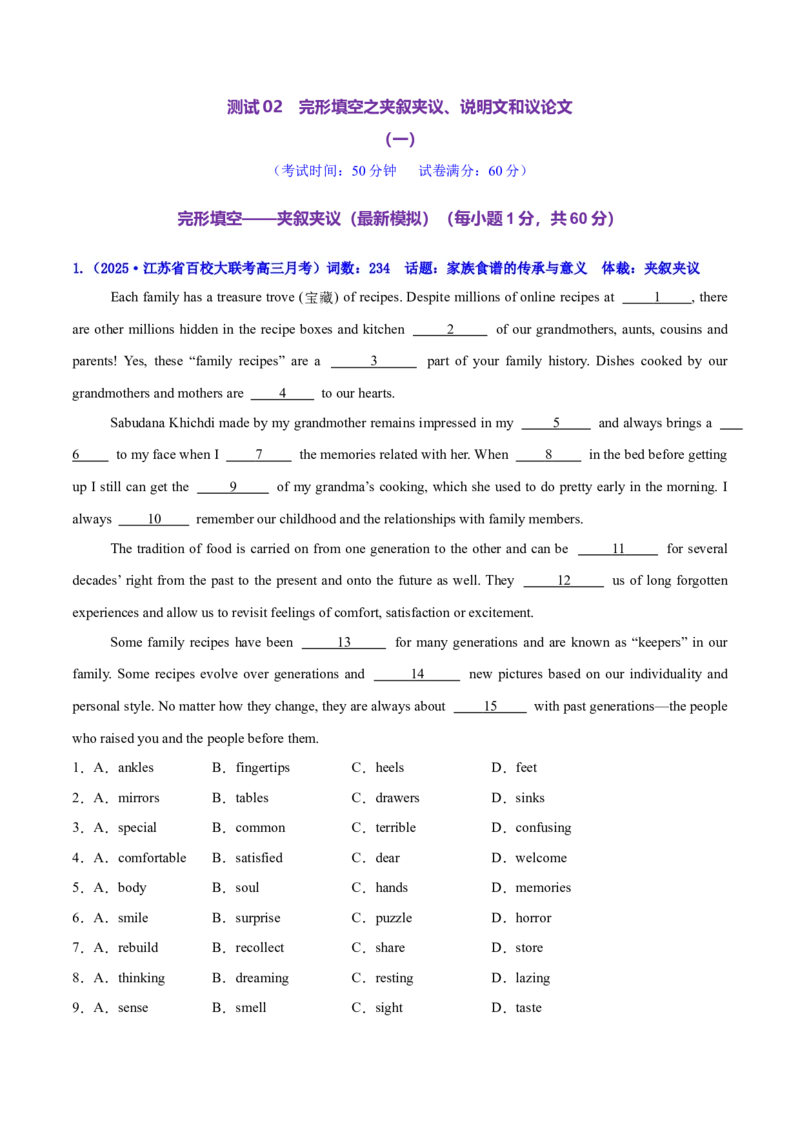
1.(2025·江苏省百校大联考高三月考)词数:234 话题:家族食谱的传承与意义 体裁:夹叙夹议
Each family has a treasure trove (宝藏) of recipes. Despite millions of online recipes at 1 , there
are other millions hidden in the recipe boxes and kitchen 2 of our grandmothers, aunts, cousins and
parents! Yes, these “family recipes” are a 3 part of your family history. Dishes cooked by our
grandmothers and mothers are 4 to our hearts.
Sabudana Khichdi made by my grandmother remains impressed in my 5 and always brings a
6 to my face when I 7 the memories related with her. When 8 in the bed before getting
up I still can get the 9 of my grandma’s cooking, which she used to do pretty early in the morning. I
always 10 remember our childhood and the relationships with family members.
The tradition of food is carried on from one generation to the other and can be 11 for several
decades’ right from the past to the present and onto the future as well. They 12 us of long forgotten
experiences and allow us to revisit feelings of comfort, satisfaction or excitement.
Some family recipes have been 13 for many generations and are known as “keepers” in our
family. Some recipes evolve over generations and 14 new pictures based on our individuality and
personal style. No matter how they change, they are always about 15 with past generations—the people
who raised you and the people before them.
1.A.ankles B.fingertips C.heels D.feet
2.A.mirrors B.tables C.drawers D.sinks
3.A.special B.common C.terrible D.confusing
4.A.comfortable B.satisfied C.dear D.welcome
5.A.body B.soul C.hands D.memories
6.A.smile B.surprise C.puzzle D.horror
7.A.rebuild B.recollect C.share D.store
8.A.thinking B.dreaming C.resting D.lazing
9.A.sense B.smell C.sight D.taste10.A.bitterly B.doubtfully C.vividly D.vaguely
11.A.traced B.applied C.combed D.abolished
12.A.convince B.inform C.warn D.remind
13.A.turned down B.passed down C.knocked down D.closed down
14.A.show off B.bring out C.take on D.put up
15.A.connecting B.corresponding C.starting D.dealing
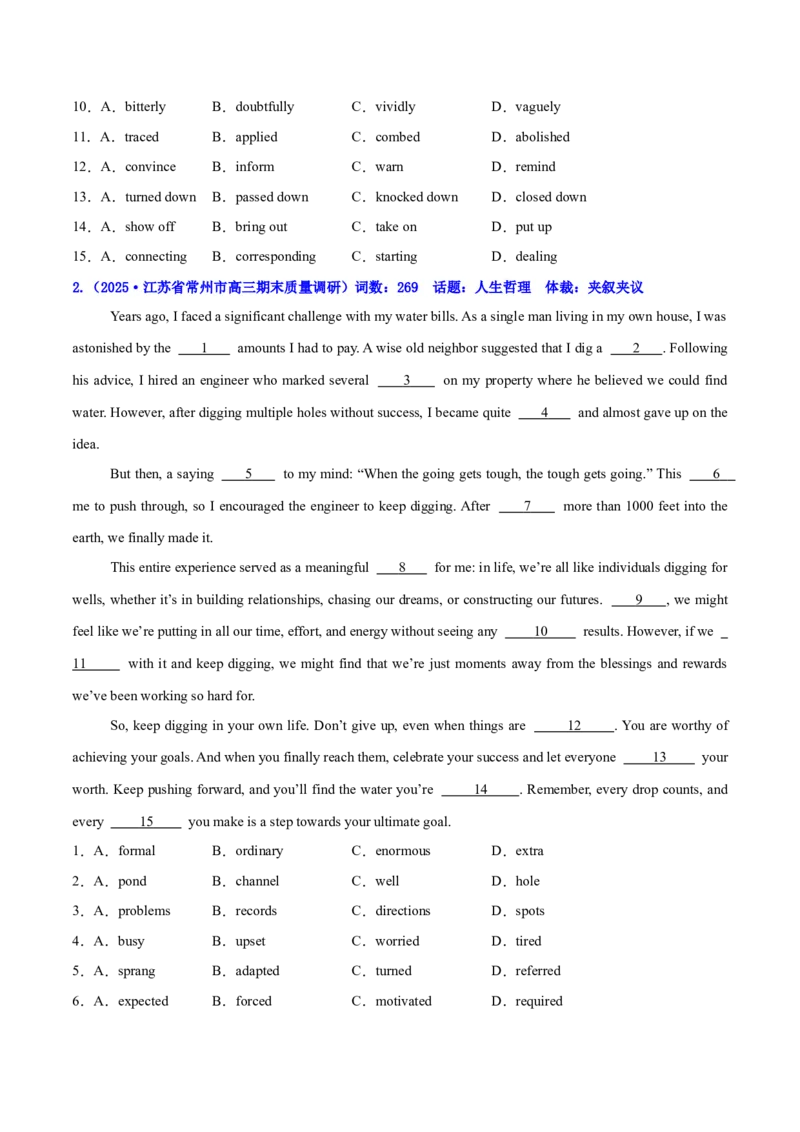
2.(2025·江苏省常州市高三期末质量调研)词数:269 话题:人生哲理 体裁:夹叙夹议
Years ago, I faced a significant challenge with my water bills. As a single man living in my own house, I was
astonished by the 1 amounts I had to pay. A wise old neighbor suggested that I dig a 2 . Following
his advice, I hired an engineer who marked several 3 on my property where he believed we could find
water. However, after digging multiple holes without success, I became quite 4 and almost gave up on the
idea.
But then, a saying 5 to my mind: “When the going gets tough, the tough gets going.” This 6
me to push through, so I encouraged the engineer to keep digging. After 7 more than 1000 feet into the
earth, we finally made it.
This entire experience served as a meaningful 8 for me: in life, we’re all like individuals digging for
wells, whether it’s in building relationships, chasing our dreams, or constructing our futures. 9 , we might
feel like we’re putting in all our time, effort, and energy without seeing any 10 results. However, if we
11 with it and keep digging, we might find that we’re just moments away from the blessings and rewards
we’ve been working so hard for.
So, keep digging in your own life. Don’t give up, even when things are 12 . You are worthy of
achieving your goals. And when you finally reach them, celebrate your success and let everyone 13 your
worth. Keep pushing forward, and you’ll find the water you’re 14 . Remember, every drop counts, and
every 15 you make is a step towards your ultimate goal.
1.A.formal B.ordinary C.enormous D.extra
2.A.pond B.channel C.well D.hole
3.A.problems B.records C.directions D.spots
4.A.busy B.upset C.worried D.tired
5.A.sprang B.adapted C.turned D.referred
6.A.expected B.forced C.motivated D.required7.A.dropping B.searching C.falling D.sinking
8.A.example B.concept C.principle D.lesson
9.A.Instead B.Sometimes C.Therefore D.Regularly
10.A.unusual B.necessary C.obvious D.remaining
11.A.stick B.agree C.conflict D.compare
12.A.wrong B.hard C.ready D.possible
13.A.challenge B.recognize C.reveal D.dominate
14.A.saving B.buying C.drinking D.seeking
15.A.effort B.decision C.judgment D.promise
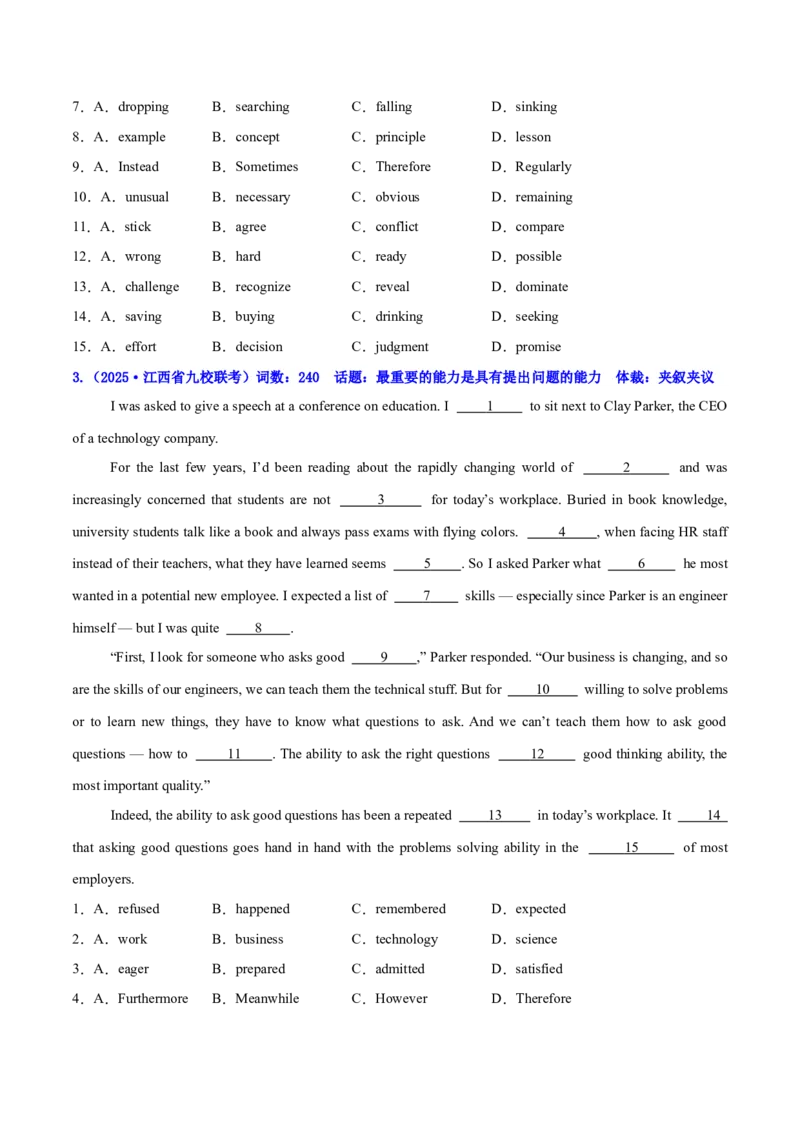
3.(2025·江西省九校联考)词数:240 话题:最重要的能力是具有提出问题的能力 体裁:夹叙夹议
I was asked to give a speech at a conference on education. I 1 to sit next to Clay Parker, the CEO
of a technology company.
For the last few years, I’d been reading about the rapidly changing world of 2 and was
increasingly concerned that students are not 3 for today’s workplace. Buried in book knowledge,
university students talk like a book and always pass exams with flying colors. 4 , when facing HR staff
instead of their teachers, what they have learned seems 5 . So I asked Parker what 6 he most
wanted in a potential new employee. I expected a list of 7 skills — especially since Parker is an engineer
himself — but I was quite 8 .
“First, I look for someone who asks good 9 ,” Parker responded. “Our business is changing, and so
are the skills of our engineers, we can teach them the technical stuff. But for 10 willing to solve problems
or to learn new things, they have to know what questions to ask. And we can’t teach them how to ask good
questions — how to 11 . The ability to ask the right questions 12 good thinking ability, the
most important quality.”
Indeed, the ability to ask good questions has been a repeated 13 in today’s workplace. It 14
that asking good questions goes hand in hand with the problems solving ability in the 15 of most
employers.
1.A.refused B.happened C.remembered D.expected
2.A.work B.business C.technology D.science
3.A.eager B.prepared C.admitted D.satisfied
4.A.Furthermore B.Meanwhile C.However D.Therefore5.A.meaningful B.reasonable C.regular D.useless
6.A.qualities B.characters C.knowledge D.aspects
7.A.communication B.reading C.writing D.technique
8.A.correct B.embarrassed C.competitive D.mistaken
9.A.suggestions B.questions C.remarks D.impressions
10.A.employees B.consultants C.managers D.students
11.A.fight B.forgive C.think D.innovate
12.A.affects B.reminds C.reflects D.witnesses
13.A.theme B.drawback C.advantage D.entertainment
14.A.works out B.figures out C.takes out D.turns out
15.A.workplace B.minds C.imagination D.prospects
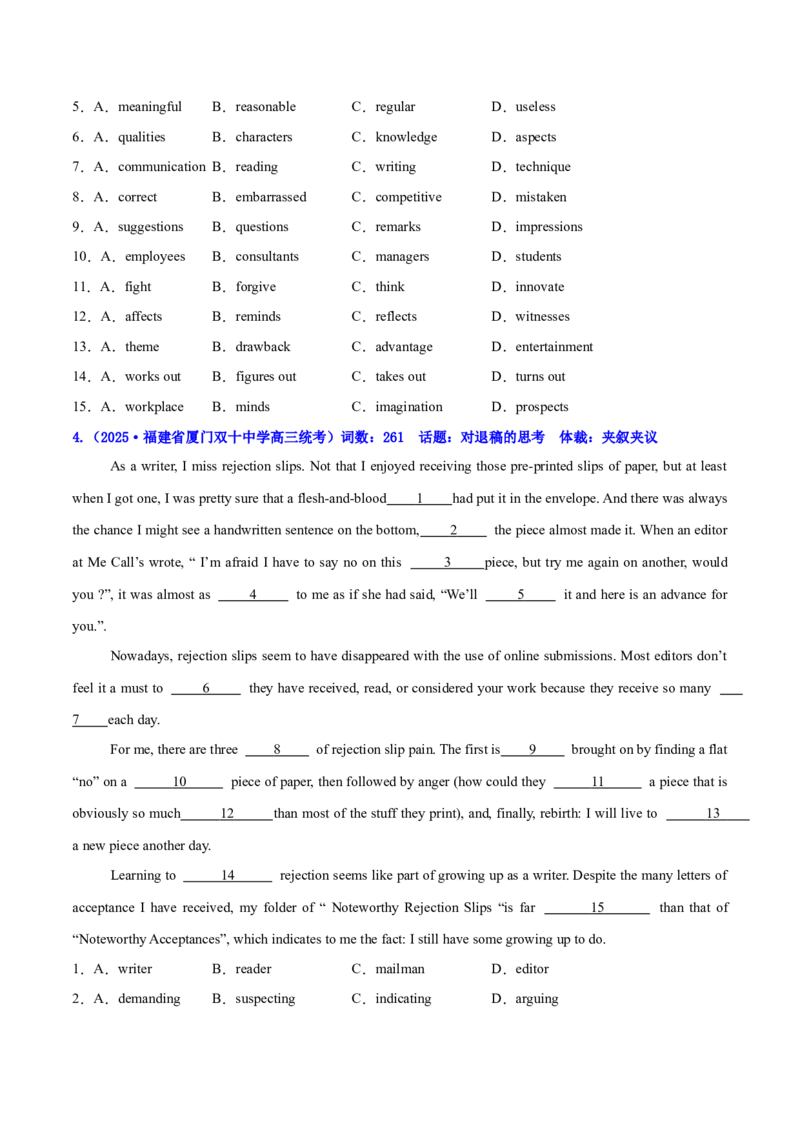
4.(2025·福建省厦门双十中学高三统考)词数:261 话题:对退稿的思考 体裁:夹叙夹议
As a writer, I miss rejection slips. Not that I enjoyed receiving those pre-printed slips of paper, but at least
when I got one, I was pretty sure that a flesh-and-blood 1 had put it in the envelope. And there was always
the chance I might see a handwritten sentence on the bottom, 2 the piece almost made it. When an editor
at Me Call’s wrote, “ I’m afraid I have to say no on this 3 piece, but try me again on another, would
you ?”, it was almost as 4 to me as if she had said, “We’ll 5 it and here is an advance for
you.”.
Nowadays, rejection slips seem to have disappeared with the use of online submissions. Most editors don’t
feel it a must to 6 they have received, read, or considered your work because they receive so many
7 each day.
For me, there are three 8 of rejection slip pain. The first is 9 brought on by finding a flat
“no” on a 10 piece of paper, then followed by anger (how could they 11 a piece that is
obviously so much 12 than most of the stuff they print), and, finally, rebirth: I will live to 13
a new piece another day.
Learning to 14 rejection seems like part of growing up as a writer. Despite the many letters of
acceptance I have received, my folder of “ Noteworthy Rejection Slips “is far 15 than that of
“Noteworthy Acceptances”, which indicates to me the fact: I still have some growing up to do.
1.A.writer B.reader C.mailman D.editor
2.A.demanding B.suspecting C.indicating D.arguing3.A.boring B.novel C.lengthy D.particular
4.A.upsetting B.thrilling C.embarrassing D.amusing
5.A.buy B.reject C.check D.substitute
6.A.prove B.determine C.explain D.acknowledge
7.A.proposals B.drafts C.contributions D.instructions
8.A.stages B.wonders C.meanings D.rewards
9.A.relief B.frustration C.anger D.hesitation
10.A.valueless B.expensive C.characterless D.shiny
11.A.make up B.put away C.turn down D.take over
12.A.easier B.better C.shorter D.longer
13.A.print B.revise C.download D.submit
14.A.accept B.criticize C.judge D.evaluate
15.A.thinner B.newer C.older D.fatter
(二)
(考试时间:50分钟 试卷满分:60分)
完形填空——说明文和议论文(最新模拟)(每小题1分,共60分)
1.(2025·广东省深圳市罗湖区高三期末)词数:236 话题:个人效率与幸福感之间的平衡 体裁:说
明文
We have been educated that we have a short life, so we’d better 1 as many things as possible by
pushing, or even forcing, ourselves to a tight schedule. Then, we could lead a fulfilling life.
However, sometimes, the more productive we are the more 2 we might be. Be 3 about a
phenomenon called the “productivity trap (陷阱)”. Believe it or not, we would do far better to 4 if we are to
make the most of our life.
Surprisingly, 5 brings anxiety. Consider a basic goal, such as improving your email response. You
might think you would be 6 with nothing in your inbox, and reply to each message the moment it comes in.
But each email you send brings further 7 and more work to complete. 8 , the messages pile up
again.
Psychologists suggest trying “have done list”, the 9 of the “to do list”. Instead of starting out 10
each morning, “have done list” fills up with tasks you completed yesterday. It gives you a greater sense of 11by recording your workload rather than stressing things you have yet to 12 .
Avoiding the productivity trap does not mean 13 tasks on purpose or working less efficiently.
Instead, it’s about finding a balance between personal efficiency and 14 . It means planning tasks carefully
and setting realistic goals, while also giving yourself enough time to 15 after working hard.
1.A.pack B.donate C.believe D.enjoy
2.A.nervous B.stressed C.happy D.successful
3.A.sorry B.cautious C.hopeful D.angry
4.A.cheer up B.go back C.break away D.slow down
5.A.capability B.flexibility C.accuracy D.efficiency
6.A.relieved B.inspired C.bored D.impressed
7.A.goals B.surprises C.replies D.improvements
8.A.Initially B.Ultimately C.Similarly D.Additionally
9.A.future B.outcome C.core D.opposite
10.A.empty B.sleepy C.delightful D.grateful
11.A.timing B.belonging C.commitment D.achievement
12.A.finish B.discover C.assess D.list
13.A.undervaluing B.delaying C.prioritizing D.tracking
14.A.task-expectation B.well-being
C.self-achievement D.time-management
15.A.create B.plan C.relax D.reflect
2.(2025·河北省部分学校期末联考)词数:252 话题:责任和独立 体裁:说明文
My home is a place which we work together to make clean and tidy. To contribute to this condition, everyone
has a small 1 : I may be washing the dishes after a meal, while my sister is 2 the living room,
and Mom putting things in order.
By keeping our house as 3 as possible, I have built a good sense of 4 . For instance,
from a younger age I learnt how to make my bed. Something as 5 as this has been beneficial, as I now
6 that it should be something I do myself, not 7 anyone else to do. Many things that I have learnt
while helping with the housework can 8 into useful skills in everyday life. For example, washing dishes
enables me to wash my own things wherever I am. From getting 9 in all of these, I have learnt duty and
independence, so I am 10 for learning them sooner rather than later.
At my house, we are all aware that without good 11 , even with everything else, you cannot livewell. Therefore, we try our best to keep fit every day. From playing tennis to running, I 12 a lot to keep
up with the healthy standards. In doing so, and by knowing the 13 implications that could occur when
people fail to complete the regular workout, I 14 to get in shape. I make sure of 15 a well-
balanced lifestyle by doing various activities and sports throughout the day during school.
1.A.role B.corner C.hobby D.aim
2.A.decorating B.entering C.sweeping D.designing
3.A.beautiful B.neat C.dynamic D.spacious
4.A.responsibility B.direction C.achievement D.security
5.A.boring B.challenging C.impressive D.simple
6.A.imagine B.understand C.predict D.claim
7.A.relying on B.appealing to C.reminding D.encouraging
8.A.go B.fall C.translate D.come
9.A.interested B.skilled C.caught D.involved
10.A.eager B.grateful C.prepared D.qualified
11.A.reason B.arrangement C.comfort D.health
12.A.exercise B.relax C.adapt D.progress
13.A.obvious B.comprehensive C.negative D.sudden
14.A.afford B.promise C.choose D.manage
15.A.identifying B.advocating C.maintaining D.transforming
3.(2025·陕西省教育联盟高三模拟)词数:262 话题:斯蒂芬·库里 体裁:说明文
Steph Curry, a superstar in NBA, knows what it’s like to be overlooked. “Coming up through basketball, I
didn’t 1 the eye test,” he says. “I was a late bloomer (大器晚成者).”
For Curry, being a “late bloomer” only 2 him. He developed a strong moral 3 of work
and didn’t let failure stop him from learning and getting better.
In kids’ critical development years, they need 4 . They need to know that failure is only 5
and that confidence is a skill to be learned alongside physical skills. 6 , many children learn too late how
to turn challenges into victories.
Curry’s new children’s book, I Am Extraordinary, shares his approach with kids everywhere. Its 7
character is a girl named Zoe, who is self-conscious about wearing hearing aids. The story features an animated (动
画的) 8 of Curry who offers encouragement: “There will always be 9 in life. It’s up to you to
find the courage and the strength to 10 them.”Curry makes scoring points look 11 . He shoots three- point shots with a grace and ease that
make us forget about all the hard work he has 12 . His friendly smile and delightful moments with his
young daughter lead us to believe that everything comes easy to the superstar.
But don’t be 13 : Curry has overcome his difficulties and worked his way to the top. He knows
what it takes to be the best. Sometimes, it’s just a 14 of finding the right question. “So, what makes
you 15 ?” Curry asks us all.
1.A.impress B.pass C.receive D.ignore
2.A.resolved B.tolerated C.motivated D.assembled
3.A.justice B.priority C.method D.code
4.A.encouragement B.chances C.liberation D.lectures
5.A.practical B.temporary C.tight D.realistic
6.A.Precisely B.Frequently C.Unfortunately D.Entirely
7.A.brilliant B.initial C.internal D.leading
8.A.version B.interaction C.passion D.innovation
9.A.patterns B.elements C.obligations D.barriers
10.A.command B.overcome C.advocate D.oppose
11.A.easy B.splendid C.identical D.slight
12.A.come across B.cut off C.put in D.taken on
13.A.occupied B.fooled C.convinced D.inspired
14.A.intervention B.routine C.practice D.matter
15.A.extraordinary B.ambitious C.devoted D.logical
4.(2025·山东省德州市德城区德州市第二中学高三月考)词数:247 话题:喜悦对于激发儿童潜在才
能的重要性 体裁:议论文
Twenty-five years ago, I was a fairly new school administrator. I was 1 by Thomas Armstrong’s
book, Awakening Genius in the Classroom. In it, he writes, “Joy is the spark that can ignite (点燃) every child’s
potential genius.” 2 linking genius to IQ scores or standardized test results, he offers a(n) 3
perspective (视角). Combining the Greek word “genesis”, meaning “birth”, and the Latin word “genial”, signifying
“joyful”, Armstrong created a novel 4 of genius as “the birth of joy”.
As Armstrong sees it, joy 5 Picasso’s creative expressions on canvases (画布) and Michael
Jordan’s mid-air technique on the basketball court. While both undoubtedly spent countless hours 6their skills, joy was the 7 force that pushed them towards excellence. And yet, joy is not only 8
for the extraordinarily accomplished. It can also exist in common 9 where a first-grader reads a book
and a middle schooler solves a math puzzle.
Throughout my years as a school administrator, I’ve held fast to Armstrong’s 10 that genius
begins with joy; however, I want to 11 something new. Joy must be sustained by purpose. For joy to
12 in the face of challenge and difficulty, it must be 13 at a deep level. In my experience,
joy continues when people recognize they have done something or are making contributions to the world.
Armstrong asks us 14 to motivate students’ potential, and, just as 15 , to reawaken
our own joy for intellectual and personal growth.
1.A.admired B.acknowledged C.inspired D.advertised
2.A.In terms of B.With regard to C.Apart from D.Instead of
3.A.refreshing B.widespread C.conventional D.unpredictable
4.A.talent B.definition C.example D.standard
5.A.explained B.challenged C.proved D.fueled
6.A.introducing B.sharpening C.assessing D.exchanging
7.A.primary B.normal C.cultural D.flexible
8.A.tested B.supported C.reserved D.practised
9.A.values B.sense C.origin D.scenes
10.A.approach B.belief C.promise D.story
11.A.learn B.translate C.add D.investigate
12.A.move on B.put off C.stand by D.hold back
13.A.conveyed B.illustrated C.polished D.felt
14.A.writers B.parents C.educators D.pioneers
15.A.skillfully B.importantly C.positively D.surprisingly