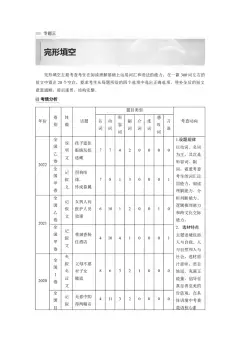
专题三 完形填空
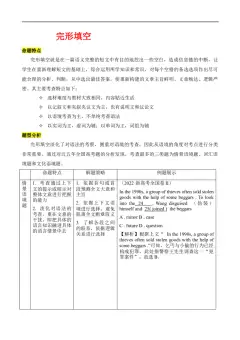
类型二 体裁破解
第2 讲 夹叙夹议文
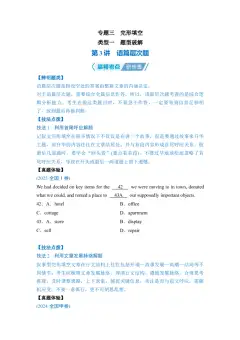
【辨明题类】
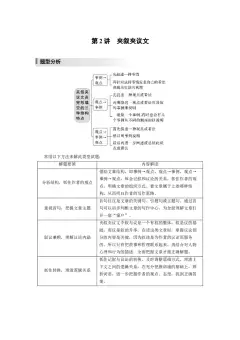
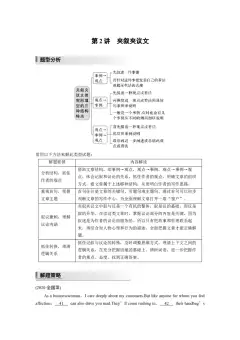
夹叙夹议类的文章通常是采用叙议结合的写作方法,文章先进行叙述,然
后再在段落的结尾或文章的末尾展开议论,说明故事所包含的哲理或总结出作
者的观点。阅读此类文章时,考生要重点关注议论的部分,从而总结出文章的
主旨。
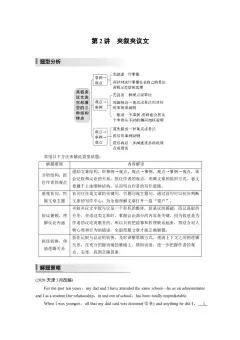
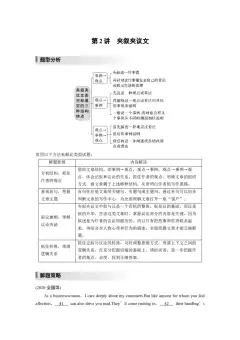
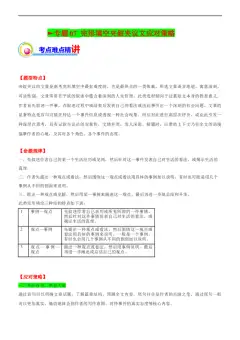
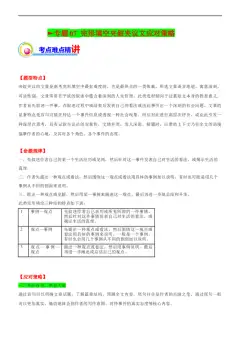
夹叙夹议类的完形填空一般有三种结构特点:
1.事例→观点:先叙述一件事情,然后针对这件事情发表自己的看法,或揭示
生活的真理。
2.观点→事例:先提出一种观点或看法,然后围绕这一观点或看法用具体的事
例来说明。一般是一个事例,有时也会用几个事例从不同的侧面加以说明。
3.观点→事例→观点:首先提出一种观点或看法,然后用事例说明,最后再进
一步阐述或总结自己的观点。
【技法点拨】
1.分析结构,抓住作者观点
在做题时大家要借助文章结构,认真体会记叙和议论的关系,抓住作者的观
点,明确文章的组织方式。看文章属于上述哪种结构,从而明白作者的思路。
2.重视首句,把握文章主题
首句往往是文章的关键句、引题句或主题句。通过首句可以初步判断文章的写
作中心,为全面理解文章打开一扇“窗户”。
3.叙议兼顾,理解议论内涵
夹叙夹议中叙与议是一个有机的整体,叙是议的基础,而议是叙的升华。在读
这类文章时,掌握议论部分的内容是关键,因为叙述是为作者的议论而服务
的。所以只有把故事和哲理联系起来,再结合人物心理和行为的描述,全面把
握文章才能正确解题。
4.抓住转换,厘清逻辑关系
抓住记叙与议论的转换,及时调整思维方式,厘清上下文之间的逻辑关系,在
充分把握语境的基础上,辨析词语,进一步把握作者的观点、态度,找到正确
答案。
【真题体验】
(2023·浙江1 月卷改编)
Last year I decided to do some volunteer work.I began to   1   on the Internet and
discovered Volunteer USA .Three months later I found myself on a plane to
Phoenix, Arizona.I was   2   at the thought of living with loads of new people for
three months.However, within fifteen minutes of
 3
 , my worries had
gone.Everyone was so friendly and like-minded that it was very   4   to feel at
home.
I was sent to the Coronado National Forest for my first 8-day   5  .We had to carry
everything we needed and walk three miles to where we worked.It may not seem like
a   6   way but in 35 ℃ heat and with a heavy pack, my legs were on fire.
My job was to   7   a stairway out of rock.This   8   climbing up and down the
side of a mountain inhabited( 栖息) by mountain lions, although I should say they
were only heard, never   9  .
Three days later, a beautiful stairway came into being.The   10   of knowing that
my work will be on that mountainside for years to come is massive.
But on the last night we were   11   in a thunderstorm.I woke up at midnight to find
a swimming pool in my tent.The temperature was close to   12  .I had to spend the
rest of the night trembling in the only   13   part of my tent.
Needless to say, I suffered a lot.But I know whatever I have to face in my life I was
there and I   14  .I think I am much   15   for having taken part in the project.
1.A.calculate
B.negotiate
C.advertise
D.research
2.A.annoyed
B.surprised
C.scared
D.excited
3.A.arriving
B.sleeping
C.thinking
D.walking
4.A.funny
B.good
C.lucky
D.easy
5.A.tour
B.project
C.campaign
D.course
6.A.nice
B.safe
C.long
D.quick
7.A.build
B.test
C.clean
D.guard
8.A.helped
B.ended
C.allowed
D.meant
9.A.hunted
B.trained
C.seen
D.fed
10.A.satisfaction
B.ambition
C.expectation
D.intention
11.A.left
B.caught
C.attacked
D.separated
12.A.boiling
B.average
C.normal
D.freezing
13.A.tidy
B.dry
C.new
D.soft
14.A.survived
B.resisted
C.escaped
D.recovered
15.A.smarter
B.stronger
C.happier
D.busier
【解题示范】 第一步:速读全文,从宏观上把握夹叙夹议文的结构形式和作
者的观点
1.文章主旨:文章讲述了作者去年通过网上查询信息得到去科罗拉多国家森林
当志愿者的机会,虽然期间作者经历了暴雨中帐篷漏水,为狮子上下山而搭建
台阶的繁重工作等磨难,仍然感谢这个经历让自己变得更坚强。
2.结构形式:先事例,后观点。首先叙述了作者做志愿的亲身经历,然后对此
发表看法。
3.作者观点:做志愿者尽管会有很多麻烦,但受益也颇多,不仅锻炼了自己的
毅力,而且还使自己变得更坚强。
第二步:细读文章,从微观上破解三大层次题
依据故事的发展情节、语言知识、文化背景、生活常识、词汇复现、上下文语
境、感情色彩等作出选择。
【解析】
1.【句组层次】逻辑推理题。句意:我开始在网上研究并且发现“美国志愿
者”。A.calculate 计算;B.negotiate 协商;C.advertise 登广告;D.research 研
究。根据前文的“Last year I decided to do some volunteer work.”可知,作者在
网上研究有哪些可以做志愿者的信息。故选D。
2.【句组层次】同义复现题。句意:一想到我要和一群陌生人一起住三个月,
我很害怕。A.annoyed 烦恼的;B.surprised 惊讶的;C.scared 害怕的;D.excited
兴奋的。根据下文“my worries had gone”可知,我一开始很担忧。故选C。
3.【句组层次】生活常识题。句意:然而,到达15 分钟里我的担忧就消失
了。A.arriving 到达;B.sleeping 睡觉;C.thinking 思考;D.walking 行走。根据
下文“feel at home”可知,到达目的地不久,作者就不担心了。故选A。
4.【句内层次】逻辑推理题。句意:每个人都如此友好和志趣相投以至于很容
易有宾至如家的感觉。A.funny 搞笑的;B.good 好的;C.lucky 幸运的;D.easy
容易的。根据本句“like-minded”和“feel at home”可知,大家都很友好并且
志趣相投,感觉到家的温暖很容易。故选D。
5.【语篇层次】同义复现题。句意:我被派往科罗拉多国家森林开始头8 天的
项目。A.tour 游览;B.project 项目;C.campaign 活动;D.course 课程。根据下文
“for having taken part in the project”可知,这是在说当志愿者的项目,原词复
现。故选B。
6.【句组层次】逻辑推理题。句意:可能看起来不远,但是在35 度高温下,
背着沉重的物品,我的腿像是着了火。A.nice 好的;B.safe 安全的;C.long 长
的;D.quick 快的。根据上文“walk three miles”可知,作者他们走的路程不
远。故选C。
7.【句组层次】逻辑推理题。句意:我的工作是用岩石建一个阶梯。A.build
建造;B.test 测试;C.clean 清洁;D.guard 保卫。根据下文“climbing up and
down the side of a mountain”可知,作者在狮子栖息地建一个阶梯供狮子攀爬。
故选A。
8.【句内层次】逻辑推理题。句意:这意味着狮子能在山上栖息地通过阶梯爬
上爬下,尽管我应该说它们只被听到,从未被看到。A.helped 帮助;B.ended 结
束;C.allowed 允许;D.meant 意味。根据空后“climbing up and down”可知,
台阶修好了意味着狮子可以爬上爬下。故选D。
9.【句内层次】逻辑推理题。句意:这意味着狮子能在山上栖息地通过阶梯爬
上爬下,尽管我应该说它们只被听到,从未被看到。A.hunted 捕猎;B.trained
训练;C.seen 看到;D.fed 喂养。根据空前“although I should say they were only
heard”可知,作者以前没有见过。故选C。
10.【句组层次】逻辑推理题。句意:知道我的作品将会在未来的几年里出现
在那片山坡上,我的满足感是巨大的。A.satisfaction 满意;B.ambition 雄心;
C.expectation 期待;D.intention 意图。根据上文“a beautiful stairway came into
being”可知,我修的台阶成型了,我很满意。故选A。
11.【句组层次】逻辑推理题。句意:但是在最后一晚,我们被困在雷雨中。
A.left 离开;B.caught 捉住;C.attacked 袭击;D.separated 分离。根据下文“I
woke up at midnight to find a swimming pool in my tent”可知,作者他们被困在
雷雨中。故选B。
12.【句组层次】同义复现题。句意:温度接近零度。A.boiling 煮沸的;
B.average 平均的;C.normal 正常的;D.freezing 冰冻的。根据下文“trembling”
可知,温度很低。故选D。
13.【句组层次】逻辑推理题。句意:我不得不后半夜在帐篷干的那一块地方
发抖。A.tidy 干净的;B.dry 干的;C.new 新的;D.soft 软的。根据上文的
“thunderstorm”和空后“part of my tent”可知,帐篷里进了水,作者蜷缩在帐
篷干的地方。故选B。
14.【句内层次】逻辑推理题。句意:但是我知道不论人生中面对什么,我都
在这,我都活了下来。A.survived 生存;B.resisted 反抗;C.escaped 逃离;
D.recovered 恢复。根据“ But I know whatever I have to face in my life I was
there”可知,作者认为再多苦都可以坚持下来,挺过去。故选A。
15.【句组层次】逻辑推理题。句意:我认为因为参加这个项目我更强壮了。
A.smarter 更聪明的;B.stronger 更强壮的;C.happier 更快乐的;D.busier 更忙碌
的。根据上文“But I know whatever I have to face in my life I was there”可知,
作者感觉经历让他更强壮。故选B。
第三步:重读文章,从逻辑上修正错误
初选之后,代入答案,把违背上下文逻辑关系的错误改正过来。
A
(2025·河南省天一大联考高三考前模拟)
I am terribly bad at bowling.It's the kind of bad where my scores   1   break 30 (a
sign of a better performance) and the only strikes I achieve are pure   2  .Yet, I love
bowling and each pin ( 球瓶) I knock down feels like a personal   3  .Most
importantly, I value the memories created with my family and friends, because even
when I'm   4  , I'm laughing.
One memorable night, my friends and I went bowling, and once again I missed the
pin.Instead of feeling   5  , we erupted into laughter.My friend Jenna, who was
equally bad at bowling, attempted to imitate (模仿) a professional bowler but   6
falling onto the floor.We laughed so hard that tears streamed down our faces and that
shared joy helped us   7   our low scores.
As the night unfolded, we started a new   8  :Each time one of us bowled badly,
we would celebrate our “achievement” with a funny dance.A stranger nearby even
9   us, transforming our silly game into a mini dance party.
Engaging in activities where we're not   10   has unexpected benefits.For instance,
when I struggle at bowling repeatedly, I learn something, and the ability to laugh at
my   11   allows me to deal with difficulties in more significant aspects of my
life.So, the next time you   12   to try something because you might be bad at it,
ask yourself:Is it worth the   13  ?If the answer is no, dive in.Joy doesn't come
from   14  , but from the freedom to enjoy the experience and the laughter that   15
it.
1.A.barely
B.suddenly
C.dramatically
D.eventually
2.A.joys
B.prejudices
C.errors
D.accidents
3.A.victory
B.belief
C.experience
D.career
4.A.complaining
B.training
C.losing
D.waiting
5.A.confused
B.relieved
C.embarrassed
D.frightened
6.A.worried about
B.put off
C.insisted on
D.ended up
7.A.recall
B.forget
C.understand
D.value
8.A.project
B.adventure
C.rule
D.relationship
9.A.joined
B.comforted
C.recognized
D.greeted
10.A.interested
B.scared
C.curious
D.skillful
11.A.anxiety
B.failure
C.responses
D.approaches
12.A.hesitate
B.manage
C.happen
D.pretend
13.A.devotion
B.risk
C.attention
D.concern
14.A.procedure
B.dominance
C.justice
D.ambition
15.A.motivates
B.generates
C.follows
D.maintains
【语篇解读】 本文是一篇夹叙夹议文。文章讲述了作者虽保龄球打得差,但
享受和家人朋友打球的过程,还通过一次经历阐述参与不擅长活动能带来意外
益处,鼓励人们勇敢尝试。
【解析】
1.A 根据前文“I am terribly bad at bowling.”表明作者保龄球打得极差,所
以结合常识可推知其得分是几乎达不到30 分的。
2.D 从前文“I am terribly bad at bowling.”可知作者水平差,那么打出全中
这种高水平表现自然不可能是常态,只能是偶然、意外的情况。
3.A 由“Yet, I love bowling”可知,作者热爱打保龄球,即便打得不好,每
击倒一个球瓶对他来说也是在这项活动中的小成就,如同一次个人胜利。
4.C 根据前文“I am terribly bad at bowling.”可知,作者保龄球技术不佳,所
以在打球过程中常常处于输的状态,但依然能和家人朋友欢笑,享受过程。
5.C 从“we erupted into laughter”大家爆发出笑声,可反推正常情况下没击
中球瓶会让人感到尴尬,但他们却以欢笑应对。
6.D 根据“attempted to imitate (模仿) a professional bowler”和“falling onto
the floor”可知,珍娜原本是要模仿专业选手,结果却摔倒在地,用“ended
up”符合语境。
7.B 从“We laughed so hard that tears streamed down our faces”可知,大家笑
得很开心,在这种快乐的氛围下,就会暂时忘记糟糕的分数。
8 .C  从“ Each time one of us bowled badly, we would celebrate our
‘achievement’ with a funny dance.”描述的具体行为来看,这是他们新设定的一
种规则。
9.A 由“transforming our silly game into a mini dance party”可看出陌生人参
与到了他们的活动中,使得活动变成了舞会。
10.D 根据前文作者和朋友打保龄球打得差以及后文“when I struggle at
bowling repeatedly”可知,在保龄球这项活动上他们不擅长,所以这里说的是
参与不擅长的活动。
11.B 从“when I struggle at bowling repeatedly”可知,作者打保龄球总是遇
到困难,也就是经常失败,所以这里是嘲笑自己的失败。
12.A 根据“because you might be bad at it”可知,人们会因为可能不擅长某
件事,而在是否尝试这件事上产生犹豫。
13.D 前文提到人们会因为可能不擅长而犹豫尝试,这种犹豫其实源于内心
的担心,所以问是否值得担心。
14.B 结合前文提到参与不擅长的活动也能获得快乐,说明快乐并非来自于
在某方面有优势、处于主导地位。procedure 程序;dominance 优势,主导地
位;justice 正义;ambition 抱负。
15.C 根据前文描述参与活动享受体验后大家会欢笑,可知欢笑是在享受体
验之后随之而来的。motivates 激励;generates 产生;follows 跟随,随之而来;
maintains 维持。
B
(2025·江西省重点中学盟校联考高三一模)
One of my friends Bob was a research and development director in a large
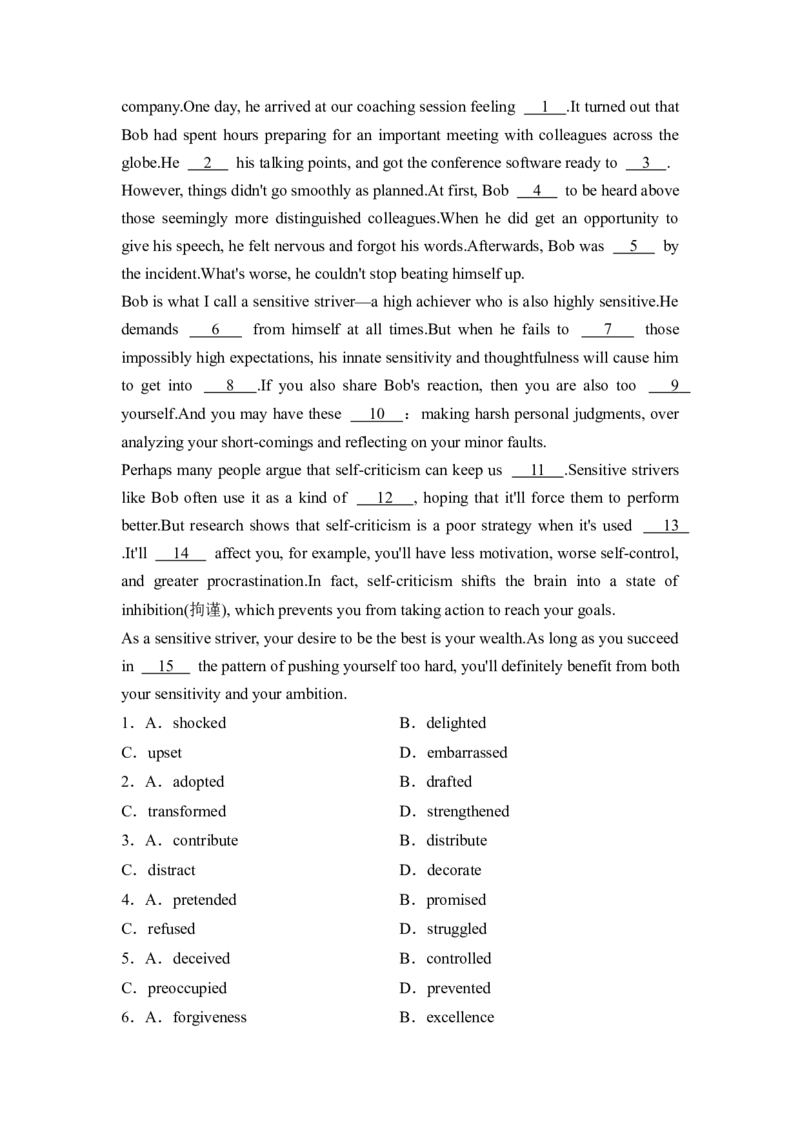
company.One day, he arrived at our coaching session feeling   1  .It turned out that
Bob had spent hours preparing for an important meeting with colleagues across the
globe.He   2   his talking points, and got the conference software ready to   3  .
However, things didn't go smoothly as planned.At first, Bob   4   to be heard above
those seemingly more distinguished colleagues.When he did get an opportunity to
give his speech, he felt nervous and forgot his words.Afterwards, Bob was   5   by
the incident.What's worse, he couldn't stop beating himself up.
Bob is what I call a sensitive striver—a high achiever who is also highly sensitive.He
demands   6   from himself at all times.But when he fails to   7   those
impossibly high expectations, his innate sensitivity and thoughtfulness will cause him
to get into   8  .If you also share Bob's reaction, then you are also too   9
yourself.And you may have these   10  :making harsh personal judgments, over
analyzing your short-comings and reflecting on your minor faults.
Perhaps many people argue that self-criticism can keep us   11  .Sensitive strivers
like Bob often use it as a kind of   12  , hoping that it'll force them to perform
better.But research shows that self-criticism is a poor strategy when it's used   13
.It'll   14   affect you, for example, you'll have less motivation, worse self-control,
and greater procrastination.In fact, self-criticism shifts the brain into a state of
inhibition(拘谨), which prevents you from taking action to reach your goals.
As a sensitive striver, your desire to be the best is your wealth.As long as you succeed
in   15   the pattern of pushing yourself too hard, you'll definitely benefit from both
your sensitivity and your ambition.
1.A.shocked
B.delighted
C.upset
D.embarrassed
2.A.adopted
B.drafted
C.transformed
D.strengthened
3.A.contribute
B.distribute
C.distract
D.decorate
4.A.pretended
B.promised
C.refused
D.struggled
5.A.deceived
B.controlled
C.preoccupied
D.prevented
6.A.forgiveness
B.excellence
C.consideration
D.expectation
7.A.get rid of
B.give way to
C.live up to
D.go back to
8.A.self-improvement
B.self-confidence
C.self-discipline
D.self-criticism
9.A.hard on
B.confident of
C.surprised by
D.proud of
10.A.restrictions
B.behaviors
C.ambitions
D.explanations
11.A.overcautious
B.awkward
C.conservative
D.sharp
12.A.campaign
B.challenge
C.motivation
D.flexibility
13.A.appropriately
B.excessively
C.efficiently
D.wisely
14.A.temporarily
B.negatively
C.permanently
D.regularly
15.A.forming
B.following
C.breaking
D.preserving
【语篇解读】 本文是一篇夹叙夹议文。文章主要讲述了作者的朋友Bob 作为
高敏感成就者,因对自己要求过高而在面对失败时陷入自责和过度反思的困
境。文章指出,虽然自我批评有时被视为促使进步的手段,但研究表明过度自
我批评反而会产生负面影响。
【解析】
1.C 根据下文“However, things didn't go smoothly as planned.”以及“When
he did get an opportunity to give his speech, he felt nervous and forgot his words.”
可知,Bob 为了准备会议做了很多工作但最后却表现不佳,他此时的情绪应该
是沮丧的。
2.B 根据“his talking points”可知,此处指起草发言稿。
3.A 根据上文“Bob had spent hours preparing for an important meeting”可
知,他做了很多准备工作是为了在会议中发表意见。
4.D 根据“to be heard above those seemingly more distinguished colleagues”可
知,在那些地位更高的同事面前,Bob 努力让别人听到他的声音。
5.C 根据下文“he couldn't stop beating himself up”可知,他一直无法停止自
责,说明他一直被这件事所困扰。be preoccupied with 意为“被……所困扰”。
6.B 根据上文“a high achiever”可知,他是一个高成就者,所以时刻要求自
己做到最好。
7.C 根据“his innate sensitivity and thoughtfulness will cause him to get into”可
知,他无法实现高期望时会陷入自责,所以此处指他无法不辜负那些高期望。
8.D 根据上文“he couldn't stop beating himself up”可知,他会陷入自责。
self-criticism 在文章中多次出现,是原词复现。
9.A 根据“If you also share Bob's reaction”及下文“making harsh personal
judgments, over analyzing your short-comings and reflecting on your minor faults”
可知,如果与Bob 一样,则对自己太苛刻。
10.B 根据“making harsh personal judgments, over analyzing your shortcomings
and reflecting on your minor faults”可知,做出严厉的个人判断,过度分析自己
的缺点和反思小错误,这些都是指一个人的行为。
11.D 根据下文“Sensitive strivers like Bob often use it”可知,像Bob 这样的
敏感奋斗者经常使用自我批评,说明他们认为自我批评能让自己变得敏锐。
12.C 根据“hoping that it'll force them to perform better”可知,他们希望自我
批评能激励自己表现得更好,把自我批评当作一种动力。
13.B 根据“self-criticism is a poor strategy”可知,过度使用自我批评是一种
糟糕的策略。
14 .B  根据“ you'll have less motivation, worse self-control, and greater
procrastination”可知,这些都是自我批评的负面影响。
15 .C  根据“ you'll definitely benefit from both your sensitivity and your
ambition”结合前文提到过度自我批评和逼自己太紧带来的不好影响可知,只要
你打破了对自己要求过严的模式,你就能受益。break the pattern of 意为“打
破……的模式”。
C
(2025·广东省深圳市高三二模)
I knew exercise is good for health—who doesn't?But   1   were easier.Running
bored me, biking sounded risky, and the gym seemed too much to handle.Each offered
me a reason to   2   it, so I did.
When I worked in Kenya, I came to realize that people there don't “  3  ” the
way I had thought.Instead, they move—with a clear   4   in mind.They move to
reach a destination.They move to hunt and to tend crops.There is no such thing as a
5  , but they are working out 24-7.Maybe I could take   6   from these people and
add meaning to my exercising.So, I launched my   7   program :“ chicken-
cising” with 15 baby chicks and a book on   8   backyard chickens.
It turned out that caring for the flightless birds was quite   9  —a full-body workout
involving bending, squatting(深蹲), weightlifting and running around.One weekend,
my e-watch   10   as many as 145 squats and 10,506 steps!
I ended up in better shape than expected and found extra   11   that no gym
workout can provide.First, quitting is not a(n)   12  :You can't put on your
“chicken-cise” clothes, sit for a while, and then simply decide not to   13  ,
especially when your feathered friends depend on you to survive.Second, you have
unbeatable workout partners, who   14   respond to your appearance with
encouragement.Bah-Baaaahk!What's more?Fresh-from-the-hen eggs!
Turning every breakfast into a celebration of my new lifestyle with the best eggs,
“chicken-cising” taught me that movement doesn't need a gym—it needs   15  .
1.A.actions
B.excuses
C.examples
D.answers
2.A.approach
B.manage
C.avoid
D.tolerate
3.A.change
B.live
C.travel
D.exercise
4.A.purpose
B.message
C.order
D.request
5.A.role
B.problem
C.gym
D.village
6.A.time
B.inspiration
C.comfort
D.pleasure
7.A.escape
B.diet
C.charity
D.fitness
8.A.cooking
B.raising
C.drawing
D.protecting
9.A.demanding
B.confusing
C.amusing
D.touching
10.A.meant
B.took
C.rang
D.read
11.A.instructions
B.pressure
C.bonuses
D.responsibility
12.A.option
B.pain
C.must
D.error
13.A.step aside
B.show off
C.turn up
D.give in
14.A.angrily
B.cheerfully
C.patiently
D.carefully
15.A.courage
B.talent
C.attention
D.meaning
【语篇解读】 本文是一篇夹叙夹议文。文章讲述了作者通过“养鸡”的健身
计划发现,为日常活动赋予意义,如照顾小鸡,比刻意去健身房更能让人坚持
运动,最终不仅收获了健康,还获得了生活乐趣。
【解析】
1.B 根据下文“Running bored me, biking sounded risky, and the gym seemed
too much to handle.”可知,这些都是作者为不运动所找的借口。
2.C 根据上文“Running bored me, biking sounded risky, and the gym seemed
too much to handle.”可知,这些都是让作者避免运动的理由。
3.D 根据下文“but they are working out 24-7”可知,肯尼亚的当地人一周24
小时都在运动,这与作者理解的“锻炼”方式不同。
4.A 根据下文“They move to reach a destination.”可知,他们为抵达某个地
方而行动,因此是带着明确的目标行动。
5.C 根据“but they are working out 24-7”可知,肯尼亚的当地人一周24 小时
都在运动,他们是没有健身房的概念的。
6 .B  根据下文“‘ chicken-cising’ with 15 baby chicks and a book on   8
backyard chickens”可知,作者计划通过养鸡来健身,因此是从这些人身上得到
灵感。
7.D 根据上文“add meaning to my exercising”可知,作者想为自己的锻炼增
添意义,因此是启动了健身计划。
8.B 根据下文“caring for the flightless birds”可知,作者得照顾这些小鸡,
因此这书是一本庭院养鸡指南。
9.A 根据“a full-body workout involving bending, squatting (深蹲), weightlifting
and running around”可知,照顾这些小鸡需要全身锻炼,包括弯腰、深蹲、举
重和跑来跑去,因此是相当费力的。
10.D 根据“my e-watch”和“as many as 145 squats and 10,506 steps”可知,
此处指因为作者养鸡时频繁地运动,他的智能手表记录显示他做的运动数据。
11.C 根据本段后面所列的三点内容可知,在养鸡过程中作者无法选择放
弃,小鸡会一直给予保持运动的鼓励,作者还能得到新鲜的鸡蛋,这些都是健
身房永远无法提供的额外馈赠。
12.A 根据“especially when your feathered friends depend on you to survive”可
知,小鸡得依靠作者生存,因此作者无法做放弃的选择。
13.C 根据“You can't put on your ‘chicken-cise’ clothes, sit for a while”可
知,作者用诙谐的口吻描述类似穿上专门运动的衣服,在出发前犹豫是否去运
动,最终决定不出现的情景。
14.B 根据“respond to your appearance with encouragement”可知,小鸡们靠
作者照顾,会愉快地迎接他的出现。
15.D 根据上文“add meaning to my exercising”可知,养鸡为运动赋予了意
义,让运动变得可坚持下去。meaning 为原词复现。
D
(2025·河南省许平汝名校高三二模)
The setting was perfect:researchers talking with excitement about their work, poster
sessions alive with questions.It was my first conference as a Ph.D.candidate, and the
1   should have excited me.It was a chance to showcase my work and build   2
.Yet things didn't go as I had thought.I wanted to connect but was afraid of seeming
3  .By the end of the day, my business cards were still in my pocket,   4  .
I knew that if I wanted to achieve in academia, I'd need to develop networking   5
.However, it wasn't easy.I went into that conference with good   6  , but came up
empty.My lab co-worker, on the other hand, walked away with an   7   from a
known research team to co-author a working paper,   8   by starting up a small
talk.I stood there, right beside her, but I let the moment slip by.That's when it hit me:
Networking wasn't about   9   everyone in the room.It was about speaking up and
finding value in even the smallest   10  .I'd been waiting for the perfect words and
the ideal opening—but those   11   rarely arrived on their own.The key was to let
go of   12   and instead seek connection.
I dove in, taking chance to attend events.I kept   13  , determined to push through,
hoping eventually it'd start to feel natural.I learned to focus less on the pressure to
network perfectly but more on building   14   relationships.
Looking back now, I see the real   15   wasn't the act of networking itself but
quitting the fear of not doing it “right”.
1.A.atmosphere
B.achievement
C.performance
D.description
2.A.happiness
B.connections
C.pressure
D.careers
3.A.powerful
B.awkward
C.creative
D.confident
4.A.unexplained
B.unexpected
C.unfinished
D.untouched
5.A.origins
B.habits
C.traditions
D.visions
6.A.signs
B.negotiations
C.intentions
D.inspirations
7.A.exploration
B.outline
C.invitation
D.extension
8.A.typically
B.officially
C.regularly
D.simply
9.A.touching
B.rejecting
C.contacting
D.impressing
10.A.themes
B.exchanges
C.requirements
D.missions
11.A.experiences
B.consequences
C.moments
D.platforms
12.A.perfection
B.depression
C.determination
D.imagination
13.A.taking off
B.standing out
C.working out
D.showing up
14.A.romantic
B.loving
C.genuine
D.lasting
15.A.challenge
B.means
C.remark
D.adventure
【语篇解读】 本文是一篇夹叙夹议文。文章主要讲述了作者作为博士生在学
术会议上的交流经历,并分享了克服交流恐惧、建立联系的心得。
【解析】
1 .A 根据上文“ researchers talking with excitement about their work, poster
sessions alive with questions”可知,此处描述的是会议的氛围。
2.B 根据下文“Networking wasn't about   9   everyone in the room.”可知,
此处指的是建立联系。
3.B 根据“I wanted to connect but was afraid of”以及语境可知,作者想与人
交流,但又害怕显得尴尬。
4.D 根据“my business cards were still in my pocket”可知,作者的名片还在
口袋里,即没有动过。
5.B 根据下文“I went into that conference with good   6  , but came up
empty.”可知,作者意识到需要培养社交习惯。
6.C 根据上文“It was my first conference as a Ph.D.candidate, and the   1
should have excited me.It was a chance to showcase my work and build   2  .”以
及“but came up empty”可知,作者带着良好的意愿参加了会议。
7.C 根据“to co-author a working paper”可知,作者的实验室同事获得了一
个知名研究团队的邀请。
8.D 根据“by starting up a small talk”可知,此处表示简单地发起一次闲聊。
9.D 根据下文“It was about speaking up and finding value in even the smallest
10  .”可知,此处表示社交并不是要给房间里的每个人都留下深刻印象。
10.B 根据“speaking up”可知,此处表示即使是最小的交流也要找到价值。
11.C 根据“I'd been waiting for the perfect words and the ideal opening”可知,
此处表示作者一直在等待的这些时刻很少会自己到来。
12.A 根据上文“I'd been waiting for the perfect words and the ideal opening”可
知,完美的时刻很少会自己到来,所以要放下完美主义。
13 .D  根据“ determined to push through, hoping eventually it'd start to feel
natural”可知,作者一直在出现并坚持下去。
14.C 根据“I learned to focus less on the pressure to network perfectly”可知,
作者更多地关注建立真诚的关系。
15.A 根据“wasn't the act of networking itself but quitting the fear of not doing it
‘right’”可知,真正的挑战是克服做得不对的挑战。