专题 22 完形填空专练(说明文)
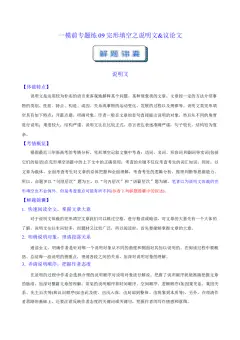
知考法 明考向:
说明文是对事物的特征、性能、状态、用途或事件的发生、发展、结果等进行介绍、解释、说明的一种文
体。说明文完形填空有以下命题特点:
1.文章多用一般现在时态。说明文通常是对客观事物或实例的介绍与说明,与时间的变化关系不大,所以文
章常用一般现在时态。
2.语言简练、平实、准确,常采用客观描述。
文章主题明确,层次分明。高考说明文类完形填空往往在文章的开头就点明说明对象,从而使考生易于把
握文章的主题。而且,作者会借助合理的说明顺序展开文章,使文章结构清晰,层次分明。
做 新 题 悟技法
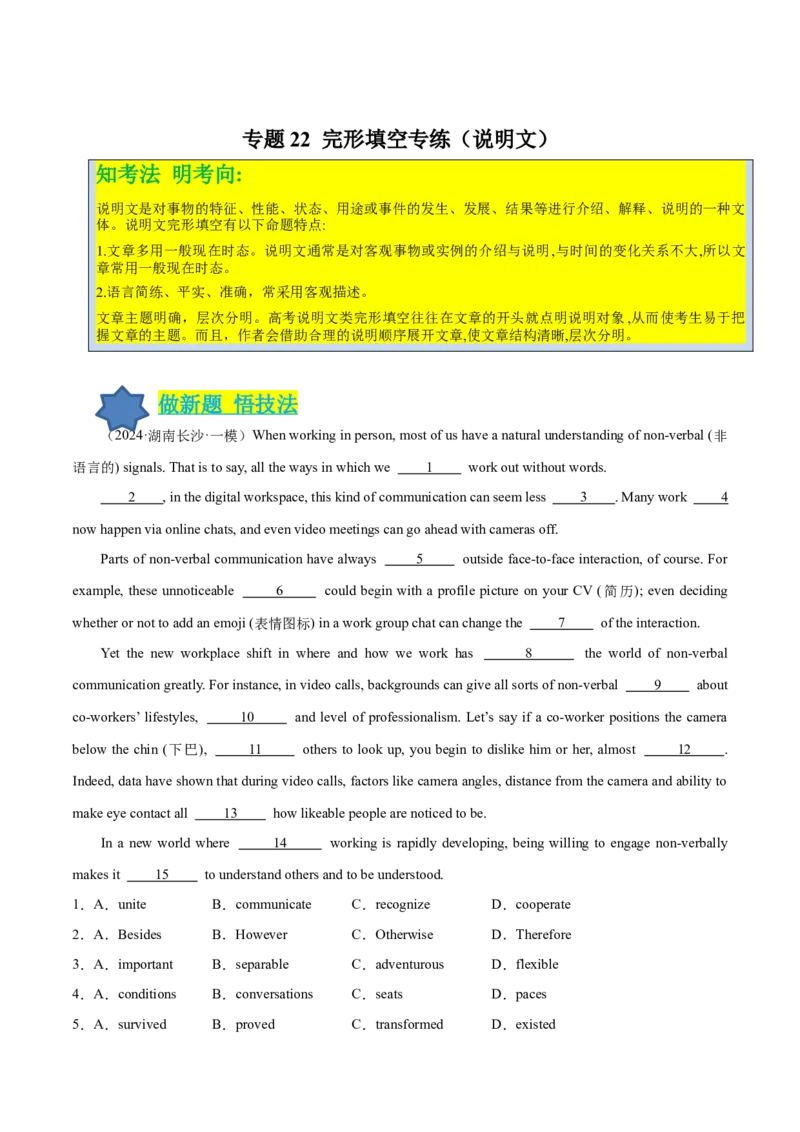
(2024·湖南长沙·一模)When working in person, most of us have a natural understanding of non-verbal (非
语言的) signals. That is to say, all the ways in which we 1 work out without words.
2 , in the digital workspace, this kind of communication can seem less 3 . Many work 4
now happen via online chats, and even video meetings can go ahead with cameras off.
Parts of non-verbal communication have always 5 outside face-to-face interaction, of course. For
example, these unnoticeable 6 could begin with a profile picture on your CV (简历); even deciding
whether or not to add an emoji (表情图标) in a work group chat can change the 7 of the interaction.
Yet the new workplace shift in where and how we work has 8 the world of non-verbal
communication greatly. For instance, in video calls, backgrounds can give all sorts of non-verbal 9 about
co-workers’ lifestyles, 10 and level of professionalism. Let’s say if a co-worker positions the camera
below the chin (下巴), 11 others to look up, you begin to dislike him or her, almost 12 .
Indeed, data have shown that during video calls, factors like camera angles, distance from the camera and ability to
make eye contact all 13 how likeable people are noticed to be.
In a new world where 14 working is rapidly developing, being willing to engage non-verbally
makes it 15 to understand others and to be understood.
1.A.unite B.communicate C.recognize D.cooperate
2.A.Besides B.However C.Otherwise D.Therefore
3.A.important B.separable C.adventurous D.flexible
4.A.conditions B.conversations C.seats D.paces
5.A.survived B.proved C.transformed D.existed6.A.signals B.maps C.journeys D.articles
7.A.milestone B.analysis C.feel D.study
8.A.quitted B.expanded C.failed D.reduced
9.A.information B.change C.application D.concern
10.A.meetings B.suggestions C.interests D.videos
11.A.inspiring B.forcing C.permitting D.warning
12.A.continuously B.willingly C.carefully D.instantly
13.A.impact B.accomplish C.report D.harm
14.A.diligent B.crazy C.remote D.abstract
15.A.easier B.harder C.more traditional D.more exciting
技法点拨: 明对象,清顺序
明确说明对象
文章的首句一般就明确指出说明对象 。 对文章进行粗读或略读 , 大致了解文章的大意。
搞清说明顺序
把握了说明顺序 , 就能准确把握文章的脉络,加强对整篇文章的理解。
把握文章结构
把握语篇特征对理解文意与答题极为有利。说明性的文章一般都是一篇完整的、 意思表达清楚的、逻辑
比较严密的短文。
注重语境
逐句精读短文 , 对特定的语境作深入理解,克服“思维定势” , 根据全文大意和“词不离句、句不离文”的
原则逐项填空。
练模拟 提能力
Passage 1
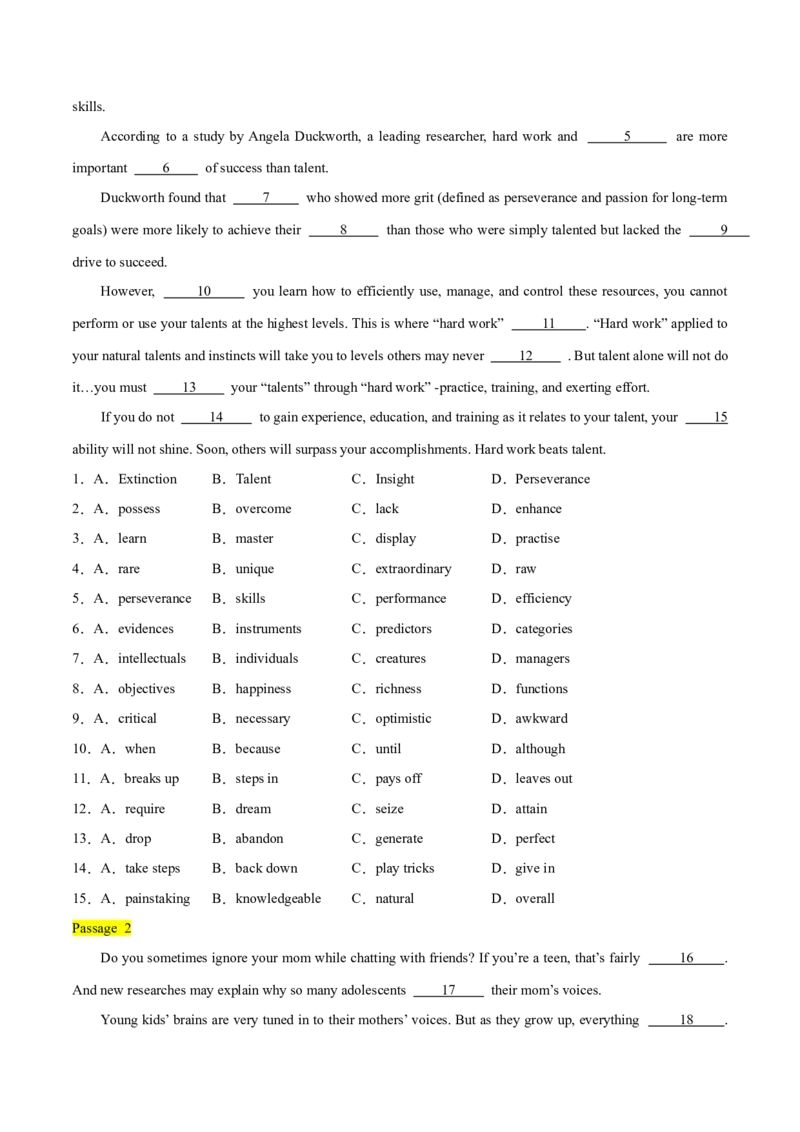
If you think you haven’t got what it takes to achieve your goals, you must remember that hard work beats
talent every time!
1 is the natural ability or capacity to perform a function. When you 2 talent in an area,
you are gifted with the “knack (诀窍)” or “instinct” needed to perform a skill or 3 a specific quality. But
this only means you have the “ 4 qualities.” So, you have the equipment or tools needed to perform theskills.
According to a study by Angela Duckworth, a leading researcher, hard work and 5 are more
important 6 of success than talent.
Duckworth found that 7 who showed more grit (defined as perseverance and passion for long-term
goals) were more likely to achieve their 8 than those who were simply talented but lacked the 9
drive to succeed.
However, 10 you learn how to efficiently use, manage, and control these resources, you cannot
perform or use your talents at the highest levels. This is where “hard work” 11 . “Hard work” applied to
your natural talents and instincts will take you to levels others may never 12 . But talent alone will not do
it…you must 13 your “talents” through “hard work” -practice, training, and exerting effort.
If you do not 14 to gain experience, education, and training as it relates to your talent, your 15
ability will not shine. Soon, others will surpass your accomplishments. Hard work beats talent.
1.A.Extinction B.Talent C.Insight D.Perseverance
2.A.possess B.overcome C.lack D.enhance
3.A.learn B.master C.display D.practise
4.A.rare B.unique C.extraordinary D.raw
5.A.perseverance B.skills C.performance D.efficiency
6.A.evidences B.instruments C.predictors D.categories
7.A.intellectuals B.individuals C.creatures D.managers
8.A.objectives B.happiness C.richness D.functions
9.A.critical B.necessary C.optimistic D.awkward
10.A.when B.because C.until D.although
11.A.breaks up B.steps in C.pays off D.leaves out
12.A.require B.dream C.seize D.attain
13.A.drop B.abandon C.generate D.perfect
14.A.take steps B.back down C.play tricks D.give in
15.A.painstaking B.knowledgeable C.natural D.overall
Passage 2
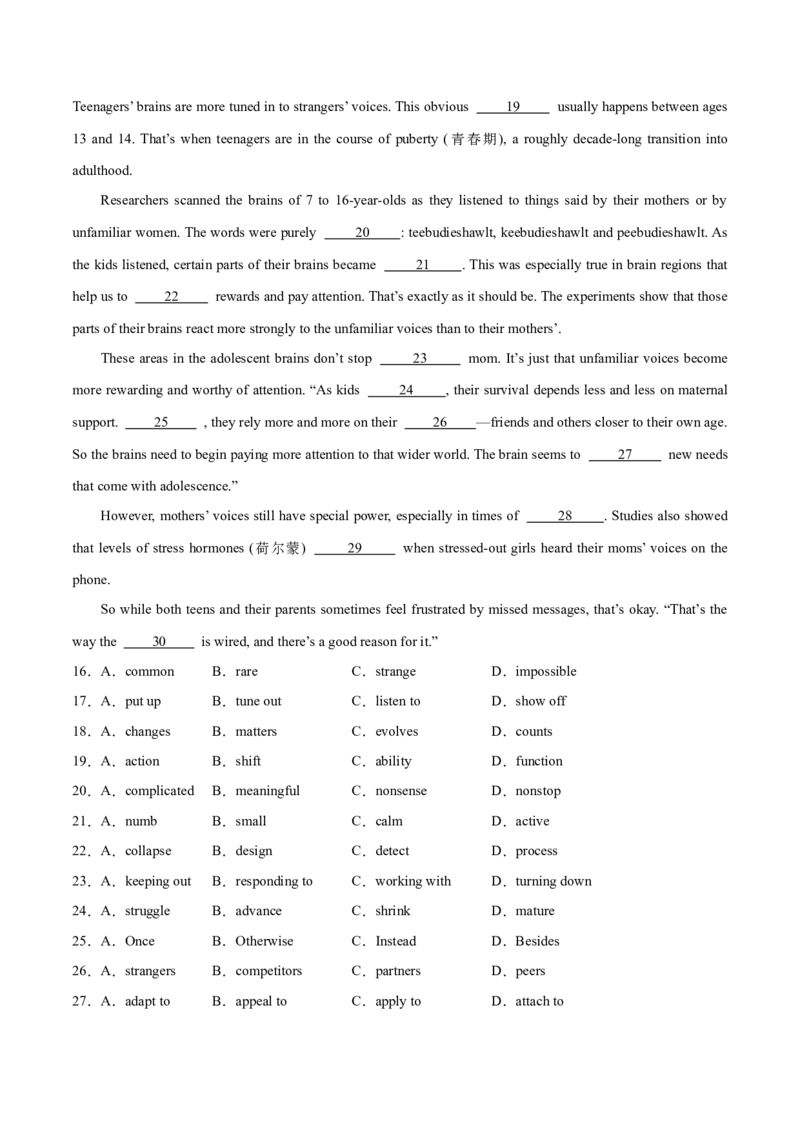
Do you sometimes ignore your mom while chatting with friends? If you’re a teen, that’s fairly 16 .
And new researches may explain why so many adolescents 17 their mom’s voices.
Young kids’ brains are very tuned in to their mothers’ voices. But as they grow up, everything 18 .Teenagers’ brains are more tuned in to strangers’ voices. This obvious 19 usually happens between ages
13 and 14. That’s when teenagers are in the course of puberty (青春期), a roughly decade-long transition into
adulthood.
Researchers scanned the brains of 7 to 16-year-olds as they listened to things said by their mothers or by
unfamiliar women. The words were purely 20 : teebudieshawlt, keebudieshawlt and peebudieshawlt. As
the kids listened, certain parts of their brains became 21 . This was especially true in brain regions that
help us to 22 rewards and pay attention. That’s exactly as it should be. The experiments show that those
parts of their brains react more strongly to the unfamiliar voices than to their mothers’.
These areas in the adolescent brains don’t stop 23 mom. It’s just that unfamiliar voices become
more rewarding and worthy of attention. “As kids 24 , their survival depends less and less on maternal
support. 25 , they rely more and more on their 26 —friends and others closer to their own age.
So the brains need to begin paying more attention to that wider world. The brain seems to 27 new needs
that come with adolescence.”
However, mothers’ voices still have special power, especially in times of 28 . Studies also showed
that levels of stress hormones (荷尔蒙) 29 when stressed-out girls heard their moms’ voices on the
phone.
So while both teens and their parents sometimes feel frustrated by missed messages, that’s okay. “That’s the
way the 30 is wired, and there’s a good reason for it.”
16.A.common B.rare C.strange D.impossible
17.A.put up B.tune out C.listen to D.show off
18.A.changes B.matters C.evolves D.counts
19.A.action B.shift C.ability D.function
20.A.complicated B.meaningful C.nonsense D.nonstop
21.A.numb B.small C.calm D.active
22.A.collapse B.design C.detect D.process
23.A.keeping out B.responding to C.working with D.turning down
24.A.struggle B.advance C.shrink D.mature
25.A.Once B.Otherwise C.Instead D.Besides
26.A.strangers B.competitors C.partners D.peers
27.A.adapt to B.appeal to C.apply to D.attach to28.A.stress B.relief C.safety D.plenty
29.A.varied B.dropped C.topped D.remained
30.A.head B.mind C.heart D.brain
Passage 3
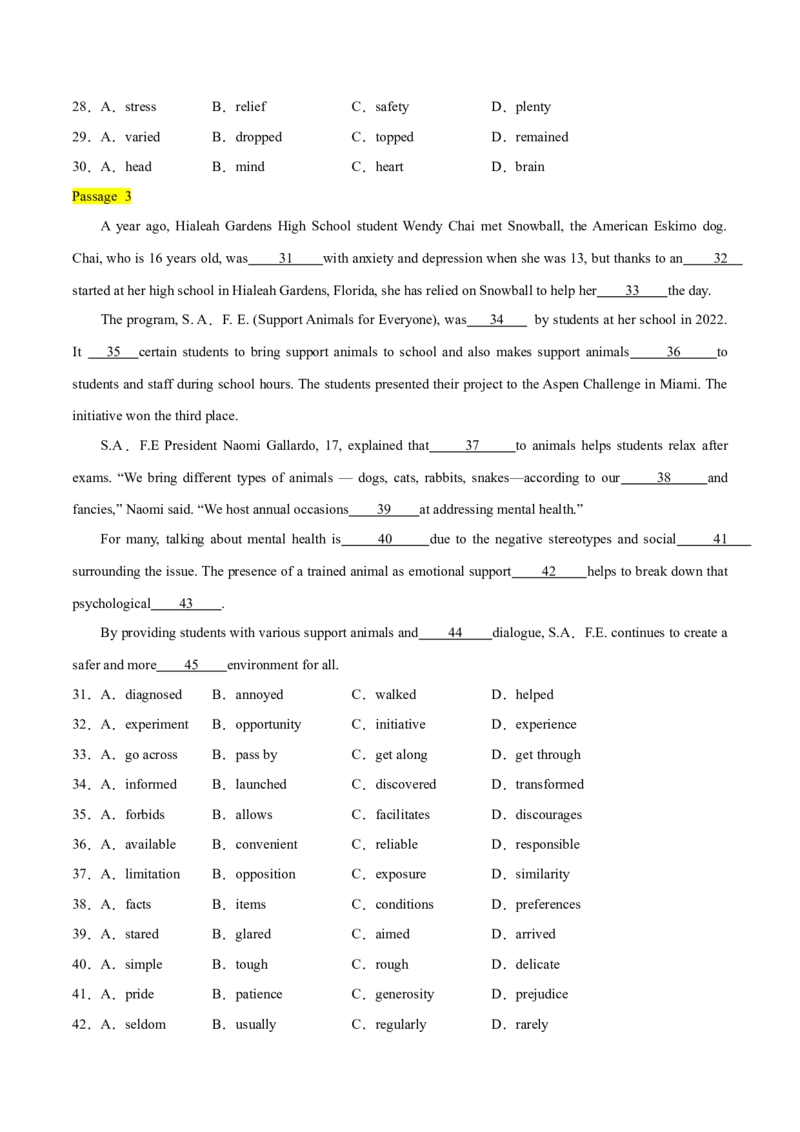
A year ago, Hialeah Gardens High School student Wendy Chai met Snowball, the American Eskimo dog.
Chai, who is 16 years old, was 31 with anxiety and depression when she was 13, but thanks to an 32
started at her high school in Hialeah Gardens, Florida, she has relied on Snowball to help her 33 the day.
The program, S. A.F. E. (Support Animals for Everyone), was 34 by students at her school in 2022.
It 35 certain students to bring support animals to school and also makes support animals 36 to
students and staff during school hours. The students presented their project to the Aspen Challenge in Miami. The
initiative won the third place.
S.A.F.E President Naomi Gallardo, 17, explained that 37 to animals helps students relax after
exams. “We bring different types of animals — dogs, cats, rabbits, snakes—according to our 38 and
fancies,” Naomi said. “We host annual occasions 39 at addressing mental health.”
For many, talking about mental health is 40 due to the negative stereotypes and social 41
surrounding the issue. The presence of a trained animal as emotional support 42 helps to break down that
psychological 43 .
By providing students with various support animals and 44 dialogue, S.A.F.E. continues to create a
safer and more 45 environment for all.
31.A.diagnosed B.annoyed C.walked D.helped
32.A.experiment B.opportunity C.initiative D.experience
33.A.go across B.pass by C.get along D.get through
34.A.informed B.launched C.discovered D.transformed
35.A.forbids B.allows C.facilitates D.discourages
36.A.available B.convenient C.reliable D.responsible
37.A.limitation B.opposition C.exposure D.similarity
38.A.facts B.items C.conditions D.preferences
39.A.stared B.glared C.aimed D.arrived
40.A.simple B.tough C.rough D.delicate
41.A.pride B.patience C.generosity D.prejudice
42.A.seldom B.usually C.regularly D.rarely43.A.barrier B.access C.connection D.bridge
44.A.recording B.interesting C.encouraging D.controlling
45.A.supportive B.critical C.cooperative D.independent
Passage 4
One of the interesting things about languages is the way they change over time. In English, everything from
spelling to vocabulary has 46 major changes over the years. In fact, to a modern speaker, the
English of 1000 years ago looks like a 47 language!
The history of English dates back around 1500 years. At that time, groups of Europeans 48
England, bringing their language with them. It developed into old English. Later in 1066, English was invaded by
the Normans from France. The language went through an important shift leading to what we now call Middle
English. Over the next 500 years, the language underwent 49 shifts, leading to modern English. As
the language has developed over time, many things about it have changed.
50 is one of the most obvious areas. For example, in old English, people say “hus” and “mus”.
Now, we say “house” and “mouse”. These days there are many differences in the way English is pronounced in the
U.S., India and elsewhere. When people live in groups separated by great distances, the 51 of
change can be fast.
Vocabulary changes happen even more quickly. English has grown by borrowing words from languages such
as French, Greek and 52 , 53 . This often happens with types of 54 ,
for example, “tofu”. Then there is slang which enters and 55 the language every year! Thirty years
ago, one often heard people saying “groovy”, meaning great. These days you rarely hear the word 56
on old TV shows or movies.
Because English is spoken by so many people worldwide, it really is an exciting time for the language. Just as
American and British versions are always changing, so are versions 57 in Canada, 58
in Asia and elsewhere. At the same time, an entirely new version of English is appearing on the Internet with whole
new 59 and writing styles. In a way, learning English is a never-ending process, even for native
speakers! Language is as much a part of the earth as 60 its soil and water of its lakes, rivers and
oceans.
46.A.gone over B.gone through C.gone into D.gone for
47.A.other B.unfamiliar C.strange D.foreign
48.A.invaded B.seized C.took over D.captured49.A.few B.some C.further D.more
50.A.Pronunciation B.Grammar C.Speaking D.Present
51.A.speed B.pace C.velocity D.way
52.A.Russian B.Vietnamese C.Latin D.Korean
53.A.to name a few B.not at all C.in all D.after all
54.A.vegetable B.fruit C.meat D.food
55.A.appears B.leaves C.escapes D.quits
56.A.except B.merely C.besides D.already
57.A.used B.written C.spoken D.seen
58.A.Nigeria B.Singapore C.Rome D.Jamaica
59.A.slang B.jargon C.image D.vernacular
60.A.are B.is C.do D.has
Passage 5
Ollivier Jean-Baptiste, 25, a vlogger from France living in China, delivered a speech on the latest episode (电
视剧集) of the China Daily Youth Power series. The episode, named “Timeless Tales from China”, was 61
on Jan 30.
In his speech, titled “Bridging Cultures: A Personal 62 from France to China”, He spoke about his
63 impressions of China. Just like his family and friends, he saw China as a distant and 64 place with a
culture entirely different from France and other Western countries.
“My wife took me to see the flag-raising 65 in Tian’ anmen Square. Witnessing countless young
people rushing 66 the flag, I was deeply moved. It’s a country of strength, unity, and love,” he said.
When Jean-Baptiste visited his Chinese wife’s hometown for the first time, he couldn’t speak much Chinese.
He felt the warmth of home in a foreign country and was 67 to live in China, he said. All of these
experiences made Jean-Baptiste eager to 68 different aspects of Chinese culture. He visited many tourist
69 in China. When he returned to France for vacation and 70 photos of his travels and life in China
with his family, they were also excited.
71 his fantastic personal experiences in China, Jean-Baptiste noticed that friendly interactions
between the two countries are 72 . After learning about the 15-day visa-free travel from France to China,
his family and friends couldn’t wait to 73 their trip to China. “I’m overjoyed to 74 them
during the 60th anniversary of China-France diplomatic relations, showcasing China’s modern development andrich history,” he said. “I may be just an ordinary person with 75 influence, but everyone can be a
cultural ambassador.”
61.A.produced B.published C.acknowledged D.aired
62.A.Business B.Journey C.Program D.Exhibition
63.A.last B.real C.initial D.right
64.A.similar B.familiar C.mysterious D.plain
65.A.ceremony B.activity C.show D.display
66.A.from B.in C.toward D.for
67.A.thrilled B.worried C.embarrassed D.surprised
68.A.collect B.explore C.fetch D.accumulate
69.A.homes B.attractions C.centers D.routes
70.A.shared B.delivered C.exchanged D.printed
71.A.Regardless of B.In spite of C.Apart from D.Far from
72.A.declining B.increasing C.stable D.flexible
73.A.cancel B.stop C.book D.suspend
74.A.relax B.join C.visit D.host
75.A.special B.limited C.significant D.extensive
Passage 6
When working in person, most of us have a natural understanding of non-verbal (非语言的) signals. That is to
say, all the ways in which we 76 work out without words. 77 , in the digital workspace, this kind of
communication can seem less 78 .
Many work 79 now happen via online chats, and even video meetings can go ahead with cameras off.
Parts of non-verbal communication have always 80 outside face-to-face interaction, of course. For
example, these unnoticeable 81 could begin with a profile picture on your CV (简历); even deciding whether
or not to add an emoji (表情图标) in a work group chat can change the 82 of the interaction.
Yet the new workplace shift in where and how we work has 83 the world of non-verbal communication
greatly. For instance, in video calls, backgrounds can give all sorts of non-verbal 84 about co-workers’
lifestyles, 85 and level of professionalism.
Let’s say if a co-worker positions the camera below the chin (下巴), 86 others to look up, you begin to
dislike him or her, almost 87 . Indeed, data have shown that during video calls, factors like camera angles,
distance from the camera and ability to make eye contact all 88 how likeable people are noticed to be.In a new world where 89 working is rapidly developing, being willing to engage non-verbally makes it
90 to understand others and to be understood.
76.A.unite B.communicate C.recognize D.cooperate
77.A.Besides B.However C.Otherwise D.Therefore
78.A.important B.separable C.adventurous D.flexible
79.A.conditions B.conversations C.seats D.paces
80.A.survived B.proved C.transformed D.existed
81.A.signals B.maps C.journeys D.articles
82.A.milestone B.analysis C.feel D.study
83.A.quitted B.expanded C.failed D.reduced
84.A.information B.change C.application D.concern
85.A.meetings B.suggestions C.interests D.videos
86.A.inspiring B.forcing C.permitting D.warning
87.A.continuously B.willingly C.carefully D.instantly
88.A.impact B.accomplish C.report D.harm
89.A.specific B.general C.remote D.abstract
90.A.easier B.harder C.more traditional D.more exciting