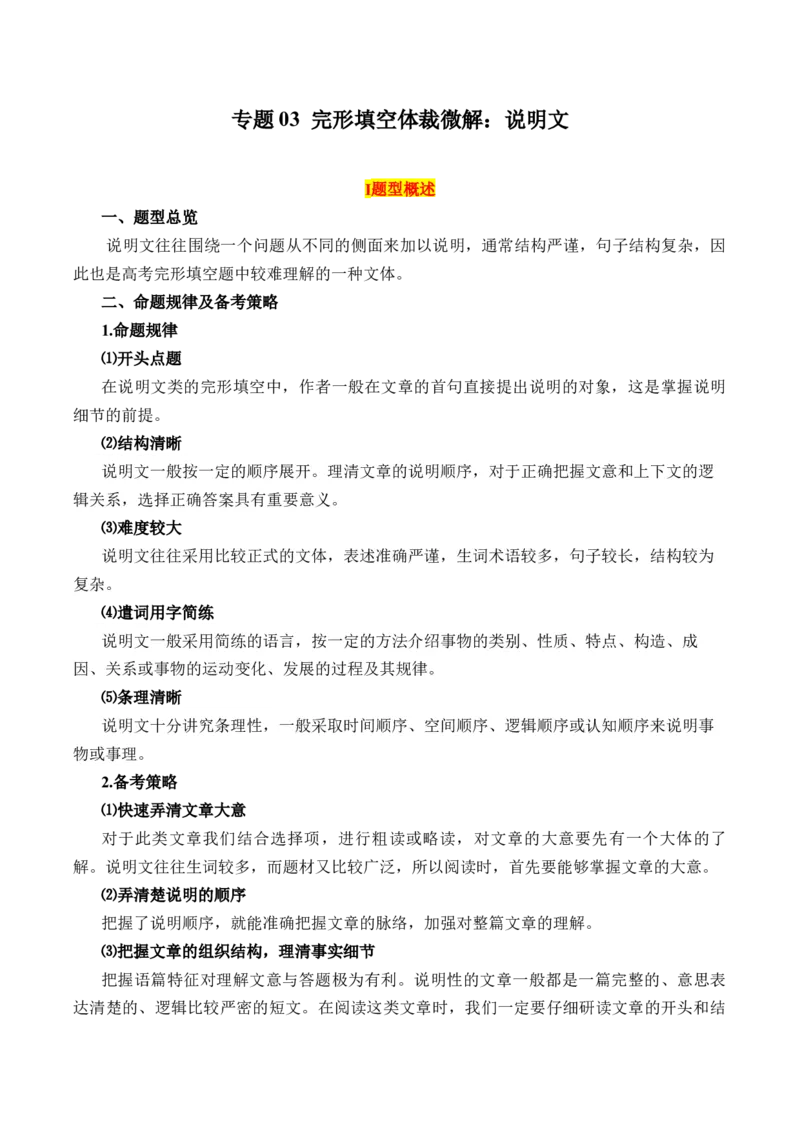
专题 03 完形填空体裁微解:说明文
I题型概述
一、题型总览
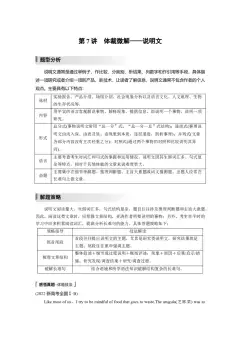
说明文往往围绕一个问题从不同的侧面来加以说明,通常结构严谨,句子结构复杂,因
此也是高考完形填空题中较难理解的一种文体。
二、命题规律及备考策略
1.命题规律
⑴开头点题
在说明文类的完形填空中,作者一般在文章的首句直接提出说明的对象,这是掌握说明
细节的前提。
⑵结构清晰
说明文一般按一定的顺序展开。理清文章的说明顺序,对于正确把握文意和上下文的逻
辑关系,选择正确答案具有重要意义。
⑶难度较大
说明文往往采用比较正式的文体,表述准确严谨,生词术语较多,句子较长,结构较为
复杂。
⑷遣词用字简练
说明文一般采用简练的语言,按一定的方法介绍事物的类别、性质、特点、构造、成
因、关系或事物的运动变化、发展的过程及其规律。
⑸条理清晰
说明文十分讲究条理性,一般采取时间顺序、空间顺序、逻辑顺序或认知顺序来说明事
物或事理。
2.备考策略
⑴快速弄清文章大意
对于此类文章我们结合选择项,进行粗读或略读,对文章的大意要先有一个大体的了
解。说明文往往生词较多,而题材又比较广泛,所以阅读时,首先要能够掌握文章的大意。
⑵弄清楚说明的顺序
把握了说明顺序,就能准确把握文章的脉络,加强对整篇文章的理解。
⑶把握文章的组织结构,理清事实细节
把握语篇特征对理解文意与答题极为有利。说明性的文章一般都是一篇完整的、意思表
达清楚的、逻辑比较严密的短文。在阅读这类文章时,我们一定要仔细研读文章的开头和结尾,从主题句着手,找出支持句,然后寻找文章的结论。这时,我们还要特别注意,不要被
表面的一些细节所迷惑,我们在理解细节的基础上,还要斟酌文字的内涵意义,从而对文章
进行深层次的理解。
⑷注重上下文语境
应逐句精读短文,逐题分析选项,对特定的语境作深入的理解,克服"思维定势",根
据全文大意和词不离句、句不离文的原则逐项填空。
⑸熟练做题方法,遵循四个原则:
①上下一致。每个选择项必须从全文出发,从大处着手,避免孤立地分析每一空格,造
成误选。
②语法正确。从语法地角度去考虑动词的时态、语态以及词类用法。
③逻辑合理。在完形填空题中,逻辑推理非常重要,有时每个选择项从语法上讲都正
确,但是有的是不合语境逻辑的。
④符合搭配。英语中固定搭配很多,需要熟练掌握,才能做好此类题目。
三、高频核心考点
考点一遇搭配,直接选
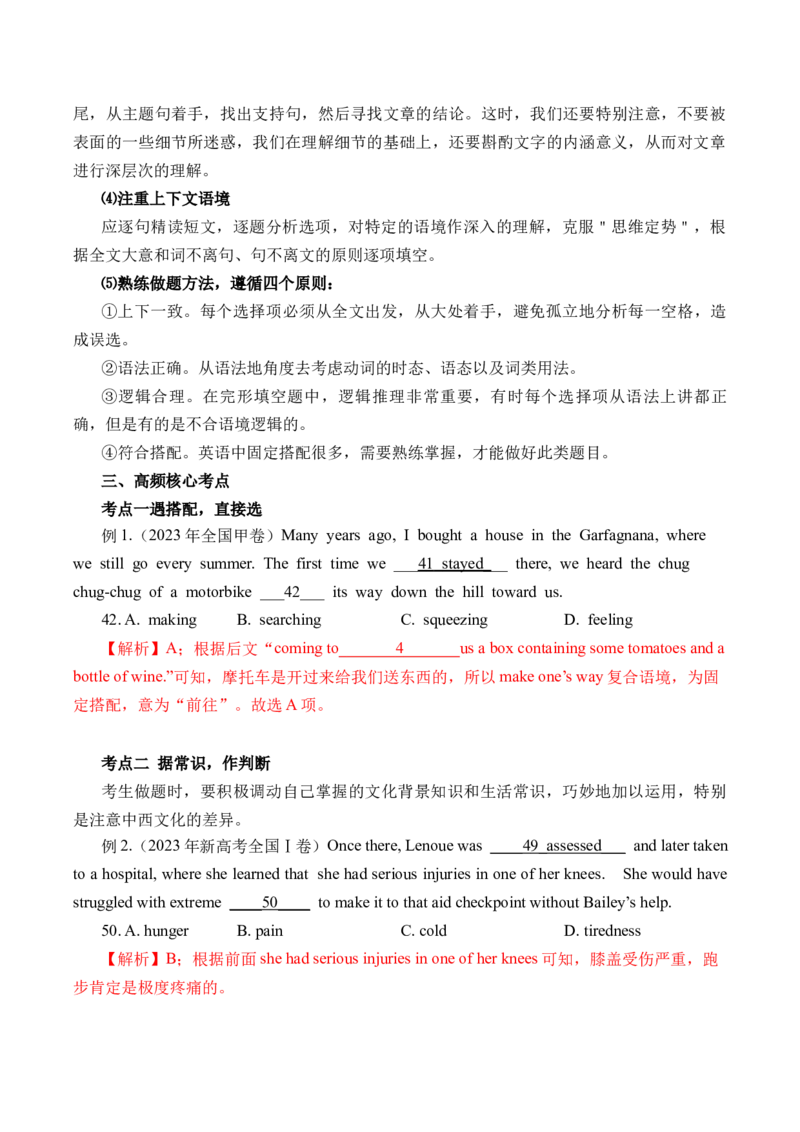
例1.(2023年全国甲卷)Many years ago, I bought a house in the Garfagnana, where
we still go every summer. The first time we ___ 4 1 stayed _ __ there, we heard the chug
chug-chug of a motorbike ___42___ its way down the hill toward us.
42. A. making B. searching C. squeezing D. feeling
【解析】A;根据后文“coming to 4 us a box containing some tomatoes and a
bottle of wine.”可知,摩托车是开过来给我们送东西的,所以make one’s way复合语境,为固
定搭配,意为“前往”。故选A项。
考点二 据常识,作判断
考生做题时,要积极调动自己掌握的文化背景知识和生活常识,巧妙地加以运用,特别
是注意中西文化的差异。
例2.(2023年新高考全国Ⅰ卷)Once there, Lenoue was ____ 4 9_ assessed ___ and later taken
to a hospital, where she learned that she had serious injuries in one of her knees. She would have
struggled with extreme ____ 5 0____ to make it to that aid checkpoint without Bailey’s help.
50. A. hunger B. pain C. cold D. tiredness
【解析】B;根据前面she had serious injuries in one of her knees可知,膝盖受伤严重,跑
步肯定是极度疼痛的。考点三 平行结构句中现
试题命制者常从平行结构的句式相同或相似这一角度出发,利用其表现出的意义的关联
性或对比性这一特点来设空。
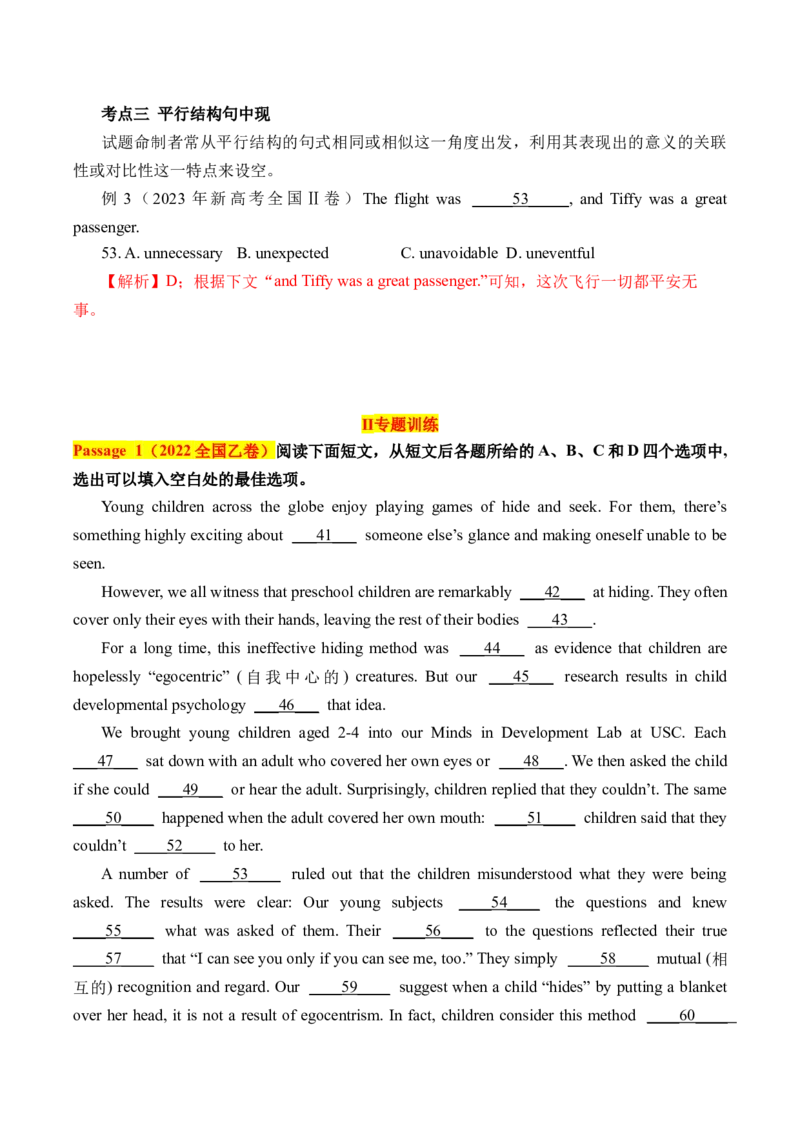
例 3(2023 年新高考全国Ⅱ卷)The flight was _____ 5 3_____ , and Tiffy was a great
passenger.
53. A. unnecessary B. unexpected C. unavoidable D. uneventful
【解析】D;根据下文“and Tiffy was a great passenger.”可知,这次飞行一切都平安无
事。
II专题训练
Passage 1(2022全国乙卷)阅读下面短文,从短文后各题所给的A、B、C和D四个选项中,
选出可以填入空白处的最佳选项。
Young children across the globe enjoy playing games of hide and seek. For them, there’s
something highly exciting about ___41___ someone else’s glance and making oneself unable to be
seen.
However, we all witness that preschool children are remarkably ___42___ at hiding. They often
cover only their eyes with their hands, leaving the rest of their bodies ___43___.
For a long time, this ineffective hiding method was ___44___ as evidence that children are
hopelessly “egocentric” (自我中心的) creatures. But our ___45___ research results in child
developmental psychology ___46___ that idea.
We brought young children aged 2-4 into our Minds in Development Lab at USC. Each
___47___ sat down with an adult who covered her own eyes or ___48___. We then asked the child
if she could ___49___ or hear the adult. Surprisingly, children replied that they couldn’t. The same
____50____ happened when the adult covered her own mouth: ____51____ children said that they
couldn’t ____52____ to her.
A number of ____53____ ruled out that the children misunderstood what they were being
asked. The results were clear: Our young subjects ____54____ the questions and knew
____55____ what was asked of them. Their ____56____ to the questions reflected their true
____57____ that “I can see you only if you can see me, too.” They simply ____58____ mutual (相
互的) recognition and regard. Our ____59____ suggest when a child “hides” by putting a blanket
over her head, it is not a result of egocentrism. In fact, children consider this method ____60____when others use it.
41. A. following B. taking C. escaping D. directing
42. A. clever B. bad C. scared D. quick
43. A. exposed B. examined C. untouched D.imbalanced
44. A. supported B. guaranteed C. imagined D. interpreted
45. A. disappointing B. mixed C. surprising D. desired
46. A. explained B. confirmed C. contradicted D. tested
47. A. parent B. child C. researcher D. doctor
48. A. feet B. nose C. hands D. ears
49. A. see B. help C. reach D. fool
50. A. event B. thing C. action D. accident
51. A. Yet B. Now C. Soon D. Once
52. A. speak B. listen C. turn D. wave
53. A. instructions B. descriptions C. experiments D.assumptions
54. A. comprehended B. predicted C. explored D. ignored
55. A. partly B. honestly C. vaguely D. exactly
56. A. responses B. approaches C. contribution D. sensitivity
57. A. ability B. belief C. identity D. purpose
58. A. hold back B. relate to C. insist on D. make up
59. A. limitations B. requirements C. theories D. findings
60. A. tentative B. impressive C. creative D. effective
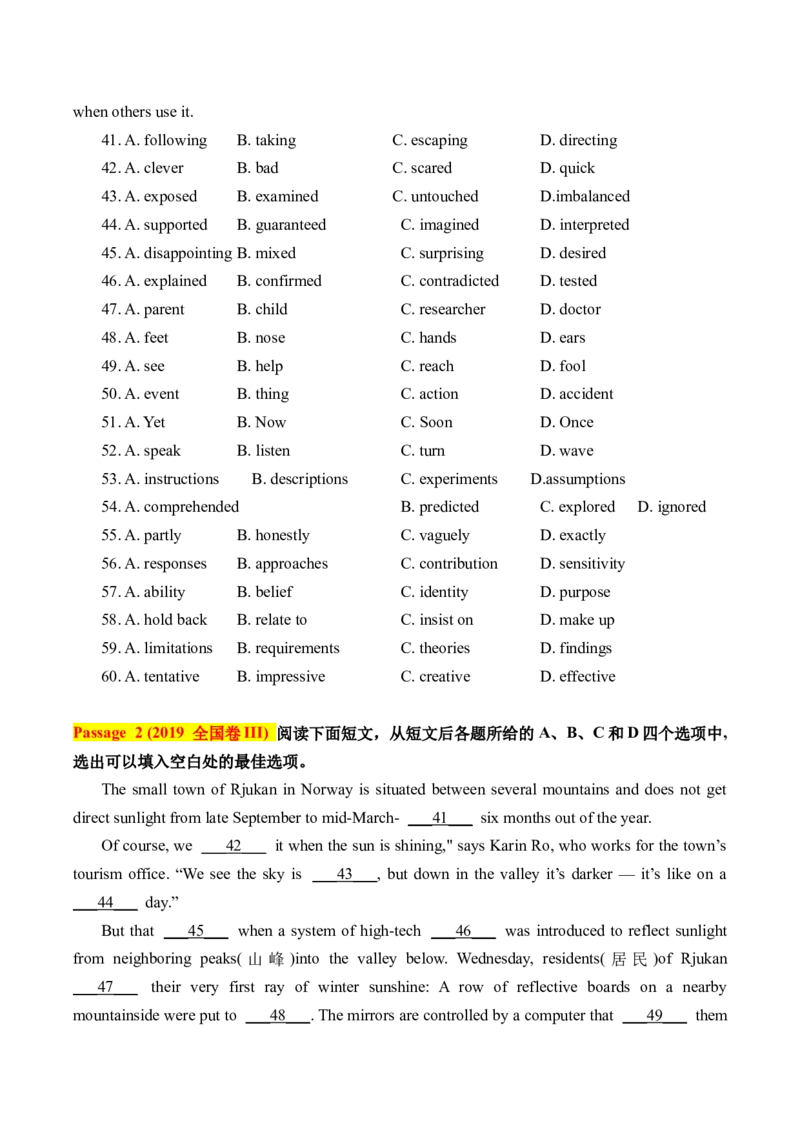
Passage 2 (2019 全国卷III) 阅读下面短文,从短文后各题所给的A、B、C和D四个选项中,
选出可以填入空白处的最佳选项。
The small town of Rjukan in Norway is situated between several mountains and does not get
direct sunlight from late September to mid-March- ___41___ six months out of the year.
Of course, we ___42___ it when the sun is shining," says Karin Ro, who works for the town’s
tourism office. “We see the sky is ___43___, but down in the valley it’s darker — it’s like on a
___44___ day.”
But that ___45___ when a system of high-tech ___46___ was introduced to reflect sunlight
from neighboring peaks( 山 峰 )into the valley below. Wednesday, residents( 居 民 )of Rjukan
___47___ their very first ray of winter sunshine: A row of reflective boards on a nearby
mountainside were put to ___48___. The mirrors are controlled by a computer that ___49___ themto turn along with the sun throughout the ___50___ and to close during windy weather. They reflect
a concentrated beam(束)of light onto the town’s central ___51___, creating an area of sunlight
roughly 600 square meters. When the light ___52___, Rjukan residents gathered together.
“People have been ___53___ there and standing there and taking ___54___ of each other," Ro
says. "The town square was totally ___55___. I think almost all the people in the town were there.
"The 3,500 residents cannot all ___56___ the sunshine at the same time. ___57___, the new light
feels like more than enough for the town’s ___58___ residents.
"It's not very ___59___,” she says, "but it is enough when we are ___60___.”
41. A. only B. obviously C. nearly D. precisely
42. A. fear B. believe C. hear D. notice
43. A. empty B. blue C. high D. wide
44. A. cloudy B. normal C. different D. warm
45. A. helped B. changed C. happened D. mattered
46. A. computers B. telescopes C. mirrors D. cameras
47. A. remembered B. forecasted C. received D. imagined
48. A. repair B. risk C. rest D. use
49. A. forbids B. directs C. predicts D. follows
50. A. day B. night C. month D. year
51. A. library B. hall C. square D. street
52. A. appeared B. returned C. faded D. stopped
53. A. driving B. hiding C. camping D. siting
54. A. pictures B. notes C. care D. hold
55. A. new B. full C. flat D. silent
56. A. block B. avoid C. enjoy D. store
57. A. Instead B. However C. Gradually D. Similarly
58. A. nature-loving B. energy-saving C. weather-beaten D. sun-starved
59. A. big B. clear C. cold D. easy
60. A. trying B. waiting C. watching D. sharing
Passage 3(2019全国卷I)阅读下面短文,从短文后各题所给的 A、B、C和D四个选项中,
选出可以填入空白处的最佳选项。
Every year about 40000 people attempt to climb Kilimanjaro, the highest mountain in Africa.
They ___41___ with them lots of waste. The ___42___ might damage the beauty of the place. Theglaciers(冰川)are disappearing, changing the ___43___ of Kilimanjaro.
Hearing these stories, I’m ___44___ about the place — other destinations are described as
“purer” natural experiences.
However, I soon ___45___ that much has changed since the days of disturbing reports of
___46___ among tons of rubbish. I find a ___47___ mountain, with toilets at camps and along the
paths. The environmental challenges are ___48___ but the efforts made by the Tanzania National
Park Authority seem to be ___49___.
The best of a Kilimanjaro ___50___, in my opinion, isn’t reaching the top. Mountains are
___51___ as spiritual places by many cultures. This ___52___ is especially evident on Kilimanjaro
as ___53___ go through five ecosystems(生态系统)in the space of a few kilometers. At the base is a
rainforest. It ends abruptly at 3000 meters, ___54___ lands of low growing plants. Further up, the
weather ___55___ — low clouds envelope the mountainsides, which are covered with thick grass.
I ___56___ twelve shades of green from where I stand. Above 4000 meters is the highland
___57___: gravel(砾石), stones and rocks. ___58___ you climb into an arctic-like zone with
___59___ snow and the glaciers that may soon disappear.
Does Kilimanjaro ___60___ its reputation as a crowded mountain with lines of tourists ruining
the atmosphere of peace?I found the opposite to be true.
41. A. keep B. mix C. connect D. bring
42. A. stories B. buildings C. crowds D. reporters
43. A. position B. age C. face D. name
44. A. silent B. skeptical C. serious D. crazy
45. A. discover B. argue C. decide D. advocate
46. A. equipment B. grass C. camps D. stones
47. A. remote B. quiet C. all D. clean
48. A. new B. special C. significant D. necessary
49. A. paying off B. spreading out C. blowing up D. fading away
50. A. atmosphere B. experience C. experiment D. sight
51. A. studied B. observed C. explored D. regarded
52. A. view B. quality C. reason D. purpose
53. A. scientists B. climbers C. locals D. officials
54. A. holding on to B. going back to C. living up to D. giving way to
55. A. changes B. clears C. improves D. permits
56. A. match B. imagine C. count D. add57. A. village B. desert C. road D. lake
58. A. Obviously B. Easily C. Consequently D. Finally
59. A. permanent B. little C. fresh D. artificial
60. A. enjoy B. deserve C. save D. acquire
Passage 4 (2015安徽卷)阅读下面短文,从短文后各题所给的 A、B、C和D四个选项中,
选出可以填入空白处的最佳选项。
In our modern world, when something wears out, we throw it away and buy a new one. The
1 is that countries around the world have growing mountains of 2 because people are
throwing out more rubbish than ever before.
How did we 3 a throwaway society? First of all, it is now easier to 4 an object than
to spend time and money to repair it. 5 modern manufacturing (制造业)and technology,
companies are able to produce products quickly and inexpensively. Products are plentiful and 6 .
Another cause is our 7 of disposable (一次性的) products. As 8 people, we are always
looking for 9 to save time and make our lives easier. Companies 10 thousands of
different kinds of disposable products: paper plates, plastic cups, and cameras, to name a few.
Our appetite for new products also 11 to the problem. We are 12 buying new things.
Advertisements persuade us that 13 is better and that we will be happier with the latest
products. The result is that we 14 useful possessions to make room for new ones.
All around the world, we can see the 15 of this throwaway lifestyle. Mountains of rubbish
just keep getting bigger. To 16 the amount of rubbish and to protect the 17 , more
governments are requiring people to recycle materials. 18 , this is not enough to solve (解决)
our problem.
Maybe there is another way out. We need to repair our possessions 19 throwing them
away. We also need to rethink our attitudes about 2 0 . Repairing our possessions and changing
our spending habits may be the best way to reduce the amount of rubbish and take care of our
environment.
1.A.key B.reason C.project D.problem
2.A.gifts B.rubbish C.debt D.products
3.A.face B.become C.observe D.change
4.A.hide B.control C.replace D.withdraw
5.A.Thanks to B.As to C.Except for D.Regardless of
6.A.safe B.funny C.cheap D.powerful7.A.love B.lack C.prevention D.division
8.A.sensitive B.kind C.brave D.busy
9.A.ways B.places C.jobs D.friends
10.A.donate B.receive C.produce D.preserve
11.A.adapts B.returns C.responds D.contributes
12.A.tired of B.addicted to C.worried about D.ashamed for
13.A.newer B.stronger C.higher D.larger
14.A.pick up B.pay for C.hold onto D.throw away
15.A.advantages B.purposes C.functions D.consequences
16.A.show B.record C.decrease D.measure
17.A.technology B.environment C.consumers D.brands
18.A.However B.Otherwise C.Therefore D.Meanwhile
19.A.by B.in favour of C.after D.instead of
20.A.spending B.collecting C.repairing D.advertising
Passage 5 (2012上海卷)阅读下面短文,从短文后各题所给的 A、B、C和D四个选项中,
选出可以填入空白处的最佳选项。
People on a college campus were more likely to give money to the March of Dimes if they were
asked for a donation by a disabled woman in a wheelchair than if asked by a nondisabled woman. In
another 29 , subway riders in New York saw a man carrying a stick stumble(绊脚) and fall
to the floor. Sometimes the victim had a large red birthmark on his 30 ; sometimes he did not.
In this situation, the victim was more likely to 31 aid if his face was spotless than if he had an
unattractive birthmark. In 32 these and other research findings, two themes are 33 : we
are more willing to help people we like for some reason and people we think 34 assistance.
In some situations, those who are physically attractive are more likely to receive aid. 35 ,
in a field study researchers placed a completed application to graduate school in a telephone box at
the airport. The application was ready to be 36 , but had apparently been "lost". The photo
attached to the application was sometimes that of a very 37 person and sometimes that of a less
attractive person. The measure of helping was whether the individual who found the envelope
actually mailed it or not. Results showed that people were more likely to 38 the application if
the person in the photo was physically attractive.
The degree of 39 between the potential helper and the person in need is also important. For
example, people are more likely to help a stranger who is from the same country rather than aforeigner. In one study, shoppers on a busy street in Scotland were more likely to help a person
wearing a(n) 40 T-shirt than a person wearing a T-shirt printed with offensive words.
Whether a person receives help depends in part on the "worth" of the case. For example,
shoppers in a supermarket were more likely to give someone. 41 to buy milk rather than to buy
cookies, probably because milk is thought more essential for 42 than cookies. Passengers on a
New York subway were more likely to help a man who fell to the ground if he appeared to be 43
rather than drunk.
29.A.study B.way C.word D.college
30.A.hand B.arm C.face D.back
31.A.refuse B.beg C.lose D.receive
32.A.challenging B.recording C.understanding D.publishing
33.A.important B.possible C.amusing D.missing
34.A.seek B.deserve C.obtain D.accept
35.A.At first B.Above all C.In addition D.For example
36.A.printed B.mailed C.rewritten D.signed
37.A.talented B.good-looking C.helpful D.hard-working
38.A.send in B.throw away C.fill out D.turn down
39.A.similarity B.friendship C.cooperation D.contact
40.A.expensive B.plain C.cheap D.strange
41.A.time B.instructions C.money D.chances
42.A.shoppers B.research C.children D.health
43.A.talkative B.handsome C.calm D.sick
Passage 6 (2011上海卷)阅读下面短文,从短文后各题所给的 A、B、C和D四个选项中,
选出可以填入空白处的最佳选项。
Everyone in business has been told that success is all about attracting and retaining (留住)
customers. It sounds simple and achievable. But, 44 , words of wisdom are soon forgotten.
Once companies have attracted customers they often 45 the second half of the story. In the
excitement of beating off the competition, negotiating prices, securing orders, and delivering the
product, managers tend to become carried away. They forget what they regard as the boring side of
business— 46 that the customer remains a customer. 47 to concentrate on retaining as
well as attracting customers costs business huge amounts of money annually. It has been estimated
that the average company loses between 10 and 30 per cent of its customers every years. Inconstantly changing 48 , this is not surprising. What is surprising is the fact that few companies
have any idea how many customers they have lost.
Only now are organizations beginning to wake up to those lost opportunities and calculate the
49 implications. Cutting down the number of customers a company loses can make a big 50
in its performance. Research in the US found that a five per cent decrease in the number of defecting
(流失的) customers led to 51 increases of between 25 and 85 per cent.
In the US, Domino’s Pizza estimates that a regular customer is worth more than $5,000 over ten
years. A customer who receives a poor quality product or service on their first visit and 52
never returns, is losing the company thousands of dollars in 53 profits (more if you consider
how many people they are likely to tell about their bad experience).
The logic behind cultivating customer 54 is impossible to deny. “In practice most
companies’ marketing effort is focused on getting customers, with little attention paid to 55
them”, says Adrian Payne of Cornfield University’ School of Management. “Research suggests that
there is a close relationship between retaining customers and making profits. 56 customers tend
to buy more, are predictable and usually cost less to service than new customers. Furthermore, they
tend to be less price 57 , and may provide free word-of-mouth advertising. Retaining customers
also makes it 58 for competitors to enter a market or increase their share of a market.
44.A.in particular B.in reality C.at least D.first of all
45.A.emphasize B.doubt C.overlook D.believe
46.A.denying B.ensuring C.arguing D.proving
47.A.Moving B.Hoping C.Starting D.Failing
48.A.markets B.tastes C.prices D.expenses
49.A.culture B.social C.financial D.economical
50.A.promise B.plan C.mistake D.difference
51.A.cost B.opportunity C.profit D.budget
52.A.as a result B.on the whole C.in conclusion D.on the contrary
53.A.huge B.potential C.extra D.reasonable
54.A.beliefs B.loyalty C.habits D.interest
55.A.altering B.understanding C.keeping D.attracting
56.A.Assumed B.Respected C.Established D.Unexpected
57.A.agreeable B.flexible C.friendly D.sensitive
58.A.unfair B.difficult C.essential D.convenient