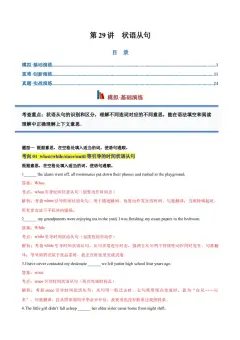
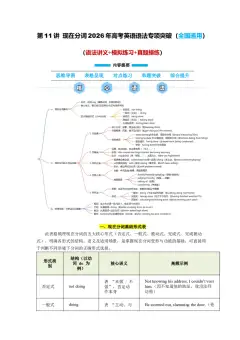
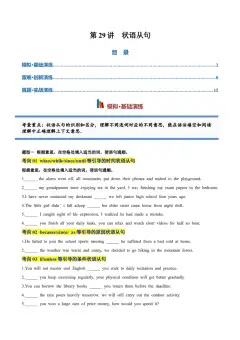
题型17 语法填空(从句题)
题型简介
从句填空是高考英语语法填空中考查复杂句子构建与逻辑分层能力的高阶题型。该题型通常
不提供提示词,要求考生通过分析句子结构,判断从句类型,并根据其在主句中的语法功能及内
部的逻辑关系,填入一个恰当的引导词(关系代词、关系副词、从属连词等)。
在高考英语语法填空中,从句填空是衡量学生能否从简单句思维跃升至复合句思维的关键标
尺。它并非孤立地考查词汇,而是对学生深入理解英语“形合”特征、精准把握主从逻辑层次、
以及根据成分缺失灵活选用连接手段等核心能力的综合检验。随着高考对语言逻辑性与结构复杂
性要求的不断提升,确保此类题目的得分率,对于学生突破语法瓶颈、冲击高分具有至关重要的
战略意义,是学生在语法填空部分实现能力分层的试金石。
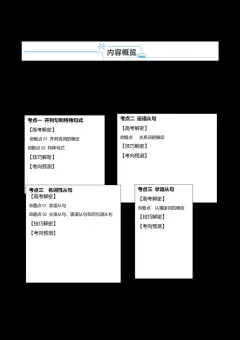
该题型主要考查三大方向:定语从句;名词性从句;状语从句。
设题类型&解题思路
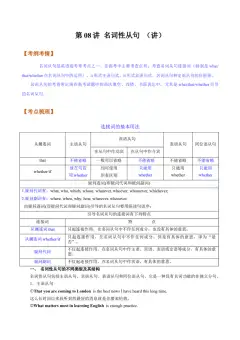
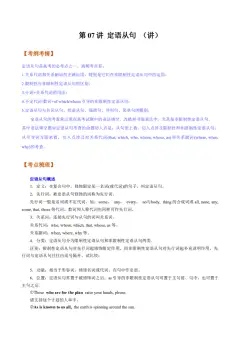
考向01 定语从句考点
核心定位:定语从句是句子的“形容词性组件”,其功能相当于一个形容词,在复合句中修
饰一个名词或代词(即先行词),对其进行限定或补充说明。在语法填空中,该考点主要考查考
生根据先行词的性质(人、物、时间、地点等)以及关系词在定语从句中所充当的句子成分,精
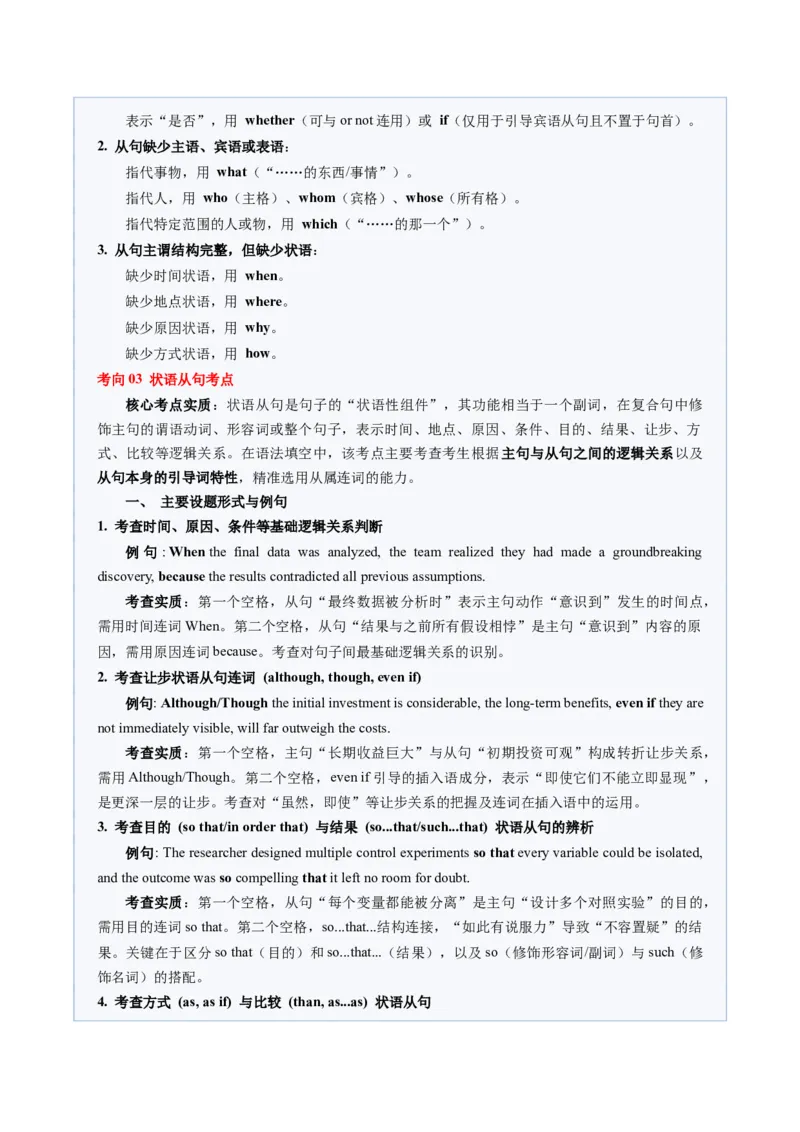
目录
第一部分 题型解码 高屋建瓴,掌握全局
第二部分 考向破译
解
微观
剖,精细教学
典例引领
方法透视
变式演练
考向01 定语从句考点【高频】
考向02 名词性从句考点【中频】
考向03 状语从句考点
第三部分 综合巩固
合
整
应用,模拟实战
专题01 高考真题练
专题02 优秀模拟题
准选用关系词(关系代词或关系副词)的能力。
构成与考查实质:解题时,考生需要先识别被修饰的先行词,然后分析将先行词代入从句后,
从句本身缺失什么成分(如主语、宾语、状语等),最后选择一个既能指代先行词又能在从句中
充当该缺失成分的关系词。这正是“关系词”这一名称的由来——它起着连接主从句并替代先行
词在从句中担当成分的双重作用。
一、 主要设题形式与复杂例句
1. 考查关系代词在复杂先行词后的用法
例句:The policy and its immediate impact that/which we discussed yesterday have raised public
concern.
考查实质:先行词是由and 连接的复合结构(The policy and its impact),指物,且从句(we
discussed)中缺少宾语,因此填that 或which。主要考查学生能否准确找出复杂的先行词。
2. 考查关系副词与非限制性定语从句的结合
例句:She spent her childhood in the small town, where she acquired her passion for painting and later
became a renowned artist.
考查实质:逗号后是非限制性定语从句,先行词the small town 表地点,从句主干完整(she
acquired...),仅缺地点状语,故填where。这要求区分定语从句与并列句。
3. 考查“介词+关系代词”结构
例句:Personal growth is a continuous process during which we constantly overcome challenges and
reshape our understanding of the world.
考查实质:先行词process 指物,代入从句后应为we constantly overcome challenges during the
process。“介词(during)+关系代词(which)”共同在从句中作时间状语。这是高频难点,需根据从句
的动词搭配判断介词。
4. 考查关系代词as/which 引导的非限制性定语从句
例句:As is known to all, persistent effort is key to success, which has been proven by countless
examples.
考查实质:第一个空格,as 引导非限制性定语从句置于句首,指代整个主句,意为“正如”。
第二个空格,which 同样指代整个主句,但只能置于主句后,意为“这一点”。考查as 和which 在
指代整个主句时的区别。
5. 考查关系代词whose 表示所属关系
例句:The company has recruited a group of young engineers whose innovative ideas have brought a
breakthrough to the project.
考查实质:先行词engineers 指人,从句中ideas 与engineers 是所属关系(the engineers' ideas),
从句缺少定语,故填whose。该考点要求识别名词间的所属关系,不只修饰人,也可修饰物。
二、 核心解题思路与步骤
三步破题法:寻先行 析成分 定关系词
→
→
第一步:寻找并确定先行词。
锁定空格前最近的名词、代词或整个句子,即定语从句所修饰的对象。这是解题的基石。注
意先行词可能是带有修饰语的复杂名词短语。
第二步:分析从句句子成分(最关键)。
将先行词代入定语从句中,尝试构成一个完整的句子,看它在从句里充当什么成分。核心原
则是:“从句缺什么成分,就补什么关系词”。
如果先行词在从句中需要充当主语、宾语或表语,那么从句缺的是名词性成分,应选用关系
代词(that, which, who, whom)。
如果先行词与从句中的某个名词存在所属关系(“……的”),那么从句缺的是定语,应选
用whose。
如果先行词在从句中表示时间、地点或原因,并且需要充当状语,那么应选用相应的关系副
词(when, where, why)。
如果代入后,发现需要用一个“介词+先行词”的结构才能在从句中充当状语(如“通过这种
方式”、“在那之后”),则考虑“介词+which/whom”结构。
第三步:综合判断,确定关系词。
结合第一步的先行词性质(指人、指物、时间、地点等)和第二步判断的从句所缺成分,在
对应的关系词类别中做出最终选择。简单来说:
缺主语/宾语/表语时:
先行词指人,用 who/that(作宾语时可用whom)。
先行词指物,用 which/that。
缺定语(表所属),无论先行词指人还是物,都用 whose。
缺状语时:
先行词表时间,用 when 或 “介词+which”。
先行词表地点,用 where 或 “介词+which”。
先行词是reason,用 why 或 “for which”。
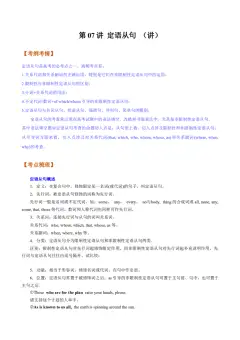
考向02 名词性从句考点
核心定位: 名词性从句是句子的“名词性组件”,其功能相当于一个名词,在复合句中充当
主语、宾语、表语或同位语。在语法填空中,该考点主要考查考生根据从句在主句中的成分以及
从句本身的句子完整性,精准选用连接词(从属连词、连接代词、连接副词)的能力。
一、 主要设题形式与例句
1. 考查从属连词 that 与 whether/if 的辨析(高频基础)
例句: The latest evidence leaves no doubt that climate change is accelerating, but scientists still
debate whether/if its local impacts can be precisely predicted.
考查实质:第一个空格,that 引导同位语从句,对抽象名词doubt 进行内容说明,从句本身意
思完整,仅起连接作用。第二个空格,whether/if 引导宾语从句,意为“是否”,表示不确定性的
争论焦点。关键在于判断从句是否含有“是否”的疑问意义,以及主句动词(如debate, discuss, do
ubt)是否要求。
2. 考查连接代词 what 的用法(“所…的”)
例句: What impressed the judges most was not the complexity of the design but the creator’s deep
understanding of what users truly needed.
考查实质:第一个What 引导主语从句,并在从句中作主语,意为“所打动评委的事情”。第
二个what 引导宾语从句,作of 的宾语,并在其引导的从句中作宾语,意为“用户真正所需要的东
西”。what 相当于“the thing(s) that”,必须在从句中充当主语、宾语或表语。
3. 考查连接副词 when, where, why, how(从句主谓完整)
例句: The research focuses on how cultural values shape consumer behavior, which
explains why certain marketing strategies fail across regions.
考查实质:第一个空格,how 引导宾语从句,意为“如何塑造”,从句主谓宾齐全(values
shape behavior),缺少方式状语。第二个空格,why 引导宾语从句,意为“为何失败”,从句主谓
完整(strategies fail),缺少原因状语。解题关键是确认从句主谓结构已完整,仅缺状语成分。
4. 考查“介词+名词性从句”结构
例句: The success of the project depends largely on who will be in charge of the team and how much
budget we can secure.
考查实质:空格位于介词on 之后,需要宾语。who 引导的名词性从句作介词宾语,同时who
在从句中作主语。how 引导并列的宾语从句,how much 修饰budget,在从句中作定语。考查了连
接词在介词后的应用,以及连接代词与连接副词的区别。
5. 考查 it 作形式主语/宾语, that/whether 从句后置
例句: The experts consider it essential that all data be double-checked before publication,
making it unclear whether the current findings are reliable.
考查实质:第一个it 作consider 的形式宾语,真正的宾语是that 引导的从句。第二个it 作
making 的形式宾语,真正宾语是whether 引导的从句。这种结构常用于保持句子平衡。关键在于识
别动词(consider, find, make)+it+adj./n.+that...这一固定句型。
二、 核心解题思路与步骤
两步破题法:定成分 析从句
→
第一步:确定从句在主句中的成分。
分析空格所在的从句部分,在整个主句中充当什么角色。
位于句首或 It is... that... 结构中
可能是
→
主语从句。
位于及物动词或介词之后
可能是
→
宾语从句。
位于系动词 (be, seem, remain) 之后
可能是
→
表语从句。
位于抽象名词 (fact, idea, news, doubt) 之后,且对该名词进行内容解释
可能是
→
同位语从句。
第二步:分析从句内部的完整性,选择连接词。
这是选择具体连接词的关键。分析名词性从句本身的句子结构:
1. 从句主谓宾结构完整,不缺任何成分:
仅起连接作用,用 that(通常可省略,但引导主语、表语、同位语从句时一般不省)。
表示“是否”,用 whether(可与or not 连用)或 if(仅用于引导宾语从句且不置于句首)。
2. 从句缺少主语、宾语或表语:
指代事物,用 what(“……的东西/事情”)。
指代人,用 who(主格)、whom(宾格)、whose(所有格)。
指代特定范围的人或物,用 which(“……的那一个”)。
3. 从句主谓结构完整,但缺少状语:
缺少时间状语,用 when。
缺少地点状语,用 where。
缺少原因状语,用 why。
缺少方式状语,用 how。
考向03 状语从句考点
核心考点实质:状语从句是句子的“状语性组件”,其功能相当于一个副词,在复合句中修
饰主句的谓语动词、形容词或整个句子,表示时间、地点、原因、条件、目的、结果、让步、方
式、比较等逻辑关系。在语法填空中,该考点主要考查考生根据主句与从句之间的逻辑关系以及
从句本身的引导词特性,精准选用从属连词的能力。
一、 主要设题形式与例句
1. 考查时间、原因、条件等基础逻辑关系判断
例句: When the final data was analyzed, the team realized they had made a groundbreaking
discovery, because the results contradicted all previous assumptions.
考查实质:第一个空格,从句“最终数据被分析时”表示主句动作“意识到”发生的时间点,
需用时间连词When。第二个空格,从句“结果与之前所有假设相悖”是主句“意识到”内容的原
因,需用原因连词because。考查对句子间最基础逻辑关系的识别。
2. 考查让步状语从句连词 (although, though, even if)
例句: Although/Though the initial investment is considerable, the long-term benefits, even if they are
not immediately visible, will far outweigh the costs.
考查实质:第一个空格,主句“长期收益巨大”与从句“初期投资可观”构成转折让步关系,
需用Although/Though。第二个空格,even if 引导的插入语成分,表示“即使它们不能立即显现”,
是更深一层的让步。考查对“虽然,即使”等让步关系的把握及连词在插入语中的运用。
3. 考查目的 (so that/in order that) 与结果 (so...that/such...that) 状语从句的辨析
例句: The researcher designed multiple control experiments so that every variable could be isolated,
and the outcome was so compelling that it left no room for doubt.
考查实质:第一个空格,从句“每个变量都能被分离”是主句“设计多个对照实验”的目的,
需用目的连词so that。第二个空格,so...that...结构连接,“如此有说服力”导致“不容置疑”的结
果。关键在于区分so that(目的)和so...that...(结果),以及so(修饰形容词/副词)与such(修
饰名词)的搭配。
4. 考查方式 (as, as if) 与比较 (than, as...as) 状语从句
例句: In scientific inquiry, one must proceed as the evidence guides, just as a sailor navigates by the
stars. The process is often more complex than it appears as if every step could lead to unexpected puzzles.
考查实质:第一个as 引导方式状语从句,“如同证据所指引的那样”。第二个as 是as...as...比
较结构的一部分。than 引导比较状语从句,与more complex 呼应。as if 引导方式状语从句,表示
“仿佛”。此题综合考查了易混连词在不同语境下的具体用法。
5. 考查连词在省略结构与非谓语形式中的运用
例句: While (he was) analyzing the samples, he noticed an anomaly. He paused, as if (he were) to
double-check his instrument, before proceeding as (he had been) instructed.
考查实质:考查状语从句的省略形式。当从句主语与主句一致,且含有be 动词时,可省略主
语和be 动词。While 后省略了he was;as if 后省略了he were;as 后省略了he had been。解题关键是
识别出主从句主语一致且从句为“主语+be”的结构,从而判断空格处应填哪个从属连词。
二、核心解题思路与步骤
两步破题法:判逻辑 选连词
→
第一步:判断主从句之间的逻辑关系。
这是解题的根本。仔细阅读空格前后的主句和从句(或意群),分析从句是为主句动作提供
时间、地点、原因、条件、目的、结果、让步、方式还是比较的说明。
关键技巧:寻找语义上的逻辑关键词。例如,前后句意相反用让步(although),前句是后句的
目的用目的(so that),前因后果用原因(because)或结果(so...that)。
第二步:根据关系类别和从句特征,选择从属连词。
确定逻辑关系后,在对应的连词库中选择,并注意以下特例与固定搭配:
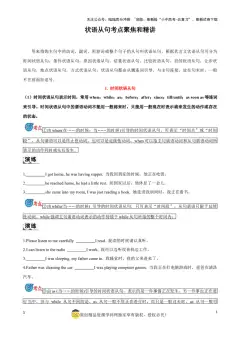
1. 时间关系:when, while, as, before, after, since, until, as soon as。注意when(点时间),while
(段时间,且主从句动作同时进行),as(伴随,“一边……一边”)。
2. 条件关系:if, unless(除非,相当于 if not), as/so long as(只要)。
3. 让步关系:although/though(虽然),even if/though(即使),while(尽管,常放句首)。
4. 原因关系:because, since, as, for。注意because 语气最强,回答“why”;since/as 常表已知原
因;for 为并列连词,表补充说明。
5. 目的关系:so that, in order that。从句中常含can/could/may/might。
6. 结果关系:so...that..., such...that...。注意so 修饰形容词/副词,such 修饰名词。
7. 方式与比较:as(按照,如同),as if/though(仿佛),than(比),as...as...(和……一
样)。
考向01 定语从句考点
【例1-1】(河北省邢台市信都区2025-2026 学年高三上学期期中英语试题节选)
Yu Zemin, Chinese translator of Krasznahorkai’s Satantango, revealed the author frequently consumed Chinese
food, listened to Beijing opera, 3
and
consistently referenced China in conversations. The writer particularly
valued ancient Chinese philosophy, repeatedly studying Tao Te Ching 4 he considered “ultimate
wisdom”.
【答案】that/which
【详解】考查定语从句。句意:克劳斯纳霍尔凯《撒旦探戈》的中文译者于泽民透露,这位作家经常吃中
国菜,听京剧,并且在谈话中经常提到中国。这位作家特别重视中国古代哲学,反复研读他认为“终极智
慧”的《道德经》。“ 4 he considered “ultimate wisdom””为限制性定语从句,修饰先行词Tao Te Ching,
指物,关系词在从句中作宾语,应用关系代词that 或which 引导。故填that 或which。
【例1-2】(贵州省贵阳市2025-2026 学年高三上学期质量监测英语试题节选)
Human-elephant conflict resulting 6 from this is a leading cause of elephant death, as 70% of the
population now lives outside protected areas. These interactions can lead to substantial damage, as seen in China 7
the herd caused an estimated $1.1 million in losses.
【答案】where
【详解】7.考查定语从句。句意:由此引发的人象冲突成为大象死亡的主因——如今70%的象群生活在
保护区外。此类冲突可能造成巨大损失,例如象群在中国造成的经济损失预估达110 万美元。此处引导定
语从句,先行词为China,在定语从句中作地点状语,故应用where 引导。故填where。
【例1-3】(重庆市第八中学校2025-2026 学年高三上学期月考英语试题节选)
For over 35 years, he has practiced and taught five-element acupuncture, 4 aims are to restore
bodily harmony and keep the balance of yin and yang rather than just treat symptoms.
【答案】whose
【详解】考查定语从句。句意:35 年来,他一直从事并教授五行针灸,其目的是恢复身体和谐、保持阴阳
平衡,而不仅仅是治疗症状。此处是非限制性定语从句,先行词是“five-element acupuncture”,在从句中
作定语,修饰“aims”,用关系代词“whose”。故填whose。
解|题|技|巧
一、 核心解题方法(三步法)
第一步:定位先行词,确定“修饰谁”。
这是解题的起点。先行词即被定语从句修饰的名词或代词。
例1-1:先行词是 Tao Te Ching(《道德经》),指物。例1-2:先行词是 China(中国),指地
点。
例1-3:先行词是 five-element acupuncture(五行针灸),指物。
第二步:分析从句成分,判断“缺什么”。(最关键步骤)
将先行词代入定语从句中,看它在从句里充当什么成分。核心口诀:“缺什么成分,补什么关系
词”。
1.
缺主语、宾语、表语
需用
→
关系代词 (that, which, who, whom)。
例1-1 分析:将先行词Tao Te Ching 代入从句,得到 he considered Tao Te Ching “ultimate wisdom”。
可见,Tao Te Ching 在从句中作considered 的宾语。故缺一个作宾语的关系代词。
2.
缺定语(表所属,“……的”)
需用
→
关系代词 whose。
例1-3 分析:先行词代入后,从句意为“五行针灸的目的是……”。aims(目的)与acupuncture
之间是所属关系,从句缺少一个表示“它的”的定语。故缺whose。
3.
缺状语(时间、地点、原因)
需用
→
关系副词 (when, where, why) 或“介词+which”。
例1-2 分析:将先行词China 代入从句,得到 the herd caused ... losses in China。in China 在从句中
作地点状语。故缺一个作地点状语的关系副词。
第三步:综合判断,选定关系词。
结合前两步的结论,从对应类别中选定最终答案。
例1-1:先行词指物,在从句中缺宾语
可填
→
that 或 which。例1-3:先行词指物,在从句中缺
定语
必须填
→
whose。例1-2:先行词指地点,在从句中缺地点状语
必须填
→
where。
注|意|事|项
1.
whose 不只修饰“人”,也可修饰“物”:这是学生常有的误解。whose 表示所属关系,其先行词
可以是人也可以是物,在从句中作定语,意为“……的”。
例1-3 中,whose aims = the aims of which(五行针灸的目的)。
类似:a room whose window faces south(一扇窗户朝南的房间)。
2.
关系副词 (when/where/why) 的使用前提是“从句主谓完整”:只有当先行词在从句中不作主语或
宾语,而是作状语时,才能用关系副词。这是区分关系代词和关系副词的黄金法则。
例1-2:从句the herd caused...主谓宾齐全,只缺地点状语,故用where。
对比:This is the factory (that/which) we visited.(从句缺宾语visited 的宾语,用关系代词)
对比:This is the factory where we worked.(从句主谓完整,worked 不缺宾语,缺地点状语,用关系
副词)
【变式1-1】(上海市青浦区2025-2026 学年高三上学期期中考试英语试题节选)
That’s no surprise, considering that his ideas came out of the 18th-century marketplace, in 1 producers
and consumers were likely to be neighbours. ………
………These middlemen, including Big Tech platforms like Amazon, make it possible for us to buy goods
made 4 on the other side of the world, but this connective power is threatening accountability by creating so
much separation between buyers and sellers 5 it’s impossible to match up with the real cost of convenience
and low prices. ……..
……….The two big questions are how to create system change and 8 will bear the cost of it. There
are no simple answers to 9 either of the questions, though technology offers new possibilities to connect
buyers and sellers.
【变式1-2】(高中英语语法与高考考法定语从句专题节选)
People who live far away from beaches, sometimes never get an opportunity to visit the beach or take dips in
the water. An educational program in Australia is changing that for local children from the bush (荒野), 1 see
and swim in the ocean for the first time.
The children, 2 ages range from eight to fifteen, participate in the volunteer-led Bush to Beach
program. The students travel 700 kilometers to South Narrabeen near Sydney. Bush to Beach, 3 was founded
by Jack Cannons in 2006, brings up to 50 outback (内陆的) kids to the beach for a three-day surf camp to learn new
skills, and to build confidence in an environment 4 is totally new to them, according to the organization.
These children have to travel a 10-hour bus ride to the beach, 5 they can have much fun. To qualify for the
program, the children are trying their best to maintain the good school attendance and behavior.
考向02 名词性从句考点
【例2-1】(2026 届浙江省台州高三一模英语试题节选)
In recent years, more young 8 professionals (profession) have joined the museum's restoration teams,
including Jin Dazhao, 34, from the metal artifacts group. Jin believes that restoring cultural relics is not simply
3. that 与 which/who 的选择依据:在指物或指人时,that 的用法更广泛,但以下情况通常有明确倾向:
宜用 that:先行词被序数词、最高级或the only, the very 等修饰时;先行词同时包含人和物时。
宜用 which:引导非限制性定语从句(从句前有逗号)时;在“介词+关系代词”结构中。
例1-1 中,先行词Tao Te Ching 未被特殊词修饰,且从句为限制性定语从句,故that 和which 均可。
4. 非限制性定语从句(逗号隔开)的识别与翻译:非限制性定语从句对先行词进行补充说明,去掉后
主句意思依然完整,翻译时常译成独立的句子。
例1-3 中,..., whose aims are to... 就是一个非限制性定语从句,对“五行针灸”进行补充说明,译作
“,其目的是……”。
mending 9 is broken, but about continuing a chain of human creativity and memory.
【答案】what
【详解】考查宾语从句。句意:近年来,更多年轻的专业人士加入了博物馆的修复团队,包括34 岁来自金
属文物组的金大钊。金认为,修复文物不仅仅是修补破损的东西,而是延续人类创造力和记忆的链条。此
处为宾语从句,作mending 的宾语,从句中缺少主语,且指物,所以用连接代词what 引导。故填what。
【例2-2】(广东省深圳市宝安第一外国语学校2025-2026 学年高三上学期期中调研考试英语试题节选)
What’s more, static electricity is more common in the winter than in the summer. This is 6 the air is
typically drier in the winter, and dry air doesn’t conduct electricity as well as moist air.
【答案】because
【详解】考查表语从句。句意:这是因为冬天的空气通常更干燥,而干燥的空气导电性能不如潮湿的空气。
此处引导表语从句,从句中不缺主语和宾语,但句意不完整,结合句意,此处表示“因为”,用连接词
because。故填because。
解|题|技|巧
名词性从句考点的核心是:先确定从句在主句中的“功能角色”(主语、宾语等),再分析从句
内部所缺成分,从而选择唯一正确的连接词。高考命题侧重于在具体语境中,区分连接词(that/
whether)、连接代词(what/who)和连接副词(why/how)的精确用法。
一、 核心解题技巧(三步法)
第一步:确定从句在主句中的成分(是什么从句?)
分析空格所在的从句部分,在整个句子中充当什么角色。
例2-1:从句 ___ is broken 位于及物动词 mending 之后,作其宾语,为宾语从句。
例2-2:从句 ___ the air is drier... 位于系动词 is 之后,说明主语 This 的内容,为表语从句。
第二步:分析从句内部的句子完整性(从句本身缺什么?)
这是选择具体连接词的关键。核心口诀:“从句缺什么,连接词补什么”。
1. 从句缺主语、宾语或表语(名词性成分)
需用
→
连接代词。
例2-1 分析:从句 ___ is broken 缺少主语。结合句意,“修补破损的东西”,指物,因此需要能充
当主语且指物的连接代词 what(= the thing that)。
2. 从句主谓宾结构完整,仅缺状语
需用
→
连接副词。
例2-2 分析:从句 the air is drier... 主系表结构完整。但它用于解释前文“静电在冬天更常见”的
原因,因此缺少一个原因状语,需用连接副词 because。
第三步:综合判断,选定连接词并验证。
结合前两步的结论,锁定最终选项,并代入检查。
【变式2-1】(河南省郑州市第一中学2025-2026 学年高三上学期期中英语试题节选)
Since I moved to China in September 2024, I’ve found exactly 1 I was looking for when I left
Italy: a change — how people get around in daily life.
【变式2-2】 (2025-2026 浙江英语学业水平考试合格考总复习专题节选)
3 Holes tells is the story of Stanley Yelnats, a boy born into a poor family. Yelnats is accused 4
(accuse) of a crime he didn’t commit.
【变式2-3】(2025-2026 浙江英语学业水平考试合格考总复习专题节选)
Does this mean medications and lifestyle methods, with further research, can also be devised to help 10
ages too rapidly and is at risk of contracting age-related diseases like hypertension and Alzheimer’s? You never
know.
考向03 状语从句考点
例2-1:宾语从句 + 从句缺主语(指物) = what。
例2-2:表语从句 + 从句主谓完整(缺原因状语) = because。
注|意|事|项
1.
连接代词 (what/who) 与连接副词 (why/how) 的核心区别:不取决于主句,而完全取决于从句内部
是否缺核心成分(主/宾/表)。
I don't know **what** happened. (what 在从句中作主语)
I don't know **why** it happened. (why 在从句中作原因状语,it happened 主谓完整)
2.
what 的独特性:它自带“东西/事情”的含义。what 相当于 “先行词 (the thing(s)) + 关系代词
(that)” ,因此它引导的从句一定在从句中充当主语、宾语或表语。这是它与 that 的本质区别(that
在从句中不作任何成分,仅起连接作用)。
3. whether 与 if 的辨析:
whether 可用于所有名词性从句(主语、宾语、表语、同位语),可与 or not 连用,可直接接 to
do。
if 通常只用于动词后的宾语从句,不能引导主语从句或位于句首,不与 or not 紧连。
口诀:“主语、句首、介词后,whether 独家秀”。
4.
that 的“无词义”与“可省略”:
that 在名词性从句中不充当任何成分,也没有词义,仅起连接作用。
引导宾语从句时,that 常可省略;但引导主语、表语、同位语从句时,that 通常不省略。
5.
“介词+名词性从句”的结构:介词(如 on, of, about)后如需接从句,必须用 what,
whether, how 等引导,一般不能用 that(除了 in that 等少数固定搭配)。
It depends on **whether** he agrees. (正确)
He gave a description of **what** he had seen. (正确)
【例3-1】(四川省达州市高级中学等部分校2025-2026 学年高一上学期期中联考英语试题节选)
Sometimes, 6 the difference in sound is clear enough, learners make the mistake of pronouncing it
the same way.
【答案】although/though/while
【详解】考查状语从句连词。句意:有时,尽管声音上的差异足够明显,学习者还是会犯同样的发音错误。
此处表示让步关系,用although/though/while 引导让步状语从句,意为“尽管,虽然”。故填although/
though/while。
【例3-2】(上海市青浦区2025-2026 学年高三上学期期中考试英语试题节选)
These middlemen, including Big Tech platforms like Amazon, make it possible for us to buy goods made
on
4
the other side of the world, but this connective power is threatening accountability by creating so much
separation between buyers and sellers 5 it’s impossible to match up with the real cost of convenience and
low prices.
【答案】that
【详解】考查状语从句。句意:包括亚马逊等大型科技平台在内的这些中间商,让我们得以购买到产自世
界另一端的商品,但这种连接能力却在削弱问责制——它在买家和卖家之间制造了巨大的隔阂,使得人们
根本无法知晓便利与低价背后的真实成本。空处为结果状语从句的引导词,构成搭配:so…that…,意为
“如此……以至于……”,符合句意。故填that。
【例3-3】(2020 年新课标全国三卷)
___65____ he asked the villagers on the banks of the river where he could find the legendary (传
奇的) artist, they smiled and 66.___ point
_ (point) down the river.
【答案】When/As
【解析】考查连接词。句意:当他问河岸上的村民,他在哪里可以找到这位传奇艺术家时,他们笑着指着
河的下游。本句为时间状语从句,表示“当……时候”,且从句中动词asked 为短暂性动作动词,不能用
while 引导,故应用when 或as 引导。句首单词首字母要大写。故填When/As。
解|题|技|巧
状语从句考点考查的核心是:精准分析主句与从句之间的逻辑关系(因果、让步、时间等),并
据此选择唯一正确的从属连词。高考题目常通过设置复杂的句子结构和近义连词来增加区分度。
一、 核心解题技巧(三步法)
第一步:确定主从句的逻辑关系。
这是解题的根基。仔细分析空格所在的从句,是为主句动作提供时间、原因、条件、让步、目的、
结果等哪一方面的说明。
例3-1 分析:主句“学习者犯错”与从句“差异足够明显”在语义上相反,构成“虽然……但
是”的让步关系。
例3-2 分析:主句“制造了巨大的隔阂”与从句“不可能知晓真实成本”之间是前因后果,从
句是主句导致的结果,构成结果关系。
例3-3 分析:从句“他问村民”是主句“他们笑着指路”发生的时间背景,构成时间关系。
第二步:根据逻辑关系,选择从属连词。
确定关系后,在对应的连词库中选取,并注意固定搭配和近义词辨析。
让步关系(例3-1):可选 although/though/while(虽然/尽管)。
结果关系(例3-2):空格前有 so,构成固定搭配 so...that...(如此……以至于……),必须填
that。
时间关系(例3-3):从句动词 asked 是短暂性动作,强调“当……那一刻”,可用 When 或
As。
第三步:代入验证,确保通顺。
将所选连词代入,通读全句,检查逻辑是否合理,搭配是否正确。
注|意|事|项
1.
让步状语从句中 while 的特殊性:while 引导让步从句时,意为“尽管”,通常置于句首,且强调
对比意味(例3-1)。这与其引导时间从句(意为“当……时”,强调同时性)和作为并列连词
(意为“而”,表对比)的用法需区分。
2.
so...that... 与 such...that... 的不可互换性:这是高频易错点。
so + **形容词/副词** + that... (如 so difficult that...)
such + **(a/an)+ 形容词 + 名词** + that... (如 such a difficult problem that...)
口诀:“形副用so,名用such”。例3-2 中,so 修饰的是形容词 much,故用 so...that...。
3.
时间连词 when, while, as 的细微差别:
when:通用,可表“当……时”(从句动作可长可短,可与主句动作同时或先后)。
while:强调从句动作正在进行或持续(例:While I was reading, he came in.),从句动词常用进行
时或状态动词。
as:强调主从句动作同时发生、伴随进行(“一边……一边”),或表示“随着”。
例3-3 中,asked 是短暂动作,不强调持续,因此用 when/as 更佳。
4.
because, since, as, for 表“原因”的层次区别:
because:语气最强,直接回答“why”,是主要原因。
since/as:语气较弱,常表已知的、显而易见的原因,意为“既然,由于”。
for:并列连词,表补充说明的间接原因,不用于句首。
5.
“主将从现”原则在条件/时间状语从句中的应用:在 if, unless, when, as soon as 等引导的条件或时
间状语从句中,如果主句用一般将来时,则从句用一般现在时表将来(如 If it rains tomorrow, I will
stay at home.)。
【变式3-1】(安徽省“江淮十校”高三上学期第一次联考英语试题节选)
A new study sheds light on what’s going on inside our brains 2 we match our music to our feelings.
【变式3-2】(2026 届浙江省永嘉中学高三上学期第一次联考模拟英语试题节选)
To expand production to industrial levels, scientists will need to design and produce large-scale bases for
growing engineered plants and obtaining oil is a challenge. Shanklin says, 10 duckweed is a non-
mainstream crop without much existing infrastructure.
【变式3-3】(四川省成都列五中学2025-2026 学年高三上学期期中英语试题节选)
Hosted by China Media Group, the event is part of the ongoing 27th Shanghai International Film Festival
running from June 13 to the coming Sunday. 3 this year celebrates the 120th anniversary of Chinese
cinema, the event paid tribute (致敬) to a number of seasoned actors 4
and
applauded works while
introducing new works that continue to tell good stories.
专题01 高考真题练
A
(2024 年新课标全国Ⅱ卷英语真题)
Chinese cultural elements commemorating (纪念) Tang Xianzu, 1 is known as “the Shakespeare of
Asia,” add an international character to Stratford-upon-Avon, William Shakespeare’s hometown.
Tang and Shakespeare were contemporaries and both died in 1616. Although they could never have met, there
are common 2 (theme) in their works, said Paul Edmondson, head of research for the Shakespeare Birthplace
Trust. “Some of the things that Tang was writing about 3 (be) also Shakespeare’s concerns. I happen to know
that Tang’s play The Peony Pavilion (《牡丹亭》) is similar in some ways 4 Romeo and Juliet.”
A statue commemorating Shakespeare and Tang was put up at Shakespeare’s Birthplace Garden in 2017. Two
years later, a six-meter-tall pavilion, 5 (inspire)by The Peony Pavilion, 6 (build)at the Firs Garden,
just ten minutes’ walk from Shakespeare’s birthplace.
Those cultural elements have increased Stratford’s international 7 (visible), said Edmondson, adding
that visitors walking through the Birthplace Garden were often amazed 8 (find)the connection between the
two great writers.
9 (recall)watching a Chinese opera version of Shakespeare’s play Richard III in Shanghai and meeting
Chinese actors who came to Stratford a few years ago to perform parts of The Peony Pavilion, Edmondson said, “It
was very exciting to hear the Chinese language 10 see how Tang’s play was being performed.”
B
(2023 年新课标全国Ⅱ卷英语真题)
Whenever I tell people that I teach English at the Berlin Zoo, I almost always get a questioning look. Behind
it, the person is trying to figure out who exactly I teach…the animals?
Since June 2017, right before the 1 (arrive) of the two new pandas, Meng Meng and Jiao Qing, I have
been helping the panda keepers at the zoo to feel more comfortable and 2 (confidence) speaking English.
And who do they speak English 3 ?
Not the pandas, even though 4 language used for the medical training instructions is actually English.
They talk to the flood of international tourists and to 5 (visit) Chinese zookeepers who often come to check
on the pandas, which are on loan from China. They also need to be ready to give 6 (interview) in English
with international journalists. This is 7 they need an English trainer.
So, what are they learning? 8 (basic), how to describe a panda’s life. It’s been an honor to watch the
panda programme develop 9 to see the pandas settle into their new home. As a little girl, I 10 (wish)
to be a zookeeper when I grew up. Now, I’m living out that dream indirectly by helping the panda keepers do their
job in English.
C
(2023 年全国甲卷英语真题)
For thousands of years, people have told fables (寓言) 1 (teach) a lesson or to pass on wisdom. Fables
were part of the oral tradition of many early cultures, and the well-known Aesop’s fables date to the 2 (six)
century, B.C. Yet, the form of the fable still has values today, 3 Rachel Carson says in “A Fable for
Tomorrow.”
Carson uses a simple, direct style common to fable. In fact, her style and tone (口吻) are seemingly directed
at children. “There was once a town in the heart of America, 4 all life seemed to enjoy peaceful existence
with its surroundings,” her fable begins, 5 (borrow) some familiar words from many age-old fables. Behind the
simple style, however, is a serious message 6 (intend) for everyone.
7 (difference) from traditional fables, Carson’s story ends with an accusation instead of a moral. She
warns of the environmental dangers facing society, and she teaches that people must take responsibility 8 saving
their environment.
The themes of traditional fables often deal with simple truths about everyday life. However, Carson’s theme
is a more weighty 9 (warn) about environmental destruction. Carson proves that a simple literal form that
has been passed down through the ages can still 10 (employ) today to draw attention to important
truths.
专题02 优秀模拟题
A
(江苏省苏州市2025-2026 学年高三上学期期中阳光调研英语试题)
In Wuhan, drones (无人机) are now replacing the traditional “spidermen” for cleaning the glass curtain walls
of high-rise buildings. This 1 (innovate) offers a more efficient, cost-effective, and stable alternative to the
dangerous human work.
Developed by Wuhan-based startup Aero Technology, the drone operates on the most ideal route and achieves
precise control of the nozzle (喷嘴) angle and pressure, 2 (adapt) to various building surfaces and thus
covering 99 percent of the cleaning areas. Also, compared to traditional workers, the drone boosts efficiency 3
20 times.
Safety is significantly enhanced. 4 (Operate) from the ground, the drone minimizes risks, resists
level-7 winds, and can work on rainy days, addressing the high accident rate and weather limitations of traditional
methods.
After cleaning is completed, it 5 (send) images to ground staff for check. If the standard is not met,
the cleaning process is repeated. Subsequently, a cleaning report and a “health record” of the building can 6
(generate) and delivered to the client. After the drone returns to the ground, specialized equipment is used to collect
and treat the wastewater.
The rise of the drone cleaning industry does not simply replace traditional jobs 7 creates new, safer,
and more technically 8 (demand) roles, such as drone pilots, observers, safety managers, and equipment
maintenance technicians.
According to Ding Jiahao, 9 drone pilot at the company, operating a cleaning drone requires knowledge
of cleaning techniques, familiarity with building structures, and experience in operating in urban environments
densely packed with high-rises, 10 places extremely high demands on precise positioning, obstacle avoidance,
and stability.
B
(山东省潍坊市2025-2026 学年高三上学期期中阶段性检测英语试题)
Zhong Mo Yuan (The Ink-Sown Garden), a TV series devoted to advocating the thousand-year-old Xuan paper
culture, was 1 (public) announced to have started shooting on Sept. 21 in the city of Xuancheng in Anhui
province, with 2 80-day filming schedule, according to the producers.
Produced by China Central Television, the story, directed by Song Yeming, 3 (follow) a young
woman who quits her job in Beijing to leave for her hometown and care for her unwell mother. After landing a
position 4 a local government official, she discovers that 5 the traditional Xuan paper industry is
faced with now is the increasing danger of decline.
Determined to revive it, she launches 6 (initiative) such as developing Xuan paper notebooks,
securing orders for Xuan wallpaper in Beijing, and 7 (organize) a cultural festival promoting the “four
treasures of the study” — a traditional term referring to the brush, ink, paper and inkstone.
Xuan paper, well-known for its exceptional quality, longevity and vital role in Chinese calligraphy and painting,
is a widely 8 (recognize) cultural symbol.
Director Song revealed he 9 (draw) to the series’ unique structure and characters, especially its
viewpoint of a grassroots government official. He was also attracted by the 10 (drama) tension within a
family of Xuan paper craftsmen as they tackle the challenges of guarding traditions, passing down their craft and
innovating for the future.
C
(2026 届江苏省南京市鼓楼区南京市第二十九中学高三上学期第一次模拟考试英语试卷)
Cliffside Café in China Serves Heart-stopping Coffee
Ye Kunkun spent 398 yuan on a special iced Americano at a rural café in southeastern China. That’s no ordinary
price. But this is no ordinary coffee shop. 1 distinguishes it is a wooden bench settled an astonishing 70
meters above the sea with breathtaking coastal views.
The 30-year-old Ye climbed down from the 2 (tower) 130-meter cliff—about 43 stories high—
along a via ferrata route with metal steps secured to the rock face, while a coach guided her along the way. “I was
scared at first when I saw the cliff right ahead of me,” Ye recalled days later. “But my fear faded away as soon as the
coach went first and led me.”
It took her 30 minutes to reach the spot, 3 a sign on the cliffside reads “Gushi Cliff Coffee.” The
café 4 (name) after the town it’s located near—Gushi village in Fuzhou, the capital of southeastern Fujian
province.
The village—a previously 5 (famous) place featuring bunches of ancient stone houses that guard
against coastal winds— 6 (see) bubble tea shops, homestays and camping sites emerge in recent years as
the local government pushes for rural tourism.
Once at the spot, Ye’s climbing guide served up the pre-made coffee and captured photos of Ye seated on the
edge of a carpet-covered bench, coffee in hand, legs 7 (hang) over the sharp drop.
Gushi Cliff Coffee has sparked a heated discussion on Chinese social media, as 8 (adventure)
visitors share their thrilling experiences online. “Not my cup of tea, but respect those who dare—No way I’d ever go
up there!” wrote one Chinese online commenter.
9 mixed opinions online, thrill-seekers keep flooding into this café. Having a drink and striking a
pose are just the basics of the fun on the cliffside bench. 10 (back) by the local government with a
grant of 1.5 million yuan, the village café is expected to support China’s rural revival efforts. In one of Xue’s
Xiaohongshu videos, a village r was setting up a stall outside the café shop during Golden Week.
D
(河北省名校联考2025-2026 学年高三上学期11 月期中英语试题)
As summer vacation drew to a close, national intangible cultural heritage (ICH) venues held diverse activities,
giving young visitors a chance 1 (experience) ICH charm through immersive participation.
At the China Traditional Culture Museum in Beijing, Xi’an drum music, 2 originated in the Sui and
Tang dynasties (581-907), drew crowds with its graceful and ancient melodies (旋律). Following the performance,
experts guided the children in hands-on sessions with traditional musical instruments, offering in-depth insights 3
the lasting appeal of Chinese music. Since the start of the summer vacation, many venues 4 (roll) out
cultural promotion activities such as “Meet the Intangible Cultural Heritage” and ICH classes. According to China
Central Television, the China Traditional Culture Museum alone hosted nearly 500 events this summer, with a daily
average 5 (attend) surpassing 13,000.
At the Zhejiang Intangible Cultural Heritage Museum, young participants wearing aprons 6 (attentive)
learned the blue printing and dyeing technique from inheritors. Due to variations in tying, each piece of tie-dye work
became 7 unique artwork. The museum organized 90 such exhibitions, demonstrations and hands-on
activities over the summer vacation, 8 (attract) more than 5,500 visitors daily on average.
The summer cultural and tourism consumption market has delivered impressive results. According to a cultural
tourism report 9 (release) by short-video platform recently, cultural consumption 10 (upgrade) were
notable in the summer tourism market.
E
(海南省海口市琼山区海南中学2025-2026 学年高三上学期11 月月考英语试题)
Frank Kouwenhoven, a 69-year-old Dutch scholar, has devoted over 20 years to studying Hua’er, a folk song
popular in northwest China. Hua’er literally means “flower” in Chinese. This oral art form, expressed in various
dialects, originates from lyrics 1 compare women to flowers and has been cherished by nine different
ethnic groups for over six hundred years. In 2009, UNESCO recognized Hua’er 2 an intangible cultural
heritage (非物质文化遗产) of humanity.
Kouwenhoven described Hua’er not only as a living art but also as a 3 (share) passion with his wife.
The couple discovered Hua’er in 4 1990s and has then set out on a journey to find the treasure in northwest
China.
Just as the couple’s research on Hua’er 5 (bear) fruit, Kouwenhoven’s wife passed away from cancer
in 2012, leaving him heartbroken. The Hua’er project was 6 (subsequent) put on hold, becoming an
emotional burden he was unwilling to face.
Kouwenhoven returned to Gansu in 2017 after realizing that the best way to honor his late wife was 7
(continue) their joint research on Hua’er.
“As I continued my trip in China, I could sense the presence of my wife beside me. We share numerous
common 8 (wish), such as our desire to conquer the highest mountain and bury 9 (we) in the
most vibrant Hua’er, ” Kouwenhoven said.
10 (speak) of the future, Kouwenhoven hopes to promote Hua’er overseas. “I have plans to write
two books. One about the music and the other about our adventurous trip searching for Hua’er. ”
F
(湖南省长沙市周南中学2025-2026 学年高三上学期第三次月考英语试题)
Yang Zhenning, one of the greatest physicists of the 20th century, passed away in Beijing on October 18, 2025,
at the age of 103. His life journey, 1 spanned two centuries, was closely tied to the progress of science and
his motherland.
In 1957, at 35, Yang became one of the first Chinese to win 2 Nobel Prize in Physics, together
with Li Zhengdao. Their 3 (discover) of parity non-conservation in weak interactions brought a great
liberation to human understanding of physics. Even more influential is his “Yang-Mills gauge theory” proposed in
1954, 4 (regard) as a cornerstone of modern physics comparable to Maxwell’s equations.
Though living abroad for 5 (decade), Yang always had a deep affection for China. In 1971, he seized
the first chance to return to his motherland after 26 years of separation. Deeply moved by China’s achievements in
self-reliant development, he became a bridge for Sino-US academic exchanges, inspiring numerous overseas
scholars 6 (visit) China.
At 75, Yang joined Tsinghua University and 7 (initiate) the High Energy Physics Research Center.
He donated his savings, raised funds, and even taught basic physics to freshmen in his 80s. 8 impressed
people most was his adherence to “academics first” — in his center, only lasting academic achievements mattered.
A towering figure in modern science, Yang made groundbreaking contributions to particle physics, field theory,
statistical mechanics, and condensed matter physics, reshaping humanity’s understanding of the physical world.
Devoted 9 his homeland, he also played a vital role in advancing China’s 10 (science)
research and education
G
(安徽省2025-2026 学年高三上学期期中大联考英语试卷)
Rising 625 meters above the Beipan River, the Huajiang Grand Canyon Bridge in Guizhou province, the
world’s tallest, turns 1 was once a two-hour drive across the canyon into a trip of barely two minutes. With
its main part 2 (measure) 1,420 meters, it acts as the key link for a new highway 3 winds through
one of China’s most mountainous provinces.
To build 4 such a height tested the limits of design and construction. Engineers faced unpredictable
weather, sheer cliffs and wind gusts topping 100 kilometers per hour. To meet those challenges, the team relied on 5
series of new technologies, like an intelligent cable-hoisting system guided by the Beidou Navigation Satellite System,
which allowed workers 6 (position) steel trusses — the structures that support the deck — with centimeter-
level accuracy.
“The job once 7 (require) 40 to 50 workers to watch the process 8 (physical) and communicate by
radio,” said Han Hongju, chief engineer of the Guizhou Communications Investment Group. “Now, one or two people
in a control room can input coordinates and limit positioning errors within 10 centimeters.”
Beyond the engineering, the bridge is already reshaping local tourism and the economy. Authorities and
developers are preparing attractions such as bungee jumping, a cafe atop the bridge tower, and an integrated tourism
area 9 (design) to channel income into surrounding communities.
Local officials estimate that 1,000 to 2,000 people were visiting daily even before the bridge opened, with no
10 (admit) fee required.
H
(2026 届山东省实验中学高三上学期一诊英语试题)
Following the success of “Ne Zha 2”, another Chinese animated film “Nobody” has gone viral. Its box office
earnings 1 (total)776 million yuan since its debut on August 2, smashing the record for Chinese-made 2D
animated films. On Douban, 2 film review platform known for its stringent(严格的)ratings, the animation
has scored an 3 (impress) 8.6, edging out “Ne Zha 2” by 0.1 points.
“Both films are excellent. The former has grand special effects, while the latter excels in storytelling,” a movie-
goer 4 surname is Cao said.
5 (base)on the classic “Journey to the West”, the film doesn’t focus on the Monkey King. Instead, it
spotlights monsters that appear in the novel. A group of four low-level yaoguais decide to journey west by dressing
up 6 Monk Tang’s team. The journey sees them save villagers from evil yaoguais and be remembered as
7 (hero).
“The film puts contemporary themes onto minor yaoguais, 8 (ultimate)crafting a new story,” said
producer Chen Liaoyu. Many viewers love 9 (it)sarcastic(讽刺的)take on work culture and focus on minor
characters. “The cinema is filled with laughs of kids and adults’ tears,” one Douban comment reads. “As kids, we
dreamed of being the Monkey King, only 10 (realize)we’re ordinary yaoguais as adults.”
Professor Liang said Chinese creators reinvent traditional stories while honoring original values.
I
(2025 届安徽省合肥市集团校高三“最后一卷” 英语试卷)
As China’s global influence grows, so does interest in 1 (it) rich traditions — including the culture of
tea, which carries stories, values, and philosophies 2 (pass) down for generations.
The experience of drinking Chinese tea abroad is not only about flavor; it also offers a sense of calm and
3 (connect). It is this emotional and cultural depth 4 makes tea different from many other global
beverages. One major government-backed program aims to introduce traditional tea culture to the world. Events
under this initiative have been held in more than 30 countries, each 5 (feature) ceremonies, lectures, and
tastings.
At a 2023 event in Berlin, the Chinese tea master’s graceful movements deeply impressed the audience, many of
6
had never seen such a ceremony before. Since then, the project 7 (function) as a reminder for many young
Chinese people of the value of their heritage. As a result, domestic interest in tea studies has grown in recent years,
8 (especial) among university students.
Tea, like music or art, is something that can even 9 (share) without translation. Villages in Yunnan
and Fujian, are now welcoming travelers eager to learn about tea. These places, gradually, are being rid 10
outdated labels, as tea brings them both pride and prosperity.
J
(2025 届江苏省南通市崇川区高三上学期第一次调研考试英语试题)
A unique food trend has recently gained 1 (popular) among young people in China. Known as
“leftover food blind boxes”, these innovative meal options provide a convenient and 2 (afford) way to
enjoy delicious food while also reducing food waste. So far this concept 3 (attract) the attention of many
curious young individuals. The concept of “leftover food blind boxes” originated abroad, specifically from an app
called Too Good To Go that started in Denmark in 2015. Its goal is 4 (fight) against food waste by offering
surplus(剩余的) unsold food from nearby stores and restaurants 5 a reduced price.
Inspired by videos posted by Chinese creators living abroad 6 shared their experience, Chinese
consumers and businesses have quickly accepted the idea, 7 (lead) to similar operations in major Chinese cities
like Beijing, Shanghai, and Chengdu. The operational methods of the “leftover food blind box” model can vary
between stores. Some boxes contain pre - packaged meals 8 (base) on a store’s sales before the evening,
while others allow customers to choose from 9 still remains in the store around closing time. However,
the latter option is less common. The contents of the blind boxes are often only revealed upon opening, adding 10
element of surprise to the dining experience.
K
(2026 届四川省绵阳南山中学高三“零诊”模拟考试英语试题)
Eight Treasures Duck, a classic dish from Jiangsu cuisine, 1 (have) a history of over 300 years. It
gets 2 (it) name from the eight ingredients stuffed inside — glutinous rice, chestnuts, and dried fruits,
3 give the dish a rich, sweet flavor.
4 making this dish, chefs first clean a whole duck and remove its bones, keeping the skin intact. The
duck 5 (stuff) with the eight treasures, then sewn up and braised ( 焖煮) slowly in soy sauce. The
process, 6 takes several hours, requires patience and skill.
In the past, Eight Treasures Duck 7 (serve) only on important occasions like weddings. Today, it is 8
(easy) to find in restaurants, yet still carries a sense of celebration. Many families enjoy it during the Lunar New Year,
as the duck’s round shape symbolizes 9 (harmonious) and unity.
10 (compare) to other duck dishes, it stands out for its combination of savory and sweet tastes. Each
bite tells a story of traditional cooking wisdom passed down through generations.